Climate Change: The Next Generation

When we see records being broken and unprecedented events such as this, the onus is on those who deny any connection to climate change to prove their case. Global warming has fundamentally altered the background conditions that give rise to all weather. In the strictest sense, all weather is now connected to climate change. Kevin Trenberth

HIT THE PAGE DOWN KEY TO SEE THE POSTS Now at 8,800+ articles. HIT THE PAGE DOWN KEY TO SEE THE POSTS

Blog Archive

  • ►  2024 (1)
    • ►  January (1)
  • ►  2023 (1)
    • ►  July (1)
  • ►  2022 (2)
    • ►  May (1)
    • ►  February (1)
  • ►  2021 (1)
    • ►  May (1)
  • ►  2020 (8)
    • ►  April (2)
    • ►  March (3)
    • ►  February (1)
    • ►  January (2)
  • ►  2019 (13)
    • ►  September (1)
    • ►  July (1)
    • ►  June (1)
    • ►  April (5)
    • ►  February (3)
    • ►  January (2)
  • ►  2018 (34)
    • ►  November (2)
    • ►  October (6)
    • ►  July (2)
    • ►  June (3)
    • ►  April (2)
    • ►  February (3)
    • ►  January (16)
  • ►  2017 (83)
    • ►  December (1)
    • ►  September (1)
    • ►  August (1)
    • ►  July (8)
    • ►  June (22)
    • ►  May (11)
    • ►  April (20)
    • ►  March (9)
    • ►  February (7)
    • ►  January (3)
  • ►  2016 (105)
    • ►  December (10)
    • ►  November (2)
    • ►  October (3)
    • ►  September (10)
    • ►  August (12)
    • ►  July (3)
    • ►  June (1)
    • ►  May (10)
    • ►  April (11)
    • ►  March (24)
    • ►  February (10)
    • ►  January (9)
  • ▼  2015 (327)
    • ►  December (17)
    • ►  November (39)
    • ►  October (37)
    • ►  September (23)
    • ►  August (5)
    • ▼  July (38)
      • #ShellNO:Climate Action Coalition Celebrates Histo...
      • WaPo: Iranian city hits heat index of 165 degrees,...
      • The Climate Question That Should Be Asked in the U...
      • Joe Romm: James Hansen Spells Out Climate Danger O...
      • Arctic sea ice expert Peter Wadhams complains to U...
      • James Hansen: Atlantis awaits: melting ice and ris...
      • James Hansen on CNN discusses rapid sea level rise
      • Arctic sea ice in noticeably precarious state with...
      • Greenland ice sheet has lost over 0.6 meters of ic...
      • Greenland ice sheet albedo down 15% in many areas
      • "Linking interannual variability in extreme Greenl...
      • James Hansen: ‘Emergency Cooperation Among Nations...
      • Alun Hubbard, Jason Box: Heavy summer rain in Gree...
      • Updated ice sheet model matches wild swings in pas...
      • Beneath the permafrost, fountains wait to burst forth
      • Robert Schribbler: Concern Over Catastrophic Metha...
      • On Jason Box: Esquire's article -- When the End o...
      • Deniers Forge Letters to Congress Long After Knowi...
      • Joe Romm: Oil Company Exxon Knew About The Scienti...
      • Exxon knew global warming was real 30 years ago! ...
      • The beyond-two-degree inferno
      • Carbon cycle feedbacks and the worst-case greenhou...
      • Van Gogh Weather Patterns in Pacific: a climate ch...
      • Jeff Masters: All-time July National Heat Records ...
      • Most Comprehensive Paleoclimate Reconstruction Con...
      • Chance to rescue the world’s oceans from climate c...
      • JAW-DROPPING [PUT YOUR COFFEE DOWN] forecast for s...
      • MUST SEE NEW VIDEO of Prof. Peter Wadhams on the A...
      • Alberta, Canada, doubles carbon tax from $15 to $3...
      • MUST READ: Thomas Jefferson's Ideas on The Natural...
      • Bernie Sanders draws crowd of 10,000 at Wisconsin ...
      • Record Heat Around the Western US, World: As Ameri...
      • Judith Curry suggests poor folks should buy air co...
      • "We're f'd!" No. 2: Robert Schribbler on the 314 ...
      • John Abraham: More evidence that global warming is...
      • High temp record in Washington state broken by 15 ...
      • Unprecedented June Heat on Four Continents; Wimble...
      • June 2015 posts
    • ►  June (32)
    • ►  May (11)
    • ►  April (23)
    • ►  March (42)
    • ►  February (15)
    • ►  January (45)
  • ►  2014 (861)
    • ►  December (20)
    • ►  November (26)
    • ►  October (48)
    • ►  September (51)
    • ►  August (73)
    • ►  July (77)
    • ►  June (40)
    • ►  May (102)
    • ►  April (77)
    • ►  March (142)
    • ►  February (114)
    • ►  January (91)
  • ►  2013 (1259)
    • ►  December (123)
    • ►  November (133)
    • ►  October (132)
    • ►  September (95)
    • ►  August (78)
    • ►  July (74)
    • ►  June (56)
    • ►  May (62)
    • ►  April (105)
    • ►  March (99)
    • ►  February (137)
    • ►  January (165)
  • ►  2012 (1039)
    • ►  December (51)
    • ►  November (40)
    • ►  October (47)
    • ►  September (103)
    • ►  August (107)
    • ►  July (92)
    • ►  June (77)
    • ►  May (80)
    • ►  April (99)
    • ►  March (130)
    • ►  February (108)
    • ►  January (105)
  • ►  2011 (2087)
    • ►  December (97)
    • ►  November (117)
    • ►  October (142)
    • ►  September (93)
    • ►  August (183)
    • ►  July (194)
    • ►  June (240)
    • ►  May (132)
    • ►  April (157)
    • ►  March (172)
    • ►  February (301)
    • ►  January (259)
  • ►  2010 (1317)
    • ►  December (176)
    • ►  November (117)
    • ►  October (109)
    • ►  September (154)
    • ►  August (135)
    • ►  July (153)
    • ►  June (104)
    • ►  May (68)
    • ►  April (72)
    • ►  March (66)
    • ►  February (94)
    • ►  January (69)
  • ►  2009 (1326)
    • ►  December (277)
    • ►  November (127)
    • ►  October (94)
    • ►  September (99)
    • ►  August (59)
    • ►  July (121)
    • ►  June (67)
    • ►  May (44)
    • ►  April (72)
    • ►  March (91)
    • ►  February (150)
    • ►  January (125)
  • ►  2008 (510)
    • ►  December (57)
    • ►  November (16)
    • ►  October (79)
    • ►  September (36)
    • ►  August (71)
    • ►  July (62)
    • ►  June (33)
    • ►  May (40)
    • ►  April (51)
    • ►  March (39)
    • ►  February (13)
    • ►  January (13)
  • ►  2007 (23)
    • ►  December (9)
    • ►  November (14)

Saturday, July 11, 2015

On Jason Box: Esquire's article -- When the End of Human Civilization Is Your Day Job

OK, here it is (and it has gone viral with over 78,800 shares since publication on the net).

by John H. Richardson, Esquire, July 6, 2015


Among many climate scientists, gloom has set in. Things are worse than we think, but they can't really talk about it.
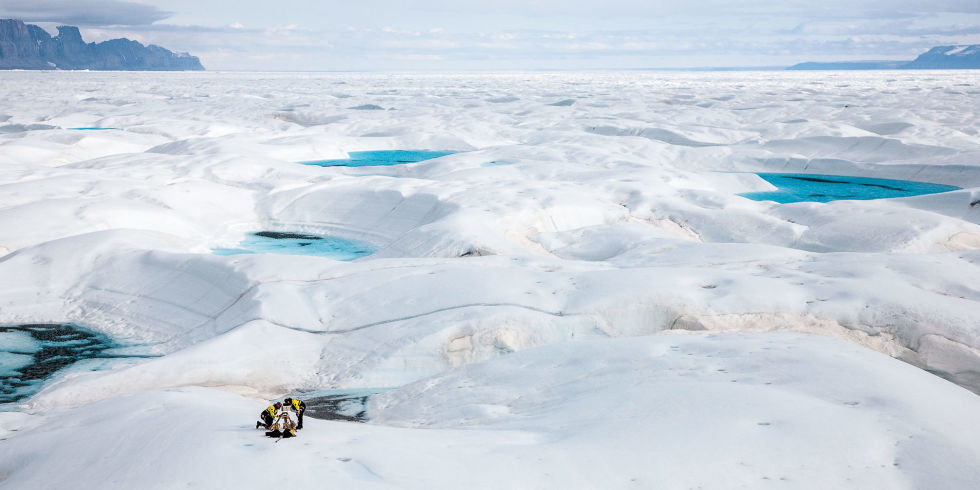


Glaciologist Jason Box, left, at work on the Petermann Glacier on Greenland's northwest coast, which has lost mass at an accelerated pace in recent years. Box and his family left Ohio State for Europe a couple years ago, and he is relieved to have escaped America's culture of climate-change denial.

In the photo: Glaciologist Jason Box, left, at work on the Petermann Glacier on Greenland's northwest coast, which has lost mass at an accelerated pace in recent years. Box and his family left Ohio State for Europe a couple years ago, and he is relieved to have escaped America's culture of climate-change denial (Photo: Nick Cobbing).
The incident was small, but Jason Box doesn't want to talk about it. He's been skittish about the media since it happened. This was last summer, as he was reading the cheery blog posts transmitted by the chief scientist on the Swedish icebreaker Oden, which was exploring the Arctic for an international expedition led by Stockholm University. "Our first observations of elevated methane levels, about ten times higher than in background seawater, were documented . . . we discovered over 100 new methane seep sites.... The weather Gods are still on our side as we steam through a now ice-free Laptev Sea...."
As a leading climatologist who spent many years studying the Arctic at the Byrd Polar and Climate Research Center at Ohio State, Box knew that this breezy scientific detachment described one of the nightmare long-shot climate scenarios: a feedback loop where warming seas release methane that causes warming that releases more methane that causes more warming, on and on until the planet is incompatible with human life. And he knew there were similar methane releases occurring in the area. On impulse, he sent out a tweet.
"If even a small fraction of Arctic sea floor carbon is released to the atmosphere, we're f'd."
The tweet immediately went viral, inspiring a series of headlines:
CLIMATOLOGIST SAYS ARCTIC CARBON RELEASE COULD MEAN "WE'RE FUCKED."
CLIMATE SCIENTIST DROPS THE F-BOMB AFTER STARTLING ARCTIC DISCOVERY.
CLIMATOLOGIST: METHANE PLUMES FROM THE ARCTIC MEAN WE'RE SCREWED.
Box has been outspoken for years. He's done science projects with Greenpeace, and he participated in the 2011 mass protest at the White House organized by 350.org. In 2013, he made headlines when a magazine reported his conclusion that a 75-foot rise in sea levels over the next few centuries was probably already "baked into the system." Now, with one word, Box had ventured into two particularly dangerous areas. First, the dirty secret of climate science and government climate policies is that they're all based on probabilities, which means that the effects of standard CO2 targets like an 80% reduction by 2050 are based on the middle of the probability curve. Box had ventured to the darker possibilities on the curve's tail, where few scientists and zero politicians are willing to go.


Jason Box, above (Photo: McKenzie Ross)

Worse, he showed emotion, a subject ringed with taboos in all science but especially in climate science. As a recent study from the University of Bristol documented, climate scientists have been so distracted and intimidated by the relentless campaign against them that they tend to avoid any statements that might get them labeled "alarmists," retreating into a world of charts and data. But Box had been able to resist all that. He even chased the media splash in interviews with the Danish press, where they translated "we're fucked" into its more decorous Danish equivalent, "on our ass," plastering those dispiriting words in large-type headlines all across the country.
The problem was that Box was now working for the Danish government, and even though Denmark may be the most progressive nation in the world on climate issues, its leaders still did not take kindly to one of its scientists distressing the populace with visions of global destruction. Convinced his job was in jeopardy only a year after he uprooted his young family and moved to a distant country, Box was summoned before the entire board of directors at his research institute. So now, when he gets an e-mail asking for a phone call to discuss his "recent gloomy statements," he doesn't answer it.
Five days later: "Dr. Box—trying you again in case the message below went into your junk file. Please get in touch."
This time he responds briefly. "I think most scientists must be burying overt recognition of the awful truths of climate change in a protective layer of denial (not the same kind of denial coming from conservatives, of course). I'm still amazed how few climatologists have taken an advocacy message to the streets, demonstrating for some policy action." But he ignores the request for a phone call.
A week later, another try: "Dr. Box—I watched your speech at The Economist's Arctic Summit. Wow. I would like to come see you."
Box takes temperature and conductivity readings at Kane Basin, near the Humboldt Glacier, Greenland. The customary scientific role is to deal dispassionately with data, but Box says that 'the shit that's going down is testing my ability to block it.' (Photo: Nick Cobbing)
But gloom is the one subject he doesn't want to discuss. "Crawling under a rock isn't an option," he responds, "so becoming overcome with PTSD-like symptoms is useless." He quotes a Norse proverb:
"The unwise man is awake all night, worries over and again. When morning rises he is restless still."
Most people don't have a proverb like that readily at hand. So, a final try: "I do think I should come to see you, meet your family, and make this story personal and vivid."
I wanted to meet Box to find out how this outspoken American is holding up. He has left his country and moved his family to witness and study the melting of Greenland up close. How does being the one to look at the grim facts of climate change most intimately, day in and day out, affect a person? Is Box representative of all of the scientists most directly involved in this defining issue of the new century? How are they being affected by the burden of their chosen work in the face of changes to the earth that could render it a different planet?
Finally, Box gives in. Come to Copenhagen, he says. And he even promises a family dinner.
Listen to John H. Richardson discuss this story below:
For more than thirty years, climate scientists have been living a surreal existence. A vast and ever-growing body of research shows that warming is tracking the rise of greenhouse gases exactly as their models predicted. The physical evidence becomes more dramatic every year: forests retreating, animals moving north, glaciers melting, wildfire seasons getting longer, higher rates of droughts, floods, and storms—five times as many in the 2000s as in the 1970s. 

In the blunt words of the 2014 National Climate Assessment, conducted by 300 of America's most distinguished experts at the request of the U. S. government, human-induced climate change is real—U. S. temperatures have gone up between 1.3 and 1.9 degrees, mostly since 1970—and the change is already affecting "agriculture, water, human health, energy, transportation, forests, and ecosystems." 


But that's not the worst of it. Arctic air temperatures are increasing at twice the rate of the rest of the world—a study by the U. S. Navy says that the Arctic could lose its summer sea ice by next year, 84 years ahead of the models—and evidence little more than a year old suggests the West Antarctic Ice Sheet is doomed, which will add between 20 and 25 feet to ocean levels. The one hundred million people in Bangladesh will need another place to live and coastal cities globally will be forced to relocate, a task complicated by economic crisis and famine—with continental interiors drying out, the chief scientist at the U. S. State Department in 2009 predicted a billion people will suffer famine within 20 or 30 years. 


And yet, despite some encouraging developments in renewable energy and some breakthroughs in international leadership, carbon emissions continue to rise at a steady rate, and for their pains the scientists themselves—the cruelest blow of all—have been the targets of an unrelenting and well-organized attack that includes death threats, summonses from a hostile Congress, attempts to get them fired, legal harassment, and intrusive discovery demands so severe they had to start their own legal-defense fund, all amplified by a relentless propaganda campaign nakedly financed by the fossil-fuel companies. Shortly before a pivotal climate summit in Copenhagen in 2009, thousands of their e-mail streams were hacked in a sophisticated espionage operation that has never been solved—although the official police investigation revealed nothing, an analysis by forensics experts traced its path through servers in Turkey and two of the world's largest oil producers, Saudi Arabia and Russia.
No scientist has come in for more threats and abuse than Michael Mann, whose "hockey stick" graph (so named because the temperature and emissions lines for recent decades curve straight up) has become the target of the most powerful deniers in the world.


No scientist has come in for more threats and abuse than Michael Mann, whose 'hockey stick' graph (so named because the temperature and emissions lines for recent decades curve straight up) has become the target of the most powerful deniers in the world. (Photo: Chris Crisman)
Among climate activists, gloom is building. Jim Driscoll of the National Institute for Peer Support just finished a study of a group of longtime activists whose most frequently reported feeling was sadness, followed by fear and anger. Dr. Lise Van Susteren, a practicing psychiatrist and graduate of Al Gore's Inconvenient Truth slide-show training, calls this "pretraumatic" stress. "So many of us are exhibiting all the signs and symptoms of posttraumatic disorder—the anger, the panic, the obsessive intrusive thoughts." Leading activist Gillian Caldwell went public with her "climate trauma," as she called it, quitting the group she helped build and posting an article called "16 Tips for Avoiding Climate Burnout," in which she suggests compartmentalization: "Reinforce boundaries between professional work and personal life. It is very hard to switch from the riveting force of apocalyptic predictions at work to home, where the problems are petty by comparison."
Most of the dozens of scientists and activists I spoke to date the rise of the melancholy mood to the failure of the 2009 climate conference and the gradual shift from hope of prevention to plans for adaptation: Bill McKibben's book Eaarth is a manual for survival on an earth so different he doesn't think we should even spell it the same, and James Lovelock delivers the same message in A Rough Ride to the Future. In Australia, Clive Hamilton writes articles and books with titles like Requiem for a Species. In a recent issue of The New Yorker, the melancholy Jonathan Franzen argued that, since earth now "resembles a patient whose terminal cancer we can choose to treat either with disfiguring aggression or with palliation and sympathy," we should stop trying to avoid the inevitable and spend our money on new nature preserves, where birds can go extinct a little more slowly.

At the darkest end of the spectrum are groups like Deep Green Resistance, which openly advocates sabotage to "industrial infrastructure," and the thousands who visit the Web site and attend the speeches of Guy McPherson, a biology professor at the University of Arizona who concluded that renewables would do no good, left his job, and moved to an off-grid homestead to prepare for abrupt climate change. "Civilization is a heat engine," he says. "There's no escaping the trap we've landed ourselves into."

The most influential is Paul Kingsnorth, a longtime climate activist and novelist who abandoned hope for political change in 2009. Retreating to the woods of western Ireland, he helped launch a group called Dark Mountain with a stirring, gloomy manifesto calling for "a network of writers, artists, and thinkers who have stopped believing the stories our civilization tells itself." Among those stories: progress, growth, and the superiority of man. The idea quickly spread, and there are now fifty Dark Mountain chapters around the world. Fans have written plays and songs and a Ph.D. thesis about them. On the phone from Ireland, he explains the appeal.

"You have to be careful about hope. If that hope is based on an unrealistic foundation, it just crumbles and then you end up with people who are despairing. I saw that in Copenhagen—there was a lot of despair and giving up after that."

Personally, though he considers them feeble gestures, he's planting a lot of trees, growing his own vegetables, avoiding plastic. He stopped flying. "It seems like an ethical obligation. All you can do is what you think is right." The odd thing is that he's much more forgiving than activists still in the struggle, even with oil-purchased politicians. "We all love the fruits of what we're given—the cars and computers and iPhones. What politician is going to try to sell people a future where they can't update their iPhones ever?"

He laughs.

Does he think it would be wrong to take a transatlantic airplane trip to interview a climate scientist?

He laughs again. "You have to answer that yourself."

***

All this leaves climate scientists in an awkward position. At NASA's Goddard Institute for Space Studies, which early in the year was threatened with 30% budget cuts by Republicans who resent its reports on climate change, Gavin Schmidt occupies the seventh-floor corner office once occupied by the legendary James Hansen, the scientist who first laid out the facts for Congress in 1988 and grew so impassioned he got himself arrested protesting coal mines. Although Schmidt was one of the victims of the 2009 computer hacks, which he admits tipped him into an episode of serious depression, he now focuses relentlessly on the bright side. "It's not that nothing has been done. There's a lot of things. In terms of per capita emissions, most of the developed world is stable. So we are doing something."

[And, now, readers, you are going to see a really special type of denial -- a denial that refuses to contemplate the possibility of catastrophe, a denial so deep that it produces an angry reaction in an otherwise level-headed and calm scientist.  Read on.]

Box's tweet sets his teeth on edge. "I don't agree. I don't think we're fucked. There is time to build sustainable solutions to a lot of these things. You don't have to close down all the coal-powered stations tomorrow. You can transition. It sounds cute to say, 'Oh, we're fucked and there's nothing we can do,' [here Gavin is putting words into Jason's mouth] but it's a bit of a nihilistic attitude. We always have the choice. We can continue to make worse decisions, or we can try to make ever better decisions. 'Oh, we're fucked! Just give up now, just kill me now,' that's just stupid." [which Jason did not tweet]
Gavin Schmidt in his office at NASA's Goddard Institute for Space Studies. Box's dire forecast annoyed him. 'You don't run around saying, 'We're fucked! We're fucked! We're fucked!' It doesn't incentivize anybody to do anything.'


Gavin Schmidt in his office at NASA's Goddard Institute for Space Studies. Box's dire forecast annoyed him. 'You don't run around saying, 'We're fucked! We're fucked! We're fucked!' It doesn't incentivize anybody to do anything.' (Photo: Sam Eaton.)

Schmidt, who is expecting his first child and tries to live a low-carbon existence, insists that the hacks and investigations and budget threats have not intimidated him. He also shrugs off the abrupt-climate-change scenarios. "The methane thing is actually something I work on a lot, and most of the headlines are crap. There's no actual evidence that anything dramatically different is going on in the Arctic, other than the fact that it's melting pretty much everywhere." [And here is another type of denial -- ignoring all the evidence of the many expeditions to the Eastern Siberian Arctic Shelf and the thawing subsea permafrost.]

But climate change happens gradually and we've already gone up almost 1 degree centigrade and seen 8 inches of ocean rise. Barring unthinkably radical change, we'll hit 2 degrees in 30 or 40 years and that's been described as a catastrophe—melting ice, rising waters, drought, famine, and massive economic turmoil. And many scientists now think we're on track to 4 or 5 degrees—even Shell oil said that it anticipates a world 4 degrees hotter because it doesn't see "governments taking the steps now that are consistent with the 2 degrees C scenario." That would mean a world racked by economic and social and environmental collapse.

"Oh yeah," Schmidt says, almost casually. "The business-as-usual world that we project is really a totally different planet. There's going to be huge dislocations if that comes about."

But things can change much quicker than people think, he says. Look at attitudes on gay marriage.

And the glaciers?

"The glaciers are going to melt, they're all going to melt," he says. "But my reaction to Jason Box's comments is—what is the point of saying that? It doesn't help anybody." [I'd say that more than 54,000 shares of this article is proof against that statement.]

As it happens, Schmidt was the first winner of the Climate Communication Prize from the American Geophysical Union, and various recent studies in the growing field of climate communications find that frank talk about the grim realities turns people off—it's simply too much to take in. But strategy is one thing and truth is another. Aren't those glaciers water sources for hundreds of millions of people?

"Particularly in the Indian subcontinent, that's a real issue," he says. "There's going to be dislocation there, no question."

And the rising oceans? Bangladesh is almost underwater now. Do a hundred million people have to move?

"Well, yeah. Under business as usual. But I don't think we're fucked."

Resource wars, starvation, mass migrations . . .

"Bad things are going to happen. What can you do as a person? You write stories. I do science. You don't run around saying, 'We're fucked! We're fucked! We're fucked!' It doesn't—it doesn't incentivize anybody to do anything." [I'd say Gavin is very wrong about this.]

***


Scientists are problem solvers by nature, trained to cherish detachment as a moral ideal. Jeffrey Kiehl was a senior scientist with the National Center for Atmospheric Research when he became so concerned about the way the brain resists climate science, he took a break and got a psychology degree. Ten years of research later, he's concluded that consumption and growth have become so central to our sense of personal identity and the fear of economic loss creates such numbing anxiety, we literally cannot imagine making the necessary changes. Worse, accepting the facts threatens us with a loss of faith in the fundamental order of the universe. Climate scientists are different only because they have a professional excuse for detachment, and usually it's not until they get older that they admit how much it's affecting them—which is also when they tend to get more outspoken, Kiehl says. "You reach a point where you feel—and that's the word, not think, feel—'I have to do something.' "


This accounts for the startled reaction when Camille Parmesan of the University of Texas—who was a member of the group that shared a Nobel prize with Al Gore for their climate work—announced that she'd become "professionally depressed" and was leaving the United States for England. A plainspoken Texan who grew up in Houston as the daughter of an oil geologist, Parmesan now says it was more about the politics than the science. "To be honest, I panicked fifteen years ago—that was when the first studies came out showing that Arctic tundras were shifting from being a net sink to being a net source of CO2. That along with the fact this butterfly I was studying shifted its entire range across half a continent—I said this is big, this is big. Everything since then has just confirmed it."


But she's not optimistic. "Do I think it likely that the nations of the world will take sufficient action to stabilize climate in the next fifty years? No, I don't think it likely."


She was living in Texas after the climate summit failed in 2009, when media coverage of climate issues plunged by two thirds—the subject wasn't mentioned once in the 2012 presidential debates—and Governor Rick Perry cut the sections relating to sea-level rise in a report on Galveston Bay, kicking off a trend of state officials who ban all use of the term "climate change." "There are excellent climate scientists in Texas," Parmesan says firmly. "Every university in the state has people working on impacts. To have the governor's office ignore it is just very upsetting."


The politics took its toll. Her butterfly study got her a spot on the UN climate panel, where she got "a quick and hard lesson on the politics" when policy makers killed the words "high confidence" in the crucial passage that said scientists had high confidence species were responding to climate change. Then the personal attacks started on right-wing Web sites and blogs. "They just flat-out lie. It's one reason I live in the UK now. It's not just been climate change, there's a growing, ever-stronger anti-science sentiment in the U.S.A. People get really angry and really nasty. It was a huge relief simply not to have to deal with it." She now advises her graduate students to look for jobs outside the U. S.


No one has experienced that hostility more vividly than Michael Mann, who was a young Ph.D. researcher when he helped come up with the historical data that came to be known as the hockey stick—the most incendiary display graph in human history, with its temperature and emissions lines going straight up at the end like the blade of a hockey stick. He was investigated, was denounced in Congress, got death threats, was accused of fraud, received white powder in the mail, and got thousands of e-mails with suggestions like, You should be "shot, quartered, and fed to the pigs along with your whole damn families." 


Conservative legal foundations pressured his university, a British journalist suggested the electric chair. In 2003, Senator James Inhofe's committee called him to testify, flanking him with two professional climate-change deniers, and in 2011 the committee threatened him with federal prosecution, along with sixteen other scientists.
Kayaking the melt-water, Petermann Glacier.
Kayaking the melt-water, Petermann Glacier. (Photo: Nick Cobbing)

Now, sitting behind his desk in his office at Penn State, he goes back to his swirl of emotions. "You find yourself in the center of this political theater, in this chess match that's being played out by very powerful figures—you feel anger, befuddlement, disillusionment, disgust."
The intimidating effect is undeniable, he says. Some of his colleagues were so demoralized by the accusations and investigations that they withdrew from public life. One came close to suicide. Mann decided to fight back, devoting more of his time to press interviews and public speaking, and discovered that contact with other concerned people always cheered him up. But the sense of potential danger never leaves. "You're careful with what you say and do because you know that there's the equivalent of somebody with a movie camera following you around," he says.
Meanwhile, his sense of personal alarm has only grown. "I know you've spoken with Jason Box—a number of us have had these experiences where it's become clear to us that in many respects, climate change is unfolding faster than we expected it to. Maybe it is true what the ice-sheet modelers have been telling us, that it will take a thousand years or more to melt the Greenland Ice Sheet. But maybe they're wrong; maybe it could play out in a century or two. And then it's a whole different ballgame—it's the difference between human civilization and living things being able to adapt and not being able to adapt."
As Mann sees it, scientists like Schmidt who choose to focus on the middle of the curve aren't really being scientific. Worse are pseudo-sympathizers like Bjorn Lomborg who always focus on the gentlest possibilities. Because we're supposed to hope for the best and prepare for the worst, and a real scientific response would also give serious weight to the dark side of the curve.
And yet, like Schmidt, Mann tries very hard to look on the bright side. We can solve this problem in a way that doesn't disrupt our lifestyle, he says. Public awareness seems to be increasing, and there are a lot of good things happening at the executive level: tighter fuel-efficiency standards, the carbon-pricing initiatives by the New England and West Coast states, the recent agreement between the U. S. and China on emissions. Last year we saw global economic growth without an increase in carbon emissions, which suggests it's possible to "decouple" oil and economic growth. And social change can happen very fast—look at gay marriage.
But he knows that gay marriage had no huge economic downside, and the most powerful companies in the world are fighting to stop any change in the fossil-fuel economy. So yes, he struggles with doubt. And he admits that some of his colleagues are very depressed, convinced there's no way the international community will rise to the challenge. He gets into that conversation in bars after climate conferences, always pushing the side of hope.
Dealing with all of this has been a long emotional journey. As a young scientist, Mann was very traditional: "I felt that scientists should take an entirely dispassionate view when discussing matters of science," he wrote in a book called The Hockey Stick and the Climate Wars. "We should do our best to divorce ourselves from all of our typically human inclinations—emotion, empathy, concern." But even when he decided that detachment was a mistake in this case and began becoming publicly active, he was usually able to put the implication of all the hockey-stick trend lines out of his mind. "Part of being a scientist is you don't want to believe there is a problem you can't solve."
Might that be just another form of denial?
The question seems to affect him. He takes a deep breath and answers in the carefully measured words of a scientist. "It's hard to say," he says. "It's a denial of futility if there is futility. But I don't know that there is futility, so it would only be denial per se if there were unassailable evidence."
There are moments, he admits, flashes that come and go as fast as a blinking light, when he sees news reports about some new development in the field and it hits him—Wait a second, they're saying that we've melted a lot. Then he does a peculiar thing: He disassociates a little bit and asks himself, How would I feel about that headline if I were a member of the public? I'd be scared out of my mind.
Right after Hurricane Sandy, he was in the classroom showing The Day After Tomorrow with the plan of critiquing its ridiculous story about the Atlantic conveyor belt slowing down so fast that it freezes
England—except a recent study he worked on shows that the Atlantic conveyor belt actually is slowing down, another thing that's happening decades ahead of schedule. "And some of the scenes in the wake of Hurricane Sandy—the flooding of the New York City subway system, cars submerged—they really didn't look that different. The cartoon suddenly looked less like a cartoon. And it's like, Now why is it that we can completely dismiss this movie?"
He was talking to students, so it got to him. They're young, it's their future more than his. He choked up and had to struggle to get ahold of himself. "You don't want to choke up in front of your class," he says.
About once a year, he says, he has nightmares of earth becoming a very alien planet.
The worst time was when he was reading his daughter Dr. Seuss's The Lorax, the story of a society destroyed by greed. He saw it as an optimistic story because it ends with the challenge of building a new society, but she burst into tears and refused to read the book again. "It was almost traumatic for her."
His voice cracks. "I'm having one of those moments now."
Why?
"I don't want her to have to be sad," he says. "And I almost have to believe we're not yet there, where we are resigned to this future."
***
The spring day is glorious, sunny and cool, and the avenues of Copenhagen are alive with tourists. Trying to make the best of things, Jason Box says we should blow off the getting-to-know-you lunch and go for a bike ride. Thirty minutes later he locks up the bikes at the entrance to Freetown, a local anarchist community that has improbably become one of Copenhagen's most popular tourist destinations. Grabbing a couple beers at a restaurant, he leads the way to a winding lake and a small dock. The wind is blowing, swans flap their wings just off the beach, and Box sits with the sun on his face and his feet dangling over the sand.
"There's a lot that's scary," he says, running down the list—the melting sea ice, the slowing of the conveyor belt. Only in the last few years were they able to conclude that Greenland is warmer than it was in the twenties, and the unpublished data looks very hockey-stick-ish. He figures there's a 50 percent chance we're already committed to going beyond 2 degrees centigrade and agrees with the growing consensus that the business-as-usual trajectory is 4 or 5 degrees. "It's, um... bad. Really nasty."
The big question is, What amount of warming puts Greenland into irreversible loss? That's what will destroy all the coastal cities on earth. The answer is between 2 and 3 degrees. "Then it just thins and thins enough and you can't regrow it without an ice age. And a small fraction of that is already a huge problem—Florida's already installing all these expensive pumps." (According to a recent report by a group spearheaded by Hank Paulson and Robert Rubin, secretaries of the Treasury under Bush Jr. and Bill Clinton, respectively, $23 billion worth of property in Florida may be destroyed by flooding within thirty-five years.)
Box is only forty-two, but his pointed Danish beard makes him look like a count in an old novel, someone who'd wear a frock coat and say something droll about the woman question. He seems detached from the sunny day, like a tourist trying to relax in a strange city. He also seems oddly detached from the things he's saying, laying out one horrible prediction after another without emotion, as if he were an anthropologist regarding the life cycle of a distant civilization. But he can't keep his anger in check for long and keeps obsessively returning to two topics:
"We need the deniers to get out of the way. They are risking everyone's future.... The Koch Brothers are criminals.... They should be charged with criminal activity because they're putting the profits of their business ahead of the livelihoods of millions of people, and even life on earth."
Like Parmesan, Box was hugely relieved to be out of the toxic atmosphere of the U. S. "I remember thinking, What a relief, I don't have to bother with this bullshit anymore." In Denmark, his research is supported through the efforts of conservative politicians. "But Danish conservatives are not climate-change deniers," he says.
The other topic he is obsessed with is the human suffering to come. Long before the rising waters from Greenland's glaciers displace the desperate millions, he says more than once, we will face drought-triggered agricultural failures and water-security issues—in fact, it's already happening. Think back to the 2010 Russian heat wave. Moscow halted grain exports. At the peak of the Australian drought, food prices spiked. The Arab Spring started with food protests, the self-immolation of the vegetable vendor in Tunisia. The Syrian conflict was preceded by four years of drought. Same with Darfur. The migrants are already starting to stream north across the sea—just yesterday, eight hundred of them died when their boat capsized—and the Europeans are arguing about what to do with them. "As the Pentagon says, climate change is a conflict multiplier."
His home state of Colorado isn't doing so great, either. "The forests are dying, and they will not return. The trees won't return to a warming climate. We're going to see megafires even more, that'll be the new one—megafires until those forests are cleared."
However dispassionately delivered, all of this amounts to a lament, the scientist's version of the mothers who stand on hillsides and keen over the death of their sons. In fact, Box adds, he too is a climate refugee. His daughter is three and a half, and Denmark is a great place to be in an uncertain world—there's plenty of water, a high-tech agriculture system, increasing adoption of wind power, and plenty of geographic distance from the coming upheavals. "Especially when you consider the beginning of the flood of desperate people from conflict and drought," he says, returning to his obsession with how profoundly changed our civilization will be.
Despite all this, he insists that he approaches climate mostly as an intellectual problem. For the first decade of his career, even though he's part of the generation of climate scientists who went to college after Al Gore's Earth in the Balance, he stuck to teaching and research. He only began taking professional risks by working with Greenpeace and by joining the protest against Keystone when he came to the intellectual conclusion that climate change is a moral issue. "It's unethical to bankrupt the environment of this planet," he says. "That's a tragedy, right?" Even now, he insists, the horror of what is happening rarely touches him on an emotional level... although it has been hitting him more often recently. "But I—I—I'm not letting it get to me. If I spend my energy on despair, I won't be thinking about opportunities to minimize the problem."
His insistence on this point is very unconvincing, especially given the solemnity that shrouds him like a dark coat. But the most interesting part is the insistence itself—the desperate need not to be disturbed by something so disturbing. Suddenly, a welcome distraction. A man appears on the beach in nothing but jockey shorts, his skin bluish. He says he's Greek and he's been sleeping on this beach for seven months and will swim across the lake for a small tip. A passing tourist asks if he can swim all the way.
"Of course."
"Let me see."
"How much money?"
"I give you when you get back."
"Give me one hundred."
"Yeah, yeah. When you get back."
The Greek man splashes into the water and Box seems amused, laughing for the first time. It's the relief of normal goofy human life, so distant from the dark themes that make up his life's work.
Usually it's a scientific development that smacks him, he says. The first was in 2002, when they discovered that meltwater was getting into the bed of the Greenland Ice Sheet and lubricating its flow. Oh, you say, it can be a wet bed, and then the implications sunk in: The
whole damn thing is destabilizing.
 Then in 2006, all of the glaciers in the southern half of Greenland began to retreat at two and three times their previous speed. Good Lord, it's happening so fast. Two years later, they realized the retreat was fueled by warm water eroding the marine base ice—which is also what's happening to the West Antarctic Ice Sheet. Just thinking about it makes him gloomy. "That's unstoppable," he says. "Abrupt sea-level rise is upon us."
The Greek man returns with surprising speed, emerging from the sea like a god in a myth, laughing and boasting. The Greeks are masters of the waters! Pay me!
"I'm gonna give this guy a hundred kroner," Box says.
He makes sure the tourists pay, too, and comes back smiling. He knows a Greek guy who's just like that, he says, very proud and jolly. He envies him sometimes.
He leads the way to a quieter spot on the lakeside, passing through little hippie villages woven together by narrow dirt lanes—by consensus vote, there are no cars in Freetown, which makes it feel pleasantly medieval, intimate, and human-scaled. He lifts a beer to his lips and gazes over the lake and the happy people lazing in the afternoon sun. "The question of despair is not very nice to think about," he says. "I've just disengaged that to a large degree. It's kind of like a half-denial."
He mentions the Norse proverb again, but a bulwark against despair so often cited becomes its own form of despair. You don't dredge up proverbs like that unless you're staying awake at night.
He nods, sighing. This work often disturbs his sleep, driving him from his bed to do something, anything. "Yeah, the shit that's going down has been testing my ability to block it."
He goes quiet for a moment. "It certainly does creep in, as a parent," he says quietly, his eyes to the ground.
But let's get real, he says, fossil fuels are the dominant industry on earth, and you can't expect meaningful political change with them in control. "There's a growing consensus that there must be a shock to the system."
So the darker hopes arise—maybe a particularly furious El Niño or a "carbon bubble" where the financial markets realize that renewables have become more scalable and economical, leading to a run on fossil-fuel assets and a "generational crash" of the global economy that, through great suffering, buys us more time and forces change.
***
The Box family dinner isn't going to happen after all, he says. When it comes to climate change at the very late date of 2015, there are just too many uncomfortable things to say, and his wife, Klara, resents any notion that she is a "climate migrant."
This is the first hint that his brashness has caused tension at home.
"Well, she..." He takes a moment, considering. "I'll say something like, 'Man, the next twenty years are going to be a hell of a ride,' or 'These poor North African refugees flooding to Europe,' and how I anticipate that flux of people to double and triple, and will the open borders of Europe change? And she'll acknowledge it... but she's not bringing it up like I am."
Later, she sends a note responding to a few questions. She didn't want to compare herself to the truly desperate refugees who are drowning, she says, and the move to Denmark really was for the quality of life. "Lastly, the most difficult question to answer is about Jason's mental health. I'd say climate change, and more broadly the whole host of environmental and social problems the world faces, does affect his psyche. He feels deeply about these issues, but he is a scientist and a very pragmatic, goal-oriented person. His style is not to lie awake at night worrying about them but to get up in the morning (or the middle of the night) and do something about it. I love the guy for it :)"
So even when you are driven to your desk in the middle of the night, quoting Norse proverbs, when you are among the most informed and most concerned, the ordinary tender mercies of the home conspire in our denial. We pour our energy into doing our jobs the best we can, avoid unpleasant topics, keep up a brave face, make compromises with even the best societies, and little by little the compartmentalization we need to survive the day adds one more bit of distance between the comfortable now and the horrors ahead. So Box turns out to be a representative figure after all. It's not enough to understand the changes that are coming. We have to find a way to live with them.
"In Denmark," Box says, "we have the resilience, so I'm not that worried about my daughter's livelihood going forward. But that doesn't stop me from strategizing about how to safeguard her future—I've been looking at property in Greenland. As a possible bug-out scenario."
Turns out a person can't own land in Greenland, just a house on top of land. It's a nice thought, a comforting thought—no matter what happens, the house will be there, safely hidden at the top of the world.
Published in the August 2015 issue.
http://www.esquire.com/news-politics/a36228/ballad-of-the-sad-climatologists-0815/


Posted by Tenney Naumer at Saturday, July 11, 2015
Email ThisBlogThis!Share to XShare to FacebookShare to Pinterest
Labels: Antarctic Ice Sheet -- Western (WAIS), Gavin Schmidt, Jason Box, Michael Mann, Sea level rise, WAIS

1 comment:

Anonymous said...

Thank you for posting this. I am no scientist, so my simplest take is that scientists, too, "observe" denial as a means of maintaining mental equilibrium in gigantic seas of observation and implication. The need to overcome drowning is very fundamental when we're all swimming, kicking, choking -- or as denialists, believing we're (or "I'm", which seems the base of such thinking) floating -- in these seething waters of reality.

July 18, 2015 at 10:25 AM

Post a Comment

Newer Post Older Post Home
Subscribe to: Post Comments (Atom)

RECEIVE POSTS BY EMAIL

Posts
Atom
Posts
Comments
Atom
Comments

Climate Science Legal Defense Fund

Climate Science Legal Defense Fund

I'm proud to be a Climate Patriot!

I'm proud to be a Climate Patriot!

Followers

Climate science and related issues

  • A Few Things Ill Considered at scienceblogs
  • Arctic from NASA's Worldview
  • Arctic Sea Ice Graphs
  • Arctic Sunrise Greenpeace blog
  • Capital Climate
  • Citizens Climate Lobby
  • Climate Code Red
  • Climate Progress by Joseph Romm
  • Climate Reanalyzer
  • Climate Science Rapid Response Team
  • Climate Tuva or Bust
  • ClimateScienceWatch
  • Deltoid by Tim Lambert
  • DeSmogBlog
  • ENSO - latest NOAA report
  • Flood List
  • From a Glacier's Perspective
  • Get Energy Smart NOW!
  • Global Glass Onion
  • Global Temp Anomalies 30-day animation
  • Greenland Today by NSIDC
  • GrIS surface mass budget from DMI
  • Huffington Post - Climate Change
  • Koch Watch
  • Methane Tracker
  • NASA Climate Research
  • Next System Project
  • Open Mind by tamino
  • Paul Douglas on Weather
  • PlanetEarth Environmental Research News
  • Real Climate
  • Sea surface temperatures
  • Skeptical Science
  • Sydney Morning Herald environ. news
  • Useful climate data links by Tamino
  • USGS Earthquakes Map
  • Wit's End - photographic evidence of enviro damage

Labels

  • 10:10 (3)
  • 2007 temperatures (24)
  • 2008 temperatures (36)
  • 2009 temperatures (49)
  • 2010 temperatures (101)
  • 2011 temperatures (51)
  • 2012 temperatures (69)
  • 2013 temperatures (34)
  • 2014 temperatures (53)
  • 2015 temperatures (35)
  • 2016 elections (2)
  • 2016 temperatures (13)
  • 2017 temperatures (6)
  • 2018 temperatures (1)
  • 2019 temperatures (1)
  • 2023 temperatures (1)
  • 6-sigma risk (1)
  • 79N Glacier (3)
  • ablation zone (1)
  • Abrupt Climate Change -- ACC (89)
  • acidizing (2)
  • Adam Siegel (18)
  • Adaptation (39)
  • Aerosols (61)
  • Africa (14)
  • Agulhas Current (4)
  • airline emissions (1)
  • Al Franken (1)
  • Al Gore (18)
  • Alan Grayson (5)
  • Alaska (128)
  • albed (1)
  • albedo (92)
  • albedo flip (61)
  • ALEC (47)
  • Algae (5)
  • Alice Hill (1)
  • Alpha Ridge (2)
  • Alpine glaciers (2)
  • Alun Hubbard (13)
  • Amazon rainforest (16)
  • AMO - Atlantic Multidecadal Oscillation (9)
  • Amplifications (1)
  • Amundi (1)
  • Andrew C. Revkin (44)
  • Andrew Dessler (24)
  • Andrew Freedman (18)
  • Andrew Glikson (14)
  • Andrew J. Weaver (24)
  • Andrew Montford (1)
  • ANDRILL (3)
  • Andy Derocher (1)
  • Andy Skuce (1)
  • Anna Haynes (1)
  • anoxia (1)
  • Antarctic abyssal water (8)
  • Antarctic bottom water (8)
  • Antarctic Circumpolar Current (26)
  • Antarctic Circumpolar Winds (11)
  • Antarctic Ice Sheet -- Western (WAIS) (160)
  • Antarctic ice shelves (3)
  • Antarctic Oscillation - AAO (4)
  • Antarctic polar vortex (8)
  • Antarctic sea ice (2)
  • Antarctic warming (135)
  • Antarctica (1)
  • Anthony Leiserowitz (5)
  • Anthony R Ingraffea (10)
  • Anthony Watts (38)
  • Anthropocene (5)
  • arct (1)
  • Arctic amplification (242)
  • Arctic ice melt (351)
  • Arctic melt season (69)
  • Arctic Methane Emergency Group (29)
  • Arctic Ocean (65)
  • Arctic Ocean dipole anomaly (6)
  • Arctic Oscillation (72)
  • Arctic sea ice mean speed (23)
  • Arctic sea ice volume (173)
  • Arctic warming (5)
  • Argo (6)
  • Arthur Smith (4)
  • Asian monsoon (3)
  • Atlantic Meridional Overturning Circulation - AMOC (40)
  • Atmospheric changes (56)
  • Atmospheric chemistry (4)
  • Atmospheric CO2 (25)
  • Atmospheric rivers (6)
  • atmospheric waveguide (1)
  • attribution (2)
  • Australia (104)
  • Axel Heiberg Island (2)
  • back bay flooding (1)
  • Baffin Island (1)
  • Bali conference (3)
  • Bangladesh (2)
  • Barry Bickmore (15)
  • Beaufort Gyre (17)
  • bees (43)
  • Benjamin Santer (33)
  • Bering Strait (3)
  • Bernie Sanders (1)
  • Bidder 70 (9)
  • Big Oil Big Coal (744)
  • Bill Gates (1)
  • Bill McKibben (68)
  • Bill Nye (2)
  • Biochar (14)
  • biodiversity (1)
  • Bjorn Lomborg (13)
  • Black carbon (30)
  • Black Cross Alliance (1)
  • Black-Bloc (3)
  • Bob Altemeyer (1)
  • BOEMRE (50)
  • Bolling-Allerod warming (7)
  • boycotts (2)
  • Brad Johnson (38)
  • Brazil (36)
  • Breakthrough Institute (2)
  • Brendan DeMelle (1)
  • Brian Angliss (4)
  • Brian Davey (1)
  • Brian Eister (2)
  • brine rejection (1)
  • brinicle (1)
  • Bru Pearce (1)
  • Bud Ward (1)
  • bush fires (2)
  • butterflies (1)
  • California (20)
  • Canada (138)
  • Canada spoof (6)
  • Cancun (18)
  • Cap-and-trade (5)
  • Cara Augustenborg (1)
  • carbon budget (4)
  • Carbon cap-and-trade problems (10)
  • Carbon capture (3)
  • Carbon Fee and Dividend Act (4)
  • Carbon sinks (18)
  • Carbon tax (6)
  • Catastrophic climate change (7)
  • Charles Monnett (80)
  • Charles Moore (1)
  • Chavez (1)
  • Chevron (4)
  • China (93)
  • chinook wind (1)
  • Chris Field (13)
  • Chris Fields (1)
  • Chris Hedges (13)
  • Chris Mooney (28)
  • Christiana Figueres (4)
  • Christiania (2)
  • Christopher Field (2)
  • Chukchi Sea (9)
  • Citizens United (1)
  • civi (1)
  • Civil resistance (264)
  • Clathrate gun effect (10)
  • Clausius-Clapeyron equation (1)
  • cliff failure (1)
  • Climate Babes and Hunks (1)
  • Climate Change Criminals (423)
  • Climate change litigation (23)
  • Climate change refugees (1)
  • Climate Denial Machine (776)
  • Climate Disruption (1)
  • Climate Justice Movement (5)
  • Climate modelling (84)
  • Climate Patriots (10)
  • climate refugees (2)
  • Climate risk (6)
  • Climate Science Rapid Response Team - CSRRT (20)
  • Climate sensitivity (12)
  • Cloud radiative forcing (1)
  • clouds (15)
  • CO2 draw-down (2)
  • CO2 emissions accounting (3)
  • CO2 equivalents (1)
  • CO2 increases and consequences (68)
  • coal gasification (1)
  • coastal erosion (5)
  • collapse (2)
  • Communicating the science (2)
  • Community Climate Change Adaptation Initiative (1)
  • Complexity (1)
  • compost-bomb instability (2)
  • Congo (1)
  • Connie Barlow (1)
  • Consequences of warming (171)
  • Consequences to infrastructure (130)
  • Consequences to our psyches (4)
  • Conservative voices (2)
  • conspiracy ideation (1)
  • contrails (1)
  • COP15 (2)
  • COP16 (8)
  • COP19 (7)
  • COP21 (5)
  • Copenhagen (118)
  • coral reefs (7)
  • Corexit (3)
  • Corinne Le Quéré (1)
  • corr (1)
  • corrupt officials (296)
  • Cosmic rays (1)
  • Coupled ice-ocean model (8)
  • Coupled ocean–atmosphere model (17)
  • Cretaceous Age (2)
  • crop yields (98)
  • CRU e-mails (122)
  • Cryo-hydrologic warming (1)
  • CryoSat (3)
  • CryoSat-2 (8)
  • cryosphere disintegration (2)
  • CSIRO (2)
  • Currygate (10)
  • cyclones (15)
  • Dakota Access Pipeline (4)
  • Dana Nuccitelli (35)
  • dangerous anthropogenic interference - DAI (4)
  • Danish text (6)
  • Dansgaard–Oeschger event (6)
  • Dark Mountain Project (1)
  • David Archer (1)
  • David Breashears (2)
  • David Brin (1)
  • David Easterling (1)
  • David Edwards (1)
  • David Roberts (7)
  • David Spratt (27)
  • David Tattershall (2)
  • David Vaughn (1)
  • David W. J. Thompson (1)
  • de (1)
  • Dead zones (9)
  • Deborah Phelan (3)
  • decarbonization (2)
  • Deep Western Boundary Current (2)
  • Deepwater Horizon (46)
  • Deforestation (19)
  • deglaciation (29)
  • Deltoid (1)
  • denial (16)
  • Denial psychology (253)
  • Derrick Jensen (1)
  • desertification (1)
  • diatom (2)
  • dicamba (2)
  • Dick Cheney (5)
  • Dick Durbin (1)
  • disaster capitalism (1)
  • divergence problem (1)
  • divestment (67)
  • Don Blankenship (3)
  • Don Shelby (11)
  • Donna Bethell (2)
  • Donors Trust (11)
  • Doomer gloom (1)
  • Drew Shindell (1)
  • Drought (196)
  • droughts (3)
  • drylands (1)
  • Duke Energy (1)
  • Durban (6)
  • dust (5)
  • Dyson Freeman (3)
  • earthquakes (14)
  • earthquakes - induced (13)
  • East Antarctica (34)
  • East Australia Current - EAC (1)
  • East Siberian Arctic Shelf (41)
  • East Siberian Arctic Shelf -- ESAS (1)
  • Eastern Siberian Arctic Shelf -- ESAS (9)
  • Economic cost (1)
  • Ed Hummel (1)
  • Eemian (8)
  • Egypt (2)
  • electric grid (2)
  • Elgin-Franklin blowout (16)
  • Eli Rabett (23)
  • Elijah Zarlin (1)
  • Elizabeth Kolbert (14)
  • Elizabeth Warren (4)
  • Ellesmere (5)
  • Enbridge (4)
  • ENS (1)
  • ENSO (129)
  • environmental justice (1)
  • Eric Holthaus (1)
  • Eric Pooley (1)
  • Eric Rignot (27)
  • Eric Steig (6)
  • Evan Kopelson (1)
  • evapotranspiration (1)
  • Extinctions (49)
  • extratropical cyclones (1)
  • extreme event attribution (4)
  • extreme temperatures (4)
  • Extreme weather events (275)
  • ExxonMobil (23)
  • famine (1)
  • fascism (6)
  • Faustian bargain (1)
  • Feasibility frontiers (3)
  • fee-and-dividend (4)
  • Ferrel cells (1)
  • Filchner-Ronne Ice Shelf (4)
  • fingerprint studies (2)
  • fire tornado (2)
  • firn (5)
  • First Nations (25)
  • Flooding (110)
  • floods (35)
  • Foehn wind (1)
  • food insecurity (19)
  • foraminifera (4)
  • Forest fires (33)
  • Fourth generation nuclear power (7)
  • Foxgate (1)
  • fracking (206)
  • Fram Strait (5)
  • Frank Luntz (1)
  • Fraud (2)
  • Fred Pearce (10)
  • Fred Singer (16)
  • Freedom of Speech (5)
  • Freedom of the Press (3)
  • Freeman Dyson (2)
  • Freshwater flux (4)
  • freshwater lens (2)
  • Friends of Earth (1)
  • fugitive emissions (8)
  • Fukushima (12)
  • G77 (7)
  • Gail Zawacki (10)
  • Gareth Renowden (29)
  • Gavin Schmidt (77)
  • Geoengineering (10)
  • geoid (1)
  • Geomorphological hazards (2)
  • George F. Will (19)
  • George Monbiot (62)
  • Gerald Meehl (8)
  • Germany (2)
  • Gigantic jet (2)
  • GIS hydrologic outlets (2)
  • GISS-TEMP (13)
  • glacial lake dam failure (1)
  • glacial rebound (4)
  • glacial runoff (12)
  • Global dimming (11)
  • global mean temperature (1)
  • glyphosate (30)
  • gone emeritus (1)
  • Gordon Hamilton (9)
  • GRACE (35)
  • Graeme Sait (1)
  • Graham Readfearn (30)
  • Grapes on Greenland - NOT (7)
  • Gravity waves (3)
  • Great Salinity Anomaly (1)
  • green investment (1)
  • Greenland ice melt (490)
  • Greenpeace (38)
  • Greg Ayers (1)
  • Greg Craven (2)
  • Greg Laden (15)
  • GrIS (151)
  • groundwater (1)
  • Gulf Stream (11)
  • GWPF (6)
  • haboob (2)
  • Hadley cells (8)
  • Hadley circulation (7)
  • hail (3)
  • Haiyan (25)
  • Halley's comet (1)
  • Halliburton (9)
  • Hans Joachim Schellnhuber (7)
  • Harrison Loony Tool Schmitt (20)
  • Heartland Institute (138)
  • heat dome (10)
  • Heat waves (116)
  • Heidi Cullen (9)
  • Heinrich events (10)
  • Helheim Glacier (9)
  • Himalayan glaciers (6)
  • Hindu Kush (1)
  • hockey stick (62)
  • Holocene thermal maximum (14)
  • hope (1)
  • hothouse earth (1)
  • hubris (2)
  • Humboldt Glacier (9)
  • humus (1)
  • Hunger Games (1)
  • Hunter Lovins (1)
  • Hurricane Maria (1)
  • hurricanes (24)
  • hydrofluorocarbons - HFCs (3)
  • hydrofracturing (1)
  • Ian Howat (4)
  • Ian Joughin (3)
  • ice arches (2)
  • ice cliff slumping (1)
  • Ice cores (20)
  • IceSat (8)
  • ICESat-2 (1)
  • Ignatius Rigor (1)
  • Igor Semiletov (30)
  • Illinois (1)
  • imidacloprid (1)
  • India (3)
  • Indian Ocean (3)
  • Indian Ocean Dipole (9)
  • Indo-Pacific warm pool (2)
  • infragravity waves (2)
  • Inhofe (46)
  • insects (2)
  • Insurers (65)
  • Interdecadal Pacific Oscillation - IPO (3)
  • Intertropical Convergence Zone - ICZ (9)
  • invasive species (1)
  • Ionosphere (1)
  • IPCC (2)
  • Jakobshavn Isbræ (54)
  • James Hansen (232)
  • James Howard Kunstler (1)
  • James Hrynyshyn (3)
  • James Lovelock (7)
  • Jane Mayer (2)
  • Japan (3)
  • Jason Box (94)
  • Jay Zwally (10)
  • Jeff Biggers (3)
  • Jeff Masters (122)
  • Jeffrey Sacks (1)
  • jellyfish blooms (1)
  • Jennifer Francis (35)
  • Jeremy Grantham (4)
  • Jet stream (25)
  • Jim Rogers (3)
  • John Abraham (117)
  • John Christy (25)
  • John Church (1)
  • John Cook (44)
  • John Harte (1)
  • John Holdren (6)
  • John Kerry (3)
  • John Mashey (18)
  • John Podesta (1)
  • John Turner (1)
  • John Wahr (13)
  • Jon Stewart (3)
  • Jonathan Koomey (2)
  • Joseph Romm (210)
  • Josh Willis (7)
  • Judith Curry (37)
  • Julie Brigham-Grette (4)
  • Julienne Stroeve (13)
  • Justin Gillis (21)
  • Kangerdlugssuaq Glacier (6)
  • Kangerlussuaq (1)
  • katabatic outflow (1)
  • Katharine Hayhoe (31)
  • Keeling curve (3)
  • Kelvin wave (6)
  • Ken Caldeira (8)
  • Ken Ward (1)
  • Kenya (1)
  • Kerry Emanuel (40)
  • Kevin Anderson (4)
  • Kevin Conrad (2)
  • Kevin Grandia (4)
  • Kevin Trenberth (108)
  • Keystone Principle (26)
  • Keystone XL (208)
  • Kilimanjaro (1)
  • Koch Industries (351)
  • Konrad Steffen (29)
  • Kulluk (16)
  • Kyoto Protocol (1)
  • Labrador Current (3)
  • Lake El'gygytgyn (4)
  • Laptev Sea shelf (4)
  • Larsen B (7)
  • Larsen C (1)
  • Last Glacial Maximum (1)
  • Laurentide ice sheet (2)
  • Laurie Dougherty (1)
  • Lee Fang (12)
  • Leo Hickman (2)
  • Leonid Yurganov (1)
  • Lester Brown (3)
  • Little Ice Age (12)
  • Lou Grinzo (1)
  • Madden-Julian Oscillation (4)
  • magnetic poles (1)
  • Marc Morano (30)
  • Marco Tedesco (27)
  • Margaret Klein (1)
  • Marine Cold-Air Outbreaks - MCAOs (2)
  • Mark Boslough (17)
  • Mark Carney (2)
  • Mark Hertsgaard (9)
  • Mark Serreze (20)
  • Mass extinctions (29)
  • materialism (1)
  • Matthew England (1)
  • Maunder Minimum (14)
  • Mauri Pelto (23)
  • McMurdo Ice Shelf (1)
  • Medieval Climate Anomaly (23)
  • megadrought (11)
  • Meridonal heat transport - MHT (3)
  • mesoscale convective systems (4)
  • Methane (228)
  • Methane Gun hypothesis (33)
  • Methane hydrates (125)
  • methanogenesis (6)
  • Michael Ashley (5)
  • Michael Le Page (4)
  • Michael MacCracken (3)
  • Michael Mann (241)
  • Michael Moore (2)
  • Michael Oppenheimer (13)
  • Michael Tobis (7)
  • Mike Roddy (7)
  • Milankovitch cycles (1)
  • Milne Ice Shelf (1)
  • Mitigation (64)
  • Monckton (88)
  • Moniz (2)
  • Monsanto (43)
  • moulins (14)
  • Mountain top removal (26)
  • mud volcano Indonesia (1)
  • Murry Salby (1)
  • muzzling scientists (1)
  • Myles Allen (1)
  • Naomi Klein (11)
  • Naomi Oreskes (20)
  • Nares Strait (2)
  • narwhals (1)
  • Natalia Shakhova (35)
  • Nathan Currier (2)
  • nation (1)
  • national security (94)
  • Neela Banerjee (6)
  • Negative feedbacks (5)
  • Neil deGrasse Tyson (1)
  • neoliberalism (1)
  • neonicotinoid pesticide (36)
  • Netherlands (1)
  • New Zealand (8)
  • Nicholas Pinter (1)
  • Nick Breeze (5)
  • Nigel Lawson (1)
  • Nightlight radiance (1)
  • Nioghalvfjerdsfjorden glacier (1)
  • Nitric acid trihydrate (1)
  • Nitrogen cycle (3)
  • Nitrogen trifluoride (2)
  • Nitrous oxide (26)
  • no-analogue world (1)
  • no-till farming (1)
  • NOAA Climate Service (2)
  • Noam Chomsky (4)
  • Noctilucent clouds (10)
  • non-linear climate change (3)
  • non-violent protest (3)
  • North Atlantic meridional overturning circulation (10)
  • North Atlantic Oscillation (40)
  • North Atlantic SST tripole (6)
  • North Atlantic subtropical gyre (2)
  • North Atlantic Subtropical High (1)
  • North Atlantic thermohaline circulation (25)
  • North Pacific Gyre Oscillation (3)
  • Northeast Greenland Ice Stream (3)
  • Northeast Passage (2)
  • Northern Annular Mode (4)
  • Northwest Passage (7)
  • Nuclear power (3)
  • O'Donnellgate (1)
  • Obama (6)
  • OccupyWallStreet (60)
  • ocean acidification (20)
  • Ocean chemistry (93)
  • Ocean circulation (25)
  • ocean heat content (101)
  • Ocean salinity (15)
  • Ocean temperatures (104)
  • Oceans Melting Greenland - OMG (1)
  • OCO-2 (2)
  • Oden Arctic methane research expedition (1)
  • Our children's future (1)
  • Ove Hoegh-Guldberg (7)
  • Ozone hole (21)
  • ozone levels (29)
  • Pachauri (1)
  • Pakistan (1)
  • paleo-climate (65)
  • Paleo-CO2 (26)
  • Patrick Michaels (41)
  • Paul Beckwith (2)
  • Paul Douglas (17)
  • Paul Hawken (1)
  • Paul Krugman (13)
  • Paul Volcker (1)
  • PDO - Pacific Decadal Oscillation (17)
  • Peak food (49)
  • Peak oil (11)
  • Peak Water (50)
  • Peat (2)
  • peatland (3)
  • Peoples Climate March (2)
  • Permafrost (147)
  • Permafrost - subsea (56)
  • Permian mass extinction (7)
  • Peru (1)
  • Peter Cox (2)
  • Peter Dykstra (3)
  • Peter Gleick (62)
  • Peter Laut (1)
  • Peter Riggs (1)
  • Peter Sinclair (101)
  • Peter Wadhams (43)
  • Petermann Glacier (29)
  • PETM (11)
  • phenology (1)
  • Phil Jones (16)
  • phytoplankton (8)
  • Pinatubo rebound effect (3)
  • pine beetles (2)
  • Pine Island Glacier (41)
  • PIOMAS (11)
  • Pliocene (5)
  • Points of no return (28)
  • polar bears (80)
  • Polar jet stream (32)
  • Polar Low (4)
  • Polar mesospheric clouds (3)
  • Polar night jet (1)
  • Polar vortex (34)
  • polynyas (3)
  • Pope Francis (13)
  • Positive feedbacks (43)
  • Precipitation extremes (185)
  • proglacial discharge (1)
  • pseudo-science (1)
  • public health (1)
  • QuikSCAT (1)
  • Rachel Maddow (2)
  • radiative forcing (11)
  • radioactive waste (1)
  • rainforest (3)
  • Rajendra Pachauri (3)
  • Ralph Hall (1)
  • Ray Weymann (5)
  • Raypierre (7)
  • red tide (1)
  • REDD (1)
  • Reese Halter (1)
  • regime shift (1)
  • Renewable energy solutions (11)
  • resilience (5)
  • resource scarcity (68)
  • Richard Alley (26)
  • Richard Black (29)
  • Richard Feynman (2)
  • Richard Lindzen (14)
  • Richard Littlemore (7)
  • Richard Muller (47)
  • Richard Somerville (6)
  • Rick Piltz (9)
  • RICO (5)
  • Rink Glacier (4)
  • Rio Doce (1)
  • Rising Tide Newcastle (5)
  • risk management (4)
  • RJ Sigmund (7)
  • Robert Altemeyer (1)
  • Robert Bindschadler (5)
  • Robert Brulle (1)
  • Robert Corell (7)
  • Robert Schribbler (8)
  • Roger Pielke Jr. (39)
  • Ron Kwok (6)
  • Ross Ice Shelf (4)
  • Rossby waves (12)
  • RoundUp (1)
  • Roy Spencer (43)
  • Russia (52)
  • Ryder Glacier (1)
  • Sahel (1)
  • Sailesh Rao (3)
  • saltwater intrusion (7)
  • Sandy (29)
  • Sascha Brand (1)
  • Scaifes (3)
  • scared scientists (2)
  • Schwarzenegger (2)
  • Scott Mandia (54)
  • Scott Wahlstrom (2)
  • Sea level rise (511)
  • Sea Shepherd (3)
  • sea surface temperature anomalies (22)
  • Sebastião Salgado (1)
  • Sediment cores (29)
  • Sediment plume (1)
  • Sergey Zimov (1)
  • Seth Borenstein (38)
  • Sharon Begley (5)
  • Shawn Lawrence Otto (3)
  • Sheldon Whitehouse (2)
  • Shell Oil (151)
  • Siberia (19)
  • Skepticgate (1)
  • snow cover (11)
  • Snowden (4)
  • snowline (1)
  • snowpack (2)
  • soil degradation (8)
  • Solar activity (25)
  • Solar energy (24)
  • solar power (17)
  • solar radiation (7)
  • Solomon Hsiang (1)
  • Soot (36)
  • Sou (2)
  • Southern Annular Mode (11)
  • Southern Atlantic subtropical gyre (1)
  • Southern Ocean (30)
  • spacequake (1)
  • Spencer Weart (2)
  • Stefan Rahmstorf (59)
  • step change (1)
  • Stephan Lewandowsky (17)
  • Stephan Lewanowsky (21)
  • Stephen Colbert (4)
  • Stephen H. Schneider (31)
  • Stephen Mulkey (10)
  • steppe grassland (1)
  • Steve Easterbrook (1)
  • Steve Horn (39)
  • Steve McIntyre (9)
  • Steven Chu (3)
  • Storm intensity (39)
  • storm surge (7)
  • Storm tracks diverted northwards (29)
  • Storm tracks diverted polewards (29)
  • stranded assets (3)
  • Stratospheric chemistry (8)
  • Stratospheric circulation (16)
  • Stratospheric Sudden Warmings (4)
  • Stratospheric temperature (3)
  • stress testing (1)
  • Stu Ostro (9)
  • subglacial lake (5)
  • subpolar gyre (3)
  • sulfoxaflor (3)
  • Sulfuryl fluoride (1)
  • super storms (1)
  • supraglacial lake (20)
  • surveillance (1)
  • Susan Solomon (9)
  • taliks (3)
  • Tamino (28)
  • tar sands (268)
  • Tasmania (1)
  • Ted Cruz (2)
  • Ted Scambos (19)
  • Ted Schuur (2)
  • teleconnections (2)
  • temperate rainforest (1)
  • Terracide (1)
  • Terrence Gerlach (2)
  • thawing permafrost (4)
  • thermal collapse of ice (1)
  • Thermokarst lakes (30)
  • These people are completely insane (183)
  • Thomas L. Friedman (10)
  • threat multiplier (11)
  • Threat to our democracy (294)
  • Thwaites Glacier (10)
  • Tibetan glaciers (2)
  • Tim DeChristopher (17)
  • Tim Flannery (4)
  • Tim Lambert (7)
  • Tim Naish (2)
  • Tipping elements (33)
  • Tipping points (87)
  • Tom Steyer (5)
  • Tornado statistics (35)
  • Totten Glacier (1)
  • trade winds (3)
  • Trans-Pacific Partnership (1)
  • TransCanada (20)
  • transition to zero-carbon economy (1)
  • trees (11)
  • trophic cascade (1)
  • Tropospheric circulation (2)
  • Tropospheric temperatures (19)
  • tropospheric water vapor (8)
  • Trump (1)
  • trust (1)
  • tundra (17)
  • Typhoon Yasi (6)
  • typhoons (17)
  • Ugo Bardi (1)
  • Van Jones (6)
  • Velicogna (3)
  • Venice effect (2)
  • Vladimir Romanovsky (2)
  • volcanism (14)
  • WAIS (63)
  • WAIS Divide (1)
  • Waleed Abdalati (19)
  • Walker circulation (6)
  • Walt Meier (7)
  • War on Science (1)
  • Ward Hunt Ice Shelf (1)
  • Water shortage (107)
  • Water vapor feedback (29)
  • Wave energy (3)
  • Wave height (5)
  • Wayne Davidson (1)
  • Weather (5)
  • weather satellites (1)
  • weather weirding (13)
  • Weddell Sea (3)
  • Wegman Report (31)
  • Wen Stephenson (6)
  • Wes Jackson (1)
  • white roofs (1)
  • Wieslaw Maslowski (11)
  • wikileaks (1)
  • Wilkins Ice Shelf (11)
  • William Connolley (3)
  • William Cronon (4)
  • William Krabill (3)
  • William Ruddiman (1)
  • William Shatner (1)
  • Willie Soon (20)
  • Wind pattern changes (20)
  • Wind power (17)
  • Wisconsin (10)
  • WiserEarth (1)
  • Wit's End (1)
  • witch hunt (11)
  • worst-case scenario (2)
  • xkcd (3)
  • yedoma (1)
  • Yes Men (4)
  • Younger Dryas (7)
  • Yves Smith (6)
  • Zachariae Isstrøm (12)
  • Zack Labe (1)
  • Zeke Hausfather (2)
  • Zwally Effect (4)
Brighter Planet's 350 Challenge
www.flickr.com
cassandra_moderna's photos More of cassandra_moderna's photos
Clique na imagem para mais detalhes

About Me

My photo
Tenney Naumer
Vitória da Conquista, Bahia, Brazil
If you want to follow new posts on twitter, my user name is TenneyNaumer. Blog on climate science: Climate Change -- The Next Generation, at http://climatechangepsychology.blogspot.com
View my complete profile