Blog Archive

Showing posts with label Jeremy Grantham. Show all posts

Tuesday, April 1, 2014

Another one bites the dust, and another one gone... Bob Ward takes down Richard Tol -- guess for whom the bell tolls?

Errors in estimates of the aggregate economic impacts of climate change

by Bob Ward, Grantham Research Institute on Climate Change and the Environment, April 2, 2014

With the publication this week of the contribution of Working Group II of the Intergovernmental Panel on Climate Change to the Fifth Assessment Report, I can reveal details of my ongoing struggle to correct errors in the report relating to the work of Richard Tol, a professor of economics at the University of Sussex. I have, so far, only been partially successful.

It was last October when I first started to closely examine Professor Tol’s work after it was cited by Viscount Ridley, a fellow member of the Academic Advisory Council of Lord Lawson’s Global Warming Policy Foundation, in a front-page article for The Spectator under the headline: ‘Why climate change is good for the world’.

Viscount Ridley drew primarily on an academic paper by Professor Tol which was published in the Journal of Economic Perspectives. The study drew together a number of estimates of the aggregate economic impacts of climate change and concluded that global warming of up to 2.2 °C would have a net beneficial impact for the world.

However, when I examined Professor Tol’s paper in detail, I discovered that he had made a number of errors, wrongly plotting studies which had found net negative impacts as if they were positive benefits. Of the 14 data listed in Table 1 and plotted in Figure 1 of the paper, at least four were wrong.

Taking into account all of these mistakes, there was only one study that showed significant positive effects from global warming. That single analysis had been published by Professor Tol himself in 2002 in the journal Environmental and Resource Economics, which concluded that warming of 1 °C would lead to benefits equivalent to 2.3% of global wealth. However, the paper also pointed out, on pages 63-64, that many impacts of climate change had been omitted from the study, including shifts in extreme weather and effects on amenity, recreation, tourism, fisheries, construction, transport, and energy supply.

I exchanged e-mail messages with Professor Tol to confirm that his 2009 paper contained mistakes, but he refused to give any undertaking to write to the journal to correct them.

I then decided to check some of the other analyses that Professor Tol had published on the economic impacts. Sure enough, I found some of the same mistakes in a couple of his papers published in 2012 in Environmental and Resource Economics  and in 2013 in the Journal of Economic Dynamics & Control.

In his 2013 paper, Professor Tol made four errors in his representation of the 17 data used in Figure 1 and Table 1. As in his earlier papers, he mistakenly plotted a 2006 study by Chris Hope as finding a net benefit equivalent to +0.9% of global wealth from a warming of 2.5 °C. In fact, it was still only the 2002 paper in Professor Tol’s dataset that showed any significant net benefits. Nevertheless, Professor Tol claimed in his 2013 paper that “the initial benefits of a modest increase in temperature are probably positive.”

Shortly after these discoveries, I found a leaked version of the final draft of the IPCC report which had been posted on a blog for climate change ‘sceptics.’ Although I am a registered reviewer on the report, I had not seen the final version because it was distributed only to governments and to authors.

I was stunned when I looked at Chapter 10 on ‘Key Economic Sectors and Services’ on which Professor Tol was one of the Coordinating Lead Authors. A section had been inserted on ‘Aggregate impacts’ which was based almost entirely on Professor Tol’s 2013 paper. The Chapter also included a new table and graph which were based on Figure 1 and Table 1 from his 2013 paper.
None of this material had been included in the Second Order Draft of the report (a copy of which was also leaked to a blog for climate change ‘sceptics’ that had been made available to reviewers, including me).

When I checked the 20 data in Table 10.B.1 and Figure 10-1, they both contained at least three errors, two of which had appeared in the 2013 paper. However, the data point attributed to Hope (2006) had been changed and was listed as -0.9% in Table 10.B.1, compared with +0.9% in the 2013 paper. Nevertheless, even though only 1 of the 20 data in Table 10.B.1 and Figure 10-1 showed any significant net benefits, the text in Section 10.9.2 of Chapter 10 stated: “Estimates agree on the size of the impact (small relative to economic growth) but disagree on the sign.”

I was not sure that governments reviewing the draft report would identify the mistakes, so in January I wrote to Professor Tol and other members of the Working Group to warn them of the problem.

I received a polite acknowledgement from Professor Doug Arent, who was the other Coordinating Lead Author with Professor Tol on Chapter 10.

Professor Tol’s reaction was rather less polite. He did not respond to me, but instead decided to leak onto his blog what he claimed was a corrected version of the graph to be included in the report, accompanied by disparaging comments against me for having pointed out his errors. He also circulated on Twitter a mocked up picture of me with the hairstyle of Irish pop music twins Jedward.

Given that Professor Tol seemed determined not to correct his papers, I also wrote to the editors of the three journals in which the flawed papers had been published.

I drew the attention of each editor to the problems. I also noted that many of the data that had been plotted by Professor Tol were aggregations that he had made of other authors’ research findings. For instance, 8 of the 17 data used in the 2013 paper had been aggregated by Professor Tol. I suggested to the editors that, given the other mistakes, Professor Tol should make available the details of his calculations so that they might also be verified.

Disappointingly, none of the journals has so far secured an agreement from Professor Tol to make his calculations available, which means that a number of the data included in Chapter 10 of the IPCC report remain unverifiable.
For this reason, I remain concerned about the following statement from the Summary for Policymakers from the report: “the incomplete estimates of global annual economic losses for additional temperature increases of ~2 °C are between 0.2 and 2% of income (±1 standard deviation around the mean).” These figures are drawn entirely from Professor Tol’s 2013 paper, and without independent verification of the data currently being possible, I do not regard them to have been proven robust.

Furthermore, the version of Chapter 10 that has been published on the IPCC’s website is the draft that was distributed to governments in October 2013, and still contains at least three erroneous data points in Table 10.B.1 and Figure 10-1. The text of Section 10.9.2 remains a highly misleading description of the data: “Estimates agree on the size of the impact (small relative to economic growth) but disagree on the sign.”

I will continue my efforts to have the errors in Professor Tol’s work corrected, as a service to researchers, policy-makers and the public.

Bob Ward is policy and communications at the ESRC Centre for Climate Change Economics and Policy and the Grantham Research Institute on Climate Change and the Environment at London School of Economics and Political Science.

http://www.lse.ac.uk/GranthamInstitute/Media/Commentary/2014/March/Errors-in-estimates-of-the-aggregate-economic-impacts-of-climate-change.aspx

One comment:
Bernard J. said...
Excellent work Bob - there will be many people closely following the outcome of this issue.

I'd for one would be very interested to see some greater explanation of how Tol derives his numbers. In brief encounters with him in the blogosphere he has demonstrated an underwhelming understanding of the functioning of ecosystems, and of the value of such functioning and of the biodiversity contained therein. And when I say "value" I mean value not only to current and near-future generations of Westerners, but to non-Western societies, to generations a century and more hence, and to the millions of other species with whom we share the planet.

Any economic analysis is effectively meaningless if it does not seriously and comprehensively account for the obvious as well as the subtle global ecological impacts of warming over the various increments of predicted temperature increase. Many of the impacts that will manifest with warming will be emergent - predicted by biologists in some instances and missed in others - and some of the most serious consequences are likely to occur in ways that were either not forseen, or were effectively ignored by everyone other than the ecologists and other scientific professionals who warn of them in the first place.

This matter is a weak link in the IPCC's reporting chain, and Tol is painting over the rust.

IPCC: Wolf! Wolf! No, Really, Wolf! [not an April Fools article]

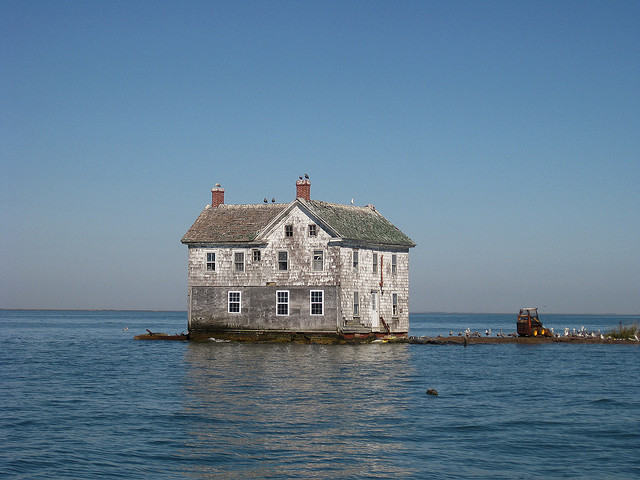
The last house on Holland Island in the Chesapeake Bay, possibly one of the first casualties of climate change induced storms and rising seas. Think they had any warning? (Photo by baldeaglebluff/Flickr)
According to the world’s largest assemblage of climate scientists, the view forward is bleak. The UN’s Intergovernmental Panel on Climate Change (IPCC) says we should expect:
  • millions of people to be displaced by rising seas and more frequent raging storms;
  • more droughts, and more intense heat waves, in more places;
  • extreme shortages of food, fuel, and medicine around the world.
That’s what the IPCC said in its first report, published in 1990. In reports issued every seven years since, including the one out today, it has said the same things, with increasing urgency and certainty.
In what sense, then, has this report “raised the threat of climate change to a whole new level,” as the UK’s Guardian puts it? My second favorite headline: The Worst is Yet to Come. Really? The IPCC has laboriously reached the conclusion that everything is not busting out roses? We are shocked.
There are two issues here. One of the unwillingness of the media to just say it straight: world civilization is facing its worst existential crisis ever, and it is self-administered. The other issue is our unwillingness to hear, and act on, this among many other warnings. We’re on the Titanic. We can see the bow is under water, we can hear the engine is stopped, we can feel the water lapping at our ankles. How many official warnings that the ship might sink do we require before we start looking for a lifeboat?
There is no point in going over the details of the latest IPCC report here. We’ve already reported on all the issues, and there are plenty of sources for what’s new. What you probably won’t see anywhere else is a consideration of how many reputable voices have been raised — just in the past few weeks — in a chorus of warnings that could not be more urgent, more worthy of a response, if one wall of the room in which you are sitting were aflame.
  • The world is heading for a financial crash “unlike any other,” according to Jeremy Grantham, the legendary hedge-fund manager who predicted the popping of the dot-com bubble and the housing bubble. This particular warning is based on finance, but he has made similar predictions based on the exhaustion of natural resources.
  • Shortages and high prices of oil will precipitate a crash of the global economy as early as 2015, according to Dr. Jeremy Leggett, a former oil geologist and energy adviser to the government of the U.K.
  • The lifestyle of western (i.e., industrialized) countries is “pushing the environment toward crisis,” one that is “hugely threatening to the world,” according to Rowan Williams, recently retired Archbishop of Canterbury.
  • World oil production is not keeping up with demand, despite the vaunted “boom” in U.S. fracking, and no one knows how to close the gap, according to Louis Powers, a former executive with Exxon and Aramco, now a consultant to the oil bidness.
  • A total and irreversible crash of the world economy is likely and imminent, according to a major interdisciplinary study conducted with funding from NASA and the National Science Foundation.
And that’s just in the last 30 days or so. So what if everybody in a crowded theater yelled “Fire!” and still nobody paid any attention?

Monday, September 23, 2013

Jeremy Grantham, WSJ: the world is running out of food

by IAN SALISBURY, The Wall Street Journal, September 22, 2013

image
Photograph by Erik Madigan Heck.  Jeremy Grantham

JEREMY GRANTHAM'S GOT A TRACK RECORD that's impossible to ignore—he called the Internet bubble, then the housing bubble. While moves like those have earned the famed forecaster the nickname "perma-bear," in early 2009 he also told clients at GMO, his $100 billion, Boston-based money-management firm, to jump back into the market. It was the same week that stocks hit their post-Lehman low.
Now, however, the outspoken Yorkshireman, who is chief investment strategist at GMO, is making headlines with a new prediction: Dire, Malthusian warnings about environmental catastrophe. To hear him tell it, the world is running out of food. Resources will only keep getting more expensive. And climate change looms over it all. Indeed, at times he sounds like someone Greenpeace would send door-to-door with a clipboard. (He's not above likening the coal-industry spin to the handiwork of Goebbels.) If it were anyone else, Wall Street would probably laugh him off. But because it's Jeremy Grantham, they just might listen.
Q: You've been ringing alarm bells about commodity prices. Why all the worry?
A: They came down for a hundred years by an average of 70%, and then starting around 2002, they shot up and basically everything tripled—and I mean, everything. I think tobacco was the only one that went down. They've given back a hundred years of price decline and they gave it back between '02 and '08, in six years. The game has changed. I suspect the game changed because of the ridiculous growth rates in China—such a large country, with 1.3 billion people using 45% of the coal used in the world, 50% of all the cement and 40% of all the copper. I mean these are numbers that you can't keep on rolling along without expecting something to go tilt.
Q: This led to some surprising conclusions, like your concerns about natural resources most of us have barely heard of.
A: We went through one by one, and we decided the most important, the most valuable and the most critical was phosphate or phosphorous. Phosphorous cannot be made, only placed. It is necessary for all living things. And we are mining it, and it's depleting. And I like to say, if that doesn't give you goosebumps, then you're tougher than me. That is a terrible equation. So I went to the professors, and I said, what's going to happen, and they said, 'Oh, there's plenty of phosphorous.' But what's going to happen when it runs out? 'Oh, there is plenty.' It's a really weak argument. We do have a lot, but 85 percent of the low-cost, high-quality phosphorous is in Morocco…and belongs to the King of Morocco. I mean, this is an odd situation. Much, much more constrained than oil in the Middle East ever was—and much more important in the end. And the rest of the world has maybe 50 years of reserve if we don't grow too fast.
Q: What are investors supposed to do?
A: The investment implications are, of course, own stock in the ground, own great resources, reserves of phosphorous, potash, oil, copper, tin, zinc—you name it. I'd be less enthusiastic about aluminum and iron ore just because there is so much. And I wouldn't own coal, and I wouldn't own tar sands. It's hugely expensive to build coal utilities, and the plants they have to build for tar sands are massive, and before they get their money back I suspect that the price of solar and wind will have come down so much.
So I wouldn't use that, but I think oil, the metals and particularly the fertilizers, I would own—and the most important of all is food. The pressures on food are worse than anything else, and therefore, what is the solution? Very good farming, which can be done. The emphasis from an investor's point of view is on very good farmland. It's had a big run. You can never afford to ignore price and value, but from time to time you can get good investments in farmland, and if you're prepared to go abroad, you can do it today. I wouldn't be too risky. I would stay with distinctly stable countries—Australia, New Zealand, Uruguay, Brazil, Canada, of course, and the U.S. But I would look around, in what I call the nooks and crannies. And forestry is the same. Forestry is not a bad bargain, a little overpriced maybe, but it's in a world where everything is overpriced today, once again, courtesy of incredibly low interest rates that push people into investing. A wicked plot of the Federal Reserve.

Rising Commodities
Total return over 10 years (2003-2013)
[image]Source: S&P Dow Jones Indices

Q: Why is this problem so hard for us to deal with? You've railed against short-termism.
A: A career politician has a very short horizon. They're not really interested in problems that go out five or 10 years. Secondly, you have what they call the discount-rate effect, which is a dollar in 10 years has a much lower value to a corporation than a dollar today. So they're only interested, at the corporate level, in the short term. And politicians, in the very short term. And you have a vested-interest effect. In other words, it's very hard to get change when the people who are benefitting very nicely, thank you, from the current situation don't want it. If the oil industry is making a bundle, which they are, they don't want to change to a system that recognizes climate change and the need to have a tax on carbon. And they can fund right-wing think tanks, and they do.
So you have vested interests fighting like mad to keep the situation the way it is. And that's always the case. So change is difficult, and with our politicians with the short-term election problems, it's nearly impossible. And when they depend so much on campaign contributions, and they find the campaign contributions come so much from the vested interests, the financial world, but more particularly the energy world, it's a bloody miracle anything gets done.
Q: And that long-term perspective is important, not only to changing society, but also to investing. As an investor, you're known for that.
A: I like to get what I consider the central idea, which in the stock market is patience and value and mean reversion. And in society, it is resources and climate damage. That's plenty to go on, and that's a pretty strong focus. We have a shockingly short horizon in the stock market, as witnessed in the Internet bubble. And we have a shockingly short horizon about social problems, where all we want to hear is how rapid the growth will be and how good everything is.
Q: How about a stock forecast. You called the market's initial 2009 rally, but by 2010 you were predicting "seven lean years." So far, however, the market's soared.
A: And it can go a lot higher than this with the Fed pushing it. And we can have another real bubble. Based on the Fed's history, that seems to be what they like. You know we had one in 2000 with Greenspan, and then we had a housing bubble and a financial bubble with Bernanke and Greenspan. And it looks like Bernanke is perfectly happy to keep the rates down and watch as stock prices rise. They do that because as the rising stock prices give you a little consumer kick, you feel richer—and then, when you least need it, the whole thing bites you, and the prices go back to fair price or lower, like they did in '09, and the consumer reacts, and you have a recession and a bad stock market. But they've had two of these, and they seem bound and determined to do it a third time. As I've said, it's a workable definition of madness to keep doing the same thing and expect a different result.
Q: Like many Englishmen, you seem to regard Americans as wildly, fool-heartedly optimistic.
A: America is a very, very optimistic-biased society, as I believe, incidentally, Australia is, for whatever that means. We're the two great optimistic societies. You can have a conversation about a housing bubble in England, and they'll say, 'oh, is that right? Let me see the data.' If you have one in Australia, you have World War III! They hate you. They hate you for years! [laughs] The idea that you could suggest that they were having a housing bubble. [laughs]
Q: So the stereotypes about us are true?
A: Absolutely. Now, it's been very useful in enterprise, in venture capital...in start-ups. We have more failures here than probably every developed country added together, but in consequence, when the smoke clears, we tend to end up with the Amazons and the Googles. It's not an accident. We just throw more darts at the dartboard. The Germans are very conservative about throwing darts. We have an admirable risk-taking attitude, and we're very tolerant of failure.
Q: We benefit from it?
A: Absolutely, but the downside is you're willing to throw darts because you think you're going to win. American entrepreneurs all know they're going to win. Only 10% survive, but they all think they're going to win.

Friday, April 12, 2013

Jeremy Grantham, environmental philanthropist: 'We're trying to buy time for the world to wake up'

You've probably never heard of him, and for years Jeremy Grantham liked it that way. But now the man who made billions by predicting every recent financial crisis is speaking out

environmental philanthropist Jeremy Grantham
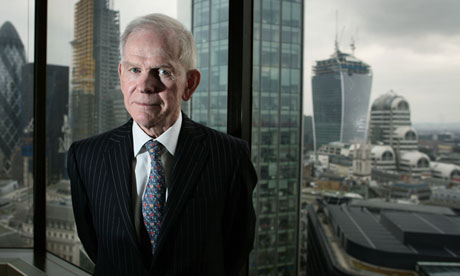
'Anyone who says government can’t do this, or can’t do that, I say a pox on you' … environmental philanthropist Jeremy Grantham. Photograph: Martin Godwin for the Guardian
by Leo Hickman, The Guardian, April 12, 2013

One icy morning in February, a train pulled into Washington, DC. It was loaded with environmentalists planning to handcuff themselves to the gates of the White House, in protest at the building of a 3,500-km oil pipeline from Canada to the Gulf of Mexico. Amid the hundreds of placard-carrying protesters stood a somewhat incongruous figure in a suit – Jeremy Grantham, a 74-year-old fund manager. "What we are trying to do is buy time," he told reporters. "Buy time for the world to wake up."
Grantham – who occupies a legendary place in the world of finance for predicting all the major stock market bubbles of recent decades (and doing very well in the process) – had decided, after 15 years of low-key environmental philanthropy, to, as he puts it, "walk the walk."
"I was committed to getting arrested," says Grantham, a tall, slight man, as he looks out across the City from his London office on the 15th floor of a glass-and-steel tower next to the Bank of England. He speaks machine gun-quickly in a soft, mid-Atlantic accent. "But the day before [the protest] my wife checked with the lawyer, who said, 'Don't do that!'" It turned out that being arrested would give him serious problems when it came to travelling. "I've had a green card since completing my MBA at Harvard in 1964."
Grantham, co-founder and chief strategist of GMO, a Boston-based global investment group, manages $106bn (£69bn) of assets on behalf of 1,000 institutional investors, and employs 600 people, so he decided that the fallout would be too great. He was forced to stand back and watch as his daughter Isabel got arrested, alongside the actor Daryl Hannah, the US's highest-profile environmentalist Bill McKibben, and NASA climate scientist James Hansen.
So he is speaking out instead. From where he stands, this bubble, the "carbon bubble," is the biggest he's seen. "We're already in a bad place. The worst accidents are [only] 20, 30, 40 years from now." Such apocalyptic talk is often the preserve of deep-green doom-mongers – the kind of talk that has led many to reject environmentalism. But Grantham insists he's guided "by the facts alone." On some issues (immigration and education) he "would be considered rightwing," but with the environment, he says he calls it as he sees it. He is disdainful of those who ignore the data, or worse, misinform the public.
"I find the parallels between how some investors refuse to recognise trends, and our reaction to some of our environmental challenges, very powerful," he says. "There is an unwillingness to process unpleasant data. In a bull market you want to believe good news. You don't want to hear that the market is going to go off a cliff." He finds climate sceptics – led by a "little army of non-scientific, persuasive loony lords," as he characterises them (a barely disguised reference to the former Conservative chancellor Lord Lawson and Ukip's Lord Monckton, both of whom promote, to varying degrees, climate-sceptic views) – a frustrating ideological phenomenon. "They have profound beliefs – as opposed to knowledge – that they are willing to protect by all manner of psychological tricks. So you have people who are very smart – great analysts and hedge-fund managers – who on paper know that their argument is wrong, but who promote it fiercely because they are libertarians. Anyone with a brain knows that climate change needs governmental leadership, and they can smell this is bad news for their philosophy. They are using incredible ingenuity to steer their way around facts they do not choose to accept."
Grantham, who was born in Hertfordshire and raised by his Quaker grandparents in Doncaster, freely admits to being a "late arrival to all this." After completing a degree in economics at the University of Sheffield in the early 1960s, he worked for a short stint at Shell before going to Harvard for an MBA. In 1977, he co-founded GMO [Grantham, Mayo, Van Otterloo]. Making his clients – and himself – wealthy filled his working days until the mid-1990s. And then he went on holiday with his children, to the Amazon and Borneo. "And without thinking about it, you start talking about the logs along the side of the river and the lack of mature forests in Borneo." He smiles, seeing the risk of being accused of being driven by emotion rather than rigorous statistical analysis. "That played a role, but we didn't treat it as an epiphany."
And he didn't preach. For years he has remained, Oz-like, behind the curtain of the environmental movement. He has shunned in-depth interviews and expressed his views only in quarterly newsletters published on GMO's website, where he writes of long-term risk, climate change and dwindling resources – not just oil, coal and natural gas, but also phosphorus and potash, whose use in modern farming methods "must be drastically reduced in the next 20–40 years or poorer countries will begin to starve."
At the same time, he has poured an ever-larger amount of his personal wealth into his Grantham Foundation for the Protection of the Environment, which he runs, with family input (his children are trustees) and minimal staff, out of GMO's Boston headquarters. The foundation's latest tax filing shows that in 2011 he increased the fund's coffers by $46m (£30m), bringing the total to something approaching $400m (£260m), up from $106m in 2006. Ever the wise moneyman, he has largely reinvested this money, in order to guarantee the foundation's long-term security. But he also spends about $17m annually on his chosen causes, in the process becoming, according to one magazine, the "world's most powerful environmentalist."
Run your finger down the tax document and you see why. In 2011 alone, his foundation gave $1m to each of the leading US conservation charities, the Sierra Club and Nature Conservancy, as well as $2m to the Environmental Defense Fund, where his German-born wife Hannelore is a trustee and where Isabel has also worked. He is perhaps best known in the green world for funding the London School of Economics' Grantham Research Institute on Climate Change and the Environment ($2.2m in 2011), and Imperial College London's Grantham Institute for Climate Change ($1.9m in 2011), but he funds climate researchers in India, too. He has written large cheques for the Carnegie Institute of Science, the Smithsonian, 350.org, WWF, Greenpeace and, keen to counter what he calls the "misinformation machine," funds environmental journalism at National Public Radio, the Center for Investigative Journalism, grist.org, Media Matters and the Yale Forum on Climate Change & the Media. Until last year (when he decided investigative and environmental journalism was "dying out" due to cutbacks), he funded the world's most lucrative journalism award, the annual $80,000 Grantham prize for environmental reporting.
In the past few months, however, there has been a conspicuous gear-shift in his activities. In addition to being more outspoken, he intends to support new research initiatives, particularly into "avant garde, sustainable" farming techniques. He talks of a "hybrid" form of farming that takes the best of organic farming and the best from "Big Ag." He doesn't rule out "compromises" such as genetic modification, which some environmentalists will find hard to swallow.
Having said that, his interest isn't entirely selfless. "Fifteen years ago, we started a forestry division [at GMO] because I had fallen in love with land and trees, and because I realised it was a mispriced asset class. We have done extremely well in that sector, outperforming the benchmark for 15 years."
Many deep-greens – who claim the root cause for our environmental woes is the slavish quest for economic growth – will recoil at the thought of a hard-boiled capitalist such as Grantham underpinning so much of the environmental movement. He is unconcerned. "Capitalism does millions of things better than the alternatives. It balances supply and demand in an elegant way that central planning has never come close to. However, it is totally ill-equipped to deal with a small handful of issues. Unfortunately, they are the issues that are absolutely central to our long-term well-being and even survival."
More awkwardly, he insists his substantial investments in oil and gas don't contradict his green views. "We need oil. If we took oil away tomorrow, civilisation ends. We can burn all the cheap, high-quality oil and gas, but if we mean to burn all the coal and any appreciable percentage of the tar sands, or even third-derivative, energy-intensive oil and gas, with 'fracking' for shale gas on the boundary, then we're cooked, we're done for."
He does think there's some cause for hope. For example, "the business mathematics of alternative energy are changing much faster [than many people] realise." Looming carbon taxes ("hopefully, in the not-too-distant future"), coupled with the increasing affordability of alternative energy, will mean that coal and oil from tar sands run the "very substantial risk of being stranded assets." There there's the "amazing" fall in fertility rates across the world ("the absolute minimum hope of survival is a gracefully declining population").
But "China is my secret weapon," he says enthusiastically. His eyes widen with excitement, and he talks quicker and quicker. "The Chinese cavalry riding to the rescue. I have very high hopes for China because they have embedded high scientific capabilities in their leadership class. They know this is serious. And they are acting much faster now than we are. They have it within their capabilities to come back in 30 years with the guarantee of complete energy independence – all alternative and sustainable for ever. They have an embarrassment of capital. We have an embarrassment of debt. So they can set a stunning pace, which they are doing. And they could crank it up. To hell with their five-year plans, they should move up to 25-year plans. They would have such low-cost energy at the end of it they'd be the terror of the capitalist system. Low energy and low labour, that's the ball game."
But he argues that there is no reason why the west can't compete. "Anyone who says government can't do this, or can't do that, I say a pox on you; have a look at the Manhattan Project. They did remarkable things. They stuck the brightest minds out in the desert. They were herding cats with great egos, but it worked. If we did that on alternative energy, we'd be home free."
Read a longer version of this interview, discussing the books he's currently reading and his views on austerity and Superstorm Sandy, at guardian.co.uk/environment on Monday