Blog Archive

Showing posts with label albedo flip. Show all posts

Sunday, May 29, 2022

Historic Greenland ice sheet rainfall unraveled

by , May 26, 2022

Historic Greenland ice sheet rainfall unravelled
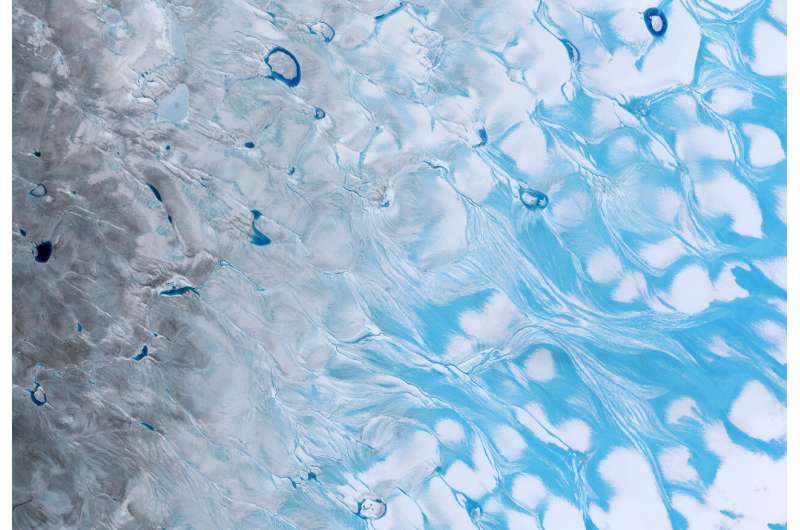
Meltwater and surface lakes on the Greenland ice sheet. Credit: contains modified Copernicus Sentinel data (2021), processed by ESA

For the first time ever recorded, in the late summer of 2021, rain fell on the high central region of the Greenland ice sheet. This extraordinary event was followed by the surface snow and ice melting rapidly. Researchers now understand exactly what went on in those fateful summer days and what we can learn from it.

The never-before-seen rainfall, on 14 August 2021, made headlines around the world. The upper-most parts of Greenland's enormous ice cap used to be too cold for anything other than  to fall, but not anymore.

What caused this extreme rainfall and how did it affect the ice?

Researchers from the Department of Glaciology and Climate at the Geological Survey of Denmark and Greenland (GEUS) in collaboration with colleagues from France and Switzerland have scrutinized these questions and come up with the answers.

It didn't only rain at Summit Camp—rain was measured by new automatic weather stations placed across the ice sheet by GEUS' ice-sheet monitoring projects PROMICE and GC-Net.

Studying detailed data from these stations alongside measurements of surface reflectivity, or albedo, from the Copernicus Sentinel-3  and information on , the researchers discovered that the rain had been preceded by a heatwave at a time of year when seasonal melting is usually slowing down.

Historic Greenland ice sheet rainfall unravelled
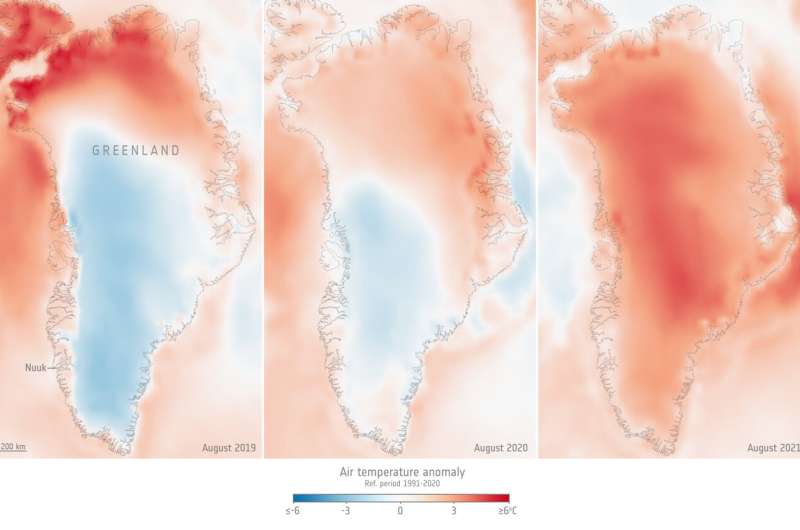
Greenland air temperature for August 2019, 2020, 2021, compared to the 1991–2020 August average. Credit: Copernicus Climate Change Service/ECMWF/ESA (data ERA5)

It wasn't the rain

"It turns out that the rain itself wasn't the most important factor," says Prof. Jason Box from GEUS and lead author of the paper reporting their results, which has been accepted for publication in Geophysical Research Letters.

"There is an irony. It's not really the rain that did the damage to the snow and ice, it's the darkening effect of the meltwater and how the heat from the event erased snow that had overlaid darker ice across the lower third of the ice sheet.

"Unusually warm atmospheric rivers swept along Greenland in the late summer months, bringing potent melt conditions when the  was drawing to a close."

In fact, this sudden increase of surface ice melt on Greenland could have happened without any rain ever touching the ground.

The never-before-seen rainfall, on 14 August 2021, made headlines around the world. The upper-most parts of Greenland's enormous ice cap used to be too cold for anything other than  to fall, but not anymore.


For the first time ever recorded, in the late summer of 2021, rain fell on the high central area of the Greenland ice sheet. This extraordinary event was preceded by a heatwave and followed by the surface snow and ice rapidly melting. The animation is a series of five images captured by the Copernicus Sentinel-2 mission and shows how the surface of the ice sheet changed between on 1, 3, 5, 20, and 23 August 2021. The melt, which also created lakes on the surface of the ice, is clear to see. Researchers, supported by ESA’s Science for Society program, discovered that it wasn’t actually the rain that caused the melt, it was unusually warm ‘atmospheric rivers’ that swept along Greenland, bringing potent melt conditions when the melt season would normally be drawing to a close. Credit: contains modified Copernicus Sentinel data (2021), processed by ESA.

Even though the rainfall was a shock and a milestone in climate history, researchers knew it was bound to happen sooner or later, given the rising temperatures of the Arctic.

Therefore, Prof. Box and the co-authors encourage research to look further into the workings behind atmospheric rivers and not just rainfall.

They conclude that understanding the frequency of heatwaves, appears to be a more significant research target than the liquid precipitation that heatwaves may or may not produce.


https://phys.org/news/2022-05-historic-greenland-ice-sheet-rainfall.html

Sunday, April 21, 2019

WaPo: It’s been exceptionally warm in Greenland lately and ice is melting a month early


Warmth over Greenland is highlighted in a daily analysis from mid-April. (ClimateReanalyzer.org)

by Matthew Cappucci, The Capital Weather Gang, The Washington Post, April 18, 2019

You might have heard about the exceptional heat this year in the northern hemisphere and around the world. March was just declared the second warmest on record globally
Records have been shattered in AlaskaScotland hit 70 degrees in February. Winter warmth has torched the U.K., The Netherlands, and Sweden as well — coming on the heels of Europe’s warmest year on record. But they’re not alone.
Greenland is baking, too. In fact, its summer melt season has already begun — more than a month ahead of schedule.
Marco Tedesco is a professor in atmospheric sciences at the Lamont Doherty Earth Observatory of Columbia University. He monitors behavior of the cryosphere — the part of earth’s water system that is frozen. He says melting of this extent shouldn’t begin until May. “The first melt event was detected on April 7,” he wrote in email.
Greenland melt extent in 2019, compared to normal. (National Snow and Ice Data Center)
“Air temperature anomalies were up to more than 20 degrees Celsius [36 Fahrenheit] above the mean,” noted Tedesco. His team has been eyeing Greenland’s southeast coast as ground zero for the early-season thaw. “Surface air temperature jumped to 41 degrees on April 2, up from minus-11,” he said. Temperatures dropped below freezing briefly before again soaring into the 30s, where the mercury has held steady for most of the past week.
What’s been sling-shotting this balmy air northward?

“The subtropical jet stream,” wrote Jennifer Francis, senior scientist at the Woods Hole Research Center in Falmouth, Mass. It’s teamed up with the polar jet to “transport warm, moist air from near Florida northward into southern Greenland,” she explained. “Locking this pattern in place has been a strong ridge — a northward bulge in the jet stream — just east of Greenland.”
A lack of ice cover in the Arctic Ocean north of Scandinavia gave this bubble of warmth a bit of an extra boost, intensifying its warm conveyor belt into Greenland.
Going forward, “[t]hese types of patterns are expected to occur more frequently,” Francis wrote, citing climate change as the culprit. “Arctic ice cover continues to dwindle and temperatures there soar.”
But advection — the transport of air, in this case warm, from somewhere else — is just half the battle. Adding insult to injury is a shortage of cloud cover in recent weeks over Greenland. The high pressure “block” that Francis described has also helped clear the skies, allowing more sunshine to pour in and heat the ground further.
A reanalysis showing precipitation also points to where the source of warmth in Greenland is coming from. (ClimateReanalyzer.org)
“Incoming solar radiation reached a value similar to ones we observed in August last year,” wrote Tedesco. That heats the ground even more. It’s a vicious cycle of positive feedback, indicating just how unstable — and delicate — the Arctic is.
“I call this ‘melting cannibalism,” explained Tedesco. And it could get even worse, as it preconditions the ice to be more vulnerable to melting in the summer.
When snow/ice on the ground melt, they form small pools of water. That changes how reflective the surface is — a measure scientists refer to as “albedo.” Snow and ice have a very high albedo, meaning it reflects most of the incoming light that hits it. That’s why you have to wear sunglasses when you go skiing. Water, on the other hand, is a lot less shiny, which allows it to absorb more heat, a cyclical process on a local level and a driver of additional warming on the global level.
According to the National Snow and Ice Data Center, the rate of melting this early in the year has been off the charts. Satellite imagery shows several patches of extremely early melt along the coast.
And it’s not just Greenland. Much of the Arctic has been baking. Ice melt in Alaska has set rivers gushing more than a month before normal in some places, setting records along the Kuskokwim River in Bethel, and triggering the earliest ice breakup along the Tanana River in Nenana.
https://www.washingtonpost.com/weather/2019/04/18/its-been-exceptionally-warm-greenland-lately-ice-is-melting-month-early/

Saturday, April 7, 2018

Algae, Impurities Darken Greenland Ice Sheet And Increases Melting

by Keith Cowing, SpaceRef, April 4, 2018


Impure Ice at Jakobshavn Isbrae on western Greenland. ©MODIS/NASA
The Dark Zone of Greenland ice sheet is a large continuous region on the western flank of the ice sheet; it is some 400 kilometers wide stretching about 100 kilometres up from the margin of the ice.
Some previous theories have attributed this darkening to water on top of the ice sheet - often seen as strikingly sapphire blue ponds, rivers and lakes. But a new study in Nature Communications provides a new hypothesis based on the character of the impurities on the ice surface itself.
"What we show is that the Dark Zone is covered in a finely distributed layer of dust, and black carbon, which provide nutrition for dark coloured algae. These are the main cause of the darkening," says professor Alun Hubbard, the co-author of the study and professor at CAGE (the Centre for Arctic Gas Hydrate, Environment and Climate at UiT, The Arctic University of Norway).
A dirt belt in the melt zone
The Dark Zone is literally a dirty belt of the melting area - the ablation zone - of the ice sheet. The darker this ablation zone is, the more of the sun's energy it absorbs, and the faster the ice melts.
Albedo is a measure of the reflectance of the ice sheet. It is the major factor governing how much incoming solar radiation is used to melt the ice and is the main positive feedback in Arctic climate change. Bright white surfaces, like snow or pure ice, reflect the sun's energy, but dark surfaces absorb it.
"The fact that a large portion of the western flank of the Greenland ice sheet has become dark means that the melt is up to five times as much as if it was a brilliant snow surface. " says Hubbard.
Algae - a major player
The ice algae seem to be one of the major players in this scheme - even the slight increase of the atmospheric temperature and liquid water production seems to promote algae colonization across the ice surface.
"The algae need nutrients and food, essentially dust, organic carbon, and water. In summer, these are plentiful and the algal bloom takes off. Because algae are dark in colour - they reinforce the dark zone. Thereby you get a positive feedback effect where the ice sheet absorbs even more solar radiation producing yet more melt."
Innovative drone study
The Dark Zone of the Greenland ice sheet is vast and previously observed by satellites such as MODIS. But for this study the scientists employed relatively modest drones - or unmanned aerial vehicles (UAV) - to survey the darkened ice belt in unprecedented detail.
While satellite data are great for the big picture of what's happening across the entire Greenland ice sheet, they only work at really coarse pixel resolutions.
"If we compare it to camera pixels, even the best satellites for the ice sheet imaging have resolution of tens of metres. They can't see the detail of what's happening on the ground. Our fixed-wing UAVs can take hundreds of images with pixel resolutions on the centimeter scale with an operating range of hundreds of kilometres," says Hubbard.
Scientists could see in real detail what the dark zone is made up of. In effect, this UAV survey across the ablation zone of the ice sheet perfectly bridges the gap between people on the ground studying what's under their feet in just one part of the ice sheet, and the satellite data that shows what's going on across the entire ice sheet.
"The UAV survey, with its amazing detail, allows us to identify and characterize all the different surface types and impurities across the entire dark zone, not just a small local little part of it."
The AUV images used in this study were collected by Johnny Ryan (Aberystwyth University, Brown University, University of California), Jason Box (GEUS) and Alun Hubbard (Aberystwyth University/CAGE) in the summer of 2014.
Please follow SpaceRef on Twitter and Like us on Facebook.

Tuesday, September 6, 2016

Peter Wadhams: ‘Next year or the year after, the Arctic will be free of ice’

Scientist Peter Wadhams believes the summer ice cover at the north pole is about to disappear, triggering even more rapid global warming

Peter Wadhams in the Arctic in 2007
Peter Wadhams in the Arctic in 2007: ‘We may able to raise the Thames barrier in Britain but in Bangladesh, people will be drowned.’

by Robin McKie, The Guardian, August 21, 2016

Peter Wadhams has spent his career in the Arctic, making more than 50 trips there, some in submarines under the polar ice. He is credited with being one of the first scientists to show that the thick icecap that once covered the Arctic ocean was beginning to thin and shrink. He was director of the Scott Polar Institute in Cambridge from 1987 to 1992 and professor of ocean physics at Cambridge from 2001 to 2015. His book, A Farewell to Ice, tells the story of his unravelling of this alarming trend and describes what the consequences for our planet will be if Arctic ice continues to disappear at its current rate.
You have said on several occasions that summer Arctic sea ice would disappear by the middle of this decade. It hasn’t. Are you being alarmist?
No. There is a clear trend down to zero for summer cover. However, each year chance events can give a boost to ice cover or take some away. The overall trend is a very strong downward one, however. Most people expect this year will see a record low in the Arctic’s summer sea-ice cover. Next year or the year after that, I think it will be free of ice in summer and by that I mean the central Arctic will be ice-free. You will be able to cross over the North Pole by ship. There will still be about a million square kilometres of ice in the Arctic in summer, but it will be packed into various nooks and crannies along the Northwest Passage and along bits of the Canadian coastline. Ice-free means the central basin of the Arctic will be ice-free, and I think that that is going to happen in summer 2017 or 2018.
Why should we be concerned about an Arctic that is free of ice in summer?
People tend to think of an ice-free Arctic in summer in terms of it merely being a symbol of global change. Things happen, they say. In fact, the impact will be profound and will effect the whole planet and its population. One key effect will be albedo feedback. Sea ice reflects about 50% of the solar radiation it receives back into space. By contrast, water reflects less than 10%. So if you replace ice with water, which is darker, much more solar heat will be absorbed by the ocean, and the planet will heat up even more rapidly than it is doing at present.
Sea ice also acts as an air-conditioning system. Winds coming over the sea to land masses such as Siberia and Greenland will no longer be cooled as they pass over ice, and these places will be heated even further. These effects could add 50% to the impact of global warming that is produced by rising carbon emissions.
What will be the effects of this accelerating increase in temperatures?
The air over Greenland will get warmer, and more and more of its ice will melt. It is already losing about 300 cubic kilometres of ice a year. Antarctica is adding to the melt as well. Sea-level rises will accelerate as a result. The most recent prediction of the Intergovernmental Panel on Climate Change (IPCC) is that seas will rise by 60 to 90 centimetres this century. I think a rise of one to two metres is far more likely. Indeed, it is probably the best we can hope for.
That may not sound a lot, but it is really very serious. It will increase enormously the frequency of storm surges all over the world. We may be able to raise the Thames barrier in Britain, but in Bangladesh, it just means more and more people will be drowned.
Global warming is generally associated with increased fossil-fuel burning and consequent rises in levels of atmospheric carbon dioxide. But is that the only climate problem we face?
No, it is not. We also have the issue of methane. Russian scientists who have investigated waters off their coast have detected more and more plumes of methane bubbling up from the seabed. The reason this is happening is closely connected with the warming of the planet and the shrinking of the Arctic icecaps.
Until around 2005, even in summer, you still had sea ice near the coast. Then it started to disappear, so that for three or four months a year warm water reached the shallow waters around the shores where there had been permafrost ground since the last ice age. It has started to melt with dangerous consequences. Underneath the permafrost there are sediments full of methane hydrates. When the permafrost goes, you release the pressure on top of these hydrates and the methane comes out of solution.
Can we monitor this methane just as we can monitor carbon dioxide?
Yes, we can measure methane over large areas using satellites. These have shown that methane levels that had been fairly flat for most of the last century have started to rise and are accelerating, often with little outliers on the graph. There is a scientist called Jason Box who works in Denmark for the Greenland Survey, and he calls these outliers dragon’s breath. They are not some sort of measurement caused by dodgy instruments. They are real pulses of methane coming from offshore flumes.
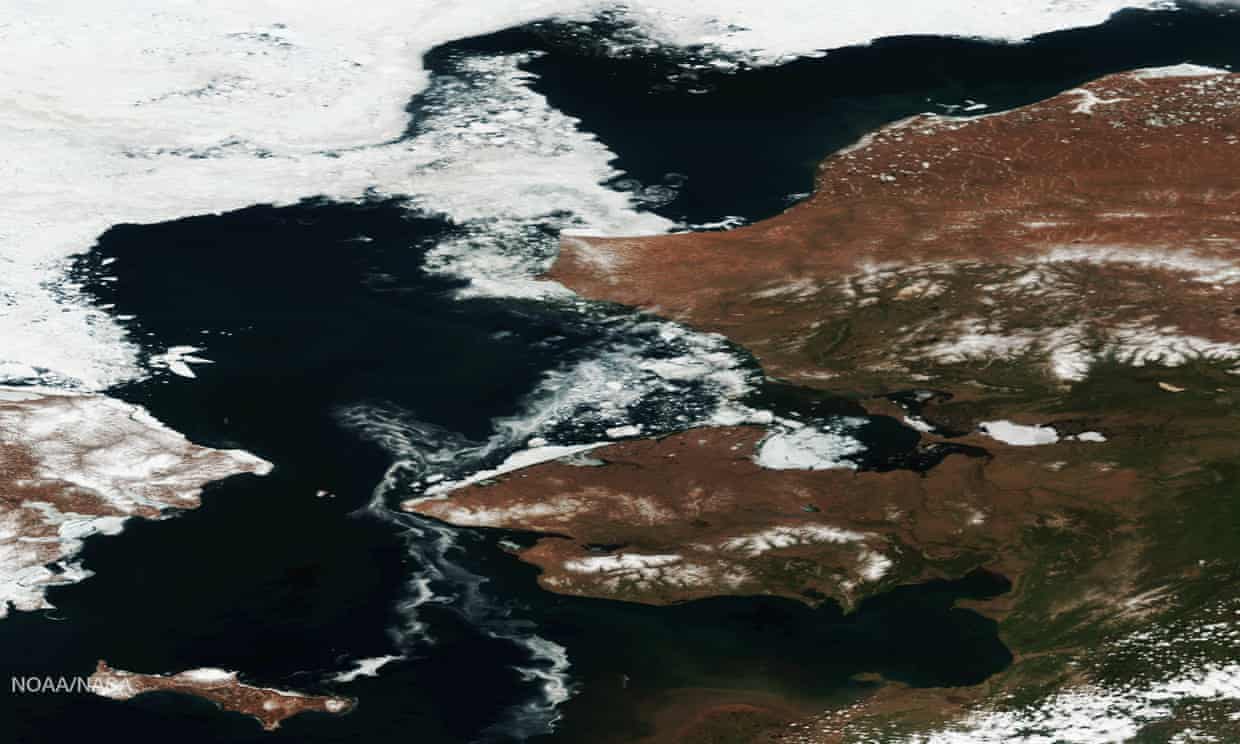
An image from the NOAA/Nasa Suomi NPP satellite taken on May 30, 2016, highlights the Arctic ice retreat off the north-west coast of Alaska
An image from the NOAA/Nasa Suomi NPP satellite taken on May 30, 2016, highlights the Arctic ice retreat off the north-west coast of Alaska. The average Arctic sea ice extent for May 2016 set a new record low since satellite observations began. Photograph: Suomi NPP/NASA/NOAA

How intense is methane as a heater of the atmosphere compared with carbon dioxide?
It is 23 times more powerful. However, methane dissipates much more quickly than carbon dioxide. It gets oxidised so that it only lingers in the atmosphere for about 7 or 8 years. By contrast, carbon dioxide hangs around in the climate system for about 100 years before it ends up in the sea and is absorbed by creatures that die and litter the seabed. At least that is what scientists thought. Today, there are quite a number of researchers who think carbon dioxide could last 1,000 years in the atmosphere.


So in the long run carbon dioxide is still going to be worse than methane in terms of heating the planet because a single methane pulse will have a disastrous effect, but if there is nothing to follow it on then it will go away. But with carbon dioxide there is a ratchet effect. All the carbon dioxide we release by burning fossil fuels just builds up in the atmosphere. We are having to live with last century’s carbon dioxide. What that says is simple: there is no such thing as a safe emission rate of carbon dioxide. That is why I am despondent about us ever being able to cut carbon emissions.
If we cannot halt the emissions of carbon dioxide, what can we do?
In the end, the only hope we have is to find a way to remove carbon dioxide from the atmosphere once it has got there. Even the IPCC has admitted that we will have to find a way to extract carbon dioxide from the air. The trouble is that they just don’t know how we can do that. The most favoured scheme is known as BECCS: bio-energy with carbon capture and storage. Essentially, you plant trees and bushes over vast swaths of ground. These grow, absorbing carbon dioxide in the process. Then you burn the wood to run power plants while trapping, liquefying and storing the carbon dioxide that is released.
It sounds straightforward. Will it work?
I am a bit suspicious of this technology. BECCS will need so much land to be effective. Calculations suggest it would need 40% to 50% of the arable land of the planet to make it work on the scale we will need and that would not leave enough land to grow crops to feed the world or to provide homes for a viable population of wild animals and plants. Other techniques, such as crushing and spreading olivine rocks, which absorb carbon dioxide, on beaches, will simply not scale up. They won’t work, so we will have to find some other way to remove carbon dioxide from the atmosphere directly.
As far as I can see, it will have to take the form of some sort of device into which you pump air at one end and you get air without carbon dioxide coming out the other end. It can be done, I am sure, but at the moment we do not have such a device. However, without something like that, I cannot see how we are going to deal with the carbon dioxide that is getting into the atmosphere. We are going to have to rely on a technology that has not yet been developed. That is a measure of the troubles that lie ahead for us. I think humanity can do it, but I would feel much better if I saw governments investing in such technology.
Farewell to Ice is published by Allen Lane (£20) on 1 September. Click here to order a copy for £16.40
https://www.theguardian.com/environment/2016/aug/21/arctic-will-be-ice-free-in-summer-next-year

"A Farewell to Ice" by Arctic sea ice expert Peter Wadhams: review – climate change writ large

The warning this book gives us about the consequences of the loss of the planet’s ice is emphatic, urgent and convincing
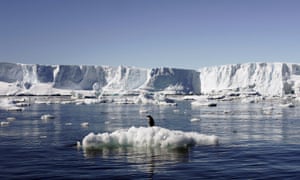
an adelie penguin in east antarctica
An Adélie penguin, east Antarctica. The loss of our sea ice will have dire consequences across the planet, not just at the poles, says Peter Wadhams. Photograph: Staff/Reuters.

by Horatio Clare, The Guardian, August 21, 2016

Becoming a world authority on sea ice has taken Peter Wadhams to the polar zones more than 50 times, travelling on foot and by plane, ship, snowmobile and several nuclear-powered submarines of the Royal Navy.
Nonscientists who read his astonishing and hair-raising A Farewell to Ice will agree that the interludes of autobiography it contains are engrossing, entertaining and, when one submarine suffers an onboard explosion and fire while under the ice, harrowing.
Any reader should find the science of sea-ice creation and the implications for us all of its loss – explored and explained here with clarity and style – beautiful, compelling and terrifying.
Wadhams thanks Ernest Hemingway for his title. Climate change, a cause and an effect of ice loss, brings conflict that would have interested the great author. Persecuted by trolls and climate-change deniers, Wadhams made news last year when three of his peers met premature deaths. One fell down stairs. One died in wilderness, possibly struck by lightning. A third, out cycling, was crushed by a lorry. Claiming that he had been targeted by a lorry while cycling, Wadhams speculated that oil companies or governments had it in for him and his ilk because of the conclusions to which their work has led them. But his book is more extraordinary than any conspiracy.
A Farewell to Ice proceeds methodically. Ice cores, tubes of compacted polar snow, record the last million years of atmospheric change, during which the Earth has oscillated between ice ages and warm periods. Now the pattern is breaking.
“Our planet has changed colour. Today, from space, the top of the world in the northern summer looks blue instead of white. We have created an ocean where there was once an ice sheet. It is Man’s first major achievement in reshaping the face of his planet,” Wadhams writes.
Polar ice is thinning and retreating with unprecedented speed. All our ingenuity cannot, at present, change that. Because ice only grows in winter but can melt year-round, its growth rate is limited, while melt rate is unlimited.
Ice is extraordinary stuff. A “puckered honeycomb” of oxygen and hydrogen atoms, it is highly mutable in different states because the length of the hydrogen bonds in its molecules varies. Ice [can] exist near absolute zero, the lowest temperature theoretically possible. Recent research suggests it may have entirely covered the Earth three times, making “snowball Earths.” Ice coats space dust, giving stars their twinkle. Life may have originated in that shining dust, according to the astronomer Fred Hoyle. Polar ice functions as Earth’s air- and water-conditioning system, and our thermostat.
Wadhams outlines how CO2 emissions are smashing the system, spinning the thermostat to hot. Without the albedo effect of ice – by which it reflects solar radiation up to 10 times more effectively than open water – we have entered a negative feedback loop.
Wadhams puts this plainly. “There is no period in Earth’s history where the rate of rise of atmospheric CO2 is as great as it is today.” The asteroid that finished the dinosaurs blasted 4.5 gigatonnes of carbon into the atmosphere, “yet the CO2 rate rise [in the aftermath] was still an order of magnitude lower than the current rate.”
The ice he worries about most covers Arctic seabeds – [made of] permafrost from the last ice age. Losing this will release huge methane plumes. Methane is 23 times more effective in raising global temperature than is CO2. Wadhams and colleagues have modelled the consequences using different dates for methane release.
A business-as-usual approach by humanity makes 2035 a plausible moment for the permafrost to melt and methane to escape. The worst floods, fires, droughts, and storms we have seen will be as nothing to what Africa, Asia, and the Americas experience in this scenario. Millions die. Low-lying areas are inundated. Survivors live in a patchy post-apocalypse. Europe’s current refugee crisis would be dwarfed.
We still have time, A Farewell to Ice concludes, for drastic action, despite long procrastination. The fall of Margaret Thatcher was bad for the ice: she was a fan of Wadhams’s work, quoting him extensively in her efforts to set up a body to understand and mitigate the loss of sea ice. Subsequent prime ministers did little or worse than nothing, suppressing facts that lobbyists in business and industry (some of them former Thatcherite ministers like Lord Lawson and Peter Lilley) did not like.
Last year’s Paris agreement, when global leaders resolved to prevent a temperature rise of 2C (with an aspiration of 1.5C), gives Wadhams hope. He believes there is now a common will across the world to confront and avert the nightmare. Solutions include wind, wave, solar, tidal, and nuclear energy (not the perilous water-cooled reactor type David Cameron wanted for Hinkley Point, which have a terrible record, but the “pebble bed” type, apparently) and, above all, direct air capture (DAC) [of CO2], which has yet to be invented.
You pump air through a system that removes the CO2 and “either liquefies it or turns it chemically into something useful,” Wadhams says. Salvation requires “a [DAC] research program on the scale of the Manhattan Project” and voluntary change by all: home insulation, no more SUVs or budget flights. We act, decisively and immediately, or our grandchildren pay full price, with our children impotent to help them, if you believe this book. I am afraid I do.
A Farewell to Ice is published by Allen Lane (£20). Click here to buy it for £16.40
https://www.theguardian.com/books/2016/aug/21/farewell-to-ice-peter-wadhams-review-climate-change