Blog Archive

Showing posts with label corrupt officials. Show all posts

Saturday, February 27, 2016

What happened to govt scientist Charles Monnett whose findings stood in the way of Shell's plans for Arctic drilling?

The fate of Dr. Charles Monnett and the suppression of his work is a lesson in corporate strong-arming

by Kamil Ahsan, AlterNet, September 1, 2015

In February 2011, Charles Monnett, an Arctic marine biologist who in 2006 published the first observations of a decline in the polar bear population of the Arctic due to melting sea ice, was interviewed by Eric May and Lynn Gibson from the Department of Interior’s Office of the Inspector General. The conversation was perplexing. May and Gibson, criminal investigators with the IG, began by suggesting that Monnett was being investigated for scientific misconduct, but early on in the conversation they admitted that neither of them had any training in science and biology.
From there, the transcript of the conversation, a document released by Monnett’s legal representation, Public Employees for Environmental Responsibility (PEER), becomes murkier. May and Gibson’s line of questioning shifts several times, making it increasingly unclear what aspects of misconduct were being investigated. Monnett explains that his findings, published in Polar Biology, were peer-reviewed; May responds by asking how Polar Biology got involved. Monnett painstakingly takes May and Gibson through the calculations and observations underlying his data, but they seem dissatisfied and change tacks.
What happened after isn’t murky at all. Soon after the interview, Dr. Monnett’s hard drive and notebooks were seized. In July 2011, Monnett found out from his employer, the Bureau of Ocean Energy Management, Regulation and Enforcement (BOEMRE), that he had been put been put on administrative leave, barring him from speaking to his colleagues or continuing his research.
The investigation had turned in to a virtual witch-hunt—but when the IG finally released its report toward the end of 2012, its only allegations were of an administrative nature. Monnett subsequently filed a whistleblower complaintagainst BOEMRE, alleging that the official harassment had impeded him from doing his job and that the Interior Department was violating its own scientific integrity policies intended to protect federal scientists from political interference. In November 2013, Monnett reached a $100,000 settlement with BOEMRE.
The tale of Dr. Monnett is now a few years old, but instructive. Both Monnett and PEER have maintained that Monnett was harassed and essentially eliminated from the ranks of BOEMRE because he represented a threat to the financial stakes of oil companies like Shell hoping to open up the Alaskan Arctic for offshore drilling projects, and that suppressing scientific research was seen as necessary for Shell’s permits to go through. At the time, BOEMRE had been reviewing Shell’s plans to drill in the Arctic. It approved those permits in 2012, and again, in a highly contentious decision by the Obama administration, earlier this year.
Now, years after the debacle, Monnett says he has complex feelings about the dynamics of the science done in federal agencies, given how overbearing the oil industry is and its pervasive influence on the government.
The Bush administration, Monnett recalls, had “created an environment where the managers [of BOEMRE] were very hostile and aggressive towards some of the scientists…which led to a number of people leaving the agency. These people were being actively attacked by managers, screamed at in hallways, threatened with all sorts of actions. Some of them were even being threatened with legal action. The agency just wasn’t receptive to honest analysis.”
“Because of pressure from industry and the administration…certain timelines had to be met, and those timelines weren’t long enough to allow [scientists] to do complete analysis. Management was dictating the outcomes…which is against the law in my view.”
The Bush administration’s agenda from the very beginning was pro-drilling, and therefore invested in fast-tracking Shell’s permits for the Arctic. During the administration’s tenure, there was a mass exodus of scientists from BOEMRE—at the time known as the Minerals Management Service—who were under pressure to overlook the overwhelming environmental concerns of Arctic oil drilling in their analyses.
But Monnett’s investigation began in 2011, not during the Bush administration but during the Obama administration, foretelling Obama’s climate legacy of paying lip service to climate change while fast-tracking Shell’s offshore drilling plans all the same.
On Monday morning, President Obama arrived in Alaska to shed “a spotlight on what Alaskans in particular have come to know: climate change is one of the biggest threats we face, it is driven by human activity, and it is disrupting Americans’ lives right now.” The trip, mere weeks after the final approvalfor Shell’s summer plans to drill in the Chukchi Sea, is likely to be seen in retrospect as illustrative of the schizophrenic energy policy the Obama administration has long espoused.
The Limits of Academic Freedom
Scientific suppression and the loss of many scientists to BOEMRE during the Bush administration have been well-documented, but as Dr. Monnett’s case reveals, something similar, if not worse, has been underfoot during the current administration. As the case of Professor Rick Steiner demonstrates, the influence of oil goes well beyond federal agencies in Alaska.
A tenured professor of marine conservation at the University of Alaska, Steiner spent a large part of his career in the Arctic and then Anchorage, Alaska. Steiner had been a vocal opponent of offshore oil drilling since the Exxon Valdez oil spill in 1989 and a staunch defender of marine conservation—positions that got him in to trouble multiple times during his career.
In December 2007, soon after Monnett’s polar bear paper was published, there was a federal proposed rule to list polar bears under the Endangered Species Act. At the time, Gov. Sarah Palin publicly stated that Alaska state marine mammal biologists (ADFG) disagreed with the rule, but Steiner was unsatisfied. After much resistance from the ADFG, he obtained the state review through a federal Freedom of Information Act request. The review, underscoring the dishonesty of the Palin administration, showed that marine mammal scientists overwhelmingly agreed that polar bears should be classified as endangered. This move, and many others, put Steiner on the radar as a staunch advocate of marine conservation and opponent of the pervasive influence of the oil industry in Alaska.
In 2008, when the federal government began to consider an expansion of oil development projects in Alaska, Steiner continued to raise major environmental concerns. Written records released by PEER chart out what happened next: the University of Alaska and the National Oceanic and Atmospheric Administration terminated the grant funding for Steiner’s research work. The documentsdemonstrate how pressure from NOAA led university officials to cut Steiner’s funding: federal officials wrote that they “had an issue with Steiner” and that his environmental advocacy could “cause problems nationally” for the agency. PEERcalled this one of the first instances where a university and federal agency admitted to removing a faculty member’s funding because of their environmental positions.
Steiner filed multiple internal grievance claims which were all rejected by the university, and in February 2010, Dr. Steiner resigned from the university faculty on principle. Soon after, he was told by a friend who had been in a meeting with university officials that oil executives had met with university officials, telling them point blank that as long as Steiner continued to oppose the oil industry, the university would not get a dime of its money. The University of Alaska, like many public institutions in Alaska, is funded largely by oil revenues.
Like Monnett, Steiner says his experience taught him the limits to academic and scientific freedom in a place like Alaska. “It is a systemic problem far beyond BOEMRE,” he explains. “It’s in all the agencies, the universities. It’s state and federal and a broad systemic problem in Alaska.
“[TheuUniversity] felt I was being too much of an advocate for marine conservation which is in contradiction to their professed goal of being in favor of academic freedom.”
And indeed, the brazen nature of the university’s statements on Steiner’s case is deeply shocking. In the recommendation to cut Steiner’s funding, Dean Wiesenburg of the University of Alaska noted that Steiner “regularly takes strong public positions on issues of public debate.” Steiner, he said, “has chosen to be a maverick and work independently.”
To Steiner, what this means is clear. “There is an unwritten orthodoxy in Alaska,” he explains, “that dissenting opinions regarding unsustainable economic and political paradigms here need to be suppressed and silenced. Everybody knows that. There’s a very strong political dynamic where agencies and public institutions like the university are captured by the oil industry because it pays 95% of the state budget. Federal agencies bend over backwards for the oil industry and tend to marginalize voices that threaten that dynamic. If you criticize oil, you will have hell to pay.”
“There aren’t very many dissenters. The whole point of making an example of me and Charles [Monnett] was to suppress people from doing that in the future. People have learned that if they want to keep their job and their pay check, and their pension and their benefits, they need to keep their head down.”
A Handy Guide to Scientific Suppression
The cases of Charles Monnett and Rick Steiner have dire implications for how we view Shell’s offshore drilling plans in the Chukchi Sea this summer, and the lengths to which they went to acquire the permits. Much of this can only be guessed at. Steiner talks about the prevailing culture where federal agencies and universities begin to eliminate scientists who do not conform to the pro-oil agenda by not granting promotions or incentive awards, or giving them inadequate annual performance reviews. Another tactic, he says, is overwhelming staff scientists with trivial tasks, pulling them off projects for which they are qualified.
Jeff Ruch, executive director of PEER, an organization that seeks to protect scientist whistleblowers, can add to this list. “The range of things we see,” he says, “range from attempts to terminate, suspend, crippling internal investigations. In one case involving a lab director, the funding for his graduate students was jeopardized so he lost a lot of his research capacity. Preventing publications has no limits—in one case, a scientist was raising issues and her email privileges were taken away. We were left scratching our heads wondering how that could have happened.”
One possible remedy is scientific integrity policies that protect whistleblowers, but as Ruch explains, they are far from satisfactory. “Industry puts pressure on government agencies, and government agencies are the instrument of retaliation,” he explains. “For the most part, scientists have few legal protections. These scientists are not covered by whistleblower laws, because they’re not disclosing violations of law, fraud, or abuse. They’re disclosing suppression of research, or watering down of methodologies or the omission of key findings.”
“The law generally treats these as a matter of opinion and in these cases, the chain of command generally wins over the staff scientist.”
In his experience, Ruch says “scientific integrity policies operate within the Department of the Interior—those were weakened in December to make it even more difficult to sustain a complaint. Up until that time, there had been 2 instances out of 14 where the scientist involved faced multiple suspensions and the responsible managers escaped punishment altogether. It’s difficult to advise scientists in good conscience to file complaints under their own name because they’re unlikely to resolve in anything good.”
Early in 2009, Obama released a presidential directive to develop policies that restore scientific integrity to federal actions, including providing federal scientists better whistleblower protections. At the time, this was hailed as a huge leap in the right direction.
Ruch feels not much has changed. “The agencies in the Interior have largely ignored the presidential directive,” he explains. “Some policies claim protections but have no mechanisms by which that protection is implemented, which makes it empty protection.”
Environmental groups argue that this scientific suppression, and overlooking the enormous environmental risks, has been key to the Obama administration’s approval of Shell’s permits this year. Much of the information detailing the safety and reliability of Shell’s operations has not been released to the public, despite multiple FOIA requests by groups like Greenpeace and PEER. A recent FOIA request by PEER, directed at the Bureau of Safety and Environmental Enforcement (BSEE), seeks to release information on how Shell’s plans for certified by third-party observers, as well as information on the deployment of capping stack and containment domes in the event of an oil spill. BSEE has not responded. PEER has now filed a lawsuit in a federal district court to bring these details to light.
As President Obama continues his trip in Alaska to highlight the dangers of climate change amid overwhelming opposition from environmental and indigenous groups, it begs big questions about the administration’s overarching legacy with federal scientists and the oil industry. Ruch feels strongly about this: “In terms of the actions inside these agencies, there has been no discernible difference between those under George Bush, who was an oil man, and Barack Obama, a constitutional law professor who when his own Commission on the Deepwater Horizon spill met with him, one of the very first questions he asked was about Arctic drilling.”
“It has been clear that Arctic drilling is part of the ‘all-the-above’ energy strategy and the same sort of suppression and the same suite of issues have never really been analyzed.”
For an administration pretending to conduct a dramatic push toward mitigating climate change, that is a shameful record.
AlterNet
Image information
Tom linster/Shutterstock
Whether in Svalbard or elsewhere polar bears are in trouble. It's not too late to change the disastrous course that President Obama has set for Shell Oil in the fragile Arctic. His administration is currently finalizing the next five year plan, in which the president has the power to exclude all drilling in the Arctic Ocean. In addition, he should instruct the U.S. Fish & Wildlife Service to review and revise its polar bear recovery plan, which currently allows for a shocking and unacceptable 85 percent decline in polar bear populations, and give polar bears the protection they deserve. 
Tell President Obama to stop drilling in the Arctic and save America's polar bears.

Friday, July 10, 2015

Deniers Forge Letters to Congress Long After Knowing Climate Science is Solid

by ClimateDenierRoundupFollow for Climate Hawks, Daily Kos, July 10, 2015

The Union of Concerned Scientists released a report with a treasure trove of primary documents from fossil fuel companies and their lobbying efforts and front groups. Here's a glimpse of what we're dealing with: industry front group astroturf campaigns, forged letters to Congress, and bought off scientists.

While those fluent in denial tactics won't be surprised by most of the revelations, there are still new outrages to get your heart rate going. The coverage has largely focused on Exxon's knowledge of the climate-carbon relationship as early as 1981 and subsequent neglect, but The Climate Deception Dossiers reveal even more sinister tactics employed by fossil fuel companies, as well as their front groups and PR hires. The primary documents reveal how companies secretly funded Willie Soon for his climate denial science, how fossil fuel lobby groups planned their campaigns of climate deceit climate deceit after internal memos acknowledged in 1995 that the link between climate change and carbon emissions "cannot be denied," and perhaps most shockingly, how a PR firm sent out forged letters to Congress before crucial votes.

The firm sent the letters—assuming the identity and misrepresenting the stance of civil rights organizations like NAACP—while Congress debated the Waxman-Markey bill (which proposed a federal emissions reduction plan). Congress members were unaware that in fact it was the PR firm, Bonner and Associates—working for the coal industry front group American Coalition for Clean Coal Electricity—that sent the oppositional letters. ACCCE and Bonner didn't bother telling the lawmakers about the forgeries until after the votes were recorded.

To make matters even worse, Bonner and Associates not only coopted a defunct chapter of the NAACP for their forgery, they even signed it as a staffer who had long since passed away.

Because just when you thought the bar couldn't get lower, deniers found a way to dig six feet under it.

Sunday, April 5, 2015

ALEC and its climate change denial activities

  The Interstate Research Commission Act on Climatic Change Act is an ALEC legislative bill, which incorrectly states that there is “a great deal of scientific uncertainty” around climate change and that it could result in “beneficial climatic changes.” Read more here.

The Interstate Research Commission Act on Climatic Change Act is an ALEC legislative bill, which incorrectly states that there is “a great deal of scientific uncertainty” around climate change and that it could result in “beneficial climatic changes.” Read more here.
  The ALEC legislative bill on science education promotes a “teach both sides” approach, despite the overwhelming scientific consensus around climate change. Read more here.

The ALEC legislative bill on science education promotes a “teach both sides” approach, despite the overwhelming scientific consensus around climate change. Read more here.
  This ALEC legislation repeals state standards requiring electric utility companies to get a portion of their electricity from renewable energy sources. Read more here. 

This ALEC legislation repeals state standards requiring electric utility companies to get a portion of their electricity from renewable energy sources. Read more here. 
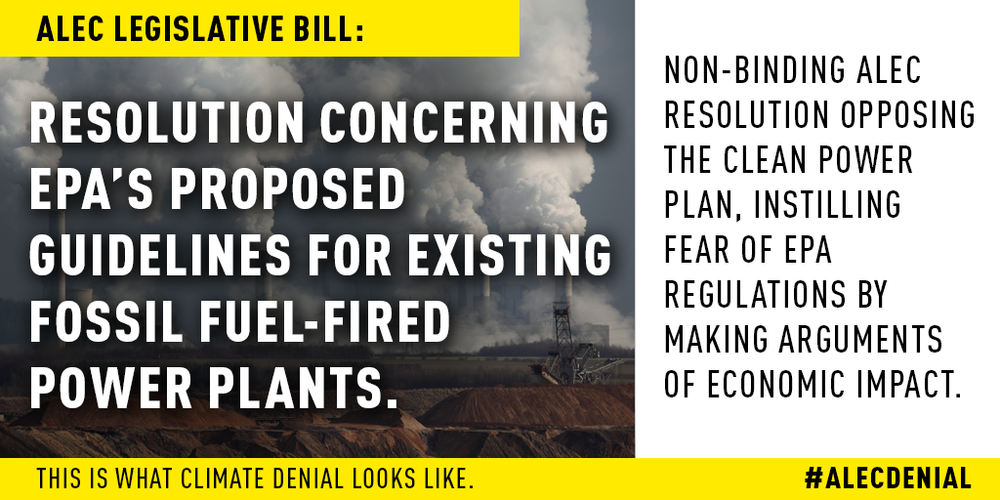
  This is a non-binding ALEC resolution opposing the Clean Power Plan, instilling fear of EPA regulations by making arguments of economic impact. Read more here.

This is a non-binding ALEC resolution opposing the Clean Power Plan, instilling fear of EPA regulations by making arguments of economic impact. Read more here.
  This ALEC legislative bill increases fees for home solar users who ALEC has described as “freeriders” taking advantage of utility companies. Read more here.  

This ALEC legislative bill increases fees for home solar users who ALEC has described as “freeriders” taking advantage of utility companies. Read more here.

  This is a non-binding ALEC resolution promoting Federal approval of the TransCanada Keystone XL Pipeline project. Read more here.

This is a non-binding ALEC resolution promoting Federal approval of the TransCanada Keystone XL Pipeline project. Read more here.
  This ALEC legislative bill creates bureaucratic red tape and would delay the state submitting its compliance plan to the EPA under the Clean Power Plan. Read more here.

This ALEC legislative bill creates bureaucratic red tape and would delay the state submitting its compliance plan to the EPA under the Clean Power Plan. Read more here.

http://alecclimatechangedenial.org/anti-climate-change-agenda/

Wednesday, January 21, 2015

Pre-eminent bee researcher Jeffrey Pettis demoted by corrupt USDA

USDA draws protests for blocking references to bee expert's resignation


Tiffany Stecker, E&E reporter
Published: Tuesday, January 20, 2015

The Department of Agriculture blocked references to a well-known bee researcher's surprise resignation last year in documents released under the Freedom of Information Act.
Jeffery Pettis' demotion from his research perch last July at the Agricultural Research Service's Bee Laboratory shocked the American Honey Producers Association (AHPA) and the American Beekeeping Federation (ABF), whose presidents and vice presidents formally asked USDA for information on why Pettis was allowed to step down.
In an Aug. 25 letter to Agriculture Secretary Tom Vilsack, the groups' leaders described Pettis as "one of the world's most renowned honey bee researchers," who led the research on colony collapse disorder -- a phenomenon in which entire colonies disappeared from hives -- and bee health decline in his years at ARS.

"It is because of Dr. Pettis's deep commitment to honey bee science that we must express concern about USDA's decision to relieve him of his duties as Laboratory Leader at the Beltsville Area Research Center in Beltsville, Maryland," ABF President Tim Tucker and Vice President Gene Brandi and AHPA President Randy Verhoek and Vice President Darren Cox said in the letter, obtained by Greenwire.

The associations questioned USDA's reason for dropping Pettis, saying "we cannot help but to view the decision cynically." The letter recounted a meeting with Agricultural Research Service Administrator Chavonda Jacobs-Young during which they were told Pettis had been reassigned to a research-only position because he had fallen behind on his administrative responsibilities.
The letter also stated that other ARS honeybee scientists are "finding themselves reprimanded for reasons unclear to our organizations."
In the agency's release of the letter, this information -- as well as AHPA and ABF's request that the department reconsider its decision on Pettis -- was withheld under the Freedom of Information Act's (b)(6) exemption, which prevents the release of personnel or medical files that would "cause a clearly unwarranted invasion of personal privacy." In a letter to explain the exemptions, USDA FOIA officer Alexis Graves said that, because the letter was not written by USDA or ARS officials, the information does not serve to shed light on agency activities. Therefore, the exemption is used to balance the public's right to know with the individual's -- Pettis -- right to privacy.

Pettis led the laboratory for nine years. He continues to work in the laboratory as a researcher but doesn't have the same authority he had in setting the research agenda for the laboratory. He will also no longer serve as a spokesman for the lab, or provide testimony to Congress as he did last year.
At the time of the resignation, ARS didn't comment on the possibility that Pettis had left under pressure, saying it is not uncommon for research leaders to step down, given the amount of additional, voluntary work the position entails (Greenwire, July 7, 2014).
Following the news, Pettis addressed colleagues and friends on his demotion, according to a letter posted on the AHPA website.

"While I have strong reservations about this decision, I do not wish to challenge it," Pettis wrote. "The truth is I have been stretched too thin over the past few years to meet all the demands of the Research Leader position and my own research. The administrative aspects of my job as Research Leader have suffered because my research took precedence over administrative responsibilities."
In their letter to Vilsack, AHPA and ABF address Pettis' reference to being "stretched too thin." If he was overwhelmed with work in his post, they said, why didn't ARS offer additional administrative support as Pettis continued to set the agenda for honeybee research?
"As business owners and operators, we struggle to understand the logic behind this decision," they wrote.

'Universally respected'

In his time at the bee laboratory, Pettis was well regarded by environmentalists and industry alike, two polarized groups in the debate on whether neonicotinoid insecticides harm bees. While green groups are calling on U.S. EPA to restrict or ban these pesticides, the pest control and horticultural industry says they are indispensable tools for farmers and can be managed in a way that does not hurt bees.
"To the best of my knowledge, Dr. Pettis is universally respected for his body of work on behalf of pollinators," said Tom Van Arsdall, a spokesman for the Pollinator Partnership, which works with scientists, environmental groups and industry -- including pesticide manufacturers -- to develop solutions for stemming the rapid declines in honeybees and other insects that pollinate crops.
Pettis testified to the House Agriculture Committee last April on factors contributing to bee health decline. A story in California's East Bay Express published two months after the testimony suggested that Pettis' stance -- that pesticides affect bee health -- differed from ARS's official statements.

"It's clear that USDA is employing a 'kill the messenger' approach," said Tiffany Finck-Haynes, a food futures campaigner with Friends of the Earth, which called attention to Pettis' demotion last year. According to Finch-Haynes, Pettis has highlighted the role of pesticides more than other scientists in the agency.
"USDA's decision indicates the agency is stacked in favor of pesticide industry interests and others who have a stake in conducting business as usual instead of promoting independent, objective science," added Finck-Haynes.
Neither USDA's Office of the Secretary nor ARS responded to a request for comment.

Saturday, October 18, 2014

Steve Horn: Court Files: Coal CEO Robert Murray Unearths Lease from Aubrey McClendon's New Fracking Company

by Steve Horn, DeSmogBlog, October 16, 2014

Robert E. Murray, CEO Murray Energy Corporation
DeSmogBlog has obtained a copy of a sample hydraulic fracturing (“fracking”) lease distributed to Ohio landowners byembattled former CEO and founder of Chesapeake EnergyAubrey McClendon, now CEO of American Energy Partners
Elisabeth Radow, a New York-based attorney who examined a copy of the lease, told DeSmogBlog she believes the lease “has the effect of granting American Energy Partners the right to use the surface and subsurface to such a great extent that it takes away substantially all of the rights attributable to homeownership.”
The American Energy Partners fracking lease was shaken loose as part of the discovery dispute process in an ongoing court case pitting coal industry executive Robert E. Murray — controversial CEO of Murray Energy Corporationand American Energy Corporation — against McClendon in the U.S. District Court for the Southern District of Ohio Eastern Division
Murray brought the suit against McClendon back in August 2013, alleging McClendon committed trademark and copyright infringement by using the “American Energy” moniker. Murray’s attorneys used the lease as an exhibit in a Motion to Compel Discovery, filed on September 8, over a year after Murray brought his initial lawsuit. 
The case has ground to a slow halt as the two sides duke it out over discovery issues and related protective order issues, making a large swath of the court records available only to both sides’ attorneys and causing many other records to be heavily redacted.
Out of that dispute has come the American Energy Partners lease, published here for the first time.

McClendon’s Company Sent Murray a Lease

As part of ongoing discovery-related legal battles, the McClendon legal team argued against handing over an unredacted copy of a sample lease requested by Murray Energy because — as it stated in a June 24 letter that is now part of the court record — Murray has yet to demonstrate the “leases are reasonably calculated to lead to the discovery of admissible evidence.”
In other words, they're arguing that Murray's team hasn't shown how getting its hands on a sample lease has anything to do with the legal case it is making: that McClendon’s company had infringed upon its trademark and copyright.

American Energy Partners CEO Aubrey McClendon; Photo Credit: YouTube Screenshot
Murray’s team subsequently threw a mighty counterpunch.
In its September 8 Motion to Compel Discovery, the Murray team submitted that McClendon’s company — while arguing in court against providing a lease  had actually sent a lease packet to Murray Energy Corporation on June 5 via lease-buying company Purple Land Management. They attached the lease as an exhibit to the motion
McClendon American Energy Partners Lease
That lease doled out to Murray Energy Corporation set off legal alarm bells for the Murray legal team. Murray's attorneys argue that the lease completely undermines the McClendon team’s discovery-related legal case, while also cutting straight to the heart of what their legal complaint centers around: McClendon's use of the name “American Energy."
Murray’s legal team argued that the content of the American Energy Partners lease itself could cause “potential and actual confusion” about the “American Energy” name and which company is which. They pointed to numerous examples of such confusion both in the September 9 Motion to Compel Discovery, as well as in a more recent October 13 Motion in Opposition to the Protective Order and an accompanying exhibit.
Affidavit of Heather Santini

Lease Allows Fracking and Waste Injection

The American Energy Partners' lease itself is 11 pages long and Radow — author of the article, “Homeowners and Gas Drilling Leases: Boon or Bust?,” published by the New York State Bar Association Journal — says it is more harmful to land-owners than an earlier lease doled out by Chesapeake Energy. Radow supplied DeSmogBlog with a copy of a Chesapeake Energy lease from December 2009 for sake of comparison.
McClendon American Energy Partners Lease
Radow pointed out two big differences between the December 2009 Chesapeake lease and the June 2014 American Energy Partners lease.
One significant addition to this lease involves the right to suspend payment of royalties to a property owner with a prior mortgage until a subordination of mortgage is delivered in a form acceptable to American Energy obtained at the cost of the property owner,” Radow told DeSmogBlog via email. 
Educated mortgage lenders are well aware of the risks to their mortgage collateral associated with hydraulic fracturing and will be unlikely to subordinate their interests to the gas company. If they do refuse to deliver a subordination agreement, this clause gives the gas company a free pass on drilling a mortgaged property without paying royalties.”
The other main addition to the June 2014 version: it permits injection of “hydrocarbon related substances from any source” on a homeowner’s property for payment of just $1,000.00 per year,* proportionately reduced to the homeowner’s interest in the estate (“estate” is likely intended to mean the homeowner’s proportionate interest in the spacing unit).
American Energy Partners Waste Injection Lease Provision
Once the lease term expires, if no drilling operations are in effect, American Energy has the unilateral right to extend the lease indefinitely to use the subsurface to inject waste,” explained Radow.
One possible effect of this clause is to entitle American Energy to sign leases on properties with existing wells and only use that property for deep well injection of waste. Without fully understanding the ramifications to a drinking water supply of injecting toxic and radioactive waste below a person’s family residence, this unregulated practice could potentially transform a residence into a property unsuitable for habitation.”
Radow also cited the risk of earthquakes caused by fracking waste injection in Ohio — and beyond — and the loss of value that could impose upon a home.
“Homeowner’s insurance does not cover hydraulic fracturing operations and the lease has no provision for insurance,” commented Radow. “Even if the homeowner, at its expense, or American Energy, at its expense, were to purchase earthquake insurance endorsements to their existing coverage, it is not at all clear that the added insurance will cover manmade earthquakes.”

Junk Debt Fuels Second Land Grab

While the U.S. shale boom currently faces free fall mode with the global price of oil plummeting, McClendon’s company appears to be repeating the ways of its precursor, Chesapeake Energy, by going full-throttle into “land grab” mode. 
Most recently, Bloomberg reported that sources say American Energy Partners may soon buy up Freeport McMoran’s acreage in California’s Monterey Shale, a basin whose oil-producing potential was downgraded by 96% by the U.S. Energy Information Agency in May 2014.
Bloomberg also reported that American Energy Partners has relied on low-rated rated junk debt bonds as capital to finance its land buying spree, graded Caa1 by Moody’s, which Bloomberg described as “a level that’s seven steps below investment-grade and indicative of 'very high credit risk.'”
Prices on $1.6 billion of speculative-grade bonds sold by the upstart exploration firm of former Chesapeake Energy Corp. chief Aubrey McClendon have plunged as much as 19 percent since being issued in July,” wrote Bloomberg.
In the history portion of its website, Chesapeake calls the period between 2003 and 2007 its “Executing the Land Rush Plan” phase
During this time, we rapidly increased our acreage positions in these unconventional plays as we won what we have called the ‘gas shale land grab,’”says the website. “We believed that by winning this land grab, we could establish Chesapeake as the premier U.S. natural gas producer for decades to come.”
McClendon has also publicly stated that flipping land is more profitable than selling gas.  
I can assure you that buying leases for x and selling them for 5x or 10x is a lot more profitable than trying to produce gas at $5 or $6 per million cubic feet,” he once said on an investor call.
Aubrey McClendon Land Grab Land Flipping
An Exhibit found within court records from the Murray v. McClendon case shows American Energy Partners has posted newspaper advertisements reading “We are drillers, not land flippers!,” likely an attempt to differentiate the new start-up company from the past deeds of Chesapeake Energy. 
Yet, the content of the American Energy Partners lease served to Murray Energy, the company's current on-the-ground activity nationwide and McClendon’s Cheasapeake Energy “land grab” track-record tells another story: that of another land grab well in the making.
Murray Energy Corporation CEO Robert E. Murray; Photo Credit: YouTube Screenshot
*A previous version of this article stated the payment was $1,000 per month. The actual amount is $1,000 per year. We regret the error.