Blog Archive

Showing posts with label TransCanada. Show all posts

Friday, September 23, 2016

First Nations across North America sign treaty alliance against the oilsands


Tsleil-Waututh leaders (left to right): Gabriel George, Charlene Aleck, and Rueben George sign the Treat Alliance Against the Tar Sands in Vancouver on Thursday, September 22, 2016. Photo by Elizabeth McSheffrey.
September 22, 2016


The thunderous pounding of indigenous drums echoed in the air on Thursday as more than 50 indigenous nations across North America rallied together to sign a historic, pan-continental treaty alliance against oilsands expansion in their traditional territory.
The collaboration, formalized at simultaneous ceremonies in Quebec and B.C., aims to block all proposed pipeline, tanker, and rail projects affecting First Nations land and water, including TransCanada's Energy East pipeline, Kinder Morgan's Trans Mountain expansion, Enbridge's Line 3 pipeline, and Enbridge Northern Gateway.
At the signing on Musqueam land in Vancouver, the lineup of chiefs waiting to put their names down filled up an entire room. It was a powerful ceremony, and participants clad in the regalia of their nations travelled from across B.C. and northern Washington to be part of the growing movement.
Grand Chief Stewart Phillip of the Union of BC Indian Chiefs, who also signed the document, said indigenous people will no longer stand for dangerous projects on their territory that advance the threat of climate change.
"In this time of great challenge we know that other First Nations will sign on," he said, extending the invitation to Indigenous communities far and wide.
"Based on our sovereign, inherent right to self-determination, we have collectively decided that we will pick up our sacred responsibilities to the land, waters, and people. We will come together in unity and solidarity to protect our territory from the predations of big oil interests, industry, and everything that represents."
It's a movement that's already happening, he added, with no better example than in North Dakota, where the Standing Rock Sioux have forced the federal government to pause Dakota Access pipeline construction.

Grand Chief Stewart Phillip, Kinder Morgan, Trans Mountain expansion, Union of BC Indian Chiefs
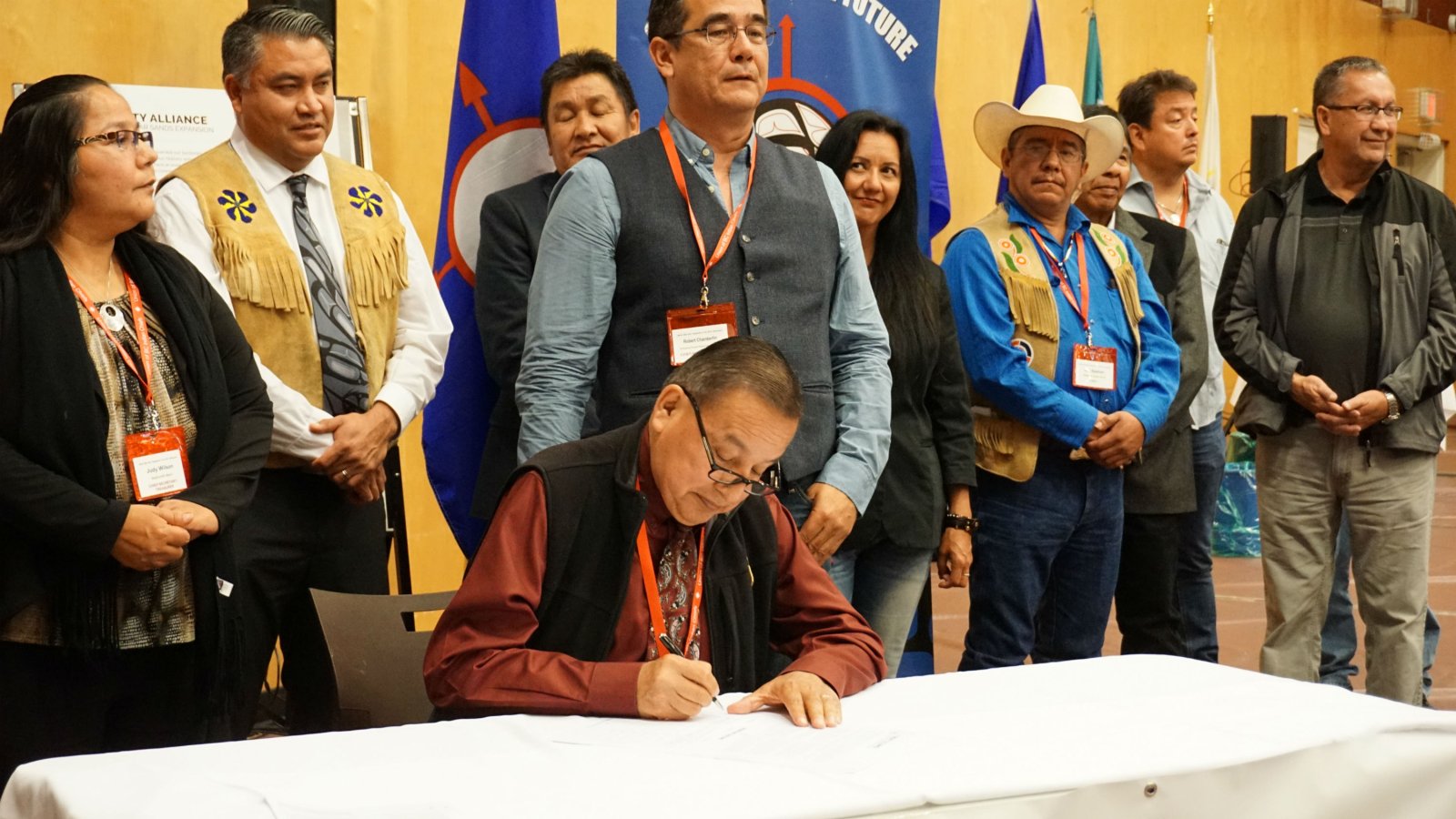
Grand Chief Stewart Phillip of the Union of BC Indian Chiefs signs the Treaty Alliance Against Tar Sands Expansion in Vancouver, BC, on Thursday, September 22, 2016. Photo by Elizabeth McSheffrey.

Meeting the call to climate change duty

The document, called the Treaty Alliance Against Tar Sands Expansion, commits its signatories to assist one another when called upon in the battle against oilsands expansion, and to work in partnership to move society towards more sustainable lifestyles. By aligning themselves with other Indigenous nations across Canada and the northern U.S., participants hope to ensure that dangerous projects are not able to "escape" by using alternative routes.
“We have the right and the responsibility to stop these major threats to our lands, our waters and our peoples,” said Kanesatake Grand Chief Serge Simon. “For example, from Quebec, we will work with our First Nation allies in B.C. to make sure that the Kinder Morgan pipeline does not pass, and we know they’ll help us do the same against Energy East.”
It comes not only from a legal and cultural responsibility to protect their land, water, air, and climate from harm, said Grand Chief Derek Nepinak of the Assembly of Manitoba Chiefs, but a desire to safeguard a future for all peoples, indigenous and non-indigenous as well.
“We want to work with the Prime Minister and the government to develop a sustainable economy that does not marginalize our people,” he said. “This is a time of great spiritual awakening for our peoples as we reinvigorate our Nations and ensure a better tomorrow for all.”
While First Nations, environmentalists and other key stakeholders across North America argue that pipelines, tankers, and oil by rail increase the risk of catastrophic oil spills, threaten critical marine and terrestrial ecosystems, and put international climate targets out of reach, energy companies argue that they will revitalize struggling Canadian economies by bringing energy to overseas markets.
The energy companies also argue that their proposed projects promote responsible resources development. The Canadian Association of Petroleum Producers however, Canada's largest oil and gas lobby group, said the Treaty Alliance will not change the way its members do business with Indigenous communities.

Chief Terry Teegee, Carrier Sekani Nation, Prince George
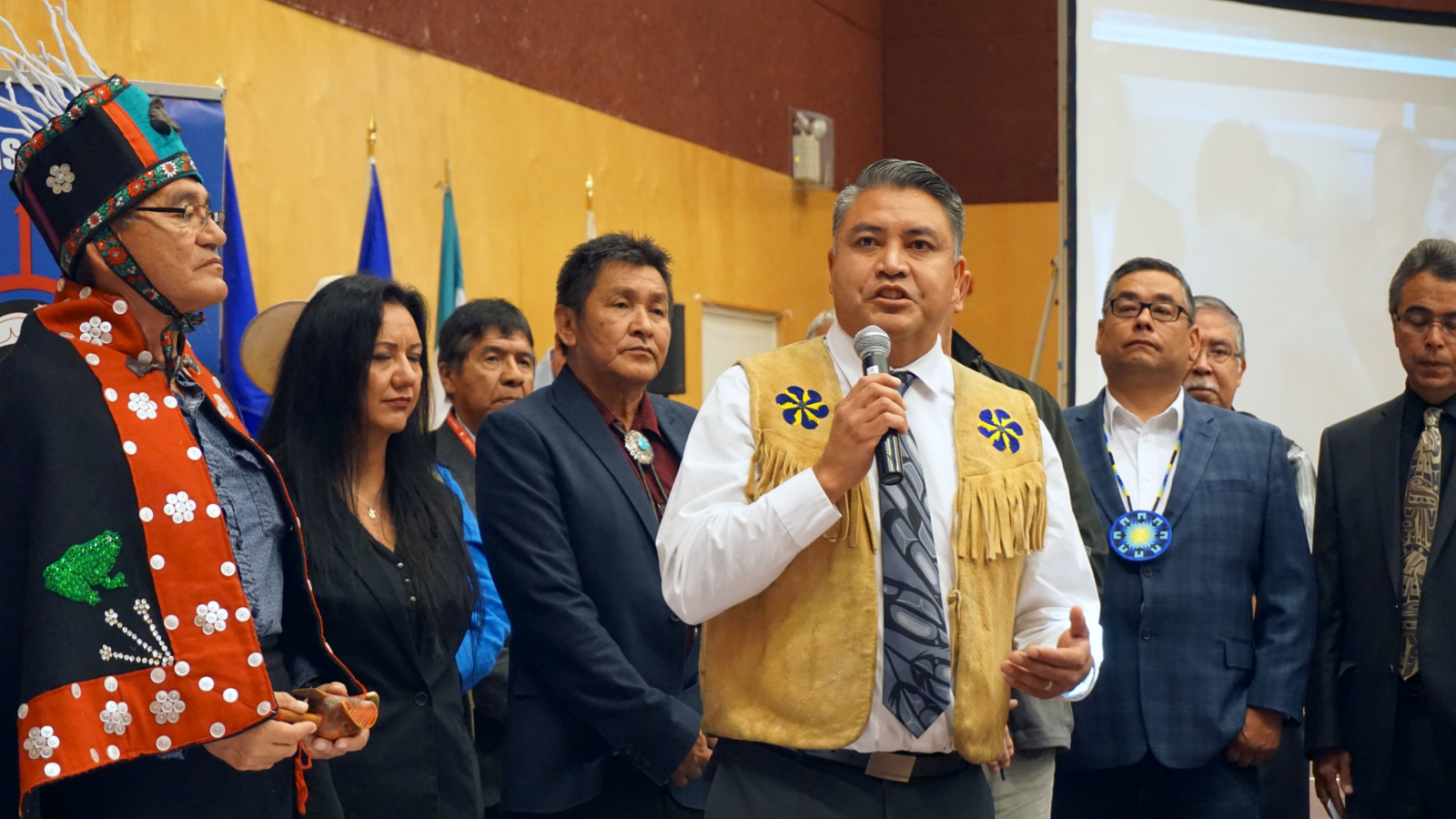
Chief Terry Teegee of the Carrier Sekani Tribal Council in Prince George, BC, calls all First Nations to stand together in the fight against oilsands expansion, Thursday, September 22, 2016, in Vancouver. Photo by Elizabeth McSheffrey.

Oil and gas industry to carry on

"Our member companies work with First Nations and Metis communities all the time, regularly, and have a long history of doing that," said Brian McGuigan, CAPP's manager of aboriginal policy. "We'll continue to work with them. Members work with them everyday and have very positive relationships... It's not always easy conversations, but they continue the dialogue."
He would not comment on whether he felt the newly-signed document would hinder CAPP's goal of getting Canadian oil to tidewater.
The new treaty builds on a series of major First Nations victories against oilsands expansion projects, including a Federal Court of Appeal decision in June that overturned the Harper government's approval of the Enbridge Northern Gateway project, and rallies across the continent that contributed to U.S. President Barack Obama's decision to kill the Keystone XL pipeline.
American signatories to the treaty include the Standing Rock Sioux, who are fighting the Dakota Access Pipeline, the Lummi Nation in Washington, which is currently fighting the Trans Mountain expansion, and the White Earth Nation in Minnesota, which has launched a legal complaint against the Enbridge Line 3 program. Canadian signatories include BC's Katzie First Nation, Tsleil-Waututh Nation, Carrier Sekani Tribal Council, Wet'suwet'en First Nation, and Heiltsuk First Nation, among others.
pipelines, oilsands, tar sands, Treaty Alliance Against Tar Sands expansion, Union of BC Indian Chiefs
A sample of pipeline projects affecting indigenous communities across North America. Graphic courtesy of the Treaty Alliance Against Tar Sands Expansion. [Note that the Dakota Access Pipeline is not shown on this map.]

Here's what the treaty says:

"Therefore, our Nations hereby join together under the present treaty to officially prohibit and to agree to collectively challenge and resist the use of our respective territories and coasts in connection with the expansion of the production of the Alberta Tar Sands, including for the transport of such expanded production, whether by pipeline, rail, or tanker.
As sovereign indigenous Nations, we enter this treaty pursuant to our inherent legal authority and responsibility to protect our respective territories from threats to our lands, waters, air and climate, but we do so knowing full well that it is in the best interest of all peoples, both indigenous and non-indigenous, to put a stop to the threat of Tar Sands expansion.
We wish to work in collaboration with all peoples and all governments in building a more equitable and sustainable future, one that will produce healthier and more prosperous communities across Turtle Island and beyond, as well as preserve and protect our peoples’ way of life."

WATCH: The signing ceremony in Vancouver

Indigenous chiefs from across BC sign a pan-continental Treaty Alliance Against Tar Sands Expansion in Vancouver on Thursday, September 22, 2016. Video by Elizabeth McSheffrey.
This report was made possible thanks to reader subscriptions. Please subscribe today.

http://www.nationalobserver.com/2016/09/22/news/first-nations-across-north-america-sign-treaty-alliance-against-oilsands

Tuesday, January 20, 2015

Faced With Eminent-Domain Land Seizures by TransCanada, Defiant Nebraskans Vow to Halt Keystone XL

Landowners from Nebraska's York and Holt counties last week filed suit against TransCanada to stall or even stop construction of the Keystone XL pipeline through their state. On Tuesday, they continued to call on President Barack Obama to veto the project altogether.

by Nadia Prupis, Common Dreams, January 20, 2015

Nebraska ranchers and farmers are building a renewable energy powered barn in the path of the Keystone XL pipeline. Mary Anne Andrei-Bold Nebraska/flickr/cc

As Canadian energy company TransCanada filed eminent domain claims against Nebraska landowners on Tuesday for the construction of the controversial Keystone XL tar sands pipeline, families whose properties are on the verge of forced seizure say they will do whatever is necessary to shut down the project.
Landowners from Nebraska's York and Holt counties last week filed suit against TransCanada to stall or even stop construction of the Keystone XL pipeline through their state. On Tuesday, they continued to call on President Barack Obama to veto the project altogether.
"Today, Nebraska families are facing an inconceivable moment when land that has been in their hands for generations is being taken away from them by a foreign oil company," Bold Nebraska director Jane Kleeb stated in a press release. "Landowners will match TransCanada’s lawsuits in local courts and continue to take our fight to the one person who can put an end to all of this: President Obama."
Obama has promised to veto legislation that would force the approval of the Keystone XL pipeline; Senate Republicans have vowed to get the pipeline approved as one of their first acts of 2015.
TransCanada's use of the "unconstitutional and void" eminent domain law, which gives the government the right to seize private lands for public use without compensation, is "another bullying move by the foreign corporation that swears they are going to be a good neighbor," said Jim Tarnick, one of the landowners who joined in the suit.
"From the Kalamazoo to the Yellowstone rivers and all across the United States, tar sands are a horrible danger and threat that the President must reject," Tarnick added.
Bold Nebraska noted that public support for the Keystone XL pipeline has waned over time, with only 41 percent approving of the project in a recent poll.
Yet while landowners, the president, and the public at large continue to speak out against the pipeline, former Nebraska Governor Dave Heineman, who approved Keystone construction in the state, "abus[ed] the powers of his office" by taking authority away from the people of Nebraska and giving it to himself "to approve a pipeline and give a foreign corporation the power of eminent domain before they have all their permits in place," the lawsuit states.
"While we fight to ensure TransCanada and the state of Nebraska do not run roughshod over farmers and ranchers, we also call upon President Obama to reject Keystone XL now," Kleeb said last week.
Meghan Hammond, a landowner whose clean energy project would have to be torn down for the construction of the pipeline, stated on Tuesday: "We can not survive as a family business without clean water. Our government has no solution to clean up tar sands and benzene from our water. Our land is not for sale and we will keep fighting TransCanada until we see their tail lights go back across our border.
http://portside.org/2015-01-20/faced-land-seizures-defiant-nebraskans-vow-halt-keystone-xl

Thursday, July 31, 2014

As Keystone XL Dominoes Fall, Time to Arrest Tar Sands Industry

by Tom Weis, EcoWatch, July 31, 2014

tweisWe’ve got this.
Thanks to the courageous and indefatigable efforts of pipeline fighters everywhere, the tide has finally turned on Keystone XL. As it becomes increasingly clear that Keystone XL’s northern leg is not going through, it is time to set our sights on ending all tar sands exploitation.
The Obama administration’s latest election year delay on Keystone North is not a victory, but the dominoes continue to fall. Earlier this year, a citizen lawsuit denied TransCanada a route through Nebraska. Last month, it lost its permit through South Dakota. Now it faces a gauntlet of “Cowboys and Indians” vowing to stop it in its tracks.
We cannot let up until Keystone North is vanquished, but all signs point to President Obama nixing TransCanada’s cross-border permit after the November elections. Don’t just take my word for it.
On April 23, Rolling Stone contributing editor Jeff Goodell wrote: “I was told recently by members of the administration that the pipeline would, in fact, be rejected.” On June 18, former Vice President Al Gore wrote in this same magazine: “[Obama] has signaled that he is likely to reject the absurdly reckless Keystone XL-pipeline proposal.”
Both pronouncements come on the heels of former President Jimmy Carter pointedly warning the president that Keystone XL ”will define your legacy on one of the greatest challenges humanity has ever faced—climate change.”
For a president who has suddenly decided to stake so much of his legacy on addressing the climate crisis, approving Keystone North would destroy any shred of credibility on this issue. It would also put an administration that prides itself on outreach to Native American communities in the position of violating the 1868 Fort Laramie Treaty.

Tom Weis, David Lautenberger, Shane Red Hawk and members of his family and tiyospaye (Lakota for "extended family") viewing the 1868 Treaty of Fort Laramie in the National Archives vault in Washington, DC.
Tom Weis, David Lautenberger, Shane Red Hawk and members of his family and tiyospaye (Lakota for “extended family”) viewing the 1868 Treaty of Fort Laramie in the National Archives vault in Washington, DC.

I recently had the honor of viewing the Fort Laramie Treaty with Shane Red Hawk and his family in the National Archives vault. There wasn’t time to read every word of the hand-written document, but there was time to absorb the meaning of the “bad man” clause in Article I on the faded first page:
If bad men among the whites, or among other people subject to the authority of the United States, shall commit any wrong upon the person or property of the Indians, the United States will, upon proof made to the agent, and forwarded to the Commissioner of Indian Affairs at Washington city, proceed at once to cause the offender to be arrested and punished according to the laws of the United States.
Tribal leaders mounted on horseback in front of the Capitol Building en route to the "Reject and Protect" tipi encampment in Washington, DC.
Tribal leaders mounted on horseback in front of the Capitol Building en route to the “Reject and Protect” tipi encampment in Washington, DC.
Because Keystone North would cross treaty territory, its construction would blatantly violate the “bad man” clause, an arrestable offense the Great Sioux Nation will not abide. President Obama knows this because the presidents of the Oglala Sioux and Rosebud Sioux tribes declared on national television their people are “willing to die” to stop it. He also knows this because his senior counselor, John Podesta, visited the “Reject and Protect” tipi encampment on the National Mall in April where this declaration of nonviolent civil resistance was made.
As fate would have it, I found myself standing next to Mr. Podesta at this historic event. I thanked him for his public opposition to Keystone, then asked him to urge the president to use his bully pulpit to speak out against all tar sands exploitation (this includes preventing the tar sands barons from gaining a foothold in Utah’s pristine red rocks country).
We should not be doing business with a misanthropic industry that knowingly poisons First Nations communities in Canada, with immoral disregard for its climate impacts on humanity. Fortunately, the U.S. is in a strong position to help starve Alberta’s landlocked tar sands beast by stopping the flow of tar sands crossing our border.
Last month, retired Navy SEAL Team 6 Commander David Cooper provided powerful ammunition for doing just that with his warning to the State Department that the Keystone pipeline is highly vulnerable to attack: “We need a serious national conversation about what we do to head off an attack. Until then, I’d offer a saying we used on the SEAL teams: ‘If you cannot defend a position, you shouldn’t take it.’ ” His threat assessment described as “the most likely scenario” a spill of more than 1 million gallons of “highly toxic” Keystone tar sands oil.
Caution demands that beyond rejecting the Keystone permit, President Obama order national security assessments on all tar sands pipelines crossing our border, and an immediate shutdown of the built-to-spill southern leg of Keystone XL in Texas and Oklahoma.
We need to heed the indictment of the tar sands industry issued by Ponca Nation matriarch and grandmother Casey Camp-Horinek of Oklahoma: “We’re suffering from environmental genocide from this extractive industry.” The closing ceremony she led on the final day of the “Reject and Protect” tipi encampment was soul searing. Gathered near the White House, we looked on as she knelt in the grass to pour some sacred water. What poured were her tears. We watched in reverent silence as she cried, and cried. The tears she shed were for all who weep for what is happening to our precious Mother Earth.
No more grandmothers must be made to cry. No more First Nations people must be made to die. The tar sand industry’s brutal assault on the human family—and all our relations—must be arrested.
http://ecowatch.com/2014/07/31/keystone-xl-dominoes-fall-arrest-tar-sands-industry/

Friday, May 9, 2014

Report Finds Investments in Alberta’s Tar Sands ‘Make Neither Economic Nor Climate Sense’

by Carol Linnitt, DeSmog Canada, EcoWatch, May 8, 2014
A total of $1.1 trillion USD earmarked for risky carbon-intensive oil sector investments need to be challenged by investors, according to a new report released today by the Carbon Tracker Initiative.
alberta
Photo credit: Howl Arts Collective/ Flickr
The research identifies oil reserves in the Arctictar sands and in deepwater deposits at the high end of the carbon/capital cost curve. Projects in this category “make neither economic nor climate sense” and won’t fit into a carbon-constrained world looking to limit oil-related emissions, Carbon Tracker states in a press release.
The report highlights the high risk of Alberta oil sands investment, noting the reserves “remain the prime candidate for avoiding high cost projects” due to the region’s landlocked position and limited access to market. “The isolated nature of the [tar sands] market with uncertainty over export routes and cost inflation brings risk.”
Oil sands major Canadian Natural Resources Limited (CNRL), the company responsible for the mysterious series of leaks at the Cold Lake oil sands deposit, has the largest total exposure to high-cost and high-risk oil investments, valued at a potential of more than $38 billion between now and 2025.
Screen Shot 2014-05-07 at 1.42.38 PM
Graphic courtesy of Carbon Tracker Initiative
Production forecasts, the basis of capital investment decisions, often rely on business-as-usual assumptions of economic growth and energy demand. But given potential changes in cost, fossil fuel consumption and emission constraints, industry demand projections may need to be reconsidered.
The report’s authors recommend such projections be “stress-tested” for a variety of future scenarios.
Recent efforts by socially responsible investment firms, such as Trillium Asset Management, to limit environmentally egregious investments, as well as the growing divestment movement throw the future of especially expensive and carbon-intensive oil reserves like the Alberta tar sands into question. They face the very likely potential of becoming “stranded assets.”
Previous Carbon Tracker research suggests about two-thirds of the world’s proven fossil fuel reserves need to remain in the ground if international targets to remain under a two degree Celsius temperature rise are to be met.
“For the first time, this report bridges the worlds of oil project economics—in terms of both the marginal cost of supply—and carbon, allowing investors to gauge where risk lies, given a range of demand scenarios,” said Mark Fulton, adviser to Carbon Tracker Initiative and a former head of research at Deutsche Bank Climate Advisors.
“It makes it clear that investors have reason to engage companies on many high-cost and high-carbon-content projects.”
The report recommends investors identify companies investing the majority of their capital in high-cost projects, set thresholds for investor exposure and demand greater transparency and disclosure from industry.
Screen Shot 2014-05-07 at 1.42.47 PM
Graphic courtesy of Carbon Tracker Initiative
The seven global “majors,” which include BP, Chevron, Shell, Exxon Mobil, Total, ConocoPhillips and Eni, represent the bulk of potential oil production and have high exposure to deposits in expensive locations with expensive-to-produce oil types, such as bitumen from the Alberta oilsands.
Several oil companies have taken steps to address their carbon investment risk. Most notably, Exxon Mobil recently announced they will begin reporting more fully on risky carbon assets in response to investor pressure.
Around $21 trillion of potential capital expenditure would need to be invested by the oil sector in high-risk projects by 2050 to keep the industry afloat, according to the report. But this investment “would not pay for itself in a world where demand is lower and that continues to take climate change and air quality seriously.”
“Many investors are concerned about the growing amount of capital that the oil companies have thrown at low-return, carbon-heavy projects,” Paul Spedding, a former-HSBC Oil &Gas Sector Analyst, said.
Major oil companies need to change their strategy, he added.
“As this report shows, returns are falling and costs are rising. To reverse this, a greater focus is needed on higher return, lower cost assets. If this means lower capital investment and higher dividends or buybacks, so much the better. This analysis is important as it provides the data investors need to challenge proposed investments on the basis of returns as well as carbon content.”
infographic oil basins1 (1)
——–
YOU MIGHT ALSO LIKE

Saturday, April 19, 2014

Steve Horn: "Russia with Love": Alaska Gas Scandal is Out-of-Country, Not Out-of-State

by Steve Horn, DeSmogBlog, April 18, 2014

A legal controversy — critics would say scandal — has erupted in Alaska's statehouse over the future of its natural gas bounty.
It's not so much an issue of the gas itself, but who gets to decide how it gets to market and where he or she resides.
The question of who owns Alaska's natural gas and where they're from, at least for now, has been off the table. More on that later.
At its core, the controversy centers around a public-private entity called the Alaska Gasline Development Corporation (AGDC) created on April 18, 2010, via House Bill 369 for the “purpose of planning, constructing, and financing in-state natural gas pipeline projects.” AGDC has a $400 million budget funded by taxpayers. 
AGDC was initially built to facilitate opening up the jointly-owned ExxonMobil-TransCanada Alaska Pipeline Project for business. That project was set to be both a liquefied natural gas (LNG) export pipeline coupled with a pipeline set to bring Alaskan gas to the Lower 48.    
Photo Credit: TransCanada
Things have changed drastically since 2010 in the U.S. gas market though, largely due to the hydraulic fracturing (“fracking”) boom. And with that, the Lower 48 segment of the Alaska Pipeline Project has become essentially obsolete.
Dreams of exporting massive amounts of Alaskan LNG to Asia, however, still remain. They were made much easier on April 14, when the Kenai LNG export facility received authorization to export gas from the U.S. Department of Energy.
Enter the latest iteration of AGDC. This phase began in January 2014 after Governor Sean Parnell, formerly a lobbyist for ConocoPhillips, signed Senate Bill 138 into law. 
The bill served as a Memorandum of Understanding (MOU) between Alaska, the AGDC, ConocoPhillips, BP, ExxonMobil, and TransCanada, with the four companies now serving as co-owners of the South Central LNG Pipeline Project.
Gov. Parnell also announced who would serve on the AGDC Board of Directors in September 2013, which began meeting in October 2013And that's where the story starts to get more interesting. 

Meet Richard “Dick” Rabinow

Under Alaska state law, you have to be a state citizen to serve on state commissions like AGDC. But one of the seven Board members, Richard “Dick” Rabinow, is a citizen of a state far from Alaska: Texas. 

Richard “Dick” Rabinow; Photo Credit: Alaska Gasline Development Corporation
Rabinow is the former president of ExxonMobil Pipeline Company (where he worked for 34 years) and former Chairman of the Trans Alaska Pipeline System (TAPS) Owners Committee. TAPS is co-owned by ExxonMobil, BP, Unocal and ConocoPhillips. He currently lives in Dallas, Texas, and runs his own consultancy called Rabinow Consortium, LLC.
Because Rabinow isn't an Alaskan, major backlash ensued when watchdogs discovered he's from Texas, which nearly caused him to step down from AGDC's Board. Alaska's Senate Democrats wrote a letter on March 21 calling on Rabinow to step down because his appointment flew in the face of state law. 
“Mr. Rabinow is a resident of the state of Texas. Mr. Rabinow is not registered to vote in the state of Alaska. Mr. Rabinow is not qualified to serve as a board appointee here,” read the letter. “[O]ut of respect for the law, we demand that you withdraw Mr. Rabinow’s appointment.”
Importantly, only 4 members of the 20-member Senate are Democrats.
So just three weeks after the Senate Democrats wrote their letter, the Senate passed HB 383 in a 13-7 vote, which also passed in the House in a 27-12 vote.
Immediately signed by Gov. Parnell on April 16, the law now says that AGDC Board members are “not required to be a registered voter or a resident of the state.”
Democratic House Leader Rep. Christ Tuck was none too pleased with the bill's passage.

Rep. Christ Tuck. Photo Credit: The Alaska State Legislature
“Alaskans are tired of multinational corporations coming up here and our government catering to them at the expense of Alaskans,” Tuck told the Alaska Dispatch
Multinational corporations in general are one thing.
But in the case of Rabinow's former employer ExxonMobil — coined a “private empire” by investigative journalist Steve Coll — it also has ties in Alaska to an out-of-country multinational corporation from Russia: Rosneft. 

ExxonMobil: “From Russia with Love”

In February 2013, ExxonMobil offered Russian state-owned oil and gas company Rosneft a 25% stake in its portion of the Point Thomson oil and gas field. 

Point Thomson Oil and Gas Field. Map Credit: Alaska Department of Natural Resources
“The agreements signed today bring the already unprecedented scale of Rosneft and ExxonMobil partnership to a completely new level,” Igor Sechin, President of Rosneft said of the deal in a press release at the time. “Participation in the Point Thomson project will increase Rosneft’s access to the latest gas and condensate field development technologies used in harsh climatic conditions.”

Stephen Greenlee, President of ExxonMobil Exploration Company (L); Russian President Vladimir Putin (C); Igor Sechin, President of Rosneft (R). Photo Credit: Rosneft.
Sechin is thought to be high up on the list of potential persons to face sanctions by the U.S. for Russia's ongoing occupation of Crimea in Ukraine. Easier said than done, of course, given the ties that bind U.S. companies to Russia's oil and gas industry. 
“[I]f anyone apart from Sechin himself is anxious about the prospect of his arrest if he travels to the West, it could be oil companies like BP and ExxonMobil,” wrote investigative reporter Steve Levine recently. “In other words, the US will be going after Sechin, but also a house that the West itself helped to build.”
Given this wheeling and dealing and geopolitical wrangling between the U.S. and Russia resembles something straight out of a James Bond film, perhaps it's only appropriate that one of the most famous Bond flicks is titled, “From Russia with Love.”
In this ongoing “Great Game,” the controversy that erupted over Rabinow's appointment appears minor by comparison. 
Photo Credit: Wikimedia Commons