Blog Archive

Showing posts with label soil degradation. Show all posts

Thursday, March 31, 2016

This is actually true: Our best hope to avert climate disaster: return to sustainable farming, get rid of Monsanto's RoundUp poison glyphosate, use cover crops


(Fritz Hahn/TWP)


Debbie Barker is the international programs director at the Center for Food Safety. Michael Pollan is the John S. and James L. Knight professor of journalism at the University of California at Berkeley.
When Will Allen is asked to name the most beautiful part of his Vermont farm, he doesn’t talk about the verdant, rolling hills or easy access to the Connecticut River. Though the space is a picturesque postcard of the agrarian idyll, Allen points down, to the dirt. “This precious resource not only grows food,” he says, “but is one of the best methods we have for sequestering carbon.”


We think of climate change as a consequence of burning fossil fuels. But a third of the carbon in the atmosphere today used to be in the soil, and modern farming is largely to blame. Practices such as the overuse of chemicals, excessive tilling and the use of heavy machinery disturb the soil’s organic matter, exposing carbon molecules to the air, where they combine with oxygen to create carbon dioxide. Put another way: Human activity has turned the living and fertile carbon system in our dirt into a toxic atmospheric gas.
It’s possible to halt and even reverse this process through better agricultural policies and practices. Unfortunately, the world leaders who gathered in Paris this past week have paid little attention to the critical links between climate change and agriculture. That’s a huge mistake and a missed opportunity. Our unsustainable farming methods are a central contributor to greenhouse gas emissions. Climate change, quite simply, cannot be halted without fixing agriculture.
The industrialization of farming has allowed farmers to grow more crops more quickly. But modern techniques have also wreaked havoc on the earth, water and atmosphere. Intense plowing, for example, has introduced more oxygen into the soil, boosting the microbes that convert organic matter into carbon dioxide. The quest to wring every last dollar out of fields has put pressure on farmers to rely on chemical fertilizers. This often leaves fields more bare between growing seasons, allowing carbon to escape into the air. Scientists estimate that cultivated soil has lost 50-70% of its carbon, speeding up climate change.
That loss has significantly degraded soil health, reducing our ability to grow food. Median crop yields are likely to decline by about 2% per decade through 2100, according to the U.N. Intergovernmental Panel on Climate Change. At the same time, the world’s population is projected to jump from 7 billion to 9 billion by 2050.
Water availability is also at risk. Currently, 1.6 billion people live in regions facing severe water scarcity; that number is expected to rise to 2.8 billion by 2025. Agriculture accounts for a whopping 70% of all water consumption. That’s in large part because degraded soil doesn’t absorb water efficiently. Instead, water sits on top of the ground and runs off (along with farm chemicals) into nearby waterways, creating toxic nitrogen “dead zones.”
Remarkably, though, restoring carbon to the soil is not nearly as complicated as rethinking our transportation systems or replacing coal with renewable energy. Innovative farmers such as Allen already know the recipe.
He and his team place “cover crops” in their fields, planting things like oats, rye and beans between rows of vegetables. This practice keeps carbon, nitrogen and other organic nutrients in the soil. “Keeping as much ground covered with plants as long as possible allows photosynthesis to draw down atmospheric carbon into soils,” Allen says. A bare field, in contrast, represents a waste of photosynthetic potential. Allen also composts, limits plowing and avoids synthetic chemicals like nitrogen fertilizers. In combination, these efforts have increased soil organic matter by 3 to 4 percent in just three years. Allen also sells some of his cover crops, adding farm income.
Allen’s results are not unusual. Studies have shown that cover cropping, crop rotation and no-till farming could restore global soil health while significantly decreasing farms’ carbon footprint. Some scientists project that 75 to 100 parts per million of CO2 could be drawn out of the atmosphere over the next century if existing farms, pastures and forestry systems were managed to maximize carbon sequestration. That’s significant when you consider that CO2 levels passed 400 ppm this spring. Scientists agree that the safe level of carbon dioxide in the atmosphere is 350 ppm.
Regenerative farming would also increase the fertility of the land, making it more productive and better able to absorb and hold water, a critical function especially in times of climate-related floods and droughts. Carbon-rich fields require less synthetic nitrogen fertilizer and generate more productive crops, cutting farmer expenses.
So why aren’t we instituting policies to encourage this kind of “carbon farming”? For one thing, the science is new and not yet widely disseminated. Additionally, most of the incentives built into America’s agricultural policies are based on maximizing yield, often at the expense of soil health.
Current federal policy, for example, limits the growing season for cover crops on the theory that they waste farmers’ time and resources on products that can’t be sold. Thus, farmers are denied full crop insurance, price supports and subsidies if they grow cover crops beyond a specified period of time. But viewing cover crops as a benefit instead of an impediment to cash crops would be the kind of climate-smart policy we need. And, as farmers such as Allen have learned, some cover crops can also be commercialized.
Giving farmers incentives to switch from synthetic nitrogen fertilizers to organic fertilizers could also lead to healthier soil. Scientists at the University of California at Berkeley working with Marin County ranchers have found that applying a single layer of compost, less than an inch thick, to rangelands stimulates a burst of microbial and plant growth that sequesters dramatic amounts of carbon in the soil — more than 1.5 tons per acre. And research has shown that this happens not just once, but year after year. This is a win-win strategy, both for the climate and the food system, since the additional carbon in the soil means more grass for cattle and more profit for ranchers. If the practice were replicated on half the rangeland area of California, it would sequester enough carbon to offset 42 million metric tons of CO2 emissions.
The possibilities are endless. What if our farmers received federal subsidies not just for bushels per acre, but for carbon sequestered or acres of cover crops planted? Many such changes could be made tomorrow at the agency level; they would not require congressional action. Incentives for carbon farming could also bridge the political chasm between ranchers, farmers and environmentalists. Even those farmers and ranchers who don’t believe in climate change desire healthy soil, high productivity and lush grasslands. There is a rich opportunity here to completely realign the politics of agricultural and environmental policy.
America is not there quite yet, but other countries are pointing the way. This year, the French government launched the 4 Per 1000 initiative, the first international effort to restore carbon to the soil. Under the proposal, nations would commit to increasing the carbon in their cultivated lands by 0.4% per year. The French calculate that this would halt the annual increase in carbon dioxide emissions. Some emerging soil science estimates that we could store 50-75% of current global carbon emissions in the soil.
In the United States, when the Dust Bowl crisis of the 1930s literally blew soil across the country, our government responded by implementing agriculture policies to ameliorate the problem. With the stakes even higher today, our politicians can once again enact policies to reward practices that rebuild soil carbon.

Another nail from the Monsanto RoundUp coffin: Glyphosate reduces vital symbiotic tree root fungi by 87%

Applied Soil Ecology, 64 (2013) 99–103; doi:10.1016/j.apsoil.2012.10.007


Glyphosate reduces spore viability and root colonization of arbuscular mycorrhizal fungi


Magdelena Druille, Marta N. Cabello, Marina Omacina, and Rudolfo A. Golluscio

Abstract

Glyphosate is the most widely used herbicide in the world, but its effects on non-target organisms, such as arbuscular mycorrhizal fungi (AMF), are unclear. No studies have been found that made reference to effects of glyphosate on AMF spore viability despite its importance as a source of propagules for the perpetuation and spread of AMF in the system. The objective of this study was to evaluate the effect of glyphosate application on AMF spore viability, and their ability to colonize roots. Soil samples were collected from a grassland area located in the Flooding Pampa region (Argentina). We evaluated three herbicide rates: 0, 0.26 and 1× recommended field rate, 10 and 30 days after application. Part of the soil from each tray was used to estimate the spore viability, and the remainder was used as substrate for growing Lolium multiflorum Lam. One month after sowing, total root colonization and percentage of arbuscules and vesicles were determined. The spore viability in herbicide untreated soils was between 5.8- and 7.7-fold higher than in treated soils. This reduction was detected even when the lower rate was applied. Root colonization was significantly lower in plants grown in glyphosate treated soil than in untreated ones. A decrease in arbuscular colonization (but not in vesicles) was found in plants grown in soils treated with the highest herbicide rate. That would indicate that symbiosis functionality was affected, given that arbuscules are the main site for host–fungus nutrient exchange. The results indicate that soil residence time of glyphosate and/or its degradation products was enough to reduce AMF spore viability and their ability to colonize roots. This decrease in propagules viability may affect plant diversity, taking into account the different degrees of mycorrhizal dependency between plant species that may coexist in grassland communities.
http://www.sciencedirect.com/science/article/pii/S0929139312002466

READ BELOW AND SEE HOW MUCH WE DEPEND ON THESE FUNGI:


NASA JPL latest news release
NASA Satellite Images Uncover Underground Forest Fungi
A NASA-led team of scientists has developed the first-ever method for detecting the presence of different types of underground forest fungi from space, information that may help researchers predict how climate change will alter forest habitats.

Hidden beneath every forest is a network of fungi living in mutually beneficial relationships with the trees. Called mycorrhizal fungi, these organisms spread underground for miles, scavenging for nutrients that they trade with trees for sugars the trees make during photosynthesis. 

"Nearly all tree species associate with only one of two types of mycorrhizal fungi," explained coauthor Richard Phillips of Indiana University, Bloomington.

Because the two types of fungi are expected to respond differently to a changing climate, knowing where each type predominates may help scientists predict where forests will thrive in the future and where they will falter.

Creating maps of forests and their fungi has traditionally relied on various methods of counting individual tree species, an approach that cannot be done at large scales. In a new study published in the journal Global Change Biology, a team led by Joshua Fisher of NASA's Jet Propulsion Laboratory, Pasadena, California, and UCLA found a way to detect this hidden network using satellite images.

Every tree species has its own spectral signature -- it absorbs or reflects light in a specific pattern across all the wavelengths in the spectrum of light. Using satellite images of forest canopies, Fisher's group probed whether they could identify any patterns in the spectral signatures of tree species associated with one type of fungus that did not appear in species associated with the other type.

Fisher explained, "Individual tree species have unique spectral fingerprints, but we thought the underlying fungi could be controlling them as groups."

The team studied images of four U.S. forest research plots that are part of the Smithsonian Institution's Forest Global Earth Observatory. In these forests, which include 130,000 trees across 77 species, the tree species associated with each type of fungus had already been mapped from the ground. The researchers analyzed images of the forest canopies taken by the NASA/U.S. Geological Survey Landsat-5 satellite from 2008 to 2011 in many different ways, searching for similarities that lined up with areas of fungus dominance. They found what they were looking for when they examined various milestones throughout the growing season, such as when the trees leafed out in spring and when they reached peak greenness. There were significant differences in the timing of these milestones between regions dominated by the two types of fungi.

Having identified the timing sequences related to each type of fungus, the researchers developed and tested a statistical model to predict the areas of fungus domination in any particular Landsat image from canopy changes alone. They found they could predict the fungus association correctly in 77% of the images. They went on to produce landscape-wide maps of fungi associations, uncovering intriguing patterns in forests that will be studied in greater depth in the future.

Fisher said, "That these below-ground agents manifest themselves in changes in the forest canopies is significant. This allows, for the first time, some light to be shed on their hidden processes."

NASA uses the vantage point of space to increase our understanding of our home planet, improve lives and safeguard our future. NASA develops new ways to observe and study Earth's interconnected natural systems with long-term data records. The agency freely shares this unique knowledge and works with institutions around the world to gain new insights into how our planet is changing. The work was also funded by the U.S. Department of Energy and the National Science Foundation.

For more information about NASA's Earth science activities, visit:

http://www.nasa.gov/earth

Saturday, March 5, 2016

One straightforward way to combat both climate change and mass hunger is to replace carbon lost from the soil

Deforestation_in_Guatemala
One prominent cause of impoverished soil is deforestation, as here in Guatemala
Image: By Pati Gaitan via Wikimedia Commons
by Paul Brown, Climate News Network, December 23, 2015
LONDON – All sorts of clever, expensive and downright daft ideas for removing carbon from the atmosphere have been suggested, but one of the simplest and most effective – building up carbon in the soil – hardly rates a mention.
It is a process that happens naturally, but intensive agriculture, deep ploughing, heavy artificial fertiliser use and cutting down forests have impoverished soils worldwide. If the process could be reversed by adding extra organic matter to the soil each year, then the worst effects of climate change could be averted.
Although the issue was hardly raised in the two weeks of negotiations on theParis Agreement in early December, behind the scenes the way farmers produce crops remains central to knowing whether we can hope to avoid the full impact of the warming climate.
More than 100 of the 196 countries present in Paris which submitted plans beforehand on how to reduce their own carbon emissions put agriculture, forestry and replacing carbon in soils into their programmes.
Better yields
Also, on the fringes of the conference, the CGIAR Consortium, a partnership of leading agricultural research organisations, announced a US$225 million five-year plan to mitigate climate change by putting carbon back into the soil while improving developing world agricultural yields.
This is part of a much longer-running international initiative started by France,the 4% Initiative, which aims to increase the carbon content of soil by four parts per thousand each year, enough to counteract human interference with the climate from the continued burning of fossil fuels.
The CGIAR plan they call “climate-smart agriculture” will help farmers in Ghana, Senegal, Tanzania, Uganda, Vietnam, Nepal and Colombia. The aim is to disturb soils as little as possible, using zero tillage (no-till) techniques, encouraging 10% tree cover and better management of rangelands. All of these methods increase yields, return carbon to the soil and help retain moisture.
According to CGIAR: “Soil is a massive carbon reservoir, containing two to three times as much carbon as the atmosphere. Increasing soil carbon by 0.4% per year would offset atmospheric carbon emissions.
“Organic agriculture used to be ridiculed for a long time but now science backs us as a solution to climate change”
“Increasing soil carbon not only mitigates climate change, it also would increase – or restore – soil health and fertility, thereby helping agriculture to adapt to climate change and improve environmental health overall.”
One of the key organisations supporting the 4 per 1,000 initiative is Organics International (IFOAM), the international organic farming organisation that has 800 members in 125 countries. The president, André Leu, is a tropical fruit farmer in Australia who says that food security and carbon sequestration in the soil are central to saving the planet from the extreme impacts of climate change.
“It does not matter which part of the world you are in and what you grow. Putting carbon back into the soil, increasing the organic matter, is essential to improving yields in the long run,” he said.
“If we are to combat droughts then organic matter retains moisture as well as carbon, so we make soils more resilient and productive. Organic agriculture used to be ridiculed for a long time but now science backs us as a solution to climate change. We want to share our knowledge so that many farmers and consumers across the world can benefit.” 

Thursday, February 4, 2016

India's rice revolution

In a village in India's poorest state, Bihar, farmers are growing world record amounts of rice – with no GM, and no herbicide. Is this one solution to world food shortages? 

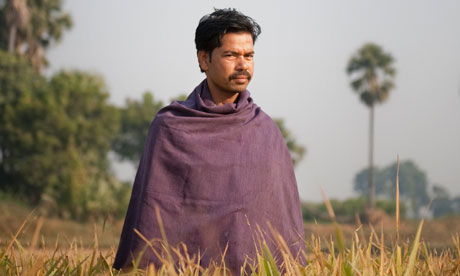
Sumant Kumar
Sumant Kumar photographed in Darveshpura, Bihar, India. Photograph: Chiara Goia for Observer Food Monthly

by John Vidal, The Guardian, February 16, 2013

Sumant Kumar was overjoyed when he harvested his rice last year. There had been good rains in his village of Darveshpura in north-east India and he knew he could improve on the four or five tonnes per hectare that he usually managed. But every stalk he cut on his paddy field near the bank of the Sakri river seemed to weigh heavier than usual, every grain of rice was bigger and when his crop was weighed on the old village scales, even Kumar was shocked.

This was not six or even 10 or 20 tonnes. Kumar, a shy young farmer in Nalanda district of India's poorest state Bihar, had – using only farmyard manure and without any herbicides – grown an astonishing 22.4 tonnes of rice on one hectare of land. This was a world record and with rice the staple food of more than half the world's population of seven billion, big news.
It beat not just the 19.4 tonnes achieved by the "father of rice," the Chinese agricultural scientist Yuan Longping, but the World Bank-funded scientists at the International Rice Research Institute in the Philippines, and anything achieved by the biggest European and American seed and GM companies. And it was not just Sumant Kumar. Krishna, Nitish, Sanjay and Bijay, his friends and rivals in Darveshpura, all recorded over 17 tonnes, and many others in the villages around claimed to have more than doubled their usual yields.
The villagers, at the mercy of erratic weather and used to going without food in bad years, celebrated. But the Bihar state agricultural universities didn't believe them at first, while India's leading rice scientists muttered about freak results. The Nalanda farmers were accused of cheating. Only when the state's head of agriculture, a rice farmer himself, came to the village with his own men and personally verified Sumant's crop, was the record confirmed.
A tool used to harvest rice
A tool used to harvest rice. Photograph: Chiara Goia
The rhythm of Nalanda village life was shattered. Here bullocks still pull ploughs as they have always done, their dung is still dried on the walls of houses and used to cook food. Electricity has still not reached most people. Sumant became a local hero, mentioned in the Indian parliament and asked to attend conferences. The state's chief minister came to Darveshpura to congratulate him, and the village was rewarded with electric power, a bank and a new concrete bridge.
That might have been the end of the story had Sumant's friend Nitish not smashed the world record for growing potatoes six months later. Shortly after Ravindra Kumar, a small farmer from a nearby Bihari village, broke the Indian record for growing wheat. Darveshpura became known as India's "miracle village", Nalanda became famous and teams of scientists, development groups, farmers, civil servants and politicians all descended to discover its secret.
When I meet the young farmers, all in their early 30s, they still seem slightly dazed by their fame. They've become unlikely heroes in a state where nearly half the families live below the Indian poverty line and 93% of the 100 million population depend on growing rice and potatoes. Nitish Kumar speaks quietly of his success and says he is determined to improve on the record. "In previous years, farming has not been very profitable," he says. "Now I realise that it can be. My whole life has changed. I can send my children to school and spend more on health. My income has increased a lot."
What happened in Darveshpura has divided scientists and is exciting governments and development experts. Tests on the soil show it is particularly rich in silicon but the reason for the "super yields" is entirely down to a method of growing crops called System of Rice (or root) Intensification (SRI). It has dramatically increased yields with wheat, potatoes, sugar cane, yams, tomatoes, garlic, aubergine and many other crops and is being hailed as one of the most significant developments of the past 50 years for the world's 500 million small-scale farmers and the two billion people who depend on them.
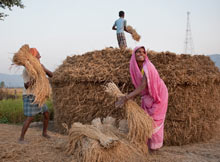
People work on a rice field in Bihar
People work on a rice field in Bihar. Photograph: Chiara Goia
Instead of planting three-week-old rice seedlings in clumps of three or four in waterlogged fields, as rice farmers around the world traditionally do, the Darveshpura farmers carefully nurture only half as many seeds, and then transplant the young plants into fields, one by one, when much younger. Additionally, they space them at 25cm intervals in a grid pattern, keep the soil much drier and carefully weed around the plants to allow air to their roots. The premise that "less is more" was taught by Rajiv Kumar, a young Bihar state government extension worker who had been trained in turn by Anil Verma of a small Indian NGO called Pran (Preservation and
Proliferation of Rural Resources and Nature), which has introduced the SRI method to hundreds of villages in the past three years.
While the "green revolution" that averted Indian famine in the 1970s relied on improved crop varieties, expensive pesticides and chemical fertilisers, SRI appears to offer a long-term, sustainable future for no extra cost. With more than one in seven of the global population going hungry and demand for rice expected to outstrip supply within 20 years, it appears to offer real hope. Even a 30% increase in the yields of the world's small farmers would go a long way to alleviating poverty.
"Farmers use less seeds, less water and less chemicals but they get more without having to invest more. This is revolutionary," said Dr Surendra Chaurassa from Bihar's agriculture ministry. "I did not believe it to start with, but now I think it can potentially change the way everyone farms. I would want every state to promote it. If we get 30-40% increase in yields, that is more than enough to recommend it."
The results in Bihar have exceeded Chaurassa's hopes. Sudama Mahto, an agriculture officer in Nalanda, says a small investment in training a few hundred people to teach SRI methods has resulted in a 45% increase in the region's yields. Veerapandi Arumugam, the former agriculture minister of Tamil Nadu state, hailed the system as "revolutionising" farming.
SRI's origins go back to the 1980s in Madagascar where Henri de Laulanie, a French Jesuit priest and agronomist, observed how villagers grew rice in the uplands. He developed the method but it was an American, professor Norman Uphoff, director of the International Institute for Food, Agriculture and Development at Cornell University, who was largely responsible for spreading the word about De Laulanie's work.
Given $15m by an anonymous billionaire to research sustainable development, Uphoff went to Madagascar in 1983 and saw the success of SRI for himself: farmers whose previous yields averaged two tonnes per hectare were harvesting eight tonnes. In 1997 he started to actively promote SRI in Asia, where more than 600 million people are malnourished.
"It is a set of ideas, the absolute opposite to the first green revolution [of the 60s] which said that you had to change the genes and the soil nutrients to improve yields. That came at a tremendous ecological cost," says Uphoff. "Agriculture in the 21st century must be practised differently. Land and water resources are becoming scarcer, of poorer quality, or less reliable. Climatic conditions are in many places more adverse. SRI offers millions of disadvantaged households far better opportunities. Nobody is benefiting from this except the farmers; there are no patents, royalties or licensing fees."
Rice seeds
Rice seeds. Photograph: Chiara Goia
For 40 years now, says Uphoff, science has been obsessed with improving seeds and using artificial fertilisers: "It's been genes, genes, genes. There has never been talk of managing crops. Corporations say 'we will breed you a better plant' and breeders work hard to get 5-10% increase in yields. We have tried to make agriculture an industrial enterprise and have forgotten its biological roots."
Not everyone agrees. Some scientists complain there is not enough peer-reviewed evidence around SRI and that it is impossible to get such returns. "SRI is a set of management practices and nothing else, many of which have been known for a long time and are best recommended practice," says Achim Dobermann, deputy director for research at the International Rice Research Institute. "Scientifically speaking I don't believe there is any miracle. When people independently have evaluated SRI principles then the result has usually been quite different from what has been reported on farm evaluations conducted by NGOs and others who are promoting it. Most scientists have had difficulty replicating the observations."
Dominic Glover, a British researcher working with Wageningen University in the Netherlands, has spent years analysing the introduction of GM crops in developing countries. He is now following how SRI is being adopted in India and believes there has been a "turf war."
"There are experts in their fields defending their knowledge," he says. "But in many areas, growers have tried SRI methods and abandoned them. People are unwilling to investigate this. SRI is good for small farmers who rely on their own families for labour, but not necessarily for larger operations. Rather than any magical theory, it is good husbandry, skill and attention which results in the super yields. Clearly in certain circumstances, it is an efficient resource for farmers. But it is labour intensive and nobody has come up with the technology to transplant single seedlings yet."
But some larger farmers in Bihar say it is not labour intensive and can actually reduce time spent in fields. "When a farmer does SRI the first time, yes it is more labour intensive," says Santosh Kumar, who grows 15 hectares of rice and vegetables in Nalanda. "Then it gets easier and new innovations are taking place now."
In its early days, SRI was dismissed or vilified by donors and scientists but in the past few years it has gained credibility. Uphoff estimates there are now 4-5 million farmers using SRI worldwide, with governments in China, India, Indonesia, Cambodia, Sri Lanka and Vietnam promoting it.

Sumant, Nitish and as many as 100,000 other SRI farmers in Bihar are now preparing their next rice crop. It's back-breaking work transplanting the young rice shoots from the nursery beds to the paddy fields but buoyed by recognition and results, their confidence and optimism in the future is sky high.
Last month Nobel prize-winning economist Joseph Stiglitz visited Nalanda district and recognised the potential of this kind of organic farming, telling the villagers they were "better than scientists". "It was amazing to see their success in organic farming," said Stiglitz, who called for more research. "Agriculture scientists from across the world should visit and learn and be inspired by them."
A man winnows rice in Satgharwa village
A man winnows rice in Satgharwa village. Photograph: Chiara Goia
Bihar, from being India's poorest state, is now at the centre of what is being called a "new green grassroots revolution" with farming villages, research groups and NGOs all beginning to experiment with different crops using SRI. The state will invest $50m in SRI next year but western governments and foundations are holding back, preferring to invest in hi-tech research. The agronomist Anil Verma does not understand why: "The farmers know SRI works, but help is needed to train them. We know it works differently in different soils but the principles are solid," he says. "The biggest problem we have is that people want to do it but we do not have enough trainers.
"If any scientist or a company came up with a technology that almost guaranteed a 50% increase in yields at no extra cost they would get a Nobel prize. But when young Biharian farmers do that they get nothing. I only want to see the poor farmers have enough to eat."
http://www.theguardian.com/global-development/2013/feb/16/india-rice-farmers-revolution

Sunday, October 25, 2015

MUST SEE VIDEO: Wes Jackson: We Can Now solve the 10,000 Year Old Problem of Agriculture


https://www.youtube.com/watch?v=A2fqNxyqubQ

MUST SEE VIDEO: Graeme Sait: how to lower carbon by using regenerative farming


Full text and slides here:  http://blog.planthealthsolutions.com.au/humus-will-help-save-world-graeme-sait-nts/

Published on May 12, 2013

Learn all about Humus, the layer of soil essential for healthy food production which is being gradually depleted by unsustainable farming practices. Graeme Sait a lifelong human and soil health educator explains how 467 billion tonnes of carbon has been released from the soil into the atmosphere, and that we urgently need to return that carbon to the soil, and start replenishing the humus in order to reverse the impact.

https://www.youtube.com/watch?v=8Q1VnwcpW7E

Sunday, November 2, 2014

Salt's poisonous effect is growing threat to crop yields

As global warming increases the world’s arid areas, scientists warn that restoring productivity to salt-affected agricultural land will be essential to feed an expanding population.

by Tim Radford, Climate News Network, November 1, 2014

LONDON − Salt is poisoning around 2,000 hectares of irrigated farm land every day – and has been doing so for the last 20 years, according to new research.

Think of an area about the size of 3,000 football fields that can no longer be used to produce food each day. And then remember that the global population actually grows by around 200,000 people every day.

Manzoor Qadir, senior research fellow at the United Nations University’s Institute for Water, Environment and Health, and colleagues report in the journal Natural Resources Forum that an area of farmland the size of France – 62 million hectares – has been affected by the build-up of salts in irrigated soil. This is one-fifth of all irrigated land.

“To feed the world’s anticipated nine billion people by 2050, and with little new productive land available, it’s a case of all lands needed on deck,” says Dr Qadir. “We can’t afford not to restore the productivity of salt-affected lands.”

Ancient hazard

Salts degradation is an ancient hazard in arid and semi-arid lands, where groundwater is pumped from aquifers below the bedrock and used to grow crops.

Evaporation and transpiration leave precipitated salts around the roots of each crop and – since there is no fresh rainwater to wash away the salts − sooner or later the levels build up to intolerable scales, and the land becomes increasingly unproductive.

The UN Food and Agriculture Organisation warns that to feed the projected 2050 population, farmers will need to grow 70% more food. Cereal production alone will have to increase by 50%, to a total of three billion tonnes a year. But, each week, the world loses an area of land the size of Manhattan to salt degradation, thanks to poor soil management, bad drainage and other problems.

The researchers, from Canada, Jordan, Pakistan and Sri Lanka, based their estimates on more than 20 studies in the last two decades in Australia, India, Pakistan, Spain, Central Asia and the US.

They also totted up the estimated economic losses: more than $27 billion a year.

In the Indo-Gangetic basin of India, the build-up of soil salts could reduce wheat harvests by 40%, and cotton by more than 60%.

Employment losses could be as much as 50-80 man days per hectare, and human health problems could be between 20% and 40% greater because of the effect. Animal health problems could increase by anywhere between 15% and 50%.

In the Indus basin in Pakistan, the average overall wheat grain loss has been put at 32%, and the average rice yield has fallen by 48%.

The worst affected regions of the world are the Aral Sea basin in Central Asia, the Indo-Gangetic basin in India, the Indus Basin in Pakistan, the Yellow River basin in China, the Euphrates basin in Syria and Iraq, the Murray-Darling in Australia, and the San Joaquin Valley in the US.

The researchers warn that their calculations concern only crop-yield losses.

Degraded lands

“However, the crop yields from irrigated areas not affected by salinisation have increased since 1990 due to factors such as improved crop varieties, efficient on-farm practices, better fertilizer use, and efficient water management practices,” they say.

“Consequently, there may be larger gaps in crop yields harvested from salt-affected and non-affected areas under similar agro-ecosystems, suggesting an underestimation of the economic cost of salt-induced land degradation.”

“These costs are expected to be even higher when other cost components − such as infrastructure deterioration (including roads, railways, and buildings), losses in property values of farms with degraded land, and the social cost of farm businesses − are taken into consideration.

“In addition, there could be additional environmental costs associated with salt-affected degraded lands as these lands emit more greenhouse gases, thus contributing to global warming.”

Some yield could be recovered. For example, farmers could irrigate more sparingly, plough deeply, dig drains, plant trees, select salt-tolerant crops, and dig in the stubble and plant waste.

An essay in the journal Trends in Plant Sciences also notes that around three hectares of farmland are lost every minute.

But plant science itself could help. Sergey Shabala, professor of crop physiology and plant nutrition at the University of Tasmania in Australia,  points out that millions of years of evolution have already devised a possible answer.

He says: “We should learn from nature and do what halophytes, or naturally salt-loving plants, are doing: taking up salt but depositing it in a safe place – external balloon-like structures called salt-bladders.”

Over-riding problem

New approaches to plant breeding could certainly provide part of the solution. The over-riding problem, however, is that water is already being used on a prodigal scale, in a globally-warming world in which some regions are in any case predicted to become even more arid.

Nine-tenths of the Aral Sea – once the world’s fourth largest lake − in Central Asia is now a sandy desert. The dust blown from it has salted half of Uzbekistan’s soil, and 70% of Turkmenistan has become desert, according to a report in the journal Nature.

But the cotton and wheat farmers in the republics that border the Aral Sea are among the highest users of water in the world. A Turkmen, on average, consumes four times the water used by a US citizen, and 13 times that of a Chinese one.

And although the Western hemisphere is in the grip of a calamitous and sustained drought, the real problem, according to Marcia McNutt, the former director of the US Geological Survey, and now the editor-in-chief of Science magazine, is that underground aquifers in the south-western US have been emptied for irrigation at such a rate that the contours on the land itself have started to change.

Californian mountains have risen up to 15 millimetres because of the water loss.

“It is high time we started managing our precious water supplies in harmony with the laws of nature,” she warns.

Tuesday, August 26, 2014

No-till and cover-crop farming removes carbon from the air, saves the soil -- more production at lower cost


Credit: Tim McCabe/USDA Natural Resources Conservation Service. No-till planting is under way at an alfalfa field on a farm in Montgomery County, Iowa.

by Adam Wernick, PRI Science Friday, August 25, 2014

What if there were a simple solution to fighting climate change right under our feet? In her new book, The Soil Will Save Us, journalist and writer Kristin Ohlson says there is.

Player utilities

00:00
00:00
(This story is based on a radio interview. Listen to the full interview.)
“The soil has been playing a mighty role in our climate ever since we've been a planet,” Ohlson says. It's full of carbon fuel that helps plants and microorganisms thrive, but today's industrial farming methods rip up the soil and release huge amounts of that carbon into the air.
Ohlson argues that returning to no-till farming practices, which leave the soil undisturbed and carbon trapped underground, will help reverse climate change and solve other pressing environmental issues at the same time. "Everything we want for our planet above the soil line depends on the activity of those microorganisms below," she says.
“Plants take carbon dioxide out of the air,” Ohlson explains. “They convert that into a carbon fuel for themselves, but they share 40 percent of that carbon fuel with the soil microorganisms. The soil microorganisms take that carbon fuel, and they eat it and they grow with it and they make a glue with it to create habitat down in the soil. All those activities fix carbon in the soil.”
But when humans came along, Ohlson says, we started “messing up nature” — with agriculture, burning forests, plowing up the soil and changing the behavior of animals on the land. Worse, we started releasing all the carbon in the soil.
One of the best solutions, Ohlson says, is also one of the simplest: no-till farming. With this method, farmers plant crops with minimal disturbance of the soil, keeping the essential system of microrganisms intact. That helps keep all of that carbon in the soil instead of releasing into the air.
David Johnson, a scientist at New Mexico State University, has been doing “amazing work,” Ohlson says, using no-till agriculture in conjuction with dense cover crops — plants, such as legumes and grasses that grow in places and at times when the ground would otherwise be bare.
Cover crops have roots in the ground that capture carbon dioxide and send carbon down into the soil, feeding the underground community of soil microorganisms. This, in turn, builds up carbon in the soil, making the soil more porous.
“So it's very healthy for the plants, it's very healthy for the land, but it's also removing a lot of carbon from the air,” Ohlson says. In fact, Johnson estimates that returning just 11 percent of the world's cropland to no-till farming could potentially offset all of our current carbon dioxide emissions.
Gabe Brown, a farmer and rancher based outside of Bismark, North Dakota, has been practicing no-till farming for 20 years. He has also greatly increased the diversity of the plants he uses on his farm.
“Nature abhors a monoculture — it likes diversity,” Brown says. “It's through that diversity that we can sequester carbon [and] put that carbon into the soil. That carbon, in turn, through the soil biology, is what produces healthy crops, healthy animals, and eventually healthy people.”
“So we're bringing the whole system together,” he says, “thinking of our farm and ranch as an ecosystem, versus the current production model, which is monocultures and low diversity.”
Farming the old-fashioned way brings other benefits, too, Brown points out. Because he no longer uses synthetic fertilizers, pesticides and fungicides, his expenses are a fraction of the conventional production model. What’s more, his yields, based on the amount of grain produced per acre, are above average in his surrounding community.
“So we're getting more production at a much lower cost,” he says. “And in turn, we're regenerating the soil, which is the important thing."
If farmers start focusing now on regenerative agriculture, they can significantly reduce the need for the fertilizers, pesticides, fungicides and herbicides within three to five years. That means dramatically less damage to the soil and to the many waterways into which they inevitably flow.
Asked if he really believes healing the soil this way in sufficient areas of land could absorb enough CO2 to make a difference, Brown is emphatic: “There's absolutely no doubt in my mind about that,” he says. “Absolutely no doubt.”
This story is based on an interview that aired on PRI's Science Friday with Ira Flatow.
http://www.pri.org/stories/2014-08-25/old-school-farming-methods-could-save-planet