Blog Archive

Showing posts with label Extreme weather events. Show all posts

Thursday, November 1, 2018

New study: Freak summer weather and wild jet-stream patterns are on the rise because of global warming


Simulation of jet stream pattern July 22, 2018. (VentuSky.com)
In many ways, the summer of 2018 marked a turning point, when the effects of climate change — perhaps previously on the periphery of public consciousness — suddenly took center stage. Record high temperatures spread all over the Northern HemisphereWildfires raged out of control. And devastating floods were frequent.
Michael Mann, climate scientist at Pennsylvania State University, along with colleagues, has published a new study that connects these disruptive weather extremes with a fundamental change in how the jet stream is behaving during the summer. Linked to the warming climate, the study suggests this change in the atmosphere’s steering current is making these extremes occur more frequently, with greater intensity, and for longer periods of time.
The study projects this erratic jet-stream behavior will increase in the future, leading to more severe heat waves, droughts, fires and floods.


The jet stream is changing not only because the planet is warming up but also because the Arctic is warming faster than the mid-latitudes, the study says. The jet stream is driven by temperature contrasts, and these contrasts are shrinking. The result is a slower jet stream with more wavy peaks and troughs that Mann and his study co-authors ascribe to a process known as “quasi-resonant amplification.”
The altered jet-stream behavior is important because when it takes deep excursions to the south in the summer, it sets up a collision between cool air from the north and the summer’s torrid heat, often spurring excessive rain. But when the jet stream retreats to the north, bulging heat domes form underneath it, leading to record heat and dry spells.
If the excursions in the jet stream endure long enough, it can then set the stage for floods where the jet dips, and wildfires and drought where it ascends.
“What made these events [in the summer of 2018] so devastating was not just the extreme nature of the meteorological episodes but their persistence,” Mann said in a blog post discussing the implications of the new study.
The study, published Wednesday in Science Advances, finds that these quasi-resonant amplification events — in which the jet stream exhibits this extreme behavior during the summer — are predicted to increase by 50 percent this century if emissions of carbon dioxide and other greenhouse gases continue unchecked.
Whereas previous work conducted by Mann and others had identified a signal for an increase in these events, this study for the first time examined how they may change in the future using climate model simulations.
“Looking at a large number of different computer models, we found interesting differences,” said Stefan Rahmstorf from the Potsdam Institute for Climate Impact Research and a co-author of the study, in a news release. “Distinct climate models provide quite diverging forecasts for future climate resonance events. However, on average they show a clear increase in such events.”
In an email, Mann said climate models aren’t fully capturing the phenomenon, and, for this reason, we should expect weather extremes “beyond what is typically projected” into the future.
Mann added the existing analyses that attempt to uncover the role of climate change in recent extreme events “are under-attributing the role that climate change is having … because they are not capturing the key mechanism responsible.”
Mann said in his blog commentary that he was particularly struck by the jet-stream behavior in the summer. “In summer 2018, I would argue, that signal was no longer subtle,” he said. “It played out in real time on our television screens and newspaper headlines in the form of an unprecedented hemisphere-wide pattern of extreme floods, droughts, heat waves and wildfires.”
Although model projections suggest these extreme jet-stream patterns will increase as the climate warms, the study concluded that their increase can be slowed if greenhouse gas emissions are reduced along with particulate pollution in developing countries. “[T]he future is still very much in our hands when it comes to dangerous and damaging summer weather extremes,” Mann said. “It’s simply a matter of our willpower to transition quickly from fossil fuels to renewable energy.”


Dr. Jennifer Francis, a climate researcher at Rutgers University who has published work exhibiting changing jet-stream behavior because of climate change, found the results of this new study compelling. “This work takes a big step toward understanding the spate of deadly extreme weather events during recent summers — heat waves, floods and droughts,” she said in an email.

Monday, January 22, 2018

Lenders' Guide for Considering Climate Risk in Infrastructure Investments, January 2018

AcclimatiseClimate Finance Advisors (CFA), and Four Twenty Seven have released a new guidance document to increase the climate resilience of large infrastructure investments. The “Lenders’ Guide for Considering Climate Risk in Infrastructure Investments” clearly breaks down the ways in which physical climate risks might affect key financial aspects of prospective infrastructure investments. 

This guide provides a framework for questioning how revenues, costs, and assets can be linked to potential project vulnerability arising from climate hazards and draws attention to the potential opportunities emerging from resilience-oriented investments in infrastructure.

Ten sub-sectors, including airports, marine ports, gas and oil transport and storage, power transmission and distribution, wind-based power generation, data centers, telecommunications, commercial real estate, healthcare, and sports and entertainment, are analysed and illustrated with topical examples.

To learn more about this document, please visit our website and download the publication here.

Download the guide at this link:

http://www.acclimatise.uk.com/wp-content/uploads/2018/01/Lenders_Guide_for_Considering_Climate_Risk_in_Infrastructure_Investments.pdf

Sunday, January 21, 2018

Climate Code Red: What we learned about the climate system in 2017 that should send shivers down the spines of policy makers


by David Spratt, Climate Code Red, January 15, 2018

Much of what happened in 2017 was predictable: news of climate extremes became, how can I put it … almost the norm. There was record-breaking heat on several continents, California’s biggest wildfire (extraordinarily in the middle of winter), an ex-tropical cyclone hitting Ireland (yes, Ireland) in October, and the unprecedented Hurricanes Harvey, Irma and Maria that swept through the Atlantic in August. The US government agency, the NOAA, reported that there were 16 catastrophic billion-dollar weather/climate events in the USA during 2017.

And 2017 “marks the first time some of the (scientific) papers concluded that an event could not have occurred — like, at all — in a world where global warming did not exist. The studies suggested that the record-breaking global temperatures in 2016, an extreme heat wave in Asia and a patch of unusually warm water in the Alaskan Gulf were only possible because of human-caused climate change,” Reuters reported.


At both poles, the news continues to be not good. At the COP23 in Bonn, Pam Pearson, Founder and Director of the International Cryosphere Climate Initiative, warned that the cryoshere is becoming “an irreversible driver of climate change.” She said that most cryosphere thresholds are determined by peak temperature, and the length of time spent at that peak, warning that “later, decreasing temperatures after the peak are largely irrelevant, especially with higher temperatures and longer duration peaks.” Thus “overshoot scenarios,” which are now becoming the norm in policy-making circles (including all 1.5 °C scenarios) hold much greater risks.

As well, Pearson said that 2100 is a misleading and minimizing measure of cryosphere response: “When setting goals, it is important to look to new irreversible impacts and the steady state circumstances. The end of the century is too soon to show that before but inevitable response especially for sea level rises.” Pearson added that: “What keeps cryosphere scientists up at night are irreversible thresholds, particularly West Antarctica and Greenland. The consensus figure for the irreversible melting of Greenland is at 1.6 °C.”

So what did we learn about the climate system in 2017? Here’s three that stand out, that should send shivers down the spines of policy makers. 


1.  2017 was the second hottest year on record and the hottest non-El Nino year on record

Whilst not all sources have yet released data on annual warming for last year, the Copernicus Climate Change Service, the first major international weather agency to report global 2017 temperatures, said they averaged 1.2 °C above pre-industrial times. 2017 was slightly cooler than the warmest year on record, 2016, and warmer than the previous second warmest year, 2015, Reuters reported.

Other organisations have unofficial figures which either agree with this assessment, or say that 2017 has tied with 2015. And last year was Australia's third-warmest year on record.

It is no surprise that the last three years have been the hottest on the instrumental record. What is remarkable is that 2017 was as hot, or hotter than 2015, because 2015 and 2016 were both El Nino years, and the evidence shows that El Nino years are, on average, about 0.15 °C warmer than La Nina years.In fact, a remarkably hot 2017 crushed the old record for hottest non-El Niño year (2014) by an astounding 0.17 °C.

The underlying temperature trend is being driven by continuing high levels of climate pollution: The UN says carbon dioxide levels grew at record pace in 2016. The atmospheric carbon dioxide  averaged 403.3 parts per million (ppm) over the year, up from 400 ppm in 2015. The growth rate was 50% faster than the average over the past decade.

And global carbon emissions are headed up again after three years in which human-caused emissions appeared to be leveling off. A 2% increase is projected overall, with the highest rise coming in China, according to new research presented at the climate talks in Bonn.

In 2017, we also learned that there was no pause in global warming: the so-called ’slow down' in climate change between 1998 and 2012 was caused by a lack of data from the Arctic.

2. It is likely to get hotter than we think

Two significant pieces of work released towards the end of 2017 suggest that warming is likely to be greater than the projections of the Intergovernmental Panel on Climate Change (IPCC), on which climate policy-making and carbon budgets are generally based. 

This is because what is called Equilibrium Climate Sensitivity (ECS), an estimate of how much the planet will warm for a doubling in the level of greenhouse gases, is higher than the median of the IPCC’s modelling analysis. 

In “Greater future global warming inferred from Earth’s recent energy budget” published in Nature in December 2017, Brown and Caldeira compared the performance of a wide range of climate models (raw model projections) with recent observations (especially on the balance of incoming and outgoing top-of-the-atmosphere radiation that ultimately determines the Earth’s temperature), in order to assess which models perform best.

The models that best capture current conditions (the “observationally-informed” models) produce 15% more warming by 2100 than the IPCC suggests, hence reducing the “carbon budget” by around 15% for the 2C target.

 For example, they find the warming associated by the IPCC with RCP 4.5 emissions scenario would in fact “follow the trajectory previously associated with (higher emissions) RCP 6.0” scenario. 

They also find that the observationally-informed ECS prediction has a mean value of 3.7 °C (for a doubling of the atmospheric greenhouse gas level), compared to 3.1 °C used in raw models, and in the carbon budget analyses widely used by the IPCC, the UN and at climate policy conferences.

In “Well below 2C: Mitigation strategies for avoiding dangerous to catastrophic climate changes,” published in September 2017, Xu and Ramanathan look at what are called the “fat tail” risks. These are the low-probability, high-impact (LPHI) consequences (“fat tails”) of future emission scenarios; that is, events with a 5% probability at the top end of the range of possible outcomes. 

These “top end” risks are more likely to occur than we think, so “it is important to use high-end climate sensitivity because some studies have suggested that 3D climate models have underestimated three major positive climate feedbacks: positive ice albedo feedback from the retreat of Arctic sea ice, positive cloud albedo feedback from retreating storm track clouds in mid-latitudes, and positive albedo feedback by the mixed-phase (water and ice) clouds.” 

When these are taken into account, the researchers find that the ECS is more than 40% higher than the IPCC mid-figure, at 4.5-4.7 °C. And this is without taking into account carbon cycle feedbacks (such as melting permafrost and the declining efficiency of forests carbon sinks), and increase methane emissions from wetlands, which together could add another 1 °C to warming be 2100. 

This work complements other recent work which also suggests a higher climate sensitivity:
  • Fasullo and Trenberth found that the climate models that most accurately capture observed relative humidity in the tropics and subtropics and associated clouds were among those with a higher sensitivity of around 4 °C.
  • Zhai et al. found that seven models that are consistent with the observed seasonal variation of low-altitude marine clouds yield an ensemble-mean sensitivity of 3.9 °C. 
  • Friedrich et al. show that climate models may be underestimating climate sensitivity because it is not uniform across different circumstances, but in fact higher in warmer, inter-glacial periods (such as the present) and lower in colder, glacial periods. Based on a study of glacial cycles and temperatures over the last 800,000 years, the authors conclude that in warmer periods climate sensitivity averages around 4.88 °C. Professor Michael Mann, of Penn State University, says the paper appears "sound and the conclusions quite defensible."
  • Lauer et al. found that climate models that most accurately simulate recent cloud cover changes in the east Pacific point to an amplifying effect on global warming and thus a more sensitive climate. 
And the bottom line?  If this work is correct, then the pledges made under the Paris Accord would not produce warming of around 3 °C as is widely discussed, but a figure closer to and even above 4 °C. And the total carbon budget would a quarter smaller than is generally accepted, or even less.

3. Climate models under-estimate future risks

This year, the Breakthrough Centre for Climate Restoration in Melbourne, published What Lies Beneath, on the scientific understatement of climate risks. The report found that human-induced climate change is an existential risk to human civilization, yet much climate research understates climate risks and provides conservative projections. Reports from the Intergovernmental Panel on Climate Change that are crucial to climate policymaking and informing public narrative are characterized by scientific reticence, paying limited attention to lower-probability, high-risk events that are becoming increasingly likely. (Disclosure: I was a co-author of this report.) 

But don’t take my word.  At the climate policy conference in Bonn, Phil Duffy, the Director of the Woods Hole Institute, explained the scientific reticence regarding the biggest system feedback issues:

"The best example of reticence is permafrost…  It’s absolutely essential that this feedback loop not get going seriously, if it does there is simply no way to control it… The scientific failure comes in because none of this is in climate models and none of this is considered in the climate policy discussion… climate models simply omit emissions from the warming permafrost, but we know that is the wrong answer because that tacitly assumes that these emissions are zero and we know that’s not right…"

And the problems of underestimation of future climate impacts from current models was explicitly recognized by the US government in its Climate Science Special Report: Fourth National Climate Assessment. In a chapter on “Potential Surprises: Compound Extremes and Tipping Element,” two key findings were:

Positive feedbacks (self-reinforcing cycles) within the climate system have the potential to accelerate human-induced climate change and even shift the Earth’s climate system, in part or in whole, into new states that are very different from those experienced in the recent past (for example, ones with greatly diminished ice sheets or different large-scale patterns of atmosphere or ocean circulation). Some feedbacks and potential state shifts can be modeled and quantified; others can be modeled or identified but not quantified; and some are probably still unknown. (Very high confidence in the potential for state shifts and in the incompleteness of knowledge about feedbacks and potential state shifts).
  • While climate models incorporate important climate processes that can be well quantified, they do not include all of the processes that can contribute to feedbacks, compound extreme events, and abrupt and/or irreversible changes. For this reason, future changes outside the range projected by climate models cannot be ruled out (very high confidence). Moreover, the systematic tendency of climate models to underestimate temperature change during warm paleoclimates suggests that climate models are more likely to underestimate than to overestimate the amount of long-term future change (medium confidence).
  • The problem is that the notion that future climate changes may be faster and hotter than those projected by climate models is one rarely understood by climate policy-makers, and rarely discussed by those who do understand.
If climate policymaking is to be soundly based, a re-framing of scientific research within an existential risk-management framework is now urgently required. This must be taken up not just in the work of the IPCC, but also in the UN Framework Convention on Climate Change negotiations if we are to address the real climate challenge.

http://www.climatecodered.org/2018/01/what-we-learned-about-climate-system-in.html

Wednesday, January 17, 2018

2017’s costly climate change-fueled disasters are the ‘new normal,’ warns major reinsurer Munich Re

“We have a new normal” thanks to climate change, explains leading reinsurer.


by Joe Romm, Climate Progress, January 4, 2018


Hurricane Harvey Impacts. CREDIT: Getty Images
HURRICANE HARVEY IMPACTS. CREDIT: GETTY IMAGES


It turns out 2017 was a uniquely disastrous year in more ways than one, evidenced by German reinsurer Munich Re’s recently released review of the year’s global catastrophes.
Led by massive, climate change-fueled hurricanes Harvey, Irma, and Maria, 2017’s natural disasters will cost insurers a record $135 billion. Adding in uninsured losses brings the total global damages to $330 billion, which is second only to 2011.
“We have a new normal,” Munich Re’s Ernst Rauch told Reuters. Rauch, who runs the group tracking climate change risks, pointed out that “2017 was not an outlier” in having more than $100 billion in insured losses (see chart below). “We must have on our radar the trend of new magnitudes,” Rauch said.
The big reinsurers like Munich Re make their money by insuring the companies that directly insure your property. Those smaller companies are often required by law to buy reinsurance because they lack the capital resources to pay out if there is a major disaster, like superstorm Harvey for instance.
Since the reinsurers must pay out billions and billions of dollars for such mega-disasters, they have a unique incentive to understand and predict trends in mega-disasters. That’s why companies like Munich Re and Swiss Re have been at the forefront of warning businesses and the public about the rise in extreme weather events due to climate change.
Indeed, back in September 2010, another year of stunning warming-driven extreme weather events, Munich Re issued a release noting it had analyzed its catastrophe database, “the most comprehensive of its kind in the world,” and concluded, “the only plausible explanation for the rise in weather-related catastrophes is climate change.” 
Then in October 2012, the company released a massive 274-page report, “Severe weather in North America,” analyzing weather catastrophes and related losses since 1980 to understand trends and their causes, including man-made climate change.
Munich Re found that the number of weather-related loss disasters has been rising much faster in North America than anywhere else, and concluded, “Climate-driven changes are already evident over the last few decades for severe thunderstorms, for heavy precipitation and flash flooding, for hurricane activity, and for heatwave, drought and wild­fire dynamics in parts of North America.”
Prof. Peter Höppe, who heads Munich Re’s Geo Risks Research unit, said at the time, “In all likelihood, we have to regard this finding as an initial climate-change footprint in our U.S. loss data from the last four decades.”
And last April, Munich Re published an article on “rapid attribution,” which explained that we can now rapidly determine how much intensity or frequency of some extreme weather events is affected by man-made climate change. Learning that, for instance, climate change has sharply increased the chances of individual extreme rain and flooding events – such as devastating August 2016 deluge and flooding of Baton Rouge, Louisiana – allows communities to do better planning and Munich Re to do better risk management.
The latest annual report amplifies the message that humans are changing the climate, boosting the intensity and frequency of extreme weather events, and that the longer we dawdle, the higher the costs we will incur. The only question is, is anyone listening?

Thursday, January 4, 2018

Michael Mann: A 'Perfect' Storm: Extreme Winter Weather, Bitter Cold, and Climate Change

by Michael Mann, The Climate Reality Project, January 4, 2018
The US East Coast is experiencing an “old-fashioned” winter, with plenty of cold weather and some heavy snowfall in certain places. Listening to climate contrarians like President Donald Trump, you might think this constitutes the death knell for concern over human-caused climate change.
Yet, what we were witnessing play out is in fact very much consistent with our expectations of the response of weather dynamics to human-caused climate change.
Let’s start with the record five-plus feet of snowfall accumulation in Erie, Pennsylvania, in late December. Does this disprove global warming? “Exactly the opposite,” explains my colleague, Dr. Katharine Hayhoe of Texas Tech University. 
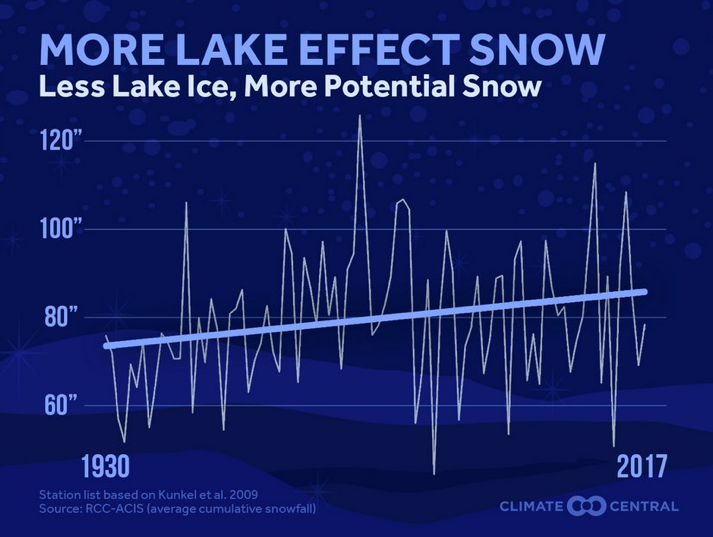
Global warming is leading to later freeze-up of the Great Lakes and warmer lake temperatures. It is the collision of cold Arctic air with relatively warm unfrozen lake water in early winter that causes lake effect snows in the first place. The warmer those lake temperatures, the more moisture in the air, and the greater potential for lake effect snows. Not surprisingly, we see a long-term increase in lake effect snowfalls as temperatures have warmed during the last century (see figure below).
iew image on Twitter
How about those frigid low temperatures back east this winter? Surely that extreme cold must disprove global warming?
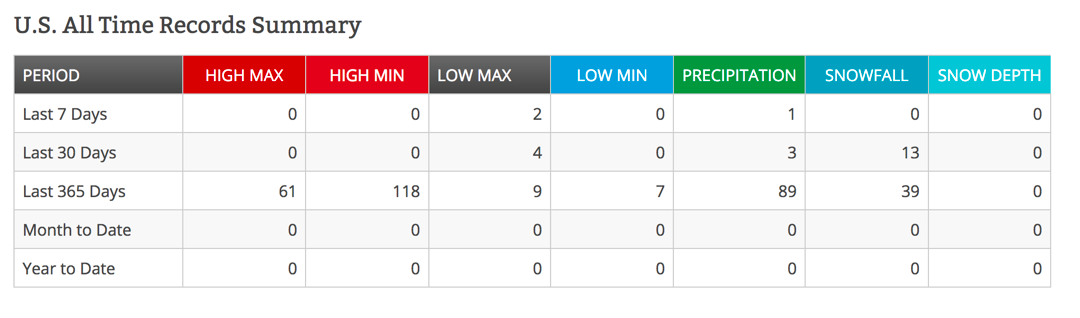
Once again, the claim is misguided. While we have seen some daily all-time lows for a smattering of locations in the US, these pale in comparison with the number of all-time highs we’ve seen over the past year. In fact, the record highs have outpaced the record lows 61 to seven, i.e. nine times more often (see table below), consistent with what we expect to see as the globe continues to warm.
../../../../Desktop/Screen%20Shot%202018-01-03%20at%205.16.4
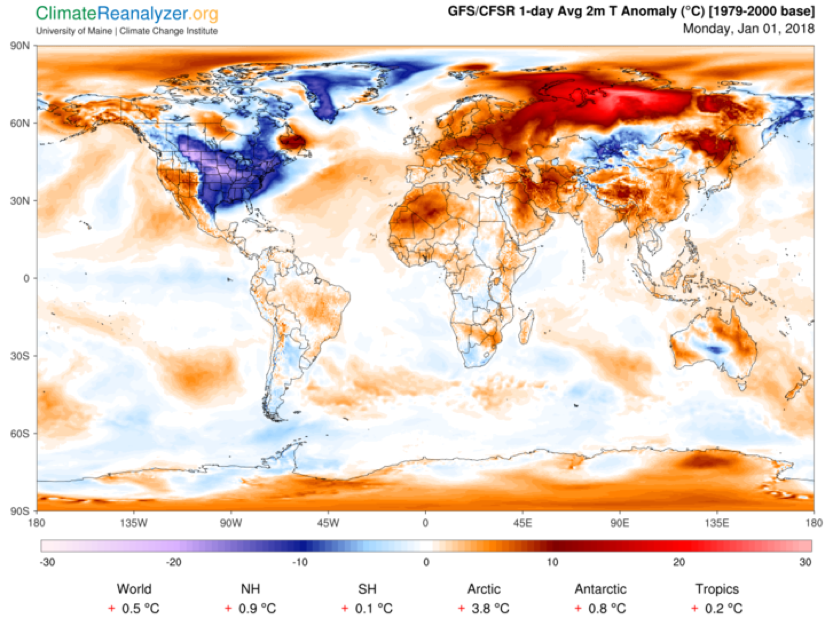
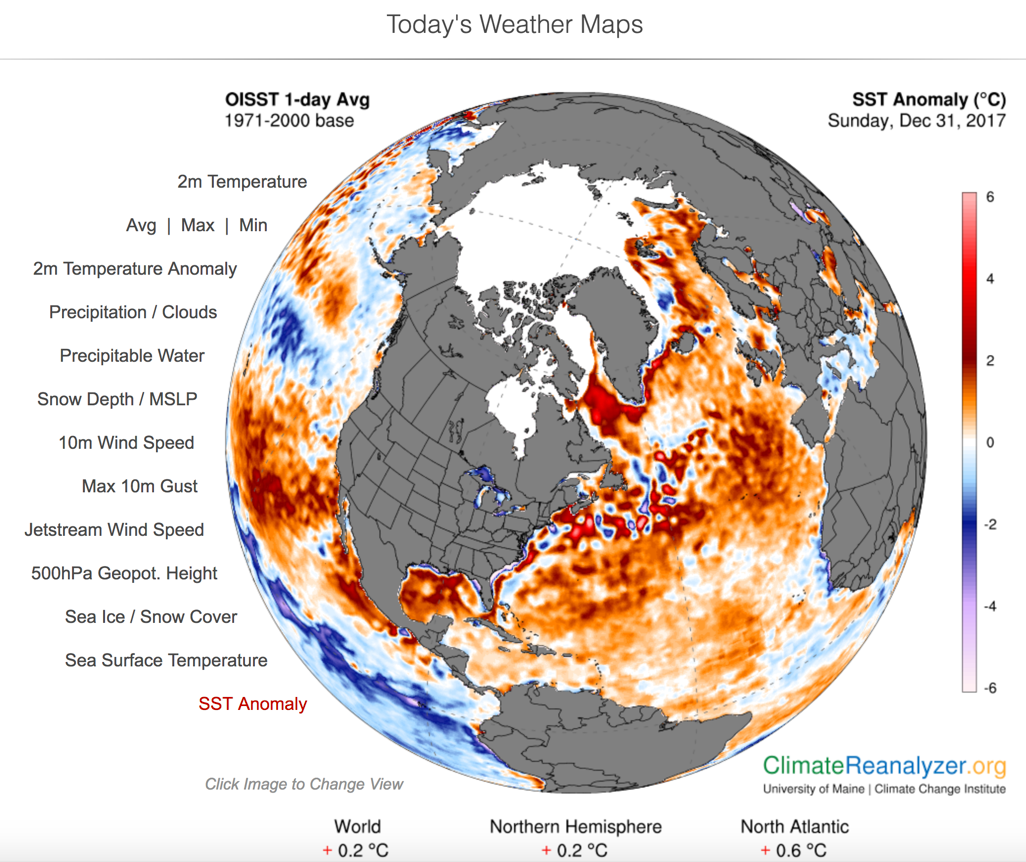
Moreover, while we’ve seen some cold weather in the eastern half of the North America (see the pattern for New Year’s Day below), the western half of North America has been unusually warm. Indeed, most of the Northern Hemisphere, and the globe overall, have been unusually warm. That’s why we call it global warming, folks.
ttps://img.huffingtonpost.com/asset/5a4ac2201c00003b0068e12d.png?ops=scalefit_720_noupscale
(Image obtained using Climate Reanalyzer, Climate Change Institute, University of Maine, USA)
But what about this pattern of cold in the eastern US and warm in the western US? This so-called “dipole” pattern has become more common in recent winters, and recent research suggests that climate change may be favoring this contrast in temperature by causing the jet stream to meander in a particular pattern, with an upward meander or “ridge” in the west bringing warm air up from the south and a downward meander or “trough” in the east, bringing cold air down from the north. Some scientists think that the dramatic loss of sea ice in the Arctic may be favoring this jet stream pattern.
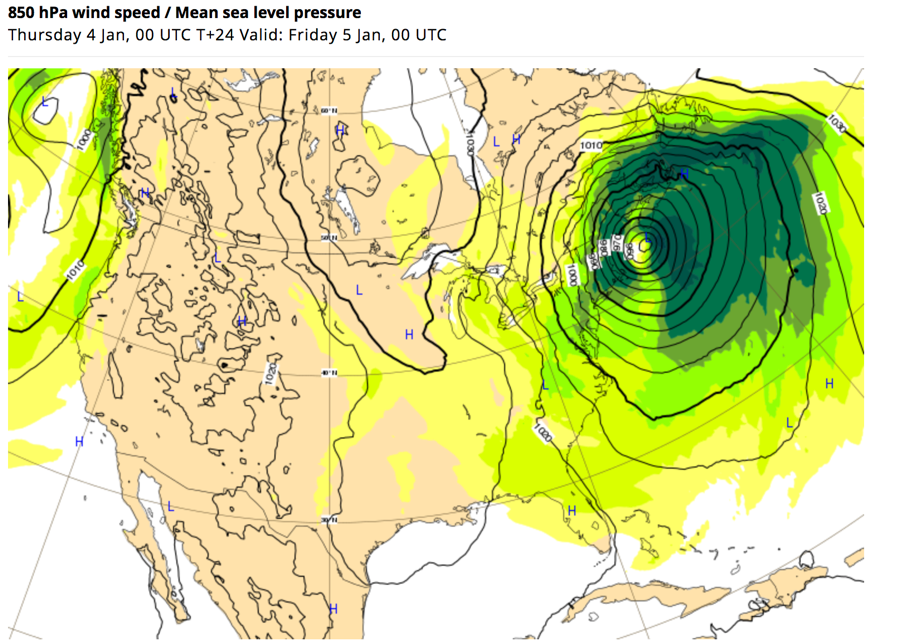
Finally, the news is abuzz today with an impending “massive Nor’easter,” a “bomb cyclone” that is “set to explode” in the days ahead (see plot below). This isn’t just hype. The National Weather Service has warned that “this rapidly intensifying East Coast storm will produce strong, damaging winds — possibly resulting in downed trees, power outages, and coastal flooding.”
With a central pressure forecast to drop very low (see plot below), the storm will threaten the record set by unprecedented 2012 Superstorm Sandy as the lowest surface pressure ever measured in the North Atlantic north of Cape Hatteras (the central surface pressure of a storm is one measure of its strength).
(© 2018 ECMWF cc by nc nd 4.0)
Surely such a massive winter storm, with its promise of bitter cold winds and potentially heavy coastal snowfalls, must be evidence against the climate crisis?
Once again, rather the opposite is true. East Coast winter storms, known as “nor’easters” because of the unusual northeasterly direction of the winds as the storm spirals in from the south, are unusual in that they derive their energy not just from large contrasts in temperature that drive most extratropical storm systems, but also from the energy released when water evaporates from the (relatively warm) ocean surface into the atmosphere.
This is a characteristic that these storms share with tropical storms and hurricanes. The warmer the ocean surface, the more energy that is available to intensify these storms. And the warmer the ocean surface, the more moisture there is in the atmosphere – moisture that is available to form precipitation. As the winds wrap around in a counter-clockwise manner, they bring all of that moisture northwest, where it is chilled and ultimately falls not as rain but snow. Lots of snow.
As the oceans continue to warm, cold Arctic air masses collide with increasingly warm Atlantic Ocean waters. That means larger temperature contrasts and potentially stronger storms. But those warmer oceans also mean more moisture in the atmosphere, even more energy to strengthen the storm, and the potential for larger snowfalls.  We might, if you’ll forgive the pun, call this a “perfect storm” of factors for intensification.
Indeed, climate model simulations indicate that we can expect more intense nor’easters as human-caused climate change continues to warm the oceans.
Screen%20Shot%202018-01-03%20at%202.11.16%20PM.png
(Image obtained using Climate Reanalyzer, Climate Change Institute, University of Maine, USA)
This leads us back to the current strengthening storm. The entire North Atlantic is unusually warm right now (+0.6 degrees Celsius) relative to the already-globally-warmed, late-twentieth-century average (1971-2000), and there are large patches of ocean water off the US East Coast that are 2-4 degrees Celsius above that average. The storm will be encountering that exceptional ocean heat as it travels northward along the US coastline, and that is part of why it has a very good chance of becoming the most intense nor’easter we’ve yet observed.
So, to the climate change doubters and deniers out there, the unusual weather we’re seeing this winter is in no way evidence against climate change. It is an example of precisely the sort of extreme winter weather we expect because of climate change.
Stay up to date with the latest in climate fight and insight from influential scientists and voices like Dr. Mann by signing up for our activist email list today.
Dr. Michael Mann is distinguished professor of atmospheric science at Penn State University and author of The Hockey Stick and The Climate Wars and, more recently, The Madhouse Effect.

https://www.climaterealityproject.org/blog/perfect-storm-extreme-winter-weather-bitter-cold-and-climate-change

"Increased rainfall volume from future convective storms in the US" by Andreas Prein et al., Nature Climate Change, 7 (2017); doi: 10.1038/s41558-017-0007-7

Nature Climate Change, 7 (2017) 880884; doi: 10.1038/s41558-017-0007-7

Increased rainfall volume from future convective storms in the US

Mesoscale convective system (MCS)-organized convective storms with a size of ~100 km have increased in frequency and intensity in the USA over the past 35 years1, causing fatalities and economic losses2. However, their poor representation in traditional climate models hampers the understanding of their change in the future3. Here, a North American-scale convection-permitting model which is able to realistically simulate MSCs4 is used to investigate their change by the end-of-century under RCP8.5 (ref. 5). A storm-tracking algorithm6 indicates that intense summertime MCS frequency will more than triple in North America. Furthermore, the combined effect of a 15–40% increase in maximum precipitation rates and a significant spreading of regions impacted by heavy precipitation results in up to 80% increases in the total MCS precipitation volume, focused in a 40-km radius around the storm center. These typically neglected increases substantially raise future flood risk. Current investments in long-lived infrastructures, such as flood protection and water management systems, need to take these changes into account to improve climate-adaptation practices.