Winter warming in West Antarctica caused by central tropical Pacific warming
Abstract
Figures at a glance
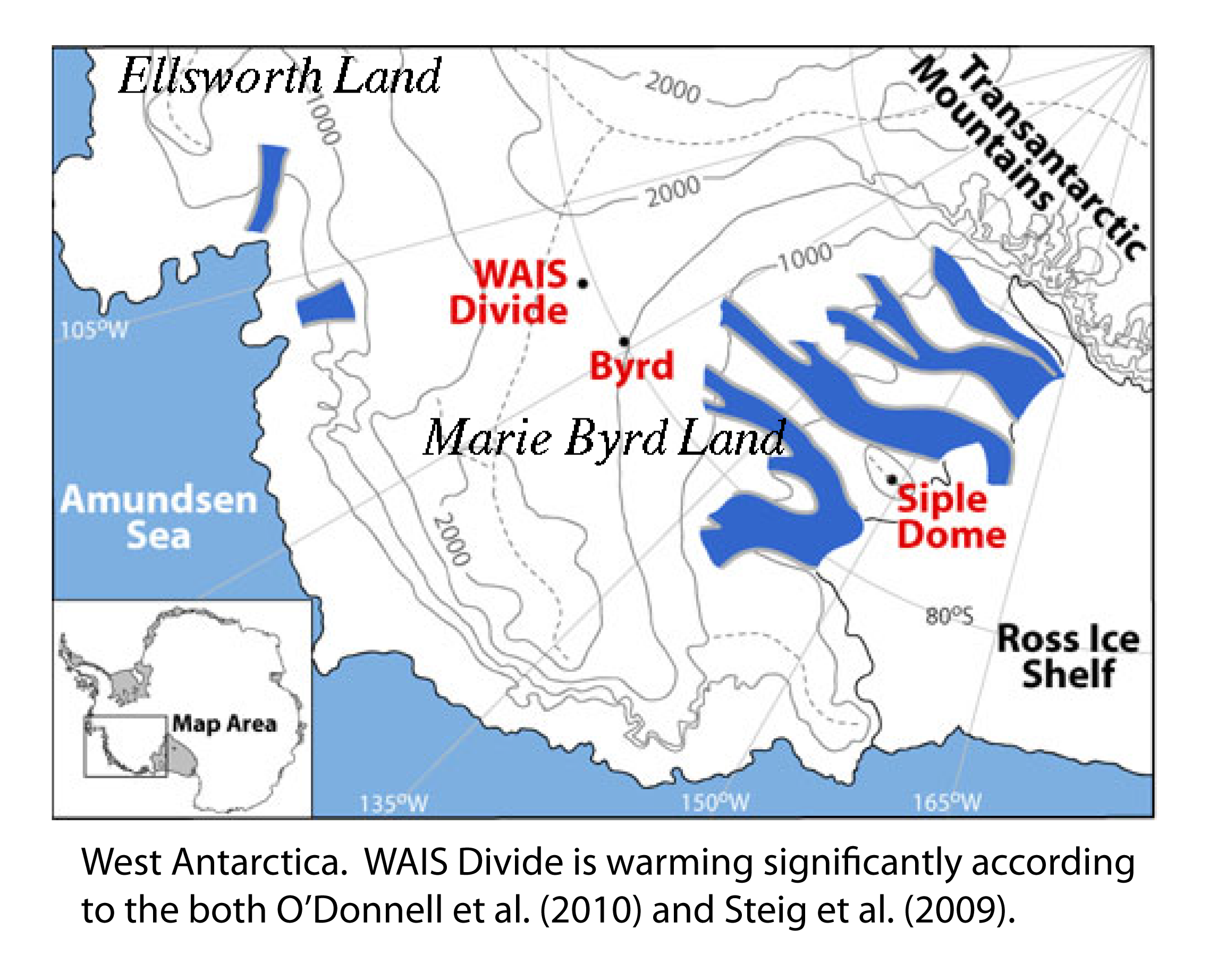 In this post, I’ll summarize the key
 “Eric recommends that we replace our TTLS results with the ridge regression ones (which required a major rewrite of both the paper and the SI) and then agrees with us that the iRidge results are likely to be better . . . and promptly attempts to turn his own recommendation against us.”
“[in his RealClimate post]…he tries to … misrepresent the Mann article to support his claim [about the iridge routine] when he already knew otherwise. How do I know he knew otherwise? Because I told him so in the review response.”
“The use of the ‘iridge’ procedure makes sense to me, and I suspect it really does give the best results. But O’Donnell et al. do not address the issue with this procedure raised by Mann et al., 2008, which Steig et al. cite as being the reason for using ttls in the regem algorithm. The reason given in Mann et al., is not computational efficiency — as O’Donnell et al state — but rather a bias that results when extrapolating (‘reconstruction’) rather than infilling is done.
I emphasize that I think that a fundamentally reworked version of this manuscript could potentially provide a useful scientific contribution, and many of the points made do indeed have scientific merit. Indeed, the authors have done a very thorough analysis, and are to be congratulated on this.
 One of my (Eric’s) favorite old books is The Starship and the Canoe by Kenneth Brower It’s a 1970s book about a father (Freeman Dyson, theoretical physicist living in Princeton) and son (George Dyson, hippy kayaker living 90 ft up in a fir tree in British Columbia) that couldn’t be more different, yet are strikingly similar in their originality and brilliance. I started out my career heading into astrophysics, and I’m also an avid sea kayaker and I grew up with the B.C. rainforest out my back door. So I think I have a sense of what drives these guys. Yet I’ve never understood how Freeman Dyson became such a climate contrarian and advocate for off-the-wall biogeoengineering solutions like carbon-eating trees, something we’ve written about before.
Thank you Anthony Watts for leaving this nonsense on your blog and acknowledging it as “an example of what not to do when graphing trends, to illustrate that trends are very often slaves to endpoints” — as opposed to 99% of your other posts, which you continue to embrace even though they are also examples of what not to do, such as these recent absurdities:
“The death spiral continues, with Arctic ice extent and thickness nearly identical to what it was 10 years ago.” (5/31)
“Over the last three years, Arctic Ice has gained significantly in thickness…. Conclusion : Should we expect a nice recovery this summer due to the thicker ice? You bet ya.” (6/2)
“Arctic Basin ice generally looks healthier than 20 years ago.” (6/23)Those laughable conclusions should have been a warning sign to Watts not to keep posting Goddard’s nonsense — except, of course, nonsensical graphing, cherry picking endpoints, and generally making up stuff is what Watts specializes in (see links below).
BTW, “the mistake was noted by Steven immediately after publication,” is Watts-speak for “Ian H pointed it out in comment #3 within maybe 15 minutes after the posting.”Tamino has a good post debunking Watts/Goddard on Arctic ice thickness (here).
If anyone needs evidence that the “reporting” crutch of He Said, She Said is still being employed by stenographers masquerading as journalists, here’s Fred Pearce in New Scientist.
No serious effort is made to inform the reader which of the parties is actually supported by reality. Note the weasel wording and false balance throughout, e.g.: “some of the researchers involved take issue with a suggestion that greenhouse gases are not primarily responsible for global warming”; “Foster’s team concludes… But de Freitas says”; “The vitriol continues”; etc.
It’s a stereotypical example of the “on the one hand, on the other” style that has so distorted the public’s understanding of the issue of anthropogenic climate change.
It’s 2010, FFS. This article should be held up as a model for how reporting should not be done.
Last week, CEI’s Christopher Horner, writing at Pajamas Media claimed that Gabriel Calzada (author of a dodgy study claiming that Spain’s green energy program had cost many jobs) had been mailed a dismantled bomb by a solar energy company. As Ed Darrell observes, the story is preposterous (even without considering the source), but a whole lot of self-styled global warming skeptics uncritically accepted it. And even after the story was completely retracted, folks like Anthony Watts and Andrew Bolt did not make corrections.
 Photo credit:Lou Albershardt | IPY Traverse Posted: May 6, 2009 Courtesy: Antarctic Sun |
| by Peter Rejcek The 12 scientists and support staff who made a slow crawl across a vast, blank stretch of East Antarctica this past austral summer for three months to study how regional climate variability relates to global climate change expected to encounter brutally cold storms and other challenges on the high polar plateau. They didn’t expect to come across other travelers in the relatively unexplored area known as Queen Maud Land. But they did — three times in one day. “We were astonished because we were supposed to be all alone,” said Ted Scambos , a member of the Norwegian-U.S. science team that crossed a large slice of the Antarctic continent using tracked vehicles pulling sleds. “I don’t know where you can go in order to be on the edge of the Earth anymore.” The encounters, all involving people taking part in a commercial race to the South Pole, occurred near a fuel depot in an area where the ice sheet was more than 3,000 meters thick, hiding at least four distinct subglacial bodies of water called the Recovery Lakes. “Fuel depots in Antarctica are kind of the equivalent of watering holes in Africa,” mused Scambos, lead scientist at the Boulder, Colo.-based National Snow and Ice Data Center. “Everybody has to come to the fuel depot, and you see all kinds of people, all kinds of groups, gathered at the fuel depot.” But for most of the roundtrip journey between Norway’s Troll research station on the coast and the U.S. Antarctic Program’s South Pole Station , the scientists and crew were on their own. They took measurements of the snow and ice in areas that virtually no one had visited since the late 1960s, when the United States primarily used tractor trains to conduct deep-field science work. Living and working out of bright red, boxed buildings mounted on sleds, the team collected ice cores at various depths and locations, used radar to map the ice sheet layers and dug snow pits — all in an effort to understand the climate in this area for the last thousand years and how it may be changing today. The project was part of the International Polar Year , a 60-nation effort to better understand the Antarctic and Arctic, which officially ended last month. “It’s really been a blank spot on the map — on both the literal map as well as the metaphoric map of climate change in Antarctica,” said Tom Neumann , leader of the traverse team during the second leg of the two-year project that began in 2007-08 and covered nearly 7,000 kilometers including a few side trips. “[The traverse] should help fill in the picture of how Antarctica overall is changing.” Scientists had believed that Antarctica was largely bucking the global warming trend. While West Antarctica was undoubtedly heating up — particularly the outstretched tip of the Antarctic Peninsula where ice shelves are disappearing at historic rates — studies of the much larger East Antarctic Ice Sheet suggested a cooling trend. Some researchers have suggested the depletion of stratospheric ozone over Antarctica — the ozone hole that appears each austral spring — is affecting atmospheric circulation and westerly winds around the continent, effectively shielding it from global warming. But a paper in the journal Nature earlier this year said warming in West Antarctica is greater than whatever cooling may be occurring on the rest of the ice-covered continent. “Simple explanations don’t capture the complexity of climate,” explained Eric Steig , lead author of the Nature paper and a professor at the University of Washington , in a statement back in January. “The thing you hear all the time is that Antarctica is cooling, and that’s not the case,” added Steig, a collaborator on the IPY traverse project. “If anything it’s the reverse, but it’s more complex than that. Antarctica isn’t warming at the same rate everywhere, and while some areas have been cooling for a long time, the evidence shows the continent as a whole is getting warmer.” Antarctica is roughly the size of the United States and Mexico: Snow in Denver doesn’t mean a blizzard stretches all the way down to Mexico City. “Antarctica is a huge place, and I would be surprised if it was all doing the same thing,” said Neumann, a scientist now with NASA Goddard Space Flight Center . Yet there’s even a hint that East Antarctica — well, at least one spot on that incomplete map — may be warming based on one initial experiment by the traverse team. Scambos deployed strings of highly sensitive “thermometers” called thermistors into two of the deeper ice core holes. The temperature on the ice sheet surface changes with the weather, but the temperature deeper down changes very slowly as the climate changes. Neumann likens it to throwing a frozen turkey into the oven — not the best way to cook a turkey, for sure, but eventually the center starts to thaw and cook based on the long-term outside temperature. “It takes a while for the ice at 90 meters to notice how the surface temperature has changed,” Neumann explained. At that depth, the ice temperature is determined by the average temperature of the last 50 years or so. The instruments will operate for the next several years, allowing the scientists to determine how surface temperature changes through time. “The initial results do say these areas are warming,” Neumann said, stressing that the measurements are in the hundredths of a degree per year and the data still raw. The chemistry will help the team calibrate the radar returns of the ice layers, a key step to nailing the snow accumulation rates in East Antarctica — one part of the equation to whether the ice sheet is overall losing or gaining mass. Loss of mass would indicate a rise in sea level. “The chemistry from the core helps because it tells you the accumulation rate at a point,” Neumann explained. “For example, how deep is the fallout from the 1960s above-ground nuclear testing? That information helps to calibrate the radar layers that intersect the core site. “If a radar layer is shallower, then it has had relatively less accumulation; a deep layer reflects relatively more accumulation. The information form the core lets you quantify the ‘relative’ statements above.” The scientists also took the opportunity to explore the Recovery Lakes, an area of at least four lakes at the head of one of the largest ice streams draining East Antarctica. Ranging in size from 600 to 1,500 square kilometers, at depths well below sea level, the lakes were likely part of a deep marine embayment millions of years ago when the ice sheet was much smaller, according to Scambos. “It was probably dynamic in the past,” he said. “In the distant future, if the Earth gets a great deal warmer, it would be dynamic again. I would prefer to think that we’ll stabilize climate change before we have to worry about this part of Antarctica disintegrating.” There is still a lot of uncertainty about what the Antarctic ice sheets may do in the future because so little of it has been measured, particularly compared to Greenland, according to Neumann. “The physical insight is coming along and the model development is coming along, but I think it’s going to be a quite a while before we really have confidence in the large-scale predictive models of ice sheet change,” he added. More ground-based studies like the traverse would help to continue filling in the blank spots of the climate change map, according to the scientists. “Most of that uncertainty [about Antarctica] can be beaten down with more and more measurements of accumulation rates,” Neumann said. “The traverse system that the Norwegians have put together is fantastic, state-of-the-art. It’s the best in the world right now in terms of supporting a science crew over long distances,” Scambos said. “They essentially have a mobile, 12-person base that provides them relatively easy access to a large area. … [Queen Maud Land is] one of the least-explored areas of Antarctica, and I think that’s going to change, in part, thanks to this traverse system they’ve got.” | |
Link to this article:
http://antarcticsun.usap.gov/

 Posts
All Comments
Posts
All Comments



|
|