Blog Archive

Showing posts with label Northeast Greenland Ice Stream. Show all posts

Tuesday, August 16, 2016

Collapsing Greenland Zachariae Isstrom glacier could raise sea levels by half a metre, say scientists

Huge Zachariae Isstrom glacier has begun to break up, starting a rapid retreat that could continue to raise sea levels for decades to come


A major glacier in Greenland that holds enough water to raise global sea levels by half a metre has begun to crumble into the North Atlantic Ocean, scientists say.


by Ian Sample, science editor, The Guardian, November 12, 2015

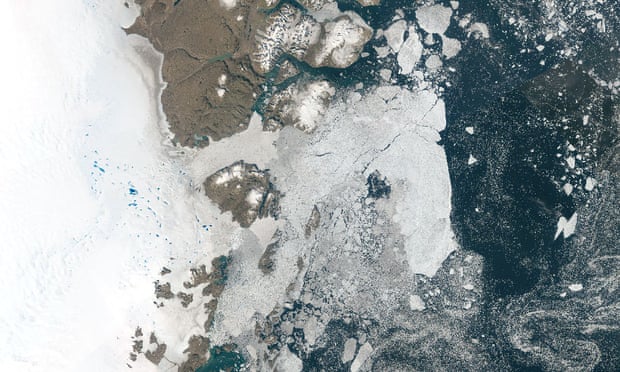
The huge Zachariae Isstrom glacier in northeast Greenland started to melt rapidly in 2012 and is now breaking up into large icebergs where the glacier meets the sea, monitoring has revealed.

The calving of the glacier into chunks of floating ice will set in train a rise in sea levels that will continue for decades to come, the US team warns.

“Even if we have some really cool years ahead, we think the glacier is now unstable,” said Jeremie Mouginot at the University of California, Irvine. “Now this has started, it will continue until it retreats to a ridge about 30km back which could stabilise it and perhaps slow that retreat down.”

Mouginot and his colleagues drew on 40 years of satellite data and aerial surveys to show that the enormous Zachariae Isstrom glacier began to recede three times faster from 2012, with its retreat speeding up by 125 metres per year every year until the most recent measurements in 2015.

The same records revealed that from 2002 to 2014 the area of the glacier’s floating shelf shrank by a massive 95%, according to a report in the journal Science. The glacier has now become detached from a stabilising sill and is losing ice at a rate of 4.5 billion tons a year.

Eric Rignot, professor of Earth system science at the University of California, Irvine, said that the glacier was “being hit from above and below,” with rising air temperatures driving melting at the top of the glacier, and its underside being eroded away by ocean currents that are warmer now than in the past.

“The glacier is now breaking into bits and pieces and retreating into deeper ground,” he said. The rapid retreat is expected to continue for 20 to 30 more years, until the glacier reaches another natural ledge that slows it down.

The scientists recreated the history of the glacier from aerial radar, gravitational measurements and laser profiles, and from radar and optical images taken from space. The combined data reveal the changing shape, size and position of Greenland glaciers over the past four decades.

To the north of Zachariae Isstrom, the scientists studied a second large glacier called Nioghalvfjerdsfjorden. Together, the two glaciers drain a region of nearly 200,000 sq km, amounting to 12% of the Greenland ice sheet. Were both to melt, they would contribute a full metre to global sea levels.

The monitoring showed that Nioghalvfjerdsfjorden glacier was also melting rapidly, but retreating more slowly than Zachariae Isstrom along uphill terrain. If the thinning continues at today’s pace, the scientists believe the ice shelf will become vulnerable to break up in the near future.

The bleak assessment of the glaciers’ retreat comes only months after NASA launched an urgent 6-year project called "Oceans Melting Greenland" (aptly contracted to OMG), to understand the processes that drive the loss of Greenland ice.


https://www.theguardian.com/environment/2015/nov/12/collapsing-greenland-glacier-could-raise-sea-levels-by-half-a-metre-say-scientists

Sunday, November 21, 2010

NYT: Restless Ice -- Greenland's glaciers accelerating

Dear Readers,

Please go to this link at the New York Times while it is still free to access their articles:


Sorry about formatting problems -- they began a couple of days ago. This is just an ordinary blogspot blog, nothing fancy, so I have no idea how to fix them.


Restless Ice


Researchers studying Greenland note that its massive ice sheet appears to have become less stable. The movement of some glaciers has doubled or tripled in speed recently, possibly because of human-induced climate change. If the trend worsens, melting ice and icebergs falling into the ocean could raise global sea levels substantially.

Circles show quakes through 2005
Kangerdlugssuaq and Helheim Glaciers have had more glacial earthquakes since 1993 than any other glaciers in Greenland.
Dotted lines highlight the boundaries between Greenland’s major ice drainage basins. Snow falling inside a boundary will flow to the sea within the same boundary.

Helheim Glacier

This large glacier in southeastern Greenland had a recent increase in speed, which was paired with a thinning of its ice front.
Helheim Glacier empties into Sermilik Fjord, where temperature measurements reveal deep layers of warm water, which may be melting the glacier from below and increasing iceberg calving.

Saturday, August 21, 2010

Jason Box: Petermann not the only major ‘loser’ in Greenland (see also: Zachariae, Humboldt, and 79N)

Petermann not the only major ‘loser’ in Greenland

MODIS, August 14th, 2010

The recent ice island detachment at Petermann glacier is part of a larger pattern of deglaciation observed at 31/34 glaciers (91%) in our survey.

We just updated our survey to include year 2010. Retreat continues at the 110 km (68 mi) wide Humboldt glacier and at the 23 km (14 mi) wide Zachariae ice stream. Humboldt, Zachariae, and Petermann (16 km or 10 mi wide) have bedrock trenches that lead inland below sea level to the thickest parts of the ice sheet.

Sleeping giants are awakening…

http://bprc.osu.edu/mediawiki/images/9/97/Cum_area_change_top5_sm.jpg
Cumulative area change at Greenland’s glacier top 5 “losers.” 2010 areas are measured ~1 month prior to the end of summer melt when the survey usually is made . We do not expect 2010 area changes to be much different using the future data. If anything, we expect the losses to be larger. Click here for a full resolution graphic.

The front areas at Jakobshavn glacier, the world’s overall fastest glacier, and at 79 N glacier, are not losing area in 2010. Jakobshavn area changes are probably less indicative of its stability because the ice is moving so fast it just jams into its ice-choked fjord resulting in growth of the front area (see Amundson, Fahnestock, Truffer, Brown, Lüthi and Motyka.  2010. Ice me´lange dynamics and implications for terminus stability, Jakobshavn Isbræ, Greenland. J. Geophys. Res., 115 (F1), 1–12. F01005.). Jakobshavn remains flowing ~2x faster than it was prior to the loss of its ice shelf 1997-2003. Ian Howat has likened this glacier to a fire hose spewing about as fast as it can.

The 79 N and Zacharaiae glaciers are outlets to the Northeast Greenland Ice Stream (see: Joughin, Fahnestock, MacAyeal, Bamber, and Gogineni. 2001, Observation and analysis of ice flow in the largest Greenland ice stream, J. Geophys. Res., 106, 34,021–34,034). The northeast ice stream has not accelerated much. If surface climate is any indicator (J. Box is convinced it is), the lesser warming rates in northeast Greenland may partly explain the relative stability.

The Bottom Line Importance
Losses at the front of glaciers translate to less ice flow-resistance and in turn accelerated flow. Flow acceleration leads to further thinning by stretching. In turn the “grounding line,” where the glacier begins to float migrates inland. For the largest glaciers that have bedrock trenches leading inland to the thickest parts of the ice sheet, there is no expected mechanism to prevent retreat from continuing, hastening ice sheet volume losses. Ice movement from land to sea rises global sea level. As climate warming continues, we expect some acceleration of global sea level rise; by how much remains the subject of intense scientific inquiry that’s making gradual progress.

This blog entry was composed by Jason Box with assistance from David Decker.

Link:  http://bprc.osu.edu/MODIS/?p%3D61