by Tim Radford, Climate News Network, April 16, 2015
LONDON − Scientists have identified the lethal agency that caused the single most catastrophic event in the history of life on Earth. The mass extinction at the boundary of the Permian and Triassic eras 252 million years ago was caused by the acidification of the world’s oceans, as a consequence of an increase in atmospheric carbon dioxide.
The Permian Extinction – sometimes called “the Great Dying” – seemed to all but obliterate life in the oceans, and perhaps on land. More than 90% of all species disappeared, more than 80% of all genera, and more than 50% of all marine families were extinguished in one prolonged calamity.
All life on Earth today has descended from the few survivors of this far-off episode. Palaeontologists, geologists, climate scientists and astronomers have all speculated on the probable cause. The latest and most confident analysis is based on a new study of ancient marine sediments and delivers obvious parallels with processes that are – for different reasons − occurring again today.
Matthew Clarkson of the University of Edinburgh in Scotland (but now at the University of Otago in New Zealand) and colleagues report in the journal Science that they examined limestone from the United Arab Emirates and found, in the isotope ratios of the element boron, evidence of ocean acidity in carbonate rocks that were laid down as sediment at the bottom of the ocean 250 million years ago. A change in the isotope ratios, they calculated, would have indicated a significant shift in seawater chemistry.
Over the last 40 years, researchers have introduced a whole suite of plausible triggers for the Permian extinction, but at last one team had clear evidence of increased atmospheric carbon, probably from a prolonged and convulsive series of volcanic eruptions that gave rise to vast, ancient geological formations now known as the Siberian Traps.
“Scientists have long suspected that an ocean acidification event occurred during the greatest mass extinction of all time, but direct evidence has been lacking until now,” said Dr Clarkson. “This is a worrying finding, considering that we can already see an increase in ocean acidity today that is the result of human carbon emissions.”
There has been recent evidence that this present change in the pH of ocean waters (pH is a measure of its acidity) as a consequence of fossil fuel combustion in the last two centuries has already disturbed the behaviour of some fish species, threatened to affect oyster fisheries and coral reefs, and even to alter whole ocean ecosystems.
The changes in the Permian were not sudden: ecosystems already seriously under stress because of lack of oxygen or rising temperatures were then dramatically affected by discharges of carbon dioxide that were probably much greater than all the modern world’s existing fossil fuel reserves could deliver. As the oceans became more acidic, many species were extinguished forever: among them the trilobites.
The whole chain of events took 60,000 years. Humans have been burning fossil fuels for only 200 years, but, the researchers point out, in the Permian crisis, carbon was probably being released into the atmosphere at the rate of about 2.4 billion tons a year. Right now, humans are estimated to be releasing carbon from fossil fuels at the rate of 10 billion tons a year.
Showing posts with label Permian mass extinction. Show all posts
Showing posts with label Permian mass extinction. Show all posts
Thursday, April 16, 2015


Friday, July 4, 2014
Newsweek: The Disaster We’ve Wrought on the World’s Oceans May Be Irrevocable

by Alex Renton, Newsweek, July 11, 2014
In the great halls of La Boqueria, Barcelona’s central market, tourists, foodies and cooks gather every day to marvel at the fresh food, like pilgrims at the site of a miracle. The chief shrines are the fish counters, where thousands of sea creatures making up dozens of species gleam pink and gray on mounds of ice. But to many ocean scientists this is not a display of the ocean’s bounty but a museum—by the end of this century, many of these animals may be history due to man’s reckless abuse of the planet. As we keep dumping greenhouse gases into the air, the oceans keep sucking them up, making the waters deadly to their inhabitants.
On the Boqueria’s fish stands I count 10 types of bivalves—creatures like clams, oysters and mussels that use calcium carbonate to make their endlessly varied shells. In as little as 20 years they will be very different and, in some parts of the world, entirely gone. Then there are the ranks of huge Asian prawns and tiny shrimps, terra-cotta crabs from Scotland, and lobsters, magnificent admirals in blue fringed with gold. Lucky for them, these creatures make their shells differently (mostly out of a polymer called chitin), so the rapidly acidifying waters of our oceans won’t dissolve them as it will the exteriors of the bivalves. But the acidification—which some scientists believe is the fastest change in the ocean’s chemistry in 300 million years—appears to harm the working of the gills and change the behavior of the crustaceans when they are very young.
On the crushed ice sit a dozen kinds of finned creatures that the Spanish love—monkfish, hake, sardines, tuna. The Spaniards eat more fish than anyone else in Europe. The effect of changing ocean chemistry on fish health, longevity and reproduction is not yet certain. But even now, many species on the Boqueria stalls are also on one or more European “at-risk” lists: under threat because of overfishing or changes in the chain of foods that supply them, or from the bigger threat of the changing ocean biogeochemistry.
The last is the least understood of these phenomena. Along the coasts and out in the deep, huge “dead zones” have been multiplying. They are the emptiest places on the planet, where there’s little oxygen and sometimes no life at all, almost entirely restricted to some unicellular organisms like bacteria. Vast blooms of algae—organisms that thrive in more acid (and less alkaline) seawater and are fed by pollution—have already rendered parts of the Baltic Sea pretty much dead. A third of the marine life in that sea, which once fed all of Northern Europe, is gone and may already be beyond hope of recovery.
“There’s a profound game-changing event going on in the life of the sea,” says Callum Roberts, a professor of marine conservation at the University of York, England. “The fact is that changes in alkalinity are going to cause massive reorganization of marine life, impacts on marine food webs, productivity, all sorts of things. We’re heading for a car crash here.”
Many of these risks are caused by one of the world’s most pressing problems: climate change. Rising greenhouse gases in the atmosphere are causing global temperatures to rise, which is leading to the melting of the polar ice caps, which in turn has resulted in rising sea levels and a host of ecological issues.
It’s also causing the chemical makeup of the world’s oceans to change so rapidly. Carbon dioxide, one of the key perpetrators in the lineup of man-made greenhouse gases, is absorbed by seawater, causing a chemical reaction near the ocean surface that results in lowered pH levels. And about one-third of all the man-made carbon dioxide released into the atmosphere ends up absorbed by the oceans. Carles Pelejero, a scientist working less than a mile from La Boqueria at the Institut de Cienciès del Mar (ICM), on Barcelona’s seafront, calls it “climate change’s evil twin.”
He illustrates the basic mechanism to schoolchildren by getting them to take a straw and blow into a glass of water. A simple litmus test shows the children how the pH level drops as the carbon dioxide from their breath dissolves in the water. It’s a sign that naturally alkaline water is becoming less so—and it’s what is happening on a global scale as the oceans absorb a significant amount of the carbon dioxide we pump out through the burning of carbon fuels. “In preindustrial times the ocean’s pH was 8.2. It has already gone down to 8.1,” says Pelejero. “Depending on what we do, it will reach an average of 7.8 or 7.7 by 2100. It hasn’t been that low for 55 million years.” For reference, the pH scale runs from 0 to 14; the lower the number the more acidic, and the higher the more alkaline.
Pelejero leads part of the ICM’s marine biogeochemistry research, but his field is even more specific: marine paleo-reconstruction. You might call it seabed archaeology; it uses drills to take samples from deep in the sediment at the bottom of the ocean. Scientists can use those samples to work out how the geochemistry of sea creatures has changed over the millennia. Pelejero started in this business in the mid-1990s using the remains of plankton in the sediments on the ocean floor to determine historic sea surface temperatures.
Then, in 1998, while studying a graph at a conference, Joanie Kleypas, an American biologist working on coral reefs, had a eureka moment. When she suddenly realized that the lowered alkalinity at the end of the 21st century would in effect corrode the calcium carbonate foundation of the reefs to destruction, she was so horrified she left the room to be sick. Herpaper on the threat, published in the journal Science in 1999, was an alarm call. Other scientists quickly dubbed the effect “ocean acidification”—although the seas would not actually turn to acid, the phrase, they reckoned, would emphasize the urgency and get action. Coral reefs are necessary to an estimated 25 percent of all marine life, including 4,000 species of fish. They are the rain forests of the sea.
Around the same time, Pelejero’s colleagues turned their core-sampling techniques to work out how the ocean and its animals behaved long ago, when the water pH was lower. What they found was horrifying. During a 100,000-year-long event known as the Palaeo-Eocene Thermal Maximum (PETM), which occurred between the Palaeo and Eocene epochs, 55 million years ago, “you see that the sediment is quite white from the fossil shells—then suddenly it turns red,” Pelejero says. “Because there are no shells at all. Then it turns white again—but the change back took more than 100,000 years.” The first change from white to red represents a sudden die-off of shell-based life; the turn back to white shows the gradual return of shellfish over time. If projections hold, the pH change that killed off or radically altered many of the deep ocean shell animals will arrive again at the end of this century.
Other problems are likely to emerge because of the pH change. One of the suggestions is that the stable, solid form of methane—called clathrates—that lurks in the ocean sediment may be upset by changes in water chemistry and temperature, and release the gas into the atmosphere. Methane is a greenhouse gas many times more damaging than carbon dioxide, which has, in the past, turbocharged global warming. This is called the “clathrate gun hypothesis,” and the core samples suggest that this is just what might have happened during the PETM, when large numbers of ocean species (particularly from the deeps of the seas) disappeared and the ocean surface was 9 to 16 degrees Fahrenheit warmer. That doesn’t sound like much. But it’s enough to radically alter life underwater—and to wreak havoc on land dwellers, too. Many of the world’s major cities would disappear beneath the rising waves as the ice melts and the water expands. During the PETM, sea levels were as much as 350 feet higher than they are today—enough to obliterate most of present-day Europe, the northeast coast of the U.S. and Argentina, for example.
What worries Pelejero most is the rapidity of today’s changes. The same shifts that happened over the course of a few thousand years during the PETM are now due to happen over just a few centuries, counting from the beginning of the Industrial Revolution and the widespread use of fossil fuels. “The record tells us that, though pH has been lower in the past, this time the changes are happening about 10 times faster. And that means there is no time for species to evolve and adapt, or the ocean to buffer itself,” Pelejero says. “It’s clear that the ocean is acidifying, much clearer than that the world is warming. And we know that most of the effect is caused by man’s actions. The only argument among scientists is over how much damage is being done.”
Already some effects are being seen. Across the world, shells of some animals are thinner than they were 300 years ago. An acidification spike around the coast of British Columbia in February 2014 wiped out 10 million scallops. Foraminifera, the tiniest shelled plankton in the ocean, are having trouble growing (as they did during the PETM)—and plankton is the food base of every animal in the sea. Coccolithophores, the shelled plankton that process sunlight like a plant, and whose remains built the White Cliffs of Dover, seem to suffer from current changes in ocean chemistry.
Pteropods, tiny swimming snails, are the main diet of cold-water fish most commonly consumed in both Europe and North America—salmon, haddock, cod and pollack. In the lab, pteropods dissolve in lowered alkali waters, like a tooth in Coca-Cola. In the Arctic, where acidification is progressing fastest, pteropods may already be on the way out. It is as though the Earth were losing its grass, and the cows had nothing to eat.
Rising Tides Kill All
A day after visiting the fish markets, I lounged on the deck of a tiny former fishing boat off the northern Catalan coast, as oceanologists threw up into the lurching waves around us. We were off to take ICM’s monthly water samples.
The boat is skippered by a remarkable man, 63-year-old Josep Pascual, a legend around the fishing ports of the Costa Brava. As a boy, he went out in this boat with his father and grandfather to net fish for the market. “I used to listen to them, talking as fishermen do about the weather and the sea temperature, and I got interested.”
He decided to add some hard data to the family debate. So since the mid-1960s he has been building his own instruments, and taking a daily record of sea temperatures at different depths in the Mediterranean current off the fishing port of Estartit, Spain. In that little harbor there’s a box containing an ingenious gadget attached to the seawall that measures the height of the sea. “I built it from parts that were thrown out of the old meteorological station,” Pascual says. “I’d read in a book that there were no tides in the Mediterranean—I wanted to prove that was wrong.” He succeeded, and he has also shown that the average sea level in the Mediterranean has risen about 3.5 inches over the past 24 years. That is in line with the global calculations of melting ice cover made by climate change scientists. The rising sea levels, of course, are caused by greenhouse gases in the atmosphere—which are also what’s causing acidification.
Pascual’s work came to the attention of the ICM in the early 1970s. Ever since then, ICM and Pascual have worked together. The fishing nets and lines on the Fiera del Mar are now replaced by global positioning systems, depth-measuring tools and complex thermometer instruments. They have done this long enough to prove significant warming of the Costa Brava sea.
Seven years ago, sponsored chiefly by the Catalan and Spanish governments, Pascual, Pelejero and their assistants started making monthly trips to measure the ocean’s acidity. These have yet to produce conclusive results—there hasn’t yet been enough time to confirm the clear drop in pH that has been observed out in the open oceans.
Pascual is a smiling, sea-worn man, his nut-brown face in sharp contrast to the biochemists’ laboratory pallor. I ask what he really thinks is going on. “What I’m shocked by most is the rising sea level—and I am convinced this is caused by climate change, and that it is mankind that has done it,” he says. “It’s worrying, because the oceans are so important in capturing the carbon. They thermo-regulate the planet. These changes in their systems are very big, and they should make us worry.”
Into the Dead Zone
Off the desert coast of Oman last winter, I saw the strangest thing I’d ever seen in a lifetime of sea voyaging. Heading in a rigid inflatable boat toward a snorkeling site, my family and I all gasped suddenly as the creamy-white of the wake turned a virulent, toxic-looking green. It had an ammoniac stink, and it stayed that way for the next mile.
“No farming nearby? River estuaries?” asked Esther Garcés, a marine biologist at ICM, when I told her this story. None. The Omani coast I saw was mountain and desert. “Probably a normal, seasonal phytoplankton bloom.”
She showed me spectacular pictures, taken from a European Space Agency satellite, of a green-blue swirl occupying most of the Bay of Biscay, between western France and northern Spain. Garcés’s specialty is harmful blooms of algae and plankton: She makes weekly risk assessments for the whole of the Catalan coast. The chief issue is their potential harm to shellfish farms—when the bivalves eat the algae, the former can become toxic to humans who consume them later. (Less pressing is the fact that they make the tourist beaches look as if they are covered in green slime.)
All such blooms are on the increase, mostly due to pollution from humans on land. Sewage, extra carbon in the atmosphere and the runoff of artificial fertilizers all feed different plankton forms, making the blooms fantastically big. Human tampering with the shape of the coast can create vast areas away from the waves where the algae can peacefully breed.
The 21st century’s algae can have adverse effects far beyond weird-colored water and a smell. The key problems come when plankton die. “The toxins released kill fish and other marine life,” says Garcés, “and then there’s the problem of hypoxia and dead zones.” As the algae blooms die out, the matter that drops from the blooms to the bottom of the ocean eats oxygen as it decomposes (with the help of the bacteria that feed on the dead plankton), and hypoxic (low oxygen) and anoxic (total depletion of oxygen) zones kill everything that needs oxygen to live.
Dead zones move and fluctuate, so they are hard to measure. Oceanographers believe they have increased exponentially since the 1960s, and now count over 400 across the globe. One of the world’s largest is off the Mississippi Delta, caused by algae blooms fed mainly by excess chemical fertilizers spread over the land through which the Mississippi flows. Though it changes from year to year, the Mississippi Delta dead zone has been recorded as large as 8,000 square miles, roughly the size of New Jersey.
Scientists diving in it are quoted by Roberts, in his book Ocean of Life: “As you go deeper, it gets kind of scary. Because there’s nothing there. There’s no fish, no organisms alive, so it’s just us.”
The Mississippi Delta zone is the world’s second biggest coastal hypoxic area, after the Black Sea. But out in the open oceans, hundreds of feet below the surface, there are dead zones so huge they may be bigger than the Sahara Desert—the largest lifeless spaces this side of the moon.
There are three different forces that create zones where there's so little oxygen that most life forms disappear. “Upwellings” in parts of the ocean are natural, caused by ocean currents or undersea seismic activity. Periodically they bring nutrients and phytoplankton (a group of plankton that use sunlight for energy) to the surface. In sunlight this mass feeds on algae blooms, until it dies and the bacteria thrive in their turn, eating the dead plankton and absorbing more oxygen. The Black Sea is stagnant and dead from about 500 feet below its warm surface because of its natural geological structure, and the fact that there are few currents to mix up the oxygen-rich surface with the dark, highly acidic waters below. But a crucial sea for human food, the Baltic, has died because of the mess humans make.
Algae blooms have been a feature of the Baltic since the 19th century, initially because nutrient-filled soil ran off as the native forest was cut down to fuel the industries and build the cities of Northern Europe. Then more plankton food was added by the runoff of pollution from the busy Baltic coastline (which includes major cities like St. Petersburg, Russia; Copenhagen, Denmark; Stockholm; Riga, Latvia; and Helsinki) as well as slurry from the industrialized pig farms that are a major business in parts of Germany and Denmark. Now much of the seabed is covered in life-choking seaweed (a multicellular type of algae), and fish eggs from species like cod cannot survive in the low-oxygen environment.
“The Nordic people have made a huge effort to control the runoff of nutrients into the Baltic,” says Garcés. “But it is too late. The nutrients don’t go away. Every time the organisms grow they die and go back to the bottom again, eating more oxygen. Biodiversity is like a dictionary, and this process in the ecosystem is like losing words. We cannot get them back.”
No Fish for You
The one thing that the Boqueria fishmongers doesn’t sell is jellyfish (there’s not much demand for them in Spain, or anywhere else in Europe), though you can find them, dried to a plastic scab, in some Chinese supermarkets. There are those who say that jellyfish and plankton are all that your average wild seafood eater will have for supper by the end of the century—the very rich will likely still be able to pay up for ultra-rare food items. That’s because as the food chain’s intricate links collapse, the complex species will go first, leaving only the most simple. “The oceans [will] revert to the earliest days of multicellular life,” Roberts drily puts it. There’s a terrifying argument that jellyfish—who rather enjoy acidification—are already taking over the seas, if not the world.
The answers are not easy. Some of the clever “geoengineering” suggestions offered to tackle global warming—like artificially cutting off sunlight—won’t work for the oceans, because we can’t just incrementally slow down the acidification — we have to remove the excess carbon dioxide that’s already out there in the atmosphere. Doing that takes economically painful initiatives—replanting vast areas of forest to recapture carbon, for example, and, above all, simply stopping the burning of fossil fuels.
There are some causes for hope. Some world leaders are beginning to take these threats more seriously. In June, for example, the Obama administration announced a series of measures aimed to conserve the ocean as a key food supply for more than 3 billion of us. These included more ocean sanctuaries to curtail overfishing, and new funds to research ocean biochemistry, including acidification.
Roberts, for his part, says that he has been happy to see that coral reefs have proved more adaptable—faster and faster at recovering from the effects of acid and ozone layer depletion—than scientists previously thought. Recent research suggests than in the more acidic waters predicted for the late 21st century, the reefs may survive a little better than Kleypas and her colleagues originally expected.
“That’s got to be cause for hope,” says Roberts. “But these are isolated instances—they say life is possible in these altered environments, they don’t say that means species will thrive in 2100. Evidence from around the world is that they will not. We have the loss of one of the world’s major habitats on the cards. It’s already happening.”
Friday, April 4, 2014
Alarming new study makes today’s climate change more comparable to Earth’s worst mass extinction
by howardlee, Skeptical Science, April 2, 2014


The Permian Mass Extinction 251.9 million years ago, otherwise known as “The Great Dying,” was the closest this planet has come to extinguishing all complex life on Earth. Around 90% of all species died out in this single event, a worse toll even than the Cretaceous extinction that wiped out the dinosaurs.
For years the cause of the Permian Mass Extinction has been linked to massive volcanic eruptions in Siberia. Volcanic CO2 and a cocktail of noxious gasses combined withburning coal and geothermally-baked methane emissions to enact a combination of toxic effects and, most importantly, ocean acidification and global warming. It led to a world where equatorial regions and the tropics were too hot for complex life to survive. That’s a fact so astonishing it bears repeating: global warming led to a large portion of planet Earth being lethally hot on land and in the oceans! The cascading extinctions in ecosystems across the planet unfolded over 61,000 years, and it took 10 million years for the planet to recover! For comparison, our distant ancestors separated from apes only 7 million years ago.
Until recently the scale of the Permian Mass Extinction was seen as just too massive, its duration far too long, and dating too imprecise for a sensible comparison to be made with today’s climate change. No longer.
In “High-precision timeline for Earth’s most severe extinction,” published in PNAS on February 10, authors Seth Burgess, Samuel Bowring, and Shu-zhong Shen employed new dating techniques on Permian–Triassic rocks in China, bringing unprecedented precision to our understanding of the event. They have dramatically shortened the time frame for the initial carbon emissions that triggered the mass extinction from roughly 150,000 years to between 2,100 and 18,800 years. This new time frame is crucial because it brings the timescale of the Permian Extinction event’s carbon emissions shorter by two orders of magnitude, into the ballpark of human emission rates for the first time.
How does this relate to today’s global warming?
Climate and CO2 have changed hand-in-hand through most of geological time. Mostly these changes happened slowly enough that the long-term feedbacks of Earth’s climate system had time to process them. This was true during the orbitally-induced glacial-interglacial cycles in the ice ages. In warmer interglacials, more intense insolation in northern hemisphere summers led to warmer oceans which were in equilibrium with slightly more CO2 in the atmosphere by adjusting their carbonate levels. In glacial times with less intense northern hemisphere summer insolation, the cooler oceans dissolved more CO2, and carbonate levels adjusted accordingly. The changes occurred over gentle timescales of tens of thousands to hundreds of thousands of years – plenty slow enough for slow feedbacks like the deep oceans and ice sheets to keep pace.
How oceans processed the slow glacial-interglacial changes in the ice ages. CCD = Carbonate Compensation Depth, CO32- = carbonate. Based on text in Zeebe, Annual Reviews 2012.
Rapid carbon belches, such as in the Permian and today, occur within the time frame of fast feedbacks (surface ocean, water vapor, clouds, dust, biosphere, lapse rate, etc.) but before the vast deep ocean reservoir and rock weathering can cut-in to buffer the changes. The carbon overwhelms the surface ocean and biosphere reservoirs so it has nowhere to go but the atmosphere, where it builds up rapidly, creating strong global warming via the greenhouse effect. The surface oceans turn acidic as they become increasingly saturated in CO2. The oceans warm, so sea levels rise. Those symptoms should sound familiar.
How oceans get overwhelmed by rapid large CO2 emissions from Large Igneous Province (LIP) eruptions and human emissions. CCD = Carbonate Compensation Depth, CO32- = carbonate. Based on text in Zeebe, Annual Reviews 2012.
Burgess et al.’s paper brings the Permian into line with many other global-warming extinction events, like the Triassic, the Toarcian, the Cretaceous Ocean Anoxic Events, The PETM, and the Columbia River Basalts, whose time frames have been progressively reduced as more sophisticated dating has been applied to them. They all produced the same symptoms as today’s climate change – rapid global warming, ocean acidification, and sea level rises, together with oxygen-less ocean dead zones and extinctions. They were all (possibly excluding the PETM – see below) triggered by rare volcanic outpourings called “Large Igneous Provinces” (LIPs) that emitted massive volumes of CO2 and methane at rates comparable to today’s emissions. The PETM may also have been triggered by a LIP, although that is still debated.
Can we seriously expect Earth’s climate to behave differently today than it did at all those times in the past?
Some have pointed out that since we began our modern climate change in an “icehouse” era with ice sheets to melt and low starting CO2 levels, we might not generate a Permian-like hothouse. In addition, since the Permian, calcareous algae have changed the way deep oceans process carbonate, providing more of a buffer. But that buffer only comes into play if the deep oceans come into play, which most estimates consider won’t happen for a few more centuries.
All in all, the parallels between the many mass extinction events in the geological record and today’s climate change offer no comfort about the legacy we’re leaving for our children and our grandchildren. Rather they stand as signposts for an increasingly scary future.
Saturday, April 20, 2013
Andrew Glikson: Another link between CO2 and mass extinctions of species
by Andrew Glikson, The Conversation, March 22, 2013
It’s long been known that massive increases in emission of CO2 from volcanoes, associated with the opening of the Atlantic Ocean in the end-Triassic Period, set off a shift in state of the climate which caused global mass extinction of species, eliminating about 34% of genera. The extinction created ecological niches which allowed the rise of dinosaurs during the Triassic, about 250–200 million years ago.New research released this morning in Science Express has refined the dating of this wave of volcanism. It shows marine and land species disappear from the fossil record within 20,000 to 30,000 years from the time evidence for the eruption of large magma flows appears, approximately 201 million years ago. These volcanic eruptions increased atmospheric CO2 and increased ocean acidity.
Mass extinctions due to rapidly escalating levels of CO2 are recorded since as long as 580 million years ago. As our anthropogenic global emissions of CO2 are rising, at a rate for which no precedence is known from the geological record with the exception of asteroid impacts, another wave of extinctions is unfolding.
Mass extinctions of species in the history of Earth include:
- the ~580 million years-old (Ma) Acraman impact (South Australia) and Acrytarch (ancient palynomorphs) extinction and radiation
- Late Devonian (~374 Ma) volcanism, peak global temperatures and mass extinctions
- the end-Devonian impact cluster associated with mass extinction, which among others destroyed the Kimberley Fitzroy reefs (~360 Ma)
- the upper Permian (~267 Ma) extinction associated with a warming trend
- the Permian-Triassic boundary volcanic and asteroid impact events (~ 251 Ma) and peak warming
- the End-Triassic (201 Ma) opening of the Atlantic Ocean, and massive volcanism
- an End-Jurassic (~145 Ma) impact cluster and opening of the Indian Ocean
- the Cretaceous–Tertiary boundary (K-T) (~65 Ma) impact cluster, Deccan volcanic activity and mass extinction
- the pre-Eocene–Oligocene boundary (~34 Ma) impact cluster and a cooling trend, followed by opening of the Drake Passage between Antarctica and South America, formation of the Antarctic ice sheet and minor extinction at ~34 Ma.
Click on graphs to enlarge.


In February 2013, CO2 levels had risen to near 396.80 ppm at Mauna Loa Atmospheric Observatory, compared to 393.54 ppm in February 2012. This rise (3.26 ppm per year) is at the highest rate yet recorded. Further measurements show CO2 is at near 400 ppm of the atmosphere over the Arctic. At this rate the upper stability threshold of the Antarctic ice sheet, defined at about 500–600 ppm CO2 would be reached later this century (although hysteresis of the ice sheets may slow down melting).
Our global carbon reserves (including coal, oil, oil shale, tar sands, gas and coal-seam gas) contain considerably more than 10,000 billion tonnes of carbon (see Figure 5). This amount of carbon, if released into the atmosphere, is capable of raising atmospheric CO2 levels to higher than 1,000 ppm. Such a rise in atmospheric radiative forcing will be similar to that of the Paleocene–Eocene boundary thermal maximum (PETM), which happened about 55 million years ago (see Figures 1, 2 and 4). But the rate of rise surpasses those of this thermal maximum by about ten times.


The Paleocene–Eocene boundary thermal maximum event about 55 million years ago saw the release of approximately 2,000–3,000 billion tons of carbon to the atmosphere in the form of methane (CH4). It led to the extinction of about 35–50% of benthic foraminifera (see Figures 3 and 4), representing a major decline in the state of the marine ecosystem. The temperature rise and ocean acidity during this event are shown in Figures 4 and 6.
Based on the amount of carbon already emitted and which could continue to be released to the atmosphere (see Figure 5), current climate trends could be tracking toward conditions like those of the Paleocene–Eocene event. Many species may be unable to adapt to the extreme rate of current rise in greenhouse gases and temperatures. The rapid opening of the Arctic Sea ice, melting of Greenland and west Antarctic ice sheets, and rising spate of floods, heat waves, fires and other extreme weather events may signify a shift in the state of the climate, crossing tipping points.

By analogy to medical science analysing blood count as diagnosis for cancer, climate science uses the greenhouse gas levels of the atmosphere, pH levels of the ocean, variations in solar insolation, aerosol concentrations, clouding states at different levels of the atmosphere, state of the continental ice sheets and sea ice, position of high pressure ridges and climate zones and many other parameters to determine trends in the climate. The results of these tests, conducted by thousands of peer-reviewed scientists world-wide, have to date been ignored, at the greatest peril to humanity and nature.
Continuing emissions contravene international laws regarding crimes against humanity and related International and Australian covenants. In the absence of an effective global mitigation effort, governments world-wide are now presiding over the demise of future generations and of nature, tracking toward one of the greatest mass extinction events nature has seen. It is time we learned from the history of planet Earth.

Andrew Glikson does not work for, consult to, own shares in or receive funding from any company or organisation that would benefit from this article, and has no relevant affiliations.

This article was originally published at The Conversation. Read the original article.
Saturday, March 3, 2012
Oceans' acidic shift may be fastest in 300 million years
Oceans' acidic shift may be fastest in 300 million years
(Reuters) - The world's oceans are turning acidic at what could be the fastest pace of any time in the past 300 million years, even more rapidly than during a monster emission of planet-warming carbon 56 million years ago, scientists said on Thursday.
Looking back at that bygone warm period in Earth's history could offer help in forecasting the impact of human-spurred climate change, researchers said of a review of hundreds of studies of ancient climate records published in the journal Science.
Quickly acidifying seawater eats away at coral reefs, which provide habitat for other animals and plants, and makes it harder for mussels and oysters to form protective shells. It can also interfere with small organisms that feed commercial fish like salmon.
The phenomenon has been a top concern of Jane Lubchenco, the head of the U.S. National Oceanic and Atmospheric Administration, who has conducted demonstrations about acidification during hearings in the U.S. Congress.
Oceans get more acidic when more carbon gets into the atmosphere. In pre-industrial times, that occurred periodically in natural pulses of carbon that also pushed up global temperatures, the scientists wrote.
Human activities, including the burning of fossil fuels, have increased the level of atmospheric carbon to 392 parts per million from about 280 parts per million at the start of the industrial revolution. Carbon dioxide is one of several heat-trapping gases that contribute to global warming.
To figure out what ocean acidification might have done in the prehistoric past, 21 researchers from the United States, the United Kingdom, the Netherlands, Germany and Spain reviewed studies of the geological record going back 300 million years, looking for signs of climate disruption.
Those indications of climate change included mass extinction events, where substantial percentages of living things on Earth died off, such as the giant asteroid strike thought to have killed the dinosaurs some 65 million years ago.
The events that seemed similar to what is happening now included mass extinctions about 252 million and 201 million years ago, as well as the warming period 56 million years in the past.
The researchers reckoned the 5,000-year hot spell 56 million years ago, likely due to factors like massive volcanism, was the closest parallel to current conditions at any time in the 300 million years.
To detect that, they looked at a layer of brown mud buried under the Southern Ocean off Antarctica. Sandwiched between layers of white plankton fossils, the brown mud indicated an ocean so acidic that the plankton fossils from that particular 5,000-year period dissolved into muck.
During that span, the amount of carbon in the atmosphere doubled and average temperatures rose by 10.8 F (6 C), the researchers said. The oceans became more acidic by about 0.4 unit on the 14-point pH scale over that 5,000-year period, the researchers said.
That is a fast warm-up and a quick acidification, but it is small compared with what has happened on Earth since the start of the industrial revolution some 150 years ago, study author Baerbel Hoenisch of Columbia University's Lamont-Doherty Earth Observatory said by telephone.
EXTINCTIONS ON THE SEAFLOOR
During the warming period 56 million years ago, known as the Paleocene-Eocene Thermal Maximum, or PETM, and occurring about 9 million years after the extinction of the dinosaurs, acidification for each century was about .008 unit on the pH scale, Hoenisch said.
Back then, many corals went extinct, as did many types of single-celled organisms that lived on the sea floor, which suggests other plants and animals higher on the food chain died out too, researchers said.
By contrast, in the 20th century, oceans acidified by .1 unit of pH, and are projected to get more acidic at the rate of .2 or .3 pH by the year 2100, according to the study.
The U.N. Intergovernmental Panel on Climate Change projects world temperatures could rise by 3.2 to 7 degrees F (1.8 to 4 degrees C) this century.
"Given that the rate of change was an order of magnitude smaller (in the PETM) compared to what we're doing today, and still there were these big ecosystem changes, that gives us concern for what is going to happen in the future," Hoenisch said.
Those skeptical of human-caused climate change often point to past warming periods caused by natural events as evidence that the current warming trend is not a result of human activities. Hoenisch noted that natural causes such as massive volcanism were probably responsible for the PETM.
She said, however, that the rate of warming and acidification was much more gradual then, over the course of five millennia compared with one century.
Richard Feely, an oceanographer at the U.S. National Oceanic and Atmospheric Administration who was not involved in the study, said looking at that distant past was a good way to foresee the future.
"These studies give you a sense of the timing involved in past ocean acidification events - they did not happen quickly," Feely said in a statement. "The decisions we make over the next few decades could have significant implications on a geologic timescale."
(Editing by Peter Cooney)
Monday, February 20, 2012
Global Extinction: Gradual Doom as Bad as Abrupt
Global Extinction: Gradual Doom as Bad as Abrupt
by John Hartz, Skeptical Science, February 20, 2012
This is a reprint of a press release posted by the National Science Foundation on February 3, 2012.

In "The Great Dying" 250 million years ago, the end came slowly
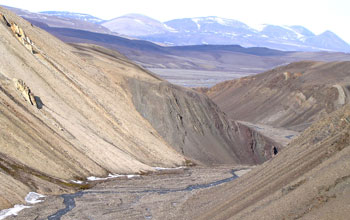 The geology of Griesbach Creek in the Arctic tells an ancient tale of slow extinction. Credit and Larger Version |
The deadliest mass extinction of all took a long time to kill 90 percent of Earth's marine life--and it killed in stages--according to a newly published report.
It shows that mass extinctions need not be sudden events.
Thomas Algeo, a geologist at the University of Cincinnati, and 13 colleagues have produced a high-resolution look at the geology of a Permian-Triassic boundary section on Ellesmere Island in the Canadian Arctic.
Their analysis, published today in the Geological Society of America Bulletin, provides strong evidence that Earth's biggest mass extinction phased in over hundreds of thousands of years.
About 252 million years ago, at the end of the Permian period, Earth almost became a lifeless planet.
Around 90 percent of all living species disappeared then, in what scientists have called "The Great Dying."
Algeo and colleagues have spent much of the past decade investigating the chemical evidence buried in rocks formed during this major extinction.
The world revealed by their research is a devastated landscape, barren of vegetation and scarred by erosion from showers of acid rain, huge "dead zones" in the oceans, and runaway greenhouse warming leading to sizzling temperatures.
The evidence that Algeo and his colleagues are looking at points to massive volcanism in Siberia as a factor.
"The scientists relate this extinction to Siberian Traps volcanic eruptions, which likely first affected boreal life through toxic gas and ashes," said H. Richard Lane, program director in the National Science Foundation's (NSF) Division of Earth Sciences, which funded the research.
The Siberian Traps form a large region of volcanic rock in Siberia. The massive eruptive event which formed the traps, one of the largest known volcanic events of the last 500 million years of Earth's geologic history, continued for a million years and spanned the Permian-Triassic boundary.
The term "traps" is derived from the Swedish word for stairs -- trappa, or trapp -- referring to the step-like hills that form the landscape of the region.
A large portion of western Siberia reveals volcanic deposits up to five kilometers (three miles) thick, covering an area equivalent to the continental United States. The lava flowed where life was most endangered, through a large coal deposit.
"The eruption released lots of methane when it burned through the coal," Algeo said. "Methane is 30 times more effective as a greenhouse gas than carbon dioxide.
"We're not sure how long the greenhouse effect lasted, but it seems to have been tens or hundreds of thousands of years."
Much of the evidence was washed into the ocean, and Algeo and his colleagues look for it among fossilized marine deposits.
Previous investigations have focused on deposits created by a now vanished ocean known as Tethys, a precursor to the Indian Ocean. Those deposits, in South China particularly, record a sudden extinction at the end of the Permian.
"In shallow marine deposits, the latest Permian mass extinction was generally abrupt," Algeo said. "Based on such observations, it has been widely inferred that the extinction was a globally synchronous event."
Recent studies are starting to challenge that view.
Algeo and co-authors focused on rock layers at West Blind Fiord on Ellesmere Island in the Canadian Arctic.
That location, at the end of the Permian, would have been much closer to the Siberian volcanoes than sites in South China.
The Canadian sedimentary rock layers are 24 meters (almost 80 feet) thick and cross the Permian-Triassic boundary, including the latest Permian mass extinction horizon.
The investigators looked at how the type of rock changed from the bottom to the top. They looked at the chemistry of the rocks and at the fossils contained in the rocks.
They discovered a total die-off of siliceous sponges about 100,000 years earlier than the marine mass extinction event recorded at Tethyan sites.
What appears to have happened, according to Algeo and his colleagues, is that the effects of early Siberian volcanic activity, such as toxic gases and ash, were confined to the northern latitudes.
Only after the eruptions were in full swing did the effects reach the tropical latitudes of the Tethys Ocean.
The research was also supported by the Canadian Natural Sciences and Engineering Research Council and the National Aeronautics and Space Administration Exobiology Program.
In addition to Algeo, co-authors of the paper are: Charles Henderson, University of Calgary; Brooks Ellwood, Louisiana State University; Harry Rowe, University of Texas at Arlington; Erika Elswick, Indiana University, Bloomington; Steven Bates and Timothy Lyons, University of California, Riverside; James Hower, University of Kentucky; Christina Smith and Barry Maynard, University of Cincinnati; Lindsay Hays and Roger Summons, Massachusetts Institute of Technology; James Fulton, Woods Hole Oceanographic Institution; and Katherine Freeman, Pennsylvania State University.
Subscribe to:
Posts (Atom)

 Posts
Posts