Blog Archive

Showing posts with label Jennifer Francis. Show all posts

Thursday, November 1, 2018

New study: Freak summer weather and wild jet-stream patterns are on the rise because of global warming


Simulation of jet stream pattern July 22, 2018. (VentuSky.com)
In many ways, the summer of 2018 marked a turning point, when the effects of climate change — perhaps previously on the periphery of public consciousness — suddenly took center stage. Record high temperatures spread all over the Northern Hemisphere. Wildfires raged out of control. And devastating floods were frequent.
Michael Mann, climate scientist at Pennsylvania State University, along with colleagues, has published a new study that connects these disruptive weather extremes with a fundamental change in how the jet stream is behaving during the summer. Linked to the warming climate, the study suggests this change in the atmosphere’s steering current is making these extremes occur more frequently, with greater intensity, and for longer periods of time.
The study projects this erratic jet-stream behavior will increase in the future, leading to more severe heat waves, droughts, fires and floods.


The jet stream is changing not only because the planet is warming up but also because the Arctic is warming faster than the mid-latitudes, the study says. The jet stream is driven by temperature contrasts, and these contrasts are shrinking. The result is a slower jet stream with more wavy peaks and troughs that Mann and his study co-authors ascribe to a process known as “quasi-resonant amplification.”
The altered jet-stream behavior is important because when it takes deep excursions to the south in the summer, it sets up a collision between cool air from the north and the summer’s torrid heat, often spurring excessive rain. But when the jet stream retreats to the north, bulging heat domes form underneath it, leading to record heat and dry spells.
If the excursions in the jet stream endure long enough, it can then set the stage for floods where the jet dips, and wildfires and drought where it ascends.
“What made these events [in the summer of 2018] so devastating was not just the extreme nature of the meteorological episodes but their persistence,” Mann said in a blog post discussing the implications of the new study.
The study, published Wednesday in Science Advances, finds that these quasi-resonant amplification events — in which the jet stream exhibits this extreme behavior during the summer — are predicted to increase by 50 percent this century if emissions of carbon dioxide and other greenhouse gases continue unchecked.
Whereas previous work conducted by Mann and others had identified a signal for an increase in these events, this study for the first time examined how they may change in the future using climate model simulations.
“Looking at a large number of different computer models, we found interesting differences,” said Stefan Rahmstorf from the Potsdam Institute for Climate Impact Research and a co-author of the study, in a news release. “Distinct climate models provide quite diverging forecasts for future climate resonance events. However, on average they show a clear increase in such events.”
In an email, Mann said climate models aren’t fully capturing the phenomenon, and, for this reason, we should expect weather extremes “beyond what is typically projected” into the future.
Mann added the existing analyses that attempt to uncover the role of climate change in recent extreme events “are under-attributing the role that climate change is having … because they are not capturing the key mechanism responsible.”
Mann said in his blog commentary that he was particularly struck by the jet-stream behavior in the summer. “In summer 2018, I would argue, that signal was no longer subtle,” he said. “It played out in real time on our television screens and newspaper headlines in the form of an unprecedented hemisphere-wide pattern of extreme floods, droughts, heat waves and wildfires.”
Although model projections suggest these extreme jet-stream patterns will increase as the climate warms, the study concluded that their increase can be slowed if greenhouse gas emissions are reduced along with particulate pollution in developing countries. “[T]he future is still very much in our hands when it comes to dangerous and damaging summer weather extremes,” Mann said. “It’s simply a matter of our willpower to transition quickly from fossil fuels to renewable energy.”


Dr. Jennifer Francis, a climate researcher at Rutgers University who has published work exhibiting changing jet-stream behavior because of climate change, found the results of this new study compelling. “This work takes a big step toward understanding the spate of deadly extreme weather events during recent summers — heat waves, floods and droughts,” she said in an email.

Saturday, June 13, 2015

Rapid Arctic ice loss linked to extreme weather changes in Europe and US

Arctic warming appears to be the prime reason behind fluctuations in the polar jet stream that is causing unusual weather, study says 

by John Vidal, The Guardian, June 1, 2015

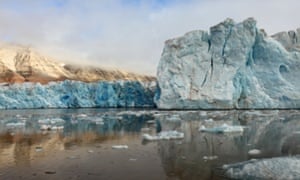
BEE9T7 Arctic Glacier Reflected and Melting in Svalbard KongsFjordenGlacierArcticIceBlueSvalbardPolarClimateArcticNorwaySvalbardSpitsbergenNyAlesundNatureLandscapeSceneryPanoramaViewScenicFjordBarentsSeaOceanNordicScandinavianMountainsPolarSummerCalmPlacidPeacefulClimateChangeGlacierMeltingIceEnvironmentalismReflectionDramaticSailingGlobalWarmingKongsfjordenFloat

 Arctic is warming faster than elsewhere, triggering changes in the jet stream which will create more extreme weather in western Europe and North America, researchers say. Photograph: Alamy
The string of massive snowstorms and bone-chilling cold on the US east coast, as well as flooding in Britain and record temperatures in Europe, are linked to rapid ice loss in the Arctic, new research appears to confirm.
While the rapidly-thawing Arctic cannot be held responsible for specific weather events like the “snowmageddon” in 2009, Hurricane Sandy, or European heatwaves, researchers at Rutgers university said it appears to be a prime reason why the polar jet stream – a ribbon of winds that encircles the globe – gets ‘stuck’ with increasing frequency.
Western Europe and large parts of North America will experience more extreme weather because of “Arctic amplification” - the enhanced sensitivity of high latitudes to global warming, the team suggested in a paper published in the journal Philosophical Transactions of the Royal Society A. 
“We are seeing these extremes because the Arctic is warming faster than elsewhere. The whole lower atmosphere is heating up but the sea ice is the most observable. This is having this effect on the jet stream, making it extend further south and stay longer,” said co-author Jennifer Francis.
“The jet stream creates weather of all sorts and where you are in relation to it dictates wether it is hot or cold. When we have a ridge, or a big bulge, in the the jet stream, it makes it extend further and stay longer. When that ridge is stronger it tends to be more persistent,” she said.
Deep troughs in the jet stream have been seen regularly in the past few years affecting the east coast of the US, western Europe and central Asia. These have brought prolonged, unusually hot weather to some places, and extended cold or record snowfall to others.
“We are seeing extended periods of extreme weather because when the temperature difference between polar and mid northern latitudes gets smaller [because of global warming] this has the effect of weakening the jet stream , allowing it to be deflects more easily and to meander more. It’s a combination of natural conditions being intensified and global warming,” said Professor Francis.
The authors expect that eventually it will be possible to predict accurately which types of extreme events will be more likely to occur in certain areas but because Arctic amplification has emerged only in the past 20 years it is a challenge to pin down exactly how it affects weather patterns. 
But the impacts could be substantial, they warn. “This new manifestation of of global warming ... may have substantial societal impact as more frequent extreme weather events in mid latitudes will affect billions of people directly through damage to property and infrastructure and indirectly through farming and water supplies,” the authors wrote.
The study builds on other research which shows how the changing Arctic may be affecting weather in mid-latitudes. According to some, a slower jet stream takes a more meandering path as it encircles the northern hemisphere. Other studies have linked ice loss in the Barents and Kara seas to the north of Russia with extremely cold winters in central Asia.
According to the US Snow and Ice data centre, Arctic sea ice extent last month averaged 5.4 million square miles), the second lowest April ice extent in the satellite record. It is 313,000 sq m) below the 1981 to 2010 long-term average of 6 million sq m) and 31,000 sq m) above the previous record low for the month observed in 2007.

Sunday, April 5, 2015

Warming Arctic blamed for worsening summer heatwaves

Russia's 2010 heatwave - a harbinger of even more torrid times? <i>(Image: ARTYOM KOROTAYEV/AFP/Getty)</i>
Russia's 2010 heatwave – a harbinger of even more torrid times? (Image: ARTYOM KOROTAYEV/AFP/Getty)

by Fred Pearce, NewScientist, March 12, 2015

It seems our weather is getting slower – and hotter. Arctic warming appears to be aggravating summer heatwaves across Europe and North America, by putting the brakes on atmospheric circulation in mid-latitudes.
The team that uncovered this Arctic effect says it caused the Russian heatwave of 2010, which lasted six weeks, killing crops and causing massive forest fires; the west European scorcher of 2003 that killed an estimated 70,000 people; and possibly the record US heatwave of 2012, which decimated corn crops.
Dim Coumou and colleagues at the Potsdam Institute for Climate Impact Research in Germany studied atmospheric circulation in the Northern Hemisphere from 1979 to 2013. They found longer and more frequent hot spells in mid-latitudes that, they say, are likely to have been triggered by a reduction in the temperature difference between the Arctic, which is warming quickly, and mid-latitudes, where average warming is slower.
The Arctic has in fact warmed twice as fast as the rest of the globe, because of the melting of the ice replaces a reflective surface with dark ocean that absorbs much more solar energy.
Climatologists believe that this temperature difference drives the general west-to-east movement of mid-latitude weather systems, such as the depressions that bring storms and the high-pressure systems that bring hot dry weather in summer and intense cold in winter. A smaller temperature difference slows these systems down, so their associated weather persists for longer.

Bogged down for weeks

Coumou's team found that the frequency of stalled weather systems in summer has doubled since the onset of rapid Arctic warming around 2000. In many cases, they stop moving for weeks at a time. That can mean long spells of hot weather that dry out soils, kill crops, empty rivers, trigger forest fires – and strain the body, with consequences for our health. So even though average weather is not changing much at mid-latitudes, the incidence of heatwaves is increasing fast.
Until recently, says Coumou, researchers had presumed that impact of the Arctic warming on mid-latitudes was greatest in autumn and winter, when heat flows from the oceans into the cooled atmosphere.
The resulting stalled weather systems have been blamed – alongside the changing polar vortex – for the present long cold winter in the eastern US and the one immediately before this. But Coumou says that the summer effects are just as strong.
Jennifer Francis of Rutgers University, New Jersey, says the findings support her hypothesis that Arctic warming is slowing the jet stream, a high-altitude wind that drives atmospheric circulation at ground level in mid-latitudes.
"Coumou and his colleagues are looking at the individual weather systems that ride along the flow of the jet. And they find that as the Arctic warms, the weather systems stall, leading to more persistent heatwaves," she says. "In the case of heatwaves, there is less surface wind to stir up and distribute heat from a scorching sun beating down on dry soil."
With the Arctic melt set to continue, the long-range forecast is looks set to feature more heatwaves and more drought.
http://www.newscientist.com/article/dn27150-warming-arctic-blamed-for-worsening-summer-heatwaves.html

Friday, January 16, 2015

Seth Borenstein, AP: Earth warms like a broken record; for 3rd time in 10 years, globe sets mark for hottest year

by Seth Borenstein, AP Science Writer, The Republic, January 16, 2015

PHOTO: FILE - In this July 25, 2014 file photo, a roofer works under the mid-day sun in Gilbert, Ariz. Federal science officials announced Friday that for the third time in a decade, the globe sizzled to the hottest year on record. Both the National Oceanic and Atmospheric Administration and NASA calculated that in 2014 the world had its hottest year in 135 years of record-keeping. Earlier, the Japanese weather agency and an independent group out of University of California Berkeley also measured 2014 as the hottest on record. (AP Photo, File)
FILE - In this July 25, 2014, file photo, a roofer works under the mid-day sun in Gilbert, Ariz. Federal science officials announced Friday that for the third time in a decade, the globe sizzled to the hottest year on record. Both the National Oceanic and Atmospheric Administration and NASA calculated that in 2014 the world had its hottest year in 135 years of record-keeping. Earlier, the Japanese weather agency and an independent group out of University of California Berkeley also measured 2014 as the hottest on record. (AP Photo, File)

WASHINGTON — For the third time in a decade, the globe sizzled to the hottest year on record, federal scientists announced Friday.

Both the National Oceanic and Atmospheric Administration and NASA calculated that in 2014 the world had its hottest year in 135 years of record-keeping. 

Earlier, the Japanese weather agency and an independent group out of University of California Berkeley also measured 2014 as the hottest on record.

NOAA said 2014 averaged 58.24 degrees Fahrenheit (14.58 degrees Celsius), 1.24 degrees (0.69 degrees Celsius) above the 20th-century average.

But NASA, which calculates temperatures slightly differently, put 2014's average temperature at 58.42 degrees Fahrenheit (14.68 degrees Celsius) which is 1.22 degrees (0.68 degrees Celsius) above the average of the years 1951-1980.

Earth broke NOAA records set in 2010 and 2005. The last time the Earth set an annual NOAA record for cold was in 1911.

NOAA also said last month was the hottest December on record. Six months in 2014 set marks for heat. The last time Earth set a monthly cold record was in December 1916.

"The globe is warmer now than it has been in the last 100 years and more likely in at least 5,000 years," said climate scientist Jennifer Francis of Rutgers University, who wasn't part of either research team. "Any wisps of doubt that human activities are at fault are now gone with the wind."

Texas A&M University climate scientist Andrew Dessler and other experts said the latest statistics should end claims by non-scientists that warming has stopped. It didn't, as climate denial sites still touted claims that the world has not warmed in 18 years.

2014's heat was driven by record warmth in the world's oceans that didn't just break old marks: It shattered them. Record warmth spread across far eastern Russia, the western part of the United States, interior South America, much of Europe, northern Africa and parts of Australia. One of the few cooler spots was in the central and eastern United States.

"Every continent had some aspect of record high temperatures" in 2014, said Tom Karl, director of NOAA's National Climatic Data Center.

Nine of the 10 hottest years in NOAA global records have occurred since 2000. The odds of this happening at random are about 1 in 650 million, according to University of South Carolina statistician John Grego. Two other statisticians confirmed his calculations.

Climate scientists say one of the most significant parts of 2014's record is that it happened during a year where there was no El Nino weather oscillation. During an El Nino, when a specific area of the central Pacific warms unusually and influences weather worldwide, global temperatures tend to spike. Previous records, especially in 1998, happened during El Nino years.

Every year in the 21st century has been in the top 20 warmest years on record, according to NOAA.

Temperatures have risen by about 1.6 degrees Fahrenheit (0.9 degrees Celsius) since the mid-19th century and pre-industrial times, said Gavin Schmidt, director of NASA's Goddard Institute for Space Studies, where the space agency tracks warming temperatures.

"We are witnessing, before our eyes, the effect of human-caused climate change," said Pennsylvania State University professor Michael Mann.

Some non-scientists who deny man-made global warming have pointed to satellite temperature records — which only go back to 1979 — which show a warming world, but no record this year and less of a recent increase than the longer-term ground thermometers. 

But Mann, Dessler, Francis and others say there have been quality and trustworthy issues with some satellite measurements and they only show what's happening far above the ground. 

They said ground measurements are also more important because it is where we live.

University of Alabama Huntsville scientist John Christy, who measures temperature via satellite, puts 2014 in a cluster of warm years behind 2010 and 1998. He said he is "puzzled that this difference between surface and deep atmosphere continues to occur as it has now for 36 years. Our theories can't explain it. I don't know what is going on."

Georgia Tech professor Judith Curry, who is not in the mainstream of climate scientists, wrote that talk about the record implies that temperatures will get warmer, something she says won't happen for at least another decade. But she added in a blog post in response to the NOAA announcement: "I'm not willing to place much $$ on that bet, since I suspect Mother Nature will manage to surprise us."

NASA's Schmidt says temperatures will continue to rise with year-to-year variations and he wouldn't be surprised if 2015 breaks 2014's record: "The increase in greenhouse gases is unrelenting and that in the end is going to dominate most things going on."

This was the 38th year in a row that the world was warmer than the 20th century average, according to NOAA data. Most people in the world and the United States were born after 1976 and have never lived in a cooler than normal year.

"You want to understand what that (cooler) world is like and you wonder are you ever to going to experience that," said Victor Gensini, a 28-year-old meteorology professor at the College of DuPage in Illinois.

http://www.therepublic.com/view/story/d7375a310ef6475c9841accc756c4ba4/US--SCI--Hottest-Year

Sunday, October 12, 2014

Michael Mann: If a Tree Falls in the Forest, But No Scientist Says So...

by Dr. Michael E. Mann, Huffington Post, October 3, 2014

CALIFORNIA DROUGHT
Photo by George Rose, Getty Images.

Recently, the highly respected Bulletin of the American Meteorology Society ("BAMS" to those in the know), published a special issue consisting of a couple dozen articles investigating the potential impact climate change might have had on various extreme weather events of 2013. This has become somewhat of an annual rite now (see for example the corresponding 2012 special issue), a sort of scientific postmortem on what role climate change might have played in specific weather events.
It might be tempting to view this volume as an authoritative statement by the scientific community on the role climate change may or may not have had in some high profile, devastating recent extreme weather events. But that would be misguided. The BAMS special issue is not a representative, community-wide scientific assessment like those published by the National Academy of Sciences or the Intergovernmental Panel on Climate Change. The editors, instead, have solicited contributions from a relatively small number of groups, so the findings do not necessarily reflect the range of views of the broader scientific community. Some leading climate scientists who were not included in the effort have presented evidence of a greater role for climate change in several of the events dismissed or downplayed by the BAMS articles (see, e.g., Kevin Trenberth of NCAR on the September 2013 Colorado floods, Stefan Rahmstorf of the University of Potsdam on the June 2013 Central European floods, and Jennifer Francis of Rutgers on the 2013/2014 California Drought).
The California drought is of particular interest since it is both an unprecedented and absolutely devastating ongoing event. The thread potentially connecting that event to climate change is the unusual atmospheric pattern that prevailed during winter 2013/2014. That pattern was associated with a persistent "ridge" of high pressure over the western U.S. (see my previous Huffington Post piece) that caused the jet stream to plunge southward over the central U.S., chilling the eastern third of the country, and to veer northward over the west coast, pushing the warm moist subtropical Pacific air masses that would normally deliver plentiful rainfall (and snowpack) to California well to the north, resulting in bone-dry conditions in California and balmy weather in Alaska.
In fact, there are at least three different mechanisms that are potentially relevant to the connection between the 2013/2014 California drought and human-caused climate change. There is (1) the impact of climate change on the pattern of sea surface temperature (SST) off the west coast. One recent study suggests that climate change favors an SST pattern in the North Pacific that increases the incidence of the atmospheric circulation pattern responsible for the current drought. Then there is (2) the marked decrease in Arctic Sea Ice due to global warming. Studies going back more than a decade show that reduced Arctic sea ice may also favor such an atmospheric circulation pattern. More recent work by Jennifer Francis of Rutgers provides independent support for that mechanism. Finally, there is (3) the effect of global warming on soil moisture. All other things being equal, warming of soils leads to greater rates of evaporation and drying. This mechanism leads to worsened drought even if rainfall patterns are unchanged.
One of the three BAMS articles investigating the climate change connection with the California Drought (by Noah Diffenbaugh of Stanford and collaborators) did find a climate change role. They found that the high pressure ridge responsible for deflecting storms to the north was indeed made more likely by climate change. Even without accounting for increased evaporation due to warmer soils, they conclude that climate change likely increased the probability of the 2013/2014 California drought.
Two of the three BAMS articles, however, argue against a climate change connection. But here's the problem: the experimental design used in these studies completely leaves out all three of the mechanisms described above. These studies only looked at the impact of the overall warming of SSTs, without addressing whether climate change might be favoring the specific pattern of SST tied to the high pressure ridge and consequent drought. Neither of the studies accounts for the possible impact of decreasing Arctic Sea Ice (Indeed, one of the two studies explicitly acknowledges this shortcoming: "Other factors, such as the impact of climate change on the...SST gradient and storm tracks... and changes in sea ice extent... are not examined."). Finally, neither of the studies account for the impact of warming on soil evaporation. So, the fact that two of the three studies find no climate change connection may simply point to deficiencies in the approaches used. The adage "absence of evidence is not evidence of absence" would appear to apply in spades here.
Predictably, the conflicting findings and mixed message of the BAMS report led to confused and misleading headlines like the LA Times "California drought and climate warming: Studies find no clear link." Contrast that with Stanford's press release "Causes of California drought linked to climate change, Stanford scientists say" and the Sacramento Bee commentary "Droughts likely to be new normal for California."
I fear that the problem here runs far deeper than the specific flaws in the experimental designs of certain studies. What is most problematic is an over-dependence on climate model "detection and attribution" approaches for assessing the impact of climate change on the likelihood of extreme weather events. That machinery fails when the approaches used in these studies fail to capture real-world processes that may be critical to these relationships. The failure to identify a climate change impact may simply represent a failure on the part of the chosen model to capture real world processes, rather than the absence of a climate change influence on the events in question.
I'm troubled that this latter possibility receives such short thrift in many of the articles in the BAMS volume. Indeed, a quote by UK scientist Myles Allen in the New York Times' coverage of the BAMS findings encapsulates the hubris by some climate researchers: "If we don't have evidence, I don't think we should hint darkly all the time that human influence must be to blame somehow." Never mind the caricature of his fellow scientists here as furtively attempting, in the absence of any evidence, to blame every weather event on climate change (who are these scientists that Allen speaks of? I've never read any quotes by climate scientists that could possibly be characterized this way). The real problem is the lack of humility among some scientists when it comes to evaluating the potential impacts that climate change may be having on our environment. As leading climate scientist Kevin Trenberth has put it, "The environment in which all storms form has changed owing to human activities." Trenberth notes that global warming has already increased the average amount of water vapor in the atmosphere by about 4%, "extra moisture flowing into the storms that produced the heavy rains and likely contributed to the strength of the storms through added energy."
In other words, climate change has fundamentally altered the atmospheric environment in which all weather takes place, and has very likely increased the frequency and intensity of various types of extreme weather, including more intense flooding events, more extensive continental drought, more extreme heat and more intense storms. Just because an event hasn't been positively "attributed" to climate change in a formal "detection and attribution" study does not preclude speaking about the role climate change may have played, when the event is (a) consistent with expectations in a warming world, and (b) part of a larger trend. A negative finding in an attribution study could be a consequence of deficiencies in the experimental design. And the notion that scientists could possibly publish a peer-reviewed article for every weather event that may have been influenced by climate change is, on its face, absurd.
And so to return to where we started, just as a tree that falls in the forest did so whether or not a scientist was there to observe it, an extreme weather event influenced by climate change was thusly influenced, whether or not a scientist published a peer-reviewed article establishing so. We should keep that in mind when we talk about the ways that climate change is already impacting extreme weather, and likely to impact it further if we do nothing to reduce the ongoing warming of the planet.
http://www.huffingtonpost.com/michael-e-mann/climate-change-weather-bams_b_5907892.html

Saturday, October 4, 2014

Nick Breeze: [Gavin Schmidt] Tweeting on Thin Ice - Reflecting on the Arctic Sea Ice Meeting at the Royal Society

by Nick Breeze, Envisionation, September 30, 2014

When it comes to changes in the global climate, one of the most visible and disturbing sites is the data that shows the diminishing state of sea ice in the Arctic region. It is both dramatic and symbolic, with known and unknown consequences. As someone who has been following the scientific literature on this for a few years now, I cannot help feeling that our collective societies, and especially those with real power, will rue the days they turned their backs on this dynamic and important component of our climate.
With this in mind, I was positively excited to attend the two-day event at the Royal Society on the 22nd and 23rd of September, titled, ‘Arctic sea ice reduction: the evidence, models, and global impacts.’ The list of scientists attending read like a dream team of big brains on Arctic sea ice matters:

Dr Julienne Stroeve, University of Colorado, USA; Reduction of summer sea ice extent
Professor Mark Serreze, National Snow and Ice Center, USA; Changes in Arctic sea ice and the polar atmosphere
Professor Peter Wadhams, University of Cambridge, UK; Sea ice thickness from submarines
Professor Ronald Kwok, Jet Propulsion Laboratory, CALTECH, USA; Satellite observations of sea ice thickness
Dr Andrey Proshuntinsky, Woods Hole Oceanographic Institution, USA; Arctic circulation regimes
Dr Helene Hewitt, Met Office Hadley Centre, UK; Using models to understand and predict Arctic Sea Ice
Professor John Turner, British Antarctic Survey, UK; Why is sea ice increasing in the Southern Ocean?
Dr Marika Holland, National Center for Atmospheric Research, USA; The capabilities and limitations of Arctic sea ice ocean climate models
Professor Daniel Feltham, University of Reading, UK; Sea ice mechanics and the next generation of sea ice physics
Dr Dirk Notz, Max Planck Institute for Meteorology, Germany; Processes controlling the Arctic sea ice mass balance
Professor Don Perovich, Dartmouth College, USA; Field studies of sea ice melt
Professor Grae Worster, University of Cambridge, UK; Sea ice thermodynamics and brine drainage
Dr Gavin Schmidt, NASA, USA; Atmospheric composition and radiative impacts of Arctic sea ice loss
Professor Jennifer Francis, Rutgers University, USA; The impact of Arctic sea ice loss on extreme weather
Dr Sheldon Bacon, National Oceanography Centre, UK; The Arctic Ocean freshwater budget and implications for climate
One of the most striking debates in the discussion of Arctic sea ice is the rate of loss and risk of feedbacks, such as large-scale methane release. The large-scale methane releases are a feature of the Earth’s history, where huge amounts of this deadly gas are released at a rate where they cannot be broken down, and therefore overwhelm the atmosphere. This heating effect, in turn, creates amplified heating making it difficult for life to survive. It is estimated that when the last big methane burst occurred, millions of years ago, 90% of life on Earth died and the recovery rate for biodiversity was millions of years more.
Russian scientist’s, Dr Natalia Shakhova and Dr Igor Semilitov have been conducting annual trips to the East Siberian Arctic Shelf for over ten years and are reporting an increased destabilisation of the permafrost on the shallow Arctic ocean floor in the region. The loss of ice has meant that significant heating has occurred this sensitive region, causing the frozen seabed to rise from -7 degrees centigrade to between -1 C and +3 C. Obviously, above zero, the seabed changes state from ice to water and releases methane from the rotting organic debris that has been frozen for thousands, or millions of years.
More importantly, this permafrost layer acts as a seal over an enormous store of methane hydrates conservatively estimated to be around 1,500 gigatonnes. To put this in perspective, there is currently about 5.5 gigatonnes of methane in the Earth’s atmosphere. A release of a small percentage of 50 gigatonnes has been cited as a risk. Wadhams and his colleagues used the Stern model to calculate that such a release would have the equivalent economic value of $50 trillion USD (roughly the same as global GDP). That is obviously much more than we could ever afford and the world, post-release, would look vastly different, with hardly any humans, or other species, remaining compared to what we see today.
Professor Wadhams gave his talk at the Royal Society focusing on the behaviour of sea ice, using submarine data to back up previous estimates of sea ice decline in volume over multi decades. As these are observations, it is not really something that can be contested. Wadhams has been going on trips to the Arctic aboard military submarines for many years, collecting data to feed into the models, calculating volume in addition to the ice area (extent) shown from the satellites. This has shown a dramatic drop in sea-ice volume by 40% since the late 1970s. The implications are that we are risking setting off a feedback process of methane release that could cause a huge boost to global warming. That is the view from those collecting data from the region.
On the other side of the debate stands the modellers. David Archer (not present at the event) is referred to as the “go to man” on Arctic methane. Archer says that no risk is posed from methane releases from Arctic shelves such as the one in Eastern Siberia. To represent this view at the Royal Society meeting was Dr Gavin Schmidt, the newly positioned Director of NASA’s Goddard Institute For Space Studies. Dr. Schmidt presented his modelling data, positing that there is no evidence such a risk exists. This is as a result of his examination of the data record of the Holocene period; a period of climate stability in which we and many other species have flourished. There are other scientists who look at our unprecedented climate situation and conclude that this is the beginning of the “Anthropocene”; a period of climate driven by human activity.
Schmidt does acknowledge there was a huge methane release way back in the geological record but states that the world was a very different place then and we cannot draw conclusions from it. Schmidt’s view is based much more on modelling data and theory, which is viewed with suspicion by some, due to the inability of the models to keep pace in real-time with the rapid decline of Arctic sea ice. The argument goes that if you cannot get the model to reproduce what is happening today, how can you draw conclusions of what the sea ice will do in 10, 20 or 100 years? All scientists use models, and they are very useful in looking at climate and their results are always getting better, as both the technological capacity, and the scientists understanding of Earth system processes gets better.
Dr Schmidt’s presentation was especially crafted to dispel the idea of a risk from methane releases and to directly discredit the work of Shakhova et al. Even when he mentioned the word methane, he did so encouraging the audience to make horror noises. This seems to me a thoughtless act, considering people are risking their lives to collect the data on the subject. I interviewed Shakhova in June and she gave examples of other expeditions that have had fatal outcomes for those involved. Also, considering Professor Wadhams was sat in the audience and held a different view, it seemed divisive and childish. Schmidt presented in his summary that there was no risk of a methane “bomb,” or other large-scale multi-gigatonne release from hydrate stores in the Arctic.

Although he didn’t explicitly say it, the implication was that the work of those saying “there is a risk” is rubbish. He showed models developed by Archer to prove it. However, I failed to draw a similar conclusion as Schmidt, because the scientists telling us there IS an issue, are the only ones actually visiting the region and collecting data. Shakhova said in June, when we spoke, that a decade ago there were hardly any bubbles coming out, and the ice pack on top was frozen solid. They could drive heavy vehicles out on the ice. Due to global warming, it has vanished, and now the dark open water is absorbing the sun's heat energy, and the waves that occur during intensifying storms (a new phenomenon for the Eastern Siberian Arctic Shelf) are transporting this heat down to the seabed, where the melting occurs. Thus, their observations show plumes of methane pouring off the seabed, from melting permafrost and over a kilometre wide.
The opposing views portended to set up a scenario for great discussion and perhaps, potentially, collaboration on how scientists could move forward to get to the bottom of what is happening in the volatile polar region. However, what really transpired was that Dr Schmidt was not that interested in any serious consideration of views outside those of his colleagues and had come here to only try and discredit what he might call “opponents.” Even when Professor Wadhams asked him a serious question at the end of his presentation, about what sea water temperature data is feeding Archer’s model (as it was being shown as evidence), he simply replied that “it’s [the answer] in the paper.” Conversely, when Wadhams was on the stage, Schmidt only raised his hand to ask “Is any of this based on physics?” to which Wadhams replied “no,” referring to the fact that it is collected, observational data.
Although having two opposing camps adds a bit of flavour to the proceedings, what soured the taste afterwards was Schmidt’s insulting tweeting during Wadhams' presentation. Probably aware that an older professor is not so likely to be microblogging during a serious conference on his main subject of expertise, Schmidt released the following tweets in reference to him:

"Some anticipation for Peter Wadhams. Audience members already crying," "Wadhams still using graphs with ridiculous projections with no basis in physics," "Wadhams now onto methane pulse of 50 GT. But no better justified than his previous statements," and "Wadhams clearly states that there is no physics behind his extrapolations.”
There is no doubt that such “tweets” must resonate with his own choir of over 5,800 followers on Twitter, but does it add anything whatsoever to the meeting in the room? In terms of credibility alone, it should be highlighted that Wadhams has been studying the sea ice for over 40 years and published over 300 papers on the subject. He has made countless voyages to both polar regions and even the Prime Minister of the day, Margaret Thatcher was heard to shout out in Downing Street, “Dennis… The ICE MAN is here!”, having previously telephoned him during an expedition to the Antarctic ahead of a conference in the 1980s. Even if Professor Wadhams was not a person of such high stature, Dr Schmidt’s treatment of him does sully a framework for finding answers to serious questions that science has always been so good at. It undermines the purpose of the meeting hosted by the Royal Society and also the reputation of his current position at Goddard (a position held by one of the most excellent and modest of climate experts we have seen, James Hansen, whom I was fortunate to meet and interview in 2012).
To conclude, the opportunity to discuss in depth the opposing views was squandered in place of a shallow and degrading barrage of Tweets. These were designed to undermine and dismiss a growing field of research that is being published around the world by many institutions, such as the United Nations Environment Programme, as well the peer-reviewed literature. Instead of an arena of informed and intellectual discussion, this behaviour is more akin to playground politics blended with egotistical nastiness.
On a completely different level altogether, one major triumph of the event was the presentation given by Professor Jennifer Francis from Rutgers University, USA, titled, ‘The impact of Arctic sea ice loss on extreme weather.’ Francis has been regularly cited by the mainstream media in recent months when we have experienced extreme weather events.  Her teams work has produced evidence linking the decline in Arctic sea ice to the changes in the oscillation of the jet stream, that delivers our weather and is now being affected by man-made climate change. Such work has been picked up by President Obama’s Chief Science Advisor, Dr John Holdren who is thus briefing the President. I was lucky enough to catch up with Professor Francis later in the week and conduct an interview. We’ll be posting this very shortly.

Monday, August 18, 2014

Scientists probe poorly understood linkage between melting Arctic and extreme weather

by Christa Marshall, E&E reporter, Climate Wire, August 18, 2014


Snowmageddon in Washington, D.C. Extreme floods in the United Kingdom last winter. A Texas heat wave two years ago.
For scientists, they all may be a byproduct of a warming Arctic. Or they might not, as much of the research on causation is still in early stages.
A new review article, released yesterday in Nature Geoscience, offers one additional theory about the link between the Arctic and extreme weather in mid-latitudes, pointing to a possible connection between snow in Siberia and unusual events in much of the United States, Europe and East Asia. But ultimately, the synthesis paper reports that much of the science remains uncertain about the link, as there is contradictory evidence for all of the main theories.
"The discussion on the topic until now has been 'he said, she said' where the ideas presented have been of individual scientists and have covered the spectrum of all possible opinions. This is the first that a group of leading experts with varying opinions all on the same paper and is the most authoritative consensus on the subject," said Judah Cohen, a scientist at Atmospheric and Environmental Research Inc. and lead author of the review article, which included scientists from six universities, research institutes and NOAA.
Basic statistics initially appear to reveal a link between Arctic changes and weather elsewhere. Since the late 1970s, Arctic September sea ice has declined at a rate of 12.4% per decade. The Arctic region has warmed about twice the global average, a phenomenon known as Arctic amplification. At the same time, there has been a trend toward many types of extreme weather in mid-latitudes.
The amount of precipitation on very wet days has increased since the late 1990s in mid-latitudes, for instance, and the percentage of warm days exceeding the 90th percentile has increased from 10% before 1980 to 16% now, the paper notes.

Dynamics that conflict with climate models

The scientists focused on winter weather extremes, as that season has "not always followed the warming script," Cohen said. "While global warming theory is consistent with record warm temperatures and more intense precipitation events, it does not directly explain cold extremes," the paper says. For example, the number of days continuously below freezing has increased in mid-latitudes, a dynamic that is not consistent with the projections of climate models.
The scientists examined dozens of papers and categorized them into three main theories about a possible link between the Arctic and different types of mid-latitude extreme weather. One suggests that warming spurs extra snow over Eurasia, as well as sea ice loss, which in turn shifts storm tracks south.
A second -- and highly discussed -- hypothesis is that a warming Arctic causes the jet stream to weaken and meander more in a North-South direction. Weather systems embedded in the jet stream then move more slowly, allowing events such as lengthy heat waves.
"The temperature difference between the Arctic and mid-latitudes is lessening. This is important because the west to east winds of the jet stream are driven by that temperature difference," said Rutgers University scientist Jennifer Francis, the lead proponent of the theory, in congressional testimony last year. Francis -- one of the co-authors of the new review article -- argued that the lessening temperature differential drives the North-South movement of air.
The third concept -- relevant for winter extremes -- is that the loss of sea ice in the Barents and Kara Seas in fall and winter helps create atmospheric "waves" that transfer energy from the low to the high atmosphere, that in turn alters the deep pressure known as the polar vortex, helping send Arctic blasts south.
The researchers added a fourth theory, that this "wave" phenomena may be boosted by increased snow cover over Siberia in October as well, in conjunction with the loss of sea ice. Previously, sea ice and snow cover on land largely had been talked about separately with the wave theory. "They can amplify the same result," Cohen said.

Four conflicting theories

Each of the theories has drawbacks, according to the paper. While most models show that warming leads to a southward movement of storm tracks, others do not, Cohen said.
The jet stream theory is probably the most controversial, as it is the least studied of the three, even as it is the most discussed, he said. The concept was the focal point of a National Academy of Sciences report in April synthesizing input from an earlier scientific meeting on the plausibility of the Arctic-weather link.
While the jet stream theory is plausible, there are also forces working against it "that may be canceling each other out," Cohen said. Arctic warming is occurring more at the surface and not at jet stream latitudes, he said. The tropics are more where warming is occurring at high latitudes, so it's not clear how much that is countering any influence on the jet stream from the north, he said.
For all three theories, it also is unclear how much Arctic amplification may be caused by mid-latitude weather in the first place via transfer of heat, as opposed to the reverse. Cohen called for more Arctic monitoring stations of everything from humidity to temperature to get a firmer grasp of what's happening.
Earlier this year, five climate scientists wrote a letter in Science during then-frigid temperatures in the eastern United States, urging the public to not make immediate conclusions about a climate change connection to the extreme weather. "The research linking summertime Arctic sea ice with wintertime climate over temperate latitudes deserves a fair hearing. But to make it the centerpiece of the public discourse on global warming is inappropriate and a distraction," the scientists wrote.
While the new analysis does not get any closer to certainty on any of the theories, it was important to get many of the lead scientists studying the topic in consensus on one paper, to provide an information baseline, Cohen said.
"I think the fact that anything was written is an accomplishment," he said.