Blog Archive

Showing posts with label Michael Mann. Show all posts

Thursday, November 1, 2018

New study: Freak summer weather and wild jet-stream patterns are on the rise because of global warming


Simulation of jet stream pattern July 22, 2018. (VentuSky.com)
In many ways, the summer of 2018 marked a turning point, when the effects of climate change — perhaps previously on the periphery of public consciousness — suddenly took center stage. Record high temperatures spread all over the Northern HemisphereWildfires raged out of control. And devastating floods were frequent.
Michael Mann, climate scientist at Pennsylvania State University, along with colleagues, has published a new study that connects these disruptive weather extremes with a fundamental change in how the jet stream is behaving during the summer. Linked to the warming climate, the study suggests this change in the atmosphere’s steering current is making these extremes occur more frequently, with greater intensity, and for longer periods of time.
The study projects this erratic jet-stream behavior will increase in the future, leading to more severe heat waves, droughts, fires and floods.


The jet stream is changing not only because the planet is warming up but also because the Arctic is warming faster than the mid-latitudes, the study says. The jet stream is driven by temperature contrasts, and these contrasts are shrinking. The result is a slower jet stream with more wavy peaks and troughs that Mann and his study co-authors ascribe to a process known as “quasi-resonant amplification.”
The altered jet-stream behavior is important because when it takes deep excursions to the south in the summer, it sets up a collision between cool air from the north and the summer’s torrid heat, often spurring excessive rain. But when the jet stream retreats to the north, bulging heat domes form underneath it, leading to record heat and dry spells.
If the excursions in the jet stream endure long enough, it can then set the stage for floods where the jet dips, and wildfires and drought where it ascends.
“What made these events [in the summer of 2018] so devastating was not just the extreme nature of the meteorological episodes but their persistence,” Mann said in a blog post discussing the implications of the new study.
The study, published Wednesday in Science Advances, finds that these quasi-resonant amplification events — in which the jet stream exhibits this extreme behavior during the summer — are predicted to increase by 50 percent this century if emissions of carbon dioxide and other greenhouse gases continue unchecked.
Whereas previous work conducted by Mann and others had identified a signal for an increase in these events, this study for the first time examined how they may change in the future using climate model simulations.
“Looking at a large number of different computer models, we found interesting differences,” said Stefan Rahmstorf from the Potsdam Institute for Climate Impact Research and a co-author of the study, in a news release. “Distinct climate models provide quite diverging forecasts for future climate resonance events. However, on average they show a clear increase in such events.”
In an email, Mann said climate models aren’t fully capturing the phenomenon, and, for this reason, we should expect weather extremes “beyond what is typically projected” into the future.
Mann added the existing analyses that attempt to uncover the role of climate change in recent extreme events “are under-attributing the role that climate change is having … because they are not capturing the key mechanism responsible.”
Mann said in his blog commentary that he was particularly struck by the jet-stream behavior in the summer. “In summer 2018, I would argue, that signal was no longer subtle,” he said. “It played out in real time on our television screens and newspaper headlines in the form of an unprecedented hemisphere-wide pattern of extreme floods, droughts, heat waves and wildfires.”
Although model projections suggest these extreme jet-stream patterns will increase as the climate warms, the study concluded that their increase can be slowed if greenhouse gas emissions are reduced along with particulate pollution in developing countries. “[T]he future is still very much in our hands when it comes to dangerous and damaging summer weather extremes,” Mann said. “It’s simply a matter of our willpower to transition quickly from fossil fuels to renewable energy.”


Dr. Jennifer Francis, a climate researcher at Rutgers University who has published work exhibiting changing jet-stream behavior because of climate change, found the results of this new study compelling. “This work takes a big step toward understanding the spate of deadly extreme weather events during recent summers — heat waves, floods and droughts,” she said in an email.

Thursday, January 4, 2018

Michael Mann: A 'Perfect' Storm: Extreme Winter Weather, Bitter Cold, and Climate Change

by Michael Mann, The Climate Reality Project, January 4, 2018
The US East Coast is experiencing an “old-fashioned” winter, with plenty of cold weather and some heavy snowfall in certain places. Listening to climate contrarians like President Donald Trump, you might think this constitutes the death knell for concern over human-caused climate change.
Yet, what we were witnessing play out is in fact very much consistent with our expectations of the response of weather dynamics to human-caused climate change.
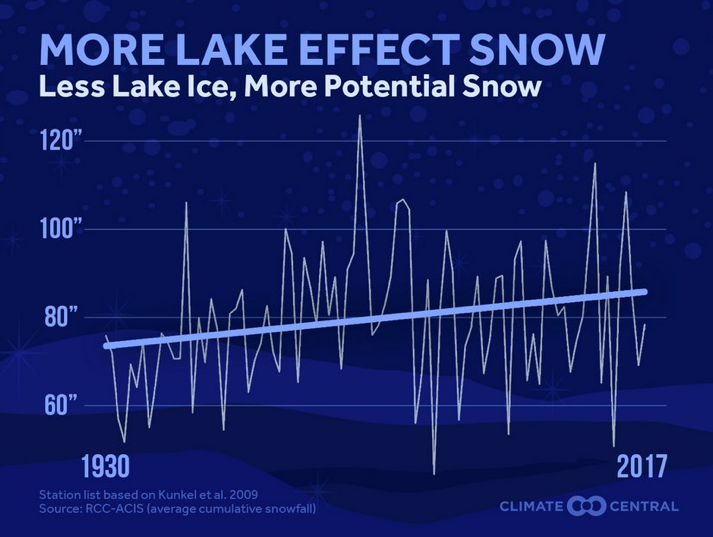
Let’s start with the record five-plus feet of snowfall accumulation in Erie, Pennsylvania, in late December. Does this disprove global warming? “Exactly the opposite,” explains my colleague, Dr. Katharine Hayhoe of Texas Tech University. 
Global warming is leading to later freeze-up of the Great Lakes and warmer lake temperatures. It is the collision of cold Arctic air with relatively warm unfrozen lake water in early winter that causes lake effect snows in the first place. The warmer those lake temperatures, the more moisture in the air, and the greater potential for lake effect snows. Not surprisingly, we see a long-term increase in lake effect snowfalls as temperatures have warmed during the last century (see figure below).
iew image on Twitter
How about those frigid low temperatures back east this winter? Surely that extreme cold must disprove global warming?
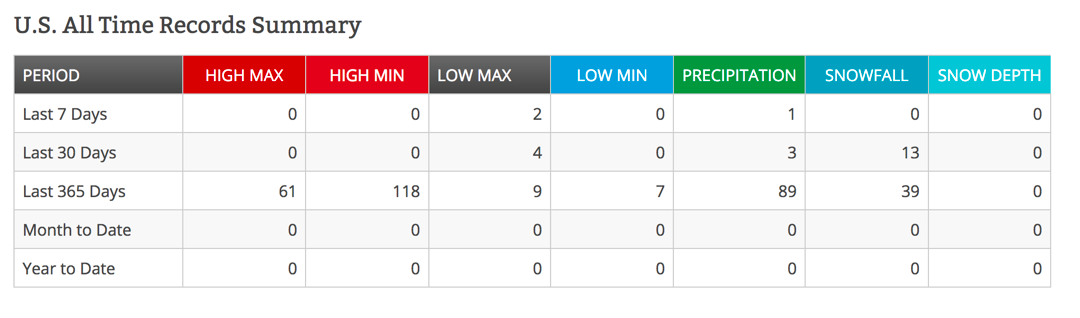
Once again, the claim is misguided. While we have seen some daily all-time lows for a smattering of locations in the US, these pale in comparison with the number of all-time highs we’ve seen over the past year. In fact, the record highs have outpaced the record lows 61 to seven, i.e. nine times more often (see table below), consistent with what we expect to see as the globe continues to warm.
../../../../Desktop/Screen%20Shot%202018-01-03%20at%205.16.4
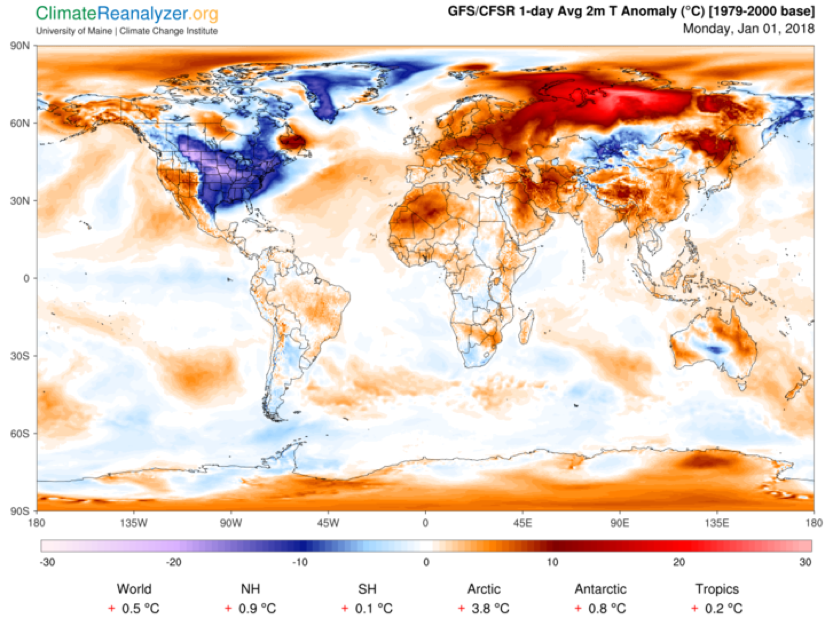
Moreover, while we’ve seen some cold weather in the eastern half of the North America (see the pattern for New Year’s Day below), the western half of North America has been unusually warm. Indeed, most of the Northern Hemisphere, and the globe overall, have been unusually warm. That’s why we call it global warming, folks.
ttps://img.huffingtonpost.com/asset/5a4ac2201c00003b0068e12d.png?ops=scalefit_720_noupscale
(Image obtained using Climate Reanalyzer, Climate Change Institute, University of Maine, USA)
But what about this pattern of cold in the eastern US and warm in the western US? This so-called “dipole” pattern has become more common in recent winters, and recent research suggests that climate change may be favoring this contrast in temperature by causing the jet stream to meander in a particular pattern, with an upward meander or “ridge” in the west bringing warm air up from the south and a downward meander or “trough” in the east, bringing cold air down from the north. Some scientists think that the dramatic loss of sea ice in the Arctic may be favoring this jet stream pattern.
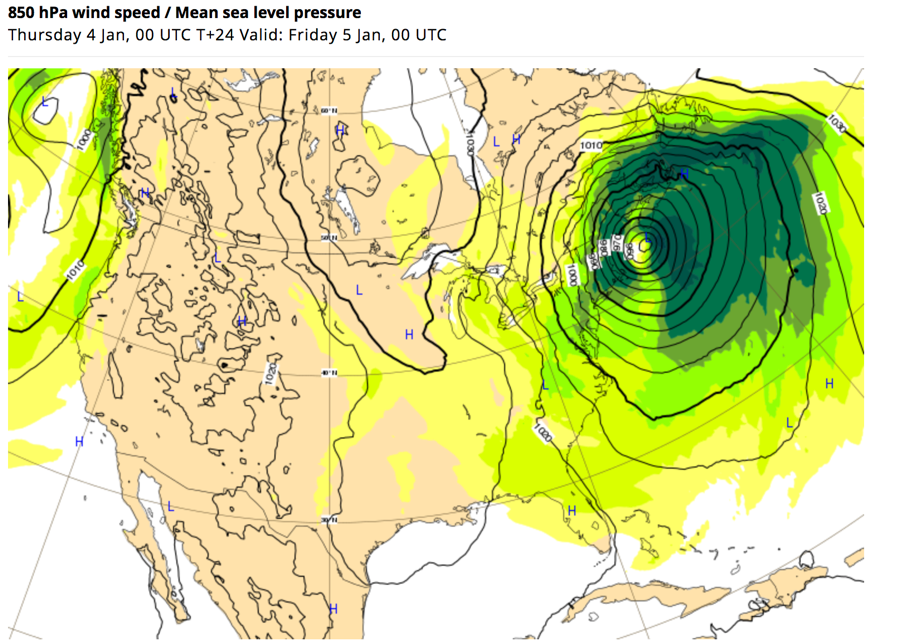
Finally, the news is abuzz today with an impending “massive Nor’easter,” a “bomb cyclone” that is “set to explode” in the days ahead (see plot below). This isn’t just hype. The National Weather Service has warned that “this rapidly intensifying East Coast storm will produce strong, damaging winds — possibly resulting in downed trees, power outages, and coastal flooding.”
With a central pressure forecast to drop very low (see plot below), the storm will threaten the record set by unprecedented 2012 Superstorm Sandy as the lowest surface pressure ever measured in the North Atlantic north of Cape Hatteras (the central surface pressure of a storm is one measure of its strength).
(© 2018 ECMWF cc by nc nd 4.0)
Surely such a massive winter storm, with its promise of bitter cold winds and potentially heavy coastal snowfalls, must be evidence against the climate crisis?
Once again, rather the opposite is true. East Coast winter storms, known as “nor’easters” because of the unusual northeasterly direction of the winds as the storm spirals in from the south, are unusual in that they derive their energy not just from large contrasts in temperature that drive most extratropical storm systems, but also from the energy released when water evaporates from the (relatively warm) ocean surface into the atmosphere.
This is a characteristic that these storms share with tropical storms and hurricanes. The warmer the ocean surface, the more energy that is available to intensify these storms. And the warmer the ocean surface, the more moisture there is in the atmosphere – moisture that is available to form precipitation. As the winds wrap around in a counter-clockwise manner, they bring all of that moisture northwest, where it is chilled and ultimately falls not as rain but snow. Lots of snow.
As the oceans continue to warm, cold Arctic air masses collide with increasingly warm Atlantic Ocean waters. That means larger temperature contrasts and potentially stronger storms. But those warmer oceans also mean more moisture in the atmosphere, even more energy to strengthen the storm, and the potential for larger snowfalls.  We might, if you’ll forgive the pun, call this a “perfect storm” of factors for intensification.
Indeed, climate model simulations indicate that we can expect more intense nor’easters as human-caused climate change continues to warm the oceans.
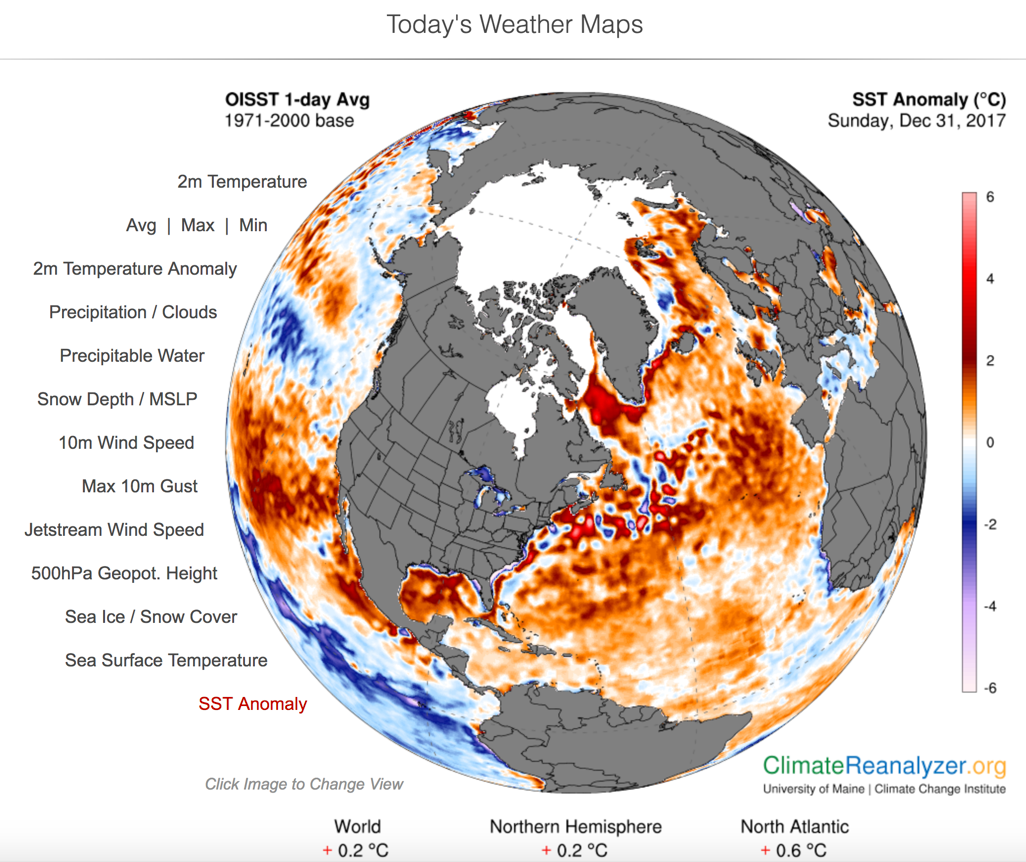
Screen%20Shot%202018-01-03%20at%202.11.16%20PM.png
(Image obtained using Climate Reanalyzer, Climate Change Institute, University of Maine, USA)
This leads us back to the current strengthening storm. The entire North Atlantic is unusually warm right now (+0.6 degrees Celsius) relative to the already-globally-warmed, late-twentieth-century average (1971-2000), and there are large patches of ocean water off the US East Coast that are 2-4 degrees Celsius above that average. The storm will be encountering that exceptional ocean heat as it travels northward along the US coastline, and that is part of why it has a very good chance of becoming the most intense nor’easter we’ve yet observed.
So, to the climate change doubters and deniers out there, the unusual weather we’re seeing this winter is in no way evidence against climate change. It is an example of precisely the sort of extreme winter weather we expect because of climate change.
Stay up to date with the latest in climate fight and insight from influential scientists and voices like Dr. Mann by signing up for our activist email list today.
Dr. Michael Mann is distinguished professor of atmospheric science at Penn State University and author of The Hockey Stick and The Climate Wars and, more recently, The Madhouse Effect.

https://www.climaterealityproject.org/blog/perfect-storm-extreme-winter-weather-bitter-cold-and-climate-change

Monday, June 5, 2017

Jane Mayer, The New Yorker: Charles and David Koch uses their spare millions to distort our politics and keep us from using clean energy to keep their dirty profits

by Jane Mayer, The New Yorker, June 5, 2017

If there was any lingering doubt that a tiny clique of fossil-fuel barons has captured America’s energy and environmental policies, it was dispelled last week, when the Trump Administration withdrew from the Paris climate accordSurveys showed that a majority of Americans in literally every state wanted to remain within the agreement, and news reports established that the heads of many of the country’s most successful and iconic Fortune 100 companies, from Disney to General Electric, did, too. Voters and big business were arrayed against leaving the climate agreement. Yet despite the majority’s sentiment, a tiny—and until recently, almost faceless—minority somehow prevailed.

How this happened is no longer a secret. The answer, as the New York Times reported, on Sunday, is “a story of big political money.” It is, perhaps, the most astounding example of influence-buying in modern American political history.

As the climate scientist Michael Mann put it to me in my book “Dark Money,” when attempting to explain why the Republican Party has moved in the opposite direction from virtually the rest of the world, “We are talking about a direct challenge to the most powerful industry that has ever existed on the face of the Earth. There’s no depth to which they’re unwilling to sink to challenge anything threatening their interests.” For most of the world’s population, the costs of inaction on climate change far outweigh that of action. But for the fossil-fuel industry, he said, “It’s like the switch from whale oil in the nineteenth century. They’re fighting to maintain the status quo, no matter how dumb.”

Until recently, those buying the fealty of the Republican Party on these issues tried to hide their sway, manipulating politics from the wings. But what became clear this past weekend is that they can remain anonymous no longer. With their success dictating America’s climate policy, the fossil-fuel industry’s political heavyweights have also won new notoriety. Charles and David Koch, the billionaire owners of the Kansas-based, fossil-fuel leviathan Koch Industries, used to attract attention only from environmental groups such as Greenpeace, which labelled them “the Kingpins of Climate Denial.” They were so secretive about their political activities that, when I first wrote about their tactics in The New Yorker, in 2010, the article was titled “Covert Operations.” But now references to the Kochs are becoming almost as commonplace as the Dixie Cups, Lycra, and other household products that their business produces. As the Times noted, Republican lawmakers’ swerves to the right on climate issues “did not happen by themselves. Republican lawmakers were moved along by a campaign carefully crafted by fossil-fuel industry players, most notably Charles D. and David H. Koch, the Kansas-based billionaires who run a chain of refineries. . . .” The Kochs were called out on the Sunday talk shows this past weekend, too. On ABC’s “This Week,” former Vice-President Al Gore cited “dark money” from fossil-fuel companies as the explanation for Trump’s withdrawal from the Paris accord; on NBC’s “Meet the Press,” former Secretary of State John Kerry specifically chastised the Kochs.

Now that they have been flushed from the shadows, the Kochs and their political operatives have proudly taken credit for obstructing the U.S. government from addressing climate change. Charles Koch, who is a hardcore libertarian, has argued that government action was only “making people’s lives worse, rather than better,” as he put it in an interview with Fortune last year. Meanwhile, Tim Phillips, the president of Americans for Prosperity, the Kochs’ main political-advocacy organization, has boasted about the group’s success in killing the careers of politicians who broke with the brothers’ anti-climate-change agenda. Phillips recounted to the Times that, after 2010, when the group spent tens of millions of dollars in campaigns aimed at defeating congressmen who wanted to take action on climate change, no Republican candidate has dared cross the Kochs on the issue again. “After that,” he said, support for renewable energy “disappeared from Republican ads. Part of that was the polling, and part of that was the visceral example of what happened to their colleagues who had done that. . . . It told the Republicans that we were serious, that we would spend some serious money against them.”

President Trump may be the face of America’s withdrawal from the Paris climate accord, but, as deeper reporting is making clear, it’s the Kochs and their fellow fossil-fuel industry donors who really own the policy. Whether responsibility for such a consequential move will redound to their favor remains to be seen. But it’s worth remembering that Fred Koch, Charles and David’s father and the founder of the family company, had a favorite admonition. He warned his boys to keep a low profile and stay below the surface, because, as he put it, “It’s when the whale spouts that he gets harpooned.”

Sunday, April 9, 2017

Northern Hemisphere jet streams stumble as the world warms

The warming of the atmosphere by greenhouse gases is slowing the jet streams which drive the Northern Hemisphere's weather, scientists say. 
by Tim Radford, Climate News Network, April 9, 2017

LONDON
 – Researchers have once again linked a sequence of devastating climate events to global warming fuelled by prodigal human use of fossil fuels. And this time, they believe they have identified the agency
 behind the blazing summers that have claimed lives and destroyed livelihoods repeatedly during this century.
They argue in the journal Scientific Reports that human impact on the climate now reaches high into the stratosphere, to influence the behaviour patterns of the giant jet streams that carry heat and moisture around the Northern Hemisphere and keep the weather on the move.
Warming driven by carbon dioxide emissions from car exhausts and power stations, they argue, tends to make these giant oscillating waves stall in their journey around the hemisphere – to create enduring episodes of high and low pressure and lingering hazards of drought and flood.
“The unprecedented 2016 California drought, the 2011 US heatwave and 2010 Pakistan flood as well as the 2003 European hot spell all belong to a most worrying series of extremes,” says Michael Mann from Pennsylvania State University in the US.

“Human activity has been suspected of contributing to this pattern before, but now we uncover a clear fingerprint of human activity”

“The increased incidence of these events exceeds what we would expect from the direct effects of global warming alone, so there must be an additional climate change effect. In data from computer simulations as well as observations, we identify changes that favour unusually persistent, extreme meanders of the jet stream that support such extreme weather events.
“Human activity has been suspected of contributing to this pattern before, but now we uncover a clear fingerprint of human activity.”
Professor Mann has repeatedly confirmed the link between human action and climate change. His co-author Dim Coumou of the Potsdam Institute for Climate Impact Research in Germany and the VU University in Amsterdam in the Netherlands has separately linked storm tracks to surface temperature extremesmade a connection between torrential rains and planetary warming, and confirmed too that less stormy weather is not necessarily a good sign, because it could be the harbinger of heat waves.
And the researchers now have support for their their suspicions: the jet streams that sweep the hemisphere in huge atmospheric waves, plunging between Arctic and tropics, bring changes of weather.
If they should stall, one region may be committed to long drought, dangerous hot weather (as in Russia in 2010 and Texas in 2011) and even forest fires as in California in 2015) – or, in some cases, catastrophic and sustained rainfall of the kind that flooded Pakistan in 2010.

Questions remain

No single extreme event could ever be satisfactorily and conclusively linked to a long-term trend like global warming. But once scientists register an increasing frequency of such events, they can start to use climate simulations to see if such events become more likely in a warming world.
“The more frequent persistent and meandering jet stream state seems to be a relatively recent phenomenon, which makes it even more relevant," said Dr Coumou. “We certainly need to further investigate this – there is some good evidence, but also many open questions.”
And Professor Mann said: “The warming of the Arctic, the polar amplification of warming, plays a key role here. The surface and lower atmosphere are warming more in the Arctic than anywhere else on the globe.
“That pattern projects onto the very temperature gradient profile that we identify as supporting atmospheric waveguide conditions.”

Saturday, March 5, 2016

Michael Mann: No hiatus in attempts to misuse the science on global warming

There is no hiatus in attempts to misuse the science on global warming, says Michael Mann, a prime target of climate deniers

A sign warning people to in California to prepare for El Nino
El Niño influences global temperatures
Mark Boster/Los Angeles Times via Getty Images
by Michael E. Mann, NewScientist, March 4, 2016

Here we go again. Along with leading climate scientists, I recently argued there was a temporary slowdown in the rate of warming during the first decade of this century. For those who seem to miss the point, this means there was still an increase in temperature, but the rate of increase was slower.

The article (Nature Climate Change, DOI: 10.1038/nclimate2938gently took issue with a conclusion reached by Tom Karl, of the US National Oceanic and Atmospheric Administration, and his colleagues last summer (Science, DOI: 10.1126/science.aaa5632), that no such slowdown had occurred.

Climate change deniers are nothing if not predictable. Give them an inch and they take a mile. They seized on this to manufacture yet another fake controversy. Conservative news outlets claimed the two studies showed a fundamental schism within the scientific community and called into question the veracity of human-caused climate change.

Chief among the critics is right-wing provocateur James Delingpole. His article was headlined Now even Michael Mann admits the ‘pause’ in global warming is real; throws allies to wolves. The title itself is false.

What the deniers fail to disclose is that there is sufficient variation in the details drawn on by studies of the period – including which version of the temperature record is used and precisely what time intervals are being compared – that different researchers can come to different honestly held conclusions about what the data show. Respectable news outlets have accurately noted that.

And there is broad consensus among all the researchers involved on key points.

Inexorable march

First, there was no pause in global warming. Indeed, I have mocked such a notion as the “faux pause.” There was at most a temporary slowdown. With the record-setting temperatures of the past two years, that slowdown is almost certainly over now.

Second, any fleeting slowdown was almost certainly due to natural factors such as the El Niño/Southern Oscillation ocean phenomenon and the effect of natural drivers including volcanic eruptions and small but measurable changes in solar output.

These natural factors cannot slow the inexorable warming of the oceans and atmosphere resulting from anthropogenic pollution, they can at most mask it temporarily. The El Niño-ish conditions of the past two years may in fact herald the flip-side, with natural variability now adding to global warming.

Finally, despite claims by climate contrarians, the temporary slowdown does not indicate any discrepancy between climate model simulations and observations. Accounting for the vagaries of internal climate variability, the observations are seen to lie well within the spread of simulated temperature trends, as the figure below shows – the red line is observed temperature departures from the long-term (18802014) mean, the grey lines are model predictions.
Long-term temperature trends
Long-term temperature trend
There are enough legitimate issues to debate, when it comes to matters of climate change adaptation and strategies for reducing carbon emissions. At a critical moment for climate action, the last thing we need is fake debates. Shame there is no hiatus on that front.

https://www.newscientist.com/article/2079454-why-we-need-to-stop-fake-claims-that-global-warming-paused/

Monday, February 22, 2016

108 scientists call on world’s largest Earth science organization (the American Geophysical Union) to reject ExxonMobil sponsorship


FOR IMMEDIATE RELEASE
February 22, 2016
Contact: Ben Scandella, 206-276-2699, bscand@gmail.com

108 scientists call on world’s largest Earth science organization
to reject ExxonMobil sponsorship

Cambridge, MA Today, more than 100* geoscientists sent a letter (also attached) to the President of the American Geophysical Union (AGU) - the world’s largest association of Earth scientists - calling for an end to ExxonMobil sponsorship of AGU in a stand against climate science disinformation.

Signatories include leading AGU-member scientists such as former Director of the NASA Goddard Institute for Space Studies and renowned climatologist Professor James E. Hansen, former President of the American Association for the Advancement of Science and Harvard Professor James J. McCarthy, Penn State’s Earth System Science Center director Michael E. Mann, and author of Merchants of Doubt and Harvard Professor Naomi Oreskes, as well as other concerned geoscientists including Professor Hans Schellnhuber, CBE, who currently serves as Chair of the German government’s Advisory Council on Global Change and as a climate advisor to the Pope.

“As Earth scientists, we are deeply troubled by the well-documented complicity of ExxonMobil in climate denial and misinformation…By allowing Exxon to appropriate AGU’s institutional social license to help legitimize the company’s climate misinformation, AGU is undermining its stated values as well as the work of many of its own members,” states the letter.

In fact, AGU’s own Organizational Support Policy states that “AGU will not accept funding from organizational partners that promote and/or disseminate misinformation of science, or that fund organizations that publicly promote misinformation of science.” Despite this claim, the nearly 24,000 attendees of the AGU 2015 Fall meeting were greeted by a prominent display of gratitude for Exxon’s sponsorship.

Asked why she signed the letter, Harvard Professor Naomi Oreskes - whose work has been instrumental in exposing the corporate-financed public relations efforts to sow confusion about scientific issues ranging from tobacco smoke to climate change - explained, “The scientific community has been clear and articulate in communicating the reality and threat of global warming. However, accepting sponsorship from ExxonMobil undermines that message. We cannot say that climate change is real and demonstrated, and at the same time turn a blind eye to the real and demonstrated nature of ExxonMobil’s anti-scientific activities.”

The letter comes amid the ExxonMobil climate denial scandal, with the company currently under investigation by the New York and California Attorneys General as to whether it lied to the public and its shareholders about climate change risks.

Leading climatologist Michael Mann, a signatory whose “hockey stick” global warming graph has made him a well-known target of attacks by climate deniers, remarked, “While I recognize that it is a contentious matter within the diverse AGU community, I just don't see how we can, in good conscience, continue to accept contributions from a company that has spent millions of dollars over several decades funding bad faith attacks on scientists within our community whose scientific findings happen to be inconvenient for fossil fuel interests.”

“As the largest and most respected society of Earth scientists in the world, the AGU should not be invested in nor take money from a corporation that places its profits above the health and well-being of our global society,” commented Cornell University Professor Charles Greene, another signatory of the letter.

The letter is the most recent example of a growing trend of scientists stepping out of their traditional roles to advocate for stronger climate action and to counter climate science disinformation in response to the urgency of climate change. For example, through the recently launched Climate Feedback project, scientists are evaluating the credibility of climate science presented in the popular press. Last Spring, dozens of the world’s top scientists released a letter urging science museums to cut ties to fossil fuel interests. They subsequently led a campaign to remove David Koch from the board of New York’s American Museum of Natural History. Mr. Koch resigned from his board position in December.

*Note: A few signatories prefer to not disclose their names in the online version of the letter.

###

RELEVANT LINKS:

  1. The letter follows an editorial by three AGU members, published in January, calling on AGU to reject Exxon’s sponsorship of its future scientific conferences: http://www.theguardian.com/environment/climate-consensus-97-per-cent/2016/jan/06/why-is-the-largest-earth-science-conference-still-sponsored-by-exxon