Blog Archive

Showing posts with label George Monbiot. Show all posts

Wednesday, November 16, 2016

George Monbiot: The Deep History Behind Trump’s Rise: How a ruthless network of super-rich ideologues killed choice and destroyed people’s faith in politics

by George Monbiot, The Guardian, November 14, 2016  www.monbiot.com

The events that led to Donald Trump’s election started in England in 1975. At a meeting a few months after Margaret Thatcher became leader of the Conservative party, one of her colleagues, or so the story goes, was explaining what he saw as the core beliefs of conservatism. She snapped open her handbag, pulled out a dog-eared book, and slammed it on the table. “This is what we believe,” she said. A political revolution that would sweep the world had begun.

The book was The Constitution of Liberty by Frederick Hayek. Its publication in 1960 marked the transition from an honest, if extreme, philosophy to an outright racket. The philosophy was called neoliberalism. It saw competition as the defining characteristic of human relations. The market would discover a natural hierarchy of winners and losers, creating a more efficient system than could ever be devised through planning or design. Anything that impeded this process, such as significant tax, regulation, trade union activity or state provision, was counter-productive. Unrestricted entrepreneurs would create the wealth that would trickle down to everyone.

This, at any rate, is how it was originally conceived. But by the time Hayek came to write The Constitution of Liberty, the network of lobbyists and thinkers he had founded was being lavishly funded by multimillionaires, who saw the doctrine as a means of defending themselves against democracy. Not every aspect of the neoliberal programme advanced their interests. Hayek, it seems, set out to close the gap.

He begins the book by advancing the narrowest possible conception of liberty: an absence of coercion. He rejects such notions as political freedom, universal rights, human equality and the distribution of wealth, all of which, by restricting the behaviour of the wealthy and powerful, intrude on the absolute freedom from coercion he demands. Democracy, by contrast, “is not an ultimate or absolute value.” In fact, liberty depends on preventing the majority from exercising choice over the direction that politics and society might take.

He justifies this position by creating a heroic narrative of extreme wealth. 

He conflates the economic elite, spending their money in new ways, with philosophical and scientific pioneers. Just as the political philosopher should be free to think the unthinkable, so the very rich should be free to do the undoable, without constraint by public interest or public opinion.

The ultra rich are “scouts,” “experimenting with new styles of living,” who blaze the trails that the rest of society will follow. The progress of society depends on the liberty of these “independents” to gain as much money as they want and spend it how they wish. All that is good and useful, therefore, arises from inequality. There should be no connection between merit and reward, no distinction made between earned and unearned income and no limit to the rents they can charge.

Inherited wealth is more socially useful than earned wealth: “the idle rich,” who don’t have to work for their money, can devote themselves to influencing “fields of thought and opinion, of tastes and beliefs.” Even when they seem to be spending money on nothing but “aimless display,” they are in fact acting as society’s vanguard. Everything the rich might do is, by definition, good.

Hayak softened his opposition to monopolies and hardened his opposition to trade unions. He lambasted progressive taxation and attempts by the state to raise the general welfare of citizens. He insisted that there is “an overwhelming case against a free health service for all” and dismissed the conservation of natural resources. It should come as no surprise to those who follow such matters that he was awarded the Nobel Prize for economics.

By the time Mrs Thatcher slammed his book on the table, a lively network of thinktanks, lobbyists and academics promoting Hayek’s doctrines had been established on both sides of the Atlantic,  abundantly financed by some of the world’s richest people and businesses, including DuPont, General Electric, the Coors brewing company, Charles Koch, Richard Mellon Scaife, Lawrence Fertig, the William Volcker Fund and the Earhart Foundation. Using psychology and linguistics to brilliant effect, the thinkers these people sponsored found the words and arguments required to turn Hayek’s anthem to the elite into a plausible political programme.

Thatcherism and Reaganism were not ideologies in their own right; they were just two faces of neoliberalism. Their massive tax cuts for the rich, crushing of trade unions, reduction in public housing, deregulation, privatisation, outsourcing and competition in public services were all proposed by Hayek and his disciples. But the real triumph of this network was not its capture of the right, but its colonisation of parties that once stood for everything Hayek detested.

Bill Clinton and Tony Blair did not possess a narrative of their own. Rather than developing a new political story, they thought it was sufficient to triangulate. In other words, they extracted a few elements of what their parties had once believed, mixed them with elements of what their opponents believed, and developed from this unlikely combination a “third way.”

It was inevitable that the blazing, insurrectionary confidence of neoliberalism would exert a stronger gravitational pull than the dying star of social democracy. Hayek’s triumph could be witnessed everywhere from Blair’s expansion of the private finance initiative to Clinton’s repeal of the Glass-Steagal Act, that had regulated the financial sector. For all his grace and touch, Barack Obama, who didn’t possess a narrative either (except “hope”), was slowly reeled in by those who owned the means of persuasion.

As I warned in April, the result is first disempowerment then disenfranchisement. If their dominant ideology stops governments from changing social outcomes and delivering social justice, they can no longer respond to the needs of the electorate. Politics becomes irrelevant to people’s lives; debate is reduced to the yabber of a remote elite. The disenfranchised turn instead to a virulent anti-politics, in which facts and arguments are replaced by slogans, symbols and sensation. The man who sank Hillary Clinton’s bid for the presidency was not Donald Trump. It was her husband.

The paradoxical result is that the backlash against neoliberalism’s crushing of political choice has elevated just the kind of man that Hayek worshipped. Trump, who has no coherent politics, is not a classic neoliberal. But he is the perfect representation of Hayek’s “independent”; the beneficiary of inherited wealth, unconstrained by common morality, whose gross predilections strike a new path that others may follow. The neoliberal think tankers are now swarming round this hollow man, this empty vessel waiting to be filled by those who know what they want. The likely result is the demolition of our remaining decencies, beginning with the agreement to limit global warming.

Those who tell the stories run the world. Politics has failed through a lack of competing narratives. The key task now is to tell a new story; of what it is to be a human in the 21st Century. It must be as appealing to some who have voted for Trump and UKIP as to the supporters of Hillary Clinton, Bernie Sanders, or Jeremy Corbyn.

A few of us have been working on this, and can discern what may be the beginning of a story. It’s too early to say much yet, but at its core is the recognition that – as modern psychology and neuroscience make abundantly clear – human beings, by comparison to any other animals, are both remarkably social and remarkably unselfish. The atomisation and self-interested behaviour neoliberalism promotes run counter to much of what comprises human nature.

Hayek told us who we are, and he was wrong. Our first step is to reclaim our humanity.

Tuesday, December 8, 2015

George Monbiot: A Storm of Ignorance [causing disasters like the Cumbria flood]

Censoring official advice, stripping the hills and rivers, the government ensures that disasters like the Cumbria floods will keep recurring

by George Monbiot, The Guardian, December 8, 2015

It’s as if it had come to remind us of what’s at stake. While the climate negotiations in Paris trudge their dreary road, Storm Desmond takes a great boot to our backsides. Yet still we fail to make the connection. The news records the spectacle and ignores the implications.

Rainfall on this scale used to be described as a one-in-100 year, or 200-year, or 1,000-year event. But in Cumbria, where some 30 cm of rain fell in 24 hours, this is the third such catastrophe since 2005. Exceptional events are, perhaps, no longer exceptional.

If so, we should scarcely be surprised. More heat means more energy in the system, and more moisture in the atmosphere. An analysis by scientists at the Met Office, published last month, found that global warming raised the odds – by a factor of seven – that a string of storms of the kind the UK suffered two winters ago would result in exceptionally wet weather.

Just as remarkable is the collective lack of interest in what happens when rain hits the ground. The government boasts that “we are spending £3.2 billion in flood management and defences over the course of this parliament – half a billion pounds more than in the previous parliament.” Yet almost all the money devoted to freshwater flood relief is being spent at the bottom of river catchments. This means waiting until the wall of water arrives before seeking to contain it; a perfect formula for disappointment.

A rational policy would aim to prevent the flood from gathering in the first place. It would address the problem, literally and metaphorically, upstream. A study in mid-Wales suggests that rainwater’s infiltration rate into the soil is 67 times higher under trees than under sheep pasture. Rain that percolates into the soil is released more slowly than rain that flashes over the surface. But Cumbria’s hills are almost entirely treeless, and taxpayers, through the subsidy regime, pay farmers to keep them that way.

Rivers that have been dredged and canalised to protect farmland rush the water instead into the nearest town. Engineering works of this kind were removed a few years ago from the River Liza in Ennerdale. It was allowed to braid, meander and accumulate logs and stones. When the last great storm hit Cumbria, in 2009, the Liza remained clear and fordable the following day, while other rivers roared into furious spate. The Liza’s obstructions held the water back, filtered it and released it slowly. Had all the rivers of Cumbria been rewilded in this way, there might have been no floods, then or now.

During the last deluge, in the winter of 2013-2014, the government’s Environment Agency published a presentation called River Dredging and Flood Defence. It remarked that “Dredging of river channels does NOT prevent flooding during extreme river flows.” Dredging, it noted, makes rivers more dangerous, destabilises bridges, banks and weirs and requires endless expense to maintain.

All copies of this presentation have now been deleted from the web (we republish it exclusively on the Guardian’s site today). It is not hard to see why. In June 2014, in pursuit of its primary mission – appeasing the farming industry – the environment department proposed to deregulate dredging, allowing landowners to strip the structure and wildlife habitat out of ditches and rivers. It will also permit them, with minimal oversight, to extract gravel from the riverbed and to build culverts. There could be no better formula for disaster downstream. Once water is in the rivers, it has to go somewhere. If you don’t hold it back in the fields, it will bowl up instead in people’s homes.

But no one in power seems interested in the causes; all focus is on the outcomes. For the past three years, Cumbria’s two most prominent MPs, Rory Stewart, now a minister at the environment department, and Tim Farron, leader of the Lib Dems, have denounced those who call for the better management of watersheds to prevent flooding. In 2013, Rory Stewart blasted the National Trust because it “allows water to ruin the lowland pastures of their small tenant farms, apparently on the advice of the Environment Agency.” In 2014, he mocked the RSPB and the water company United Utilities for managing their land “in a way that ‘increased biodiversity, decreased flooding, increased carbon capture.’”

In 2013, Tim Farron pronounced himself “delighted that Natural England are readjusting their approach to the uplands, with the recent dropping of their Uplands Vision.” This vision (called Vital Uplands) proposed that there should be more vegetation in the hills to reduce “the risk of downstream flooding.” It noted that “Intensive grazing can cause soil erosion and compaction, and prevent regeneration of scrub and trees, thus speeding water run-off.” The report was publicly denounced by the head of the government body that had commissioned it, Natural England, who happened to make his living as a farmer. Once again, the online version was deleted and the hard copies were pulped. Is this how democracies behave?

Now Messrs Stewart and Farron wring their hands and wring out their clothes, lamenting this inexplicable act of God. On Saturday, Tim Farron was trapped in the floodwaters while driving his car, and had to be rescued. The car, apparently, is a write-off. There is relief that he and his four children came to no harm. Still, parables have been told about men like him.

Meanwhile the talks in Paris have become a festival of empty gestures. The pledges governments have brought fall short of those required to prevent disasters on a much greater scale, and even they are broken as they are made. By pursuing a new dash for gas, while closing down its carbon capture and storage, renewable power and energy efficiency programs, David Cameron’s government makes a mockery of its promises. Worse still, the collective refusal even to discuss keeping fossil fuels in the ground condemns the talks to futility.

Nothing is learnt, crucial discussions are avoided or buried. We are drowning in ignorance; ignorance manufactured by an illiterate media and a hostile government. Every time disaster strikes we respond with bewilderment. Our understanding of what confronts us seems scarcely to have advanced since we responded to catastrophe by burning old women.

Monday, July 21, 2014

Barry Bickmore's hilarious takedown of the Potty Peer's latest rampage, this time on his home away from castle -- WUWT

Readers, have you been finding the summer just a bit too droll?  Well, things are looking up!

For your enjoyment, Dr. Barry Bickmore does another simply marvelous takedown of Monckton's latest antics on WUWT:

by Barry Bickmore, Climate Asylum, July 21, 2014

Hang around the Watt’s Up With That? blog for any length of time, and it will become apparent that His Lordship, Christopher Monckton, 3rd Viscount of Brenchley, is all but worshipped by many of the regulars there.  No matter how absurd Monckton’sintellectual flagellations, Anthony Watts will post them, and hordes of credulous commenters will heap adulation upon His Lordship.  One of Monckton’s long-time fans is Willis Eschenbach–construction manager, climate hobbyist, and frequent contributor to both the blog and the Heartland disinformation conference.  Willis, unfortunately, learned what happens if you express strong disagreement with anything Monckton says, i.e., Monckton threatens to sue you.  Yes, Monckton has turned yet another corner, and has begun threatening his fellow climate change contrarians, in addition to the typical academics and reporters.  Witness poor Willis begging his fallen hero to reconsider!
Christopher, please, I implore you as a friend, cease with the legal threats. Every time you make such a threat of legal action against some scientist that you disagree with, your credibility sinks another notch.
Yes, you have the means and the position and the title and the power and the friends and the money to cause trouble for people … do you truly not understand that your threats to use your power and money and advantages and hereditary title against some poor skeptical shlub like myself because you don’t like his claims just makes you look like an insecure bully? Is there truly no other way to defend yourself? Dang, dude, you can strip the hide off a buffalo with your unmatchable eloquence, or have half the world laughing at someone’s foolishness with your irascible wit … you don’t need legal means to set things straight, your intellect and your words are more than enough to do that.
Alas, Willis’s struggle isn’t merely against a momentary lapse in judgement by his hero.  He is fighting INVIOLATE LAWS OF THE UNIVERSE–Bickmore’s First and Second Laws of Monckton.
Bickmore’s First Law of Monckton 
For every person who publicly endorses Lord Monckton’s climate pronouncements for merely irrational reasons, there exists a threshold in Monckton’s behavior which, if crossed, will cause said person to regret their association.
Bickmore’s Second Law of Monckton
Any behavioral threshold posited by Bickmore’s First Law of Monckton will eventually be crossed by Lord Monckton.
Let’s back up and examine the series of events that led to this curious juncture, so that we might recognize the inexorable march of fate, driven by the Invisible Hand of Bickmore’s Laws of Monckton.
A Pebble in the Pond
Our story begins with Dr. David Evans, an electrical engineer who goes about inexplicably calling himself a “Rocket Scientist”, and a conspiracy theorist who makes Jews uncomfortable by going on and on about an international banking conspiracy involving the Rothschilds.  Evans is in the running for the Next Climate Galileo for his new “theory,” which posits a mysterious “Force X” from the Sun that influences the Earth’s climate with an 11-year delay.  And it involves math.  Jo Nova, Lord Monckton, and some other prominent contrarians immediately jumped on the bandwagon, but others (i.e., the ones who don’t think the Sun can possibly the culprit for recent warming) weren’t so sure.  Among them were Willis Eschenbach and Leif Svalgaard.  Svalgaard appears to be a solar physicist, and doesn’t buy the idea that the Sun explains everything, but I’ve heard he is some kind of “lukewarmer.  He comments regularly at WUWT, to the extent that Anthony Watts calls him “WUWT’s resident solar expert.”
The usual protocol at WUWT is that Anthony will put up a guest post by some wing nut, even if he knows it is utter nonsense.  (Check out some of my favorite examples here.)  Some commenters will jump right on the bandwagon, but others will disagree.  A few hardy souls from Reality might pop in to take a swipe at it, and will get dog-piled.  Watts and all the regulars will pat themselves on the back for being so open-minded, in contrast to the “alarmists” who are always trying to stifle such scintillating intellectual exchanges.  It’s all good, as long as the conclusion to any argument (no matter how ridiculous) is that the scientific consensus on climate change is wrong, or doesn’t exist, etc.
The problem is that some of the contrarians–even the sort who hang about WUWT–still have some minimal intellectual standards.  Both Eschenbach and Svalgaard were able to recognize that much of Evans’s work relied on a bizarre hodgepodge of solar data sets that was apparently corrupted by some improper data processing techniques.  They spoke up, and lots of angry back-and-forth ensued, most notably with the following comment by Svalgaard.
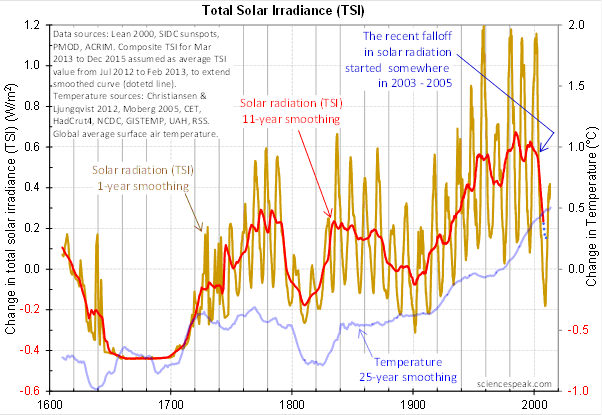
It is worse than I thought. The TSI used by Evans is totally wrong
Apart from the use of the obsolete Lean TSI for the early years, the most blatant error is the statement that TSI has had a sharp unprecedented drop starting in 2003-2005 to now. This is complete nonsense. Here is TSI since 2003
There is no such drop. If anything TSI is now higher than it were in 2003. As far as I am concerned, the model is already falsified. Not by the observations but by the [almost fraudulent - as there clearly is an agenda here] use of invalid input to begin with. This concludes my comments as the prediction is worthless on its face.
Monckton Escalates
The “almost fraudulent” comment angered His Lordship, who called it “libelous.”  Svalgaard returned fire, calling one of Monckton’s comments “outright stupid, and advising, “You do yourself no favours by pretending to be so dumb.”  Monckton insisted he was right, and pronounced Svalgaard’s scientific career to be over.
He is a quack, not a scientist. This was not inadvertence on his part: it was plain wickedness. Nothing he ever says again on any scientific subject can or will be taken seriously. He is finished, dead by his own hand.
Willis Eschenbach was chiming in, meanwhile, and getting a little hot under the collar when Monckton defended Evans’s refusal to make his data and code available to others.  “Ooooh, bad Lord Moncton [sic], no cookies, logical fail.”
Monckton, in his usual fashion, started throwing out threats.
I have given Mr Svalgaard every opportunity to apologize to Dr Evans but he has chosen not to take it. I shall now consult the statistician, verify Mr Svalgaard’s employment status and, if any academic institution is employing him, refer his allegation against Dr Evans to the appropriate authorities as an instance of gross and persisting research misconduct.
Which really ticked off Svalgaard.  “Good luck with that. I can’t wait.”  Monckton thenwent into some detail about his plans.
I do not speak for Dr Evans in any way, and I have no idea of whether he will decide to sue. As a first step, he might request Anthony to allow him to answer the allegations in a head posting, which would go some way towards expunging Mr Svalgaard’s nastly libel of him in his calling as a scientist.
Perhaps in the United States, as one thoughtful commenter has suggested, persistently and falsely calling someone “almost fraudulent” for allegedly “fabricating” scientific data is thought acceptable. Not in Australia. There, as in any British-law jurisdiction, such a libel is taken very seriously indeed. I had hoped I had made that plain to Mr Svalgaard, so as to give him the chance to get himself off the hook.
For my part, I am referring Mr Svalgaard’s long list of malicious comments about Dr Evans (but not about me: I give as good as I get) to his university, which will know best how to handle the matter, for there is a rather delicate aspect that I am not at liberty to discuss here. The university will most certainly realize that the do-nothing option is not an option. The libel is too grave and too persistent. My lawyers are looking at it tomorrow to see whether malice is present, in which case the damages would triple, to say nothing of the costs. Their corresponding lawyers in the U.S. will be giving advice on whether Dr Evans would count in U.S. law as a “public figure,” Probably not, from what I know of the “public-figure” test, in which event, in order to enforce the judgement of the Australian courts in the U.S., it would not be necessary to prove malice (for, though malice seems evident, the test in Australian law is high).
It would also be open to Dr Evans simply to apply to the court for a declaration (in Scotland, declarator) that he had not fabricated anything or engaged in any of the other varieties of scientific misconduct of which Mr Svalgaard has seen fit to accuse him with such vicious and unbecoming persistence. Given the sensitivity to which I shall be drawing the university’s attention, that might be the kindest course.
And there, I think, we had better leave it and let the appropriate authorities take over. I have only been as explicit as this because this posting will also go some little way towards expunging the libel and minimizing the damage to Dr Evans’ reputation that Mr Svalgaard seems to have intended.
What His Lordship forgot to mention was that the 2010 SPEECH Act makes foreign libel judgements unenforceable in the USA, unless they are compliant with the First Amendment.  Oh, and the allegedly libelous statements must be provably false.  Given that Svalgaard only said that Evans’s mistakes were “almost fraudulent,” whatever that means, good luck with that.
The Olive Branch Gets Torched
Willis felt bad that he had let his temper get the best of him, and he regretted Svalgaard’s “almost fraudulent” comment, so he wrote another blog post called “Mending Fences, in which he apologized for any rhetorical excesses, but defended his position.  He also said that, while he disagreed with Svalgaard’s characterization, he thought it was “understandable” that he would float the idea, given the sheer number of mistakes Evans had made.  Monckton showed up in the comments, once again, demanded further apologies, and hinted that he was following through on his threats against Svalgaard.
Mr Eschenbach says it was “understandable” that another contributor had accused Dr Evans of being “almost fraudulent.” It was not “understandable.” It was irresponsible and inappropriate…. There was no basis whatsoever for accusing Dr Evans of being “almost fraudulent,” and the person who made that allegation and regrettably failed to withdraw it is now in considerable trouble over it. There are plenty of fraudsters in the climate scam, but Dr Evans is most certainly not one of them.
Well, Svalgaard wasn’t having any of that, and responded with the Big Guns, namely, my own Lord Monckton’s Rap Sheet!!!!
Monckton of Brenchley says:
July 17, 2014, at 3:56 am
“There are plenty of fraudsters in the climate scam,”
I note that another commenter here has accused me of fraud, and has cited a particular website much of whose contents I had not previously seen. My lawyers will be visiting me early next week to deal with some of the allegations on that website.
So apparently now he’s going to lob some legal threats my way, too, unless he was talking about Gavin Schmidt’s piece at the Realclimate site.  If he wants to threaten me, it won’t be the first time.  I am now opening a betting pool in the comments, so my readers can weigh in about (1) whether Monckton will actually follow through on his threats, and (2) if so, whether his objections will include his oft repeated claim that he is a member of Parliament, no matter what Parliament says.
Willis chastised His Lordship for his hypocritical behavior.
Finally, you advocate “greater civility all around,” while at the same time you said you are paying your lawyers to find out if David and Jo can claim triple monetary damages from Leif and unspecified “others” (perhaps including myself) for some imagined damage to their reputations … perhaps it’s just me, but I find resorting to threats of legal action and triple monetary damages in a scientific discussion, however fractious, to be … well … not all that civil …
Monckton shot back:
That commenter finally presumes to give me legal advice. With respect, that is not a matter for him, nor am I aware that he has legal qualifications. I had not until recently realized the extent to which websites all over the place were accusing me of falsehoods and fabrications of which I was not guilty. One of these accusations was so effective that even our kind host here was initially taken in by it. However, unlike the commenter who has made such an uncommon nuisance of himself here, he quietly investigated the allegation in question, found it to have been entirely unmeritorious, and was good enough to publish the results of his researches. It will now be necessary for me to have that and other libels retracted and apologized for, so that no one else is taken in.
[NOTE:  That's why I'm betting that Monckton might bring up his claim to be a member of Parliament.  Anthony Watts ("our kind host") once posted an explanation by a lawyer Monckton hired, about why he is really a member, no matter what Parliament says.  I responded with a post about how ridiculous the lawyer's claims were. ]
Which brings us back to Willis’s plea to his fallen hero.
Christopher, please, I implore you as a friend, cease with the legal threats. Every time you make such a threat of legal action against some scientist that you disagree with, your credibility sinks another notch.
Yes, you have the means and the position and the title and the power and the friends and the money to cause trouble for people … do you truly not understand that your threats to use your power and money and advantages and hereditary title against some poor skeptical shlub like myself because you don’t like his claims just makes you look like an insecure bully? Is there truly no other way to defend yourself? Dang, dude, you can strip the hide off a buffalo with your unmatchable eloquence, or have half the world laughing at someone’s foolishness with your irascible wit … you don’t need legal means to set things straight, your intellect and your words are more than enough to do that.
Alas, Willis may still fail to realize that every time someone has bothered to look beyond Monckton’s “unmatchable eloquence” (translation:  “bombastic nonsense calculated to impress the credulous”) they have found the “intellect” lacking and the “words” misleading.  And they have very often become the target of his threats.  Lest any of us forget the history, I include here the “Threatening Those Who Disagree With Him” section of Lord Monckton’s Rap Sheet.  I’ll have to update it, now.
1. Monckton has threatened to instigate academic misconduct investigations against several professors who have exposed his misrepresentations.  The list so far includes Naomi Oreskes, John Abraham, and myself.  He has even threatened a libel suit against John Abraham.  UPDATE:  Monckton has now threatened to extend the libel suit to include Scott Mandia.  Here is Scott’s reply.  UPDATE:  John Abraham tells me that Monckton has threatened lawsuits against him several more times, and Monckton has also threatened me, once again.  He also wrote my university administration to tell them I was mentally imbalanced, and that I had been sending him “hate mail.”  Well, at least the second part is false. UPDATE:  He also tried to get Tony Press (U. Tasmania) fired.  UPDATE:  Monckton also lodged a complaint at a New Zealand university against professors Jonathan Boston, David Frame, and Jim Renwick for “academic fraud” and libel.  The university investigated the complaint, then blew it off.  But before the verdict was in, Monckton threatened to sic the police on the university if they were to… you know… blow him off.  I’m sure the police have an entire unit on the case as I write this.
2. He launched a complaint to the Press Complaints Commission in the UK against The Guardian because of a column George Monbiot wrote about Monckton’s antics.  The PCC threw out the complaint. In a bizarre twist, George Monbiot reported that someone claiming to be Monckton and using Monckton’s IP address had tried to edit his Wikipedia page to falsely claim that he had won a £50,000 settlement from The Guardian because of Monbiot’s article.
3. Monckton lobbed threats against Arthur Smith after Arthur objected that Monckton (and the Science and Public Policy Institute) had violated copyright.  Smith had written a rebuttal of one of Monckton’s articles, and was trying to get it published.  Monckton put the entire thing up on the web along with his comments, and altered the article to imply that Smith had written it at the behest of his employer, the American Physical Society, which was not true.  Arthur prevailed after threatening legal action, because he was clearly in the right.
4. John Mashey pointed out an instance where one contrarian had plagiarized from Monckton (and cited papers that had been challenged and withdrawn), and then Monckton turned around and praised the work.  When Richard Littlemore reported this, Monckton left a comment on the page saying that Mashey was “under investigation” for breaching “doctor-patient confidentiality,” and that he was guilty of “interfering in an unlawful manner on the blogosphere.”  To this day, I don’t think anyone has any idea what Monckton was talking about.
5. George Monbiot chronicled how Monckton has threatened several times to sue The Guardian for libel.  The U.K. has libel laws that are absurdly in favor of plaintiffs, and yet, these lawsuits have never materialized.
6. Senators John Rockefeller and Olympia Snowe wrote an open letter to Exxon-Mobil, urging them to stop funding climate-contrarian “think-tanks,” whose tactics resemble those of the tobacco industry, Lord Monckton wrote an open letter to the senators, in which he said, “In the circumstances, your comparison of Exxon’s funding of sceptical scientists and groups with the former antics of the tobacco industry is unjustifiable and unworthy of any credible elected representatives. Either withdraw that monstrous comparison forthwith, or resign so as not to pollute the office you hold.”  Ok, so this isn’t really a threat, but Monckton’s language is so bombastic and filled with fake moral outrage that it almost feels like a threat.  I should note that (1) in his letter, Monckton falsely claimed to be a member of Parliament, and (2) Naomi Oreskes, a prominent science historian, and Erik Conway, have shown that not only do the most prominent organizations fighting mainstream climate science follow the same playbook as the tobacco industry, but it’s often the SAME organizations and people doing the fighting on both fronts!
7. Monckton launched yet another complaint to the Press Complaints Commission against New Scientist magazine, which had the temerity to point out that Monckton’s article on climate sensitivity in an American Physical Society newsletter was not peer-reviewed, among other things.  Of course, the editor had specifically noted that the newsletter is not a peer-reviewed publication, but Monckton said he had the article critiqued by a “Professor of Physics,” i.e., someone who isn’t a climate specialist.   The complaint was not upheld.
8. His Lordship complained to Ofcom, the British regulator for TV and radio programming, that he had been unfairly treated by the producers of the BBC documentary, Earth:  The Climate Wars.  Ofcom found that the show’s producers should have given more information to Monckton upfront about the nature of the program (even though Monckton expressed familiarity with how the BBC had covered the issue in the past).  However, they found that the lack of informed consent did not result in any misrepresentation of Monckton’s views by unfair editing.  The complaint summary linked above is a fascinating read, if you have about 15 minutes.
9. Monckton threatened to have IPCC Chairman Rajendra Pachauri jailed for fraud because he used an IPCC graph that turns out to be correct, but misleading.  In his letter to Pachauri, however, His Lordship used a temperature graph that had already been shown by several scientists to be blatantly fabricated.  I’m sure Monckton is on his way to Scotland Yard right now to give himself up.
10. The BBC aired a documentary called “Meet the Climate Sceptics” which apparently focused largely on Lord Monckton.  (Click here to see the trailer.)  In fact Monckton unsuccessfully attempted to have the courts stop the BBC from airing it unless they allowed him to insert a 3-minute video rebuttal into the program.
11. The ABC (Australia) aired a rather stunning gutting of Monckton and his crowd.  Journalist Wendy Carlisle brought up several instances where Monckton’s sources contradicted him, the fact that he falsely claims to be a member of Parliament, his miracle cure-all, and more.  So of course, Monckton threatened to sue unless given airtime to reply.
http://bbickmore.wordpress.com/2014/07/21/the-monckton-files-a-hero-has-fallen/


Thursday, January 9, 2014

George Monbiot: Dead Zone

A shocking new bill threatens to make this country feel like a giant shopping mall.

by George Monbiot, published in the Guardian 7th January 2014


Until the late 19th century, much of our city space was owned by private landlords. Squares were gated, streets were controlled by turnpikes(1). The great unwashed, many of whom had been expelled from the countryside by acts of enclosure, were also excluded from desirable parts of town.

Social reformers and democratic movements tore down the barriers, and public space became a right, not a privilege. But social exclusion follows inequality as night follows day, and now, with little public debate, our city centres are again being privatised or semi-privatised. They are being turned by the companies that run them into soulless, cheerless, pasteurised piazzas, in which plastic policemen harry anyone loitering without intent to shop.

Streetlife in these places is reduced to a trance-world of consumerism, of conformity and atomisation, in which nothing unpredictable or disconcerting happens, a world made safe for selling mountains of pointless junk to tranquilised shoppers. Spontaneous gatherings of any other kind – unruly, exuberant, open-ended, oppositional – are banned. Young, homeless and eccentric people are, in the eyes of those upholding this dead-eyed, sanitised version of public order, guilty until proven innocent.

Now this dreary ethos is creeping into places which are not, ostensibly, owned or controlled by corporations. It is enforced less by gates and barriers (though plenty of these are reappearing) than by legal instruments, used to exclude or control the ever widening class of undesirables.

The existing rules are bad enough. Introduced by the 1998 Crime and Disorder Act, anti-social behavour orders (Asbos) have criminalised an apparently endless range of activities, subjecting thousands – mostly young and poor – to bespoke laws(2). They have been used to enforce a kind of caste prohibition: personalised rules which prevent the untouchables from intruding into the lives of others.

You get an Asbo for behaving in a manner deemed by a magistrate as likely to cause harassment, alarm or distress to other people. Under this injunction, the proscribed behaviour becomes a criminal offence. Asbos have been granted which forbid the carrying of condoms by a prostitute, homeless alcoholics from possessing alcohol in a public place, a soup kitchen from giving food to the poor, a young man from walking down any road other than his own, children from playing football in the street(3). They were used to ban peaceful protests against the Olympic clearances(4).

Inevitably, over half the people subject to Asbos break them. As Liberty says, these injunctions “set the young, vulnerable or mentally ill up to fail”, and fast-track them into the criminal justice system(5). They allow the courts to imprison people for offences which are not otherwise imprisonable. One homeless young man was sentenced to five years in jail for begging: an offence for which no custodial sentence exists(6). Asbos permit the police and courts to create their own laws and their own penal codes.

All this is about to get much worse. Tomorrow the Anti-social Behaviour, Crime and Policing Bill reaches its report stage (close to the end of the process) in the House of Lords(7). It is remarkable how little fuss has been made about it, and how little we know of what is about to hit us.

The bill would permit injunctions against anyone of 10 or above who “has engaged or threatens to engage in conduct capable of causing nuisance or annoyance to any person.”(8) 
It would replace Asbos with Ipnas (Injunctions to Prevent Nuisance and Annoyance), which would not only forbid certain forms of behaviour, but also force the recipient to discharge positive obligations. In other words, they can impose a kind of community service on people who have committed no crime, which could, the law proposes, remain in force for the rest of their lives.

The bill also introduces Public Space Protection Orders, which can prevent either everybody or particular kinds of people from doing certain things in certain places. It creates new dispersal powers, which can be used by the police to exclude people from an area (there is no size limit), whether or not they have done anything wrong.

While, as a result of a successful legal challenge, Asbos can be granted only if a court is satisfied “beyond reasonable doubt” that anti-social behaviour took place, Ipnas can be granted “on the balance of probabilities”. Breaching them will not be classed as a criminal offence, but can still carry a custodial sentence: without committing a crime, you can be imprisoned for up to two years. Children, who cannot currently be detained for contempt of court, will be subject to an inspiring new range of punishments for breaking an Ipna, including three months in a young offenders’ centre(9).

Lord Macdonald, formerly the director of public prosecutions, points out that “it is difficult to imagine a broader concept than causing ‘nuisance’ or ‘annoyance’. The phrase is apt to catch a vast range of everyday behaviours to an extent that may have serious implications for the rule of law”(10). Protesters, buskers, preachers: all, he argues, could end up with Ipnas.

The Home Office minister, Norman Baker, once a defender of civil liberties, now the architect of the most oppressive bill pushed through any recent parliament, claims that the amendments he offered in December will “reassure people that basic liberties will not be affected”(11). But Liberty describes them as “a little bit of window-dressing: nothing substantial has changed.”(12)

The new injunctions and the new dispersal orders create a system in which the authorities can prevent anyone from doing more or less anything. But they won’t be deployed against anyone. Advertisers, who cause plenty of nuisance and annoyance, have nothing to fear; nor do opera lovers hogging the pavements of Covent Garden. Annoyance and nuisance are what young people cause; they are inflicted by oddballs, the underclass, those who dispute the claims of power.

These laws will be used to stamp out plurality and difference, to douse the exuberance of youth, to pursue children for the crime of being young and together in a public place, to help turn this nation into a money-making monoculture, controlled, homogenised, lifeless, strifeless and bland. For a government which represents the old and the rich, that must sound like paradise.

www.monbiot.com