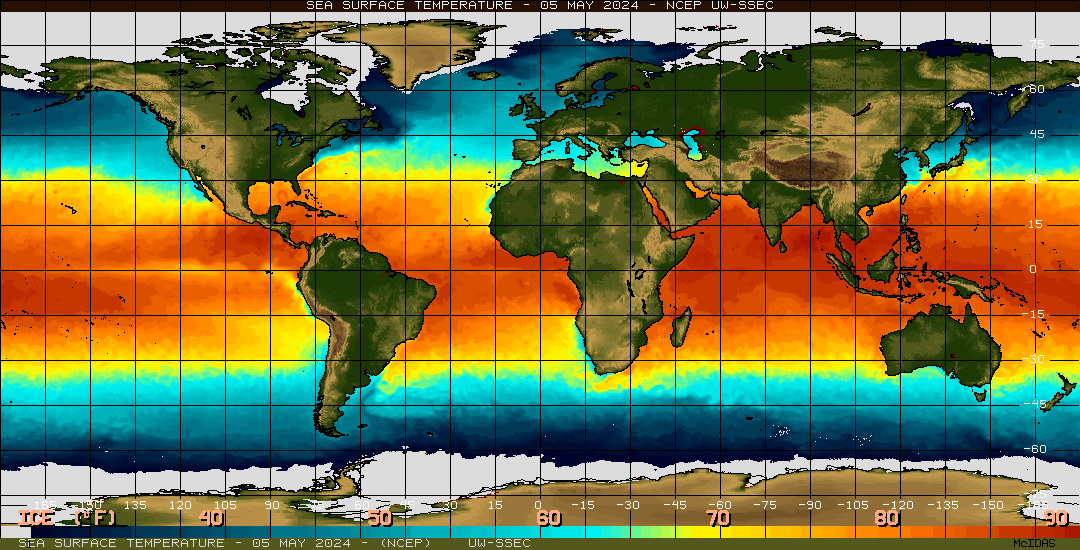
When we see records being broken and unprecedented events such as this, the onus is on those who deny any connection to climate change to prove their case. Global warming has fundamentally altered the background conditions that give rise to all weather. In the strictest sense, all weather is now connected to climate change. Kevin Trenberth
HIT THE PAGE DOWN KEY TO SEE THE POSTS
Now at 8,800+ articles. HIT THE PAGE DOWN KEY TO SEE THE POSTS
A warmer world could mean shrinking harvests and a more meagre diet for millions of people, according to two new studies.
by Tim Radford,Climate News Network, June 19, 2018
LONDON – A hotter world could also be a hungrier one, with shrinking harvests and poorer quality plants. As planetary temperatures rise in response to ever more profligate combustion of fossil fuels, climate change could lower the yield of vegetable and legume crops – and at the same time reduce their nutritional content.
And the same high end-of-the-century temperatures could raise the risk of massive, near-global losses for the world’s most widely grown cereal, maize.
British researchers report in the Proceedings of the National Academy of Sciencesthat they studied 174 research papers based on 1,540 experiments in 40 countries between 1975 and 2016, on the probable effect of changes in water supplies, ozone, atmospheric carbon dioxide, and ambient temperatures, on vegetables and legumes.
They found that on the basis of changes predicted for later this century, average yields of vegetables could fall by 35%, and legumes by 9%. There has been evidence that more atmospheric carbon dioxide could fertilize more plant growth, but other accompanying changes – greater extremes of heat, drought, flood and so on – could cancel out any such gains.
“As the planet warms, it becomes more likely for different countries to simultaneously experience major crop losses”
Pauline Scheelbeck, of the London School of Hygiene and Tropical Medicine, who led the study, called the finding “a real threat to global agricultural production, with likely impacts on food security and population health.”
Scientists have been warning for at least five years of the potential impact of climate change on agriculture and food supply: other studies have shown that fruit and vegetable supplies could be at risk.
US researchers report – once again, in the Proceedings of the National Academy of Sciences – that they took a fresh look at the response of markets to what they call “volatility” in the global crop of just one cereal: maize, or corn.
Heavy dependence
This is grown widely: it is a staple for humans and fodder for livestock; it provides oil for cooking and has even been turned into fuel for motor cars. It is traded worldwide, but four countries – the US, Brazil, Argentina, and Ukraine – account for more than 85% of all exports. The chance that all four exporters would have bad harvests in the same year right now is almost zero.
But under a warming of 2 °C – a level which 195 nations agreed in Paris in 2015 to keep well below – this risk would rise to 7%. If global temperatures rise by 4 °C, which is what will happen if humans go on burning ever more fossil fuels, the chance that all four maize exporters would have harvest failures at the same time rises to 86%. And, if that happened, corn prices would rise dramatically.
“When people think about climate change and food, they initially think about drought, but it’s really extreme heat that’s very detrimental for crops,” said Michelle Tigchelaar of the University of Washington, who led the research.
“We find that as the planet warms, it becomes more likely for different countries to simultaneously experience major crop losses, which has big implications for food prices and food security.”
by Robin McKie, Observer Science Editor, The Guardian, July 15, 2017
Governments may be seriously underestimating the risks of crop disasters occurring in major farming regions around the world, a study by British researchers has found.
The newly published research, by Met Office scientists, used advanced climate modelling to show that extreme weather events could devastate food production if they occurred in several key areas at the same time. Such an outcome could trigger widespread famine.
The scientists, led by Chris Kent, of the Met Office, focused their initial efforts on how extreme weather would affect maize, one of the world’s most widely grown crops. Heat and drought were the prime risks, although flooding was also included in the analysis.
The group found there is a 6% chance every decade that a simultaneous failure in maize production could occur in China and the US – the world’s main growers – which would result in widespread misery, particularly in Africa and south Asia, where maize is consumed directly as food.
“The impact would be felt at a global scale,” Kent told the Observer. “This is the first time we have been able to quantify the risk. It hasn’t been observed in the last 30 years, but the indications are that it is possible in the current climate.”
An example of the kind of disaster that could occur is provided by the maize harvests that failed last year in Africa. Communities in Zambia, Congo, Zimbabwe, Mozambique and Madagascar were affected and six million people were left on the brink of starvation. A joint failure of China and America’s maize harvest would have a far greater impact.
Having studied the risks facing maize production, the group is now following up this work by studying climate impacts on the world’s other staple crops – in particular rice, wheat and soy beans – in order to assess how weather extremes could affect their production.
According to the UN Food and Agriculture Organisation, maize, rice and wheat together make up 51% of the world’s calorie intake. Billions of people rely on these crops for survival. Any disruption to their production would have calamitous consequences.
The trouble is that crop-growing methods and locations have changed considerably over time, as has the climate and the probability of extreme events, Kent told the Observer. “This means the number of relevant observations to the present-day growing of stable crops has been reduced, and that limits our ability to have useful estimates of the risks to the growing of these crops.”
To get round this problem, the team ran 1,400 climate model simulations on the Met Office’s new supercomputer to understand how climate might vary in the next few years and found that the probability of severe drought was higher than if estimated solely from past observations. The scientists concluded that current agricultural policies could considerably underestimate the true risk of climate-related shocks to maize growing and food supply.
The particular risk outlined by the study envisaged simultaneous catastrophic disruptions in China and the US. In 2014, total world production of maize was around 1 billion tonnes, with the US producing 360 million tonnes and China growing 215 million. If production in these two countries were hit by simultaneous extreme weather events, most likely droughts, more than 60% of global maize production would be hit.
A double whammy like this has never happened in the past, but the work by the Met Office indicates that there is now a real risk. In addition, there may be risks of similar events affecting rice, wheat or soy bean harvests. These are now being studied by the Met Office, which is also working with researchers in China in a bid to understand climate risks that might affect agricultural production.
“We have found that we are not as resilient as we thought when it comes to crop growing,” said Kirsty Lewis, science manager for the Met Office’s climate security team. “We have to understand the risks we face or there is a real danger we could get caught out. For now we don’t have the means to quantity the risks. We have to put that right.”
Study shows almost all farms could significantly cut chemical use while producing as much food, in a major challenge to the billion-dollar pesticide industry
Many farmers want to reduce pesticide use but do not have good access to information on alternatives, scientists say. Photograph: Remy Gabalda/AFP/Getty Images by Damian Carrington, Environmental editor, The Guardian, April 6, 2017
Virtually all farms could significantly cut their pesticide use while still producing as much food, according to a major new study. The research also shows chemical treatments could be cut without affecting farm profits on over three-quarters of farms.
The scientists said that many farmers wanted to reduce pesticide use, partly due to concerns for their own health. But farmers do not have good access to information on alternatives, the researchers said, because much of their advice comes from representatives of companies that sell both seeds and pesticides.
The work presents a serious challenge to the billion-dollar pesticide industry, which has long argued its products are vital to food production, especially with the world population set to grow to nine billion people by 2050.
However, this was dismissed as a “myth” in March by UN food and pollution experts, who said pesticides cause “catastrophic impacts on the environment and human health” and accused pesticide manufacturers of a “systematic denial of harms.” In a further blow, The Guardian revealed in March that Europe is poised to ban the world’s most widely used insecticides from all fields.
The new research, published in the peer-reviewed journal Nature Plants, analyzed the pesticide use, productivity, and profitability of almost 1,000 farms of all types across France. By comparing similar farms using high or low levels of pesticides, the scientists found that 94% of farms would lose no production if they cut pesticides and two-fifths of these would actually produce more.
The results were most startling for insecticides: lower levels would result in more production in 86% of farms and no farms at all would lose production.
The research also indicated that 78% of farms would be equally or more profitable when using less pesticide of all types.
“It is striking,” said Nicolas Munier-Jolain, at France’s National Institute for Agricultural Research, and one of the team who conducted the new study. He said the results show that pesticide reduction is possible today for most arable farmers, without losing money: “Our results are quite consistent with the UN [myth] report.”
“But [the research] does not mean pesticides are useless or inefficient,” he said. The farmers using low levels of chemicals employ other methods to control pests, he said, such as rotating crops, mechanical weeding, using resistant varieties and carefully managing sowing dates and fertiliser use. “It’s a big change, but not a revolution,” he said.
“If you want real reduction in pesticide use, give the farmers the information about how to replace them,” said Munier-Jolain. “This is absolutely not the case at the moment. A large proportion of advice is provided by organisations that are both selling the pesticides and collecting the crops. I am not sure the main concern of these organisations is to reduce the amount of pesticide used.”
Prof Dave Goulson, at the University of Sussex, UK, said: “While we have a system where farmers are advised by agronomists, most of whom work on commission for agrochemical companies, then inevitably pesticides will be massively overused. Even the few independent agronomists struggle to get independent information and advice to pass on to farmers.”
“Despite evidence that much pesticide use is unnecessary and a big European Union initiative to encourage sustainable use, farming continues to be dominated by pesticide use,” said Matt Shardlow, chief executive of Buglife.
France’s deadline for a 50% cut in pesticide use was meant to be 2018 but has been postponed to 2025, with use actually rising not falling. The UK’s action plan for the sustainable use of pesticides contains no targets or timetable. “Financial advisors and doctors cannot profit from their advice to individuals and it is time that this market failure was corrected for pesticide sales as well,” Shardlow said.
Graeme Taylor, a spokesman for the European Crop Protection Association (ECPA) which represents pesticide manufacturers, said: “Characterizing it as an argument between using more or less is unhelpful as it ignores the reality that any genuine commitment to sustainable agriculture means giving farmers access to a variety of tools. Pesticides are not a panacea, but are one of the most important tools available to the farmer to fight pests and diseases.”
He said a recent consultancy report commissioned by the ECPA indicated that French farmers would lose €2bn of grape production without access to certain pesticides.
The new research showed that the type of farms most sensitive to cuts in pesticide use are potato and sugar beet farms, because they use high levels of pesticides and are highly profitable. But it showed that most arable farms could cut pesticides by over 40% without losses. The researchers wrote: “The reduction of pesticide use is one of the critical drivers to preserve the environment and human health.”
“Farmers are doing their best to use fewer pesticides,” said Munier-Jolain. “Many are motivated because they are thinking about their own health.” He said that there was a perception among farmers that cutting pesticide use increases the risk of poor harvests, but that those diversifying their crops actually decreased such risks: “They sleep better than the other farmers.”
This article was amended on 10 April 2017 to clarify that lower levels of insecticides would result in more production in 86% of farms and no farms at all would lose production.
from the UNIVERSITY OF ILLINOIS COLLEGE OF AGRICULTURAL, CONSUMER AND ENVIRONMENTAL SCIENCES, March 27, 2017
URBANA, Ill. - Scientists the world over are working to predict how climate change will affect our planet. It is an extremely complex puzzle with many moving parts, but a few patterns have been consistent, including the prediction that farming as we know it will become more difficult.
Scientists infer the impact on agriculture based on predictions of rainfall, drought intensity, and weather volatility. Until now, however, the average farmer may not have been able to put predictions like these into practice. A new University of Illinois study puts climate change predictions in terms that farmers are used to: field working days.
"Everything else flows from field working days," says U of I and USDA Agricultural Research Service ecologist Adam Davis. "If you're not able to work, everything else gets backed up. Workable days will determine the cultivars, the cropping system, and the types of pest management practices you can use. We're simply asking, 'Can you get in to plant your crop?'"
In a previous study, the group developed models that reliably translated past climate data into field working days for Illinois. In the new study, they coupled those models with climate change scenarios to forecast field working days into the future.
The group ran the models for nine crop districts in Illinois for two time periods, mid-century (2046 to 2065) and late-century (2080 to 2099), using three climate scenarios ranging from mild to extreme.
The models suggest that the typical planting window for corn will no longer be workable; April and May will be far too wet to work the fields in most parts of Illinois.
"Going forward, we're predicting warmer and wetter springs, and drier, hotter summers," Davis says. "The season fragments, and we start to see an early-early season, so that March starts looking like a good target for planting in the future. In the past, March has been the bleeding edge; nobody in their right mind would have planted then. But we've already seen the trend for early planting. It's going to keep trending in that direction for summer annuals."
Those drier, hotter summers are likely to change farming practices too, particularly in southern Illinois.
"Drought periods will intensify in mid- to late-summer under all the climate scenarios. If farmers decide to plant later to avoid the wet period in April and May, they're going to run into drought that will hit yield during the anthesis-silking interval, leading to a lot of kernel abortion. That second planting window is probably pretty risky," Davis says.
Risk is the key word. If farmers bet on the early planting window and get hit with a frost or more March precipitation than expected, are they out of luck? Davis says they will have to choose to mud the seed in, plant a different hybrid, or even scrap corn and go for winter wheat later in the season. But given that many farmers choose hybrids and purchase seeds the previous fall, they're unlikely to have that kind of flexibility come spring. Any miscalculation will be incredibly costly.
"It will come down to whether crop insurers will move planting dates earlier in the spring. They're going to need enough years of empirical evidence that this early window exists before they are likely to make that change," Davis notes.
The researcher suggests three strategies to cope with the changes. Farmers could plant early with long-season cultivars to maximize yield potential, betting on a pollination window to open up before the drought kicks in. Or farmers could choose shorter-season cultivars, planting early and then harvesting before the drought, possibly sacrificing yield.
The last strategy will require a more radical shift.
"Create cropping systems that can deal with increased volatility by conserving soil moisture. Most of the effort in yield stability and resilience focuses on genetic improvement of crops. That's good, but I think we've fallen behind in the cropping system management side. If you've got an elite cultivar that's drought resistant in the same old cropping system that's not shifting with environmental changes, then we're not doing full justice to that cultivar," Davis says.
Given the weather in Illinois this late winter/early spring, this work seems particularly timely.
"All this weird weather? It's part of a trend," Davis says. "Now is the time to prepare, because the future is here."
###
The article, "Changes in field workability and drought risk from projected climate change drive spatially variable risks in Illinois cropping systems," is published in PLOS One. Lead author Bradley Tomasek is at Duke University. Marty Williams and Adam Davis are research ecologists with the USDA Agricultural Research Service, and faculty members in the U of I crop sciences department. Funding was provided by the USDA Agricultural Research Service.
Global use of irreplaceable groundwater is exhausting the supply so fast that researchers say it will drive up food prices and hit international trade
by Alex Kirby, Climate News Network, April 2, 2017
LONDON – China, the world’s most populous country, doubled within just 10 years its use of irreplaceable groundwater from underground reservoirs that are replenished more slowly than they are drained.
And in the same decade, 2000 to 2010, global use of this non-renewable water resource for irrigation increased by a quarter, according to a new study published in the journal Nature.
The research suggests that unless producers and consumers of food make changes, this trend could lead to depleted water reserves, limited availability of food imports, and higher food prices.
Groundwater – from underground supplies, as opposed to water in rivers or lakes – supplies global agriculture with 43% of its crop irrigation needs.
The country exporting the most crops produced using irreplaceable groundwater is Pakistan, with 29% of global non-renewable sources embedded in trade – closely followed by the US (27%), with India (12%) in third place.
Groundwater abstraction
The study’s authors say excessive extraction of groundwater for irrigation – part of the wider virtual water trade – is leading to rapid depletion of aquifers in key food-producing regions, including north-western India, the North China Plain, central US, and California.
“This depletion of the largest liquid freshwater stock on Earth,” they write, “threatens the sustainability of food production, and water and food security, not only locally, but also globally via international food trade.
“Aquifer depletion can also induce significant environmental degradation, such as land subsidence and seawater intrusion.”
In another example of the way in which climate change works to intensify existing threats, the researchers say the depletion of local water reserves also risks putting large populations at serious danger during emergencies such as droughts, earthquakes or fires, when immediate access to water is needed.
Using UN trade data and estimates of non-renewable groundwater removal, researchers traced the sources of water used to produce agricultural crops. They found that the crops contributing most to the non-renewable groundwater trade are rice (29%), wheat (12%), cotton (11%), maize (4%), and soybeans (3%).
“Under future climate change, droughts may be more frequent in many regions and we may want to keep groundwater reserves for these periods”
“People are rightfully food shopping with the environment in mind more than ever before – but it is not just about meat versus vegetables, organic or fair trade,” Dr Dalin says.
“Where and how the products are grown is crucial, and basic foods like rice and bread could have a damaging impact on global water supplies.
“Our research shows that unless both consumers and producers agree to adopt strategies that maximise the long-term sustainability of water use, most of the world’s population risks seeing increased food prices or disrupted food supply.
Potentially dangerous
“Under future climate change, droughts may be more frequent in many regions and we may want to keep groundwater reserves for these periods.”
Thomas Kastner, senior scientist at the Senckenberg Biodiversity and Climate Research Centre, Germany, and the Alpen-Adria University, Austria, says: “Our work shows where trade flows are contributing to the unsustainable, and ultimately potentially dangerous, use of water resources. The use of non-renewable water in one place can put food supply in distant regions at risk.”
Yoshihide Wada, a co-author of the report and deputy director of the IIASA Water Programme, says: “The products that consumers buy at a supermarket may have very different environmental impacts depending on where they are produced and how they are irrigated.
“In order to help consumers make more sustainable choices about their food, producers should consider adding water labels that make these impacts clear.”
Farming in the Midwest likely to suffer under future climatic conditions. A new study says if the threats aren't addressed, future US food production may well be lower than necessary to meet global demand. HARVEST PUBLIC MEDIA FILE PHOTO
The agriculture sector needs to ramp up its response to climate change, especially in the Midwest, according to a new study published in the Proceedings of the National Academy of Sciences.
Researchers at the University of Maryland used climate projections and historical trends in agricultural productivity to predict how changes in temperature and rainfall will impact food production.
They found that without changes to farm policy and improvements to agricultural technology, the nation’s productivity in 2050 could look like it did in 1980. That’s because at the present rates of innovation, new technologies won’t be able to keep up with the damage caused by the changes in climate in our major growing regions.
Lead author Xin-Zhong Liang, a professor at the University of Maryland, says both policymakers and those who work directly in agriculture should consider changes that might prevent this drop. On the policy side, Liang said, changes to water management could help. On the technology side, the development of seeds that can withstand more extremes of heat and rain would likely help mitigate the climate’s impact on overall productivity.
But, he adds, such advances will need to come at a faster pace than they have in the past.
The new research identifies the Corn Belt as the region where the changes could have the biggest impact on overall productivity, with California and the Southwest region second in line. The transition area from the Corn Belt into the southern cotton and pasture region is also vulnerable. Losses in U.S. production could impact the global food supply.
This research, Liang says, enhances existing studies to offer a more robust picture of how total agricultural output of the country could change under different climate change scenarios.
Glyphosate, the active ingredient in Monsanto's Roundup, "probably" causes cancer, according to the World Health Organization's International Agency for Research on Cancer. Flickr
On Wednesday, a motion was filed with the U.S. Judicial Panel on Multidistrict Litigation to create a coordinated docket for 21 pending federal cases that involve the exact same product, the same active ingredient and the same injury, the legal news site Harris Martin Publishing writes.
The plaintiffs—represented by personal injury lawyers Aimee H. Wagstaff and David J. Wool of the Colorado law firm Andrus Wagstaff, P.C.—allege that exposure to glyphosate caused them to develop non-Hodgkin's lymphoma.
As Harris Martin reported (via Sustainable Pulse), the plaintiffs want to unite the cases in one court either before judge Nancy J. Rosenstengel or judge David R. Herndon of the U.S. District Court for the Southern District of Illinois.
The Illinois court was chosen for a number of reasons. First, three of the 21 Roundup cancer cases are pending in the state. Second, the midwestern state is the largest producer of soybeans, which were doused with 122,473,987 pounds of glyphosate-based herbicides in 2014 alone, "more than any other crop," the plaintiffs said. Third, the Southern District of Illinois is located within 20 miles of St. Louis-headquartered Monsanto.
"Accordingly, Illinois' factual nexus and interest in the outcome of this litigation is extremely strong," the motion stated.
"Each Roundup Case requires extensive discovery concerning the safety, development and marketing of Roundup, which has been on the market since the mid 1970s," the motion said.
"Each Plaintiff will need to conduct the same complicated regulatory and scientific discovery (spanning over 40 years) to demonstrate that exposure to Roundup caused their non-Hodgkin's lymphoma. To date, a few of the Roundup Cases have commenced discovery, but that discovery is being conducted under different, and sometimes conflicting, judicial constraints and orders. Centralizing these cases before one [Multidistrict Litigation] Judge to ensure that the discovery is done once for all claimants makes sense."
The World Health Organization's International Agency for Research on Cancer (IARC) classified glyphosate as "probably carcinogenic to humans" last year.
Just last week, an Illinois woman filed a lawsuit against Monsanto in the U.S. District Court for the Southern District of Illinois alleging Roundup caused her to develop non-Hodgkin lymphoma, according to the Madison County Record.
Plaintiff Lynda K. Patterson alleges that she used Roundup on her garden and landscaping for more than a decade before being diagnosed with stage four non-Hodgkin lymphoma in August 2014, the Madison County Record reported. She underwent aggressive treatment, including chemotherapy.
She claims Monsanto allegedly designed formulated, manufactured and distributed the herbicide and failed to adequately warn consumers of the product's health risks.
The plaintiff is represented by David M. Hundley of Hundley Law Group PC in Chicago and Christopher L. Coffin and Nicholas R. Rockforte of Pendley, Baudin & Coffin LLP in New Orleans. She is seeking a trial by jury and compensatory and punitive damages and attorneys' fees.
Robin Greenwald, the head of environmental protection at personal injury law firm Weitz & Luxenberg, told EcoWatch that people across the U.S. have been contacting her about Roundup lawsuits, raising similar allegations that Monsanto has not adequately warned about Roundup's link to cancer.
She said these people come in three categories: farmers and nursery workers who have been exposed to the compound through agricultural work; people who regularly apply Roundup to their own lawns and property; and landscapers who go from town to town and get exposed to the product.
Greenwald has helped at least 10 plaintiffs file lawsuits against Monsanto. She said all of these cases are focused on exposure to Roundup and diagnosis of non-Hodgkin's Lymphoma.
The agritech giant has vehemently denied the cancer claims of its blockbuster product and has demanded a retraction of the IARC report.
Meanwhile, the U.S. Environmental Protection Agency (EPA) issued a Federal Register notice Tuesday, saying it is seeking eight ad hoc scientists to serve on the Federal Insecticide, Fungicide and Rodenticide Act Scientific Advisory Panel that will review glyphosate's link to cancer at a four-day meeting this October.
"Individuals nominated for this meeting should have expertise in one or more of the following areas: Carcinogenicity (mammalian), cancer biostatistics, rodent cancer bioassays, epidemiology (cancer/occupational), genotoxicity/genetic toxicology/mutagenicity (related to human cancer risk), risk assessment, weight of evidence analysis, and mode of action/human relevance/adverse outcome pathway frameworks," the notice states.
In May, the EPA's Cancer Assessment Review Committee (CARC) inadvertently published a report online that concluded glyphosate is not likely to be carcinogenic to humans but the document was taken offline a few days later. The agency said it has not finished its review of the chemical. The Federal Register notice also makes no mention of the pulled CARC review.
In a village in India's poorest state, Bihar, farmers are growing world record amounts of rice – with no GM, and no herbicide. Is this one solution to world food shortages?
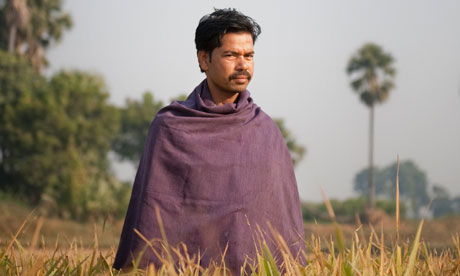
Sumant Kumar photographed in Darveshpura, Bihar, India. Photograph: Chiara Goia for Observer Food Monthly by John Vidal, The Guardian, February 16, 2013 Sumant Kumar was overjoyed when he harvested his rice last year. There had been good rains in his village of Darveshpura in north-east Indiaand he knew he could improve on the four or five tonnes per hectare that he usually managed. But every stalk he cut on his paddy field near the bank of the Sakri river seemed to weigh heavier than usual, every grain of rice was bigger and when his crop was weighed on the old village scales, even Kumar was shocked.
This was not six or even 10 or 20 tonnes. Kumar, a shy young farmer in Nalanda district of India's poorest state Bihar, had – using only farmyard manure and without any herbicides – grown an astonishing 22.4 tonnes of rice on one hectare of land. This was a world record and with rice the staple food of more than half the world's population of seven billion, big news.
It beat not just the 19.4 tonnes achieved by the "father of rice," the Chinese agricultural scientist Yuan Longping, but the World Bank-funded scientists at the International Rice Research Institute in the Philippines, and anything achieved by the biggest European and American seed and GM companies. And it was not just Sumant Kumar. Krishna, Nitish, Sanjay and Bijay, his friends and rivals in Darveshpura, all recorded over 17 tonnes, and many others in the villages around claimed to have more than doubled their usual yields.
The villagers, at the mercy of erratic weather and used to going without food in bad years, celebrated. But the Bihar state agricultural universities didn't believe them at first, while India's leading rice scientists muttered about freak results. The Nalanda farmers were accused of cheating. Only when the state's head of agriculture, a rice farmer himself, came to the village with his own men and personally verified Sumant's crop, was the record confirmed.
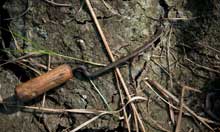
A tool used to harvest rice. Photograph: Chiara Goia
The rhythm of Nalanda village life was shattered. Here bullocks still pull ploughs as they have always done, their dung is still dried on the walls of houses and used to cook food. Electricity has still not reached most people. Sumant became a local hero, mentioned in the Indian parliament and asked to attend conferences. The state's chief minister came to Darveshpura to congratulate him, and the village was rewarded with electric power, a bank and a new concrete bridge.
That might have been the end of the story had Sumant's friend Nitish not smashed the world record for growing potatoes six months later. Shortly after Ravindra Kumar, a small farmer from a nearby Bihari village, broke the Indian record for growing wheat. Darveshpura became known as India's "miracle village", Nalanda became famous and teams of scientists, development groups, farmers, civil servants and politicians all descended to discover its secret.
When I meet the young farmers, all in their early 30s, they still seem slightly dazed by their fame. They've become unlikely heroes in a state where nearly half the families live below the Indian poverty line and 93% of the 100 million population depend on growing rice and potatoes. Nitish Kumar speaks quietly of his success and says he is determined to improve on the record. "In previous years, farming has not been very profitable," he says. "Now I realise that it can be. My whole life has changed. I can send my children to school and spend more on health. My income has increased a lot."
What happened in Darveshpura has divided scientists and is exciting governments and development experts. Tests on the soil show it is particularly rich in silicon but the reason for the "super yields" is entirely down to a method of growing crops called System of Rice (or root) Intensification (SRI). It has dramatically increased yields with wheat, potatoes, sugar cane, yams, tomatoes, garlic, aubergine and many other crops and is being hailed as one of the most significant developments of the past 50 years for the world's 500 million small-scale farmers and the two billion people who depend on them.
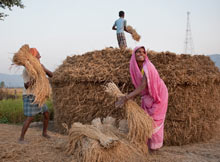
People work on a rice field in Bihar. Photograph: Chiara Goia
Instead of planting three-week-old rice seedlings in clumps of three or four in waterlogged fields, as rice farmers around the world traditionally do, the Darveshpura farmers carefully nurture only half as many seeds, and then transplant the young plants into fields, one by one, when much younger. Additionally, they space them at 25cm intervals in a grid pattern, keep the soil much drier and carefully weed around the plants to allow air to their roots. The premise that "less is more" was taught by Rajiv Kumar, a young Bihar state government extension worker who had been trained in turn by Anil Verma of a small Indian NGO called Pran (Preservation and Proliferation of Rural Resources and Nature), which has introduced the SRI method to hundreds of villages in the past three years.
While the "green revolution" that averted Indian famine in the 1970s relied on improved crop varieties, expensive pesticides and chemical fertilisers, SRI appears to offer a long-term, sustainable future for no extra cost. With more than one in seven of the global population going hungry and demand for rice expected to outstrip supply within 20 years, it appears to offer real hope. Even a 30% increase in the yields of the world's small farmers would go a long way to alleviating poverty.
"Farmers use less seeds, less water and less chemicals but they get more without having to invest more. This is revolutionary," said Dr Surendra Chaurassa from Bihar's agriculture ministry. "I did not believe it to start with, but now I think it can potentially change the way everyone farms. I would want every state to promote it. If we get 30-40% increase in yields, that is more than enough to recommend it."
The results in Bihar have exceeded Chaurassa's hopes. Sudama Mahto, an agriculture officer in Nalanda, says a small investment in training a few hundred people to teach SRI methods has resulted in a 45% increase in the region's yields. Veerapandi Arumugam, the former agriculture minister of Tamil Nadu state, hailed the system as "revolutionising" farming.
Given $15m by an anonymous billionaire to research sustainable development, Uphoff went to Madagascar in 1983 and saw the success of SRI for himself: farmers whose previous yields averaged two tonnes per hectare were harvesting eight tonnes. In 1997 he started to actively promote SRI in Asia, where more than 600 million people are malnourished.
"It is a set of ideas, the absolute opposite to the first green revolution [of the 60s] which said that you had to change the genes and the soil nutrients to improve yields. That came at a tremendous ecological cost," says Uphoff. "Agriculture in the 21st century must be practised differently. Land and water resources are becoming scarcer, of poorer quality, or less reliable. Climatic conditions are in many places more adverse. SRI offers millions of disadvantaged households far better opportunities. Nobody is benefiting from this except the farmers; there are no patents, royalties or licensing fees."
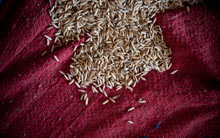
Rice seeds. Photograph: Chiara Goia
For 40 years now, says Uphoff, science has been obsessed with improving seeds and using artificial fertilisers: "It's been genes, genes, genes. There has never been talk of managing crops. Corporations say 'we will breed you a better plant' and breeders work hard to get 5-10% increase in yields. We have tried to make agriculture an industrial enterprise and have forgotten its biological roots."
Not everyone agrees. Some scientists complain there is not enough peer-reviewed evidence around SRI and that it is impossible to get such returns. "SRI is a set of management practices and nothing else, many of which have been known for a long time and are best recommended practice," says Achim Dobermann, deputy director for research at the International Rice Research Institute. "Scientifically speaking I don't believe there is any miracle. When people independently have evaluated SRI principles then the result has usually been quite different from what has been reported on farm evaluations conducted by NGOs and others who are promoting it. Most scientists have had difficulty replicating the observations."
Dominic Glover, a British researcher working with Wageningen University in the Netherlands, has spent years analysing the introduction of GM crops in developing countries. He is now following how SRI is being adopted in India and believes there has been a "turf war."
"There are experts in their fields defending their knowledge," he says. "But in many areas, growers have tried SRI methods and abandoned them. People are unwilling to investigate this. SRI is good for small farmers who rely on their own families for labour, but not necessarily for larger operations. Rather than any magical theory, it is good husbandry, skill and attention which results in the super yields. Clearly in certain circumstances, it is an efficient resource for farmers. But it is labour intensive and nobody has come up with the technology to transplant single seedlings yet."
But some larger farmers in Bihar say it is not labour intensive and can actually reduce time spent in fields. "When a farmer does SRI the first time, yes it is more labour intensive," says Santosh Kumar, who grows 15 hectares of rice and vegetables in Nalanda. "Then it gets easier and new innovations are taking place now."
In its early days, SRI was dismissed or vilified by donors and scientists but in the past few years it has gained credibility. Uphoff estimates there are now 4-5 million farmers using SRI worldwide, with governments in China, India, Indonesia, Cambodia, Sri Lanka and Vietnam promoting it.
Sumant, Nitish and as many as 100,000 other SRI farmers in Bihar are now preparing their next rice crop. It's back-breaking work transplanting the young rice shoots from the nursery beds to the paddy fields but buoyed by recognition and results, their confidence and optimism in the future is sky high.
Last month Nobel prize-winning economist Joseph Stiglitz visited Nalanda district and recognised the potential of this kind of organic farming, telling the villagers they were "better than scientists". "It was amazing to see their success in organic farming," said Stiglitz, who called for more research. "Agriculture scientists from across the world should visit and learn and be inspired by them."
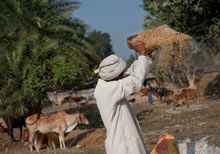
A man winnows rice in Satgharwa village. Photograph: Chiara Goia
Bihar, from being India's poorest state, is now at the centre of what is being called a "new green grassroots revolution" with farming villages, research groups and NGOs all beginning to experiment with different crops using SRI. The state will invest $50m in SRI next year but western governments and foundations are holding back, preferring to invest in hi-tech research. The agronomist Anil Verma does not understand why: "The farmers know SRI works, but help is needed to train them. We know it works differently in different soils but the principles are solid," he says. "The biggest problem we have is that people want to do it but we do not have enough trainers.
"If any scientist or a company came up with a technology that almost guaranteed a 50% increase in yields at no extra cost they would get a Nobel prize. But when young Biharian farmers do that they get nothing. I only want to see the poor farmers have enough to eat."





 Posts
Posts