When we see records being broken and unprecedented events such as this, the onus is on those who deny any connection to climate change to prove their case. Global warming has fundamentally altered the background conditions that give rise to all weather. In the strictest sense, all weather is now connected to climate change. Kevin Trenberth
HIT THE PAGE DOWN KEY TO SEE THE POSTS
Now at 8,800+ articles. HIT THE PAGE DOWN KEY TO SEE THE POSTS
Institute of Natural Resources, National Tomsk Research Polytechnic University, 30 Prospect Lenina, Tomsk 634050, Russia
2
International Arctic Research Center, University Alaska Fairbanks, Akasofu Building, Fairbanks, AK 99775-7320, USA
3
Pacific Oceanological Institute, Russian Academy of Science, 41 Baltiiskaya Street, Vladivostok 690022, Russia
4
Moscow Institute of Physics and Technology, 9 Institutskiy per., Dolgoprudny, Moscow Region 141701, Russia
5
Science and Education Center, Northern (Arctic) Federal University, Naberezhnaya Severnoy Dvini, 17, Arkhangelsk 163002, Russia
6
Skolkovo Institute of Science and Technology (Skoltech), 3, Nobel st., Innovation Center Skolkovo, Moscow 121205, Russia
*
Author to whom correspondence should be addressed.
Received 4 April 2019; accepted 3 June 2019; published 5 June 2019.
Abstract
This paper summarizes current understanding of the processes that determine the dynamics of the subsea permafrost–hydrate system existing in the largest, shallowest shelf in the Arctic Ocean; the East Siberian Arctic Shelf (ESAS). We review key environmental factors and mechanisms that determine formation, current dynamics, and thermal state of subsea permafrost, mechanisms of its destabilization, and rates of its thawing; a full section of this paper is devoted to this topic. Another important question regards the possible existence of permafrost-related hydrates at shallow ground depth and in the shallow shelf environment. We review the history of and earlier insights about the topic followed by an extensive review of experimental work to establish the physics of shallow Arctic hydrates. We also provide a principal (simplified) scheme explaining the normal and altered dynamics of the permafrost–hydrate system as glacial–interglacial climate epochs alternate. We also review specific features of methane releases determined by the current state of the subsea-permafrost system and possible future dynamics. This review presents methane results obtained in the ESAS during two periods: 1994–2000 and 2003–2017. A final section is devoted to discussing future work that is required to achieve an improved understanding of the subject.Open access: https://www.mdpi.com/2076-3263/9/6/251/htm
Scientist Peter Wadhams believes the summer ice cover at the north pole is about to disappear, triggering even more rapid global warming Peter Wadhams in the Arctic in 2007: ‘We may able to raise the Thames barrier in Britain but in Bangladesh, people will be drowned.’
by Robin McKie, The Guardian, August 21, 2016
Peter Wadhams has spent his career in the Arctic, making more than 50 trips there, some in submarines under the polar ice. He is credited with being one of the first scientists to show that the thick icecap that once covered the Arctic ocean was beginning to thin and shrink. He was director of the Scott Polar Institute in Cambridge from 1987 to 1992 and professor of ocean physics at Cambridge from 2001 to 2015. His book, A Farewell to Ice, tells the story of his unravelling of this alarming trend and describes what the consequences for our planet will be if Arctic ice continues to disappear at its current rate.
You have said on several occasions that summer Arctic sea ice would disappear by the middle of this decade. It hasn’t. Are you being alarmist? No. There is a clear trend down to zero for summer cover. However, each year chance events can give a boost to ice cover or take some away. The overall trend is a very strong downward one, however. Most people expect this year will see a record low in the Arctic’s summer sea-ice cover. Next year or the year after that, I think it will be free of ice in summer and by that I mean the central Arctic will be ice-free. You will be able to cross over the North Pole by ship. There will still be about a million square kilometres of ice in the Arctic in summer, but it will be packed into various nooks and crannies along the Northwest Passage and along bits of the Canadian coastline. Ice-free means the central basin of the Arctic will be ice-free, and I think that that is going to happen in summer 2017 or 2018.
Why should we be concerned about an Arctic that is free of ice in summer? People tend to think of an ice-free Arctic in summer in terms of it merely being a symbol of global change. Things happen, they say. In fact, the impact will be profound and will effect the whole planet and its population. One key effect will be albedo feedback. Sea ice reflects about 50% of the solar radiation it receives back into space. By contrast, water reflects less than 10%. So if you replace ice with water, which is darker, much more solar heat will be absorbed by the ocean, and the planet will heat up even more rapidly than it is doing at present.
Sea ice also acts as an air-conditioning system. Winds coming over the sea to land masses such as Siberia and Greenland will no longer be cooled as they pass over ice, and these places will be heated even further. These effects could add 50% to the impact of global warming that is produced by rising carbon emissions.
What will be the effects of this accelerating increase in temperatures? The air over Greenland will get warmer, and more and more of its ice will melt. It is already losing about 300 cubic kilometres of ice a year. Antarctica is adding to the melt as well. Sea-level rises will accelerate as a result. The most recent prediction of the Intergovernmental Panel on Climate Change (IPCC) is that seas will rise by 60 to 90 centimetres this century. I think a rise of one to two metres is far more likely. Indeed, it is probably the best we can hope for.
That may not sound a lot, but it is really very serious. It will increase enormously the frequency of storm surges all over the world. We may be able to raise the Thames barrier in Britain, but in Bangladesh, it just means more and more people will be drowned.
Global warming is generally associated with increased fossil-fuel burning and consequent rises in levels of atmospheric carbon dioxide. But is that the only climate problem we face? No, it is not. We also have the issue of methane. Russian scientists who have investigated waters off their coast have detected more and more plumes of methane bubbling up from the seabed. The reason this is happening is closely connected with the warming of the planet and the shrinking of the Arctic icecaps.
Until around 2005, even in summer, you still had sea ice near the coast. Then it started to disappear, so that for three or four months a year warm water reached the shallow waters around the shores where there had been permafrost ground since the last ice age. It has started to melt with dangerous consequences. Underneath the permafrost there are sediments full of methane hydrates. When the permafrost goes, you release the pressure on top of these hydrates and the methane comes out of solution.
Can we monitor this methane just as we can monitor carbon dioxide? Yes, we can measure methane over large areas using satellites. These have shown that methane levels that had been fairly flat for most of the last century have started to rise and are accelerating, often with little outliers on the graph. There is a scientist called Jason Box who works in Denmark for the Greenland Survey, and he calls these outliers dragon’s breath. They are not some sort of measurement caused by dodgy instruments. They are real pulses of methane coming from offshore flumes.
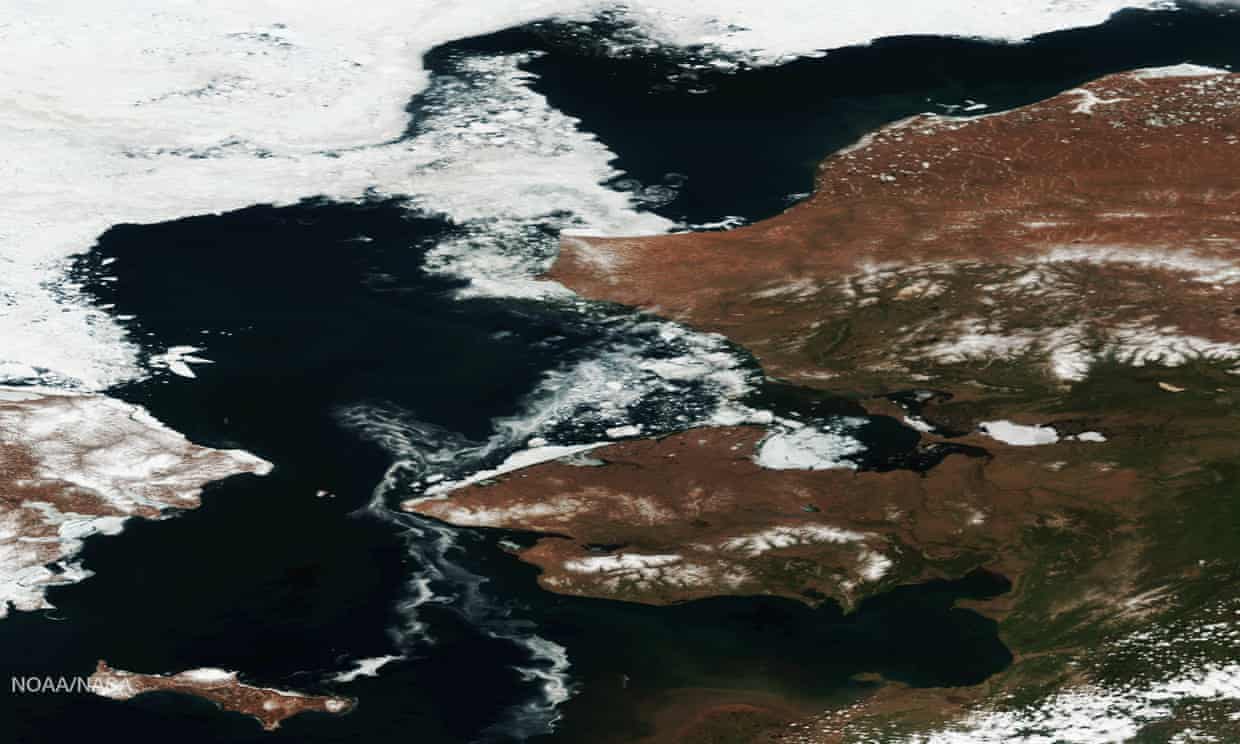
An image from the NOAA/Nasa Suomi NPP satellite taken on May 30, 2016, highlights the Arctic ice retreat off the north-west coast of Alaska. The average Arctic sea ice extent for May 2016 set a new record low since satellite observations began. Photograph: Suomi NPP/NASA/NOAA How intense is methane as a heater of the atmosphere compared with carbon dioxide? It is 23 times more powerful. However, methane dissipates much more quickly than carbon dioxide. It gets oxidised so that it only lingers in the atmosphere for about 7 or 8 years. By contrast, carbon dioxide hangs around in the climate system for about 100 years before it ends up in the sea and is absorbed by creatures that die and litter the seabed. At least that is what scientists thought. Today, there are quite a number of researchers who think carbon dioxide could last 1,000 years in the atmosphere.
So in the long run carbon dioxide is still going to be worse than methane in terms of heating the planet because a single methane pulse will have a disastrous effect, but if there is nothing to follow it on then it will go away. But with carbon dioxide there is a ratchet effect. All the carbon dioxide we release by burning fossil fuels just builds up in the atmosphere. We are having to live with last century’s carbon dioxide. What that says is simple: there is no such thing as a safe emission rate of carbon dioxide. That is why I am despondent about us ever being able to cut carbon emissions.
If we cannot halt the emissions of carbon dioxide, what can we do? In the end, the only hope we have is to find a way to remove carbon dioxide from the atmosphere once it has got there. Even the IPCC has admitted that we will have to find a way to extract carbon dioxide from the air. The trouble is that they just don’t know how we can do that. The most favoured scheme is known as BECCS: bio-energy with carbon capture and storage. Essentially, you plant trees and bushes over vast swaths of ground. These grow, absorbing carbon dioxide in the process. Then you burn the wood to run power plants while trapping, liquefying and storing the carbon dioxide that is released.
It sounds straightforward. Will it work? I am a bit suspicious of this technology. BECCS will need so much land to be effective. Calculations suggest it would need 40% to 50% of the arable land of the planet to make it work on the scale we will need and that would not leave enough land to grow crops to feed the world or to provide homes for a viable population of wild animals and plants. Other techniques, such as crushing and spreading olivine rocks, which absorb carbon dioxide, on beaches, will simply not scale up. They won’t work, so we will have to find some other way to remove carbon dioxide from the atmosphere directly.
As far as I can see, it will have to take the form of some sort of device into which you pump air at one end and you get air without carbon dioxide coming out the other end. It can be done, I am sure, but at the moment we do not have such a device. However, without something like that, I cannot see how we are going to deal with the carbon dioxide that is getting into the atmosphere. We are going to have to rely on a technology that has not yet been developed. That is a measure of the troubles that lie ahead for us. I think humanity can do it, but I would feel much better if I saw governments investing in such technology.
PRESS RELEASE by the Arctic
Methane Emergency Group, AMEG
November 2015
Transforming to a safer world
COP-21 is ignoring huge danger
COP-21 will not save
humanity from catastrophic climate change and metres of sea level rise, if they
continue to rely on IPCC assessments.
The world expects
IPCC to ensure the safety of future generations, by producing realistic
assessments of the dangers from climate change and by giving good advice to
governments on how to deal with these dangers and prevent catastrophe. But IPCC has absolutely failed in their
obligation, under UNFCCC Article 2, to give adequate warning of the planetary
emergency resulting from past and continued anthropogenic interference on two
counts: excess CO2 in the atmosphere; and an Arctic
soon to become seasonally free of sea ice.
Removing excess CO2
IPCC have
consistently understated the dangers from global warming and ocean
acidification arising from excess CO2 in the atmosphere. A safe, sustainable target level for CO2
concentration has not been established, as required by UNFCCC Article 2; and
other constraints, such as a limit on ocean acidification, rate of sea level
rise and Arctic warming, have not been established either.
It is cogently
argued by leading climate expert, Professor James Hansen, that the limit for
CO2 should be set at 350 ppm or below.
It will require a massive effort in carbon dioxide removal to achieve
this level within a few decades. A similar
limit on CO2 is required to avoid excessive ocean acidification, which, in
combination with global warming, is already causing coral reefs to die. By ignoring the dangers of ocean
acidification, the whole marine food chain has been put at risk.
IPCC has set a
carbon budget of around 1000 gigatons of carbon for total allowed CO2
emissions, of which they say about half has been spent, leaving a remaining
budget of less than 500 gigatons to achieve the 2 degrees target. But other greenhouse gases together add 75%
to the climate forcing from CO2. This
means that the CO2eq level is around 490 ppm.
If allowance is also made for climate forcing from black carbon and
albedo loss, then it appears that the budget has already been used up. The IPCC has failed to do the necessary
calculations to establish the real position on carbon budget and what has to be
achieved to have a good chance of preventing dangerous interference with the
climate system, as UNFCCC require IPCC to establish.
Emissions
reduction by itself will not remove CO2 from the atmosphere. While focussing on
emissions reduction IPCC have been ignoring the urgency and immensity of the
task to remove excess CO2 from the atmosphere, which will require a revolution
in agriculture, forestry and marine management to put carbon in the ground and
improve food production at the same time.
Any delay in getting started on these revolutions will increase the risk
of disaster in decades to come.
It is proposed
that the funding of the CO2 removal initiative should come from a carbon levy
on fossil fuel producers. This would
provide justice, in that the people who benefit from taking carbon out of the
ground would be paying for the carbon to be returned to the ground. The levy would be ramped up until the CO2
level starts to fall towards the target 350 ppm.
Preventing the Arctic Ocean
becoming seasonally free of sea ice
But, more serious
still than the problem of excess CO2, IPCC has failed to acknowledge the
dangers arising from rapid Arctic warming and the rapid decline of Arctic sea
ice. The Arctic
Ocean could become seasonally free of sea ice within a few
years. This rapid decline is the real
“elephant in the room”. The sea ice has
provided a reflective surface to keep the Arctic cool, maintain permafrost and
stabilise our planet’s temperature, sea level and climate. Now the sea ice is declining to a much lower
level, and IPCC is ignoring the implications.
Because of this
glaring omission from IPCC reports, it may soon be too late to prevent the Arctic getting locked into a state of low sea ice and
rapid warming, from which there will be no escape. Continued rapid warming will inevitably lead
to several absolute catastrophes for the world:
accelerated meltdown of the Greenland
Ice Sheet to give metres of sea level rise within decades;
accelerated meltdown of permafrost, releasing
vast quantities of the potent greenhouse gas, methane, which both
accelerates the Arctic warming in a positive feedback loop and counters
attempts to limit global warming to a safe level;
destabilisation of the planet’s
climate system, giving ever worse weather extremes compounded by global
warming and El Niño events.
Conclusion
In brief, humanity
faces a planetary emergency from precipitous decline of Arctic sea ice as well
as from an excess of CO2 in the atmosphere.
COP-21 must now prepare to take the necessary interventions.
Our condemnation
of IPCC assessment reports is not idle speculation or doom-mongering but based
on the best available scientific evidence.
There now has to be a strenuous, focussed and determined effort to find
solutions to these problems and make the necessary interventions. Of particular urgency, the Arctic
has to be cooled such as to prevent further decline of sea ice. This is a significant engineering
challenge. Any delay risks the passing
of a point of no return, whereby the challenge becomes impossible.
By facing up to
the truth of the situation, means can surely be found to avoid catastrophe,
using mankind’s collective intelligence, technology and vast resources.
All nations must
now work together to stave off the huge threats facing our civilisation.
Submitted on
behalf of the Arctic Methane Emergency Group, 5 November 2015
General view of a 35-meter-high riverbank exposure of the ice-rich syngenetic permafrost (yedoma) containing large ice wedges along the Itkillik River in northern Alaska. Copyright-free photo courtesy Mikhail Kanevskiy; University of Alaska Fairbanks, Institute of Northern Engineering; 8/13/2011. (High resolution image)
Researchers from the U.S. Geological Survey and key academic partners have quantified how rapidly ancient permafrost decomposes upon thawing and how much carbon dioxide is produced in the process.
Huge stores of organic carbon in permafrost soils — frozen for hundreds to tens of thousands of years across high northern latitudes worldwide — are currently isolated from the modern day carbon cycle.
However, if thawed by changing climate conditions, wildfire, or other disturbances, this massive carbon reservoir could decompose and be emitted as the greenhouse gases carbon dioxide and methane, or be carried as dissolved organic carbon to streams and rivers.
"Many scientists worldwide are now investigating the complicated potential end results of thawing permafrost," said Rob Striegl, USGS scientist and study co-author. "There are critical questions to consider, such as: How much of the stored permafrost carbon might thaw in a future climate? Where will it go? And, what are the consequences for our climate and our aquatic ecosystems?"
At a newly excavated tunnel operated by the U.S. Army Corps of Engineers near Fairbanks, Alaska, a research team from USGS, the University of Colorado Boulder, and Florida State University set out to determine how rapidly the dissolved organic carbon from ancient (about 35,000 years old) “yedoma” soils decomposes upon soil thaw and how much carbon dioxide is produced.
Yedoma is a distinct type of permafrost soil found across Alaska and Siberia that accounts for a significant portion of the permafrost soil carbon pool. These soils were deposited as wind-blown silts in the late Pleistocene age and froze soon after they were formed.
"It had previously been assumed that permafrost soil carbon this old was already degraded and not susceptible to rapid decomposition upon thaw," said Kim Wickland, the USGS scientist who led the team.
The researchers found that more than half of the dissolved organic carbon in yedoma permafrost was decomposed within one week after thawing. About 50% of that carbon was converted to carbon dioxide, while the rest likely became microbial biomass.
Map of the northern circumpolar permafrost zone, highlighting the extent of the yedoma permafrost region (indicated in yellow and red). Map image and copyright permission courtesy of Macmillan Publishers Ltd, from NATURE, Schuur et al., 2015, Climate change and the permafrost carbon feedback, doi:10.1038/nature14338, copyright 2015. (High resolution image)
"What this study adds is that we show what makes permafrost so biodegradable," said Travis Drake, the lead author of the research. "Immediately upon thaw, microbes start using the carbon and then it is sent back into the atmosphere." Drake was both a USGS employee and a master’s degree student at the University of Colorado during the investigation.
The researchers attribute this rapid decomposition to high concentrations of low molecular weight organic acids in the dissolved organic carbon, which are known to be easily degradable and are not usually present at high concentrations in other soils.
These rates are among the fastest permafrost decomposition rates that have been documented. It is the first study to link rapid microbial consumption of ancient permafrost soil-derived dissolved organic carbon to the production of carbon dioxide.
An important implication of the study for aquatic ecosystems is that dissolved organic carbon released by thawing yedoma permafrost will be quickly converted to carbon dioxide and emitted to the atmosphere from soils or small streams before it can be transported to major rivers or coastal regions.
This research was recently published in the Proceedings of the National Academy of Sciences. The National Science Foundation’s Division of Polar Programs provided essential support for the investigation.
Exclusive interview with Professor Peter Wadhams, leading Arctic scientist, Cambridge University - Filmed by Judy Sole, the University of Earth - www.theuniversityofearth.net
The Intergovernmental Panel on Climate Change (IPCC) as well as world governments ignores the risks of an ice-free Arctic (Peter Wadhams). Rather, an ice-free Arctic is widely applauded by much of the world as a positive way forward for re-opening of northern shipping routes, new trips for cruise lines, and access to a huge cache of fossil fuels.
According to Professor Peter Wadhams of Cambridge University, an ice-free Arctic with its concomitant methane outbreak potential is scarcely mentioned by the IPCC in its assessment. Evidently, the IPCC does not want to discuss the possibility of major catastrophes.
In truth, an ice-free Arctic tempestuously opens up eons of methane entrapped ever since the last Ice Age. The ramifications are profound.
When the Vatican recently held meetings with leading scientists about climate change in preparation for the Pope’s encyclical of June 2015, one of the invited guest speakers was Professor Peter Wadhams. Assuming that the Pontifical Academy of Sciences listened carefully to his words, they may still be suffering from bouts of sleeplessness.
Status of Arctic Sea Ice and Why it Matters
Peter Wadhams, Professor of Ocean Physics and Head of the Polar Ocean Physics Group, Department of Applied Mathematics and Theoretical Physics, University of Cambridge, recently committed to a very candid interview: “Our Time is Running Out – The Arctic Sea Ice is Going,” May 15th, 2015 (all subsequent quotes are from that interview).
“I’ve been measuring the ice thickness go down by 50% over the last 30 years. In the summer for instance, you used to see very heavy pack ice so that a ship would have great difficulty getting through it. Today, it’s more like a blue planet. It’s almost an ice-free Arctic. That’s a big change.”
Accordingly, with the passage of time, the risk of a massive methane outbreak increases along with the ongoing disintegration of sea ice.
“We’re really concerned about the Arctic offshore… the continental shelves of Siberia are very shallow waters. And up until recently there was always sea ice over those shelves, even in the summer… now, it retreats in the summer and it already disappears for 2-3 months off of those shelves. That allows the water to warm up. And, when the water warms up, it causes underwater permafrost to melt, which hadn’t melted since the last Ice Age, and that’s allowing methane to be released.”
According to Professor Wadhams, the East Siberian Sea is a lurking monster. He believes the effect of a methane outbreak could be as catastrophic as an asteroid collision into Earth. The amount of warming would be immediate and large. The probability it will happen: “I would say it is about 50% because we’re seeing the permafrost melting and we’re seeing the methane already being released.”
In fact, field scientists are already seeing sizeable increases of big plumes of methane in the summer whilst discovering new areas of methane release. Until only recently, the East Siberian Sea was monitored every year by one Russian ship. Whereas nowadays, and over the past couple of years, Swedish ships are going elsewhere in the Arctic, and “they’re seeing just as much methane coming out as in East Siberia.”
“So, it’s not a low probability, high catastrophic risk. It’s a high catastrophic, high probability risk.”
He believes complete disappearance of the ice in mid summer could occur within the next couple of years. Presently, the volume of ice in the summer is only a quarter of the 1980s. If that trend continues, summer ice will go to zero very soon.
Impact of Ice-Free Arctic
Changes in the Arctic are driving changes elsewhere on the planet. “For instance, the disappearance of ice in the Arctic is leading to warmer air masses moving over Greenland in the summer. That’s causing the Greenland ice sheet to melt faster. And, that’s causing global sea level rise to elevate.”
Result, instead of a one-meter sea level rise this century, as predicted by the IPCC, Greenland’s melt could cause a rise of a couple of meters, or more. In fact, some glaciologists are talking about 4 or 5 meters [13-16 ft.].
The final cataclysmic impact of too much sea level rise would be some areas of the world, like Miami, would have to be completely abandoned, vacated, evacuated similar to Chernobyl, and very much like Chernobyl, because of cuckoo energy policies.
Not only that, global warming accelerates as a result of Arctic sea ice loss, which reduces global albedo whereby radiation is reflected straight back into outer space, but with loss of the white icy reflective background the sun’s radiation absorbs into a dark background, all of which results in the rate of worldwide warming much faster than anticipated by mainstream science, the IPCC.
“So, this attempt to pretend that we can keep global warming below two degrees C, which was already a pretense, is even more ridiculous. It’s certainly going to get to 4 °C or 5 °C degrees by the end of this century, which will have quite catastrophic impacts on agricultural production.”
What to do?
As for stopping offshore methane release by “bringing back Arctic sea ice, some people are proponents of doing that. The problem is you really cannot bring back the ice without cooling the planet. Global temperatures govern sea ice; it cannot be isolated or targeted. Finding a way to bring back Arctic sea ice won’t work unless you can cool the entire planet.”
The only realistic possibility, ironically, is modification of the fracking method used in oil and gas drilling by utilizing offshore platforms along the Arctic coastline, a network of horizontal drills into the creation of cavities to suck up the methane to prevent it from emitting into the atmosphere (Wadhams). But, no research has been done on this. It has only been suggested.
Regardless of how, what, or when, resolution of the problem is an enormous, overwhelming task: “There is a conspiracy of complacency around the world in which they still imagine that if we do a few minor things, minor adjustments and reduce our carbon dioxide emissions, then all will be well. But, it won’t because we’ve already got too much carbon dioxide in the atmosphere. We’re already going to have more than 2 °C degrees of warming even if we don’t emit anymore because of the already existing carbon dioxide in the atmosphere. So, we’ve got to not only stop emitting it or reducing it, reducing emissions, but find ways to take it out of the atmosphere, and that’s a technology that hasn’t been developed.”
Climate change has a progressive effect, slowly working throughout the world. But, all of the slowness is building up to a big change. Moreover, by the time anomalous weather patterns disrupt agriculture, causing worldwide starvation, it’ll be too late to do anything. Unfortunately, global inertia is the problem. “The forces of inertia are so enormous… the use of fossil fuel is so built into our society. Everything in life results from burning fossil fuels.”
Timing of the Worse Case
The only way to save civilization as it currently exist is to bring CO2 levels down, and that can only be accomplished by some drastic method of actually removing CO2 from the atmosphere. “We can’t do it by messing around with reducing our emissions, we can’t even do it by stopping our emissions because we’ve gone too far. We’ve got to actually take it out.”
Professor Wadhams claims climate change research must, front and center, become the major thrust of a worldwide scientific effort, and it must be done urgently, similar to the Manhattan Project (ironically). Society will be forced to use some technology, which is not yet proven, to remove CO2 to prevent a catastrophe. Accordingly, there is no time to tinker around.
He believes in a worse case scenario, “by ten years time, we’ll really be in the soup.”
Current Arctic Weather Conditions
According to Arctic News, as of July 2nd: “While the media gives wide coverage to the heat waves that have been hitting populous countries such as India, Pakistan, the U.S., Spain and France recently, less attention is given to heat waves hitting the Arctic.”
Furthermore: “The heat waves that hit Alaska and Russia recently are now followed up by a heat wave in East Siberia… a location well within the Arctic Circle… temperatures as high as 37.1 °C (98.78 °F) were recorded on July 2, 2015.”
And, even more, “With temperatures as high as the 37.1 °C (98.78 °F) recorded on July 2, 2015, huge melting can be expected where there still is sea ice in the waters off the coast of Siberia, while the waters where the sea ice is already gone will warm up rapidly. Note that the waters off the coast of Siberia are less than 50 meters (164 ft.) deep, so warming can quickly extend all the way down to the seabed, that can contain enormous amounts of methane in the form of free gas and hydrates.”
Also, on July 1, 2015, a temperature of 36 °C (96.8 °F) was recorded near the Kolyma River that flows into the East Siberian Sea.
The Arctic is hotter than Miami!
Somehow or other, 98 °F in the Arctic makes the world seem upside down/sideways. Is it?
Efter den första tidens villervalla med att hitta och få ordning på alla saker och hitta sin egen plats i tillvaron ombord, så har rutinerna fallit på plats och åtminstone mina dagar är rätt lika varandra. Tänkte att jag skulle beskriva hur en vanlig arbetsdag ser ut:
Efter frukost, som serveras 7.45–8.15, är det dags för mig att gå ut till det blå tältet på fördäck och dela sedimentkärnor i halvor – eller ”splitta” dom, som vi säger. Det kommer nya kärnor i en aldrig sinande ström, och vi försöker splitta dom så snart som möjligt, men ligger ständigt efter.
Kärnorna är redan delade i längder på 1,5 meter eller kortare, och har scannats av ett instrument som mäter bland annat densitet och magnetiska egenskaper. Några har också redan tagits vattenprov ifrån genom hål borrade i linern (plaströret som sedimentet ligger i).
Jag delar sedimentet med ståltråd.
I det blå tältet har vi en ”core splitter”, som består av ett spår man lägger kärnan på och två sågar monterade på en bygel över spåret. Man ställer in sågarna så att de nästan ska gå igenom linern, men inte in i sedimentet. Efter sågarna sitter knivblad som ska skära sista biten. Bygeln med sågarna vevar man för hand från ena änden till den andra. När linern har delats skär man locken som sitter i ändarna mitt itu och efter det delar man själva sedimentet genom att dra en ståltråd igenom det. Därefter kan man i bästa fall bara låta halvorna falla isär – eller i värsta fall, när det bara klibbar ihop, behöva ta en stekspade och göra en mindre snygg delning. Jag splittar kärnor tillsammans med antingen Pedro, Natalia eller Laura. Tre till sex sektioner per dag brukar det bli och ibland går det lätt som en plätt, men ofta är det något som krånglar – knivbladet går av, sågen/kniven har inte sågat hela vägen igenom, ståltråden går av, eller så blåser det så att vinden trycker in sidan på tältet och håller på att välta bordet vi jobbar på när linern är delad... När vinden kommer från andra sidan blåser det rakt in i tältet så snön yr in och fingrarna domnar bort. Tur att vi är utrustade med gott humör.
Sågar och knivblad på core splittern.
Core splitter med sedimentkärna.
Pedro med splittad sedimentkärna.
När kärnorna är delade bär vi in dem i labbet, där Pedro gör mätningar av några fysikaliska egenskaper på den ena halvan, som sedan packas in och sparas som ”arkivhalva”. Den andra halvan, ”arbetshalvan”, gör Laura och Tom en noggrann beskrivning av. De antecknar hur sedimentet ser ut, vid vilka djup vi ser förändringar i färg och kornstorlek och om förändringarna är skarpa eller gradvisa. Om vi hittar stenar, som sannolikt transporterats dit av is, eller större snäckskal noteras det också. Snäckskalen kan senare användas för att göra kol-14-dateringar. För att färgbeskrivningen inte ska bli helt subjektiv, använder man en färgkarta (soil color book) för att hitta den nyans som ligger närmast sedimentets. Man brukar se istiderna som grå lager, medan perioder av varmare klimat som nu, ger chokladbrun lera. Under tider då stora istäcken smälter av får man grövre material i sedimentet. I många kärnor ser vi bara den senaste istiden (ca 15–25 tusen år sedan), men vissa kan man se flera, åtminstone tre, och vi är då ungefär 150–200 tusen år tillbaka i tiden.
Medan experterna beskriver sedimentet, gör jag etikett- och märkningsarbete av provpåsar på löpande band. Alla prover måste vara märkta med vilken sedimentkärna de kommer ifrån, vilken sektion och vilket djup. Sedan, någon gång under eftermiddagen, börjar vi ta ut delprover ur arbetshalvan, för att titta på forntida småkryp och skal i mikroskåp, eller göra kemiska analyser senare. Även arbetshalvan packas sedan noga in och sparas för att kunna ta ut flera delprover senare. När vi hunnit så långt har klockan ofta hunnit bli sju-åtta på kvällen. I början bar vi alla inpackade kärnor direkt till kylcontainern på fjärde våningen – ganska tungt för en klen typ som mig – men efter några småincidenter med snubbel i trapporna och vind som gjorde det svårt att komma runt hörnen (och blåste min hjälm från huvudet över bord), har vi börjat bära kärnorna dagtid istället, när vi ligger still under provtagning.
Utöver splittande och provtagning, gör jag också pH-mätningar på vissa kärnor – men mer om det en annan gång.
Sedimentkärna med tydliga färg- och kornstorleksförändringar. Till höger sektion ett med bottenytan överst, därefter sektion två och tre till vänster. I nedre högra hörnet Munsell soil color book, som används för att bestämma färgnyanser.
Peter Wadhams is Professor of Ocean Physics in the University of Cambridge, and is an oceanographer and glaciologist involved in polar oceanographic and sea ice research and concerned with climate change processes in the polar regions. He leads the Polar Ocean Physics group studying the effects of global warming on sea ice, icebergs and the polar oceans. This involves work in the Arctic and Antarctic from nuclear submarines, autonomous underwater vehicles (AUVs), icebreakers, aircraft and drifting ice camps. He has led over 40 polar field expeditions.
Vast methane plumes have been discovered boiling up from the seafloor of
the Arctic ocean on the continental slope of the Laptev Sea by a dream
team of international scientists. Over the last decade a warming tongue
of Atlantic ocean water has been flowing along the Siberian Arctic
ocean's continental slope destabilizing methane ice, hypothesize the
team of Swedish, Russian and American scientists. The research team will
take a series of measurements across the Siberian seas to attempt to
understand and quantify the methane release and predict the effect of
this powerful greenhouse gas on global and Arctic warming. Because the
Siberian Arctic contains vast stores of methane ices and organic carbon
that may be perturbed by the warming waters and Arctic climate, Arctic
ocean and Siberian sea methane release could accelerate and intensify
Arctic and global warming.
Methane megaflare on Laptev Sea slope at around
62m depth. "We are “sniffing” methane. We see the bubbles on video from
the camera mounted on the CTD or the Multicorer. All analysis tells the
signs. We are in a Mega flare. We see it in the water column we read it
above the surface an we follow it up high into the sky with radars and
lasers. We see it mixed in the air and carried away with the winds.
Methane in the air." Ulf Hedman, Science Coordinator, Swedish Polar
Research Secretariat
SWERUS expedition preliminary cruise plan and
study areas of Leg 1 and 2. EEZ=Exclusive Economic Zone; LR=Lomonosov
Ridge; MR=Mendeleev Ridge; HC=Herald Canyon; NSI=New Siberian Islands.
So, what have we found in the first couple of days of methane-focused studies?
(1) Our first observations of elevated methane levels, about ten times
higher than in background seawater, were documented already as we
climbed up the steep continental slope at stations in 500 and 250 m
depth. This was somewhat of a surprise. While there has been much
speculation of the vulnerability of regular marine hydrates (frozen
methane formed due to high p and low T) along the Arctic rim, very few
actual observations of methane releases due to collapsing Arctic upper
slope marine hydrates have been made.
It has recently been documented that a tongue of relatively varm
Atlantic water, with a core at depths of 200–600 m may have warmed up
some in recent years. As this Atlantic water, the last remnants of the
Gulf Stream, propagates eastward along the upper slope of the East
Siberian margin, our SWERUS-C3 program is hypothesizing that this
heating may lead to destabilization of upper portion of the slope
methane hydrates. This may be what we now for the first time are
observing.
(2) Using the mid-water sonar, we mapped out an area of several
kilometers where bubbles were filling the water column from depths of
200-500 m. During the preceding 48 h we have performed station work
in two areas on the shallow shelf with depths of 60-70 m where we
discovered over 100 new methane seep sites. SWERUS-C3 researchers have
on earlier expeditions documented extensive venting of methane from the
subsea system to the atmosphere over the East Siberian Arctic Shelf. On
this Oden expedition we have gathered a strong team to assess these
methane releases in greater detail than ever before to substantially
improve our collective understanding of the methane sources and the
functioning of the system. This is information that is crucial if we are
to be able to provide scientific estimations of how these methane
releases may develop in the future.
Methane bubbles discovered on Laptev continental slope of Arctic ocean.
Just a week into the sampling program and SWERUS-C3
scientists have discovered vast methane plumes escaping from the
seafloor of the Laptev continental slope. These early glimpses of what
may be in store for a warming Arctic Ocean could help scientists project
the future releases of the strong greenhouse gas methane from the
Arctic Ocean.
”This was somewhat of a surprise,” writes chief scientist Örjan
Gustafsson, Stockholm University, in his latest blog entry. He
speculates that the leaking methane from the seafloor of the continental
slope may have its origins in collapsing “methane hydrates,” clusters
of methane trapped in frozen water due to high pressure and low
temperature.
The discovery was made while the icebreaker Oden crosscut the Laptev
Sea along a depth gradient from 1000 m to just 100 m following the
continental slope upward to reach the shallow waters of the outer Laptev
Sea Shelf. By use of acoustic techniques and geochemical analyses of
water samples, the scientists found vast methane plumes escaping from
the seafloor at depths between 500 m and 150 m. At several places, the
methane “bubbles“ even rose to the ocean surface. What’s more, results
of preliminary analyses of seawater samples pointed towards levels of
dissolved methane 10–50 times higher than background levels.
“While there has been much speculation about the vulnerability of
regular marine hydrates along the continental slopes of the Arctic rim,
very few actual observations of methane releases due to collapsing
marine hydrates on the Arctic slope have been made,” writes Örjan
Gustafsson.
Örjan Gustafsson thinks that the mechanism behind the presence of
methane seeps at these depths may have something to do with the ”tongue”
of relatively warm Atlantic water, presumably intruding across the
Arctic Ocean at 200–600 m depths.” Some evidence have shown that this
water mass has recently become warmer. As this warm Atlantic water, the
last remnants of the Gulf Stream, propagates eastward along the upper
slope of the East Siberian margin, it may lead to destabilization of
methane hydrates on the upper portion of the slope. This may be what we
are now seeing for the first time,” writes Örjan Gustafsson.
SWERUS-C3 scientists could determine the depth from which methane
plumes were bubbling up with the help of precise sonar instruments
commonly used to map the bottom of the deep ocean and detect gas seeps
in the water column. ”We mapped out an area of several kilometers where
bubbles were filling the water column at depths of 200 to 500 m,” writes
Örjan Gustafsson. Additional observations include the discovery of over
100 new methane seep sites in the shallower waters of the Laptev shelf
(at 60–70 m depth), a likely consequence of the thawing subsea
permafrost.





 Posts
Posts