Blog Archive

Showing posts with label Waleed Abdalati. Show all posts

Tuesday, February 25, 2014

Meltwater warming interior of Greenland's Ice Sheet causing accelerating outflow

New Research Explains Acceleration of Greenland’s Inland Ice

July 24, 2013
By developing a new model investigate the effects of meltwater on Greenland glaciers, researchers discovered that meltwater warms the ice sheet, which then softens, deforms, and flows faster.
This animation shows how ice is naturally transported from interior topographic divides to the coast via glaciers. The colors represent the speed of ice flow, with areas in red and purple flowing the fastest at rates of kilometers per year. The vectors indicate the direction of flow.
Surface meltwater draining through cracks in an ice sheet can warm the sheet from the inside, softening the ice and letting it flow faster, a new NASA-funded study finds.
During the last decade, researchers have captured compelling evidence of accelerating ice flow at terminal regions, or “snouts,” of Greenland glaciers as they flow into the ocean along the western coast. Now, the new research shows that the interior regions are also flowing much faster than they were in the winter of 2000-2001, and the study authors propose a reason for the speedup.
“Through satellite observations, we determined that an inland region of the Sermeq Avannarleq Glacier, 40 to 60 miles from the coast, is flowing about 1.5 times faster than it was about a decade ago,” said Thomas Phillips, lead author of the new paper and a research associate at the time of the study with the Cooperative Institute for Research in Environmental Sciences at the University of Colorado, Boulder.
The researchers used ice-sheet-wide velocity maps for Greenland from a NASA program called Making Earth System Data Records for Use in Research Environments. Studying the velocity maps, the researchers saw that in 2000-2001 the inland segment of the Sermeq Avannarleq Glacier was flowing at about 130 feet (40 meters) per year. In 2007-2008, that speed was closer to 200 feet (60 meters) per year.
“At first, we couldn’t explain this rapid interior acceleration,” Phillips said. “We knew it wasn’t related to what was going on at the glacier’s terminus. The speedup had to be due to changes within the ice itself.”
To shed light on the observed acceleration, Phillips and his team developed a new model to investigate the effects of meltwater on the ice sheet’s physical properties. The team found that percolating meltwater carries heat from the sun and warms the ice sheet, which then—like a warm stick of butter—softens, deforms and flows faster.
Previous studies estimated that it would take centuries to millennia for new climates to increase the temperature deep within ice sheets. But when the influence of meltwater is considered, warming can occur within decades and, thus, produce rapid accelerations. The paper has been accepted for publication in the Journal of Geophysical Research: Earth Surface, a journal of the American Geophysical Union.
The researchers were tipped off to this mechanism by the massive amount of meltwater they observed on the ice sheet’s surface during their summer field campaigns, and they wondered if it was affecting the ice sheet. During the last several decades, atmospheric warming above the Greenland Ice Sheet has caused an expanding area of the surface to melt during the summer, creating pools of water that gush down cracks in the ice. The meltwater eventually funnels to the interior and bed of the ice sheet.
“The sun melts ice into water at the surface, and that water then flows into the ice sheet carrying a tremendous amount of latent energy,” said William Colgan, a coauthor and adjunct research associate with the University of Colorado’s Cooperative Institute for Research in Environmental Sciences. “The latent energy then heats the ice.”
The new model shows that this speeds up ice flow in two major ways: One, the retained meltwater warms the bed of the ice sheet and preconditions it to accommodate a basal water layer, making it easier for the ice sheet to slide by lubrication. Two, warmer ice is also softer (less viscous), which makes it flow more readily.
“Basically, the gravitational force driving the ice sheet flow hasn’t changed over time, but with the ice sheet becoming warmer and softer, that same gravitational force now makes the ice flow faster,” Colgan said.
This transformation from stiff to soft only requires a little bit of extra heat from meltwater. “The model shows that a slight warming of the ice near the ice sheet bed—only a couple of degrees Celsius—is sufficient to explain the widespread acceleration,” Colgan said.
The findings have important ramifications for ice sheets and glaciers everywhere. “It could imply that ice sheets can discharge ice into the ocean far more rapidly than currently estimated,” Phillips said. “It also means that the glaciers are not finished accelerating and may continue to accelerate for a while. As the area experiencing melt expands inland, the acceleration may be observed farther inland.”
The study’s results suggest that to understand future sea-level rise, scientists need to account for a previously overlooked factor — meltwater’s latent energy — and its potential role in making glaciers and ice sheets flow faster into the world’s oceans. In 2007, the Intergovernmental Panel on Climate Change wrote that one of the most significant challenges in predicting sea-level rise was “limited” understanding of the processes controlling ice flow. The panel’s next assessment is due out in 2014.
“Traditionally, latent energy has been considered a relatively unimportant factor, but most glaciers are now receiving far more meltwater than they used to and are increasing in temperature faster than previously imagined,” Colgan said. “The chunk of butter known as the Greenland Ice Sheet may be softening a lot faster than we previously thought possible.”
The study was funded through a NASA ROSES grant, NASA’s Greenland Climate Network and the National Science Foundation. Other coauthors on the paper were CIRES Director Waleed Abdalati, who is also former chief scientist for NASA; former CIRES Director Konrad Steffen; and CU-Boulder engineering professor Harihar Rajaram.
Publication: Thomas Phillips et al., “Evaluation of cryo-hydrologic warming as an explanation for increased ice velocities in the wet snow zone, Sermeq Avannarleq, West Greenland,” J. Geophys. Res.: Earth Surface, 2013; DOI: 10.1002/jgrf.20079

Saturday, July 27, 2013

Supra-glacial lakes flowing into moulins release latent heat, softening the Greenland Ice Sheet up like butter

Like butter: Study explains surprising acceleration of Greenland’s inland ice

Like butter: Study explains surprising acceleration of Greenland’s inland ice

NOAA, July 16, 2013
Surface meltwater draining through cracks in an ice sheet can warm the sheet from the inside, softening the ice and letting it flow faster, according to a new study by scientists at the Cooperative Institute for Research in Environmental Sciences (CIRES) at the University of Colorado Boulder.
During the last decade, researchers have captured compelling evidence of accelerating ice flow at terminal regions, or “snouts,” of Greenland glaciers as they flow into the ocean along the western coast. Now, the new CIRES research shows that the interior regions are also flowing much faster than they were in the winter of 2000-2001, and the paper proposes a reason for the speedup.
Melt on surface of Greeland's Avannarleq Glacier
Melt on surface of Greeland's Avannarleq Glacier. Meltwater from the surface of the Sermeq Avannarleq Glacier drains down toward interior ice. This photograph depicts a region about 10 miles from the ice sheet margin in Southwest Greenland. (Credit: William Colgen, CIRES)
“Through satellite observations, we determined that an inland region of the Sermeq Avannarleq Glacier, 40 to 60 miles from the coastis flowing about 1.5 times faster than it was about a decade ago,” said Thomas Phillips, lead author of the new paper and a CIRES research associate at the time of the study. In 2000-2001, the inland segment was flowing at about 130 feet (40 meters) per year; in 2007-2008, that speed was closer to 200 feet per year (60 m).
“At first, we couldn’t explain this rapid interior acceleration,” Phillips said. “We knew it wasn’t related to what was going on at the glacier’s terminus. The speedup had to be due to changes within the ice itself.”
To shed light on the observed acceleration, Phillips and his team developed a new model to investigate the effects of meltwater on the ice sheet’s physical properties. The team found that meltwater warms the ice sheet, which then—like a warm stick of butter—softens, deforms, and flows faster.
Previous studies estimated that it would take centuries to millennia for new climates to increase the temperature deep within ice sheets. But when the influence of meltwater is considered, warming can occur within decades and, thus, produce rapid accelerations. The paper has been accepted for publication in the Journal of Geophysical Research: Earth Surface, a journal of the American Geophysical Union.
The CIRES researchers were tipped off to this mechanism by the massive amount of meltwater they observed on the ice sheet’s surface during their summer field campaigns, and they wondered if it was affecting the ice sheet. During the last several decades, atmospheric warming above the Greenland Ice Sheet has caused an expanding area of the surface to melt during the summer, creating pools of water that gush down cracks in the ice. The meltwater eventually funnels to the interior and bed of the ice sheet.
Graph of ice sheet velocity, between 2005-2007
Graph of ice sheet velocity, between 2005-2007. A new study explains recent, satellite-observed acceleration of an interior region of the southwestern Greenland Ice Sheet. In this map, reds and yellows indicate areas where ice sheet velocity increased substantially between 2005 and 2007. (Credit: CIRES & AGU)
As the meltwater drains through the ice, it carries with it heat from the sun.
“The sun melts ice into water at the surface, and that water then flows into the ice sheet carrying a tremendous amount of latent energy,” said William Colgan, a coauthor and CIRES adjunct research associate. “The latent energy then heats the ice.”
The new model shows that this speeds up ice flow in two major ways: One, the retained meltwater warms the bed of the ice sheet and preconditions it to accommodate a basal water layer, making it easier for the ice sheet to slide by lubrication. Two, warmer ice is also softer (less viscous), which makes it flow more readily.
“Basically, the gravitational force driving the ice sheet flow hasn’t changed over time, but with the ice sheet becoming warmer and softer, that same gravitational force now makes the ice flow faster,” Colgan said.
This transformation from stiff to soft only requires a little bit of extra heat from meltwater. “The model shows that a slight warming of the ice near the ice sheet bed—only a couple of degrees Celsius—is sufficient to explain the widespread acceleration,” Colgan said.
The findings have important ramifications for ice sheets and glaciers everywhere. “It could imply that ice sheets can discharge ice into the ocean far more rapidly than currently estimated,” Phillips said. “It also means that the glaciers are not finished accelerating and may continue to accelerate for a while. As the area experiencing melt expands inland, the acceleration may be observed farther inland.”
The new model will help scientists more accurately forecast these impacts, and it is being incorporated into Earth-system models for predicting future ice discharge from the Greenland Ice Sheet.
“Traditionally, latent energy has been considered a relatively unimportant factor, but most glaciers are now receiving far more meltwater than they used to and are increasing in temperature faster than previously imagined,” Colgan said. “The chunk of butter known as the Greenland Ice Sheet may be softening a lot faster than we previously thought possible.”
The study was funded through a NASA ROSES grant, NASA’s Greenland Climate Network, and the National Science Foundation. Other coauthors on the paper were CIRES Director Waleed Abdalati, former CIRES Director Konrad Steffen, and CU-Boulder Engineering Professor Harihar Rajaram.

Wednesday, April 25, 2012

Seth Borenstein, AP: Antarctica's floating ice shelves are melting from beneath due to warmer ocean waters being pushed closer by changing winds

Study: Antarctic Ice Melting From Warm Water Below 


by Seth Borenstein, Associated Press, April 25, 2012


Antarctica's massive ice shelves are shrinking because they are being eaten away from below by warm water, a new study finds. That suggests that future sea levels could rise faster than many scientists have been predicting. 


The western chunk of Antarctica is losing 23 feet of its floating ice sheet each year. Until now, scientists weren't exactly sure how it was happening and whether or how man-made global warming might be a factor. The answer, according to a study published Wednesday in the journal Nature, is that climate change plays an indirect role — but one that has larger repercussions than if Antarctic ice were merely melting from warmer air. 


Hamish Pritchard, a glaciologist at the British Antarctic Survey, said research using an ice-gazing NASA satellite showed that warmer air alone couldn't explain what was happening to Antarctica. A more detailed examination found a chain of events that explained the shrinking ice shelves. Twenty ice shelves showed signs that they were melting from warm water below. Changes in wind currents pushed that relatively warmer water closer to and beneath the floating ice shelves. The wind change is likely caused by a combination of factors, including natural weather variation, the ozone hole and man-made greenhouse gases, Pritchard said in a phone interview. 


As the floating ice shelves melt and thin, that in turn triggers snow and ice on land glaciers to slide down to the floating shelves and eventually into the sea, causing sea level rise, Pritchard said. Thicker floating ice shelves usually keep much of the land snow and ice from shedding to sea, but that's not happening now. That whole process causes larger and faster sea level rise than simply warmer air melting snow on land-locked glaciers, Pritchard said. 


"It means the ice sheets are highly sensitive to relatively subtle changes in climate through the effects of the wind," he said. What's happening in Antarctica "may have already triggered a period of unstable glacier retreat," the study concludes. 


If the entire Western Antarctic Ice Sheet were to melt — something that would take many decades if not centuries — scientists have estimated it would lift global sea levels by about 16 feet. 


NASA chief scientist Waleed Abdalati, an expert in Earth's ice systems who wasn't involved in the research, said Pritchard's study "makes an important advance" and provides key information about how Antarctica will contribute to global sea level rise. 


Another outside expert, Ted Scambos of the National Snow and Ice Data Center, said the paper will change the way scientists think about melt in Antarctica. Seeing more warm water encircling the continent, he worries that with "a further push from the wind" newer areas could start shrinking.


http://abcnews.go.com/Technology/wireStory/study-antarctic-ice-melting-warm-water-16212616#

Friday, April 13, 2012

Shawn Lawrence Otto: From a boy who loved NASA: How 49 former NASA astronauts and scientists soiled their good names over climate politics

From a boy who loved NASA: How 49 former NASA astronauts and scientists soiled their good names over climate politics


Sadly, these aren't the can-do right stuff guys they used to be


by Shawn Lawrence Otto, neorenaissance, April 12, 2012
Shawn Otto at NASA Goddard Space Flight Center
Timing is Everything

When I was a boy, I loved NASA.  So imagine how pleased I was to be invited to speak at NASA Goddard Space Flight Center this week -- where the kindly, soft-spoken and brilliant Willy Wonka of the place, astrophysicist John Mather, and his team are building the James Webb Space Telescope -- perhaps humanity's most ambitious engineering project -- and where scientists use satellites to study climate change in incredible detail. 

My talk, on Wednesday, was about the subject of my new book, Fool Me Twice: fighting the assault on science in America, and ways NASA scientists, particularly NASA climate scientists, can communicate complex science in the face of antiscience attacks, such as those by global warming deniers.

At that very moment a living example was was unfolding around me.  I started getting texts, tweets and emails about 49 former NASA employees who were taking the agency to task for publishing information on climate change -- something they didn't politically agree with.

The sweet and fetid stench of propaganda

One of the most common tactics deniers use is something I call The Impressive Letter Technique, or this being NASA, let it be known by the acronym TILT -- which is exactly what it tries to do to your thinking.  A TILT is a letter signed by a lot of impressive sounding people who make a public statement or demand, and expect the gullible antiscience press (whose last science class was probably in high school), and the public, to lap it up because of their collective authority

OISM petition project scientists
99.9% of Petition Project signers (pink)
are not climate scientists (green).
The classic example of a denialist TILT is the OISM Petition Project, which claims to have the signatures of 31,487 scientists who question the scientific consensus on climate change.  Pretty impressive, huh?  That many scientists questioning something must mean there's a real scientific controversy about it.  Until you break it down and then the petition project begins to evaporate into the fetid smoke and mirrors of propaganda.  It turns out that the petition is open to anyone with a bachelor's of science degree, which is roughly 20.5 million Americans.  Those are their "scientists."  So it's perhaps not surprising that of the signers, 99.9% of them don't have any training in climate science.   And out of a pool of 20.5 million, only 31.5 thousand, or 00.15%, have signed the petition.  In other words, outliers.

49 former NASA employees fall from grace

Ironically, at the same time I was speaking to some of NASA's climate scientists about how to counter these kinds of propaganda attacks, the denialsphere was abuzz with a new TILT -- this one signed by 49 former NASA employees.  Like other letters of its kind this one, addressed to NASA Administrator Charlie Bolden, is signed by some prominent and semi-prominent names, thus is has the sheen of collective authority, but none of them are climate scientists or have any training in it.  In fact when you break the letter down, it too evaporates into propaganda -- in a way that sullies the names and credentials of these formerly respected individuals. 

A word about "unproven remarks"

For example, the letter demands that NASA

"refrain from including unproven remarks in public releases and websites.  We believe the claims by NASA and GISS, that man-made carbon dioxide is having a catastrophic impact on global climate change are not substantiated, especially when considering thousands of years of empirical data." 

Sounds impressive.  Troubling even.  Until you realize that science never proves anything.  Ever.  That would be math. 

What science does is measure, compare those measurements to known quantities, make testable predictions, do experiments, and produce results that either confirm or refute the predictions.  In this way it builds knowledge of the physical world that is separate from us as individuals and our opinions and beliefs about the way we wish things would be.  After a while that knowledge begins to pile up and paint a pretty compelling picture. Then we can either accept it or begin to deny reality.

BEST global temperatures
Berkeley Earth Surface Temperature study (BEST) was partly funded by the Koch brothers, but it, too, verified the measurements of NASA.
That's the sort of hard-headedness that I used to love about NASA -- the idea that humans, if they just kept plugging away, could figure stuff out.  Not this hand-wringing by deniers that argue we can't figure anything out, we can't afford to do anything, it's all a vast hoax, and we shouldn't try.  A far cry from the can-do of NASA.  How could guys that once put their very lives in the hands of science be so dumb about it as they get old?

In the case of climate change, those measurements after measurements by thousands of scientists for over fifty years are adding up to an extremely compelling and robust argument because they all pretty much agree with each other

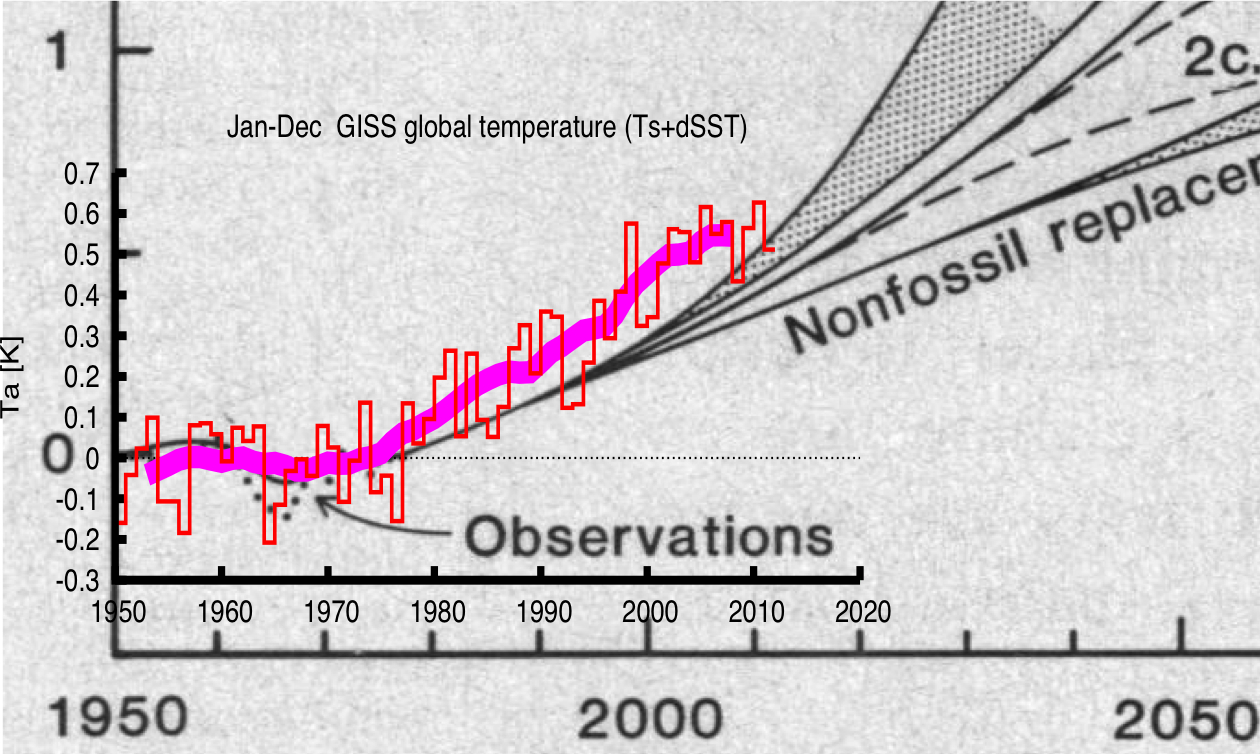
Take for example, NASA GISS director James Hanson's 1981 prediction (pdf), which the climate scientists who blog at RealClimate have overlayed with a chart of what the temperature actually turned out to be:

That is an excellent example of good science: based on measurements of carbon dioxide and temperature, and on our understanding from basic physics of the interactions between carbon dioxide and light, Hanson made a bold prediction that could be tested and verified experimentally over time. He put it out there for anyone to tear apart.  His career hung in the balance.

In the more than 30 years since, he's been proven correct -- sort of.  It turns out Hanson was too conservative.  He underestimated the temperature rise by about 30%.

Or consider Peter Sinclair's brief video comparing the statements of climate scientist Mike MacCracken in 1982 to what actually happened:


49 more authoritarians abandoning science in favor of politics

Next this TILT makes the classic appeal of antiscientists -- not to facts, not to data, but to authority -- the sort of appeal that would have made any colonial Tory proud to support the authority of the King instead of the upstart self-determining colonists:

"With hundreds of well-known climate scientists and tens of thousands of other scientists publicly declaring their disbelief in the catastrophic forecasts, coming particularly from the GISS leadership, it is clear that the science is NOT settled."

Uh, wait a minute.  Haven't we seen that?  Tens of thousands of scientists?  Really boys?  I thought you guys all had the "right stuff."  Would you really let just anyone with a BS run mission control when your butts were up in orbit? 

If yes, you're not so bright after all, and if no, well, don't try to fool us with your OISM "tens of thousands" of scientists.  If that makes the science unsettled when compared to the billions of data points accumulated by thousands of real climate scientists working over fifty years, then nothing will ever be settled enough for you.  The hypocrisy of this is astounding and saddening.

If you ain't got the data, you can always use smear

Considering this, I guess it shouldn't have surprised me these gentlemen -- 49 out of tens of thousands for former NASA employees (more than 18,000 people currently work for NASA, so this is about 0.27% of current employees) would next move into the emotional language.  It shouldn't have surprised me, but it disappointed me just the same.

NASA's polar satellite fleet
NASA's polar fleet of satellites observe the Earth
and measure climate change.
Often deniers portray themselves as reasoned, cautious, and conservative scientists, while the real scientists working in the field are described with emotionally charged adjectives like "alarmists," "warmers," and the like to weaken the public's respect for their work and to fool journalists about whose who.  If you can degrade, mock or destroy the individual, then it's easier for the public to dismiss everything that individual said. 

"The unbridled advocacy of CO2 being the major cause of climate change is unbecoming of NASA’s history of making an objective assessment of all available scientific data prior to making decisions or public statements."

So, here we see fifty years of science manipulatively described instead as "unbridled advocacy."  As in wild, emotional, and not objective, but rather subject to the passions of an unbroken horse -- just the opposite of the careful collection, calibration, and verification of billions of data points, which last I checked, don't have feelings, unbridled or otherwise.

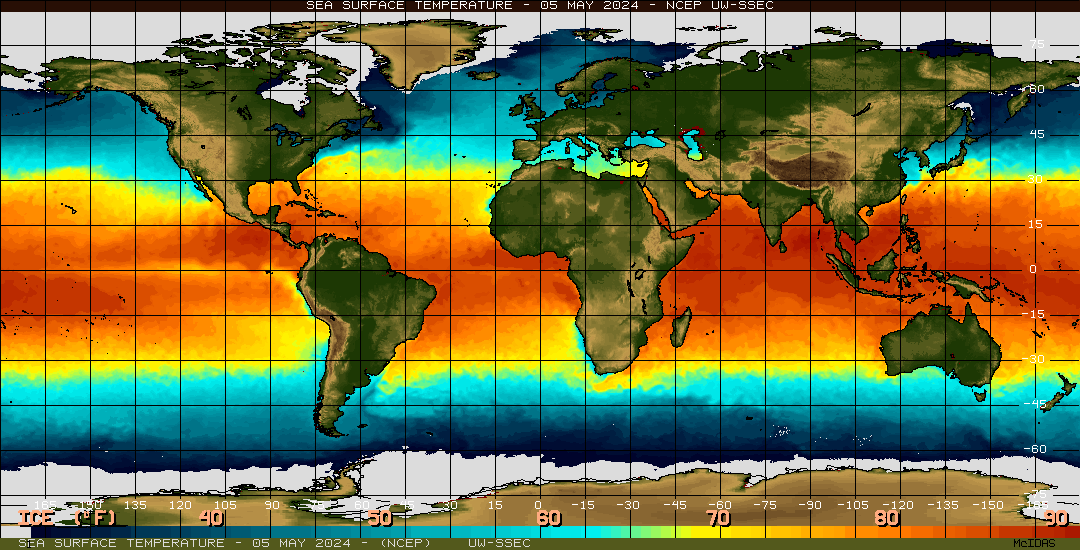
Some of those data points can be seen in this incredible video prepared at Goddard that layers sea surface temperature data on top of ocean current data to create a powerful representation.  For instance, it's easy to see why England, which is much further North than most of the US, is still fairly temperate. This is the 
kind of thing these guys should be standing up and applauding.


Heartland Institute propaganda outfit ties

Former Apollo astronauts Walter Cunningham and Harrison “Jack” Schmitt are listed as the main contacts for the letter, and both of them have a public history of advocacy against climate change science.  This casts doubt on the scientific validity of any of their statements.

In 2009, Schmitt appeared on the talk show of 9/11 conspiracy theorist Alex Jones and said that he believed that the environmental movement was a front for Communism.

“I think the whole trend really began with the fall of the Soviet Union. Because the great champion of the opponents of liberty, namely communism, had to find some other place to go and they basically went into the environmental movement.”

Walter Cunningham wrote against climate science in a pamphlet (pdf) published by the Heartland Institute, a libertarian think tank fighting climate science.

Schmitt, a former Republican senator from New Mexico, is a current board member of the Heartland Institute, and was a speaker at a conference arranged by the Heartland Institute to deny climate change.

“The Heartland Institute provides the most coherent and consistent articulation of and source of information on basic American approaches to the resolution of major issues of our times,"said Schmitt.

ExxonMobil and the Koch Brothers, who stand to gain hundreds of billions of dollars in profits from the denial of climate science, have been major funders of the Heartland Institute in the past.

Recently leaked documents show Heartland is drafting a national science curriculum created by a non-climate scientist database technician designed to undermine traditional science education and promote climate change denial by teaching school children that there is a scientific controversy when in fact there is not -- the controversy is political.

Hail to the chief (scientist)

NASA chief scientist Waleed Abdalati
Waleed Abdalati, NASA Chief Scientist. Credit: NASA/Bill Ingalls
NASA chief scientist Waleed Abdalati handled this propaganda attack with the grace and aplomb of a leader who's come up through the trenches and seen this sort of shameful ploy before.

"NASA sponsors research into many areas of cutting-edge scientific inquiry, including the relationship between carbon dioxide and climate. As an agency, NASA does not draw conclusions and issue 'claims' about research findings. We support open scientific inquiry and discussion... If the authors of this letter disagree with specific scientific conclusions made public by NASA scientists, we encourage them to join the debate in the scientific literature or public forums rather than restrict any discourse."

That is the key point.  Abdalati has graciously skewered these denialist propagandists by reminding everyone that they haven't produced any scientific evidence to back up their claims -- no data, no peer-reviewed research.  Just smears and emotional ploys in a TILT letter. 

If you disagree, he's telling them, let's see what you got.  Step up to the table like real men or women and subject your work to the withering scrutiny of peer review.  Can't do it?  Thought so.  Because it's not based in reality.

Two questions: why, and why?

In the end, these 49 signers sought to ... what?  Embarrass NASA into abandoning real science?  Pressure director Bolden into firing James Hansen?  Probably just to give Republican climate deniers some more ammo in the propaganda war to go after NASA's budget in the upcoming review on Capitol hill.  Watch for it and see which Members trot this out.  Odds are on Inhofe, Shimkus and the like.

But what they really did is tarnish their own names.  And that's a sad thing for a boy who loved NASA.

Thursday, April 12, 2012

Attacks on climate science by former NASA staff shouldn't be taken seriously. A letter from former administrators, astronauts, and engineers at NASA expressing climate change scepticism does not deserve parity with the agency's peer-reviewed climate scientists

Attacks on climate science by former NASA staff shouldn't be taken seriously

A letter from former administrators, astronauts, and engineers at NASA expressing climate change scepticism does not deserve parity with the agency's peer-reviewed climate scientists

Attacks on climate science by former NASA staff should not be considered equal to the work of NASA climate scientists such as James Hansen, pictured. Photograph: Gareth Fuller/PA
Almost exactly two years ago, John Cook wrote about the 5 characteristics of science denialism.  The second point on the list involved fake experts.

"These are individuals purporting to be experts but whose views are inconsistent with established knowledge. Fake experts have been used extensively by the tobacco industry who developed a strategy to recruit scientists who would counteract the growing evidence on the harmful effects of second-hand smoke."

We have seen many examples of climate denialists producing long lists of fake experts, for example the Oregon Petition and the Wall Street Journal 16.  Now we have yet another of these lists of fake experts.  49 former National Aeronautics and Space Administration (NASA) employees (led by Harrison Schmitt, who was also one of the Wall Street Journal 16 [who is also affiliated with the now infamous Heartland Institute]) have registered their objection to mainstream climate science through the most popular medium of expressing climate contrarianism -- a letter.  As is usually the case in these climate contrarian letters, this one has no scientific content, and is written by individuals with not an ounce of climate science expertise, but who nevertheless have the audacity to tell climate scientists what they should think about climate science.
It's worth noting that when the signatories Meet The Denominator, as is also always the case, their numbers are revealed as quite unimpressive.  For example, over 18,000 people currently work for NASA.  Without even considering the pool of retired NASA employees (all signatories of this list are former NASA employees), just as with the Oregon Petition, the list accounts for a fraction of a percent of the available pool of people.
This letter, as these letters always do, has gone viral in the climate denial blogosphere, and even in the climate denial mainstream media (Fox News).  But why exactly is this letter being treated as major news?  That is something of a mystery.  Or it would be, if the behavior of the climate denial community weren't so predictable.

The Signatories

Obviously this letter first gained attention because the signatories are former NASA employees.  They are being touted as "top astronauts, scientists, and engineers" and "NASA experts, with more than 1,000 years of combined professional experience."  Okay, but in what fields does their expertise lie?
Based on the job titles listed in the letter signatures, by my count they include 23 administrators, 8 astronauts, 7 engineers, 5 technicians, and 4 scientists/mathematicians of one sort or another (none of those sorts having the slightest relation to climate science).  Amongst the signatories and their 1,000 years of combined professional experience, that appears to include a grand total of zero hours of climate research experience, and zero peer-reviewed climate science papers.  You can review the signatories for yourself here.

Contrarians for Censoring Climate Science

These 49 former NASA employees wrote this letter to the current NASA administrator requesting that he effectively muzzle the climate scientists at NASA Goddard Institute for Space Studies (GISS).
"We, the undersigned, respectfully request that NASA and the Goddard Institute for Space Studies (GISS) refrain from including unproven remarks in public releases and websites."
Since nothing in science is ever proven, apparently these individuals simply don't want NASA GISS to discuss science in their public releases or websites anymore.  What specifically do they object to?
"We believe the claims by NASA and GISS, that man-made carbon dioxide is having a catastrophic impact on global climate change are not substantiated, especially when considering thousands of years of empirical data. With hundreds of well-known climate scientists and tens of thousands of other scientists publicly declaring their disbelief in the catastrophic forecasts, coming particularly from the GISS leadership, it is clear that the science is NOT settled."
Ah yes, the ever-more-popular goalpost shift of "catastrophic climate change."  The letter of course provides no examples of NASA GISS public releases or websites claiming that CO2 is having a catastrophic impact on climate change, and of course provides zero examples of these mysterious "hundreds of well-known climate scientists and tens of thousands of other scientists" who disbelieve these unspecified catastrophic claims.  As is always the case with these types of letters, it is all rhetoric and no substance.
"As former NASA employees, we feel that NASA's advocacy of an extreme position, prior to a thorough study of the possible overwhelming impact of natural climate drivers is inappropriate.
As Skeptical Science readers are undoubtedly well aware, the impact of natural climate drivers has been very thoroughly studied, and they simply cannot account for the observed global warming or climate change, especially over the past 50-65 years (Figure 1).
HvA 50 years
Figure 1: Net human and natural percent contributions to the observed global surface warming over the past 50-65 years according to Tett et al. 2000 (T00, dark blue), Meehl et al. 2004 (M04, red), Stone et al. 2007 (S07, green), Lean and Rind 2008 (LR08, purple), Huber and Knutti 2011 (HK11, light blue), and Gillett et al. 2012 (G12, orange).
The contrarians continue:
"We request that NASA refrain from including unproven and unsupported remarks in its future releases and websites on this subject. At risk is damage to the exemplary reputation of NASA, NASA's current or former scientists and employees, and even the reputation of science itself."
If NASA administrators were to censor the organization's climate scientists at the behest of a few of its former employees who have less climate science experience and expertise combined than the summer interns at NASA GISS, that would really damage NASA's exemplary reputation.

Expertise Matters

Let's be explicit about our choice here. 
  • On the one hand we have a bunch of former administrators, astronauts, and engineers who between them have zero climate expertise and zero climate science publications. 
  • On the other hand we have the climate scientists at NASA GISS who between them have decades, perhaps even centuries of combined professional climate research experience, and hundreds, perhaps even thousands of peer-reviewed climate science publications.
Amongst those individuals at NASA GISS are some of the world's foremost climate scientists.  They include James Hansen, who created one of the earliest global climate models in the 1980s, which has turned out to be remarkably accurate (Figure 2).
Hansen Actual Prediction
Figure 2: Observed temperature change (GISTEMP, blue) and with solar, volcanic and El Niño Southern Oscillation effects removed by Foster and Rahmstorf (green) vs. Hansen Scenario B trend adjusted downward 16% to reflect the observed changes in radiative forcings since 1988, using a 1986 to 1990 baseline.
This is not a difficult choice for NASA Administrator Charles Bolden, Jr.  We would not be surprised if he gave the 'skeptic' letter one look and tossed it in the recycle bin.
Climate contrarians clearly disagree, but in the real world, expertise matters.  The fact that these 49 individuals used to work at NASA does not make them experts in everything NASA does.  If the issue at hand were another moon landing, then by all means, the opinions of many of these individuals would be well worth considering.  But we're not talking about space shuttle launches or moon landings here, we're talking about climate science.  This is a subject which, to be blunt, these 49 individuals clearly don't know the first thing about.
To those who are making so much noise about this letter -- the next time you are at a medical center in need of major surgery, will you go see a pediatrician?  Or as a more relevant analogy, will you visit your neighbor, the retired dentist, and ask him to perform the surgery for you?
Somehow we suspect you will insist that the surgery be performed by a surgeon with relevant expertise.  The reason is of course that expertise matters.  Perhaps you would be wise to consider that fact the next time a group of climate contrarians with little to no expertise publish another of these letters.
As we suggested to William Happer, if climate contrarians want their opinions to be taken seriously, they should engage in real science within the peer-review system that works for every scientific field.  That is how science advances -- not through letters filled with empty rhetoric, regardless of how many inexpert retirees sign them.
Note that NASA Chief Scientist Waleed Abdalati has issued a responsewith very similar points and suggestions as our post:
"NASA sponsors research into many areas of cutting-edge scientific inquiry, including the relationship between carbon dioxide and climate. As an agency, NASA does not draw conclusions and issue 'claims' about research findings. We support open scientific inquiry and discussion.
"Our Earth science programs provide many unique space-based observations and research capabilities to the scientific community to inform investigations into climate change, and many NASA scientists are actively involved in these investigations, bringing their expertise to bear on the interpretation of this information. We encourage our scientists to subject these results and interpretations to scrutiny by the scientific community through the peer-review process. After these studies have met the appropriate standards of scientific peer-review, we strongly encourage scientists to communicate these results to the public.
"If the authors of this letter disagree with specific scientific conclusions made public by NASA scientists, we encourage them to join the debate in the scientific literature or public forums rather than restrict any discourse."
http://www.guardian.co.uk/environment/2012/apr/12/attacks-climate-science-nasa-staff