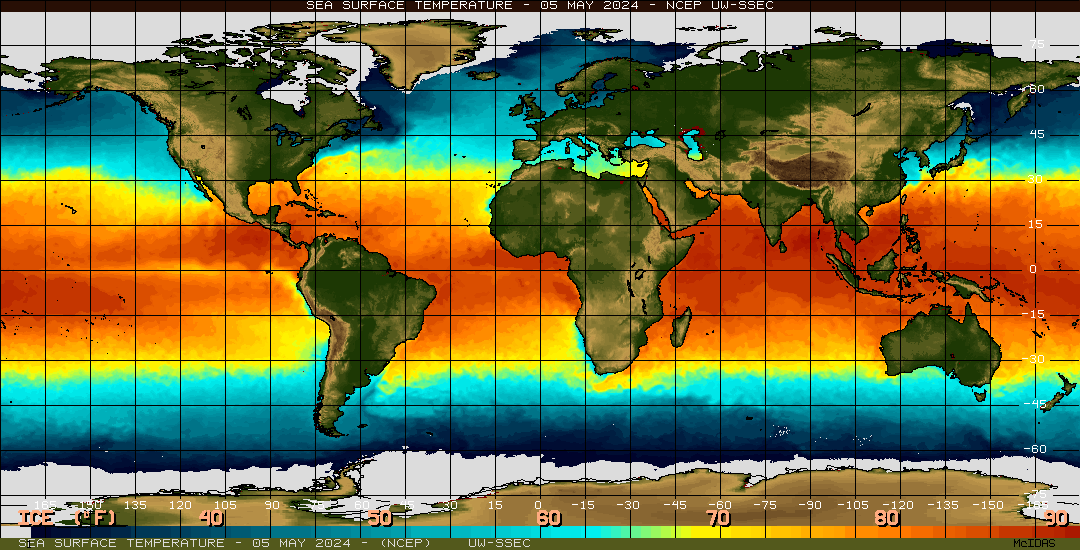
When we see records being broken and unprecedented events such as this, the onus is on those who deny any connection to climate change to prove their case. Global warming has fundamentally altered the background conditions that give rise to all weather. In the strictest sense, all weather is now connected to climate change. Kevin Trenberth
HIT THE PAGE DOWN KEY TO SEE THE POSTS
Now at 8,800+ articles. HIT THE PAGE DOWN KEY TO SEE THE POSTS
It’s hard to ignore Antarctica’s natural beauty, especially when ice halos come out to play. Michael Ashley
Professor Michael Ashley is currently in Antarctica to deploy a telescope to one of the most remote locations on Earth – a place known as Ridge A, some 850 km from the South Pole.
This is the fifth instalment in Professor Ashley’s Antarctica Diaries. To read the previous instalments, follow the links at the bottom of this article.
January 9 – Airdrop, or not
An “airdrop” is where an aircraft flies over and, rather than landing, drops cargo using parachutes. This isn’t all that useful during summertime, where it is easier just to land an LC-130 on the ice. But during winter (when it’s not possible to land due to low ground temperatures which freeze the aircraft’s hydraulics) an airdrop can be the only way of getting urgent cargo such as medical supplies to the Pole.
For the past week, a C-17 aircraft has been waiting at Christchurch for the weather to be good enough for an airdrop. The C-17 will fly non-stop to the Pole, drop its cargo, and then head back to Christchurch.
Early this morning, after several false starts, the C-17 started its long journey south, and just after breakfast a group of 50 of us waited about 500 metres from the station to witness the airdrop. By all accounts it can be quite spectacular.
Much, much more at this link, and it just keeps getting more and more interesting as you keep reading, no kidding! Do you know what the SPUD experiment is, for example? The Holy Grail of cosmology...!
by Scott Mandia, "Climate Change - Man or Myth?" blog, November 29, 2011
Want to learn more about the Climate Science Rapid Response Team (CSRRT)? Come hear my presentation at the AGU Fall Meeting 2011 in San Francisco on Wednesday December 7. During this 15 minute presentation, I will describe CSRRT’s history and process along with a few example success stories. The various other science communication outreach activities that the CSRRT scientists and its matchmakers are engaged in will also be presented.
PA33C-06. The Climate Science Rapid Response Team – A Model for Science Communication Scott A. Mandia; John A. Abraham; Ray Weymann; Michael Ashley Location: Room 302 (Moscone South) Time: 3:10–3:25 PST
Event horizon: the black hole in The Australian’s climate change coverage
The Australian’s coverage of climate changed is seriously warped. AFP PHOTO/NASA- CXC/A. HOBART
The Conversation, August 31, 2011: MEDIA & DEMOCRACY – Michael Ashley investigates the national paper’s op-ed policy.
The “event horizon” of a black hole is one of the most mind-boggling concepts in astrophysics.
The black hole’s stupendous gravity causes time itself to be warped — an astronaut falling inwards sufficiently slowly would see arbitrarily far into the future history of the Universe during their final minutes and seconds before crossing the event horizon.
There is no other place in time or space where our normal perception of reality is so completely overturned.
That is, apart from a meeting room deep within the News Limited bunker at 2 Holt Street, Surry Hills.
It is in this room that Chris Mitchell, editor-in-chief of The Australian, holds editorial meetings.
And it is in this room that reality becomes so distorted that The Australian was able to state earlier this month, “it is in keeping with this newspaper’s rationalist pedigree that we have long accepted the peer-reviewed science on anthropogenic climate change,” while at the same time engaging in a campaign to misrepresent and distort climate science.
Other editorials have made it clear that The Australian believes it is treating its readers as mature adults who should be able to make up their own minds based on arguments from “both sides” of the debate.
Excuse my bluntness, but it is past time to acknowledge that the science underpinning anthropogenic climate change is rock solid. The sceptics have had the time and opportunity to come with up a convincing case, but their best efforts read like arguments that NASA faked the moon landing.
My colleagues working in the climate sciences have largely given up trying to correct the constant stream of misinformation from The Australian, in frustration.
The Australian’s anti-science campaign takes many forms. One is the inflation of the credentials of their fake experts. For example, OpEd writer and member of the Outdoor Recreation Party Jon Jenkins was referred to as an “Adjunct Professor”. Bond University wrote to The Australian informing them that this was not true.
Howard Brady was called a “climate change researcher from Macquarie University”; in fact, Brady is a 70 year-old retiree who has published just seven scientific papers (on Antarctic sediments, not climate), the most recent one in 1983, following which he worked for 17 years in the oil industry. Macquarie University contacted The Australian to set the record straight.
In neither of these cases did The Australian publish a retraction or clarification.
Another tactic is to accept opinion pieces on science from unqualified sources. When I contacted The Australian’s opinion editor late last year to express dismay at their bias, I was given the example of Michael Asten, a part-time professorial fellow in the school of geosciences at Monash University, Melbourne, as someone who was well-qualified to comment.
So I did some investigation into Asten and his four OpEds in The Australian over the past two years.
A quick check of Asten’s peer-reviewed publications shows that while he appears to be your go-to guy if you have electromagnetic interference problems with your fluxgate magnetometer, he hasn’t published anything remotely related to climate science. He is, however, well-connected with the mining and coal industries.
In his first OpEd (“Climate claims fail science test”, December 9, 2009), Asten wrote “recent results published by top scientists cast doubt on the Intergovernmental Panel on Climate Change’s theory” and he showcased the work that Pearson et al published in the top journalNature.
But Asten misrepresented the findings in the Nature paper. Don’t just take my word for it— Paul Pearson and his co-authors wrote to The Australian saying “Professor Michael Asten has misrepresented our recent research by suggesting that it casts doubt on the link between atmospheric carbon dioxide and global warming”.
They added, “We would like to take this opportunity to add our voices to the strong and steady message that the world scientific community is delivering to the Copenhagen negotiators — the greenhouse problem is real, imminent and potentially devastating for the planet, its life, and human civilization. Fortunately it is still not too late to avert the catastrophe.”
You would think you couldn’t ask for a clearer statement than that, but Asten went on to argue in his second opinion piece (“More evidence CO₂ not culprit”, December 29, 2009) that he used data in Pearson’s paper to arrive at a different conclusion from Pearson himself.
So, Asten, with no expertise in the field, is using a paper published in Nature to argue the opposite of what the paper actually says.
He then spins this as “top scientists cast doubt” on the IPCC. Gobsmacking.
In Asten’s third article (“CSIRO should establish if there was medieval warming Down-Under”, 13 May 2010) he asserts that if the medieval warm period was a global phenomenon, then “warming during the past century should be seen as predominantly natural climate change rather than driven by man-made carbon emissions.”
This is bunkum. The effect of man-made carbon dioxide is clear from multiple independent lines of evidence.
Asten interprets this as a serious discrepancy in climate predictions that the CSIRO was withholding from the Government. He also describes how compliant scientists were intimately involved in the formulation of Nazi racial policy, and outspoken academics were removed by the Gestapo.
But once again, Asten misunderstands the science. The Riva et al paper wasn’t an observation of the total sea-level rise at all, just an estimate of the contribution from melting ice. The Nazi stuff is simply bizarre.
You would think The Australian, if it had any editorial integrity, would have called a halt to Asten’s ready access to the opinion pages after serious flaws were found with each of his contributions. But the lure of publishing an opinion supporting their editorial bias, from an apparently reputable source, was just too strong to resist.
I have singled out Asten in this article, but the same applies to every one of the climate contrarians that are repeatedly given exposure in The Australian.
For example, Bob Carter has claimed “temperature records confirm that cooling is under way” – no they don’t.
Ian Plimer says “To argue that human additions to atmospheric CO2, a trace gas in the atmosphere, changes climate requires an abandonment of all we know about history, archaeology, geology, solar physics, chemistry and astronomy” – this statement is just absurd.
None of these people has made any impact whatsoever with their arguments in the peer-reviewed literature — they just aren’t contributing to any real scientific debate. The only place that they can publish their junk science is in outlets such as The Australian, where they are welcomed with open arms.
And if you think the bias in The Australian only affects its choice of OpEd pieces, wait till you read Tim Lambert’s examination of news reporting in his article later in this series for The Conversation.
So, when The Australian claims in its editorials to support the peer-reviewed science, it is really just an insurance clause for when the tide inevitably turns against their campaign of misinformation.
The Murdoch media empire has cost humanity perhaps one or two decades of time in the battle against climate change. Each lost decade greatly increases the eventual economic costs, the devastation to our ecosystems, and the suffering of future generations.
Do you think I’m exaggerating?
Read the real science, ask the real experts.
The editors sitting around the table in that meeting room in Surry Hills need to reflect on their culpability.
A journey into the weird and wacky world of climate change denial
The Royal Society for the Protection of Birds, Prince Charles, the Archbishop of Canterbury and David Attenborough – just some of the oppressive forces faced by climate deniers. -(Jonathan)-/flickr, scottgun/flickr, Kew Gardens/fickr
CLEARING UP THE CLIMATE DEBATE: Professors Stephan Lewandowsky and Michael Ashley step into the twilight zone of climate change scepticism: where the sun is made of iron and the royals are out to get you.
by Stephan Lewandowsky and Michael Ashley, The Conversation, June 21, 2011
Science, like much human endeavour, thrives on debate.
Climate deniers want to participate in this debate as equal partners, and feel that they are entitled to be heard and to be taken seriously. This is quite understandable, but by itself does not create an entitlement.
In science, to actually contribute at the forefront of a field one has to earn credibility, not demand it. Being taken seriously is a privilege, not a right.
In science, this privilege is earned by not only following conventional norms of honesty and transparency but by supporting one’s opinions with evidence and reasoned argument in the peer-reviewed literature.
This is what makes science self-correcting. If arguments turn out to be wrong, in time they are caught and corrected by other scientists. It is virtually impossible to publish long-refuted nonsense in good peer-reviewed journals.
Climate deniers, by contrast, seem to avoid the peer-reviewed literature or publish by sometimes abusing the system. Nor do the deniers turn up and present their ideas at any of the many international scientific conferences, open to anyone, where these issues have been explored for decades.
Deniers simply keep restating nonsensical arguments that the scientific community has known to be wrong for a long time.
The illusion of debate
So why do deniers continue to make their loud, and egregiously mistaken, claims? And what explains the tiny handful of deniers with verifiable academic credentials?
Many are (generally former) Professors, albeit usually with tenuous unpaid Adjunct or Emeritus associations with universities.
Are these individuals indicative of a scientific debate, after all? And if not, what motivates them?
Today, denial of the link between HIV and AIDS would be laughable, if the consequences of that denial hadn’t been so serious.
It is thus important to remember that twenty years ago a tiny handful of people in the medical community, including senior academics at reputable universities, rejected the consensus that HIV causes AIDS.
It is illuminating that just as in climate science, the contrarian publications on HIV were accompanied by an unusual context that made headlines and raised eyebrows for the same ethical reasons that arise from climate deniers’ subversion of peer review.
An example from astronomy is also prescient. The consensus of astronomers is that the sun consists largely of hydrogen and helium, and is powered by fusion at its core.
The evidence for this is overwhelming, and supported by multiple independent lines of investigation.
Like climate change, there are contrarian academics who argue against the consensus. O. Manuel, unpaid Emeritus of the Missouri University of Science and Technology, has claimed for decades that the sun is mostly composed of iron.
Manuel has recently published his bizarre theories in the bottom-tier journal Energy & Environment, also a favorite of climate deniers due to its, to put it mildly, unusual review processes.
There is an important lesson here: an overwhelming scientific consensus does not imply the absence of contrarian voices even within the scientific community.
Over time, those contrarian voices simply fade away because no one takes them seriously, despite their shouts of “censorship” and accusations of bias.
This is not to say that a scientific consensus is never overturned.
There are well-known examples such as the Helicobacter pylori discovery in medicine, and continental drift in geology. But in both cases the arguments were won and lost in the peer-reviewed literature, not by contrarians sitting on the side-lines writing opinion pieces about how they were being oppressed.
Manipulating the media
Normally the underbelly of obsessed contrarians that strangely afflicts many areas of science would go unnoticed.
With climate change, however, we are in the extraordinary situation where the deniers have had almost free reign in media outlets such as The Australian, while scientists aregiven short shrift.
Providing a platform for deniers, thereby enabling political leaders to mistake contrarian cranks for real science, can have horrendous consequences, as we have seen in the case of HIV, where perhaps hundreds of thousands of people have needlessly died.
There is an ethical imperative to hold deniers accountable for their actions.
But the question remains: what motivates deniers?
With very few exceptions, academic climate deniers are male and either retired or close to retirement.
The climate deniers’ champion, MIT’s 71-year old Richard Lindzen, has had a distinguished career, but 30 years after his major contributions, he appears to struggle to respond to devastating peer reviews when he attempts to publish his contrarian views in a major journal.
More commonly, the academic climate denier will have had a mediocre career that escaped public notice and left little imprint on science. Some haven’t been able to keep up with the rapid advances in science coming from its increasing complexity and the impact of computers and new technologies. Once respected, these scientists find themselves “out of the loop” and being ignored, which sometimes makes them quite grumpy.
There is much truth in the eminent physicist Max Planck’s observation, “a new scientific truth does not triumph by convincing its opponents and making them see the light, but rather because its opponents eventually die, and a new generation grows up,” sometimes paraphrased as, “science advances one funeral at a time.”
A strong motivation for contrarians appears to be the attention that they can gain or re-gain in the public arena.
Any scientist, no matter how out of touch, can become the darling of talk shows by simply disagreeing with the consensus on climate.
89-year-old Vincent Gray was introduced recently by shock jock Alan Jones as “world acknowledged and acclaimed,” and among “some of the most eminent people in the world”.
Gray’s most recent peer-reviewed publication appears to be an article on the chemical properties of coal, from 17 years ago. Nothing at all on climate.
Jones also recently interviewed 72-year-old Tim Ball, describing him as “one of the world’s most eminent climate scientists, and acknowledged as such.” This is in contrast to Ball’s CV, in which he reveals he got his PhD at the age of 44 and retired from academia at the age of 57 with a very thin list of publications, most frequently in The Beaver and the Manitoba Social Science Teachers Journal.
Jones’ listeners and The Australian’s readers are being misled.
David Attenborough is watching you…
Another necessary element of denial is conspiratorial thinking. Any denier sooner or later, whether an academic or not, must resort to a global conspiracy theory to negate the overwhelming evidence arrayed against them.
One self-proclaimed “rocket scientist” who has published junk science in the opinion pages of The Australian has been quoted on a New Zealand website as saying:
“To win the political aspect of the climate debate, we have to lower the western climate establishment’s credibility with the lay person. And this paper [an accompanying picture book of thermometers] shows how you do it. It simply assembles the most easily understood points that show they are not to be entirely trusted, with lots of pictures and a minimum of text and details. It omits lots of relevant facts and is excruciatingly economical with words simply because the lay person has a very short attention span for climate arguments. The strategy of the paper is to undermine the credibility of the establishment climate scientists. That’s all. There is nothing special science-wise.”
Undermine credibility.
That’s all.
Nothing science-wise.
Are these the people one should entrust with the welfare of future generations?
Lest one think this is an isolated case, conspiracy theories are an essential ingredient in writings of deniers.
According to a recent (not peer-reviewed) book by Bob Carter, who has an unpaid Adjunct position at James Cook University, it is “simply professional suicide for a scientist to put a questioning head above the parapet” when faced with opposition from “the BBC, commercial television, all major newspapers, the Royal Society, the Chief Scientist, the Archbishop of Canterbury, the Bishop of London, David Attenborough, countless haloed-image organisations such as the Royal Society for the Protection of Birds, and even Prince Charles himself.”
Just imagine the devastating rebuttal of climate change that Bob Carter could submit for peer-review if he wasn’t being oppressed by the Archbishop of Canterbury and Prince Charles.
But seriously, why doesn’t Carter, or any of the deniers, simply write a coherent outline of their best arguments against the expert consensus and publish it in the peer-reviewed literature?
Why don’t they turn up to the relevant scientific conferences and give a talk on their theories?
The answer is simple: they don’t have any arguments that have any scientific merit.
Returning to our discussion of conspiracy theorists, O. Manuel, whose imaginative theories on the sun we discussed earlier, avidly posts to blogs and often mentions President Eisenhower’s 1961 warning against a government-funded “scientific-technological elite”.
Manuel claims that this “tax-feeding ‘elite’ has distorted experimental data to give tax-payers misinformation about the sun’s origin.”
The peer-reviewed literature on conspiratorial thinking cites several identifying attributes that are replete in the statements of climate deniers.
For example, the imaginary conspirators are at once small in number but also all powerful.
They claim on the one hand that science is based on the strength of argument, not on the consensus of experts, but on the other hand they desperately manufacture petitions and lists of “scientists” on their side.
There’s a laughable list circulating on the internet of 31,000 “scientists” — including at one point Dr. Pierce and Dr. Hunnicutt of M*A*S*H fame — who allegedly oppose the consensus on climate change. But on the other hand there’s the simultaneous claim that opposition is squashed by the world’s science academies and Prince Charles.
Deniers yelp about being oppressed, while at the same time claiming to number 31,000.
And just to be sure, Prince Phillip runs the world’s drug trade and climate change is a means by which the Royal family is culling the population for a forthcoming genocide. Or something like that, maybe you can figure it out.
Time to close the phony debate on climate science
At a time when the oceans are accumulating heat at the rate of five Hiroshima bombs per second, are conspiracy theorists the people whom a nation should entrust with the future of our children?
The so-called “debate” on climate change has been over for decades in the peer-reviewed literature. It is time to accept the scientific consensus and move on, and to stop giving air-time to the cranks.
It is time for accountability.
This is the eighth part of our series Clearing up the Climate Debate. To read the other instalments, follow the links below:


 Posts
Posts