Blog Archive

Showing posts with label Deforestation. Show all posts

Saturday, June 3, 2017

Brazil's environment risks political capsize

A serious political crisis over demands for its president to step down is adding to the threats to Brazil's environment.
The Jamanxim area of the Amazon is losing almost 600,000 hectares from two national parks.
by Jan Rocha, Climate News Network, June 3, 2017

SAO PAULO
 – Brazil faces an unpredictable political crisis as the country's president fights demands for him to leave office. And as the price of his survival, he is making damaging concessions on Brazil's environment.
President Michel Temer is facing calls to resign after the owners of Brazil’s biggest meat-packing industry, JBS, alleged he had been involved in bribery and the obstruction of justice.
To retain support in congress, he is now working with the powerful farmers lobby, the bancada ruralista, which wants to reduce conservation areas and weaken environmental licensing laws.
He hopes to cling to power by making concessions to the bancada. In exchange for support from the Parliamentary Agriculture Front (FPA), the bancada’s formal name, he tore up the government’s project for modernising the environmental licensing law, telling lobby members they could present whatever amendments to it they liked.
So a congressional committee is now about to approve a radically different version of the government’s original proposal for a new General Licensing Law.

Licensing discarded

Dubbed “flex licensing”, it dispenses with the need for licences in some of the areas where they are most needed – largescale cattle ranching, mining in protected areas, and even roadbuilding in the Amazon, one of the biggest causes of deforestation. Once past the committee stage, it will be voted into law in a plenary session.
This is a serious blow to the environment minister, José Sarney Filho, who spent a year negotiating a more reasonable version of the bill with environmentalists, farmers and industry.
Nevertheless, he has chosen to remain in the government, although his party, the Greens, together with several other small parties, has decided to abandon the ruling coalition in protest at President Temer’s alleged involvement in corrupt practices.
The minister says he has decided to stay in order to defend the cause of sustainability and the green economy", and his achievements. These include the suspension of the environmental licensing process which would have allowed the proposed São Luis dam on the Tapajos river, in the Amazon, to go ahead, and incentives for clean and renewable energy sources.   
The political turmoil has left Sarney Filho powerless to stop the tide of anti-conservation legislation being tabled by the farmers’ lobby in their desire to open up to economic exploration previously protected land like indigenous areas and national parks.

“Brazil is undergoing an unprecedented offensive against its protected areas”

In a 2017 report (available only in Portuguese) the Worldwide Fund for Nature, WWF, says there is an imminent risk of Brazil losing up to 80,000 square kms of parks and forests, an area the size of Portugal.
“Brazil is undergoing an unprecedented offensive against its protected areas”, WWF says, with up to 10% of the country’s total protected area under threat.
On 24 May, in the capital, Brasilia, the lower house representatives came to blows over the legitimacy of passing any laws while the scandal involving the president remains unresolved.
In the senate the farmers’ lobby quietly passed  two controversial bills which will reduce the size of two national parks in the Jamanxim river area in the Amazon by almost 600,000 hectares, reckoned as the equivalent of 486,000 soccer fields.
This reduction had been proposed by the government to allow the building of a new railway, Ferrogrão – the Grain Railway– to carry the soya harvest from the huge farms of central Brazil to the Amazon river port of Santarem.
After studies by the government’s environment agency, the Chico Mendes Institute for Biodiversity Conservation (ICMBio – Portuguese only) it was decided that an area of 862 ha would be adequate for the railway. But the ruralistas have increased that to a whopping 600,000 ha.

Growing deforestation

They are using the bill to remove protected status from a much wider area so that  it can be used for farming, mining and logging.
They also introduced a clause into the bill, reducing the size of São Joaquim, a national park in the Atlantic Forest, located in the southern state of Santa Catarina, by 20%, although it has nothing to do with the railway. 
The environment minister’s warning that the bills will severely affect the government's plan to combat deforestation by strengthening conservation areas in the Amazon, not reducing them, was simply ignored. Deforestation is already on the rise, reaching 7,989 sq kms in 2016, the environment ministry says.
The new legislation also completely contradicts Brazil’s Paris Agreement commitments to combat global warming by reducing greenhouse gas emissions. 
Climate scientists also point out that reducing the size of conservation areas will help to dismember the Amazon, transforming it into an archipelago of forest fragments, leaving plant and animal populations more susceptible to extinction.
Ironically it is the ruralistas, the big farmers, who will suffer from lower rainfall in the midwest region – Brazil’s grain basket – more than anyone. 

Thursday, May 4, 2017

In controversial move, Brazil may outsource Amazon deforestation monitoring


Fires and deforestation in the Amazon, as seen by a sensor aboard a NASA satellite. NASA Earth Observatory
by Erik Stokstad, Science Magazine,
With reporting by Herton Escobar.

In a major change, Brazil's Ministry of the Environment is looking for a company to help it monitor deforestation in the Amazon. "This is a surprise for everyone … crazy stuff," says Tasso Azevedo, coordinator of the Greenhouse Gas Emission Estimate System and Observatório do Clima in São Paulo and former head of the Brazilian Forest Service. The controversial proposal led to the firing of one of the ministry's top scientists, who is a vice president of the Intergovernmental Panel on Climate Change (IPCC).  

Since 1988, the ministry has relied on the National Institute of Space Research (INPE) to analyze land cover changes in the Amazon, which holds the world’s largest intact swaths of forest. Efforts to combat deforestation there have been the focus of worldwide interest, in large part because of the region’s rich biodiversity and the forest’s role in shaping regional climate.

The ministry says INPE will continue to monitor the Amazon, but researchers worry that the $25 million annual contract will result in significant duplication of effort, a waste of scarce resources, possible confusion over deforestation rates, and create an apparent conflict of interest for the ministry. 

The data from INPE's remote sensing analyses helped the ministry create and enforce policies that slashed deforestation by 72% between 2004 and 2016. The flagship effort at INPE is the Program for Monitoring Deforestation of the Amazon by Satellite (PRODES), in which technicians analyze LANDSAT data to identify clear-cuts larger than 6.25 hectares and produce a yearly estimate of deforestation in the Amazon.

Since 2004, INPE has added techniques to detect smaller patches of illegal cutting, and also created a program called DETER to provide monthly and weekly updates that could be used for enforcement. The long track record with PRODES and INPE's newer approaches have won praise from international experts. "Brazil is the leading country in terms of monitoring deforestation," says Matthew Hansen of the University of Maryland in College Park. "No one touches Brazil."

But on 20 April, the ministry quietly issued a 160-page request for proposals for "contracting specialized services of support to the infrastructure of geoprocessing and remote sensing activities to meet the demands of environmental monitoring and geoprocessing." The 2-week deadline for proposals closes Thursday, after which the ministry will consider any bids for up to 60 days. The 12-month contract could be extended for up to 5 years. News of the proposal request was first reported Wednesday by Estadão magazine.  

The decision to hire a commercial firm to do remote-sensing analysis was disputed within the ministry. The head of the program to combat deforestation, mathematician Thelma Krug, who helped create PRODES, reportedly objected to the decision. She was dismissed from her position on 19 April, the day before the request for proposals was issued. In a statement, the ministry said she wanted to spend more time on her work for IPCC. "She's a scientist who knows better than anyone in Brazil what's going on with measuring deforestation in the Amazon," says Paulo Moutinho, an ecologist at the Amazon Environmental Research Institute in Brasília. Her firing was "not good news for Brazilian society or those trying to protect the forest."  

In a statement yesterday, the ministry said that the purpose of the contract is to add technology, such as radar imagery, not available from INPE. The space agency will continue to monitor and estimate deforestation in the Amazon, the ministry said, and disputed that work done under the contract would be redundant with INPE’s activities. But Raoni Rajão, a social scientist at the Federal University of Minas Gerais in Belo Horizonte, says that much of the work called for by the bid request is already being done by INPE, so hiring a contractor to replicate it is "basically a waste of money." The contract would eat up 18% of the ministry's budget, which was cut 51% in March to $142 million. That's money that could be better spent fighting illegal logging, which rose 29% last year, says Carlos Souza, a remote sensing expert with Imazon, a research institute in Belém.

There's also the potential for conflict of interest, critics say. The ministry would be paying a company to evaluate deforestation, which is one measure of how well the ministry is doing its job. That raises important questions, Souza says: "How transparent will the system be? Can it be verified by civil society?"

INPE's methods are transparent and its analysis independent of the ministry, experts say. "If you want to save the Amazon," says Moutinho, "we need a very robust monitoring system of deforestation."
Rajão, who has created an online petition to ask the ministry to cancel the request, also worries that the ministry could cherry-pick deforestation data from the contractor or INPE and highlight the better-looking numbers. Multiple sources of government information could create confusion over the status and trends of deforestation, he says.
A big value of INPE’s annual deforestation estimates is that they offer a simple, clear indicator about how the world's largest rainforest is faring, says tropical ecologist Dan Nepstad of the Earth Innovation Institute in San Francisco, California. "It's become part of the national narrative on the Amazon," he says.

Tuesday, October 6, 2015

Threat to Brazil’s indigenous reserves raises climate and health concerns as studies show that reduced deforestation leads to lower CO2 emissions and better air quality

by Jan Rocha, Climate News Network, October 1, 2015

SÃO PAULO − Environmental organisations warn that a bill now going through the Brazilian Congress to transfer responsibility for demarcating indigenous reserves from federal government experts to politicians could lead to an increase of 110 million tonnes of CO2 emissions by 2030.

The Amazon Environmental Research Institute (IPAM) calculates that the accumulated carbon stock inside indigenous reserves in the Amazon basin amounts to 47 billion tonnes − or more than a year’s worth of global emissions.

Studies have shown that rainforest located in indigenous reserves is almost always preserved, even when much of the land around it has been cleared for farming.

But the controversial bill that might soon be voted into law could radically change that situation by giving Congress responsibility for demarcating indigenous reserves − which critics liken to asking the fox to look after the chicken house.

The 2014 elections in Brazil produced a very reactionary chamber of deputies, many of them belonging to the “bullet, bull and bible” lobbies defending law and order, agribusiness and conservative moral issues, with very little sympathy for, or understanding of, Brazil’s hundreds of indigenous groups.

Formally recognised

At present, indigenous lands are formally recognised only after detailed anthropological, archaeological and historical studies conducted by the National Indian Foundation (FUNAI), the government agency for policies relating to indigenous peoples, which then physically demarcates their territory.

It is a slow and painstaking process that allows for the compensation of farmers who have settled in good faith − sometimes with land titles dating back to Brazil’s imperial government in the 19th century.

The 698 indigenous reserves occupy 13% of Brazil’s total land area, almost all (98%) of it in the Amazon basin. Two-thirds have been officially recognised, while another 228 await demarcation, but the bill could include a clause making even recognised reserves open to revision.

If the demarcation process were transferred to congress, environmental groups such as the Socioenvironmental Institute (ISA), a well-respected Brazilian NGO, fear that forested indigenous areas will be opened up “to high impact activities like mining, dams, oil and gas pipelines, waterways, railways, roads, and non-indigenous settlements and farming activities.”

“It is worth emphasising the strategic importance of indigenous lands for environmental conservation,” ISA says.

The accumulated deforestation in indigenous territories in Amazonia is just 1.9% of the original forested area within them, compared to overall deforestation of 22.8% of the total original forested area, according to figures produced for 2013 by the Program to Calculate Deforestation in the Amazon (PRODES), the monitoring project of Brazil’s National Institute for Space Research.

“Even outside Amazonia, where indigenous reserves are much smaller in area, they have played an important role in safeguarding biodiversity,” ISA adds.

If the new bill is approved by Congress, IPAM reckons that the probable changes could lead to an extra 110 million tonnes of carbon emissions by 2030.

The Brazilian government is committed [watch what they do, not what they say!] to zero illegal deforestation in the Amazon by 2030, but embattled president Dilma Rousseff is currently too busy fighting the threat of impeachment to take on another fight with some of the Congress members she needs to keep on her side.

Criminal loggers

The government has mounted a number of successful law enforcement operations to crack down on criminal loggers, and deforestation rates have been falling. But if indigenous areas stop being protected, and fall into the hands of farmers, loggers and mining companies, the Forest Code allows for 20% of the acquired area to be cleared.

According to a recent study published in Nature Geoscience, falling deforestation rates are not only good for reducing CO2 emissions, but have also contributed to saving lives by improving air quality.

The study found that the 40% reduction in Brazil’s deforestation rates since 2004 is preventing 1,060 premature adult mortalities annually across South America, because of the consequent reduction in fire emissions and, therefore, of particulate matter (PM).

The study says: “Inhalation of PM from fires has adverse impacts on human health, including increased hospital admissions and premature mortality.”

It estimates that deforestation fires alone cause an average of 2,906 premature deaths annually across South America from cardiopulmonary disease and lung cancer. 

*Jan Rocha, a freelance journalist living in Brazil, is a former correspondent there for the BBC World Service and The Guardian.

Sunday, November 2, 2014

Amazon rainforest losing ability to regulate climate, scientist warns

Report says logging and burning of Amazon might be connected to worsening droughts – such as the one plaguing São Paulo

amazonin
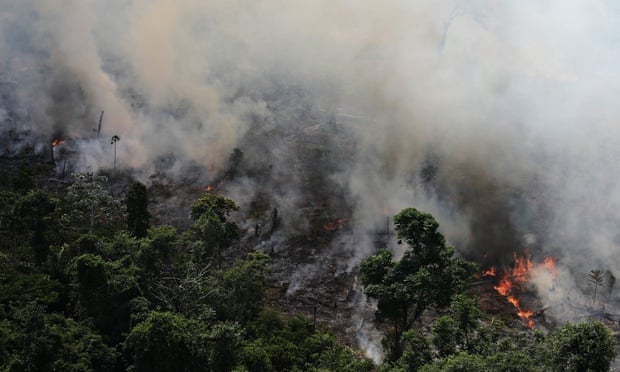
Smoke billows as an area of the Amazon rainforest is burned to clear land for agriculture near Novo Progresso, Para State. Photograph: Nacho Doce/Reuters
by Jonathan Watts in Rio de Janeiro, The Guardian, October 31, 2014

The Amazon rainforest has degraded to the point where it is losing its ability to benignly regulate weather systems, according to a stark new warning from one of Brazil’s leading scientists.
In a new report, Antonio Nobre, researcher in the government’s space institute, Earth System Science Centre, says the logging and burning of the world’s greatest forest might be connected to worsening droughts – such as the one currently plaguing São Paulo – and is likely to lead eventually to more extreme weather events.
The study, which is a summary drawing from more than 200 existing papers on Amazonian climate and forest science, is intended as a wake-up call.
“I realised the problem is much more serious than we realised, even in academia and the reason is that science has become so fragmented. Atmospheric scientists don’t look at forests as much as they should and vice versa,” said Nobre, who wrote the report for a lay audience. “It’s not written in academic language. I don’t need to preach to the converted. Our community is already very alarmed at what is going on.”
A draft seen by The Guardian warns that the “vegetation-climate equilibrium is teetering on the brink of the abyss.” If it tips, the Amazon will start to become a much drier savanna, which calamitous consequences.
The Amazon works as a giant pump, channeling moisture inland via aerial rivers and rainclouds that form over the forest more dramatically than over the sea, the author says. It also provides a buffer against extreme weather events, such as tornados and hurricanes.
In the past 20 years, the author notes that the Amazon has lost 763,000 sq km, an area the size of two Germanys. In addition another 1.2m sq km has been estimated as degraded by cutting below the canopy and fire.
As a result, the report notes, the deterioration of the rainforest – through logging, fires and land clearance – has resulted in a decrease in forest transpiration and a lengthening of dry seasons. This might be one of the factors of the severe drought affecting south-east Brazil. São Paulo – the biggest city in South America – is facing its worst water shortages in almost a century. October, which is usually the start of the rainy season, was drier than at any time since 1930, leaving the volume of the Cantareira reservoir system down to 5% of capacity.
“Studies more than 20 years ago predicted what is happening with lowering rainfall. Amazon deforestation is altering climate. It is no longer about models. It is about observation,” said Nobre. “The connection with the event in São Paulo is important because finally people are paying attention.”
Nobre calls for a “war effort” to reverse the damage and secure the global climate and security of future generations. This would involve a ramped-up effort to immediately halt existing deforestation and a major new project to replant trees.
Whether the government listens, however, is another matter. Forest clearance has accelerated under Brazil’s president, Dilma Rousseff, after efforts to protect the Amazon were weakened. Last month, satellite data indicated a 190% surge in deforestation in August and September. The influence of the “ruralista” agribusiness lobby in Congress has also grown in recent years, making it harder for the authorities to push through new legislation to demarcate reserves.
“They have taken good action in the past,” says Nobre. ““I hope they will listen now.”

Sunday, September 14, 2014

Amazon rainforest deforestation in Brazil drastically reducing rain for agriculture and drinking

Scientists in Brazil believe the loss of billions of litres of water released as vapour clouds by Amazon rainforest trees is the result of continuing deforestation and climate change – leading to devastating drought.

by Jan Rocha, Climate News Network, September 14, 2014

SÃO PAULO − The unprecedented drought now affecting São Paulo, South America’s giant metropolis, is believed to be caused by the absence of the “flying rivers” − the stream of water vapor clouds from the Amazon that normally bring rain to the centre and south of Brazil.

Some Brazilian scientists say the absence of rain that has dried up rivers and reservoirs in central and southeast Brazil is not just a quirk of nature, but a change brought about by a combination of the continuing deforestation of the Amazon and global warming.

This combination, they say, is reducing the role of the Amazon rainforest as a giant “water pump,” releasing billions of litres of humidity from the trees into the air in the form of water vapor.

Meteorologist Jose Marengo, a member of the Intergovernmental Panel on Climate Change, first coined the phrase “flying rivers” to describe these massive volumes of atmospheric water vapor that rise from the rainforest, travel west, and then − blocked by the Andes − turn south.

Satellite images from the Centre for Weather Forecasts and Climate Research of Brazil’s National Space Research Institute (INPE) clearly show that, during January and February this year, the flying rivers failed to arrive, unlike the previous five years.

Alarming proportions

Deforestation all over Brazil has reached alarming proportions: 22% of the Amazon rainforest (an area larger than Portugal, Italy and Germany combined), 47% of the Cerrado in central Brazil, and 91.5% of the Atlantic forest that used to cover the entire length of the coastal area.

Latest figures from Deter, the Real Time Deforestation Detection System based on high frequency satellite images used by INPE, show that, after falling for two years, Amazon deforestation rose again by 10% between August 2013 and July 2014. The forest is being cleared for logging and farming.

Tocantins, Pará and Mato Grosso, three states in the Greater Amazon region that have suffered massive deforestation, are all registering higher average temperatures.

As long ago as 2009, Antonio Nobre, one of Brazil’s leading climate scientists, warned that, without the “flying rivers,” the area that produces 70% of South America’s GNP would be desert.

In an interview with the journal Valor Economica, he said: “Destroying the Amazon to advance the agricultural frontier is like shooting yourself in the foot. The Amazon is a gigantic hydrological pump that brings the humidity of the Atlantic Ocean into the continent and guarantees the irrigation of the region.”

“Of course, we need agriculture,” he said. “But without trees there would be no water, and without water there is no food.

"A tonne of soy takes several tonnes of water to produce. When we export soy we are exporting fresh water to countries that don’t have this rain and can’t produce. It is the same with cotton, with ethanol. Water is the main agricultural input. If it weren’t, the Sahara would be green, because it has extremely fertile soil.”

Underestimated

Like other climate scientists, Nobre thinks the role of the Amazon rainforest in producing rain has been underestimated. In a single day, the Amazon region evaporates 20 billion tons of water vapor − more than the 17 million tonnes of water that the Amazon river discharges each day into the Atlantic.

“A big tree with a crown 20 metres across evaporates up to 300 litres a day, whereas one square metre of ocean evaporates exactly one square metre,” he said. “One square metre of forest can contain eight or 10 metres of leaves, so it evaporates eight or 10 times more than the ocean. This flying river, which rises into the atmosphere in the form of vapor, is bigger than the biggest river on the Earth.”

The fear is that if the Amazon rainforest continues to be depleted at the present rate, events like the unprecedented drought of 2010 will occur more often. The fires set by farmers to clear areas for planting or for cattle-raising make it more vulnerable.

Nobre explained: “The smoke from forest fires introduces too many particles into the atmosphere, dries the clouds, and they don’t rain. During the dry period, of the fires, the forest always maintained a little rain that left it humid and non-flammable, but now two months go by without rain, the forest gets very dry, and the fire gets into it. Amazon trees, unlike those of the Cerrado, have no resistance to fire.”

Nobre’s warning in 2009 was that if deforestation did not stop, there would be a catastrophe in five or six years time. Five years on, his words are now proving to be prophetic as São Paulo and all Brazil’s centre and southeast suffer their worst ever drought, with devastating effects on agriculture, energy and domestic water supplies.

Friday, September 12, 2014

Brazil says rate of Amazon deforestation up for first time in years


Rainforest of Maranhao

by Vincent Bevins, The Los Angeles Times, September 11, 2014

Belo Horizonte, Minas Gerais, Brazil -- The  deforestation of the Amazon in Brazil increased by 29% in the last recorded year, according to figures released Wednesday by the country's National Institute for Space Research (INPE). 

According to the study, carried out by satellite imaging, the Brazilian region of the world's largest rain forest lost 2,275 square miles, nearly five times the area of the city of Los Angeles, from August 2012 through July 2013.

“The result indicates there is effectiveness in combating deforestation, particularly since the 2004 creation of the Action Plan for the Prevention and Control of Deforestation in the Legal Amazon,” the report says. 

Marina Silva
Marina Silva, presidential candidate of Brazil's Socialist Party, speaks to reporters during a visit to a public school in Sao Paulo on Monday. (Andre Penner / Associated Press)

Brazil's environment minister in 2004 was Marina Silva, who is now narrowly ahead in polls and poised to defeat incumbent Dilma Rousseff for the presidency next month. If she wins, she would be considered Brazil's first environmentalist president as well as the first president from the Amazon region.

But despite a relative slowing of the speed of destruction in the last decade, the Amazon has continued to shrink every year. Some of its trees are cleared for timber, but more are cleared to create grazing land for agriculture.

The rate of deforestation increased recently most quickly in the states of Mato Grosso, in the middle of Brazil's soy boom, and Maranhao, where armed indigenous residents recently captured and expelled illegal loggers from their land.

In 2012, Brazil's Congress passed a new forestry code governing the Amazon and deforestation. The law was seen as a step forward from the lawlessness that preceded it but was criticized by environmental groups that disagreed with provisions that would give amnesty to illegal Amazon destroyers.

Most analysts consider the pro-development agricultural bloc the most powerful alliance in Brazil's legislature.

http://www.latimes.com/world/mexico-americas/la-fg-brazil-amazon-deforestation-rises-20140910-story.html

Wednesday, May 14, 2014

WWF staff receive death threats for opposing Virunga oil exploitation

Phone calls follow attempted assassination of national park's chief warden and increased reports of intimidation

by John Vidal, The Guardian, May 13, 2014


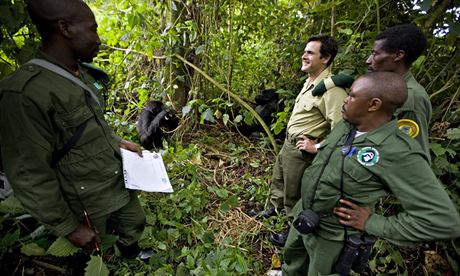
The Rangers of Virunga National Park with Emmanuel De Merode
Virunga national park rangers and a mountain gorilla. Park director, Emmanuel De Merode (third from right), was shot in an ambush while driving alone in a park vehicle in April. Photograph: Brent Stirton/Getty Images
WWF staff have been telephoned with death threats for opposing oil exploitation in Africa's oldest national park, which is home to one in four of the world's estimated 800 remaining mountain gorillas. It follows the attempted assassination of the Virunga national park's chief warden last month and the death of two Congolese park wardens in the last few months.
"We are taking the calls seriously," said a spokeswoman at the conservation group's Swiss HQ. "Two anonymous callers made specific threats. They were angry about a staff member's public statements about the negative impacts of oil. One caller said: 'We want his head'."
Reports of intimidation are said to have increased in the weeks since the Virunga chief warden, the Belgian aristocrat Emmanuel de Merode, was shot in an ambush by three people while driving alone in a park vehicle in April. "The callers … said that they had missed killing de Merode, but would not miss WWF's employees," said the WWF spokeswoman.
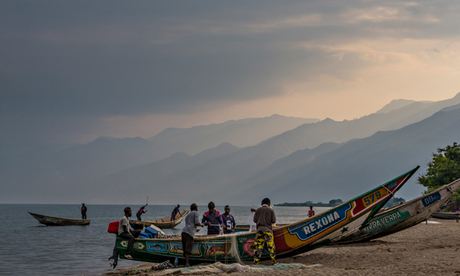
Soco International Oil Exploration Threatens Virunga National Park : fishing village of KavanyongiThe fishing village of Kavanyongi on the northern shores of Lake Edward. WWF has said that oil exploitation could put at risk the livelihoods of 50,000 families that depend on the lake for jobs, food and drinking water. Photograph: Brent Stirton/Getty Images
Tensions are rising in Virunga as UK-based oil company Soco International PLC starts six weeks of seismic tests in Lake Edward. If successful, this can be expected to lead to exploratory drilling, possibly starting next year.
Soco, which received permission from the Democratic Republic of Congo (DRC) government to explore for oil in the park in 2010, has been strongly opposed by environmental and civil society organisations as well as the UK government. The company has stated it will not seek to operate in the mountain gorilla habitat, the Virunga volcanoes or equatorial rainforest.
However, WWF has said that oil exploitation could put at risk the livelihoods of 50,000 families that depend on the lake for jobs, food and drinking water. Its country director in Congo DRC, Raymond Lumbuenamo, has said that security in and around the park is likely to deteriorate further if Soco goes ahead with its exploration plans.
"The security situation in the park is already bad. The UN is involved with fighting units and the M23 rebel force is inside the park. Oil would be a curse. It always increases conflict. It would attract human sabotage. The park might become like the Niger delta. Developing Virunga for oil will not make anything better. When you take part of the land [for oil] you put more pressure on the rest," he told The Guardian last year.
The park, which stretches over two million acres of forests, swamps, savannahs, snowfields and includes several active volcanoes, is the oldest in Africa, founded in 1925 by Belgium's King Albert I. It has been a battleground for decades and has been occupied by a succession of Congolese and Rwandan militia groups, including the M23 rebel force, the Hutu paramilitary Interahamwe group, and the armies of several countries. An estimated 140 conservation wardens have been killed and many more have fled or left since 1996.
De Merode, who is recovering in Nairobi, said in a statement: "Unfortunately the attack is not an uncommon incident for Virunga national park. Our rangers are targeted frequently due to their difficult work in protecting the park and its many valuable resources. They continue to face such risks to restore peace and the rule of law to the area and the people in their care."

Sunday, December 29, 2013

Amazon deforestation threatens food, water, energy, health security in Bolivia, Brazil, Columbia, Ecuador and Peru

Amazon forest loss threatens five countries

FOR IMMEDIATE RELEASE

by Paul Brown, Climate News Network, December 29, 2013

Water, food supplies and energy production are all in jeopardy as the Amazon forest is felled for profit, campaigners say - and the damage is spreading beyond Amazonia itself.

LONDON, 29 December 2013 -- The continued destruction of the Amazon to exploit its resources for mining, agriculture and hydro-power is threatening the future of the South American continent, according to a report by campaigning groups using the latest scientific data.

Five countries -- Bolivia, Brazil, Colombia, Ecuador and Peru -- share the Amazon, and for all of them the forest area occupies more than 40% of their territory. All face threats to their water supply, energy production, food and health.

In addition, the report says, because of the over-exploitation of the region rainfall will fall by 20% over a heavily-populated area far to the south of Amazonia known as the La Plata basin, covering parts of Argentina, Brazil, Bolivia, Paraguay and Uruguay.

Last month it was reported that deforestation in Amazonia had increased by almost a third in the past year, with an area equal to 50 football pitches destroyed every minute since 2000.

The report, the Amazonia Security Agenda, authored by the Global Canopy Programme  and CIAT, the International Centre for Tropical Agriculture, says the prosperity of the region is based on the abundance of water.

There always seemed to be an endless supply of water, but the combination of industrial and agricultural pollution and droughts is creating a once unthinkable vulnerability for the five countries of Amazonia.

Profits syphoned off

The huge wealth being generated from the forests comes with large-scale environmental and social costs. Local people do not benefit, and the profits from minerals, mining and agriculture are syphoned out of the region.

The large-scale economic development of the region causes deforestation. That in turn is threatening not only the wellbeing of the local people but the economic stability of the industries themselves.

Climate change is adding to both the uncertainty and the instability. Increasing temperatures, as much as 3.5 °C in the near future, changing rainfall patterns and more intense and frequent extreme weather events will have further impacts on the health and well-being of the population. Energy supply from hydro-electric dams will decline.

Big bill coming

Among those welcoming the report is Manuel Pulgar, Peru's environment minister.  He will play a leading part when the country’s capital, Lima, hosts the 20th summit of the UN Framework Convention on Climate Change in December 2014. http://unfccc.int/2860.php

He said: “Climate change is a global problem, but one that will multiply local and regional problems in unforeseeable ways. In Latin America, we have taken Amazonia and its seemingly limitless water and forests as a given. But recent unprecedented droughts have shown us just what happens when that water security falters...”

The report says the impacts of environmental degradation that have so far been felt in other parts of the world are now likely to be felt in Amazonia, threatening economic development and security.

Governments in the region, it says, need to recognize that development cannot continue without recognising the damage caused to the water supply and the climate both globally and locally.  Policy makers need scientists to monitor changes to conditions and the economic risks they pose.

Trillions of tons of water

These findings must be shared between academic institutions and governments so that they can decide how to remedy the problem. Annual reviews of dangerous hotspots are also needed, and cross-border groups of experts who could help both national and regional development plans to be worked out.

Carlos Klink, Brazil’s national secretary for climate change and environmental quality, endorsed these findings. “We are understanding more and more how interdependent water, food, energy and health security are across our continent.

“There is also interdependence between the countries that share the Amazon, which recycles trillions of tons of water that all our people and economies rely on.

"The challenge that we are just beginning to recognise and act upon is one of transitioning to a more sustainable economy -- one that values the role of a healthy Amazonia in underpinning long-term security and prosperity.”

Friday, May 10, 2013

Amazon ‘may lose 65% of land biomass by 2060′

by Alex Kirby, Climate News Network, May 10, 2013


Irreplaceable forest may be lost, for no gain at all Image: By Sascha Grabow www.saschagrabow.com
Irreplaceable forest may be lost, for no gain, and the climate will feel the impact. Image: Sascha Grabow www.saschagrabow.com
Making more land in the Amazon available for farming and ranching means felling more trees to make space – and researchers say that risks meaning that more agricultural expansion will simply mean less production, because of deforestation’s effect on the climate.
LONDON, 10 May – There will be no winners if agriculture made possible by widespread felling in the Amazon continues to expand, say researchers from Brazil and the US.
They calculate that the large-scale expansion of agriculture at the expense of the forest could entail the loss of almost two-thirds of the Amazon’s terrestrial biomass by later this century.
Their study, published in the journal Environmental Research Letters, shows that deforestation will not only reduce the capacity of the Amazon’s natural carbon sink.
It will also cause climate feedbacks that will decrease the productivity of pasture and soybeans – the reason advanced for felling the trees in the first place.
Brazil is under intense pressure to convert the Amazon forests to produce crops and provide pasture for cattle. But the forests’ natural ecosystems sustain wild food production, maintain water and other resources, regulate climate and air quality and ameliorate the impact of  infectious diseases.
The researchers are from the Brazilian federal universities of Viçosa, Pampa, Minas Gerais and the Woods Hole Research Center in the US.
They used model simulations to assess how the agricultural yield of the Amazon would be affected under two different land-use scenarios: one, business-as-usual, where recent deforestation trends continue and new protected areas are not created; and the other a governance scenario, which assumes Brazilian environmental legislation is implemented.
They predict that by 2050 a decrease in precipitation caused by deforestation will reduce pasture productivity by 30% in the governance scenario and by 34% in the business-as-usual scenario.
They say increasing temperatures could cause a reduction in soybean yield by 24% in the governance scenario and by 28% under the business-as-usual scenario.
It is significant that the study finds relatively little difference between the outcomes of the two scenarios, perhaps suggesting that Brazil needs to tighten its environmental legislation drastically and to enforce it more effectively.
“…it was a surprise to us that high levels of deforestation could be a no-win scenario – the loss of environmental services from the deforestation may not be offset by an increase in agricultural production”
Perhaps the authors’ starkest conclusion (but see our story of 11 March) is that a combination of the forest biomass removal itself, and the resulting climate change, which feeds back on ecosystem productivity, could result in biomass on the ground declining by up to 65% for the period 2041-2060.
And all this would achieve little or nothing in terms of food production. The researchers write: “…total agricultural output may either increase much less than expected proportional to the potential expansion in agricultural area, or even decrease, as a consequence of climate feedbacks from changes in land use.
“These climate feedbacks, usually ignored in previous studies, impose a reduction in precipitation that would lead agricultural expansion in Amazonia to become self-defeating: the more agriculture expands, the less productive it becomes.”
The lead author of the study, Dr Leydimere Oliveira, said: “We were initially interested in quantifying the environmental services provided by the Amazon and their replacement by agricultural output.
“We expected to see some kind of compensation or off-put, but it was a surprise to us that high levels of deforestation could be a no-win scenario – the loss of environmental services from the deforestation may not be offset by an increase in agricultural production.”
The study shows that the effects of deforestation will be felt most in the eastern Pará and northern Maranhão regions. Here the local precipitation appears to depend strongly on the forests, and changes in land cover would drastically affect the local climate, possibly to the point where agriculture became unviable.
“There may be a limit to the expansion of agriculture in Amazonia. Below this limit, there are not important economic consequences”, said Dr Oliveira.
“Beyond this limit, the feedbacks that we demonstrated start to introduce significant losses in agricultural production.” 

Sunday, April 14, 2013

David Suzuki: The Pine Beetles Are Coming


Published on Apr 6, 2013

Summer 2006: Peter Jackson, a meteorologist in Prince George, B.C., couldn't believe what he was seeing on his radar screen. It was like a rainstorm, but thicker, and it was crossing east over the Rocky Mountains. It looked a little like insect swarms, except insects had never been seen at such high altitudes before. Farmers on the eastern slope of the Rockies described huge clouds of insects. They could hear them pinging off their steel roofs. The swarms were so dense they gummed up the windshield wipers on the farmers' vehicles.

This was this first attack of the Mountain Pine Beetle east of the Rocky Mountains... the year when the unthinkable actually happened: carried along by the prevailing winds, trillions of Mountain Pine Beetles crossed the Rocky Mountains from BC into Alberta. Now, the great Northern Boreal Forest, one of the world's richest ecosystems and one of its greatest carbon sinks, was face to face with a grave threat - a plague of insects, each the size of a grain of rice.

In British Columbia, the damage done by this hungry little creature was already well known. In the interior of B.C. people called it 'The Lodgepole Tsunami.' In a period of less than 10 years, swarms of Mountain Pine Beetles ate their way through 18 million hectares of lodgepole Pine forest, an area the size of Nova Scotia and New Brunswick combined. The ecological and economic cost has been staggering.

But the Mountain Pine Beetle is NOT an invasive species. It has lived with and co-evolved with the Lodgepole Pine for millennia. Like natural forest fires, the pine beetle is a critical actor in the natural cycle of forest regeneration. Every 25 years or so, in a period of warm winters and warm, dry summers, the beetle's population would spike. Then they would attack, taking out over-mature trees, thus thinning the canopy to make way for younger tree growth. These outbreaks would last a year or two, then the normal weather patterns would prevail and an early cold snap or a stretch of cold winter weather would bring the population back under control.

But, in this outbreak, the beetle population in BC grew massively for a decade, and devastated the province's forests. So what was it that unleashed this terrible force of nature? The culprit is climate change. In its natural range, there is no longer the cold weather brake that has kept the Beetle's population under control. Now that the population has exploded, there's no telling where it will stop. For the first time, the eastward march across Canada of this seemingly unstoppable beetle invasion is now perceived as inevitable, especially since the beetle has no natural enemies, nor has man found any way to kill it.

The pine dominant Northern Boreal Forest, stretching all the way to the Atlantic, is now
under threat, with ominous ramifications for our travel and tourism, as well as our forestry industries. Without our pine forests, long a symbol of the Canadian landscape and identity, the result will be a Canada we no longer recognize.

The Beetles are Coming takes the viewer on a rich, up close and personal journey into the world of the Mountain Pine Beetle, and uncovers the science behind this ecological disaster. The story of this remarkable little creature the size of a grain of rice that will destroy the pine forests of North America epitomizes the cause and effect of how climate change can upset the balance of nature with unpredictable, unimaginable, devastating results. Forest officials scrambled to contain the damage. Once the lodgepole pines turned red they burned with a ferocious intensity. That combined with hot summers, created the ideal conditions for raging out-of-control forest fires. Industry began logging the infected trees in attempt to clear the forest and capitalize on the economic value of the timber. At considerable expense, forestry officials in B.C. and Alberta began marking and burning infested trees to control the spread but found it impossible to keep up.

Despite repeated attempts to stop the pine beetle, the only real effective way to control
its population and expansion is cold. Yet, winters continue to get warmer. According to research from Oregon State University, the lodgepole pine could almost disappear from the Pacific Northwest by 2080. The beetles unstoppable advance is now poised to attack the jack pine, a close relative to the lodgepole pine, found in the boreal forest, the massive northern eco-region that stretches from Alaska to Newfoundland.

More ominously, the Alberta Forest Genetic Resources Council believes that Canada's boreal forest which has evolved for thousands of years, will be vastly different in the short time period of one century - or less.