Blog Archive

Showing posts with label Raypierre. Show all posts

Wednesday, October 1, 2014

Raymond T. Pierrehumbert: Steve Koonin takedown

by Raymond T. Pierrehumbert (Louis Block professor in geophysical sciences at the University of Chicago and the King Carl XVI Gustaf chair in environmental science at Stockholms Universitet), Slate, October 1, 2014

Photo by William Hong/Reuters
A man scoops fish from a partially dried-up pond in China’s Zhejiang province on Aug. 13, 2013. It’s true that the climate has always changed and always will, but does that mean we should just shrug at situations like these? Photo by William Hong/Reuters

When the Wall Street Journal publishes yet another argument for doing nothing about global warming, it’s just a dog-bites-man story. So why should anybody get particularly exercised by the Journal’s latest incarnation of this fixed idea, in the form of an extended essay by Steve Koonin? It was to be expected that the Journal would try to take some pre-emptive action on the eve of the opening of the United Nations Climate Summit in New York and the world’s largest climate-action rally. What makes Koonin’s piece noteworthy more than anything else is the messenger.
Steve Koonin is the answer to a troublesome question facing the Journal’s opinion page editors: What you do if you want to continue obstructing progress on global warming pollution, but your usual stable of tame skeptics is starting to die off (Fred Seitz), retire from active research (Dick Lindzen), or discredit itself through serial scientific errors (John Christy) or by taking fanatical and manifestly untenable positions (Heartland Institute)? That puts the editors in quite a pickle. The Wall Street Journal evidently has high hopes for promoting Koonin as a prominent new voice for inaction, having lavished on him 2,000 words and front-page Saturday exposure outside the Journal’s paywall.
Who is Steve Koonin and why should we care?
Koonin has constructed a narrative that is calculated to make people take notice even if they wouldn’t ordinarily trust anything the Wall Street Journal published on global warming: I’m a physicist bringing my brilliance and outside perspective to the backwater of climate science! (He was a professor of physics, and later provost, at Caltech.) I’m green! (He was chief scientist for BP, the oil firm that likes to tout itself as the “beyond petroleum” company, and he was involved with renewables there, among other things.) I’ve got true-blue Democratic credentials! (He was undersecretary for science in the Department of Energy during Obama’s first term.)
But there are flaws in this narrative. Being a smart physicist can just give you more elaborate ways to delude yourself and others, along with the arrogance to think you can do so without taking the time to really understand the subject you are discussing.Freeman Dyson is a famous example. Koonin’s role in the Department of Energy was marginal and largely powerless, leading ultimately to his resignation. BP’s “beyond petroleum” vision evidently includes tar sands (both extraction and refining) and petcoke (arguably the worst fossil fuel of all). And anyway, how green can you be if you’re the company that gave us the Deepwater Horizon disaster?
Koonin is currently director of New York University’s Center for Urban Science and Progress, which was formed in partnership with New York City under former Mayor Michael Bloomberg. One of the missions of the center is to increase urban resilience, and there is hardly any aspect of urban resilience that is unaffected by climate change. This is highlighted prominently in the center’s roster of research interests, which states: “The effects of Hurricane Sandy on NYC and surrounding regions highlighted the combined danger of extreme weather events and the reality of global climate change.” Can somebody with Koonin’s evident misconceptions about climate science and its policy implications really be trusted to provide effective leadership for such an institution? If I were the president of NYU, or indeed Mayor Bill de Blasio, I would be having a lot of second thoughts right now.
The American Physical Society is currently reviewing its policy statement on climate change, and Koonin has had a substantial hand in that five-year process. He was a member of the society’s Panel on Public Affairs, which has responsibility for vetting policy statements, and is still listed as chair-elect. He was a member of the subcommittee charged with overseeing the statement revision, and appears to have been the organizer of a hearing on climate science conducted at the Center for Urban Science and Progress, his current home institution in Brooklyn. The full transcript of this hearing is available here.
The choice of its drafting committee indicates some serious problems with the APS process for its climate change statement, as the committee did not include a single physicist who was actually doing work in the area of climate science. Given that, one might think the committee would avail itself of the opportunity to become better educated through hearing from the best and most representative experts the field has to offer. The panel of experts it consulted did include three scientists with impeccable track records of contributions to the field: Isaac Held, Ben Santer, and Bill Collins. But these experts were “balanced” with people picked disproportionately from the tiny wing of climate skeptics: Dick Lindzen, Judy Curry, and John Christy. One participant in the process described it to me as being set up as “a show trial of the IPCC”—that is, the Intergovernmental Panel on Climate Change—rather than an educational event aimed at probing the deeper questions concerning global warming. If you expose a panel of physicists who are ignorant of climate science to 50 percent wisdom and 50 percent nonsense, one cannot hold out much hope for a good outcome.
Koonin seems to have taken most of the talking points in his Journal essay from the presentations of the skeptics, ignoring or belittling the more considered assessment given by the other invited panelists. The word I have from inside APS is that Koonin has resigned from the Panel on Public Affairs to allow himself greater latitude to make public pronouncements on climate change, so we can expect to be hearing much more from him in the future. There is a lot of good will (and intelligence) on the remaining panel, so there is a good chance that it will be able to recover from an inauspicious beginning.
A litany of discredited arguments.
Let’s first gratefully acknowledge that in some ways this piece represents a material step forward in the annals of the Wall Street Journal’s coverage of climate change: Koonin writes that the human influence on climate is “no hoax,” and that “continually growing amounts of greenhouse gases in the atmosphere, due largely to carbon-dioxide emissions from the conventional use of fossil fuels, are influencing the climate.” He affirms that “uncertainty need not be an excuse for inaction.” If all the economic heavy hitters who read the Journal subscribed to these views, that would represent progress of a sort.
But the nuggets of truth in Koonin’s essay are buried beneath a rubble of false or misleading claims from the standard climate skeptics’ canon. To pick a few examples:
  • He claims that the rate of sea level rise now is no greater than it was early in the 20th century, but this is a conclusion one could draw only through the most shameless cherry-picking. In reality, according to the data, the sea level trend was .8 millimeters of rise per year from 1870 to 1924, 1.9 millimeters per year from 1925 to 1992, and 3.2 millimeters per year from 1993 to 2014—i.e., the rate has actually quadrupled since preindustrial times.
  • He claims that the human imprint on climate is only “comparable” to natural variability, whereas multiple lines of research confirm that the climate signature of human-caused greenhouse gas increases has already risen well above thebackground noise level. Koonin’s claim also obscures the fact that human-induced greenhouse gas increases are the only influences that have been found to provide a significant drive for warming. The most prominent natural influences, such as volcanic eruptions and heat uptake by the ocean, only serve to offset some of the warming caused by human influences.
  • He states that human additions to the greenhouse effect will shift the natural greenhouse effect by only 1 percent to 2 percent by the middle of the century. This is another variant of the standard skeptics’ arguments that attempt to make the human influence seem small, but, like all such arguments, requires a lot of creative accounting. In reality, a large part of the natural greenhouse effect is due to substances (mainly water vapor, and consequent cloudiness) that are in the atmosphere only because carbon dioxide keeps the Earth warm enough to prevent them from condensing out. Carbon dioxide is the main control knob for Earth’s climate, and if one looks at the effect of doubling carbon dioxide relative to the baseline carbon dioxide greenhouse effect, that amounts to a change of over 10 percent—and at the rate our fossil fuel burning is increasing, we could go well beyond doubling. Further, if one looks at fossil fuel burning in terms of the magnitude of our disruption of the natural carbon cycle, industrial civilization looks like a force of much more than geological proportions. Fossil fuel burning is adding carbon to the Earth system at a rate that is more than 100 times greater than the volcanic sources that drive the Earth’s natural long-term carbon cycle.
  • He states that the effects of carbon dioxide will last “several centuries,” whereas “several millennia” would be closer to the truth. The carbon dioxide we emit while dithering about what to do will cause essentially irreversible changes to our climate.
  • He does a lot of hand-wringing about the uncertainties in ocean behavior, but doesn’t seem to appreciate that oceans cannot be a cause of long-term warming because almost all of the mass of the oceans is colder than the lower atmosphere. Oceans can delay warming by taking up heat (indeed they are, as ocean observations confirm), but the warming will be made up with a vengeance once the oceans stop taking up heat, as they eventually must.
One could go on for a long time dissecting the flaws and misleading spin in Koonin’s arguments. Most of the old chestnuts are there, including the dismissive statement that “climate has always changed and always will” (true enough, but not cause for complacency about human influences), the supposedly missing tropical “hot spot” (which Koonin badly garbles in multiple ways, but which is well-discussed by Carl Mears and by Steve Sherwood here), and the by-now-obligatory reference to the decadal “pause” in global warming. Without belaboring the point, let’s just say that Koonin’s arguments are not the sort of thing that would emerge from a period of deep reflection by some brilliant mind turning serious attention to the subject. Rather, they are the sorts of things one could pick up in a weekend surfing a few of the more willfully ignorant skeptic’s blogs.
Climate science is not settled, but it’s settled enough.
Koonin’s most seriously misleading claims concern uncertainty. There are two parts to his attack: first, that climate scientists systematically suppress discussion of uncertainty, especially when communicating with policymakers; and second, that climate science is too uncertain to provide a basis for policy decisions.
To anybody with even a cursory familiarity with the climate science literature, the claim that it is impermissible to discuss uncertainties is laughable. There is hardly anything else scientists do, in climate science or elsewhere, besides dispute received wisdom and one another’s findings. The reward structure in all of science favors those who overturn some widely accepted theory over those who just confirm or provide an elaboration on what is already known. A lot of these disputes (and I have been party to several myself) are more like bar fights than the secretive “hushed sidebar conversations” Koonin makes them out to be. Climate science has been refined in the fires of such disputes for well over a century now, and the constant turmoil of questioning still dominates the professional journals and meetings. Indeed, most of the uncertainties highlighted by Koonin were first identified and reported in professional journals by climate science “insiders” (in some cases even IPCC authors), and continue to be vigorously discussed there. For example, the case of the (possibly) missing tropical hot spot was first discussed in a paper by Dian Gaffen in 2000, and has been the subject of numerous other papers, including this recent one co-authored by Suki Manabe, one of the founding fathers of climate modeling. Climate sensitivity—the amount by which the global average temperature increases upon doubling of the amount of carbon dioxide in the atmosphere—is one of the key uncertain factors governing our climate future, and results on this key parameter are almost invariably presented in terms of adistribution of possible values.
Science is never settled, but it can be settled enough. Newtonian mechanics was not settled science—it was overturned by both relativity and quantum mechanics. Nonetheless, it was, and continues to be, settled enough to build bridges and design airplanes. It is in this spirit that the word settled is used sometimes in connection with climate science, and not in the cartoonish sense that Koonin fabricates in his straw-man argument. It is always easy to find gaps—even very significant gaps—in the understanding of a system as complex as the climate, but the issue on the table isn’t whether our understanding is complete, but whether it is complete enough to justify the need for serious controls on carbon dioxide emissions. It’s not the situation that the range of climate predictions runs from “pretty good” to “somewhat bad”—the truth is more like “bad” to “extremely bad,” unless emissions growth is halted and eventually reversed.
Photo by Utpal Baruah/Reuters
Rickshaw pullers wade through a flooded road after heavy rains at Guwahati in the northeastern Indian state of Assam on June 27, 2014. Photo by Utpal Baruah/Reuters
Let’s imagine you are a smoker and go to the doctor with a variety of troubling physical complaints. She tells you, “Well, a lot of these troubles are typically associated with smoking, but you don’t have cancer yet and the fact is we don’t know everything about the precise biochemical pathways that connect smoking to cancer, and anyway there’s always the chance you’ll get emphysema before you get cancer.” If you were to apply Koonin’s reasoning to this situation, your response would be, “OK, Doc, I’ll wait to give up smoking until you can tell me exactly how it will kill me and when.”
Climate science is settled enough to provide the policy guidance that matters most, namely that there is an urgent need for halting, and eventually reversing, the worldwide growth in carbon dioxide emissions. At a time when essentially nothing effective is being done, it is pointless to fret, as Koonin does, about exactly how much reduction is optimal—the clear answer from climate science is: “The more the better, the sooner the better, and whatever we actually do is apt to be less than what is really needed, though worth doing nonetheless.” Major policy decisions are routinely made in economic and national security areas in the face of far greater uncertainty than prevails in climate science.
The conclusion that climate science is settled enough proceeds from two well-established properties of the climate system: No. 1, most climate damages rise with the rise in global mean temperature, though the regional distributions of the damages are uncertain and vary from model to model; and No. 2, the peak global mean warming is approximately proportional to the total amount of carbon dioxide emitted up to the time such emissions cease completely. Given current rates of emissions growth, about 2.5 percent annually, we will exceed a threshold corresponding to 2 degrees Celsius of warming in a matter of a few decades, if climate sensitivity turns out to be in the middle of the uncertainty range. If we are lucky and climate sensitivity turns out to be at the lower end of the range of scientifically credible estimates, then given a 2.5 percent annual rate of growth of emissions, the good news would buy us only an extra 28 years beyond the perilously short time that would be allotted to us under midrange climate sensitivity. Given that we really should have started decarbonizing the economy 30 years ago, that’s not much justification for inaction; in fact, it would be nothing but good news since it would make the task more feasible. 
But what if we are unlucky and climate sensitivity turns out to be at the high end of the range? In that case we would be locked into 4 degrees Celsius of eventual warming within the next few decades, even in the unlikely event we were able to stop using fossil fuels cold turkey. As Koonin rightly notes, the past 30 years of intensive research in climate science has not managed to narrow the uncertainty range in climate sensitivity. What he fails to note is that this uncertainty provides an argument for more rather than less action on emissions control, since it means that no scientifically credible argument advanced in the past several decades has been able to rule out the risk that climate sensitivity is at the high end of the range. In the face of that, the only way to avert the risk is to simply not emit so much carbon dioxide. And the millennial duration of the warming induced by carbon dioxide means that we don’t have the luxury of waiting a few more decades before taking action, in the hopes that 30 more years of research will finally accomplish what the past 30 failed to do. As the Swedish cookbook pioneer Kajsa Warg is reputed to have said, “You cook with what you have.”

Monday, April 1, 2013

Justin Gillis, NYT: Maverick climate scientist James Hansen retiring from NASA, can now take a more active role in lawsuits challenging states and the federal government over their failure to limit CO2 emissions


Climate Maverick to Quit NASA

by , The New York Times, April 1, 2012
James E. Hansen, the climate scientist who issued the clearest warning of the 20th century about the dangers of global warming, will retire from NASA this week, giving himself more freedom to pursue political and legal efforts to limit greenhouse gases.
His departure, after a 46-year career at the space agency’s Goddard Institute for Space Studies in Manhattan, will deprive federally sponsored climate research of its best-known public figure.
At the same time, retirement will allow Dr. Hansen to press his cause in court. He plans to take a more active role in lawsuits challenging the federal and state governments over their failure to limit emissions, for instance, as well as in fighting the development in Canada of a particularly dirty form of oil extracted from tar sands.
“As a government employee, you can’t testify against the government,” he said in an interview.
Dr. Hansen had already become an activist in recent years, taking vacation time from NASA to appear at climate protests and allowing himself to be arrested or cited a half-dozen times.
But those activities, going well beyond the usual role of government scientists, had raised eyebrows at NASA headquarters in Washington. “It was becoming clear that there were people in NASA who would be much happier if the ‘sideshow’ would exit,” Dr. Hansen said in an e-mail.
At 72, he said, he feels a moral obligation to step up his activism in his remaining years.
“If we burn even a substantial fraction of the fossil fuels, we guarantee there’s going to be unstoppable changes” in the climate of the earth, he said. “We’re going to leave a situation for young people and future generations that they may have no way to deal with.”
His departure, on Wednesday, will end a career of nearly half a century working not just for a single agency but also in a single building, on the edge of the Columbia University campus.
From that perch, seven floors above the diner made famous by “Seinfeld,” Dr. Hansen battled the White House, testified dozens of times in Congress, commanded some of the world’s most powerful computers and pleaded with ordinary citizens to grasp the basics of a complex science.
His warnings and his scientific papers have drawn frequent attack from climate-change skeptics, to whom he gives no quarter. But Dr. Hansen is a maverick, just as likely to vex his allies in the environmental movement. He supports nuclear power and has taken stands that sometimes undercut their political strategy in Washington.
In the interview and in subsequent e-mails, Dr. Hansen made it clear that his new independence would allow him to take steps he could not have taken as a government employee. He plans to lobby European leaders — who are among the most concerned about climate change — to impose a tax on oil derived from tar sands. Its extraction results in greater greenhouse emissions than conventional oil.
Dr. Hansen’s activism of recent years dismayed some of his scientific colleagues, who felt that it backfired by allowing climate skeptics to question his objectivity. But others expressed admiration for his willingness to risk his career for his convictions.
Initially, Dr. Hansen plans to work out of a converted barn on his farm in Pennsylvania. He has not ruled out setting up a small institute or taking an academic appointment.
He said he would continue publishing scientific papers, but he will no longer command the computer time and other NASA resources that allowed him to track the earth’s rising temperatures and forecast the long-run implications.
Dr. Hansen, raised in small-town Iowa, began his career studying Venus, not the earth. But as concern arose in the 1970s about the effects of human emissions of greenhouse gases, he switched gears, publishing pioneering scientific papers.
His initial estimate of the earth’s sensitivity to greenhouse gases was somewhat on the high side, later work showed. But he was among the first scientists to identify the many ways the planet is likely to respond to rising temperatures and to show how those effects would reinforce one another to produce immense changes in the climate and environment, including a sea level rise that could ultimately flood many of the world’s major cities.
“He’s done the most important science on the most important question that there ever was,” said Bill McKibben, a climate activist who has worked closely with Dr. Hansen.
Around the time Dr. Hansen switched his research focus, in the 1970s, a sharp rise in global temperatures began. He labored in obscurity over the next decade, but on a blistering June day in 1988 he was called before a Congressional committee and testified that human-induced global warming had begun.
Speaking to reporters afterward in his flat Midwestern accent, he uttered a sentence that would appear in news reports across the land: “It is time to stop waffling so much and say that the evidence is pretty strong that the greenhouse effect is here.”
Given the natural variability of climate, it was a bold claim to make after only a decade of rising temperatures, and to this day some of his colleagues do not think he had the evidence.
Yet subsequent events bore him out. Since the day he spoke, not a single month’s temperatures have fallen below the 20th-century average for that month. Half the world’s population is now too young to have lived through the last colder-than-average month, February 1985.
In worldwide temperature records going back to 1880, the 19 hottest years have all occurred since his testimony.
Again and again, Dr. Hansen made predictions that were ahead of the rest of the scientific community and, arguably, a bit ahead of the evidence.
“Jim has a real track record of being right before you can actually prove he’s right with statistics,” said Raymond T. Pierrehumbert, a planetary scientist at the University of Chicago.
Dr. Hansen’s record has by no means been spotless. Even some of his allies consider him prone to rhetorical excess and to occasional scientific error.
He has repeatedly called for trying the most vociferous climate-change deniers for “crimes against humanity.” And in recent years, he stated that excessive carbon dioxide emissions might eventually lead to a runaway greenhouse effect that would boil the oceans and render earth uninhabitable, much like Venus.
His colleagues pointed out that this had not happened even during exceedingly warm episodes in the earth’s ancient past. “I have huge respect for Jim, but in this particular case, he overstated the risk,” said Daniel P. Schrag, a geochemist and the head of Harvard’s Center for the Environment, who is nonetheless deeply worried about climate change.
Climate skeptics have routinely accused Dr. Hansen of alarmism. “He consistently exaggerates all the dangers,” Freeman Dyson, the famed physicist and climate contrarian, told The New York Times Magazine in 2009.
Perhaps the biggest fight of Dr. Hansen’s career broke out in late 2005, when a young political appointee in the administration of George W. Bush began exercising control over Dr. Hansen’s statements and his access to journalists. Dr. Hansen took the fight public and the administration backed down.
For all his battles with conservatives, however, he has also been hard on environmentalists. He was a harsh critic of a failed climate bill they supported in 2009, on the grounds that it would have sent billions into the federal government’s coffers without limiting emissions effectively.
Dr. Hansen agrees that a price is needed on carbon dioxide emissions, but he wants the money returned to the public in the form of rebates on tax bills. “It needs to be done on the basis of conservative principles — not one dime to make the government bigger,” said Dr. Hansen, who is registered as a political independent.
In the absence of such a broad policy, Dr. Hansen has been lending his support to fights against individual fossil fuel projects. Students lured him to a coal protest in 2009, and he was arrested for the first time. That fall he was cited again after sleeping overnight in a tent on the Boston Common with students trying to pressure Massachusetts into passing climate legislation. [Camping out in freezing temperatures shortly after having had surgery for prostate cancer, no less.]
“It was just humbling to have that solidarity and support from this leader, this lion among men,” said Craig S. Altemose, an organizer of the Boston protest.
Dr. Hansen says he senses the beginnings of a mass movement on climate change, led by young people. Once he finishes his final papers as a NASA employee, he intends to give it his full support.
“At my age,” he said, “I am not worried about having an arrest record.”

Saturday, February 12, 2011

Eric Steig & Ray Pierrehumbert: The Starship vs. Spaceship Earth (or why Freeman Dyson went emeritus)

The Starship vs. Spaceship Earth


by Eric Steig and Ray Pierrehumbert, RealClimate, February 7, 2011

One of my (Eric’s) favorite old books is The Starship and the Canoe by Kenneth Brower It’s a 1970s book about a father (Freeman Dyson, theoretical physicist living in Princeton) and son (George Dyson, hippy kayaker living 90 ft up in a fir tree in British Columbia) that couldn’t be more different, yet are strikingly similar in their originality and brilliance. I started out my career heading into astrophysics, and I’m also an avid sea kayaker and I grew up with the B.C. rainforest out my back door. So I think I have a sense of what drives these guys. Yet I’ve never understood how Freeman Dyson became such a climate contrarian and advocate for off-the-wall biogeoengineering solutions like carbon-eating trees, something we’ve written about before.

It turns out that Brower has wondered the same thing, and in a recent article in The Atlantic, he speculates on the answer. “How could someone as smart as Freeman Dyson,” writes Brower, “be so wrong about climate change and other environmental concerns..?”

Brower goes through a number of possible explanations for the Dyson paradox, some easily dismissed (senility; he’s a theoretician with no sense of practicality) some not so easily dismissed (he’s only joking, don’t take it seriously, he doesn’t take it all that seriously himself). But in the end, for Brower, it seems to come down to two conspiring things about Dyson. The first is that Dyson has an abiding faith in the ability of technology to do anything we want it to. It’s not surprising, then, that Dyson thinks we can ‘fix climate’ as well. That, in itself, makes Dyson not so much a “global warming skeptic” as an extreme techno-optimist. In fact, even leaving technology aside, he has a touching faith that whatever humans may do to the environment, it usually turns out for the best. In this essay, he writes:

“The natural ecology of England was uninterrupted and rather boring forest. Humans replaced the forest with an artificial landscape of grassland and moorland, fields and farms, with a much richer variety of plant and animal species. Quite recently, only about a thousand years ago, we introduced rabbits, a non-native species which had a profound effect on the ecology. Rabbits opened glades in the forest where flowering plants now flourish.”

We daresay that the Australians have a somewhat less benign view of rabbits (as the New Zealanders do of possums). And that maybe Dyson has a thing or two to learn about the biodiversity of unmanaged ecosystems.

Second, Dyson’s obsession has always been the stars, not the earth: he spent many years working on the design of a spaceship (hence the title of Brower’s 30-year old book) that would take him there. It’s not so much that he doesn’t care about our home planet — he must have learned something about ‘spaceship earth’ from son George over the years. Rather, he is simply very confident that we can always get off if we have to. “What the secular faith of Dysonism offers,” Brower writes” is, first, a hypertrophied version of the technological fix, and second, the fantasy that, should the fix fail, we have someplace else to go.” Dyson has stated in many places, and in various ways, that he thinks global warming is not a big problem, and that its importance has been exaggerated. To put things in perspective, though, Dyson doesn’t particularly think that the extirpation of all life other than human would be a particularly big deal “We are moving rapidly into the post-Darwinian era, when species other than our own will no longer exist, and the rules of Open Source sharing will be extended from the exchange of software to the exchange of genes,” he is quoted as saying in Brower’s article. Dyson’s idea of what constitutes a “big problem” may be, well, just a bit different from what most of the rest of us might have in mind.

Brower’s conclusions sound right on the mark to us, but don’t fully explain Dyson. Perhaps Brower is being gentle, since he is an old friend, or perhaps he simply isn’t aware of it, but one issue he does not touch on in his article is is how deceptive (apparently deliberately) Dyson can be.

The problem is that Dyson says demonstrably wrong things about global warming, and doesn’t seem to care so long as they support his notion of human destiny. Brower reports that Dyson doesn’t consider himself an expert on climate change, has no interest in arguing the details with experts, and yet somehow knows that the experts don’t have any answers worth listening to. That doesn’t stop Dyson from making sweeping pronouncements, many of them so egregiously wrong that it would hardly have taken an expert to set him straight.

The examples of this are legion. In the essay “Heretical thoughts about science and society” (excerpted here) Dyson says that CO2 only acts to make cold places (like the arctic) warmer and doesn’t make hot places hotter, because only cold places are dry enough for CO2 to compete with water vapor opacity. But in jumping to this conclusion, he has neglected to take into account that even in the hot tropics, the air aloft is cold and dry, so CO2 nonetheless exerts a potent warming effect there. Dyson has fallen into the same saturation fallacy that bedeviled Ångström a century earlier.

And then there are those carbon-eating trees. He likes this one so much he put it in both theHeresy essay and in his piece in NY Review of Books. He points out that the annual fossil fuel emissions of carbon correspond to a hundredth of an inch of extra biomass per year over half the Earth’s surface, and suggests that it shouldn’t be hard to tweak the biosphere in such a way as to sequester all the fossil fuel carbon we want to in this way. Dyson could well ask himself why we don’t have kilometers-thick layers of organic carbon right now at the surface, resulting from a few billion years of outgassing of volcanic CO2. The answer is that bacteria have had about two billion years to evolve so as to get very, very good at combining any available organic carbon with oxygen. It is in fact extremely hard to put organic carbon in a form or place where it doesn’t get oxidized back into CO2 (Mother Nature thought she had done that trick with fossil fuels but we sure fooled her!) And if you did somehow coopt ten to twenty percent of the worldwide biosphere’s photosynthetic capacity to take up carbon and turn it into a form that couldn’t rot ever, you’d have to sort of worry about how nutrients would ever get back into the ecosystem. And also maybe whether the carbon-eating trees might get out of control and suck out so much CO2 you wound up in a Snowball Earth.

Dyson espouses a generic disdain for climate models and climate modellers: ” Here I am opposing the holy brotherhood of climate model experts and the crowd of deluded citizens who believe the numbers predicted by the computer models.” Like most of us, he has little confidence in the modelling of clouds. But with great ignorance of the nature of the modelling enterprise, he declares: “It is much easier for a scientist to sit in an air-conditioned building and run computer models, than to put on winter clothes and measure what is really happening outside in the swamps and the clouds” Actually, those of us who go to Antarctica to drill ice cores certainly put on winter clothes, and paleoclimatologists are out in the swamps and ocean muck all the time. And there are plenty of scientists flying around in the clouds, trying to gauge their effects. The mainstream estimate that the climate sensitivity is around 3°C for a doubling of CO2 does not simply comes from computer models. Study of the Last Glacial Maximum, the Pliocene and the Paleocene-Eocene Thermal Maximum all rule out the idea that there is a strongly stabilizing cloud feedback. Ahe fact that we cannot precisely quantify cloud feedbacks also means that there is a lot of risk, that cloud feedbacks could make a doubled-CO2 world much hotter, not much cooler. Dyson’s writings conveniently ignore this two-directional implication of uncertainty, and they they also ignore the implications of the long atmospheric lifetime of CO2, which means if we wait and see how hot it gets and find we don’t like it, there’s nothing much to be done (unless, of course, we can simply go somewhere else).

Finally, there is the familiar examples of Dyson attacking the style of the debate, rather than its substance. Reporting on written debate between Richard Lindzen and Stefan Rahmstorf, in theNew York Review of Books 
New York Times book review
, Dyson juxtaposes Lindzen’s claim that “observations suggest that the sensitivity of the real climate is much less than that found in computer models” with Stefan calling this “simply ludicrous”. Dyson gives the impression that rational arguments from skeptics are met with “open contempt” by the majority. But he fails to mention that Stefan showed in detail why Lindzen’s claim is wrong: Lindzen ignored ocean thermal inertia when comparing observed warming with the equilibrium climate sensitivity. Any physicist should be able to judge that Stefan is right and Lindzen is wrong on this point. He also failed to mention that Stefan used the word “ludicrous” only in a “personal postscript” to a completely sober scientific article, referring to Lindzen’s claims that a vast conspiracy of thousands of climatologists worldwide is misleading the public for personal gain. Dyson’s account of the Lindzen-Rahmstorf exchange neither fairly covers the substance of the argument, nor is it a fair portrayal of its style – Dyson seems to have twisted it as much as he could to score a political point.

In the Heresy essay, Dyson repeatedly gives himself a way out by claiming he is only tossing out ideas that should be thought about; he at times emphasizes that he does not know the answers, only the questions that should be raised. However, that does not stop him from making confident claims that he has a broader view than others, as in this interview with Mike Lemonick, and somehow Dyson never gets around to thinking about what the consequences are if we continue inaction on CO2 emissions and he turns out to be wrong. More importantly, all of the things Dyson argues “heretically” should be looked at — e.g. land carbon sequestration or the lessons from the Altithermal period around 8000 years ago — are in fact already being intensively investigated and are not turning up any silver bullets to allay concern about climate change. When push comes to shove, Dyson is really only offering warmed-over standard contrarian talking points. Heresy, or more broadly an outsider’s viewpoint, can be a good thing when it shakes loose new ideas. But surely, we have a right to expect a more original form of heresy from the architect of Dyson spheres and nuclear starships.

In short, it’s not so simple as the ‘self delusion’ Brower talks about. Dyson is not doing science, but he is deluding others under the guise of science. Given’s Dyson’s evident love of science (and expertise in it), that’s the part that we still don’t get.

Wednesday, December 8, 2010

Raypierre, Real Climate: Losing time, not buying time

Losing time, not buying time


Control of methane, soot, and other short-lived climate-forcing agents has often been described as a cheap way to "buy time" to get carbon dioxide emissions under control. But is it really?

by raypierre, Real Climate, December 6, 2010

Expectations for the outcome of the Cancun climate talks seem to be running low, and the suggestion has emerged that maybe we should forget about controlling CO2 emissions for now, and instead do something with short lived climate forcing agents like methane or soot. This is often described as "buying time" to put CO2 emissions controls into place. For example, in a recent New York Times Op-Ed, Ramanathan and Victor write:
"Reducing soot and the other short-lived pollutants would not stop global warming, but it would buy time, perhaps a few decades, for the world to put in place more costly efforts to regulate carbon dioxide." — Ramanathan and Victor
The idea that aggressive early action to control short-lived climate forcing "buys time" to do something about CO2 has often been pushed in the past, e.g., in various newsletters and press releases associated with the UNEP Atmospheric Brown Cloud program, for example
"The BC reduction proposal is not proposed as an alternative to CO2 reduction. At best, it is a short term measure to buy a decade or two of time for implementing CO2emission reduction strategies." — Ramanathan, writing in the UNEP Black Carbon Newsletter.
To be fair, it should be acknowledged that such pleas for more attention to short-lived climate forcing are almost invariably accompanied by a salutary reminder that it is really CO2 that needs to be gotten under control, as in the quote above. Achim Steiner, writing in the same issue of the Black Carbon Newsletter writes "Paying attention to black carbon should not distract people from the real issue at hand, carbon dioxide." A similar sentiment is expressed in the Ramanathan and Victor op-ed. While emphasizing the central importance of CO2, Penner et al. argue that "…to provide short-term relief from climate warming, the short-lived compounds that induce warming need to be brought under control within a timescale of a few decades." (They also make the intriguing suggestion that doing so might provide a global experiment that could help constrain climate sensitivity.) Writing in Science, Stacy Jackson concludes that "… a focus on CO2 may prove ineffective in the near term without comparable attention to pollutants with shorter lifetimes."

All of this is well-intentioned stuff, none of it denies the central importance of CO2, and I’m sure there are many benefits to be had from reducing soot emissions sooner rather than later. Given the large agricultural component of methane emissions, keeping these emissions from growing in the face of a the need to feed a growing number of people is a serious challenge that must ultimately be met. But still, these proposals tend to convey the impression that dealing with the short-lived forcings now will in some way make it easier to deal with CO2 later, and that’s wrong. In this post, I will explain why.

To get a feel for the issues in play, we’ll first take a look at methane vs. CO2. This provides a clean example, because methane has a straightforward, well-characterized warming effect which is easy to compare with that of CO2. If you’re just looking at the concentration of methane and CO2 at a given time, the methane/ CO2 equivalence is pretty easy to figure, since you can turn them both into the common currency of top-of-atmosphere radiative forcing. For example, doubling CO2 from 300 ppm to 600 ppm yields a clear-sky radiative forcing of 4.5 W/m2. Doubling methane from 1 ppm to 2 ppm yields a radiative forcing of 0.8 W/m2, but since we started from such a low concentration of methane, it takes many fewer molecules of methane to double methane than to double CO2. Per molecule added, methane yields about 54 times as much radiative forcing as CO2. Note that most of this effect has nothing much to do with any special property of methane, but arises simply because the radiative forcing for most greenhouse gases is logarithmic in concentration, so you sort of get the same radiative forcing for everybody upon doubling their concentration — but if you start with somebody whose concentration is low, it takes many fewer molecules to double. That means that the CO2 equivalent of methane depends on what concentration you are starting with. If you started from a concentration of 10ppm, then the equivalence factor drops to 10. If you start out with equal amounts of methane and CO2 (300 ppm), then the equivalence factor drops further to 0.5. In that sense, methane is, intrinsically speaking, a worse greenhouse gas than CO2, though the crossover is at values that are so high they are only relevant (at most) to the Early Earth. (I ran these calculations with the Python interface to the NCAR radiation model, provided in the Chapter 4 scripts of my book, Principles of Planetary Climate. They are done using an idealized clear-sky atmospheric profile, so the numbers are a bit different from what you’ll find in the IPCC reports, but it’s nice to have a calculation simple enough you can re-do it yourself.)

Things get a lot trickier when you try to bring time into the problem, because methane and CO2have vastly different atmospheric lifetimes. Methane oxidizes to CO2 in about 10 years, and since we are dealing with so little methane, that extra ppm of CO2 you get after it oxidizes adds little ongoing warming. That means that the methane concentration in the atmosphere is determined by the methane emission rate averaged over the previous ten years, and the methane component of warming disappears quickly after emissions cease. In contrast, about half of CO2 emitted disappears into the ocean fairly quickly, while the other half stays in the atmosphere for thousands of years. Therefore, the atmospheric burden of CO2 in any given year is determined by the cumulative emissions going back to the beginning of the Industrial Revolution, and the warming persists for thousands of years after emissions cease. Over the long term, CO2 accumulates in the atmosphere, like mercury in the body of a fish, whereas methane does not. For this reason, it is the CO2 emissions, and the CO2 emissions alone, that determine the climate that humanity will need to live with for a time that stretches into the future at least as long as the time since the founding of the first Sumerian cities stretches into the past. The usual wimpy statement that CO2stays in the air for "centuries" doesn’t begin to convey the far-reaching consequences of the amount of CO2 we decide to pump out in the coming several decades.

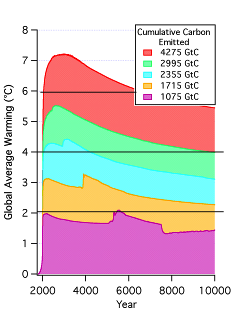
As a reminder of that, here’s a graph from the NRC Climate Stabilization Targets report (of which I was an author) summarizing how cumulative carbon emissions set the climate thermostat for the next 8000 years and more.
NRC Cumulative Carbon effect on Climate
The numbers on each curve gives the total cumulative carbon emissions (in gigatonnes) during the time when human activities continue to emit carbon. These results are based on calculations by Eby et al. using the UVIC coupled carbon/climate model, and they are really just a reprise of what Dave Archer has been telling all of us for years (e.g., here, here and here). It turns out that it matters little to temperature whether all the CO2 is emitted in a carbon orgy near the beginning of the fossil fuel era, or spread out over a few hundred years. It’s cumulative carbon that counts, and pretty much it is the only thing that counts. A cumulative emission of a trillion tonnes of carbon just might keep the Earth below a warming of 2 °C, in line with earlier estimates equating the European Union target warming threshold with cumulative carbon (see our Trillion Tonne post). The peak warming scales approximately linearly with cumulative emissions, and the warming you get at the peak is pretty nearly the warming you are stuck with for the next millennium, with only slight declines beyond that. We are currently about halfway to our first trillion tonnes, but given the miracles of exponential growth, we are going to get there pretty quickly if nothing changes. If you go beyond, and dump 2355 gigatonnes into the atmosphere before kicking the fossil fuel habit, then the global mean temperature will still be 3 °C warmer than pre-industrial in the year 8000. That gives plenty of time for bad stuff to happen, including deglaciation of Greenland, loss of the West Antarctic Ice Sheet, or a destabilizing PETM-type soil carbon release. Note further that these calculations were done with a model designed to have a climate sensitivity similar to the IPCC median. Therefore, even if you hold the line at a trillion tonnes, there is still about a 50% chance that warming will exceed 2 °C.

Let’s suppose, however, that we decide to go all-out on methane, and not do anything serious about CO2 for another 30 years. To keep the example simple, we’ll think of a world in which methane and CO2 are the only anthropogenic climate forcing agents. Suppose we are outrageously successful, and knock down anthropogenenic methane emissions to zero, which would knock back atmospheric methane to a pre-industrial concentration of around 0.8 ppm. This yields a one-time reduction of radiative forcing of about 0.9 W/m2. Because we’re dealing with fairly short-term influences which haven’t had time to involve the deep ocean, we translate this into a cooling using the median transient climate sensitivity from Table 3.1 in the NRC Climate Stabilization Targets report, rather than the higher equilibrium sensitivity. This gives us a one-time cooling of 0.4 °C. The notion of "buying time" comes from the idea that by taking out this increment of warming, you can go on emitting CO2 for longer before hitting a 2 degree danger threshold. The problem is that, once you hit that threshold with CO2, you are stuck there essentially forever, since you can’t "unemit" the CO2 with any known scalable economically feasible technology.
While we are "buying" (or frittering away) time dealing with methane, fossil-fuel CO2 emission rate, and hence cumulative emissions, continue rising at the rate of 3% per year, as they have done since 1900. By 2040, we have put another 573 gigatonnes of carbon into the atmosphere, bringing the cumulative fossil fuel total up to 965 gigatonnes. By controlling methane you have indeed kept the warming in 2040 from broaching the 2 °C limit, but what happens then? In order to keep the cumulative emissions below the 1 trillion tonne limit, you are faced with the daunting task of bringing the emissions rate (which by 2040 has grown to 22 gigatonnes per year) all the way to zero almost immediately. That wasn’t very helpful, was it? At that point, you’d probably like to return the time you bought and get a refund (but sorry, no refunds on sale items). More realistically, by the time you managed to halt emissions growth and bring it down to nearly zero, another half trillion tonnes or so would have accumulated in the atmosphere, committing the Earth to a yet higher level of long-term warming.

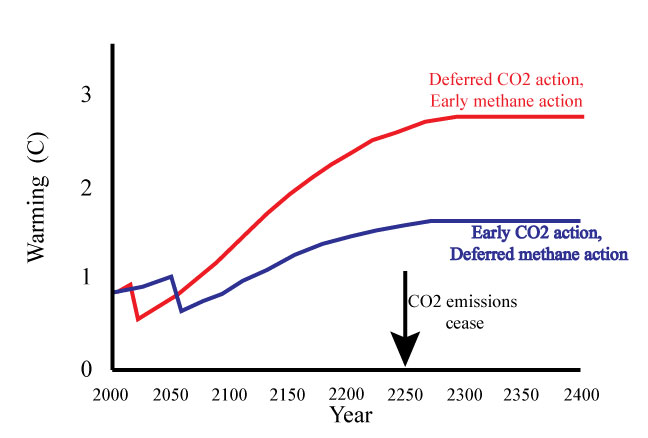
Suppose instead that you had focused all efforts on reducing the growth rate of CO2 emissons from 3% to 2%, averaged over 2010-2040, forgetting about methane until the end of that period. In this scenario, the cumulative carbon emitted up to 2040 is only 713 gigatonnes, giving more time to avoid hitting the trillion-tonne threshold. The warming from CO2 in 2040 is about 1.2 °C, but we have to add in another 0.4 °C because we haven’t done anything to bring down methane emissions. That brings the warming to 1.6 °C, which will increase further beyond 2040 as the cumulative carbon emissions approach a trillion tonnes. However, since methane responds within a decade to emissions reductions, we still get the full climate benefit of reducing methane even if the actions are deferred to 2040. The same cannot be said for deferral of action on CO2emissions.

The following cartoon, loosely based on Eby’s calculations shows two illustrative scenarios: one in which early action is taken on methane, at the expense of allowing cumulative CO2-carbon emissions to rise to around 1.7 trillion tonnes, and another in which action on methane is delayed until 2040, allowing cumulative emissions to be held to a trillion tonnes. The curves can be diddled a bit depending on how much short term warming you get from controlling additional short-lived gases, and how much extra cumulative carbon emissions you assume goes along, but it is really hard to come up with any scenario where you come out ahead from acting early on the short-lived forcings instead of going all-out to reduce the rate of CO2 emissions.

There are a few greenhouse gases other than CO2 that have lifetimes sufficiently long to lend some urgency to their control. That would include HFC23 with a lifetime of 260 years, CFC13 with a lifetime of 640 years and SF6 with a practically unlimited lifetime. Most of the rest are more like methane than they are like CO2 (e.g., HFC31 at 5 years).

Absorbing aerosols — soot, loosely speaking — have a number of complex regional effects that make it difficult to treat their climate impact on an equal footing with that of well-mixed greenhouse gases. Soot falling on snow or ice has an unambiguous warming effect, manifest particularly strongly at high latitudes and high altitudes. For airborne absorbing aerosols, though, it is hard to even know whether they have a warming or cooling effect on surface temperature, or leave it more or less unchanged. Except over high albedo surfaces, airborne aerosols mainly heat the atmosphere by direct solar absorption, at the expense of reduced solar absorption at the surface. When the shading is not too strong, the main consequence is a reduction of the convection that would ordinarily carry solar energy from the ground to the atmosphere. This profoundly influences precipitation, and the atmospheric circulation, especially in the tropics. In extreme cases, the atmospheric absorption can even shut down convection completely, leading to stabilization of the tropospheric lapse rate and a severe surface cooling, as in the Nuclear Winter limit (see also the more elementary discussion of this limit in Chapter 4 of Principles of Planetary Climate).

A further consideration is that most activities that emit soot also emit precursors to reflecting aerosols which cool the planet. It is unlikely (and probably undesirable) that one would be able to limit one without also limiting the other. Hence, the net implication of the black carbon component is probably that it will help offset some of the warming caused by eliminating sulfate aerosols. That’s good, but it’s not what you bargained for if you were expecting a cooling for your money. The main thing about soot and the stew of toxic emissions going into the Atmospheric Brown Cloud, though, is that there are compelling human health, agricultural, and regional climate reasons to eliminate them, regardless of the side effect on global temperature. These are things that need to be done regardless of the climate implications (positive or negative), just as there is a need to supply the developing world with reliable clean water. It is pointless to make an already complicated climate negotiation yet more complicated by wrapping such things into the mix. It is nonetheless worth noting that many of the things one would do to reduce soot emissions, such as substituting natural gas for coal, or burning coal in cleaner, more efficient power plants, also would tend to reduce CO2 emissions, and such double-wins are of course to be sought and pursued ardently (note Gavin’s op-ed on co-benefits of CO2 reduction).

IPCC-style Global Warming Potentials attempt to trade off radiative forcing against lifetime in a Procrustean attempt to boil all climate forcings down to a single handy-dandy number that can be used in climate treaties and national legislation. In reality, aerosol-forming emissions, short-lived greenhouse gas emissions, and CO2 emissions are seperate dials, controlling very different aspects of the Earth’s climate future. CO2 emissions play a distinguished role, because they ratchet up the Earth’s thermostat. It’s a dial you can turn up, but you can’t turn it back down. CO2 is a genie you can’t put back in the bottle. Climate forcings should not be aggregated. Each category should be treated in its own right. Otherwise, there are perverse incentives to do too much too soon on short-lived forcings and too little too late on CO2.