Blog Archive

Showing posts with label Donors Trust. Show all posts

Sunday, March 1, 2015

Bjorn Lomborg unmasked as cog in Climate Denial Machine financed by billionaire vulture capitalist Republican Paul Singer

by Graham Readfearn, DeSmog UK, February 9, 2015

A billionaire “vulture capitalist” and major backer of the US Republican Party is a major funder of the think tank of Danish climate science contrarian and fossil fuels advocate Bjørn Lomborg, DeSmogBlog has found.
New York-based hedge fund manager Paul Singer’s charitable foundation gave $200,000 to Lomborg’s Copenhagen Consensus Center (CCC) in 2013, latest US tax disclosures reveal.
The grant to Lomborg’s think tank is revealed in the tax form of the Paul E. Singer Foundation covering that foundation’s activities between December 2012 and November 2013.
Singer, described as a “passionate defender of the 1%,” has emerged as a major force in the Republican party in recent years and was a key backer and influencer during Mitt Romney’s failed tilt at the Presidency.
The $200,000 grant represented almost one third of the $621,057 in donations declared by the Copenhagen Consensus Center in 2013.
A spokesperson for the think tank told DeSmogBlog that “not one dollar” of the Singer grant had been spent.
Lomborg, a Danish political scientist, is often cited on lists of the world’s most influential people.
He writes extensively on climate change and energy issues with his columns appearing in many of the world’s biggest news outlets.
The CCC think tank produces reports that consistently argue that cutting greenhouse gas emissions and increasing the roll-out of current renewable energy technologies should be low priorities for policy makers.
Most recently, Lomborg wrote a column for the Wall Street Journal arguing climate change was not the urgent problem that many thought.
He wrote that “the narrative that the world’s climate is changing from bad to worse is unhelpful alarmism.”
Lomborg argues the poorest countries need fossil fuels to lift themselves out of poverty – a position that gained support from the world’s richest man, Bill Gates.
At a G20 side event in Brisbane last year, Lomborg appeared at an event sponsored by the world’s largest private coal company, Peabody Energy, where he again argued that the world’s poor needed fossil fuels. 
The CCC’s keystone project is the Post 2015 Consensus that is trying to influence the formulation of the next set of global development goals being discussed by the United Nations. Those goals will replace the millennium development goals.
Lomborg’s CCC think tank was registered as a not-for-profit in the US in 2008 and has attracted almost $5 million in donations since then. In 2013, the CCC paid Lomborg, its founder and president, $200,484 for his work. The previous year Lomborg was paid $775,000.
The think tank has insisted that its funders, most of which are anonymous, do not influence its research.  The think tank says it does not accept funding from the fossil fuel industry.
Despite being registered in the US, Lomborg has admitted that all but one of the think tank’s seven staff are based elsewhere.  The think tank’s address is a parcel service (mail pickup store) in Lowell, Massachusetts.
The discovery of support from Paul Singer comes after a DeSmogBlog investigation last year found that CCC’s early funders included conservative think tanks with links to the network of organisations funded by the Koch brothers, who have pushed millions into organisations denying climate science and blocking action to cut fossil fuel emissions.
In the 2014 US political spending cycle, data presented by OpenSecrets shows Singer spent $9.4 million influencing Republicans – the biggest disclosed individual spender on the conservative side of US politics.
Singer, whose Elliott Management hedge fund manages about $25 billion in assets, has been branded a “vulture capitalist” enterprise due to investment strategies employed by his firm that targets foreign economies in trouble.
A 2011 summary of “vulture funds” in The Guardian said Elliott Management’s “principal investment strategy” was “buying distressed debt cheaply and selling it at a profit or suing for full payment.”
Greg Palast, the author of Vulture’s Picnic, documented in The Guardian how Singer’s firm had managed to pocket $1.29 billion from the US Treasury after a “brilliantly complex” financial manoeuvre in 2009 that saw Singer lead a consortium to buy the parts supplier of General Motors and Chrysler before claiming cash from a government bailout of the struggling auto industry.
Singer, who according to Forbes is personally worth $1.8 billion, remains in conflict with the Argentinian government over debt bought by an Elliott affiliate and other investors.
As well as the generosity shown to Bjorn Lomborg’s think tank, Singer’s foundation gave $500,000 to the Manhattan Institute for Policy Research, where Singer is chairman of the board of trustees.
The Manhattan Institute is also known for downplaying the impacts of climate change while promoting fossil fuels.
In October 2014, Manhattan senior fellow Robert Bryce wrote a report "Not Beyond Coal" arguing that the future for the coal industry was bright and the fossil fuel was “essential” for addressing poverty in developing countries — a position identical to that pushed by Lomborg.
Bryce also attacks the wind industry claiming it cannot cut emissions, describing wind turbines as “climate change scarecrows.” In testimony to the US Senate Environment and Public Works Committee in February 2014, Bryce said wind turbines were “slaughtering wildlife” and killed 600,000 birds every year in the US.
review of studies and data into US bird deaths has found about 600 million birds are killed annually in collisions with windows and buildings, but even this high number was only a quarter of the birds killed annually in the US by feral cats.
Another large donation from Singer’s foundation went to the Moving Picture Institute – an organisation that says it produces films that promote understanding of “individual rights, limited government, and free markets.”
The MPI helped fund the 2004 pro-mining documentary Mine Your Own Business by Irish filmmakers Phelim McAleer and Ann McElhinney.
The two would go on to make the 2009 climate science denial film Not Evil Just Wrong, which was partly funded through a grant from DonorsTrust – a fund which stockpiles cash from conservative philanthropists and that has pushed millions into organisations promoting climate science denial while fighting action to cut emissions.
Roland Mathiasson, Executive Vice President at the Copenhagen Consensus Center, told DeSmogBlog: “Not one dollar of this grant has been spent. It's for a potential future project, pending support from a broad range of political perspectives to underline the non-political nature of the project.
It is a project for the public conversation, so obviously there will be a lot of communication once broad support is secured, and the project is launched.”
Mathiasson declined to provide further details.
DeSmogBlog attempted to contact the Paul E Singer Foundation to ask about their donation to CCC, but email requests went unanswered.
  

Saturday, February 21, 2015

NYT: Deeper Ties to Corporate Cash for a Doubtful Climate Scientist -- aka Willie Soon


Wei-Hock Soon of the Harvard-Smithsonian Center for Astrophysics, whose articles have been tied to corporate funding. Credit Pete Marovich

by Justin Gillis and John Schwartz, The New York Times, February 21, 2015

For years, politicians wanting to block legislation on climate change have bolstered their arguments by pointing to the work of a handful of scientists who claim that greenhouse gases pose little risk to humanity.

One of the names they invoke most often is Wei-Hock Soon, known as Willie, a scientist at the Harvard-Smithsonian Center for Astrophysics who claims that variations in the sun’s energy can largely explain recent global warming. He has often appeared on conservative news programs, testified before Congress and in state capitals, and starred at conferences of people who deny the risks of global warming.

But newly released documents show the extent to which Dr. Soon’s work has been tied to funding he received from corporate interests.

He has accepted more than $1.2 million in money from the fossil-fuel industry over the last decade while failing to disclose that conflict of interest in most of his scientific papers. At least 11 papers he has published since 2008 omitted such a disclosure, and in at least eight of those cases, he appears to have violated ethical guidelines of the journals that published his work.
Senator James M. Inhofe, Republican of Oklahoma, praising scientists like Dr. Soon. Credit CSPAN
The documents show that Dr. Soon, in correspondence with his corporate funders, described many of his scientific papers as “deliverables” that he completed in exchange for their money. He used the same term to describe testimony he prepared for Congress.

Though Dr. Soon did not respond to questions about the documents, he has long stated that his corporate funding has not influenced his scientific findings.

The documents were obtained by Greenpeace, the environmental group, under the Freedom of Information Act. Greenpeace and an allied group, the Climate Investigations Center, shared them with several news organizations last week.

The documents shed light on the role of scientists like Dr. Soon in fostering public debate over whether human activity is causing global warming. The vast majority of experts have concluded that it is and that greenhouse emissions pose long-term risks to civilization.

Historians and sociologists of science say that since the tobacco wars of the 1960s, corporations trying to block legislation that hurts their interests have employed a strategy of creating the appearance of scientific doubt, usually with the help of ostensibly independent researchers who accept industry funding.

Fossil-fuel interests have followed this approach for years, but the mechanics of their activities remained largely hidden.

“The whole doubt-mongering strategy relies on creating the impression of scientific debate,” said Naomi Oreskes, a historian of science at Harvard University and the co-author of “Merchants of Doubt,” a book about such campaigns. “Willie Soon is playing a role in a certain kind of political theater.”

Environmentalists have long questioned Dr. Soon’s work, and his acceptance of funding from the fossil-fuel industry was previously known. But the full extent of the links was not; the documents show that corporate contributions were tied to specific papers and were not disclosed, as required by modern standards of publishing.

“What it shows is the continuation of a long-term campaign by specific fossil-fuel companies and interests to undermine the scientific consensus on climate change,” said Kert Davies, executive director of the Climate Investigations Center, a group funded by foundations seeking to limit the risks of climate change.

Charles R. Alcock, director of the Harvard-Smithsonian Center, acknowledged on Friday that Dr. Soon had violated the disclosure standards of some journals.

“I think that’s inappropriate behavior,” Dr. Alcock said. “This frankly becomes a personnel matter, which we have to handle with Dr. Soon internally.”

Dr. Soon is employed by the Smithsonian Institution, which jointly sponsors the astrophysics center with Harvard.

“I am aware of the situation with Willie Soon, and I’m very concerned about it,” W. John Kress, interim under secretary for science at the Smithsonian in Washington, said on Friday. “We are checking into this ourselves.”

Dr. Soon rarely grants interviews to reporters, and he did not respond to multiple emails and phone calls last week; nor did he respond to an interview request conveyed to him by his employer. In past public appearances, he has reacted angrily to questions about his funding sources, but then acknowledged some corporate ties and said that they had not altered his scientific findings.

“I write proposals; I let them decide whether to fund me or not,” he said at an event in Madison, Wis., in 2013. “If they choose to fund me, I’m happy to receive it.” A moment later, he added, “I would never be motivated by money for anything.”

The newly disclosed documents, plus additional documents compiled by Greenpeace over the last four years, show that at least $409,000 of Dr. Soon’s funding in the past decade came from Southern Company Services, a subsidiary of the Southern Company, based in Atlanta.

Southern is one of the largest utility holding companies in the country, with huge investments in coal-burning power plants. The company has spent heavily over many years to lobby against greenhouse-gas regulations in Washington. More recently, it has spent significant money to research ways to limit emissions.

“Southern Company funds a broad range of research on a number of topics that have potentially significant public-policy implications for our business,” said Jeannice M. Hall, a spokeswoman. The company declined to answer detailed questions about its funding of Dr. Soon’s research.

Dr. Soon also received at least $230,000 from the Charles G. Koch Charitable Foundation. (Mr. Koch’s fortune derives partly from oil refining.) However, other companies and industry groups that once supported Dr. Soon, including Exxon Mobil and the American Petroleum Institute, appear to have eliminated their grants to him in recent years.

As the oil-industry contributions fell, Dr. Soon started receiving hundreds of thousands of dollars through Donors Trust, an organization based in Alexandria, Va., that accepts money from donors who wish to remain anonymous, then funnels it to various conservative causes.

The Harvard-Smithsonian Center for Astrophysics, in Cambridge, Mass., is a joint venture between Harvard and the Smithsonian Institution, housing some 300 scientists from both institutions. Because the Smithsonian is a government agency, Greenpeace was able to request that Dr. Soon’s correspondence and grant agreements be released under the Freedom of Information Act.
Though he has little formal training in climatology, Dr. Soon has for years published papers trying to show that variations in the sun’s energy can explain most recent global warming. His thesis is that human activity has played a relatively small role in causing climate change.

Many experts in the field say that Dr. Soon uses out-of-date data, publishes spurious correlations between solar output and climate indicators, and does not take account of the evidence implicating emissions from human behavior in climate change.

Gavin A. Schmidt, head of the Goddard Institute for Space Studies in Manhattan, a NASA division that studies climate change, said that the sun had probably accounted for no more than 10 percent of recent global warming and that greenhouse gases produced by human activity explained most of it.

“The science that Willie Soon does is almost pointless,” Dr. Schmidt said.

The Harvard-Smithsonian Center for Astrophysics, whose scientists focus largely on understanding distant stars and galaxies, routinely distances itself from Dr. Soon’s findings. The Smithsonian has also published a statement accepting the scientific consensus on climate change.

Dr. Alcock said that, aside from the disclosure issue, he thought it was important to protect Dr. Soon’s academic freedom, even if most of his colleagues disagreed with his findings.

Dr. Soon has found a warm welcome among politicians in Washington and state capitals who try to block climate action. United States Senator James M. Inhofe, an Oklahoma Republican who claims that climate change is a global scientific hoax, has repeatedly cited Dr. Soon’s work over the years.

In a Senate debate last month, Mr. Inhofe pointed to a poster with photos of scientists questioning the climate-change consensus, including Dr. Soon. “These are scientists that cannot be challenged,” the senator said. A spokeswoman for the senator said Friday that he was traveling and could not be reached for comment.

As of late last week, most of the journals in which Dr. Soon’s work had appeared were not aware of the newly disclosed documents. The Climate Investigations Center is planning to notify them over the coming week. Several journals advised of the situation by The New York Times said they would look into the matter.

Robert J. Strangeway, the editor of a journal that published three of Dr. Soon’s papers, said that editors relied on authors to be candid about any conflicts of interest. “We assume that when people put stuff in a paper, or anywhere else, they’re basically being honest,” said Dr. Strangeway, editor of the Journal of Atmospheric and Solar-Terrestrial Physics.

Dr. Oreskes, the Harvard science historian, said that academic institutions and scientific journals had been too lax in recent decades in ferreting out dubious research created to serve a corporate agenda.


“I think universities desperately need to look more closely at this issue,” Dr. Oreskes said. She added that Dr. Soon’s papers omitting disclosure of his corporate funding should be retracted by the journals that published them.

http://www.nytimes.com/2015/02/22/us/ties-to-corporate-cash-for-climate-change-researcher-Wei-Hock-Soon.html

Friday, December 20, 2013

Conservative groups spend $1bn a year to fight action on climate change

• Author: 'I call it the climate-change counter movement'
• Study focuses on groups opposing US political action

by Suzanne, Goldenberg, U.S. environment correspondent, The Guardian, December 20 2013

A coal fired plant
A coal fired plant. Photograph: John Giles/PA
Conservative groups have spent $1bn a year on the effort to deny science and oppose action on climate change, according to the first extensive study into the anatomy of the anti-climate effort.
The anti-climate effort has been largely underwritten by conservative billionaires, often working through secretive funding networks. They have displaced corporations as the prime supporters of 91 think tanks, advocacy groups and industry associations which have worked to block action on climate change. Such financial support has hardened conservative opposition to climate policy, ultimately dooming any chances of action from Congress to cut greenhouse gas emissions that are warming the planet, the study found.
“I call it the climate-change counter movement,” said the author of the study, Drexel University sociologist Robert Brulle. “It is not just a couple of rogue individuals doing this. This is a large-scale political effort.”
Brulle's study, published on Friday in the journal Climatic Change, offers the most definitive exposure to date of the political and financial forces blocking American action on climate change. But as he acknowledged, there are still big gaps.
It was not always possible to separate funds designated strictly for climate-change work from overall budgets, Brulle said. “Since the majority of the organizations are multiple focus organizations, not all of this income was devoted to climate change activities.”
Some of the think tanks on Brulle's list – such as the American Enterprise Institute (AEI) – said they had no institutional position on climate change and did not control the output of their scholars. In addition, Brulle acknowledged that he was unable to uncover the full extent of funding sources to the effort to oppose action on climate change. About three-quarters of the funds were routed through trusts or other mechanisms that assure anonymity to donors – a trend Brulle described as disturbing and a threat to democracy.
“This is how wealthy individuals or corporations translate their economic power into political and cultural power,” he said. “They have their profits and they hire people to write books that say climate change is not real. They hear people to go on TV and say climate change is not real. It ends up that people without economic power don't have the same size voice as the people who have economic power, and so it ends up distorting democracy.
“That is the bottom line here. These are unaccountable organisations deciding what our politics should be. They put their thumbs on the scale … It is more one dollar one vote than one person one vote.”

Top-tier conservative think tanks

The vast majority of the 91 groups on Brulle's list – 79% – were registered as charitable organisations and enjoyed considerable tax breaks. Those 91 groups included trade organisations, think tanks and campaign groups. The groups collectively received more than $7bn over the 8 years of Brulle's study – or about $900m a year from 2003 to 2010. Conservative think tanks and advocacy groups occupied the core of that effort.
The funding was dispersed to top-tier conservative think tanks in Washington, such as the AEI and Heritage Foundation, which focus on a range of issues, as well as more obscure organisations such as the Atlas Economic Research Foundation and the John Locke Foundation.
Funding also went to groups that took on climate change denial as a core mission – such as the Heartland Institute, which held regular conclaves dedicated to undermining the United Nations climate panel's reports, and the Competitive Enterprise Institute, which tried and failed to prosecute a climate scientist, Michael Mann, for academic fraud.
AEI was by far the top recipient of such funds, receiving 16% of total funding over the 8 years, or $86.7m. Heartland Institute, in contrast, received just 3% of the total, $16.7m. There was also generous support to Americans for Prosperity, the advocacy group affiliated with the conservative Koch billionaires, which received $22.7m.

'It won't be going to liberals'

Brulle admits, however, that he was far less successful in uncovering the sources of funding for the counter-climate movement. About 75% of such funding sources remain shrouded in secrecy, with wealthy conservatives routing their donations through a system of trusts which guarantee anonymity.
The leading venue for those underground donations was the Donors Trust and Donors Capital Fund, which alone accounted for 25% of funding of the groups opposed to climate action. An investigation by the Guardian last February found that the Donors Trust and Donors Capital Fund had distributed nearly $120m to more than 100 anti-climate groups from 2002-2010. The Donors group has now displaced such previous prominent supporters of the climate denial movement as the Koch-affiliated foundations and corporations like Exxon Mobil, Brulle said.
Other conservative foundations funding climate denial efforts include: the Searle Freedom Trust, the John William Pope Foundation, the Howard Charitable Foundation and the Sarah Scaife Foundation, which also promote a free-market approach on other issues.
A number of the groups on Brulle's list – both as funders and recipients – refused to comment on his findings or disputed his contention that they were part of a movement to block action on climate change.
Whitney Ball, the president of the Donors Trust and Donors Capital Fund, said the organisation had no say in deciding which projects would receive funding. However, Ball told the Guardian last February that Donors offered funders the assurance their money would never go to Greenpeace. “It won't be going to liberals,” she said at that time.
“We do not otherwise drive the selection of grantees, nor do we conduct in-depth analyses of projects or grantees unless an account holder specifically requests that service,” Ball said in an email. “Neither Donors Trust nor Donors Capital Fund as institutions take positions with respect to any issue advocated by its grantees.”
Recipients of the funds also disputed the assertion they were part of a larger effort to undermine climate science or block action on climate change.
“Each of the scholars that work on any particular issue speaks for his or her own work,” said Judy Mayka Stecker, director of media relations at AEI, in an email. She went on to write, however, that most of the AEI scholars who have worked on energy and climate change have moved on and would be unavailable to comment.
David Kreutzer, an energy and climate change fellow at the Heritage Foundation, said Brulle was unfairly conflating climate denial with opposition to policies that would require industry reduce greenhouse gas emissions.
“We do believe that CO2 is a greenhouse gas and that man-made emissions will lead to some warming,” said David Kreutzer, an energy and climate-change fellow at the Heritage Foundation. “We are opposed to mandatory greenhouse gas emissions cuts.”
He said many conservatives saw a carbon tax, cap-and-trade and other climate policies as a government takeover by stealth.
“What we are not interested in doing is a huge shift of power to the government under the guise of preventing some climate problem,” he said.
The Hoover Institution, which received about $45m, claimed to produce no work on climate change – while displaying on its website an article by a Hoover research fellow on an August 2013 Hoover poll on economic, energy and environmental issues.
"Hoover has no institutional initiatives on climate change,” a spokeswoman, Eryn Witcher, wrote in an email. “Individual Hoover fellows research and write on a wide variety of topics of their own choosing, but we're not aware of any who are working in that field at this time, nor are we aware of any gifts or grants that have been received for that purpose.”
In the article, the Hoover fellow, Jeremy Carl, who works extensively on energy and climate issues, discussed climate change and fracking, concluding: “Many Democrats and liberals are in denial when it comes to reality on energy and climate policy, endorsing both science and political fiction.”


Friday, June 14, 2013

The Heartland Institute's skeptical Chinese fantasy

The Chinese Academy of Sciences translated a Heartland report, but endorses the climate change consensus
US and Chinese flags in front of the White House
US and Chinese flags in front of the White House. The USA and China recently agreed to reduce emissions of HFCs, which are potent greenhouse gases. Photograph: Carolyn Kaster/AP
 
by Dana Nuccitelli, Climate Consensus: The 97%, The Guardian, June 14, 2013

The Heartland Institute is a fossil fuel-funded think tank that gained notoriety in May 2012 for launching an ad campaign comparing those who agree that humans are causing global warming (that's 97% of climate scientists and the majority of the rest of us) to the Unabomber and Osama bin Laden.

Billboards in Chicago paid for by The Heartland Institute along the inbound Eisenhower Expressway in Maywood, Illinois. Photograph: The Heartland Institute 
  Heartland also funds a report written by a group calling themselves the Nongovernmental International Panel on Climate Change (NIPCC), which tries to be the contrarian response to the IPCC. The NIPCC report itself is BS (Bad Science), repeating numerous long-debunked climate myths and cherry picking data.

However, a branch of the Chinese Academy of Sciences recently decided to translate the NIPCC report. The Heartland Institute has triumphantly trumpeted this as evidence that the Chinese are becoming "skeptics" and the climate consensus is crumbling, claiming for example,
"The trend toward skepticism and away from alarmism is now unmistakable,"
"Publication of a Chinese translation of Climate Change Reconsidered by the Chinese Academy of Sciences indicates the country's leaders believe their [failure to sign a global climate treaty] is justified by science and not just economics."
However, Heartland's interpretation of these events does not jibe with the statements or actions of the translators, the Chinese Academy of Sciences, or the Chinese government. Here are relevant comments from the NIPCC translator's preface [PDF]:
"The most recent [IPCC] report ... found that most of the observed increase in globally averaged temperatures since the mid-20th century is very likely (>90%) due to the observed increase in anthropogenic greenhouse gas concentrations, represents the consensus scientific opinions on international climate change studies. Yet, as with any academic topic, there are still differing viewpoints and debates on the causes, facts, impacts and trends in climate change."
"In order to help Chinese researchers to understand different opinions and positions in debates on climate change, at the end of 2011, we contact The Heartland Institute, the publisher of these two reports."
"The work of these translators, organizations and funders has been in the translation and the promotion of scientific dialogue, does not reflect that they agree with the views of NIPCC"
And here is the Chinese Academy of Sciences' response to inquiries about the translation and Heartland's (mis)interpretation of its meaning:
"...this is only a book cooperation between the Lanzhou Branch of the National Science Library and Heartland Institute, and is limited only to copy right trading, with no academic research work involved.
A few CAS experts participated in the translation of the book, aiming to demonstrate different voices in the global scientific field to the Chinese science community, however, that does not mean that we CAS joined the research or agree with their view point; neither does it mean that CAS will decide "promote" the climate "skeptic" view or group."
These are not quite the ringing endorsements of the NIPCC report or the climate contrarian position that the Heartland comments imply. In fact, the Chinese Academy of Sciences has signed onto this joint statement along with 12 other Academies of Science, in which they endorse the IPCC consensus position on human-caused global warming and note,
"Responding to climate change requires both mitigation and adaptation to achieve a transition to a low carbon society and our global sustainability objectives."
In short, the Chinese Academy of Sciences endorses the IPCC consensus position that humans are causing global warming. They recognize that there are dissenting views (from the 2–3% minority in the scientific literature), and they offered to translate the NIPCC report as an opportunity for climate contrarians to make their case. However, the translators and Chinese Academy of Sciences explicitly note that this translation does not mean they agree with the contrarian position or the contents of the NIPCC report.

In fact, China has recently been taking a leading role in addressing climate change. They're testing out a carbon cap and trade system, are trying to ensure that their coal consumption has peaked, and have reached an agreement with the USA to reduce hydrofluorocarbon (HFC) emissions, which are potent greenhouse gases. China has also been diversifying towards more low-carbon energy sources.

Does this sound like a country that denies that human greenhouse gas emissions are causing climate change, as Heartland suggests?

As if Heartland's misrepresentation of China and its Academy of Sciences weren't bad enough, they also distorted the positions of the Russian and Polish Academies of Sciences, claiming the translation "follows strong statements by the Russian Academy of Sciences and the Polish Academy of Sciences dissenting from claims that global warming is either man-made or a crisis."

The claim about the Russian Academy of Sciences is based on a statement from a single scientist affiliated with the Academy. What does the Russian Academy of Science actually say about global warming? They signed the same joint statement as the Chinese Academy of Sciences, endorsing the IPCC consensus view that humans are causing global warming, and that we must "transition to a low-carbon society."

The claim about the Polish Academy of Sciences is based on a statement from the Academy's geologic science committee. Like its Chinese and Russian counterparts, the full Polish Academy of Sciences has signed statements endorsing the human-caused global warming consensus. For example in 2007 (Google English translation) and in 2010:
"It is widely agreed that human activities are changing Earth's climate beyond natural climatic fluctuations. The emission and accumulation of greenhouse gases associated with the burning of fossil fuels, along with other activities, such as land use change, are the principal causes of climate change."
So Heartland's claim about "the trend toward skepticism" (where "skepticism" actually means contrarianism) is pure fantasy. The reality is that the Chinese, Russian, and Polish Academies of Science all endorse the consensus position that humans are causing global warming.

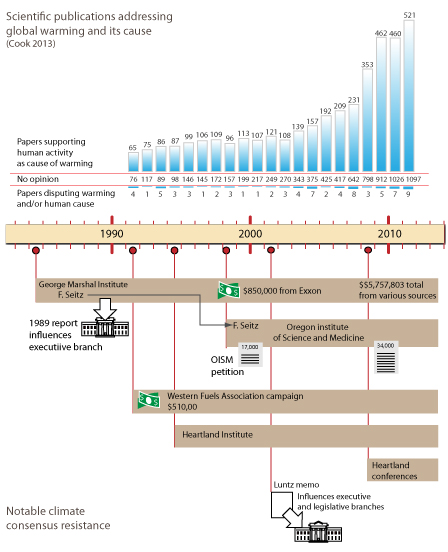
Moreover, as our recent study found, that consensus position is growing in the peer-reviewed scientific literature. As Graham Readfearn recently documented, over the past two decades, fossil fuel interests have engaged in a number of campaigns to cast doubt on the existence of the consensus on human-caused global warming. Convincing the public that this settled science is still in dispute has long been a top priority for industry groups.

Cook et al. (2013) 97% consensus results and notable anti-consensus campaigns.  Image by John Garrett  
Cook et al. (2013) 97% consensus results and notable anti-consensus campaigns. Image by John Garrett
Heartland's misrepresentation of the positions of the Chinese, Russian and Polish Academies of Science is the latest in this long line of efforts to cast doubt on the expert consensus on climate change. However, if the Bad Science in the NIPCC report represents the "differing viewpoints" the Chinese will be exposed to, I wouldn't bet on them reversing their endorsement of the human-caused global warming consensus anytime soon. Global temperatures will continue to rise, and the expert consensus on human-caused global warming will continue to grow along with them.

http://www.guardian.co.uk/environment/climate-consensus-97-per-cent/2013/jun/14/climate-change-heartland-chinese-academy-sciences

Saturday, April 20, 2013

Willie Soon, Koch & Exxon-funded scientist, challenged by students at climate denial events in Wisconsin (VIDEO) and Michigan


Koch & Exxon-funded scientist challenged by students at climate denial event (VIDEO)

Rarely do we meet those who have made careers selling us lies. Consider the oddball doctors who took tobacco money to deny a link between cigarette smoking and cancer, or the handful of scientists who take oil and coal money to discredit global warming science, or the people who have done both.
Last week, students in Wisconsin and Michigan stepped up to such an opportunity when CFACT Campus, the student arm of a well-known cabal of fossil fuel apologists, hosted climate change denier Willie Soon at several campus events around the country.
Dr. Willie Soon is a Smithsonian Institution astrophysicist paid by Charles Koch, ExxonMobil, the American Petroleum Institute and coal utility Southern Company to write papers dismissing climate change, publish op-eds saying coal pollution won't affect our health, refute the seriousness of ocean acidification, and apparently anything else he can be paid to deny. Dr. Soon has misrepresented himself by repeatedly claiming affiliation with Harvard University and using his credentials as an astrophysicist to make people believe he's a climate expert, and he shows no sign of stopping. Indeed, he told students in Madison, "I am as as qualified as anyone on the planet on this topic."
In both Madison, Wisconsin, and East Lansing, Michigan, Dr. Soon was caught with his pants down. As the Michigan State News documented in its article and accompanying audio interviewSoon claims that all the scientists around the world who study and recognize the seriousness of climate change are motivated by money, yet somehow his funding from coal and oil companies for his extremely marginalized viewpoints doesn't matter.
Here is the dialog with Willie Soon at the University of Wisconsin, Madison, with direct links to key clips below:
1) Willie Soon insinuates ExxonMobil will no longer fund him (emphasis added): 
"I have been receiving money from whoever that wants to give me money. I write my scientific proposal. I have received money from ExxonMobil, but ExxonMobil will no longer give me any money for a long time. American Petroleum Institute, anything you wish for, from Southern Company, from all these companies. I write proposal and let them judge whether they will fund me or not, always for a very small amount. If they choose to fund me, I'm happy to receive it." Click to watch (starts @ 1:52).
2) Dr. Soon stands behind his attempts to discredit the Intergovernmental Panel on Climate Change with help from ExxonMobil lobbyists: 
"I was trying to bring down IPCC -- is that what you imply?! [...] Let it be known that I do not like IPCC, because IPCC does not stand for science, it is corrupting science." Click to watch (starts @ 3:32).
After a question referencing emails with ExxonMobil lobbyists to undermine climate research at the United Nations before it even hit publication, Dr. Soon quickly loses his cool over his record of global warming denial, peppering the student with mild insults before owning up to his actions.
3) Dr. Soon thanks anyone who uses petroleum products or electricity from coal for supporting his work:
"I really want to thank her, because she's receiving the electricity used for her house, she's driving cars, she's doing all of these things because you are funding me. It's not an oil or coal company. They are a company that provides a service to humanity -- to people who want to use electricity." Click to watch (starts @ 5:14)
Anyone looking at Southern Company's record of pollution and political interference would be skeptical about its commitment to serve humanity. Soon continues with an aggressive rant claiming that the student isn't qualified to question his fossil fuel payments until she stops driving, using electricity, and wearing nylon. 
4) Willie Soon states "I don't like to claim that I am an expert on anything," despite listing himself as an "expert in mercury and public health" for a discredited Wall Street Journal op-ed dismissing health concerns over mercury pollution from coal plants. Soon invented similar credentials for another opinion piece in the Washington Times, before he swapped back to being a 22-year veteran of "researching the relationship of solar radiation and the Earth's climate," research Dr. Soon did on the dime of oil and coal companies.
Basically, Willie Soon is an expert in whatever problems vested industries will pay him to deny. Michigan State students note how Willie Soon now refutes research indicating adverse impacts from ocean acidification, a global crisis that is married to climate change (both problems stem from humans burning fossil fuels and releasing carbon dioxide into the atmosphere).
That's effed up. This man makes a career lying to the public, not to mention our lawmakers, about some of the most serious issues of our time. Climate change is already contributing to the deaths of 400,000 people each year and costing global GDP about $1.2 trillion, according to a report commissioned by multiple nations. 98% of actual climate scientists (a distinction Dr. Willie Soon does not earn) agree that global warming is real and primarily drive by humans burning fossil fuels like coal and oil.
Not only has Dr. Soon lied to us and our lawmakers about the seriousness of global warming -- he even lied directly to Congress in 2003 about his sources of funding at a time when he was promoting his study funded by the American Petroleum Institute, the $200 million/year oil and gas lobbying group. The Guardian wrote last year:
"In 2003 Soon said at a US senate hearing that he had "not knowingly been hired by, nor employed by, nor received grants from any organisation that had taken advocacy positions with respect to the Kyoto Protocol or the UN Framework Convention on Climate Change."
This is why it's crucial to demand accountability of people like Willie Soon. He is a public relations tool of oil and coal companiesand as a scientist attempting to publish in fields well outside of his expertise, that oil and coal money is crucial to recognize.
Here are some of the best examples of Soon's pseudo-science paid for by Big Oil and King Coal:
Dr. Soon's work is like a joke, but not the type you'd laugh at. While he cracks these fossil-funded zingers, reputable scientists warn that humanity is running out of time to stop climate change from self-reinforcing to the point that it spirals out of human control. As quoted by the Michigan State News, young conservatives on campus had trouble taking Dr. Willie Soon's presentation seriously:
“I’m not a science major, but I think (Soon’s presentation) has got valid points, but also other scientists who disagree with him have valid points,” Sobecki said. “I’m not crazy enough to think that six billion people don’t have an effect on climate in the world we live in.”
Science majors attending the MSU event didn't agree that Soon's points were particularly valid. See this account from a MSU Greenpeace student activist on PolluterWatch for more details.