Blog Archive

Showing posts with label methanogenesis. Show all posts

Thursday, March 3, 2016

Frozen peatlands in a warming world

by Tom Roland, Bogology, January 22, 2016

Peatlands grow in any region where decomposition of the plant matter they contain is slowed down, typically by waterlogging or cool temperatures. Of course, there are significant amounts of peat in the warm and wet tropical regions. Carbon-rich peat provides a lush carpet for many of the world’s most famous rainforests in, for example, the Amazon, Indonesia and – as you may have seen in the news – central Africa, where researchers recently found a colossal peatland. However, the amount of carbon stored in these vast peatlands still pales in comparison to that which is found in the ‘circum-Arctic’ – the vast area of land that wraps around the high-latitudes of the Northern Hemisphere. Owing to the relative imbalance in the distribution of landmass between the Northern (68%) and Southern Hemispheres (32%), particularly in terms of the colder and relative moist higher latitudes, the North possesses a far greater area of land conducive to the development of peat.
bnz_permafrost_fig1a
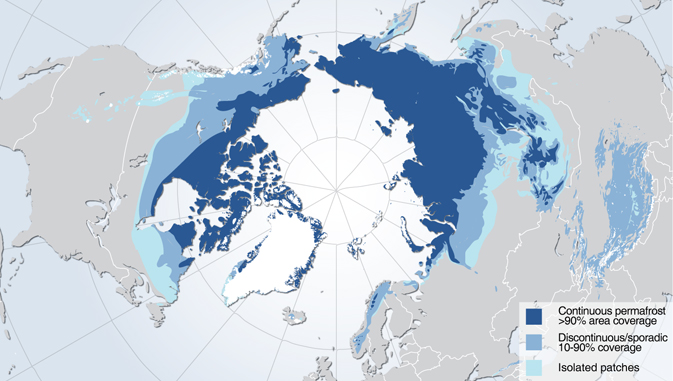
The distribution of permafrost in the Northern Hemisphere.
The peatlands in the circum-Arctic contain nearly 300 GtC, almost half of all the carbon stored in the entire world’s peatlands [2] and remain frozen as permafrost for most or all of the year. Whilst frozen, the carbon in these peatlands is rendered ‘inert,’ locked in and protected from decomposition, which would otherwise lead to it being lost into the atmosphere in the form of carbon dioxide and methane – compounding already dangerous levels of greenhouse gases in our atmosphere.
Unfortunately this huge frozen carbon store is at serious and increasing risk.
The effects of global warming are now well documented across the world, but what many people may not realise is that different areas of the world are warming at different rates. The northern high-latitudes and the ecosystems within them are considered more at risk of rising temperatures than many other areas of the world. As a result of this on-going warming, zones of permafrost have retreated rapidly polewards in recent decades, leaving in their wake evidence of peatland degradation in the form of collapsed peat domes and thaw lakes as the land melts. The ultimate fate of permafrost peatlands and the carbon they contain remains uncertain, however, owing to a complex set of feedbacks between peat growth, hydrology and vegetation.
Our recent paper, led by Graeme Swindles at the University of Leeds and published in Nature Scientific Reports aims to improve our understanding of permafrost peatland response to climate warming [3]. Because instrumental and observational records only go back a few decades in the region, we took peat cores spanning between 100 and 200 years from peatlands suffering at various stages of the thaw-driven degradation process in the Abisko region of northern Sweden. Here, we looked at how carbon accumulation had varied over this time period and by examining the shells, or ‘tests,’ of moisture-sensitive testate amoebae that live in the water films of peatland plants, we were able to reconstruct how water tables had fluctuated alongside these changes in peatland accumulation.
The Abisko region is a classic example of the damage being done by the warming climate. Here the average annual temperature is now above freezing – the permafrost is melting rapidly, and will eventually disappear completely. Our longer-term palaeoecological perspective on this process allowed us to produce a five-phase model outlining how we think permafrost peatlands are likely to respond to continued climate warming. Under increasing temperatures we found that intact permafrost peatlands begin to dry, with water tables and carbon accumulation both decreasing. At some point in this process a threshold state is reached and the peatland begins to degrade – cracking in the peat surface occurs and the link between climate and the peatland’s water table breaks down, lowering carbon accumulation further. At this point, the thaw has reached such a level that the peat dome collapses and becomes saturated by the underlying water table. This leads to the development of the final phase and common end point for thawing permafrost peatlands – an inundated arctic fen.
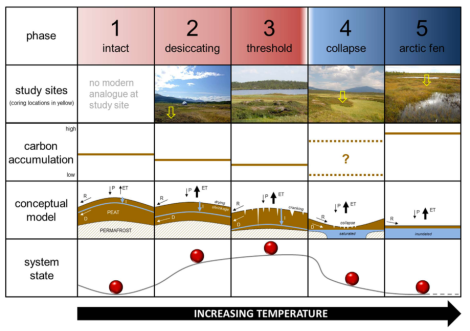
Screen Shot 2016-01-21 at 15.29.19
Our five-phase model for permafrost peatland response to increasing temperatures. © Nature Publishing Group.
Interestingly, we found that carbon accumulation in these new systems was relatively high. That news might sound good, but it is offset by bad – the waterlogged conditions experienced in these fens are highly likely to cause elevated methane emissions. Methane is 28 times more potent a greenhouse gas than carbon dioxide [4] and subsequently these increased emissions could well lead to increased climate warming. We often call these sorts of processes ‘climate-feedback mechanisms,’ but the phrase ‘vicious circle’ would do just as well.
References

Saturday, May 3, 2014

"Synthesis of methane emissions from 71 northern, temperate, and subtropical wetlands," by Merritt R. Turetsky et al., GCB (2014); doi: 10.1111/gcb.12580

Global Change Biology,  (28 April 2014); doi: 10.1111/gcb.12580

A synthesis of methane emissions from 71 northern, temperate, and subtropical wetlands


  1. Merritt R. Turetsky1,*
  2. Agnieszka Kotowska1
  3. Jill Bubier2
  4. Nancy B. Dise3
  5. Patrick Crill4
  6. Ed R. C. Hornibrook5
  7. Kari Minkkinen6,
  8. Tim R. Moore7
  9. Isla H. Myers-Smith8,
  10. Hannu Nykänen9
  11. David Olefeldt1
  12. Janne Rinne10
  13. Sanna Saarnio11
  14. Narasinha Shurpali12
  15. Eeva-Stiina Tuittila13
  16. J. Michael Waddington14
  17. Jeffrey R. White15,
  18. Kimberly P. Wickland16 and
  19. Martin Wilmking17
Abstract


Wetlands are the largest natural source of atmospheric methane. Here, we assess controls on methane flux using a database of approximately 19,000 instantaneous measurements from 71 wetland sites located across subtropical, temperate, and northern high-latitude regions. Our analyses confirm general controls on wetland methane emissions from soil temperature, water table, and vegetation, but also show that these relationships are modified depending on wetland type (bog, fen, or swamp), region (subarctic to temperate), and disturbance. Fen methane flux was more sensitive to vegetation and less sensitive to temperature than bog or swamp fluxes. The optimal water table for methane flux was consistently below the peat surface in bogs, close to the peat surface in poor fens, and above the peat surface in rich fens. However, the largest flux in bogs occurred when dry 30-day averaged antecedent conditions were followed by wet conditions, while in fens and swamps, the largest flux occurred when both 30-day averaged antecedent and current conditions were wet. Drained wetlands exhibited distinct characteristics, e.g., the absence of large flux following wet and warm conditions, suggesting that the same functional relationships between methane flux and environmental conditions cannot be used across pristine and disturbed wetlands. Together, our results suggest that water table and temperature are dominant controls on methane flux in pristine bogs and swamps, while other processes, such as vascular transport in pristine fens, have the potential to partially override the effect of these controls in other wetland types. Because wetland types vary in methane emissions and have distinct controls, these ecosystems need to be considered separately to yield reliable estimates of global wetland methane release.

http://onlinelibrary.wiley.com/doi/10.1111/gcb.12580/abstract

Friday, May 2, 2014

Climate Central: Methane emissions from thawing Arctic permafrost: ‘Certain to Trigger Warming’

by Bobby McGill, Climate Central, May 1, 2014

As climate change melts Arctic permafrost and releases large amounts of methane into the atmosphere, it is creating a feedback loop that is "certain to trigger additional warming," according to the lead scientist of a new study investigating Arctic methane emissions. 
The study released this week examined 71 wetlands across the globe and found that melting permafrost is creating wetlands known as fens, which are unexpectedly emitting large quantities of methane. Over a 100-year timeframe, methane is about 35 times as potent as a climate change-driving greenhouse gas than carbon dioxide, and over 20 years, it's 84 times more potent.
Permafrost terraces in Alaska.
Credit: U.S. Fish and Wildife Service Alaska/flickr
Methane emissions come from agriculture, fossil fuel production and microbes in wetland soils, among other sources. The study says scientists have assumed that methane emissions from wetlands are high in the tropics, but not necessarily in the Arctic because of the cold temperatures there. 
But a spike in global methane concentrations in the atmosphere seen since 2007 can be traced back to the formation of fens in areas where permafrost once existed, according to the study, led by University of Guelph (Ontario, Canada) biology professor Merritt Turetsky.
The methane emissions stemming from melting permafrost could be critical to determining how fast the climate will change in the future.
“Methane emissions are one example of a positive feedback between ecosystems and the climate system,” Turetsky said. “The permafrost carbon feedback is one of the important and likely consequences of climate change, and it is certain to trigger additional warming.”
Warming and thawing permafrost stimulate methane release, which enhances the greenhouse effect, creating a feedback loop, she said.
“Even if we ceased all human emissions, permafrost would continue to thaw and release carbon into the atmosphere,” Turetsky said. “Instead of reducing emissions, we currently are on track with the most dire scenario considered by the IPCC. There is no way to capture emissions from thawing permafrost as this carbon is released from soils across large regions of land in very remote spaces.”
The Intergovernmental Panel on Climate Change projected in its fifth assessment on climate change report that the earth’s average temperatures could warm by as much as 8.64 °F above 1986-2005 temperatures if nothing is done to curb greenhouse gas emissions.
Coastal erosion reveals the ice-rich permafrost underlying the Arctic Coastal Plain in the National Petroleum Reserve in Alaska.
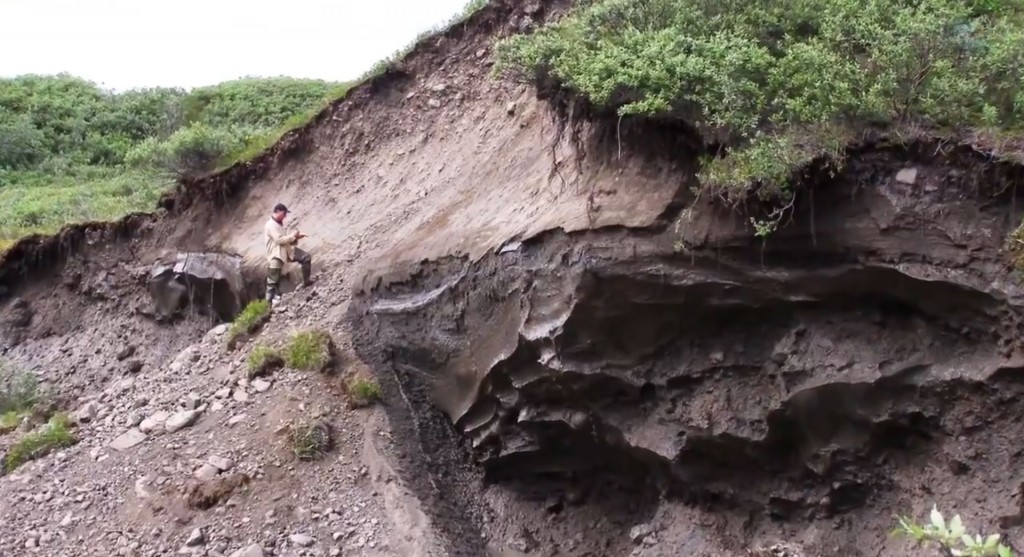
Credit: USGS
Turetsky’s study shows that fens in the northern latitudes created when permafrost thaws can have emissions similar to wetlands in the tropics. Emissions from fens are generally higher than bogs and some other wetland types because fens, fed by groundwater, have higher nutrient levels and more grasses than bogs, leading to more methane production.
“Our study highlights that northern wetlands without permafrost emit more methane than wetlands with permafrost,” U.S. Geological Survey research ecologist and study co-author Kimberly Wickland said.
“When permafrost is absent, wetlands can be more connected to groundwater, allowing for wetter conditions — the main ingredient for methane production,” she said. “It is possible that methane emissions from wetlands will continue to increase with continued permafrost thaw, but that will depend primarily on whether wetlands stay wet. If they dry, then methane emissions will decline.”
Gavin Schmidt, a climate scientist at NASA's Goodard Institute for Space Studies in New York and not part of the study, said it's too soon to draw conclusions about how much wetland methane emissions will impact global warming, though scientists widely agree that the amplified feedback is generally going to increase. 
The paleo record shows that the Arctic was several degrees warmer during the last interglacial period 120,000 years ago, and there is no evidence of increased levels of methane in the atmosphere during that period, he said. 
"It's not to say at some point it won't become an issue," Schmidt said, adding that there is evidence of many "methane burps" across the globe in the very distant past. 
"The planet is very capable of surprising us," he said.
By surveying many wetland sites across the globe as Turetsky and her team have, scientists can gain a much broader understanding of the source of methane emissions from melting permafrost and their role in the feedback loop, Schmidt said. Many previous studies have examined just a single site whereas Turetsky's team examined numerous sites across the globe. 
"The work these people are doing in terms of trying to synthesize that information and bring it all together, I think it's certainly going in the right direction," he said. 
Turetsky's study, “A synthesis of methane emissions from 71 northern, temperate, and subtropical wetlands,” was published this week in the journal Global Change Biology.

Thursday, March 20, 2014

Increasing temperatures cause more methane to be emitted from fresh water sources

by Tim Radford, Climate News Network, March 20, 2014

Scientists think the amount of methane emitted to the atmosphere from freshwater ecosystems will increase as the climate warms, triggering further warming.

LONDON, 20 March - British scientists have identified yet another twist to the threat of global warming. Any further rises in temperature are likely to accelerate the release of methane from rivers, lakes, deltas, bogs, swamps, marshlands and rice paddy fields.

Methane or natural gas is a greenhouse gas. Weight for weight, it is more than 20 times more potent than carbon dioxide over a century, and researchers have repeatedly examined the contribution of natural gas emitted by ruminant cattle to global warming. But Gabriel Yvon-Durocher of the University of Exeter and colleagues considered something wider: the pattern of response to temperature in those natural ecosystems that are home to microbes that release methane.

They report in Nature that they looked at data from hundreds of field surveys and laboratory experiments to explore the speed at which the flow of methane increased with temperature.

Microbes, algae, freshwater plants and animals are all part of an active ecosystem and take their nourishment from and return waste to the atmosphere. Healthy plants take carbon dioxide from the atmosphere with photosynthesis. Most of the methane in freshwater systems is produced by an important group of microbes called Archaea that live in waterlogged, oxygen-free sediments and play an important role in decay.

Plant uptake of carbon dioxide is affected by temperature, and so is microbial methane production. Respiration also releases carbon dioxide. The questions the researchers set out to answer were: which gas is more likely to be released in greater quantities as temperatures rise? And is the outcome the same whether they examine the Archaea only, or all the microbes in an ecosystem, or the entire package of submerged freshwater life?

More heat, more methane

The answer is, the scientists say, that methane emissions go up with increased temperatures and the ratio of methane to carbon dioxide also goes up in step with temperature. And the result is the same whether you consider the microbes or the whole ecosystem.

“The discovery that methane fluxes are much more responsive to temperature than the processes that produce and consume carbon dioxide highlights another mechanism by which the global carbon cycle may serve to accelerate rather than mitigate future climate change,” says Dr Yvon-Durocher.

This is not the end of the story. All such studies raise as many questions as they answer, and more research is necessary. The next puzzle is how to fit such findings into models of climate change. However, the researchers feel they have cleared up one point. Dr Yvon-Durocher says:


“Our research provides scientists with an important clue about the mechanisms that may control the response of methane emissions from ecosystems to global warming.”


http://www.climatenewsnetwork.net/2014/03/warmer-freshwater-emits-more-methane/

Saturday, March 15, 2014

Robert Schribbler: The Arctic Methane Monster’s Nasty Little Helpers: Study Finds Ancient, Methane Producing, Archaea Gorge on Tundra Melt

by Robert Schribbler, robertscribbler.com, March 14, 2014


An emerging methane feedback in the Arctic. It’s something that, since last summer, I’ve been calling the Arctic Methane Monster. A beast of a thing composed of giant reserves of sea bed methane and an immense store of carbon locked away in Arctic tundra.

How dangerous and vicious the monster ends up being to a world set to rapidly warm by humans depends largely on three factors. First — how fast methane is released from warming stores in the sea bed. Second — how swiftly and to what degree the tundra carbon store is released as methane. Third — how large the stores of carbon and methane ultimately are.
permafrost_arctic-1024x557
Thawing permafrost and organic carbon in Yedoma region of Russia. Image source: NASA.
On the issue of the first and third questions, scientists are divided between those like Peter Wadhams, Natalia Shakhova and Igor Simeletov who believe that large methane pulses from a rapidly warming Arctic Ocean are now possible and warrant serious consideration and those like Gavin Schmidt and David Archer — both top scientists in their own right — who believe the model assessments showing a much slower release are at least some cause for comfort. Further complicating the issue is that estimates of sea-bed methane stores range widely with the East Siberian Arctic Shelf region alone asserted to contain anywhere between 250 and 1500 gigatons of methane (see Arctic Carbon Stores Assessment Here).
With such wide-ranging estimations and observations, it’s no wonder that a major scientific controversy has erupted over the issue of sea bed methane release. This back and forth comes in the foreground of observed large (but not catastrophic) sea-bed emissions and what appears to be a growing Arctic methane release. A controversy that, in itself, does little inspire confidence in a positive outcome.
But on the second point, an issue that some are now calling the compost bomb, most scientists are in agreement that the massive carbon store locked in the swiftly thawing tundra is a matter of serious and immediate concern.
Tundra Thaw by Human GHG Now Practically Inevitable
At issue here is the initial power of the human heat forcing and what consequences that forcing is likely to unlock. Consequences that are directly tied to the amount of greenhouse gasses we emit. A total forcing that is now likely equivalent to around 425 CO2e when taking into account the effect of human aerosols and an even more ominous 480 CO2e when and if those aerosols fall out (IPCC and MIT).
The first number, 425 CO2e, were it to remain stable over years, decades and centuries, is enough push global temperatures above the 1.5 C warming threshold that would thaw the northern hemisphere tundra. And within this tundra is locked a store of about 1,500 gigatons of carbon. A massive store that is set to eventually, thaw, decompose and release its carbon as either CO2 or methane over the long period of warmth that is to come.
Area of contiguous permafrost
Northern Hemisphere Permafrost Zones. Image source: NASA.
The immense size of this carbon store represents an extreme risk both for extending the period of human warming and for, potentially, generating a feedback in which natural warming adds to, rather than simply extends, human warming. By comparison, human fossil fuel emissions have already resulted in about 540 gigatons of carbon being released into the atmosphere. The tundra store alone represents nearly three times this amount. But the concern is not just the massive size of the tundra store now set to thaw, or the rate at which the tundra will, eventually, release its carbon to the atmosphere. The concern is also how much of the tundra store carbon is released as either methane or CO2.
Methane Provides a Strong Amplifying Feedback
Since methane’s radiative absorption is about 35 times that of CO2 by volume in the IPCC climate assessments (and its short term global warming potential is as much as 72 to 105 times that of a comparable amount of CO2) and since methane release sets off other feedbacks by turning into CO2 after it is oxidized and by increasing atmospheric water vapor, a strong greenhouse agent in its own right, a significant portion of tundra carbon being liberated as methane could result in a rather powerful heat amplification. In the worst case, such an amplification could set off conditions similar to those during which other mini-greenhouse gas runaways occurred — such as the Permian, Triassic and PETM events.
Which is why the release of a new paper should be cause for serious concern.
Ancient Archaea – The Arctic Methane Monster’s Nasty Little Helpers
This week, a paper published in Nature Communications described findings based on a study of thawing Swedish permafrost. The study investigated how microbes responded to thawing tundra in various mires throughout warming sections of Sweden. What they discovered was the increased prevalence of an ancient methane producing micro-organism.
Billions of years ago, methane producing cyanobacteria or archaea were prevalent in the world’s oceans. The methane they produced helped keep the Earth warm at a time when solar output was much less than it is today. Later, as oxygen producing plants emerged, the archaea, to which oxygen was a poison, retreated into the anoxic corners of the more modern world. Today, they live in the dark, in the mud, or in the depths of oceans. There, they continue to eek out an existence by turning hydrogen and carbon dioxide into methane.
A kind of archaea, the newly discovered organism, named Methanoflorens stordalenmirensis, was found to be exploding through sections of rapidly melting Swedish tundra. In fact, it is so at home in regions of melting permafrost that it blooms in the same way algae blooms in the ocean. As a result, it comes to dominate the microbial environment, representing 90% of the methanogens and crowding out many of the other microbes.
Distribution of Methanogen
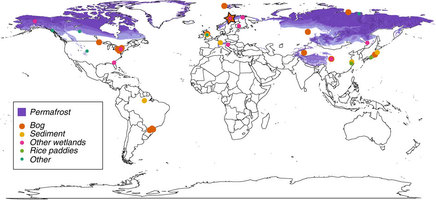
Methanogen shows global distribution. Each dot indicates a location where Methanoflorens stordalenmirensis was discovered. Image source: Nature.
That these massive archaea blooms can effectively convert large portions of the newly liberated tundra carbon store into methane was not at all lost on researchers:
“Methanoflorens stordalenmirensis seems to be a indicator species for melting permafrost. It is rarely found where there is permafrost, but where the peat is warmer and the permafrost is melting we can see that it just grows and grows. It is possible that we can use it to measure the health of mires and their permafrost. The recently documented global distribution also shows, on a much larger scale, that this microbe spreads to new permafrost areas in time with them thawing out. This is not good news for a stable climate“, said study author Rhiannon Mondav.
So what we have here is a billions year old microbe that thrives in wet regions called mires where permafrost is melting, rapidly converts tundra carbon to methane, readily spreads to new zones where permafrost melt occurs, and explodes into algae like blooms to dominate these environments.
One could not ask for a set of more diabolic little helpers for the already very disturbing Arctic Methane Monster…
Implications Going Forward: Arctic Methane Emission Not Currently Catastrophic, But Likely to Continue to Grow
Recent research shows that the current methane emission from all natural sources north of 53 degrees north latitude is on the order of 81 trillion grams (TG) each year. A portion of this, about 17 TG, comes from the East Siberian Arctic Shelf. Other inputs are from sea bed sources, thawing tundra and existing wetlands in the region. Meanwhile, the global emission, including both human and natural sources is in the range of about 600 TG each year. Overall, this emission is enough to overwhelm current sinks by about 40 TG each year, which results in continuing increases of atmospheric methane.
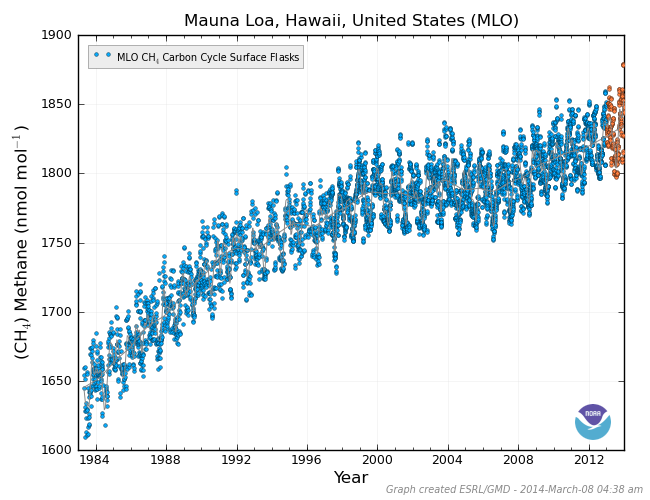
Atmospheric Methane Mauna Loa
Atmospheric methane levels since 1969, Mauna Loa, show levels rising by about 200 ppb over the 45 year period. Image source: NOAA ESRL.
As more and more of the tundra melts and as seabed methane continues to warm it is likely that total Arctic methane emissions will continue to rise, perhaps eventually rivaling or, in the worst case, exceeding the size of the human methane emission (350 TG). But, to do so, current Arctic and boreal emissions would have to more than quadruple — either through a slow increase (high likelihood) or through more catastrophic large pulse events (lower likelihood, but still enough for serious concern). By contrast, recent warm years have shown increases in the rate of methane flux/emission of around 5% with the average flux increase being around 2%.
It is worth noting that NOAA and a number of other agencies do track methane emissions in the Arctic but that a comprehensive tool set for accurately tracking the total emission does not appear to be currently available. Instead, various studies are conducted in an effort to capture total emissions levels. Monitoring does, however, track total atmospheric values.
[Readers, it is well worth going to the link to the post, below, and reading the comments.]
Links: