Blog Archive

Showing posts with label Copenhagen. Show all posts

Wednesday, October 6, 2010

Denmark's fascist government continues illegal prosecutions of non-violent demonstrators during Copenhagen conference. Two Danish spokespersons of the global network Climate Justice Action's "Reclaim Power – Push for Climate Justice" rally (Stine Gry Jonassen and Tannie Nyboe) are made scapegoats

Global climate movement put on trial in Denmark: two Danish spokespersons Stine Gry Jonassen and Tannie Nyboe are made scapegoats

Today, on Wednesday, the 6th of October, the trial against the two spokespersons from the Global Network "Climate Justice Action” (CJA), Stine Gry Jonassen and Tannie Nyboe, begins. During the climate summit in Copenhagen in December last year, CJA organised several non-violent civil disobedience protests, including the "Reclaim Power  Push for Climate Justice" rally on the 16th of December. Stine Gry and Tannie were both the public face of the movement, but now they stand accused of being organisers and instigators of violence and vandalism.

Stine Gry Jonassen explains: "in several months before the summit, both of us acted as spokespersons for Climate Justice Action and we openly spoke about the demonstration on 16th of December. However, it does not turn us into principal organisers: the demonstration was planned jointly at international meetings with several hundred participants. Therefore, it is not reasonable to identify two people out of many as leaders just because they have chosen to be public faces.”

Both of them are shocked by the accusations that they were to have instigated violence. Tannie Nyboe explains: "we have all along emphasized that Reclaim Power was a non-violent demonstration. The purpose was not to achieve a confrontation with the police but to have a public gathering focusing on climate justice, with participations from both outside and inside the Bella Centre.“

Stine Gry Jonassen adds: "This lawsuit sends a significant message; if you have the nerve to rise up and have a critical point of view of society, you can end up in jail. It is absurd that a large public movement as CJA is criminalised because they dared to criticise the ongoing negotiations during the climate change summit  especially in the light of how poorly things turned out with the negotiations and how criticisable Denmark's role was."

Contacts:  Phone: (+45) 50 58 87 51; e-mail: media@climatecollective.org

Background:

Climate Justice Action (CJA) is a global network of social movements and groups, which mobilised and called out for protests during the climate summit in Copenhagen in December last year, in order to challenge the insubstantial political negotiations at the Bella Centre and demanding just solutions to the climate problems. On the 16th of December, CJA organised the demonstration "Reclaim Power  Push for Climate Justice" to give voice to the people mostly affected by climate changes – the same people who were not heard inside the Bella Centre.

At the time, Stine Gry and Tannie were spokespersons for the movement and argued for the right to protest and for the freedom of speech. They are now made responsible for planning the "Reclaim Power" demonstration and they are accused of plotting violence against an official in function, of severe vandalism, of serious disturbance of public peace and order, and of illegal
trespassing.

The trial of the two spokespersons takes place in Copenhagen City Court on the 6th, 27th, and 28th of October 2010 at 9.30 a.m.

Campaign:  ”I also shouted PUSH”

The police can and should not hold individuals responsible for the actions and decisions of a whole movement; therefore, a campaign called “I also shouted PUSH” is launched in connection to the trial. This is done in order to clarify that there were several hundred people shouting PUSH at the Bella Centre on the 16th December and that is was not an action in which Tannie and Stine Gry can be held personally liable to.

For further information: www.climatecollective.org/push

Thursday, March 18, 2010

Denmark's fascist government takes peaceful activists, Natasha Verco and Noah Weiss, to trial with no evidence

Copenhagen activist trial: 'I can't see what evidence there is for the charges'

Australian honours student 'indignant' over charges of organising violence and disorder at climate summit as trial opens
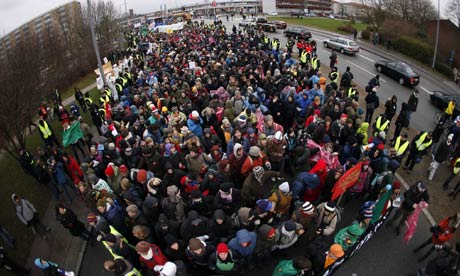
COP15 Protestors march towards Bella Center in Copenhagen
Protesters march towards Bella Centre where the UN climate change Conference takes place to disrupt proceedings. Photograph: Pawel Kopczynski/Reuters

Two environmental activists appeared in court today accused of terrorism-related offences during the Copenhagen climate summit in December.

Natasha Verco, an Australian honours student, and Noah Weiss, an American citizen who lives in Denmark, will face similar charges in a trial which is due to last all week.

Verco, who has organised non-violent direct action in her native country and who has been part of the Climate Justice Action (CJA) network in the lead-up to the summit in Copenhagen, has been charged with organising violence, organising public disorder, significant damage to property, and organising disorder during the international talks on climate change which took place in Copenhagen last year. If found guilty, Verco faces a maximum of twelve and a half years in prison.

Speaking a day ahead of the start of the trial, Verco recalled her arrest: "On December 13 I was riding my bike down by the Copenhagen lakes,and a plainclothes police woman jumped out at me and pushed me off the bike. She took me to an unmarked police van with six or seven plainclothes policemen. I asked them 'Are you randomly picking me up?' and they said 'No, we hunted you'. They held me by myself in an underground carpark for about 16 hours, I think. Then I was taken to Vester prison and held there for three weeks and two days. I was charged the day after I got to prison, but bail was refused because, they said, the investigation was ongoing and I would influence it if I was released."

Verco and Weiss say they both had their phones tapped, along with 17 other activists, which is legal under recently introduced terror legislation in Denmark. Verco said: "I feel nervous and indignant at the same time, I wonder what the hell they're going to argue because I can't see what evidence they've got for these charges. And looking back at the calls that they've taped, it feels very invasive. Under the new terror laws they can do this, but it seems to me that applying terror laws to activists is steadily eroding the base of our democracy."

Verco was heavily involved in organising the day of action on December 14, but was arrested before it happened. When it took place, she was still being held by police. "The police say that they prevented anything happening by taking me in. There was no violence, and no disruption of the public infrastructure, because they'd arrested me."

During the fortnight of talks, dozens of protests from the small to mass rallies of 40,000 people, took place; the Danish police arrested nearly 2,000 people. The police are now processing nearly 200 legal complaints about the treatment of the arrestees. Verco and Weiss were both involved with CJA, the network which helped to organise some of the protests during the talks, most notably the Reclaim Power demonstration outside the conference centre for the negotiations.

Apart from Weiss and Verconone of the other activists charged during the protests, including the Greenpeace Four who were arrested and held for three weeks after unfurling a banner during a black tie event, have yet had their court dates set.

Link:  http://www.guardian.co.uk/environment/2010/mar/16/copenhagen-activist-trial

Saturday, February 27, 2010

The Guardian: Is the climate change movement splintering?

Dear Readers,

I noticed a lot of mention of anarchism and anti-capitalism during Copenhagen, and for the life of me, I don't get it.  What does anarchism do for anything?  I lived in Holland for 7 years, and I can live with democratic socialism combined with capitalism, as it exists there, but just pure anti-capitalism makes no sense -- for one thing, we know that communism never gets beyond the dictatorship of the proletariat and the inevitable corruption that ensues from that kind of concentrated power.

In any case, I don't think that anarchism has any place in the world.  Nevertheless, in the climate movement, we need all possible bodies to participate, and if that means some peppery anarchists in the mix, so be it.

And, I am all for civil disobedience protests whenever necessary.

Here is a recent article from The Guardian (yeah, the same Guardian that publishes libelous garbage written by Fred Pearce about honest climate scientists).

Tenney

Is the climate change movement splintering?

Climate change activists are regrouping post-Copenhagen – and some are reasserting their radical roots

by Bibi van der Zee, The Guardian, February 25, 2010

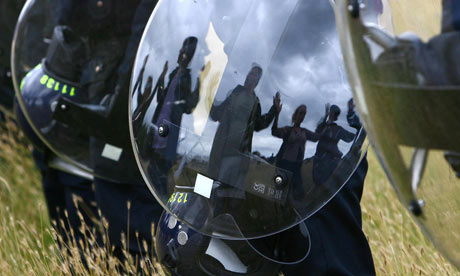
Eco-activists reflected in a Police riot shield  at the Climate Camp near Kingsnorth Power Station
Activists reflected in a police riot shield at the Climate Camp near Kingsnorth power station in Kent, August 4, 2008. Photograph: Gareth Fuller/PA

The climate change movement is dead, long live the climate change movement! was the proclamation made last week by Rising Tide North America, as green campaigners around the world begin coming to terms with the switchback ride of the last three months.

"A particular model of dealing with climate change is dying. It is revealing itself before the world as nothing more than a final scramble for the remaining resources of a planet in peril," states a quote from Naomi Klein at the beginning of the document, before stating:
Many in the climate movement have grown all too cosy with the status quo. The 'bold' action they call for will result in the privatisation of the air, to be divided up by mega-polluters. Their demands for carbon neutrality seek to offset our problems onto poor countries while the rich keep burning and consuming. Those who still cling to the old climate movement have committed themselves to a sinking ship.
It comes out against a backdrop of restlessness, as activists take stock of where they have been and where they are going. Now that the climate talks in Copenhagen have failed, the activists who campaigned inside and outside the Bella Centre are subsiding naturally into two groups – those who didn't want a deal in the first place, and those who did.

People in the latter group, which includes campaign groups such as UK Youth Climate Coalition and the umbrella group tck tck tck, are devastated. As Gemma Bone, one of UKYCC's members puts it; "I didn't expect that there would be a final agreement, but I did think that we would make some kind of progress, and that this year would be all about finalising details. Now it's not clear how the UN process will even go forward. It's absolutely knocked me for six."

But activists in the former group – including Climate Camp, Rising Tide and Climate Justice Network – are more positive. A spokesman for Rising Tide said: "To be honest we never expected a deal at Copenhagen. We don't want an international agreement." Like many activists he is profoundly sceptical about the ability of a carbon trading market – one of the central mechanism of any international agreement – to deliver real reductions in emissions of carbon dioxide.

In fact, Copenhagen and the failure of the meeting has in some ways liberated activists. Climate Campers, for example, have been discussing being more upfront about their anarchist and anti-capitalist roots. In the Climate Camp reader which was circulated in January, writers suggested that the camp had been "hijacked by a hardcore of liberals" and asked if it might be time to be more open about the anarchist, anti-capitalist core to the camp.

In many cases the focus is shifting from global action to local issues, such as fossil-fuel power plants or mines. Rising Tide North America's document calls for "an asymmetrical assault on the fossil fuel industry" while in the UK and in Europe campaigners are also planning to focus more on local grassroots campaigns, "to start from the bottom" as the Rising Tide spokesman put it.

The global network that was formed in Copenhagen, as activist groups from around the world worked together to organise the giant march and the Step Up the Resistance demonstration outside the Bella Centre, will also be in correspondence. Nicola Bullard of Focus on the Global South and Climate Justice Network, will be attending the People's World Conference on Climate Change in Bolivia this Easter, along with representatives from Climate Camp, Via Campesina and Jubilee South.

But there is no plan to return to the old summit-hopping ways of the anti-capitalist movement, following the G20 and the WTO from conference to conference. "We need to carry on building on the simple principles that we've established, which held us together in Copenhagen," says Bullard. She agrees that the main focus now has to be getting on with what is already happening. "Sometimes the issue is just too big, too contingent on everything else going on around you. Sometimes, to be honest, you just have to start to do the work."

Link:  http://www.guardian.co.uk/environment/blog/2010/feb/25/climate-change-movement

Saturday, January 30, 2010

Stefan Rahmstorf & Yvo de Boer: Copenhagen: what next?

Copenhagen: what next?

It's coming up to six weeks since the end of the Copenhagen negotiations on climate change. Now that the dust has settled, there's time to stand back and take a more considered look. Here Yvo de Boer, executive secretary of the United Nations Framework Convention on Climate Change (UNFCCC), and Stefan Rahmstorf, professor of physics of the oceans at Potsdam University, Germany give their views on the outcome of the COP15 talks and the way forward
At a press conference last week, de Boer said that the outcome in Copenhagen made "the task to hand more urgent…the window of opportunity we have to come to grips with this issue is closing faster than it was before." But he claimed that the talks did raise climate-change issues to the highest level of government, helped to define temperature limits and financial contributions, and set 2015 as a date for reviewing whether global action needs to be more urgent.

The Copenhagen Accord, meanwhile, an agreement negotiated by China, South Africa, India, Brazil and the US, and noted by the other nations at the conference, "reflects a political consensus on the long-term global response" that is needed to climate change, according to de Boer. "We are now in a cooling off period," he added. "This gives useful time for countries to resume discussions with each other."

Climate scientist Stefan Rahmstorf thinks that the outcome of COP15 is depressing, but also tried to highlight some more upbeat aspects. "On the positive side: most of the actors in Copenhagen by far were quite willing to commit to a substantial effort to halt global warming – including many who were not willing to do this earlier, for example the US or Australia," he told environmentalresearchweb. "And some important developing countries have made very constructive pledges as well. We were closer than ever to major progress in fighting global warming."

Rahmstorf reckons that an agreement was not reached because "the consensus-based UN process with 192 ountries is very cumbersome, and it was exceptionally badly managed at this conference," because China did not play a very constructive role and because the US was not able to offer enough. "The IPCC deemed 25–40% emissions reductions below 1990 values necessary by 2020 by developed nations to limit warming to 2 °C, and what the US offered amounted to only 4%," he explained. "This is largely a result of the lost years under previous administrations, during which the US emissions increased steeply – unlike those in Europe."

During his briefing, de Boer said that he never ceases to be amazed by the vision that some people have of the UN. "To me it is a collection of countries that have created a body to facilitate negotiation among each other," he added. "If those governments were to go and negotiate in a different setting with a different secretariat I don't know if that would fundamentally change their behaviour."

Keeping on the UN track
Both de Boer and Rahmstorf would like to see the UN process continue. "Everybody I have spoken to so far doesn't want the Accord to be a third track," said de Boer.

Rahmstorf agrees. "I hope that the multilateral UN track to a global climate agreement will not die, however cumbersome it is, because the alternatives are even worse," he said, "for example, the G20 with only the biggest emitters on the table deciding alone on climate policy, without those affected, like the small island nations, having a proper voice." In the meantime, Rahmstorf says that "while we wait for our world leaders to get their act together, there is nothing to stop us as world citizens to do all we can to reduce emissions bottom-up."

The next UNFCCC negotiating session is due to take place in late May 2010 in Bonn, with the next COP meeting set for Mexico in late November. According to de Boer, many countries feel that there is a need for an intensified negotiating schedule this year – he plans to convene the COP bureau to determine whether it's possible to slot in another set of negotiations before May 2010.

The countries that negotiated the Copenhagen Accord – China, South Africa, India, Brazil and the US – account for around 80% of carbon emissions. "It's true to say there was not final agreement on the Accord, but an overwhelming majority supported it," said de Boer. "It was not formally adopted by COP – only noted – and we should be careful not to make it more than it is."

But de Boer believes the Accord is a political tool that has broad support at a high level and that can be usefully employed in negotiations. He says the Accord is clear on a long-term goal, on how it can be measured, on financial support and on a number of new institutions that need to be established. "It can be used by us to help speed up the negotiations," he said.

Countries have until 31 January to let the UN know if they wish to be associated with the Accord in the official report of the COP15 negotiations. Industrialized countries have the option of including details of the targets they intend to commit to, while developing nations can indicate the action that they plan to take. The deadline is for administrative reasons only; the list of countries associated with the Accord will be updated on the UNFCCC secretariat website as later details come in. "It's a soft deadline, there's nothing deadly about it," said de Boer.

The climate for science
But what does this mean for the day-to-day lives of researchers? Rahmstorf believes the outcome in Copenhagen has no direct or immediate effects on climate science. "The morale of many is shaken, though," he added. "We've got an important job: since the Copenhagen Accord calls for limiting global warming to a maximum of 2 °C, possibly even 1.5 °C (this option is left open at the end of the Accord), one of the major tasks of science will be to narrow down the range of future emissions that is compatible with these policy goals."

Rahmstorf reckons that climate scientists have communicated their work quite well, particularly through the IPCC. While 2010 is the UN year of biodiversity, the biodiversity community has "not yet managed to get as much high-level attention to the biodiversity crisis; it is only now calling to set up something like the IPCC for biodiversity." On the other hand, "climate science could still do a lot better if more climate scientists get involved, take an interest in public understanding of science and educate themselves more about how to effectively work with the media". Rahmstorf reckons that "too many scientists are still stuck in the ivory tower and – for example – shrug off and ignore wrong media reports about climate science, rather than recognizing that public perception matters and that they should not leave the public debate to people with a political agenda."

The last word goes to de Boer: while the Copenhagen negotiations "didn't produce the final cake," they did leave countries "with all the key ingredients to bake a new one." Although the proof of the pudding, as they say, is in the eating.

Link:  http://www.guardian.co.uk/environment/2010/jan/29/copenhagen-what-next

Friday, January 1, 2010

The failure of COP15 was China's fault -- I know because I was in the room

Dear Readers,

I have no way to vouch for the authenticity of this comment I am lifting from a discussion on another blog, but it certainly contains interesting details (if true).

Here is the comment (part of it is a quote from The Guardian article-- which I will post below -- and part of it was written by Teryn Norris -- which I boldfaced):

The comment can be found at this link (http://itsgettinghotinhere.org/2009/12/19/open-letter-to-bill-mckibben-blaming-obama-for-copenhagen-is-wrong/).

Teryn NorrisDec 23rd, 2009 at 6:18 pm
Another perspective from The Guardian worth reading, “How do I know China wrecked the Copenhagen deal? I was in the room.” I think blaming China is too simplistic (just as is blaming Obama or any single country), but based on what I’m hearing from those closest to the negotiation table, this is a much more accurate picture than what Bill McKibben and Naomi Klein are saying:
“The truth is this: China wrecked the talks, intentionally humiliated Barack Obama, and insisted on an awful “deal” so western leaders would walk away carrying the blame. How do I know this? Because I was in the room and saw it happen…"
To those who would blame Obama and rich countries in general, know this: it was China’s representative who insisted that industrialised country targets, previously agreed as an 80% cut by 2050, be taken out of the deal. “Why can’t we even mention our own targets?” demanded a furious Angela Merkel. Australia’s prime minister, Kevin Rudd, was annoyed enough to bang his microphone. Brazil’s representative too pointed out the illogicality of China’s position. Why should rich countries not announce even this unilateral cut? The Chinese delegate said no, and I watched, aghast, as Merkel threw up her hands in despair and conceded the point. Now we know why – because China bet, correctly, that Obama would get the blame for the Copenhagen accord’s lack of ambition.”
[end comment]


How do I know China wrecked the Copenhagen deal? I was in the room

As recriminations fly post-Copenhagen, one writer offers a fly-on-the-wall account of how talks failed

 Ed Miliband: China tried to hijack climate deal
 The key players and how they rated

A woman listens to Barack Obama's speech at Copenhagen climate change conference 18 December 2009
A woman listens to Barack Obama's speech at the Copenhagen climate change conference on 18 December 2009. Photograph: Axel Schmidt/AFP/Getty Images
Copenhagen was a disaster. That much is agreed. But the truth about what actually happened is in danger of being lost amid the spin and inevitable mutual recriminations. The truth is this: China wrecked the talks, intentionally humiliated Barack Obama, and insisted on an awful "deal" so western leaders would walk away carrying the blame. How do I know this? Because I was in the room and saw it happen.
China's strategy was simple: block the open negotiations for two weeks, and then ensure that the closed-door deal made it look as if the west had failed the world's poor once again. And sure enough, the aid agencies, civil society movements and environmental groups all took the bait. The failure was "the inevitable result of rich countries refusing adequately and fairly to shoulder their overwhelming responsibility", said Christian Aid. "Rich countries have bullied developing nations," fumed Friends of the Earth International.
All very predictable, but the complete opposite of the truth. Even George Monbiot, writing in yesterday's Guardian, made the mistake of singly blaming Obama. But I saw Obama fighting desperately to salvage a deal, and the Chinese delegate saying "no", over and over again. Monbiot even approvingly quoted the Sudanese delegate Lumumba Di-Aping, who denounced the Copenhagen accord as "a suicide pact, an incineration pact, in order to maintain the economic dominance of a few countries".
Sudan behaves at the talks as a puppet of China; one of a number of countries that relieves the Chinese delegation of having to fight its battles in open sessions. It was a perfect stitch-up. China gutted the deal behind the scenes, and then left its proxies to savage it in public.
Here's what actually went on late last Friday night, as heads of state from two dozen countries met behind closed doors. Obama was at the table for several hours, sitting between Gordon Brown and the Ethiopian prime minister, Meles Zenawi. The Danish prime minister chaired, and on his right sat Ban Ki-moon, secretary-general of the UN. Probably only about 50 or 60 people, including the heads of state, were in the room. I was attached to one of the delegations, whose head of state was also present for most of the time.
What I saw was profoundly shocking. The Chinese premier, Wen Jinbao, did not deign to attend the meetings personally, instead sending a second-tier official in the country's foreign ministry to sit opposite Obama himself. The diplomatic snub was obvious and brutal, as was the practical implication: several times during the session, the world's most powerful heads of state were forced to wait around as the Chinese delegate went off to make telephone calls to his "superiors".
Shifting the blame
To those who would blame Obama and rich countries in general, know this: it was China's representative who insisted that industrialised country targets, previously agreed as an 80% cut by 2050, be taken out of the deal. "Why can't we even mention our own targets?" demanded a furious Angela Merkel. Australia's prime minister, Kevin Rudd, was annoyed enough to bang his microphone. Brazil's representative too pointed out the illogicality of China's position. Why should rich countries not announce even this unilateral cut? The Chinese delegate said no, and I watched, aghast, as Merkel threw up her hands in despair and conceded the point. Now we know why – because China bet, correctly, that Obama would get the blame for the Copenhagen accord's lack of ambition.
China, backed at times by India, then proceeded to take out all the numbers that mattered. A 2020 peaking year in global emissions, essential to restrain temperatures to 2C, was removed and replaced by woolly language suggesting that emissions should peak "as soon as possible". The long-term target, of global 50% cuts by 2050, was also excised. No one else, perhaps with the exceptions of India and Saudi Arabia, wanted this to happen. I am certain that had the Chinese not been in the room, we would have left Copenhagen with a deal that had environmentalists popping champagne corks popping in every corner of the world.
Strong position
So how did China manage to pull off this coup? First, it was in an extremely strong negotiating position. China didn't need a deal. As one developing country foreign minister said to me: "The Athenians had nothing to offer to the Spartans." On the other hand, western leaders in particular – but also presidents Lula of Brazil, Zuma of South Africa, Calderón of Mexico and many others – were desperate for a positive outcome. Obama needed a strong deal perhaps more than anyone. The US had confirmed the offer of $100bn to developing countries for adaptation, put serious cuts on the table for the first time (17% below 2005 levels by 2020), and was obviously prepared to up its offer.
Above all, Obama needed to be able to demonstrate to the Senate that he could deliver China in any global climate regulation framework, so conservative senators could not argue that US carbon cuts would further advantage Chinese industry. With midterm elections looming, Obama and his staff also knew that Copenhagen would be probably their only opportunity to go to climate change talks with a strong mandate. This further strengthened China's negotiating hand, as did the complete lack of civil society political pressure on either China or India. Campaign groups never blame developing countries for failure; this is an iron rule that is never broken. The Indians, in particular, have become past masters at co-opting the language of equity ("equal rights to the atmosphere") in the service of planetary suicide – and leftish campaigners and commentators are hoist with their own petard.
With the deal gutted, the heads of state session concluded with a final battle as the Chinese delegate insisted on removing the 1.5C target so beloved of the small island states and low-lying nations who have most to lose from rising seas. President Nasheed of the Maldives, supported by Brown, fought valiantly to save this crucial number. "How can you ask my country to go extinct?" demanded Nasheed. The Chinese delegate feigned great offence – and the number stayed, but surrounded by language which makes it all but meaningless. The deed was done.
China's game
All this raises the question: what is China's game? Why did China, in the words of a UK-based analyst who also spent hours in heads of state meetings, "not only reject targets for itself, but also refuse to allow any other country to take on binding targets?" The analyst, who has attended climate conferences for more than 15 years, concludes that China wants to weaken the climate regulation regime now "in order to avoid the risk that it might be called on to be more ambitious in a few years' time".
This does not mean China is not serious about global warming. It is strong in both the wind and solar industries. But China's growth, and growing global political and economic dominance, is based largely on cheap coal. China knows it is becoming an uncontested superpower; indeed its newfound muscular confidence was on striking display in Copenhagen. Its coal-based economy doubles every decade, and its power increases commensurately. Its leadership will not alter this magic formula unless they absolutely have to.
Copenhagen was much worse than just another bad deal, because it illustrated a profound shift in global geopolitics. This is fast becoming China's century, yet its leadership has displayed that multilateral environmental governance is not only not a priority, but is viewed as a hindrance to the new superpower's freedom of action. I left Copenhagen more despondent than I have felt in a long time. After all the hope and all the hype, the mobilisation of thousands, a wave of optimism crashed against the rock of global power politics, fell back, and drained away.

Wednesday, December 30, 2009

James Hansen on why he’s disappointed that we did not show more leadership at the Copenhagen, “Cap and Fade,” Climategate, and more

James Hansen on why he’s disappointed that we did not show more leadership at the Copenhagen summit, “Cap and Fade,” Climategate, and more


Democracy Now, December 22, 2009

James-hansen-dn
We speak with the nation’s leading climate scientist, James Hansen. He wasn’t at the Copenhagen climate summit and explains why he thinks it’s ultimately better for the planet that the talks collapsed. We also speak with with Dr. Hansen about his new book, Storms of My Grandchildren: The Truth about the Coming Climate Catastrophe and Our Last Chance to Save Humanity, and much more. [includes rush transcript]

AMY GOODMAN: We are just back from Copenhagen. Even as global criticism of the proceedings and final outcome of the two-week climate summit in Copenhagen continues to mount, the United Nations is trying to put a positive spin on the non-binding Copenhagen Accord. Speaking to reporters Monday, UN Secretary-General Ban Ki-moon insisted the accord was “quite a significant achievement.”
    SECRETARY-GENERAL BAN KI-MOON: While I’m satisfied that we sealed a deal, I’m aware that the outcome of the Copenhagen conference, including the Copenhagen Accord, did not go as far as many would have hoped. Nonetheless, they represent a beginning, an essential beginning. We have taken an important step in the right direction.
AMY GOODMAN: Today I’m joined by the scientist who first convinced the world to take notice of the looming problem of global warming back in the 1980s. Yes, I’m talking about the nation’s leading climate scientist, James Hansen.

But the outspoken director of the NASA Goddard Institute for Space Studies wasn’t at Copenhagen. He decided to sit out the climate conference, saying it would be better for the planet if the summit ended in collapse.

James Hansen also teaches at the Department of Earth and Environmental Sciences at Columbia University. He’s just out with his first book; it’s called Storms of My Grandchildren: The Truth [about] the Coming Climate Catastrophe and Our Last Chance to Save Humanity..

Welcome to Democracy Now!

JAMES HANSEN: Thanks for having me.

AMY GOODMAN: Dr. Hansen, start off with why you weren’t at Copenhagen. I mean, this is your thing. It was the global warming summit of summits.

JAMES HANSEN: Well, they were talking about having a cap-and-trade-with-offsets agreement, which is analogous to the Kyoto Protocol, which was disastrous. Before the Kyoto Protocol, global emissions of carbon dioxide were going up one-and-a-half percent per year. After the accord, they went up three percent per year. That approach simply won’t work.

And I’m actually quite pleased with what happened at Copenhagen, because now we have basically a blank slate. We have China and the United States talking to each other, and it’s absolutely essential. Those are the two big players that have to come to an agreement. But it has to be an honest agreement, one which addresses the basic problem. And that is that fossil fuels are the cheapest source of energy on the planet. And unless we address that and put a price on the emissions, we can’t solve the problem.

AMY GOODMAN: I wanted to go for a minute to a quote of Paul Krugman. Paul Krugman is the New York Times op-ed columnist. You had written a very interesting piece in the New York Times called “Cap and Fade.” The Nobel Prize-winning economist Paul Krugman said about your December 7th op-ed—his response was called “Unhelpful Hansen.” And he said, “James Hansen is a great climate scientist. He was the first to warn about the climate crisis; I take what he says about coal, in particular, very seriously.

“Unfortunately, while I defer to him on all matters climate, today’s op-ed article suggests [that] he really hasn’t made any effort to understand the economics of emissions control. And that’s not a small matter, because he’s now engaged in a misguided crusade against cap and trade, which is—let’s face it—the only form of action against greenhouse gas emissions we have any chance of taking before catastrophe becomes inevitable.”

Your response?

JAMES HANSEN: That’s not right. In fact, I’ve talked with many economists, and the majority of them agree that the cap and trade with offsets is not the way to address the problem. You have to put an honest price on carbon, which is going to have to gradually rise over time.

But what you need to do—and many people call that a tax, but in fact the way that it should be done is to give all of the money that’s collected in a fee, that should be across the board on oil, gas and coal, collect that money at the mine or at the port of entry from the fossil fuel companies, and then distribute that to the public on a per capita basis to legal residents of the country. Then the person that does—that has less than average carbon emissions would actually make money from the process, and it would stimulate the economy. It would give the public the funds that they need in order to invest in low-carbon technologies. The next time they buy a vehicle, they should get a low-emission one. They should insulate their homes. Such actions. And those people who do that will come out ahead. That’s—the economists agree that that’s the way you should address the problem, with a price on carbon. Otherwise, the emissions will just continue to go up.

AMY GOODMAN: Explain exactly what’s meant by “cap and trade.”

JAMES HANSEN: Cap and trade, they attempt to put a cap on different sources of carbon dioxide emissions. They say there’s a limit on how much a given industry in a country can emit. But the problem is that the emissions just go someplace else. That’s what happened after Kyoto, and that’s what would happen again, if—as long as fossil fuels are the cheapest energy, they will be burned someplace. You know, the Europeans thought they actually reduced their emissions after Kyoto, but what happened was the products that had been made in their countries began to be made in other countries, which were burning the cheapest form of fossil fuel, so the total emissions actually increased.

AMY GOODMAN: Let me play an excerpt of what the Australian scientist Tim Flannery says. He was speaking on Democracy Now! earlier this year in defense of cap and trade.

TIM FLANNERY: Look, cap and trade, by itself, is not enough, but it is essential in terms of these international negotiations. And one way of showing that is to look at the alternatives. Just say the US went with a carbon tax. That would leave the President in a position where he’d be going to Copenhagen and saying, “Look, we’ve got a carbon tax, but we’ve got no idea really what it’s going to do in terms of our emissions profile.” So, countries would just say, “Well, what are you actually pledging to? What are you—how are you going to deal with your emissions?” You know, the only method, really, to allow countries to see transparently what other countries intend to do and then share the burden equally is through a cap-and-trade system. So it’s not enough to deal with emissions overall, but it is an essential prerequisite for any global deal on climate change.

AMY GOODMAN: The Australian scientist Tim Flannery. Dr. Hansen?

JAMES HANSEN: Well, I guess I would turn Krugman’s comment around and say Tim is a great biologist, but he hasn’t looked at the data on emissions and the effect of a cap with offsets. In fact, it does not decrease emissions. And that’s one reason, in my book, I say that I’m going to update the graphs every month and every year, just showing what’s really happening, because, in fact, you have to actually decrease the emissions.

And the only way that will happen is if the price of the fossil fuels is gradually rising so that the alternatives—energy efficiency, renewable energies, nuclear power, the things that can compete with fossil fuels—begin to be cost-competitive. That’s the only way it will work.

AMY GOODMAN: Well, let’s go back for a minute and talk about what we are actually facing. I mean, it’s amazing to come back from Copenhagen after two weeks there, where the entire discussion was about global warming, back to the US media, where there is almost no mention. It’s more the politics of what did it mean for President Obama to swoop in, did he save the talks, did he collapse the talks, whatever. But actually, what the stakes are. You begin your book, Storms of My Grandchildren, by talking about a tipping point. What do you mean by that, Dr. Hansen?

JAMES HANSEN: Well, there are tipping points in the climate system, where we can push the system beyond a point where the dynamics begins to take over. For example, in the case of an ice sheet, once it begins to disintegrate and slide into the ocean, you’ve passed the point where you can stop it. So that’s what we have to avoid.

Another tipping point is in the survival of species. As we begin to put pressure on species and move the climate zone so that some of the species can’t survive because they can only live within certain climate parameters, because species depend upon each other, you can drive an ecosystem such that when some species go extinct, then the entire ecosystem will collapse. So you don’t want to push the system that far.

And these tipping points are not hypothetical. We know from the earth’s history that these have happened in the past, especially when we’ve had large global warmings. We’ve driven more than half the species on the planet to extinction. And then, over hundreds of thousands and millions of years, new species come into being. But for any time scale that we can imagine, we would be leaving a much more desolate planet for our children and grandchildren and future generations. So we don’t want to pass those tipping points.

AMY GOODMAN: And how do you know that we are headed in that direction?

JAMES HANSEN: Yeah.

AMY GOODMAN: What, in your work, has told to this?

JAMES HANSEN: Well, in the case, say, of the ice sheets and sea level, we see. We began in 2002 to get this spectacular data from the gravity satellite, which measures the gravitational field of the earth with such a high precision that you can get the mass of the Greenland ice sheet and the Antarctic ice sheets. And what we see is that in 2002 to 2005, we were losing mass from Greenland at a rate of about 150 cubic kilometers per year. Well, now that’s doubled to about 300 cubic kilometers per year. And likewise, the mass loss from Antarctica has also doubled over that time period.

So we can see that we’re moving toward a tipping point where those ice sheets will begin to disintegrate more rapidly, and sea level will go up. And that’s one of the bases, and others, for saying that a safe level of carbon dioxide is actually less than what we have now. It’s—

AMY GOODMAN: Which is?

JAMES HANSEN: What we have now is 387 parts per million. But we’re going to have to bring that down to 350 parts per million or less. And that’s still possible, provided we phase out coal emissions over the next few decades. That’s possible. We would also have to prohibit unconventional fossil fuels like tar sands and oil shale.

But if you look at what governments are doing, the reason that you know that the kind of accords they’re talking about are not going to work is because, look at what they’re actually doing. The United States had just agreed to have a pipeline from the tar sands in Canada to the United States.

AMY GOODMAN: In Alberta.

JAMES HANSEN: Yeah, so they’re planning on actually burning those tar sands, which we can’t do.

AMY GOODMAN: Explain how that works. What are the tar sands? I mean, this was a major issue in Copenhagen, and we played a number of pieces, especially indigenous people, for example, marching on the Canadian embassy—

JAMES HANSEN: Yeah.

AMY GOODMAN: —to try to stop the drilling.

JAMES HANSEN: They’re among the dirtiest fossil fuels on the planet. There’s oil mixed in the ground with the sand. You have to cook that material to get oil to drip out of it. That takes a lot of energy to cook it. And then you end up with oil, which also has carbon. Then you burn the oil, and you get more carbon. So it’s much more carbon-intensive than oil itself.

AMY GOODMAN: We get more oil from Canada than anywhere else in the world, is that right?

JAMES HANSEN: I’m not sure about that, but the plan is, in the long run. There’s much more there in tar sands than even in Saudi Arabia.

So the point is, we’re going to have to move to the energy system beyond fossil fuels. We need to drive the economic system so that we move to a clean energy future. And there are many other advantages in doing that: cleaning up the atmosphere, cleaning up the ocean. You get—the mercury and arsenic and all these pollutants are coming from fossil fuels. So we need to get off this fossil fuel addiction. And the way you do that is to put a gradually rising price on the carbon emissions.

AMY GOODMAN: How many times have you been arrested protesting now the issue of coal and mountaintop removal?

JAMES HANSEN: A couple of times in West Virginia, with regard to the mountaintop removal, and in Boston, where we were sleeping out on the Boston Commons. But, yeah, trying to draw—

AMY GOODMAN: So, how did you go from being the head of the NASA Goddard Institute for Space Studies to getting arrested for these protests?

JAMES HANSEN: Well, these protests are what we call civil resistance, in the same way that Gandhi did. We’re trying to draw attention to the injustice, because this is really analogous. This is a moral issue, analogous to that faced by Lincoln with slavery or by Churchill with Nazism, because what we have here is a tremendous case of intergenerational injustice, because we are causing the problem, but our children and grandchildren are going to suffer the consequences.

And our parents didn’t know that they were causing a problem for future generations, but we do. The science has become very clear. And we’re going to have to move to a clean energy future. And we could do that. And there would be many other advantages of doing it. Why don’t we do it? Because of the special interests and because of the role of money in Washington.

AMY GOODMAN: Now, you don’t just protest outside of, you know, these companies that do mountaintop removal; you were protesting outside the Natural Resources Defense Council, the NRDC.

JAMES HANSEN: Yeah. They and some other environmental organizations have become too much of the Washington scene, and they’re trying to work on the terms that Washington now works on, in which the lobbyists are driving the legislation. We have to get the legislation designed in the public’s interest, not in the interests of the people who have the money to influence the process.

AMY GOODMAN: We’re going to break and then come back. Our guest today is James Hansen. Storms of My [Grandchildren]: The Truth [about] the Coming Climate Catastrophe and Our Last Chance to Save Humanity is his first book. He’s the director of the NASA Goddard Institute for Space Studies, teaches at Columbia University. He’s been arrested protesting coal mining and didn’t go to Copenhagen, because he wanted those talks to collapse, felt they wouldn’t save the planet. This is Democracy Now! Back in a minute.
 [break]  

AMY GOODMAN: Our guest is Jim Hansen. Storms of My Grandchildren is his new book, The Truth about the Coming Climate Catastrophe and Our Last Chance to Save Humanity.

I wanted to play for you, Dr. Hansen, the comment of the Prime Minister of Nepal. Days before the climate talks began in Copenhagen, cabinet ministers from Nepal held a cabinet meeting on Mount Everest, at the base, to send a message on the impact of global warming on the Himalayas. I spoke to the Nepalese Prime Minister in Copenhagen.
    PRIME MINISTER MADHAV KUMAR NEPAL: Global warming has its impact on the top of the mountain. And the snows are melting. Glaciers, many of the glaciers, Himalaya glaciers, has evaporated, has disappeared. Many glacial lakes are emerging, and many of the glacial lakes are the [inaudible]. So we have seen many landslides there and no regular land or rainfall there. Droughts and all these problems relating to the health of the people has been seen. And we have seen power plants that is damaging many of the villages. The natural calamities has been seen. And the impact on the mountainous region is much more in the downstream, where 1.3 billion of the population live in India, in Bangladesh. So the problem of Nepal is not only the problem of Nepal’s people, rather the problem of at least 1.3 billion of population.
AMY GOODMAN: That’s the Nepali Prime Minister Nepal. That is his name. Your response to that, Dr. Jim Hansen?

JAMES HANSEN: Well, yeah, we see the climate changes. It’s at the top of the mountains. The glaciers all around the world are melting. And those glaciers are actually very important, because they provide fresh water for the major rivers of the world. During the dry season, the rivers, such as the Brahmaputra and the Ganges Rivers, more than half the water in the river is from melting glaciers. So once those glaciers are gone, it’s a real problem.

But the problems are also occurring at the other end of the rivers. The coastline of Bangladesh, for example, is going to be moving inward, and you’re going to have hundreds of millions of people who will be refugees. So it’s especially these poor nations around the world that will suffer from climate change.

AMY GOODMAN: Last week I also caught up with the President of the Maldives, Mohamed Nasheed. Now, this is a low-lying island, the Maldives, at the frontline of climate change. And I asked him what a three degree Celsius rise in temperature, because the IFCCC, the climate change conference—apparently there was this document that we exposed on Democracy Now! with the French news organization Mediapart, saying that their plans, what they were putting forward, wouldn’t actually increase the temperature by two degrees Celsius, but actually by three degrees. And I asked the Maldivian President Mohamed Nasheed to describe what that would mean for his country.
    PRESIDENT MOHAMED NASHEED: That would mean that we won’t be around. That would mean the death of us. And that’s really not acceptable for us. We cannot survive with that kind of temperature rise. 
    AMY GOODMAN: For people who don’t understand climate change, which is probably most people in the United States, why wouldn’t you be around? What would happen?  
    PRESIDENT MOHAMED NASHEED: Sea levels would rise. We are just 1.5 meters above the water. And if we have sea levels rising to seventy, eighty centimeters, that’s going to eat up most of our country. So we won’t be around.  
    AMY GOODMAN: Are you making preparations for a mass population removal to dry land?  
    PRESIDENT MOHAMED NASHEED: Well, you know, we’ve been there in the middle of the Indian Ocean for the last 10,000 years, and we have a written history that goes back 2,000 years. I can move, but where would all the butterflies go, all the sounds go, all the culture go, all the color go? I don’t think it really is a feasible option to move. It’s going to be almost impossible for us to convince our people to move.
AMY GOODMAN: That is the Maldivian President Mohamed Nasheed.

JAMES HANSEN: Yeah, yeah. That’s exactly the problem. And that’s what was happening in Copenhagen. The wealthy countries are trying to basically buy off these countries that will, in effect, disappear. It doesn’t make sense. I mean, and the danger is that these countries will see this money—that’s why the United States offered to promote $100 billion per year, which is imaginary money, because I don’t think that’s going to happen. The United States’ share of that, based on our contribution to the carbon in the atmosphere, would be 27 percent, $27 billion per year. Do you think that our Congress is going to vote $27 billion per year to give these poor countries? It’s not going to happen. What we—but that’s the danger, that these poor countries will say, “Gee, that’s a lot of money. Maybe we can get that.” What we actually have to do is solve the problem, not pay people off. And that requires reducing the carbon emissions.

AMY GOODMAN: Let me ask you about the East Anglia controversy, the University of East Anglia, that the climate deniers, the climate change deniers, are using. Explain what happened, actually, the discussion between the scientists, what is being called Climategate, in emails that hackers got a hold of, and how it’s being used.

JAMES HANSEN: Yeah, well, obviously, this discussion between some of the climate scientists revealed frustrations that they have with the contrarians who continually will nitpick about “Is the station data good?” or “Is that one not?” And what they should have done is release their full data immediately, because there’s no question about the actual climate change. And by having—by this attempt to not be completely open, they opened themselves up to criticism.

But, in fact, the climate record is not debated, and it’s not debatable. If they give all the data, then they give the opportunity to somebody else to show, “Oh, it’s really not warming.” But, of course, they can’t show that, because the evidence is all over the place that the climate really is changing.

But unfortunately, this episode has been very confusing to the public, so now there are many in the United States, especially, who are skeptical about whether the climate change is real. So it’s been a public relations disaster, but it doesn’t change the science one iota. In fact, the science has become clearer and clearer over the last several years.

AMY GOODMAN: Can you talk about where the United States is versus Europe? I talked to people throughout Europe in Copenhagen. I mean, thousands of people came out. Whether you wanted those talks to collapse or not, the level of networking and of groups all over the world was truly remarkable that took place there largely outside of the Bella Center—

JAMES HANSEN: Yeah.

AMY GOODMAN: —but also inside, because in the last few days, civil society was really kept out of those talks. But they said the United States is years behind in just the discourse, because we are at the point of—

JAMES HANSEN: Yeah.

AMY GOODMAN: —if you even have a discussion in the US media, it’s about whether global warming exists.

JAMES HANSEN: Yeah.

AMY GOODMAN: Whereas in Europe, it’s about—the debates are about, well, what do we do?

JAMES HANSEN: Yeah.

AMY GOODMAN: I mean, carbon sequestration? Should there be cap and trade? What are the alternatives? That’s where the debates lie there. Here, we’re way behind.

JAMES HANSEN: Yeah, and for a very good reason: because of the effectiveness of the industries that don’t want to see change. They have had an enormous impact on the public’s perception of the issue.

AMY GOODMAN: Where do you see that with scientists, for example? We just did that piece on healthcare, the amount of money they’re pouring in lobbying on healthcare. What is it in—on global warming legislation that didn’t pass the Senate, $300,000 a day from coal, oil, gas?

JAMES HANSEN: Well, yeah, there are more than two-and-a-half thousand energy lobbyists in Washington, so that’s more than four per congressperson. And that’s—unfortunately, the public just doesn’t have that kind of representation. And it’s also a fact that the industry influences the media, so that you always see this presented as if it’s an either—there’s one side and there’s another side, as if they were equal. But, in fact, the science has become crystal clear. And we have the most authoritative scientific body in the world in the National Academy of Sciences. So all the President would need to do if he wants to make this issue clear to the public is ask the Academy to give him a clear report on this subject, and the answer would be very clear.

AMY GOODMAN: The effect of the EPA now announcing that carbon, methane, that they are threats to public health? Can the EPA just start regulating regardless of Congress passing legislation?

JAMES HANSEN: Well, they can. But then, when we have a new election and a different party comes to power, that their ability to do that might be changed. And so, that’s why it’s preferable to have laws written by Congress and signed by the President. But in the absence of that, EPA can get us moving in the right direction. And they are beginning to do that, for example, in vehicle efficiencies.

AMY GOODMAN: Talk about the level of suppression of science in the United States. You personally experienced it. There was this exposé in the Times where you first were talking to Andrew Revkin and explaining what was happening under the Bush administration, and even before that, the suppression of your work when you testified before Congress to, what, Senator Al Gore at the time.

JAMES HANSEN: Yeah. There are two major problems. One is that the public affairs offices of the science agencies are headed by political appointees, and they tend to try to control the information that goes from the science agencies to the public, if it is a politically sensitive topic. In many topics, maybe 99 percent, there’s no interference. But when it becomes a sensitive issue, as it was with global warming, there is that tendency.

So the solution to that would be to have professionals, career civil servants, head the public affairs offices. Otherwise, they are offices of propaganda. And it still—it doesn’t matter which, whether it’s Democrats or Republicans; as soon as there’s an election, a change of the party in power, they replace the heads of these offices. So they’re still offices of propaganda, in my opinion.

The other thing is, is if a government scientist testifies to Congress, he has to first show his testimony to the White House. Doesn’t make sense. Why should Congress not get the best opinion of the scientists? This is a power which is just taken by the executive branch, and the Congress has not objected to it. Again, it doesn’t make sense, because the scientific—the scientists are paid by the public, so they shouldn’t be under the control of the White House. They should be free to give the best scientific advice they can.

AMY GOODMAN: You had a young man, twenty-four years old, named George Deutsch, put in charge of you as the top scientist over at NASA Goddard Institute for Space Studies under the Bush administration. It turned out he hadn’t graduated from college, whatever. He was determining who you got to talk to in the media, what information you were putting out? He was—

JAMES HANSEN: Well, that’s the way the story came out in the New York Times. And it sounded as if this low-level person was responsible for the censorship. He was reporting to the highest level at NASA headquarters, the head of the public affairs offices. So, in fact, this was the problem I just described. It’s the fact that the administration in power feels that it gets to control the information that goes to the public. It doesn’t make sense in a democracy. A democracy doesn’t work right if the public cannot be honestly informed.

AMY GOODMAN: Do you feel your work is being suppressed now? You still work with NASA.

JAMES HANSEN: No, I don’t feel that it’s being suppressed now. But the fundamental problem has not been solved, in that the heads of these offices are still political appointees. But I’ve been—ever since this issue became open during the Bush administration, I’ve been allowed to say what I want, because I think the bad publicity of any censorship is not worth it, so they’re not trying to control what I say.

AMY GOODMAN: You were reporting to the top people. It was not only the top people controlling what you had to say. You were meeting with Dick Cheney, the Vice President, you were meeting with Colin Powell, to warn them about global warming. What was their response?

JAMES HANSEN: Well, yeah, I had the opportunity at the beginning of the Bush administration to speak to the energy climate task force, which was headed by Vice President Cheney and which had six cabinet members plus the EPA administrator and the national security adviser on it. But what I learned was—and we, I think, gave them a clear story about the dangers in continuing greenhouse gas emissions, but the decisions on what the policies were made were made a couple of weeks before they listened to the science stories, as I discuss in one of the chapters in my book. So the policies were based on other considerations rather than the scientific information.

AMY GOODMAN: Finally, what do you think needs to happen right now?

JAMES HANSEN: Yeah, what needs to happen right now—we have this great opportunity this spring, I would say, to have discussions in the House and Senate about what really needs to be done to solve this problem. And it’s not cap and trade with offsets. We can prove that that’s completely ineffectual. What we have to do is put a price on carbon, and the money that’s collected needs to be given to the public, not used for boondoggles, like Congress is taking—plans to take the money from cap and trade that’s collected in selling the permits to pollute and to use that money for things like clean coal or to give the money back to the polluters. That won’t solve the problem. We have to give the money to the public.

AMY GOODMAN: Do you see the Obama administration in any way going in this direction?

JAMES HANSEN: I think it’s possible. There were a couple of encouraging things in Copenhagen. For one thing, Al Gore made a clear statement that a carbon price is a better solution than cap and trade. And John Kerry also indicated that he had an open mind on that question. So that’s why I say the discussions in the next few months are very important, because the way the United States goes is going to determine the way the world goes, I think.

AMY GOODMAN: I want to thank you very much for being with us. Dr. James Hansen is our guest. He is author of Storms of My Grandchildren: The Truth about the Coming Climate Catastrophe and Our Last Chance to Save Humanity and one of the world’s leading climatologists.

Link:  http://www.democracynow.org/2009/12/22/leading_climate_scientist_james_hansen_on

Thursday, December 24, 2009

INHUMANE DENMARK: The Red Carpet Four - Greenpeace activists imprisoned in ISOLATION in Copenhagen jail -- Fascism personified!

Dear Readers,

Fascism is alive and well in of all countries -- DENMARK!  Something is very rotten there.

Let me see -- unarmed peaceful protesters unfurl a banner in a banquet hall (but not all that far from Queen Margrethe II -- who apparently is nothing like her famous and courageous namesake), and the protesters are quite logically arrested.  Then, they are quite illogically KEPT IN ISOLATION and will not receive a trial until January 7th.

OK, maybe we have become a world of whiners, but when the brutality of the Copenhagen police against legally marching, peaceful protesters (who included children and the elderly) -- marchers who were brutally beaten with batons repeatedly for nothing, marchers who were held in improvised cages and pepper sprayed -- is considered, I guess this last business is just the icing on the cake for the Danish government.

I am not going to blame the police -- they had their orders -- apparently, they followed them well.

What idiots the Danish government have running things these days.

In one fell swoop, more than 65 years of Denmark's good name have been destroyed.  Just like that!  Poof! Bye!

Tenney Naumer

Below, an update from Kumi Naidoo, Executive Director, Greenpeace International (see also the video on the planning, carrying out, motivations and fears of the Red Carpet Four):

The Red Carpet Four

by Kumi Naidoo (Executive Director, Greenpeace International), Huffington Post, December 23, 2009

Tonight four of my friends sit in a Danish jail, in isolation, detained without trial over Christmas and New Year. I've had friends in jail before, but never under circumstances quite as ludicrous as these. On Thursday December 19, Juan Lopez de Uralde, Nora Christiansen and Christian Schmutz's three-vehicle convoy was ushered through police lines, past sharpshooters and up to the Danish Parliament where Queen Margrethe II was hosting a banquet for Heads of State attending the UN climate conference.

Surprising, really, as this was anything but a sophisticated operation. It relied entirely on simple, readily available materials and had elements of farce about it. 'Greenpeace' signs displayed on the windscreens of limousines hired by the activists were in one case wedged in place by a pair of socks. One of the car number plates included "007" -- a reference to James Bond. Blue 'police' lights on top of another vehicle were purchased for Danish Kroner 50 (around US$ 9.60) off the internet.

Juan, dressed in a tuxedo, and Nora, decked out in a red silk floor-length gown, walked up the red carpet as "Head of State of the Natural Kingdom, and his wife." Christian entered behind them playing their official help. The trio was followed by Hillary Clinton. Once inside the great hall they unfurled two yellow banners reading "Politicians Talk, Leaders Act." Guards were so taken aback that it took them a few seconds to gather their wits and arrest my Greenpeace colleagues. Police later arrested Joris Thijssen, a Greenpeace climate campaigner, while he was eating in a restaurant the following day for alleged involvement in the activity.

Nora, 35, Juan, 46, and Christian, 37, had one goal when they set out to crash the Queen's banquet: to send a friendly reminder to Heads of State that there was precious little time left to secure a fair, ambitious and legally binding deal for the climate -- and that they should use their time over dinner wisely. These world leaders were gathered in Copenhagen for the UN climate conference -- but failed utterly to lead, and did nothing to stop global warming.

The "Red Carpet Four" activity is in line with a long history of Greenpeace protests. The first occurred in 1971, when a small group of concerned men and women felt it was in the best interest of the planet to stop the US from carrying out underground atomic bomb tests on the earthquake-prone island of Amchitka, off the coast of Canada. They decided to sail to the island to bear witness. Their journey -- in an old boat over dangerous waters -- was left unfinished but captured admiration and attention from around the globe. Nuclear testing on Amchitka ended that same year.

Many would argue as I do, that climate change poses the same level of threat to life on this planet that nuclear bombs did some 40 years ago. According to Kofi Annan's Global Humanitarian Forum, 300,000 people have died from the results of climate change this year alone.

In the run-up to Copenhagen, civil society spent the year trying to make politicians understand that the time has come to act. That they can not play dice with the future of our children. That nature does not negotiate. More than 15 million people joined in the call from the tcktcktck campaign (which includes partners such as Amnesty, Avaaz, Greenpeace, 350, Oxfam, and WWF) to demand a FAB "fair, ambitious, binding" treaty to stop climate change. We did achieve some small victories, not least of which was that we made climate justice an issue so big and so important that neither media, nor politicians could chose to avoid the conference.

Unfortunately, it was not enough to stop the Copenhagen talks from turning to farce and delivering only an empty shell of a document called the "Copenhagen Accord". This does not mean our actions were not without impact. No, I am convinced that if we as a united civil society persist in making our voices heard, politicians will feel enough pressure that they will take the steps necessary to avert catastrophic climate change. Let's just hope it's not too late.

In the meantime, four of my friends sit in Danish prison cells. A judge has ordered their detainment until the next hearing scheduled for January 7th. They face three charges: trespassing, falsifying documents and impersonating a police officer (the charges are aggravated because the activists were in the vicinity of the Queen). The Red Carpet Four gave up their freedom to get a message out calling for action against climate. Don't let in be in vain. Please support our new campaign to keep the pressure on world leaders for a real climate deal in 2010.

In the close to 40-year history of Greenpeace I am not aware of a single activist trying to avoid the legal consequences of his or her actions. Between the four of them, the "Red Carpet" group has five children, aged two to thirteen, and one pregnant partner. Denying these people release, thus keeping them away from their families over the holidays, for the crime of peaceful protest is a travesty of justice -- especially when world leaders who failed to stand up for the climate have been comfortably back home for days.

Let us hope that people will be inspired by these four brave souls who were not afraid to risk their freedom to demand real action against climate change. That people will make their own efforts to act against the greatest single threat we face and join the call for the prompt release of the Red Carpet Four and other peaceful climate protesters who are still detained.

Link:   http://www.huffingtonpost.com/kumi-naidoo/the-red-carpet-four_b_402453.html

THE STORY OF THE RED CARPET FOUR  (this video shows the preparation for the impersonation and entering the banquet hall, as well as the thoughts of the three Greenpeace members -- their fears and their motivations)


Link to YouTube video:   http://www.youtube.com/watch?v=NOL-X9Nk7Xw


Foto: ERIC FEFERBERG/AFP

Tuesday, December 22, 2009

Four Greenpeace members held in isolation in Copenhagen, write to the Danish ambassador to ask for their release, please!


Nora is one of the four being held in isolation in a Danish jail.


Dear Readers,

At the time of this writing, four members of Greenpeace are being held in isolation in a Danish jail in Copenhagen for the "crime" of attending the gala state dinner for heads of state, in order to bring attention to the plight of our planet.

Danish authorities intend to hold these four brave people until January 7th, 2010. 

Aside from the fact that during COP15 perfectly legal, unarmed, non-violent marchers were beaten repeatedly with batons and thrown into cages (yes, cages!) and pepper-sprayed, and

Aside from the fact that marchers had permits to march,

Aside from the fact that elderly people and small children were walking peacefully in these legal marches,

Aside from the fact that fascist and brutal methods are absolutely certain to breed a new generation of radicalized extremists in a country that had been known for the valiant and heroic actions of its Queen Margrethe during World War II that saved almost all of its Jews from deportation, and which government apologized in 2005 for the ones who were not saved (click here),

Is the holding of peaceful protesters in isolation for weeks not a clear example of a violation of human rights!?!

Greenpeace, U.K., has a site where there is a letter that can be sent by e-mail to the Danish ambassador.  It is a form letter, but you may change any and all of it.  I did. 

Here is a link to that site:  http://e-activist.com/ea-campaign/clientcampaign.do?ea.client.id=18&ea.campaign.id=5324

Greenpeace, U.K., has provided a very polite letter to be sent to the ambassador, but I don't like to mince words, so I deleted theirs and wrote my own.

Here is a copy of what I wrote to the ambassador:

Ambassador Birger Riis-Jørgensen
Embassy of Denmark
55 Sloane Street
London SW1X 9SR

Dear Ambassador Riis-Jørgensen,

I believe that it has not escaped anyone's notice that the methods used to deal with legal and illegal protests in Copenhagen were very unprofessional, not to mention going against modern, less-violent, and in the end, far more productive methods of dealing with such protests.

Elderly people and small children walked peacefully and legally down the streets and they were viciously attacked by Danish police.

I personally watched many, many videos of the brutal methods of the Danish police. I watched them strike people who had no weapons, people who held their arms straight up in the air to show their peaceful nature, and the police struck them with clubs, again and again.

What sort of image has this given Denmark in the eyes of the world, today?

Please think on this, and help to release the 4 members of Greenpeace, who are being held -- shall we say -- in a rather fascist way, an inhumane way, that does not jibe with the image of Denmark acquired when your valiant Queen stood up to the Nazis.

Very sincerely yours,

Tenney Naumer, M.Acc., M.B.A.
Rua Leoncio Santos, 107
Bairro Recreio
Vitoria da Conquista, Bahia, Brazil