Blog Archive

Showing posts with label Ted Scambos. Show all posts

Saturday, February 16, 2019

Chris Mooney, WaPo: Earth Is 'Missing' at Least 20 Ft of Sea Level Rise. Antarctica Could Be The Time Bomb

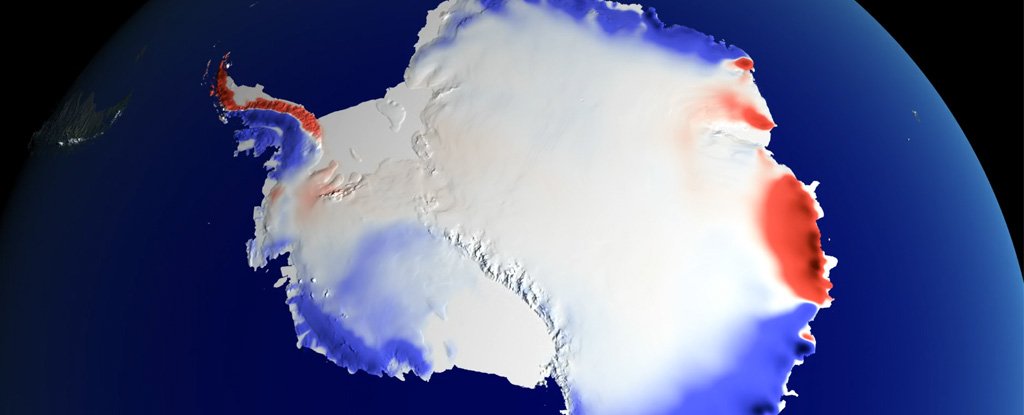
main article image

by Chris Mooney, The Washington Post, February 12, 2019

Some 115,000 years ago, Homo sapiens were still living in bands of hunter gatherers, largely confined to Africa. We still shared the globe with the Neanderthals, although it's not clear we had met them yet.

And though these various hominids didn't know it, the Earth was coming to the end of a major warm period. It was one that's quite close to our current climate, but with one major discrepancy - seas at the time were 20 to 30 feet (6 to 9 metres) higher.
During this ancient period, sometimes called the Eemian, the oceans were about as warm as they are today.
And last month, intriguing new research emerged suggesting that Northern Hemisphere glaciers have already retreated just as far as they did in the Eemian, driven by dramatic warming in Arctic regions.
The finding arose when a team of researchers working on Baffin Island, in northeastern Canada, sampled the remains of ancient plants that had emerged from beneath fast-retreating mountain glaciers.
And they found that the plants were very old indeed, and had probably last grown in these spots some 115,000 years ago.
That's the last time the areas were actually not covered by ice, the scientists believe.
"It's very hard to come up with any other explanation, except that at least in that one area where we're working ... the last century is as warm as any century in the last 115,000 years," said Gifford Miller, a geologist at the University of Colorado in Boulder who led the research on Baffin Island.
But if Miller is right, there's a big problem. We have geological records of sea levels from the Eemian. And the oceans, scientists believe, were 20 to 30 feet (6 to 9 metres) higher.
Some extra water likely came from Greenland, whose ice currently contains over 20 feet (6 metres) of potential sea level rise. But it couldn't have been just Greenland, because that entire ice sheet did not melt at the time.
That's why researchers also suspect a collapse of the most vulnerable part of Antarctica, the West Antarctic ice sheet. This region could easily supply another 10 feet (3 metres) of sea level rise, or more.
"There's no way to get tens of meters of sea level rise without getting tens of meters of sea level rise from Antarctica," said Rob DeConto, an Antarctic expert at the University of Massachusetts.
Trying to understand how Antarctica will fall
Scientists are now intensely debating precisely which processes could have played out then — and how soon they'll play out again. After all, West Antarctica has already been shown, once again, to be beginning a retreat.
Some researchers, including DeConto, think they have found a key process - called marine ice cliff collapse - that can release a lot of sea level rise from West Antarctica in a hurry.
But they're being challenged by another group, whose members suspect the changes in the past were slow - and will be again.
To understand the dispute, consider the vulnerable setting of West Antarctica itself.
Essentially, it's an enormous block of ice mostly submerged in very cold water. Its glaciers sit up against the ocean in all directions, and toward the center of the ice sheet, the seafloor slopes rapidly downward, even as the surface of the ice sheet itself grows much thicker, as much as two miles thick in total.
As much as a mile and a half of that ice rests below the sea level, but there is still plenty of ice above it, too.
So if the gateway glaciers start to move backward - particularly a glacier named Thwaites, by far the largest of them - the ocean would quickly have access to much thicker ice.
The idea is that during the Eemian, this whole area was not a block of ice at all, but an unnamed sea. Somehow, the ocean got in, toppling the outer glacial defenses, and gradually setting all of West Antarctica afloat and on course to melting.
DeConto, with his colleague David Pollard, built a model that looked to the Eemian, and another ancient warm period called the Pliocene, to try to understand how this could happen.
In particular, they included two processes that can remove glaciers. One, dubbed 'marine ice sheet instability,' describes a situation in which a partially submerged glacier gets deeper and thicker as you move toward its center.
In this configuration, warm water can cause a glacier to move backward and downhill, exposing ever thicker ice to the ocean - and thicker ice flows outward faster.
So the loss feeds upon itself.
Marine ice sheet instability is probably underway already in West Antarctica, but in the model, it wasn't enough. DeConto and Pollard also added another process that they say is currently playing out in Greenland, at a large glacier called Jakobshavn.
Jakobshavn is moving backward down an undersea hill slope, just in the way that it is feared the much larger Thwaites will drift. But Jakobshavn is also doing something else. It is constantly breaking off thick pieces at its front, almost like a loaf of bread, dropping slice after slice.
That's because Jakobshavn no longer has an ice shelf, a floating extension that used to grow out over the ocean at the front of the glacier and stabilize it. The shelf collapsed as Greenland warmed in the past two decades.
As a result, Jakobshavn now presents a steep vertical front to the sea. Most of the glacier's ice is under the water, but more than 100 meters (330 feet) extend above it - and for DeConto and Pollard, that's the problem. That's too much to be sustained.
Ice is not steel. It breaks. And breaks. And breaks.
This additional process, called 'marine ice cliff collapse,' causes an utter disaster if you apply it to Thwaites. If Thwaites someday loses its own ice shelf and exposes a vertical front to the ocean, you would have ice cliffs hundreds of meters above the surface of the water.
DeConto and Pollard say that such cliffs would continually fall into the sea. And when they added this computation, it not only recreated Eemian sea level rise, it greatly increased their projection of how much ice Antarctica could yield in this century - more than three feet.
Since there are other drivers of sea level rise, like Greenland, this meant that we could see as much as six feet in total in this century, roughly double prior projections. And in the next century, the ice loss would get even worse.
"What we pointed out was, if the kind of calving that we see in Greenland today were to start turning on in analogous settings in Antarctica, then Antarctica has way thicker ice, it's a way bigger ice sheet, the consequences would be potentially really monumental for sea level rise," DeConto said.
Moreover, the process, he argues, is essential to understanding the past - and thus how we could replicate it.
"We cannot recreate six meters of sea level rise early in the Eemian without accounting for some brittle fracture in the ice sheet model," said DeConto.
A massive debate over marine ice cliffs
Tamsin Edwards is not convinced. A glaciologist at Kings College London, she is lead author - with a number of other Antarctic experts - of a study published Wednesday in Nature (the same journal that published DeConto and Pollard in 2016) that disputes their model, in great detail.
Using a statistical technique to examine the results, Edwards and her collaborators find that the toppling of ice cliffs is not necessary to reproduce past warm periods after all.
They also present lower sea level rise possibilities from Antarctica in this century. If they're right, the worst case is back down to about 40 centimeters, or a little over a foot, rather than three to four feet.
"Things may not be as absolutely terrible as that last study predicted," Edwards said. "But they're still bad."
It is a new science, she said, and without more modeling it's unclear how ice cliffs will ultimately affect sea level rise.
But then what happened in the Eemian? Edwards thinks it just took a long time to lose West Antarctica. That it wasn't fast. After all, the entire geologic period was thousands of years long.
"We're an impatient lot, humans, and the ice sheets don't respond in a decade, they're slow beasts," she said.
DeConto says he's learned something from the critique.
"The Edwards study does illustrate the need for more in-depth statistics than we originally applied to our 2016 model output, but the models are evolving rapidly and they have already changed considerably since 2016," he said in a written statement.
But he's not backing down on marine ice cliffs. The new critique, DeConto said, implies that "these processes aren't important for future sea level rise. And I think to me, that's kind of a dangerous message."
He certainly has his allies. Richard Alley, a well known glaciologist at Penn State University who has published with DeConto and Pollard, wrote in an email that "cliff retreat is not some strange and unexpected physical process; it is happening now in some places, has happened in the past, and is expected wherever sufficiently high temperatures occur in ocean or air around ice flowing into the ocean."
The Eemian - but worse?
There's one important thing to consider - the Eemian occurred without humans emitting lots of greenhouse gases.
Atmospheric carbon dioxide was far lower than it is today. The event was instead driven by changes in the Earth's orbit around the sun, leading to more sunlight falling on the northern hemisphere.
The big difference, this time around, is that humans are heating things up far faster than what is believed to have happened in the geologic past.
And that makes a key difference, said Ted Scambos, an Antarctic researcher who is leading the US side of an international multimillion dollar mission to study Thwaites Glacier, and who is a senior researcher at the National Snow and Ice Data Center in Colorado.
"The current pace of climate change is very fast," Scambos said, and the rate of warming might cause glaciers to behave differently than they did in the past.
Accordingly, Scambos says he sees the current debate as fruitful - "it's the discussion that needs to happen" - but that it doesn't lessen his worry about the fate of Thwaites Glacier if it retreats far enough.
"There's no model that says the glacier won't accelerate if it gets into those conditions," said Scambos. "It just has to."
Humans were nowhere near the Antarctic in the Eemian - and we have never, in the modern period, seen a glacier as big as Thwaites retreat. It's possible something is going to happen that we don't have any precedent or predictions for.
Just last week, for instance, scientists reported a large cavity opening beneath one part of the glacier - something they said models could not have predicted.
There is a massive stake involved now in at least trying to figure out what could happen - before it actually does. It will help determine whether humans, now organized and industrialized and masters of fossil fuels, are poised to drive a repeat of our own geological history.
2019 © The Washington Post

Monday, October 17, 2016

Peter Sinclair: 2016 Arctic Sea Ice (new video!)

by Peter Sinclair, Climate Denial Crock of the Week, October 17, 2016


I included interviews here with David Barber, one of the truly important experts in the area, that I conducted on the first leg of this year’s crowd funded Dark Snow Field work, at a meeting in Lund, Sweden.

You’ll also see Ted Scambos, lead scientist at the National Snow and Ice Data Center

Important points: although this year did not set a new record low for sea ice minimum, the kind of ice loss we did see, and the mechanism of that loss, show that, even in a year when the months of greatest insolation, July and August, were not particularly conducive to melt, we can still see dramatic losses.

Also, important fun fact – although we generally assume that since the ice is melting, it automatically makes human endeavors in polar regions easier and safer. Not so.
Barber points out some counter-intuitive processes that make the Arctic more unpredictable, and at least for now, just as challenging if not more so than in the past.

https://climatecrocks.com/2016/10/17/new-video-2016-arctic-sea-ice/

Thursday, September 19, 2013

David Spratt: Is climate change already dangerous? Part II. Arctic sea ice

by David Spratt, Climate Code Red, September 19, 2013

Second in a series:  Arctic sea ice


Download full report
On 16 September 2012, Arctic sea-ice reached its minimum extent for the 2012 northern summer of 3.41 million square kilometres, the lowest seasonal minimum extent in the satellite record since 1979, and just half of the average area for the 1979–2000 period.  There was a loss of 11.83 million square kilometres of ice from the maximum extent on 20 March 2012.  This was the largest summer ice extent loss in the satellite record, more than one million square kilometres greater than in any previous year.

Two-thirds of the loss of sea-ice extent has happened in the 12 years since 2000, and the process appears to be accelerating.  From 1979 to 1983 in the Arctic, the sea ice summer minimum covered an average of just over 51% of the ocean.  It fell to just 24% of the Arctic ocean surface in 2012.

Not only does the sea ice cover a smaller area of ocean in summer, it is also thinning rapidly.  The sea-ice volume is now down to just one-fifth of what it was in 1979.  The PIOMAS project, which captures the process of sea-ice retreat far better than any other general climate models, finds a September 2012 minimum of 3,263 km3 of ice.  Contrasted with the figure of 16,855 km3 in 1979, more than 80% of ice volume has been lost.


Arctic sea-ice volume loss (based on PIOMAS)
It is now clear that the Arctic is heading quickly for summer periods free of sea ice.  A linear extrapolation of sea-ice mass loss suggests it may occur within a decade or so.  An exponential fit, which is a better fit for the current data, suggests it might occur within a few years . At time of publication, the minimum volume figure for 2013 was not available, but it may be a little higher than the record low of 2012, and similar to 2011.

Because climate models generally have been poor at dealing with Arctic sea-ice retreat , expert elicitations play a key role in considering whether the Arctic has passed a very significant and “dangerous” tipping point.  Here’s what leading figures in the research field say:
PIOMAS Arctic sea ice annual minimum volume (black) plus “best fit” trend (red)
  • Dr Tim Lenton of the University of Exeter told the March 2012 Planet Under Pressure
conference that sea ice since 2007 had departed from model predictions, and that disappearance of Arctic sea ice has crossed a “tipping point” that could soon make ice-free summers a regular feature across most of the Arctic Ocean.  This conclusion was drawn from a subsequently published paper  which finds that “an abrupt and persistent increase in the amplitude of the seasonal Arctic sea-ice cover in 2007 which we describe as a (non-bifurcation) ‘tipping point.’ ”  If 2007 is the crucial point on the Arctic sea-ice decline timeline, it is also important to note that global warming above pre-industrial was 0.76 ºC at that time. At equilibrium, a 0.76 ºC rise is equivalent to CO2 levels of 335 ppm, so the “safe boundary” of 350 ppm already looks too optimistic from this perspective.
  • The Australian Climate Commissioner, Professor Will Steffen, told The Age in September last year: “I’m pretty certain that we have now passed the tipping point for Arctic sea ice.”
  • Dr Seymour Laxon, of the Centre for Polar Observation and Modelling at University College London, says: “Preliminary analysis of our data indicates that the rate of loss of sea-ice volume in summer in the Arctic may be far larger than we had previously suspected…  Very soon we may experience the iconic moment when, one day in the summer, we look at satellite images and see no sea-ice coverage in the Arctic, just open water.”
  • Professor Carlos Duarte, Director of University of WA’s Oceans Institute, says an Arctic “snowballing” situation would prove as hard to slow down as a runaway train.  He says melting of the ice is accelerating faster than any of the models could predict and the prospect of an Arctic Ocean free of ice had been brought forward to 2015, compared with a prediction in 2007 that at least one-third of the normal extent of sea ice would remain in summer in 2100.  Duarte says that the Arctic region is fast approaching a series of imminent “tipping points” which could trigger a domino effect of large-scale climate change across the entire planet with “major consequences for the future of humankind as climate change progresses.”
  • US National Snow and Ice Data Centre Director Dr Mark Serreze told Climate Progress in 2010: “I stand by my previous statements that the Arctic summer sea-ice cover is in a death spiral.  It’s not going to recover.”   Without human intervention to drive recovery, the evidence is very clear that Serreze is right.
  • Professor Peter Wadhams, of Cambridge University and the Catlin Arctic Survey, and a leading authority on the polar regions, concludes in a research paper: “Has Arctic sea ice reached a tipping point? I believe that it has...”
Wadhams explains:
I have been predicting [the collapse of sea ice in summer months] for many years.  The main cause is simply global warming: as the climate has warmed there has been less ice growth during the winter and more ice melt during the summer… in the end the summer melt overtook the winter growth such that the entire ice sheet melts or breaks up during the summer months.  This collapse, I predicted would occur in 2015–16 at which time the summer Arctic (August to September) would become ice-free.  The final collapse towards that state is now happening and will probably be completed by those dates.  As the sea ice retreats in summer the ocean warms up (to +7 ºC in 2011) and this warms the seabed too.  The continental shelves of the Arctic are composed of offshore permafrost, frozen sediment left over from the last ice age.  As the water warms, the permafrost melts and releases huge quantities of trapped methane, a very powerful greenhouse gas so this will give a big boost to global warming.
Wadhams’ analysis relies in part on a new, more specialised regional climate model, acronym NAME, developed by Dr Wieslaw Maslowski and colleagues. NAME is head and shoulders above other models so far in projecting and replicating sea-ice losses.“The future of Arctic sea ice” found that: “Given the estimated trend and the volume estimate for October–November of 2007 at less than 9,000 cubic kms, one can project that at this rate it would take only 9 more years or until 2016 +/-3 years to reach a nearly ice-free Arctic Ocean in summer.”

The impacts of lengthening periods of sea-ice-free Arctic summers are significant and will, together with warming already “in the system,” push more climate elements past their tipping points. Our knowledge is limited because “a system-level understanding of critical Arctic processes and feedbacks is still lacking” (Maslowski, Kinney et al.) and “no serious efforts have been made so far to identify and qualify the interactions between various tipping points” (Schellnhuber).

However, we do know that the Arctic is warming quicker than the global average.  Duarte, Lenton et al. find that: “Warming of the Arctic region is proceeding at three times the global average, and a new ‘Arctic rapid change’ climate pattern has been observed in the past decade.” Reductions in the sea-ice cover are believed to be the largest contributor toward Arctic amplification. Maslowski, Kinney et al. note that: “a warming Arctic climate appears to affect the rate of melt of the Greenland ice sheet, Northern Hemisphere permafrost sea-level rise, and global climate change.”

The sea-ice cover in June is about 2% of the earth’s surface.  Replacing that during summer in the Arctic with darker, more heat-absorbing ocean waters is equivalent to about 20 years of human greenhouse emissions, or about +0.5 ºC of warming, according to Peter Wadhams.  This is consistent with a study by Stephen Hudson, which found that, if the Arctic were ice-free for one month a year plus associated ice-extent decreases in other months, then, without taking cloud changes into account, the global impact would be about +0.2 ºC of warming.  If there were no ice at all during the main three months of sunlight, the increase would be +0.5 ºC.

The consequences of the Arctic big melt and the subsequent regional amplification and global temperature increase will include:
  • Accelerated melting of the Greenland ice sheet, very likely pushing it past its tipping point;
  • Pushing Arctic temperatures into a range that will trigger large-scale Arctic carbon store releases of methane and CO2, a positive feedback which will drive further warming;
  • Further destabilisation of the Jet Stream and hence more northern hemisphere extreme weather; and
  • The destruction of the Arctic ecosystem, which is already well under way. This has been chronicled by many researchers and organisations, including the Center for Biological Diversity and Care for the Wild International.  In the Arctic, the rate of climate change is now faster than ecosystems can adapt to naturally, and the fate of many Arctic marine ecosystems is clearly connected to that of the sea ice (Duarte, Lenton et al.). I remember well attending an Academy of Science conference in Canberra in May 2008 where the international guest speaker was Dr Neil Hamilton, then head of the WWF Arctic Programme. He told a somewhat stunned audience that the WWF was not trying to preserve the Arctic ecosystem because “it was no longer possible to do so.”  Whilst the campaign to stop the development of an oil and gas industry in the Arctic is necessary (if only to prevent more global warming emissions), the claim that in so doing we can thereby “save the Arctic” seems wide of the mark.

Greenland Ice Sheet

Complex, non-linear systems typically shift between alternative states in an abrupt, rather than a smooth manner, so it is often difficult to identify tipping points in advance. Only a few Arctic specialists, including Ted Scambos, Mark Serreze and Ron Lindsay, said prior to 2007 that the sea ice was close to a phase change.

If it is sometimes hard to see tipping points coming, it is also too late to be wise after the fact. And that is precisely the case with the Greenland Ice Sheet (GIS).

Current-generation climate models are not yet all that helpful on GIS. They have a poor understanding of the processes involved, and acceleration, retreat and thinning of outlet glaciers are not represented.

Recent research (next post) puts a lower boundary of 0.8 ºC on GIS’s tipping point, a warming level we have already reached.  In July 2013, a new study found that stretches of ice on the coasts of Antarctica and Greenland are at risk of rapidly cracking apart and falling into the ocean: “rapid iceberg discharge is possible in regions where highly crevassed glaciers are grounded deep beneath sea level, indicating portions of Greenland and Antarctica that may be vulnerable to rapid ice loss through catastrophic disintegration.”

In 2012, GIS melting shattered the seasonal record; the duration of GIS melting was the longest yet observed; a rare, nearly ice sheet-wide melt event (covering as much as 97% of the ice sheet’s surface on a single day) occurred in July; and the reflectivity of GIS, particularly at the high elevations that were involved in the mid-July melt event, declined to record lows. Unfortunately, data from the GRACE satellite observation of GIS is not yet of sufficient duration to robustly describe the melt trend, but observations are that the rate of melting is increasing, and many glaciers are picking up speed. Since 2001, the Jakobshavn Glacier, the world’s fastest flowing glacier, has more than doubled its flow rate, and total GIS mass loss in 2011 was 70% larger than the 2003–2009 average annual loss rate.

Previously, studies have estimated that it would take centuries to millennia for new climates to increase the temperature deep within ice sheets such as GIS. But a new study finds that when the influence of meltwater (which drains through cracks in an ice sheet and can warm the sheet from the inside, softening the ice and letting it flow faster) is considered, warming can occur within decades and produce rapid accelerations. Lead author Thomas Phillips says this research “could imply that ice sheets can discharge ice into the ocean far more rapidly than currently estimated,” thus requiring a re-assessment of the rate of both future sea-level rises and the rate of mass loss of GIS. 
  
Has Greenland passed its tipping point?  What would be the impact of a sea-ice-free Arctic summer and the consequent amplified regional warming on the stability of the Greenland ice sheet? Research does not yet provide a robust framework for considering such questions, yet most scientists if asked for their expert elicitation would probably say that it is hard to imagine the GIS doing anything other than actively de-glaciating at an accelerating rate and passing a critical tipping point in such circumstances.

NASA climate research chief Dr James Hansen answered this question in the affirmative, in a peer-reviewed paper in 2007:
Could the Greenland ice sheet survive if the Arctic were ice-free in summer and fall? It has been argued that not only is ice sheet survival unlikely, but its disintegration would be a wet process that can proceed rapidly. Thus an ice-free Arctic Ocean, because it may hasten melting of Greenland, may have implications for global sea level, as well as the regional environment, making Arctic climate change centrally relevant to definition of dangerous human interference.”
In the same year, Hansen said that today’s level of CO2 was enough to cause Arctic sea-ice cover and massive ice sheets such as in Greenland to eventually melt away: “I think in most of these cases, we have already reached the tipping point.”

And last year, Hansen told Bloomberg that: “Our greatest concern is that loss of Arctic sea ice creates a grave threat of passing two other tipping points – the potential instability of the Greenland ice sheet and methane hydrates… These latter two tipping points would have consequences that are practically irreversible on time scales of relevance to humanity.”

Glaciologist Jason Box told reporters at the annual conference of the American Geophysical Union last December: “In 2012 Greenland crossed a threshold where for the first time we saw complete surface melting at the highest elevations in what we used to call the dry snow zone… As Greenland crosses the threshold and starts really melting in the upper elevations, it really won’t recover from that unless the climate cools significantly for an extended period of time, which doesn’t seem very likely.”
Next post: Dangerous impacts from the current implied temperature rise

Link: http://www.climatecodered.org/2013/09/is-climate-change-already-dangerous-2_19.html

Tuesday, January 15, 2013

Nation’s Top Climate Scientists Urge President Obama to Reject Keystone XL Pipeline


For immediate release, January 15, 2013, 350.org
OAKLAND CA -- Eighteen of the nation’s top climate scientists released a letter to President Obama today urging him to say no to the Keystone XL tar sands pipeline. 
“Eighteen months ago some of us wrote you about the proposed Keystone XL tar sands pipeline, explaining why in our opinion its construction ran counter to both national and planetary interests,"  wrote the scientists. "Nothing that has happened since has changed that evaluation; indeed, the year of review that you asked for on the project made it clear exactly how pressing the climate issue really is."
Indeed the past year has shown that climate change is here. A few months after Superstorm Sandy flooded parts of the Northeast, NOAA announced last week that the average temperature for 2012 was 55.3 degrees Fahrenheit, 3.2 degrees above normal and a full degree higher than the previous warmest year recorded -- 1988. 
The State Department is expected to soon release its supplemental environmental impact statement (SEIS) required for the northern leg of the Keystone XL pipeline. The department’s previous pipeline EIS downplayed climate risks by arguing that the tar sands would be developed with or without Keystone XL and therefore the project had no responsibility for the additional greenhouse gas emissions that come from burning tar sands oil. 
But two of Canada's largest banks, TD Economics and CIBC, have recently said that without added capacity, "Canada's oil industry is facing a serious challenge to its long-term growth" and that “Canada needs pipe — and lots of it — to avoid the opportunity cost of stranding over a million barrels a day of potential crude oil growth.”
The Obama Administrations has promised action on climate change but if KXL is approved, the Administration would be actively supporting and encouraging the growth of an industry which has demonstrably serious effects on climate.
Thousands of concerned citizens will come to Washington, DC on February 17th, President's Day weekend, to oppose the Keystone XL pipeline. Rally information is at www.350.org/presidentsday.
### 
1. Full text of the letter: 
Dear Mr. President,
You take office for the second time at a critical moment. As you may know, the U.S. has just recorded the hottest year in its history, beating the old mark by a full degree; the same year that saw the deep Midwest drought, and the fury of Hurricane Sandy, also witnessed the rapid and unprecedented melt of the Arctic ice pack. 
If we are to restrain the rise in the planet's temperature, it will require strong action from, among others, the planet's sole superpower. Some of that work will be difficult, requiring the cooperation of Congress. But other steps are relatively easy.
Eighteen months ago some of us wrote you about the proposed Keystone XL tar sands pipeline, explaining why in our opinion its construction ran counter to both national and planetary interests. Nothing that has happened since has changed that evaluation; indeed, the year of review that you asked for on the project made it clear exactly how pressing the climate issue really is. 
We hope, as scientists, that you will demonstrate the seriousness of your climate convictions by refusing to permit Keystone XL; to do otherwise would be to undermine your legacy.
Thank you,
James Hansen, Research Scientist, The International Research Institute for Climate and Society, The Earth Institute, Columbia University
Ralph Keeling, Director, Scripps CO2 Program Scripps Institution of Oceanography
John Harte, Professor of Ecosystem Sciences, University of California
Jason E. Box, Professor, Byrd Polar Research Center
John Abraham, Associate Professor, School of Engineering, University of St. Thomas
Ken Caldeira, Senior Scientist. Department of Global Ecology, Carnegie Institution
Michael MacCracken, Chief Scientist for Climate Change Programs, Climate Institute
Michael E. Mann, Professor of Meteorology, Director, Earth System Science Center, The Pennsylvania State University
James McCarthy, Alexander Agassiz Professor of Biological Oceanography, Harvard University
Michael Oppenheimer, Albert G. Milbank Professor of Geosciences and International Affairs, Woodrow Wilson School and Department of Geosciences, Princeton University
Raymond T. Pierrehumbert, Louis Block Professor in the Geophysical Sciences, The University of Chicago
Richard Somerville, Distinguished Professor Emeritus and Research Professor, Scripps Institution of Oceanography
George M. Woodwell, Founder, Director Emeritus, and Senior Scientist, Woods Hole Research Center
Mauri Pelto, Department of Environmental Science, Nichols College
David Archer, Professor, Department of Geophysical Sciences, The University of Chicago
Dr. Ted Scambos, Lead Scientist, National Snow and Ice Data Center, University of Colorado at Boulder
Terry L. Root, Senior Fellow, Stanford University
Alan Robock, Professor II, Distinguished Professor, Department of Environmental Sciences, Rutgers University
Affiliations are listed for identification purposes only. 

Friday, August 31, 2012

Fen Montaigne: Arctic Tipping Point: A North Pole Without Ice


Arctic Tipping Point:
A North Pole Without Ice

Scientists say this year’s record declines in Arctic sea ice extent and volume are powerful evidence that the giant cap of ice at the top of the planet is on a trajectory to largely disappear in summer within a decade or two, with profound global consequences.


by fen montaigne, yale360, August 30, 2012


As the northern summer draws to a close, two milestones have been reached in the Arctic Ocean — record-low sea ice extent, and an even more dramatic new low in Arctic sea ice volume. This extreme melting offers dramatic evidence, many scientists say, that the region’s sea ice has passed a tipping point and that sometime in the next decade or two the North Pole will be largely ice-free in summer.

NASA and U.S. ice experts announced earlier this week that the extent of Arctic sea ice has dropped to 4.1 million square kilometers (1.58 million square miles) — breaking the previous record set in 2007 — and will likely continue to fall even farther until mid-September. As the summer melt season ends, the Arctic Ocean will be covered with 45 percent less ice than the average from 1979 to 2000.

NASA
On August 26, 2012, Arctic sea ice reached a new record-low summer extent.
Even more striking is the precipitous decline in the volume of ice in the Arctic Ocean. An analysis conducted by the University of Washington’s Pan Arctic Ice Ocean Model Assimilation System (PIOMAS) estimates that sea ice volumes fell in late August to roughly 3,500 cubic kilometers — a 72-percent drop from the 1979-2010 mean.

Peter Wadhams, who heads the Polar Ocean Physics Group at the University of Cambridge and who has been measuring Arctic Ocean ice thickness from British Navy submarines, says that earlier calculations about Arctic sea ice loss have grossly underestimated how rapidly the ice is disappearing. He believes that the Arctic is likely to become ice-free before 2020 and possibly as early as 2015 or 2016 — decades ahead of projections made just a few years ago.

Mark Drinkwater, mission scientist for the European Space Agency’s CryoSat satellite and the agency’s senior advisor on polar regions, said he and his colleagues have been taken aback by the swiftness of Arctic sea ice retreat in the last 5 years. “If this rate of melting [in 2012] is sustained in 2013, we are staring down the barrel and looking at a summer Arctic which is potentially free of sea ice within this decade,” Drinkwater said in an e-mail interview.

A small number of climate scientists say that natural variability may be playing a significant role in the rapid retreat of Arctic sea ice, intensifying human-caused climate change, and they caution against predicting the imminent demise of the region’s summer sea ice. But an 
Extraordinarily low ice levels indicate the summer sea ice has passed a point of no return.
overwhelming majority of Arctic ice experts say that recent data offer powerful evidence that summer sea ice has passed a point of no return.

The dramatic ice loss is being driven by a several key factors, scientists say. Chief among them is that decades of warming have so extensively melted and thinned Arctic sea ice that rapidly expanding areas of dark, open water are absorbing ever-greater amounts of the sun’s radiation, further warming the region in a vicious cycle.

Second, swiftly warming air and ocean temperatures in the Arctic have, for now at least, altered atmospheric activity, with two consequences: Warmer air is being pulled into the Arctic, and increased storms and cyclones in summer are not only driving ice out of the Arctic basin, but also breaking up the ice pack and further exposing more dark water.

And finally there is the inescapable reality that steadily rising levels of carbon dioxide being pumped into the atmosphere by human activity are continuing to warm the Arctic and the rest of the globe, further hastening the loss of Arctic Ocean ice. Several experts say that the only thing that could slow this disappearance — and then only for a few years — would be a major volcanic eruption that reduces the amount of the sun’s energy striking the earth.

“It’s sobering to see the Arctic change so rapidly,” said Ted Scambos, senior research scientist at the National Snow & Ice Data Center in Colorado. “Simply staring at the satellite data that we’re seeing every day is awesome, but in a sad sort of way. It doesn’t look like the Arctic anymore. The summer ice used to look like a cap that nearly filled the Arctic basin. It now looks like a raft with room on every side. You can imagine what it’s going to 
‘The summer ice used to look like a cap…. It now looks like a raft with room on every side.’
look like when the North Pole is open water, when there is only a tiny amount of ice left in August and September. The planet will look a lot different.”

The loss of the great white dome of ice at the top of the world in summer will have profound effects, scientists say. These include a reduction of the amount of solar radiation reflected back into space by the ice, significant changes to the jet stream and Northern Hemispheric weather patterns, and even-more rapid warming in the far north, speeding the melting of Greenland’s massive ice sheets and increasing global sea levels.

In addition to these impacts, said Drinkwater, “Increased storminess will generate ocean wave systems which, un-damped by the presence of sea ice, will pound the circumpolar north coastlines. Current rates of coastal permafrost degradation will be accelerated, leading to significant coastal erosion and reconfiguration of the high-latitude shoreline. Meanwhile, we have also recently heard about the potential for release of sub-sea methane deposits and thereby an acceleration of the current greenhouse effect.”

The record low sea ice extent in 2007 of 4.2 million square kilometers was due to some unusual circumstances, including a sunny summer in the Arctic and higher temperatures. Summer sea ice extent rebounded somewhat in the next several years, rising to 5.3 million square kilometers in 2009, giving some hope to mainstream scientists that Arctic sea ice was not in a “death spiral.”

But Scambos and other experts say that recent data on plummeting ice extent and volume show that the Arctic has entered a “new normal” in which ice decline seems irreversible. Because of thinning ice and swiftly expanding areas of open water, the Arctic Ocean will no longer be kept frigid in summer by the reflectivity of snow and ice — the so-called ice-albedo effect, in which ice and snow reflect a high percentage of the sun’s energy back into space.

Arctic Sea Ice NASA
NASA
Melting Arctic sea ice.
Thick sea ice that formed over many years is increasingly rare in the Arctic. In the 1960s, submarines routinely encountered 12-foot-thick ice around the North Pole and 20-foot-thick ice in some other areas; now those regions often contain ice that is only three to four feet thick. Many parts of the Arctic Ocean are now covered with thin, year-old ice that melts quickly in spring and summer.

This spring, noted Scambos, extensive late winter snow cover on land melted unusually rapidly, reaching record low levels by June. Sea ice across much of the Arctic began to melt 10 to 14 days earlier than in the preceding few decades. Relatively clear skies from late May through June further hastened the melting of sea ice, but even as cloudier weather prevailed in July and August, the record sea ice retreat continued.

“The sensitivity of the Arctic to a warm summer is much higher now than it was in the 1990s or early 2000s,” said Scambos. “What we’re seeing last year and this year is that 2007 wasn’t a fluke. As we’ve gone forward a few years, we’re seeing that many different patterns of weather lead to significant sea ice loss in the Arctic.”

Scambos does not foresee summer sea ice in the Arctic largely disappearing this decade, estimating that such an event could occur around 2030, “plus or minus a decade.” He said the “endgame” of Arctic summer sea ice will probably mean that around 1 million square kilometers — about 15% of what existed in the mid-20th century — will remain in the Canadian High Arctic and some other regions, leaving the North Pole generally ice-free in August and September.

Drinkwater said that changing weather patterns, related to more heat and moisture being released into the Arctic atmosphere, have played a significant role in accelerating sea ice loss. Sea ice retreat in the past decade has been accompanied by a trend toward lower atmospheric pressure and more storms and cyclonic activity, which in turn breaks up
Changing weather patterns have played a significant role in accelerating sea ice loss.
the pack ice and exposes more open water. A powerful Arctic storm earlier this month did just that, Drinkwater noted.

He said that Arctic sea ice could conceivably rebound for some period of time if atmospheric circulation changes and a pattern known as the Arctic Oscillation — currently in a positive phase — moves into a negative phase and ushers in a period of prolonged high atmospheric pressure and fewer storms. This, said Drinkwater, would enable sea ice to remain trapped in the Arctic basin and thicken.

“However,” added Drinkwater, “this seems like blind hope in a system whose feedbacks all appear geared to getting rid of sea ice.”

Judith Curry [snip].

MORE FROM YALE e360
Linking Weird Weather to
Rapid Warming of the Arctic
The loss of Arctic summer sea ice and the rapid warming of the Far North are altering the jet stream over North America, Europe, and Russia. As Jennifer Francis writes, scientists are now just beginning to understand how these profound shifts may be increasing the likelihood of more persistent and extreme weather.
READ MORE
Jay Zwally, chief cryospheric scientist at NASA’s Goddard Space Flight Center and an observer of Arctic ice for 40 years, places little stock in the likelihood of a reversal of disappearing Arctic ice. New satellite technology has given scientists the ability to measure the height of sea ice above the water, and hence ice volume. Those measurements, he said, have vividly underscored that Arctic sea ice is in a swoon.

For example, a recent analysis of data from CryoSat and NASA’s ICESat satellite estimates that the volume of sea ice in a large area of the central Arctic Ocean has plummeted in late winter — February and March — by nearly half in just eight years, from an estimated 13,000 cubic kilometers in 2004 to 7,000 cubic kilometers in 2012.

“We’ve gone through a tipping point, and of all the things a tipping point applies to, sea ice is the most appropriate, because the idea is when it goes below a certain thickness it doesn’t go back under present conditions,” said Zwally. “People can get hung up on the specifics and lose track of the big picture, which is that it’s getting worse and it’s going to get [even] worse.”

http://e360.yale.edu/feature/tipping_point_arctic_heads_to_ice_free_summers/2567/

Friday, August 3, 2012

NOAA: Summer weighing heavily on Greenland Ice Sheet

Summer weighing heavily on Greenland Ice Sheet

by Rebecca Lindsey, NOAA's Climate Watch Magazine, August 2, 2012
In late July, NASA announced that satellites had detected signs of melting across virtually the entire surface of the Greenland Ice Sheet in mid-July, even at the two-mile-high summit of the ice cap—a first for the satellite record and a historically rare occurrence based on ice core data.
The unusual melting event followed several months during which high pressure systems repeatedly parked over Greenland. As many a weather forecaster has explained, high pressure generally leads to calm winds and sunny skies, both of which boost temperatures during the all-day sunshine of mid-summer at high latitudes.


The map on the left shows the difference from average pressure at the 700 millibar pressure level from May-July 2012 compared to the 1981-2010 average. Gold colors indicate higher-than-average pressure. A large dome of high pressure camped over Greenland and the Northwest Atlantic this summer. The influence on temperatures (map on right) was dramatic. Temperature anomalies at the same altitude were as much as 11 degrees Fahrenheit warmer than average over Greenland.
At Summit Station, a research camp at the top of the Greenland ice sheet, the temperatures made a clear excursion above freezing in mid-July, lending supporting evidence to the satellite observations of ice melting even at the ice sheet’s highest location. Temperatures flirted with the melting threshold again late in the month.
The graph below shows hourly average summer temperatures at Summit Station, Greenland. Gray lines show temperatures from 2005-2011; 2012 summer temperatures through late July are shown in red. Even compared to the past 7 years—globally some of the warmest on record—the 2012 summer temperatures at Summit Station stand out for their repeated warmth.


Graph adapted from original by Mike Schnaubelt and Christopher Shuman, NASA-GSFC, based on NOAA data provided by Tom Mefford.


Strong anomalies of both high and low pressure come and go across Greenland and the North Atlantic over the span of weeks to months, and they exert a powerful influence on regional weather and seasonal climate. In addition to favoring cloudless skies, high pressure tends to bring southerly winds across western Greenland, providing another warming influence.
Research published earlier this year found that since the late 1950s, the 6 warmest summers and 5 of the 6 largest melt years in Greenland have occurred since 2000. A similar “dome” of persistent high pressure was common to each of the episodes, but it is probably not the sole cause of the unusual warmth and melting.
Scientists continue to investigate how the anomalous atmospheric circulation pattern interacts with other climate conditions, including natural cycles of ocean temperature in the North Atlantic and human-caused climate change, to influence the summer melt rate on the Greenland Ice Sheet.
References
Hanna, E., Jones, J. M., Cappelen, J., Mernild, S. H., Wood, L., Steffen, K., & Huybrechts, P. (2012, in press). The influence of North Atlantic atmospheric and oceanic forcing effects on 1900-2010 Greenland summer climate and ice melt/runoff. International Journal of Climatology. doi:10.1002/joc.3475
Reviewed by James Partain, Jim Overland, John Nielsen-Gammon, Ted Scambos, Walt Meier, Christopher Shuman, and Edward Hanna.