Blog Archive

Showing posts with label Danish text. Show all posts

Monday, December 14, 2009

NGOs raise concerns about the COP Presidency’s efforts to create a parallel ‘unofficial’ negotiating process – in the margins of the UN

NGOs raise concerns about the COP Presidency’s efforts to create a parallel ‘unofficial’ negotiating process – in the margins of the UN

Talking points – Green Room process from Copenhagen, December 14, 2009

Last week, NGOs raised concerns about the COP Presidency’s efforts to create a parallel ‘unofficial’ negotiating process – in the margins of the UN. NGO’s called the COP Presidency to serve in an unbiased manner to ensure that Copenhagen delivers a fair and ambitious outcome

This weekend the COP Presidency hosted a meeting (known as the Green Room) outside the Bella Center – the official UN meeting point – and in the middle of the UN negotiation process. The UN process includes all parties to the UNFCCC, this process excluded most.

Around 40 representatives of a selection of parties, to discuss mitigation and finance issues. Several parties were excluded from these discussions, despite the fact that the COP Presidency has stated that it is committed to continuing negotiations in a transparent and open way.

This week, several European capitals will be hosting closed meetings with representatives from different country groupings – ahead of the formal UN Leaders meeting.

The leaked Danish text last week puts in evidence that when negotiations take place behind closed doors and with only a handpicked selection of countries the ambition and fairness of the outcome is severely compromised.

It is clear that the UN process is stalled as a result of the lack of ambition of developed countries (cuts and finance) – there’s no reason to believe that these blockages will be surmounted outside the UN process.

The process being taken forward by the COP Presidency further provides evidence of attempts to divide the group of G77+China into different blocks of countries.

Such efforts are closely related to the substance of what is on the negotiating table – vulnerable countries are being talked into accepting an agreement which allows developed countries off the hook in terms of their emission cuts but offers the poorest countries a tempting short term finance package for adaptation.

Wednesday, December 9, 2009

Andrew Light: Reaction of G77 and Lumumba Di-Aping to outdated Danish draft agreement is typical overblown COP drama

Posted: 09 Dec 2009 05:31 AM PST
Our guest blogger is Andrew Light, a Senior Fellow at American Progress specializing in climate, energy, and science policy.  He will be leading the CAP delegation in Copenhagen this week.  The photo is of Lumumba Di-Aping, the Sudanese chair of the G77 (by Adam Welz).
Lumumba Di-ApingThe Guardian reported yesterday that the UN climate meeting currently underway in Copenhagen (the 15th meeting of the Conference of the Parties or COP 15) had disintegrated into disarray when secret draft language for an interim climate agreement from the host Danish delegation had been uncovered by the Group of 77 – the coalition of well over a hundred developing countries which negotiate as a group at the UN climate meetings. A secret group of nations had supposedly put the document together without any consultation.

The so-called Danish text, a secret draft agreement worked on by a group of individuals known as “the circle of commitment” – but understood to include the UK, US and Denmark – has only been shown to a handful of countries since it was finalized this week.

The British daily goes on to breathlessly claim that it had not only received the document but had been privy to a “confidential analysis” of it by developing countries and that it turned the Kyoto Protocol on its head. They go on to list a dizzying array of dramatic and unjust reductions in emissions required by the Danish text without any actual support from the document itself. They were joined in their condemnation by an array of people like Friends of the Earth U.S. President Erich Pica who condemned the U.S. in similar terms: “The Obama administration’s role in what appears to be a secret plot to strong-arm through an agreement forcing poor countries to bear much of the cost of reducing emissions is despicable.”

In response the G77, plus representatives from China, walked out of a press conference led by the Sudanese chair of the G77, Lumumba Stanislaus Di-Aping, claiming that the Danish text had come from nowhere and reiterating their claim that they would not accept any binding commitments to reductions in carbon pollution.

What do we make of this implosion in the meeting so quickly?

Any veteran of the UN climate meetings will recognize the G77+China reaction to “the” Danish draft today – as the Danes reiterated, there is no single definitive draft and nothing has been finalized – as more of the same drama that has pervaded these meetings for the last 14 years. A not terribly creative mind could script these events before they happen. Two things jump out from yesterday’s episode that are typical: first, the shock expressed by Di-Aping at the very idea that the Danes were drafting anything, and second, the insistence that developing countries, writ large, will never, ever agree to any mandatory emissions reductions.

The first part of the drama has become par for the course for Di-Aping who, since becoming the chief negotiator to the G77 last August has worked tirelessly to make sure there is absolutely no progress in the UN negotiations. But ask yourself, how could Di-Aping (or Pica, for that matter) be surprised that the Danes are working on text for an interim political agreement for this meeting when it’s been reported in every major media outlet in the world since the APEC conference in Singapore last month that they were doing so? Recall that there the President of Mexico and the Prime Minister of Australia hastily organized a meeting to present the idea of focusing Copenhagen on an interim “political agreement” as a first step to finalizing a fully legal and ratifiable agreement over the course of 2010 in advance of COP 16 in Mexico City, if not earlier at an interim meeting. Both President Obama and President Hu endorsed this two step strategy later that week at their presidential summit in Beijing, and Obama’s commitment that whatever was decided in Copenhagen should take immediate operational effect was again reported around the world. The Danes have been discussing draft text with everyone since they got the green light on this plan.

So how could Di-Aping possibly be surprised that the Danes were actually doing what they promised to do in front of the leader of the largest developed and developing countries in the world? The expressed shock here is incredulous.

There is a precedent, however, to Tuesday’s announcement. Di-Aping closed the Bangkok round of UN climate negotiations two months ago with a bold condemnation of the US for having hidden from developing countries a super-secret second treaty designed to replace the Kyoto Protocol when it expires in 2012. Of course, what he was talking about was the treaty language that had been under discussion for six months in the “LCA track” of the UN climate framework (the Ad-hoc Working Group on Long-term Cooperative Action) which was authorized at the Bali meeting in 2007. The “secret” treaty was the discussion draft in the LCA track, publicly available to anyone with a working internet connection, and consisting primarily of contributions by Australia, Costa Rica, and Norway. D-Aping’s condemnation was pure spin, worthy of D.C.’s best spinmeisters.

The second part of the drama — the claim that developing countries will never agree to anything ever — is also a mainstay. No one agrees to anything in these meetings until the very bitter end. The conventional wisdom is that it’s the only way any party can actually get what they want.

Consider the run up to this meeting: Both China and India had major presidential-level summits with the United States in Beijing and D.C. last month. Both agreed to major bilateral agreements aimed squarely at fulfilling one of the core mandates of the Bali Action Plan — namely, assistance from a developed country with clean energy technology in exchange for eventual cuts in emissions. Both agreed to the ground work for creating the capacity for eventually being able to measure, report, and verify their emissions reductions (MRV) — assistance from the US for a carbon inventory in China and for improving the environmental ministry in India.

But these countries also met prior to Copenhagen, along with the leaders from Brazil and South Africa, to reiterate their position that they would never agree to any emissions cuts. Why? To reset the negotiating clock to zero lest developed countries take it for granted that they could get even an interim agreement out of this meeting without some hard negotiations.

I’d love to see COP 15 go forward without any more needless posturing by any of the parties like we saw yesterday, but I’m not holding my breath. I applaud the Danes for what they are trying to do to pull some significant advances out of this meeting and would hope that the rest of the parties give them a chance to actually deliver on their promise.
 

Lumumba Di-Aping, Sudanese negotiator at COP15, calls Danish text a suicide pact

UPDATE: See post by guest blogger on Joseph Romm's Climate Progress blog.  Remember, let us not be too naive about negotiators.


http://climatechangepsychology.blogspot.com/2009/12/andrew-light-reaction-of-g77-and.html

Emotional scenes at Copenhagen: Lumumba Di-Aping @ Africa civil society meeting – 8 Dec 2009


from Adam Welz's Weblog, December 8, 2009

Dear All,

The leak of a so-called ‘Danish text’ that would sideline the UN in future climate deals is reverberating around the Copenhagen negotiations. (see http://www.guardian.co.uk/environment/2009/dec/08/copenhagen-climate-summit-disarray-danish-text)

Today, I witnessed an unexpected and extraordinary outburst of candour from one of the key players in these negotiations — Lumumba Di-Aping, Sudanese by birth and chief negotiator of the so-called G77 bloc (which mostly consists of poor countries).

I attended an ad-hoc meeting in a meeting room of the Bella Center attended by about 100 African representatives of civil society and a few African parliamentarians (among them Lance Greyling, an MP from South Africa) this afternoon. The meeting was called at short notice and its agenda was not announced. After a few minutes of introductions Di-Aping was given the floor to speak to fellow Africans. Requests were made by organisers to turn off all microphones so as not to record what was going to be said, although Di-Aping made a point of turning his on, saying half-jokingly “they are probably listening anyway.”

He did not start his speech immediately. Instead he sat silently, tears rolling down his face. He put his head in his hands and said, “We have been asked to sign a suicide pact.” The room was frozen into silence, shocked by the sight of a powerful negotiator, an African elder if you like, exhibiting such strong emotion. He apologised to the audience, but said that in his part of Sudan it was “better to stand and cry than to walk away.”

Once he had composed himself, Di-Aping launched into an eloquent and direct attack on the apparent subversion of the climate negotiation process by certain developing countries, the leaked so-called “Danish” agreement that has become the talk of the conference. Since I did not feel it appropriate to stand up and video the proceedings, I live-tweeted what I could (www.twitter.com/adamwelz).

Speaking in measured tones, Di-Aping first attacked the 2 °C warming maximum that most rich countries currently consider acceptable. Referring continuously to science, in particular parts of the latest IPCC report (which he referenced by page and section) he said that 2 °C globally meant 3.5 °C for much of Africa. He called global warming of 2 °C “certain death for Africa,” a type of “climate fascism” imposed on Africa by high carbon emitters. He said Africa was being asked to sign on to an agreement that would allow this warming in exchange for $10 billion, and that Africa was also being asked to “celebrate” this deal.

He then went on to forthrightly address the weakness of many African negotiating delegations, noting that many were unprepared and that some members were either lazy or had been “bought off” by the industrialised nations. He singled out South Africa, saying that some members of that delegation had actively sought to disrupt the unity of the bloc. He said that civil society needed to hold its negotiators to account, but warned of a long and difficult struggle for a fair climate deal (words to the effect of ‘you have no idea of the powers that are arrayed against you,’ spoken in the tone of someone who has spent years interacting with these powers.)
He said that people all over the world had to be made aware of what a bad climate deal means for Africa (“I am absolutely convinced that what Western governments are doing is NOT acceptable to Western civil society.”).

He explained that, by wanting to subvert the established post-Kyoto process, the industrialised nations were effectively wanting to ignore historical emissions, and by locking in deals that would allow each citizen of those countries to carry on emitting a far greater amount of carbon per year than each citizen in poor countries, would prevent many African countries from lifting their people out of poverty. This was nothing less than a colonisation of the sky, he said. “$10 billion is not enough to buy us coffins.”

Obama, he said, would probably be brought to Copenhagen to 'sanctify' this deal. “What is Obama going to tell his daughters? That their [Kenyan] relatives’ lives are not worth anything? It is unfortunate that after 500 years-plus of interaction with the West we [Africans] are still considered ‘disposables.’ ”  “My good friends… we’ve got to get together and fight the fight.”

Di-Aping accused a group of US industrialists behind an organisation called the Climate Works Foundation of being behind the efforts to sideline the process and African countries, noting that rich governments did not want to pay the true cost of climate change or confront their own citizens with the urgent need to change their lifestyles.


Lumumba Di-Aping at African civil society meeting during climate talks at Bella Center, Copenhagen, 8 December 2009

Calling the current deal that was being proposed “worse than no deal,” he called on Africans to reject it — “I would rather die with my dignity than sign a deal that will channel my people into a furnace.” Africans had to make clear demands of their leaders not to sign on. He suggested a couple of slogans: “One Africa, one degree” and “Two degrees is suicide.”

Di-Aping’s speech crystallised the room into action. A demonstration was immediately planned, and a few minutes after its end the people in the room converged on a central point in the Bella Center and began chanting and shouting — attracting a storm of media interest. (Di-Aping later addressed a formal press conference where he repeated some the points made in the African meeting, apparently no less eloquently but far less emotionally.)

Some commentators have suggested that the leak of the so-called “Danish” proposal will not significantly affect the progress of the talks here. After witnessing Di-Aping speaking to the African group, I am not so sure. It’s becoming increasingly clear that many rich countries are seeking a deal that falls well short of what the vast majority of current science indicates we need to do to avoid extremely damaging climate change, and that representatives of people in poor countries are becoming increasingly fed up at their ongoing marginalisation by the rich governments. The divide between the civil servants and NGO managers lazily discussing career options on the train across Copenhagen and those that have grasped the urgency of climate change is becoming more apparent.

With clear, credible voices like Di-Aping’s articulating the frustration of so many, are we seeing a fracturing of the Copenhagen process? Is this conference, which seems to be trying so hard to be just another ‘normal’ conference, with ordered meeting halls, name tags and too many glossy brochures floating around, going to turn into something really historic and interesting?

A note: Di-Aping mentioned in his speech that he was named after the famous Congolese leader Patrice Lumumba, even though he was Sudanese (“My parents were Lumumbist”). Patrice Lumumba was of course murdered after asserting himself too strongly against western powers, and replaced by the famously corrupt but US- and Belgian-friendly Mobutu Sese Seko.

Cheers,

Adam

Link:  http://adamwelz.wordpress.com/2009/12/08/emotional-scenes-at-copenhagen-lumumba-di-aping-africa-civil-society-meeting-8-dec-2009/

Link to the "basic text" of the "Danish text" (no official confirmation of this text):  http://www.scribd.com/doc/23871004/Basic-Text

Tuesday, December 8, 2009

Richard Black of the BBC: Draft text, the so-called "Danish text," divides climate summit

Draft text divides climate summit

by Richard Black, Environment correspondent, BBC News website, Copenhagen, December 8, 2009


Climate protester at the Copenhagen summit (Getty Images)
The leaked text has overshadowed the first day's upbeat speeches

Earth Watch - Richard Black's blog
Documents leaked at the UN climate summit reveal divisions between industrialised and developing countries over the shape of a possible new deal.

Campaigners say a draft text proposed by the Danish host government would disadvantage poorer nations.

It also sees everything coming under a single new deal, whereas an alternative text from developing countries wants an extension to the Kyoto Protocol.

Other blocs are expected to release their own texts in the next few days.

Chairmen of working groups will then have to turn the various documents into a political document that 100-odd world leaders, plus delegates representing all other nations, could sign at the end of the conference.

The Danish document, plus the alternative text submitted by the BASIC group (Brazil, South Africa, India and China) were discussed by a small group of key countries in Copenhagen last week.

But the Danish proposal had remained under wraps until The Guardian newspaper published it on its website during the second afternoon of the conference.

More ambition
The documents show that at the broadest level, developed and developing worlds are split on several points:
  • the level of cuts from developed countries
  • the establishment of a target date by which global emissions should peak and begin to fall
  • most fundamentally, the shape of any future deal.
The BASIC draft sees emission reductions from developed countries coming under the Kyoto Protocol, whereas the Danish draft envisages all measures coming under a single new agreement.

Although this might appear a technical point, developing countries have so far remained adamant on the retention of the protocol because of the measures it contains on financial assistance and technology transfer, and because it is the only legally binding treaty in existence that makes countries reduce emissions.

The only formal texts in the UN process are the ones tabled by the Chairs of this Copenhagen conference at the behest of the parties

Yvo de Boer,
UNFCCC executive secretary


The Danish text sets out a vision of greenhouse gas emissions peaking globally by 2020, then declining.

It specifies a 50% emissions cut globally (from 1990 levels) by 2050. Most industrialised nations have already pledged an 80% cut in their own emissions.

According to some calculations, those figures, when combined with projected population growth in the developing world, mean that per-capita emissions in developing countries will remain below those in the west, "locking in" inequality.


Oxfam's Antonio Hill said industrialised nations had to offer bigger cuts than are currently on the table.
"The targets need to rise in ambition and in line with what the science says," he told BBC News.

"We think that at least 40% (from 1990 levels by 2020) is needed; and even that is not enough to produce equity."

However, Mr Hill suggested that measures on transferring finance from industrialised to developing countries -- to help them curb their emissions and help them protect against the impacts of climate change -- were "quite good."

Impossible dream?
Other observers, such as Sol Oyuela from the development agency CAFOD, were more damning.
"The document should not even exist," she said.


Graphic of global warming projection (Image: BBC)


"There is a UN legal process which is the official negotiating text; there is no need for any other texts.

"To be working on a rival text is a kick in the teeth to the UN process that has been negotiated for so long."

Yvo de Boer, executive secretary of the UN climate convention, also said the document had no formal weight within the negotiations.

"This was an informal paper ahead of the conference given to a number of people for the purposes of consultations," he said.

"The only formal texts in the UN process are the ones tabled by the Chairs of this Copenhagen conference at the behest of the parties."

The UK government dissociated itself from the text.

"At this stage in the negotiation there's inevitably all sorts of texts doing the rounds and more will no doubt appear over the next 10 days," said a spokesman for the Department for Energy and Climate Change (DECC).

"The UK is continuing to strive for the most ambitious deal possible, as the prime minister has made clear again today."

Gordon Brown declared earlier that he would favour the EU moving from its current 20% target to 30%, which governments have agreed to do if there is a global deal here.

Over the next few days, small island states, least developed countries, the African bloc and the overall G77/China grouping are expected to present their own texts.

The small island states are expected to demand a legally binding outcome from Copenhagen, which many insiders say is impossible.

Richard.Black-INTERNET@bbc.co.uk


Link to article: http://news.bbc.co.uk/2/hi/science/nature/8402502.stm

Richard Black of the BBC: COP15 Copenhagen Climate Summit: Day 2

COP15 Copenhagen Climate Summit: Day 2

by Richard Black, environmental correspondent of the BBC, December 8, 2009

15.16 CET: As the seriously obscure parts of the UN climate conference got down to business this morning, attention turned to some of the science being presented -- notably, the analyses from the World Meteorological Organization and the UK Met Office that pegged the "Noughties" -- the decade since 2000 -- as the warmest since instrumental observations began.

The essential conclusions are in our news story; but obviously there's some interest these days in how the records are put together.

Some news reports on the "ClimateGate" affair might have given the impression that the UK's Climatic Research Unit (CRU), and maybe the Met Office team that works closely with it too, has its own network of weather stations across the world and that somehow data from that network is collected, stored and processed separately from every other source of temperature data.

It's erroneous; and for pretty obvious reasons. If you have three or four major centres in the world doing climate analysis, why would they each set up and safeguard data from their own stations?

Would a UK or US centre, for example, be allowed to set up its own weather station in Tibet? Would three agencies go through the financial and logistical pain of setting up their own instruments in Antarctica, say, when one could do it and share the data?

The other factor is that temperature measurements aren't only used for climate research. They're also vital for weather monitoring and forecasting -- indeed, most were set up for that purpose.

What there is is a series of weather stations around the world -- thousands of them -- mostly maintained by national weather services. These services now generally share information with each other as a matter of policy, in theory in real time or as close as possible:
"As a fundamental principle of the World Meteorological Organization (WMO), and in consonance with the expanding requirements for its scientific and technical expertise, WMO commits itself to broadening and enhancing the free and unrestricted international exchange of meteorological and related data and products."
When there isn't a national weather service, things become a little messy. Some stations are not set up for immediate data transfer; some are privately maintained and are under no obligation to provide data free of constraint.

Adding into this now, as the Met Office explains, is a fleet of floating buoys that now numbers well over a thousand; plus a number of ships that take the sea temperature as they move.

Much of this data has to be scrutinised and processed. Sometimes instruments take a knock and produce bizarre reading, which may be taken out of the record until the problem can be investigated.

More importantly, the spread of instruments across the world is very uneven; lots in North America and western Europe, very few in parts of Africa.

The US GISS-TEMP dataset gets round this, for example, by "interpolating," or filling in, the important but data-scarce Arctic region, whereas the Met Office record does not -- which, in the words of Met Office head of climate research Vicky Pope, means that the Met Office record "tends to underestimate the warming."

Then there are satellites. And these too are showing increasing temperatures, as demonstrated in the latest bulletin from the University of Alabama at Huntsville, where John Christy, Roy Spencer and their team collect and collate satellite readings.

Their value for the global trend since 1978 is 0.13 °C per decade, with 2009 featuring the warmest November in the 31-year record.

That's slightly less than the Met Office figures that show about 0.18 °C per decade; but a clear trend nevertheless.

The data should come as no surprise to anyone who's been following the issue for a long time -- and that includes delegates to the UN climate talks here, where the UN system means IPCC and WMO advice carries official weight.

16.19 CET: Something of a buzz going around the centre now, as the Guardian's estimable environment editor John Vidal reveals the so-called "Danish text."

It's a document drawn up by the Danish hosts and distributed around a select group of 40 countries last week, apparently as their preferred basis for a political outcome here.

The whole exercise has the potential to disrupt things hugely as -- according to John Vidal's analysis -- it removes lots of power from the UN climate convention and legitimises a long-term inequality between developed and developing countries.

Developing countries have already found plenty in it to hate.

I'll file a news story at some point once various radio commitments are out of the way.

In the meantime, The Guardian has posted the text here.

19.30 CET: So, if you've seen my news story on the "Danish text" issue you'll see that not everyone is using the "something rotten in the state of Denmark" line that The Guardian followed.

Some agencies such as CAFOD (quoted in the news story) were very damning, but other observers saw less to disagree about.

One long-time observer of this process -- from another charity working on poverty and development issues -- suggested positions were close enough for a deal to be likely.

Both the Danish text and that from the BASIC bloc (again, see the news story for details) leave brackets where numbers should be for pledges on cutting emissions.

The big issue is the legal form of a new agreement -- whether to extend the Kyoto Protocol to cover further pledges from developed nations, or whether to stick everything under a new agreement -- and that's been going on since discussions started shortly after the 2007 climate summit in Bali.
placards_afp226.jpg
So what can we learn from the issue that might help make sense of the rest of the conference?

Firstly, bits of text will abound -- some will turn out to be important, others will fade into obscurity. Some contain the seeds of a compromise, others are intended to mark a position with steel.

Secondly, some commentators will bend whatever texts emerge (or are selectively leaked) to the service of long-held positions. Nothing wrong with that -- one expects bodies engaged in this process to spin fast and furiously -- but the spin has to be taken off before we can see the form underneath.

Thirdly, governments may not always speak with one voice. One rumour doing the rounds -- from a credible source, to me -- is that the Danish text is very much the agent of the Prime Minister's office and regarded with distaste in the environment ministry.

True? I have no idea; sounds possible, might be wrong; or perhaps that idea has been dropped into the mix to make someone look good -- who knows?

At some point over the next couple of days, I'll blog further about how the summit works, and how people in my position attempt to make sense of it for you -- and why we sometimes fail.

Link:  http://www.bbc.co.uk/blogs/thereporters/richardblack/2009/12/cop15_copenhagen_climate_summi_1.html

The Guardian: Copenhagen climate summit in disarray after 'Danish text' leak

Copenhagen climate summit in disarray after 'Danish text' leak

Developing countries react furiously to leaked draft agreement that would hand more power to rich nations, sideline the UN's negotiating role and abandon the Kyoto protocol
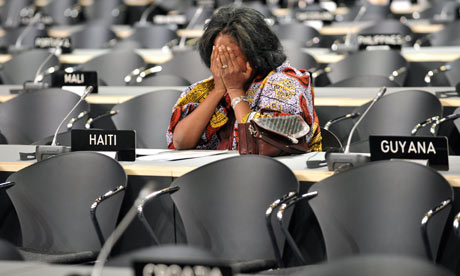
COP15: A Haitian delegation during second-day session at the Bella center in Copenhagen
The UN Copenhagen climate talks are in disarray today after developing countries reacted furiously to leaked documents. Photograph: Attila Kisbenedek/AFP/Getty Images

The UN Copenhagen climate talks are in disarray today after developing countries reacted furiously to leaked documents that show world leaders will next week be asked to sign an agreement that hands more power to rich countries and sidelines the UN's role in all future climate change negotiations.

The document is also being interpreted by developing countries as setting unequal limits on per capita carbon emissions for developed and developing countries in 2050; meaning that people in rich countries would be permitted to emit nearly twice as much under the proposals.

The so-called Danish text, a secret draft agreement worked on by a group of individuals known as "the circle of commitment" – but understood to include the UK, US and Denmark – has only been shown to a handful of countries since it was finalised this week.

The agreement, leaked to The Guardian, is a departure from the Kyoto protocol's principle that rich nations, which have emitted the bulk of the CO2, should take on firm and binding commitments to reduce greenhouse gases, while poorer nations were not compelled to act. The draft hands effective control of climate change finance to the World Bank; would abandon the Kyoto protocol – the only legally binding treaty that the world has on emissions reductions; and would make any money to help poor countries adapt to climate change dependent on them taking a range of actions.

The document was described last night by one senior diplomat as "a very dangerous document for developing countries. It is a fundamental reworking of the UN balance of obligations. It is to be superimposed without discussion on the talks."

A confidential analysis of the text by developing countries also seen by the Guardian shows deep unease over details of the text. In particular, it is understood to:

• Force developing countries to agree to specific emission cuts and measures that were not part of the original UN agreement;
• Divide poor countries further by creating a new category of developing countries called "the most vulnerable";
• Weaken the UN's role in handling climate finance;
• Not allow poor countries to emit more than 1.44 tonnes of carbon per person by 2050, while allowing rich countries to emit 2.67 tonnes.

Developing countries that have seen the text are understood to be furious that it is being promoted by rich countries without their knowledge and without discussion in the negotiations.

"It is being done in secret. Clearly the intention is to get [Barack] Obama and the leaders of other rich countries to muscle it through when they arrive next week. It effectively is the end of the UN process," said one diplomat, who asked to remain nameless.

Antonio Hill, climate policy adviser for Oxfam International, said: "This is only a draft but it highlights the risk that when the big countries come together, the small ones get hurting. On every count the emission cuts need to be scaled up. It allows too many loopholes and does not suggest anything like the 40% cuts that science is saying is needed."

Hill continued: "It proposes a green fund to be run by a board but the big risk is that it will run by the World Bank and the Global Environment Facility [a partnership of 10 agencies including the World Bank and the UN Environment Programme] and not the UN. That would be a step backwards, and it tries to put constraints on developing countries when none were negotiated in earlier UN climate talks."

The text was intended by Denmark and rich countries to be a working framework, which would be adapted by countries over the next week. It is particularly inflammatory because it sidelines the UN negotiating process and suggests that rich countries are desperate for world leaders to have a text to work from when they arrive next week.

Few numbers or figures are included in the text because these would be filled in later by world leaders.

However, it seeks to hold temperature rises to 2 °C and mentions the sum of $10bn a year to help poor countries adapt to climate change from 2012-15.

Link:  http://www.guardian.co.uk/environment/2009/dec/08/copenhagen-climate-summit-disarray-danish-text