Blog Archive

Showing posts with label Scott Mandia. Show all posts

Saturday, October 18, 2014

Judith Curry Advocates Against Action on Climate Change

by Michael Mann, Huffington Post, October 17, 2014

Georgia Tech's Judith Curry has authored an op-ed in the Wall Street Journal claiming that "there is less urgency to phase out greenhouse gas emissions now" than in the past. This could not be further from the truth.
She ties her argument to a new study she has co-authored, as well as the global warming speed bump (or faux pause). Neither offers a compelling reason to avoid reducing emissions. Her study looks at recent temperatures and uses them to try and determine how much the atmosphere will warm from our CO2 emissions.
The result is a figure low enough for contrarians to trumpet, but still not really that far from the official figures provided by the UN's IPCC, the gold standard of climate science. This is why the new study (and the others very similar to it) have elicited only a collective yawn from serious academia.
So the piece repeats the same tired claims about lowered sensitivity, using the "pause" meme and her own study as justification for delaying action. According to her (and of course the contrarians) a limited set of studies using a single incomplete methodology are reason enough to put off getting serious about climate change. One of us (Dr. Mann) addressed this misguided claim about climate sensitivity to CO2 earlier this year in a detailed piece in Scientific American.
To summarize the article, it turns out that even if one assumes these recent studies are correct, this buys us only a decade of extra time before crossing the internationally agreed-upon limit of 2 °C of warming. This means that even if Curry's correct, it may just be the difference between bad and terrible consequences of our inability to get emissions under control.
This understanding is shared by all the mainstream climate scientists who have examined the breadth of the scientific literature. For example, Oxford University professor and IPCC author Dr. Myles Allen told Carbon Brief that a reduction in climate sensitivity as presented by Curry and others "is hardly a game-changer" because it "would mean the changes we expect between now and 2050 might take until the early 2060s instead."
In a response from the Union of Concerned Scientists, Peter Frumhoff describes it even more eloquently, saying that Curry's call for delay "is like refusing to treat a patient because you can't tell if their fever is 103 or 104 degrees."
Esoteric and academic arguments about the response of the atmosphere to a doubling of CO2 may be interesting for those steeped in the peer-reviewed literature, but for the public and policy makers the important and unfortunate fact is that climate change is continuing unabated. This was the hottest September on record, after the hottest August on record (yielding the hottest summer on record), and the oceans continue to warm rapidly. In fact, some parts of the ocean have been shown to be warming even more rapidly than we thought.
In the end, Curry's claims fly in the face of what we know. Quite literally, according to the largest scientific organization in the world and publisher of the journal Science. The American Association for the Advancement of Science (AAAS) released this year a report titled "What We Know" that shows that taking action now reduces both the cost and the risks associated with our warmed world.
Regardless of whether Curry is right about the climate being slightly less sensitive to CO2 (something that hundreds of thousands of years of paleoclimate records suggest is false) the fact remains that the sooner we reduce emissions, the less damage we will endure. And interestingly, Curry admits that the only substantial worry is from a high emissions scenario. But if we listen to her argument for inaction, that high emissions scenario is exactly what we'll get.
Ultimately, we all wish that Curry is right, and climate change won't be as costly as the mountain of evidence suggests. Unfortunately, the science so far shows that if anything, we've been underestimating the scale of the impacts. The Wall Street Journal does its audience a disservice by portraying a ten-year reprieve (at best) as though it was a full pardon.
Signed,
Professor John Abraham, University of St. Thomas
Dr. Peter Gleick, MacArthur Fellow, hydro climatologist
Professor Scott Mandia, Suffolk County Community College
Professor Michael Mann, Pennsylvania State University
Professor Richard C.J. Somerville, University of California, San Diego

Monday, July 21, 2014

Barry Bickmore's hilarious takedown of the Potty Peer's latest rampage, this time on his home away from castle -- WUWT

Readers, have you been finding the summer just a bit too droll?  Well, things are looking up!

For your enjoyment, Dr. Barry Bickmore does another simply marvelous takedown of Monckton's latest antics on WUWT:

by Barry Bickmore, Climate Asylum, July 21, 2014

Hang around the Watt’s Up With That? blog for any length of time, and it will become apparent that His Lordship, Christopher Monckton, 3rd Viscount of Brenchley, is all but worshipped by many of the regulars there.  No matter how absurd Monckton’sintellectual flagellations, Anthony Watts will post them, and hordes of credulous commenters will heap adulation upon His Lordship.  One of Monckton’s long-time fans is Willis Eschenbach–construction manager, climate hobbyist, and frequent contributor to both the blog and the Heartland disinformation conference.  Willis, unfortunately, learned what happens if you express strong disagreement with anything Monckton says, i.e., Monckton threatens to sue you.  Yes, Monckton has turned yet another corner, and has begun threatening his fellow climate change contrarians, in addition to the typical academics and reporters.  Witness poor Willis begging his fallen hero to reconsider!
Christopher, please, I implore you as a friend, cease with the legal threats. Every time you make such a threat of legal action against some scientist that you disagree with, your credibility sinks another notch.
Yes, you have the means and the position and the title and the power and the friends and the money to cause trouble for people … do you truly not understand that your threats to use your power and money and advantages and hereditary title against some poor skeptical shlub like myself because you don’t like his claims just makes you look like an insecure bully? Is there truly no other way to defend yourself? Dang, dude, you can strip the hide off a buffalo with your unmatchable eloquence, or have half the world laughing at someone’s foolishness with your irascible wit … you don’t need legal means to set things straight, your intellect and your words are more than enough to do that.
Alas, Willis’s struggle isn’t merely against a momentary lapse in judgement by his hero.  He is fighting INVIOLATE LAWS OF THE UNIVERSE–Bickmore’s First and Second Laws of Monckton.
Bickmore’s First Law of Monckton 
For every person who publicly endorses Lord Monckton’s climate pronouncements for merely irrational reasons, there exists a threshold in Monckton’s behavior which, if crossed, will cause said person to regret their association.
Bickmore’s Second Law of Monckton
Any behavioral threshold posited by Bickmore’s First Law of Monckton will eventually be crossed by Lord Monckton.
Let’s back up and examine the series of events that led to this curious juncture, so that we might recognize the inexorable march of fate, driven by the Invisible Hand of Bickmore’s Laws of Monckton.
A Pebble in the Pond
Our story begins with Dr. David Evans, an electrical engineer who goes about inexplicably calling himself a “Rocket Scientist”, and a conspiracy theorist who makes Jews uncomfortable by going on and on about an international banking conspiracy involving the Rothschilds.  Evans is in the running for the Next Climate Galileo for his new “theory,” which posits a mysterious “Force X” from the Sun that influences the Earth’s climate with an 11-year delay.  And it involves math.  Jo Nova, Lord Monckton, and some other prominent contrarians immediately jumped on the bandwagon, but others (i.e., the ones who don’t think the Sun can possibly the culprit for recent warming) weren’t so sure.  Among them were Willis Eschenbach and Leif Svalgaard.  Svalgaard appears to be a solar physicist, and doesn’t buy the idea that the Sun explains everything, but I’ve heard he is some kind of “lukewarmer.  He comments regularly at WUWT, to the extent that Anthony Watts calls him “WUWT’s resident solar expert.”
The usual protocol at WUWT is that Anthony will put up a guest post by some wing nut, even if he knows it is utter nonsense.  (Check out some of my favorite examples here.)  Some commenters will jump right on the bandwagon, but others will disagree.  A few hardy souls from Reality might pop in to take a swipe at it, and will get dog-piled.  Watts and all the regulars will pat themselves on the back for being so open-minded, in contrast to the “alarmists” who are always trying to stifle such scintillating intellectual exchanges.  It’s all good, as long as the conclusion to any argument (no matter how ridiculous) is that the scientific consensus on climate change is wrong, or doesn’t exist, etc.
The problem is that some of the contrarians–even the sort who hang about WUWT–still have some minimal intellectual standards.  Both Eschenbach and Svalgaard were able to recognize that much of Evans’s work relied on a bizarre hodgepodge of solar data sets that was apparently corrupted by some improper data processing techniques.  They spoke up, and lots of angry back-and-forth ensued, most notably with the following comment by Svalgaard.
It is worse than I thought. The TSI used by Evans is totally wrong
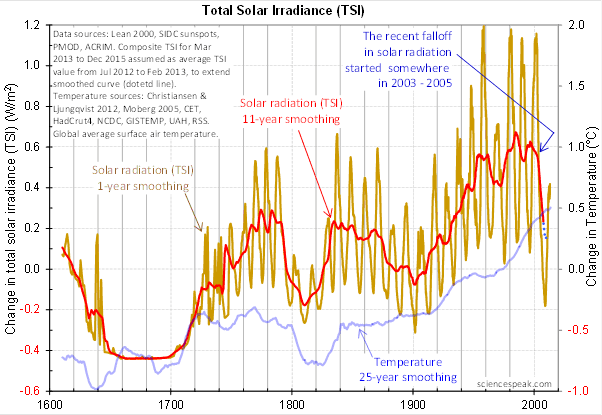
Apart from the use of the obsolete Lean TSI for the early years, the most blatant error is the statement that TSI has had a sharp unprecedented drop starting in 2003-2005 to now. This is complete nonsense. Here is TSI since 2003
There is no such drop. If anything TSI is now higher than it were in 2003. As far as I am concerned, the model is already falsified. Not by the observations but by the [almost fraudulent - as there clearly is an agenda here] use of invalid input to begin with. This concludes my comments as the prediction is worthless on its face.
Monckton Escalates
The “almost fraudulent” comment angered His Lordship, who called it “libelous.”  Svalgaard returned fire, calling one of Monckton’s comments “outright stupid, and advising, “You do yourself no favours by pretending to be so dumb.”  Monckton insisted he was right, and pronounced Svalgaard’s scientific career to be over.
He is a quack, not a scientist. This was not inadvertence on his part: it was plain wickedness. Nothing he ever says again on any scientific subject can or will be taken seriously. He is finished, dead by his own hand.
Willis Eschenbach was chiming in, meanwhile, and getting a little hot under the collar when Monckton defended Evans’s refusal to make his data and code available to others.  “Ooooh, bad Lord Moncton [sic], no cookies, logical fail.”
Monckton, in his usual fashion, started throwing out threats.
I have given Mr Svalgaard every opportunity to apologize to Dr Evans but he has chosen not to take it. I shall now consult the statistician, verify Mr Svalgaard’s employment status and, if any academic institution is employing him, refer his allegation against Dr Evans to the appropriate authorities as an instance of gross and persisting research misconduct.
Which really ticked off Svalgaard.  “Good luck with that. I can’t wait.”  Monckton thenwent into some detail about his plans.
I do not speak for Dr Evans in any way, and I have no idea of whether he will decide to sue. As a first step, he might request Anthony to allow him to answer the allegations in a head posting, which would go some way towards expunging Mr Svalgaard’s nastly libel of him in his calling as a scientist.
Perhaps in the United States, as one thoughtful commenter has suggested, persistently and falsely calling someone “almost fraudulent” for allegedly “fabricating” scientific data is thought acceptable. Not in Australia. There, as in any British-law jurisdiction, such a libel is taken very seriously indeed. I had hoped I had made that plain to Mr Svalgaard, so as to give him the chance to get himself off the hook.
For my part, I am referring Mr Svalgaard’s long list of malicious comments about Dr Evans (but not about me: I give as good as I get) to his university, which will know best how to handle the matter, for there is a rather delicate aspect that I am not at liberty to discuss here. The university will most certainly realize that the do-nothing option is not an option. The libel is too grave and too persistent. My lawyers are looking at it tomorrow to see whether malice is present, in which case the damages would triple, to say nothing of the costs. Their corresponding lawyers in the U.S. will be giving advice on whether Dr Evans would count in U.S. law as a “public figure,” Probably not, from what I know of the “public-figure” test, in which event, in order to enforce the judgement of the Australian courts in the U.S., it would not be necessary to prove malice (for, though malice seems evident, the test in Australian law is high).
It would also be open to Dr Evans simply to apply to the court for a declaration (in Scotland, declarator) that he had not fabricated anything or engaged in any of the other varieties of scientific misconduct of which Mr Svalgaard has seen fit to accuse him with such vicious and unbecoming persistence. Given the sensitivity to which I shall be drawing the university’s attention, that might be the kindest course.
And there, I think, we had better leave it and let the appropriate authorities take over. I have only been as explicit as this because this posting will also go some little way towards expunging the libel and minimizing the damage to Dr Evans’ reputation that Mr Svalgaard seems to have intended.
What His Lordship forgot to mention was that the 2010 SPEECH Act makes foreign libel judgements unenforceable in the USA, unless they are compliant with the First Amendment.  Oh, and the allegedly libelous statements must be provably false.  Given that Svalgaard only said that Evans’s mistakes were “almost fraudulent,” whatever that means, good luck with that.
The Olive Branch Gets Torched
Willis felt bad that he had let his temper get the best of him, and he regretted Svalgaard’s “almost fraudulent” comment, so he wrote another blog post called “Mending Fences, in which he apologized for any rhetorical excesses, but defended his position.  He also said that, while he disagreed with Svalgaard’s characterization, he thought it was “understandable” that he would float the idea, given the sheer number of mistakes Evans had made.  Monckton showed up in the comments, once again, demanded further apologies, and hinted that he was following through on his threats against Svalgaard.
Mr Eschenbach says it was “understandable” that another contributor had accused Dr Evans of being “almost fraudulent.” It was not “understandable.” It was irresponsible and inappropriate…. There was no basis whatsoever for accusing Dr Evans of being “almost fraudulent,” and the person who made that allegation and regrettably failed to withdraw it is now in considerable trouble over it. There are plenty of fraudsters in the climate scam, but Dr Evans is most certainly not one of them.
Well, Svalgaard wasn’t having any of that, and responded with the Big Guns, namely, my own Lord Monckton’s Rap Sheet!!!!
Monckton of Brenchley says:
July 17, 2014, at 3:56 am
“There are plenty of fraudsters in the climate scam,”
I note that another commenter here has accused me of fraud, and has cited a particular website much of whose contents I had not previously seen. My lawyers will be visiting me early next week to deal with some of the allegations on that website.
So apparently now he’s going to lob some legal threats my way, too, unless he was talking about Gavin Schmidt’s piece at the Realclimate site.  If he wants to threaten me, it won’t be the first time.  I am now opening a betting pool in the comments, so my readers can weigh in about (1) whether Monckton will actually follow through on his threats, and (2) if so, whether his objections will include his oft repeated claim that he is a member of Parliament, no matter what Parliament says.
Willis chastised His Lordship for his hypocritical behavior.
Finally, you advocate “greater civility all around,” while at the same time you said you are paying your lawyers to find out if David and Jo can claim triple monetary damages from Leif and unspecified “others” (perhaps including myself) for some imagined damage to their reputations … perhaps it’s just me, but I find resorting to threats of legal action and triple monetary damages in a scientific discussion, however fractious, to be … well … not all that civil …
Monckton shot back:
That commenter finally presumes to give me legal advice. With respect, that is not a matter for him, nor am I aware that he has legal qualifications. I had not until recently realized the extent to which websites all over the place were accusing me of falsehoods and fabrications of which I was not guilty. One of these accusations was so effective that even our kind host here was initially taken in by it. However, unlike the commenter who has made such an uncommon nuisance of himself here, he quietly investigated the allegation in question, found it to have been entirely unmeritorious, and was good enough to publish the results of his researches. It will now be necessary for me to have that and other libels retracted and apologized for, so that no one else is taken in.
[NOTE:  That's why I'm betting that Monckton might bring up his claim to be a member of Parliament.  Anthony Watts ("our kind host") once posted an explanation by a lawyer Monckton hired, about why he is really a member, no matter what Parliament says.  I responded with a post about how ridiculous the lawyer's claims were. ]
Which brings us back to Willis’s plea to his fallen hero.
Christopher, please, I implore you as a friend, cease with the legal threats. Every time you make such a threat of legal action against some scientist that you disagree with, your credibility sinks another notch.
Yes, you have the means and the position and the title and the power and the friends and the money to cause trouble for people … do you truly not understand that your threats to use your power and money and advantages and hereditary title against some poor skeptical shlub like myself because you don’t like his claims just makes you look like an insecure bully? Is there truly no other way to defend yourself? Dang, dude, you can strip the hide off a buffalo with your unmatchable eloquence, or have half the world laughing at someone’s foolishness with your irascible wit … you don’t need legal means to set things straight, your intellect and your words are more than enough to do that.
Alas, Willis may still fail to realize that every time someone has bothered to look beyond Monckton’s “unmatchable eloquence” (translation:  “bombastic nonsense calculated to impress the credulous”) they have found the “intellect” lacking and the “words” misleading.  And they have very often become the target of his threats.  Lest any of us forget the history, I include here the “Threatening Those Who Disagree With Him” section of Lord Monckton’s Rap Sheet.  I’ll have to update it, now.
1. Monckton has threatened to instigate academic misconduct investigations against several professors who have exposed his misrepresentations.  The list so far includes Naomi Oreskes, John Abraham, and myself.  He has even threatened a libel suit against John Abraham.  UPDATE:  Monckton has now threatened to extend the libel suit to include Scott Mandia.  Here is Scott’s reply.  UPDATE:  John Abraham tells me that Monckton has threatened lawsuits against him several more times, and Monckton has also threatened me, once again.  He also wrote my university administration to tell them I was mentally imbalanced, and that I had been sending him “hate mail.”  Well, at least the second part is false. UPDATE:  He also tried to get Tony Press (U. Tasmania) fired.  UPDATE:  Monckton also lodged a complaint at a New Zealand university against professors Jonathan Boston, David Frame, and Jim Renwick for “academic fraud” and libel.  The university investigated the complaint, then blew it off.  But before the verdict was in, Monckton threatened to sic the police on the university if they were to… you know… blow him off.  I’m sure the police have an entire unit on the case as I write this.
2. He launched a complaint to the Press Complaints Commission in the UK against The Guardian because of a column George Monbiot wrote about Monckton’s antics.  The PCC threw out the complaint. In a bizarre twist, George Monbiot reported that someone claiming to be Monckton and using Monckton’s IP address had tried to edit his Wikipedia page to falsely claim that he had won a £50,000 settlement from The Guardian because of Monbiot’s article.
3. Monckton lobbed threats against Arthur Smith after Arthur objected that Monckton (and the Science and Public Policy Institute) had violated copyright.  Smith had written a rebuttal of one of Monckton’s articles, and was trying to get it published.  Monckton put the entire thing up on the web along with his comments, and altered the article to imply that Smith had written it at the behest of his employer, the American Physical Society, which was not true.  Arthur prevailed after threatening legal action, because he was clearly in the right.
4. John Mashey pointed out an instance where one contrarian had plagiarized from Monckton (and cited papers that had been challenged and withdrawn), and then Monckton turned around and praised the work.  When Richard Littlemore reported this, Monckton left a comment on the page saying that Mashey was “under investigation” for breaching “doctor-patient confidentiality,” and that he was guilty of “interfering in an unlawful manner on the blogosphere.”  To this day, I don’t think anyone has any idea what Monckton was talking about.
5. George Monbiot chronicled how Monckton has threatened several times to sue The Guardian for libel.  The U.K. has libel laws that are absurdly in favor of plaintiffs, and yet, these lawsuits have never materialized.
6. Senators John Rockefeller and Olympia Snowe wrote an open letter to Exxon-Mobil, urging them to stop funding climate-contrarian “think-tanks,” whose tactics resemble those of the tobacco industry, Lord Monckton wrote an open letter to the senators, in which he said, “In the circumstances, your comparison of Exxon’s funding of sceptical scientists and groups with the former antics of the tobacco industry is unjustifiable and unworthy of any credible elected representatives. Either withdraw that monstrous comparison forthwith, or resign so as not to pollute the office you hold.”  Ok, so this isn’t really a threat, but Monckton’s language is so bombastic and filled with fake moral outrage that it almost feels like a threat.  I should note that (1) in his letter, Monckton falsely claimed to be a member of Parliament, and (2) Naomi Oreskes, a prominent science historian, and Erik Conway, have shown that not only do the most prominent organizations fighting mainstream climate science follow the same playbook as the tobacco industry, but it’s often the SAME organizations and people doing the fighting on both fronts!
7. Monckton launched yet another complaint to the Press Complaints Commission against New Scientist magazine, which had the temerity to point out that Monckton’s article on climate sensitivity in an American Physical Society newsletter was not peer-reviewed, among other things.  Of course, the editor had specifically noted that the newsletter is not a peer-reviewed publication, but Monckton said he had the article critiqued by a “Professor of Physics,” i.e., someone who isn’t a climate specialist.   The complaint was not upheld.
8. His Lordship complained to Ofcom, the British regulator for TV and radio programming, that he had been unfairly treated by the producers of the BBC documentary, Earth:  The Climate Wars.  Ofcom found that the show’s producers should have given more information to Monckton upfront about the nature of the program (even though Monckton expressed familiarity with how the BBC had covered the issue in the past).  However, they found that the lack of informed consent did not result in any misrepresentation of Monckton’s views by unfair editing.  The complaint summary linked above is a fascinating read, if you have about 15 minutes.
9. Monckton threatened to have IPCC Chairman Rajendra Pachauri jailed for fraud because he used an IPCC graph that turns out to be correct, but misleading.  In his letter to Pachauri, however, His Lordship used a temperature graph that had already been shown by several scientists to be blatantly fabricated.  I’m sure Monckton is on his way to Scotland Yard right now to give himself up.
10. The BBC aired a documentary called “Meet the Climate Sceptics” which apparently focused largely on Lord Monckton.  (Click here to see the trailer.)  In fact Monckton unsuccessfully attempted to have the courts stop the BBC from airing it unless they allowed him to insert a 3-minute video rebuttal into the program.
11. The ABC (Australia) aired a rather stunning gutting of Monckton and his crowd.  Journalist Wendy Carlisle brought up several instances where Monckton’s sources contradicted him, the fact that he falsely claims to be a member of Parliament, his miracle cure-all, and more.  So of course, Monckton threatened to sue unless given airtime to reply.
http://bbickmore.wordpress.com/2014/07/21/the-monckton-files-a-hero-has-fallen/



Friday, April 11, 2014

Dana Nuccitelli: Climate imbalance – disparity in the quality of research by contrarian and mainstream climate scientists

Contrarian papers tend to be rebutted quickly in peer-reviewed literature, but receive disproportionate media attention

by Dana Nuccitelli, "Climate Consensus - The 97%," The Guardian, April 11, 2014


Unbalanced
Both the quality of mainstream and contrarian climate research and their media coverage have been unbalanced, but in different directions. Photograph: www.alamy.com
A new paper has been published in the journal Cosmopolis entitled "Review of the consensus and asymmetric quality of research on human-induced climate change." The paper was authored by John Abraham, myself, and our colleagues John CookJohn Fasullo, Peter Jacobs, and Scott Mandia. Each of the authors has experience in publishing peer-reviewed responses to flawed contrarian papers.
Despite the 97% expert consensus on human-caused global warmingsupported by peer-reviewed research, expert opinion, the IPCC reports, and National Academies of Science and other scientific organizations from around the world, a large segment of the population remains unconvinced on the issue. A new commentary by Edward Maibach, Teresa Myers and Anthony Leiserowitz in Earth's Future notes that most people don't know there is a scientific consensus about human-caused climate change, which undermines public engagement on the subject.
This 'consensus gap' is in large part due the media giving disproportionate coverage to climate contrarians. In our paper, we sought to evaluate whether that disproportionate media coverage was justified by examining how well contrarian hypotheses have withstood scientific scrutiny and the test of time. The short answer is, not well.
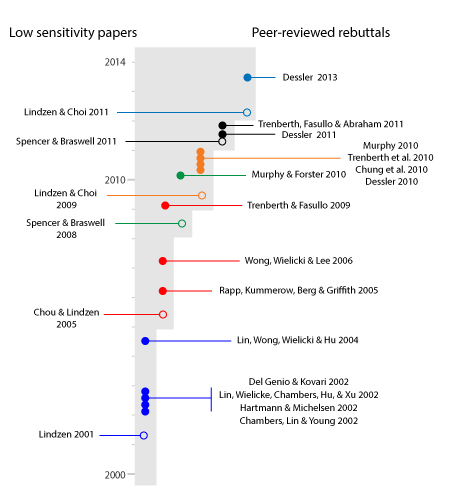
Low climate sensitivity papers by Lindzen and Spencer (open circles) and peer-reviewed rebuttals (closed circles).  Created by John Garrett (Wildomar, CA).Low climate sensitivity papers by Lindzen and Spencer (open circles) and peer-reviewed rebuttals (closed circles). Created by John Garrett of Wildomar, CA.
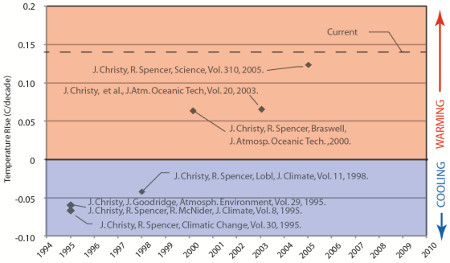
The first contrarian argument examined in our paper was the claim that the Earth is not warming. This argument was particularly popular in the late 1990s and early 2000s, when John Christy and Roy Spencer from the University of Alabama at Huntsville published an analysis of satellite data that seemed to indicate the lower atmosphere was cooling. This appeared to contradict surface temperature measurements from thousands of thermometers around the world, which when combined together, indicated substantial global warming. Contrarians were certain that the thermometers were wrong, the satellites were right, and we didn't have to worry about global warming.
However, it turns out that satellite measurements of atmospheric temperatures are very tricky. The satellites are positioned above the atmosphere that they're trying to measure, and have to peer through many different atmospheric layers. Their orbits also drift, and satellites have limited lifespans, forcing scientists to splice together measurements from different instruments.
Gradually, various problems with the satellite temperature measurements were identified, some by the Huntsville group, and several by other groups. Corrections were made to the record, and before long the satellite record showed the warming of the lower atmosphere happening at a similar rate to that estimated from the thermometers around the globe.
Evolution of lower tropospheric temperature trends from satellite observations.Evolution of lower tropospheric temperature trends from satellite observations.
Two decades later, additional possible biases are still being identified in the satellite temperature record. Nevertheless, contrarians continue that the lower atmosphere isn't warming as fast as it should be, or that the surface thermometer measurements are biased hot (recent research has shown they actually have a cool bias). However, Christy and Spencer's claim that the planet isn't warming did not withstand scientific scrutiny or the test of time.
The second contrarian argument we investigated involved the claim that the global climate is not very sensitive to the increased greenhouse effect because the planet has some sort of natural climate response that will offset global warming. One of the first such arguments in the peer-reviewed literature was the 'infrared iris' hypothesis from contrarian darling Richard Lindzen.
The premise of Lindzen's hypothesis was that as the climate warms, the area in the atmosphere covered by high cirrus clouds will contract to allow more heat to escape into outer space, similar to the iris in a human eye contracting to allow less light to pass through the pupil in a brightly lit environment. However, within a year of Lindzen's iris hypothesis paper being published, four scientific groups had published their own studies finding significant flaws in his methods and assumptions, shown in dark blue in the first graphic above.
Several more critiques were published in the ensuing years failing to find evidence supporting the iris concept (red in the first graphic), showing that while the scientific community took this new hypothesis seriously, it simply failed to withstand scientific scrutiny. Although this is the case for most of Lindzen's arguments, he continues to be among the most highly sought contrarians by journalists and policymakers who try to create the perception of significant disagreement amongst climate science experts.
Roy Spencer and his colleague Danny Braswell have similarly published papers arguing that the climate is not as sensitive to the increased greenhouse effect as most climate scientists believe and most of the available evidence indicates. A paper they published in 2008 used a very simple climate model to make this argument, but subsequent research showed that their model was actually too simple, and failed to accurately represent how the global climate operates (green in the first graphic).
Spencer and Lindzen published several other papers making similar arguments in subsequent years, but these again failed to withstand scientific scrutiny (orange, black, and light blue in the first graphic). Various other scientific groups pointed out several flaws in the methods and assumptions in each of their publications, and in fact one editor resigned because he felt his journal had failed its task of conducting rigorous peer-review in publishing a fundamentally flawed 2011 Spencer and Braswell paper (black in the first graphic).
To contrast, human-caused global warming is based on solid fundamental physics that we've understood for over a century. In contrast to the relatively few studies mentioned here, thousands of studies have scrutinized and reaffirmed the basic physics that underlies the theory. It has withstood the test of time.
While there are still some areas of climate science undergoing serious research, like how much we're influencing changes in various types of extreme weather, the central tenets of human-caused global warming are solidly established. While some challenges have been advanced in the scientific literature, these challenges have been found to be incorrect.
In addition to the failure of their alternative hypotheses to withstand scientific scrutiny, research has shown that contrarian scientists have less expertise and fewer publications than mainstream climate scientists, and that as climate expertise increases, so does acceptance of human-caused global warming.
This then raises the question as to why contrarians are given disproportionate attention by the media and policymakers. They represent a small minority of experts with fringe views that have failed to convince the rest scientific community, simply because their ideas haven't withstood scientific scrutiny. On the other side we have human-caused global warming, supported by 97% of peer-reviewed research, expert opinion, fundamental physics, and having withstood the test of time. The fact that these two groups are treated as being on equal scientific footing and the issue continues to be 'debated' in the media has resulted in a misinformed public, and that's a problem.
http://www.theguardian.com/environment/climate-consensus-97-per-cent/2014/apr/11/climate-change-research-quality-imbalance

Tuesday, February 18, 2014

Debating climate science is the "moral and scientific equivalent of debating gravity," Paul Douglas, Republican meteorologist.

by Scott Mandia, "Global Warming -- Man or Myth?" February 18, 2014

A few weeks ago, a journalist contacted the Climate Science Rapid Response Team to get various opinions about whether climate scientists should take a public position or in some sense a political position on the issue and get involved in the debate/discussion over climate change in public venues and through media coverage. After sending the request to several climate experts, I also asked Paul Douglas, a meteorologist, registered Republican, and entrepreneur, for his thoughts. With permission, I have posted his response below:


My name is Paul Douglas. Scott Mandia suggested I drop you a quick note in response to your recent CSRRT inquiry. I’m not a climate scientist; I’m a Penn State meteorologist and an entrepreneur who has launched a series of weather/technology companies over the years. I’ve been talking about weather trends; how what I’ve been witnessing on the weather maps since the 1990s dovetails with what climate models have been predicting all along. I began talking about these trends on WCCO-TV and The Star Tribune in the Twin Cities back in the late 90s, and immediately got push-back from a minority of viewers and readers who felt somehow threatened by the science. I still write a daily weather and climate science blog, and produce a daily 2:30 video segment on meteorology and climate science for our new national weather channel, WeatherNation TV.

I talk to 50+ organizations about weather and climate trends during a typical year across the Upper Midwest, and still hear a fair amount of skepticism, cynicism and outright science denial. As a meteorologist I have an obligation to be scientifically accurate, to explain the trends and most likely triggers as competently as possible. 
Communication, especially of complex scientific issues, is always challenging, but I believe we have an obligation to translate the implications of science, not only what it is – but what it means. The implications. It would be like a heart surgeon telling a patient he has an irregular heartbeat, and then leaving out the part of an implantable stent and going on a statin. I’m a meteorologist, but I haven’t renounced my citizenship. As such I speak out about issues, trying to highlight the signal amidst the noise. And there’s an awful lot of noise, confusion, obfuscation and (deliberate, well-funded and orchestrated) denial out there today, because of policy implications, and the sheer amount of money in the energy sector that’s in play. Trillions of dollars of carbon potentially at risk.

As an entrepreneur if I don’t respect the data and see the business world as it really is, not as I’d like it to be, I become road kill. My venture quickly goes out of business and I have to lay off good people. So it is with science, which, like nature, never moves in a straight line. But I tell people the truth as I perceive it to be. The data is the data. If we don’t react to facts on the ground and listen to professional scientists, including climate scientists, and base policy decisions on a careful and deliberate attempt to document observed changes/causes using the scientific method, we’re setting ourselves up for failure on a planetary scale.

To the heart of your question, why don’t more climate scientists enter into the public debate? Because the debate is over. It’s the moral and scientific equivalent of debating gravity. The experts have spoken, and because a very small minority of stakeholders and shareholders don’t care for the implications there is vociferous push-back from certain special interests. I worked in television news for 35 years. Mainstream media likes a good on-air food-fight, a protagonist and antagonist, shouting at each other about their worldviews. It attracts curiosity and eyeballs – it’s ultimately good for ratings. But it’s a false equivalent, and it’s a terrible way to conduct science. We put a handful of (paid) climate skeptics and industry lobbyists on a stage with thousands of the world’s leading climate PhD’s, and think this is somehow serving the public interest? It’s not. It’s creating more confusion, more delay and more denial, as viewers and readers pick and choose their reality as easily as reading changing channels on their TV or grazing over their morning horoscope. I can absolutely understand why more professionals don’t want to subject themselves to inane banter with science-deniers.

When I talk to groups and individuals I tell them the truth: it’s good to be skeptical. In a day and age of hackers, scams, media spin and political lobbyists people should be skeptical – it’s a necessary self-defense mechanism these days. And then I remind them that the most skeptical people on the planet are scientists. Science is organized skepticism. The fact that thousands of experts agree on not only climate trends, but the triggers (burning of fossil fuels) is extremely significant.

Schopenhauer once said that all truth goes through 3 stages: first it is ridiculed, then violently opposed, then finally accepted as self-evident. We are at the end of Stage 2. Manufactured doubt and industry push-back is preventing us from taking the planetary actions necessary to avoid even more disastrous climate volatility. When sea walls go up around Manhattan and Miami, when a large western city runs out of water or goes up in flames, when crops fail year after year across the Midwest and cruise ships packed with curious gawkers routinely sail across the North Pole, maybe the professional denialists will move on to their next target.

Not sure if that answers your question – just wanted to offer up my opinion. Let me know if there’s anything else I can do to help.

Paul Douglas
Founder, President
Media Logic Group LLC


http://profmandia.wordpress.com/2014/02/18/republican-meteorologist-entrepreneur-debating-cause-of-climate-change-is-moral-and-scientific-equivalent-of-debating-gravity/