Blog Archive

Showing posts with label Enbridge. Show all posts

Friday, September 23, 2016

First Nations across North America sign treaty alliance against the oilsands


Tsleil-Waututh leaders (left to right): Gabriel George, Charlene Aleck, and Rueben George sign the Treat Alliance Against the Tar Sands in Vancouver on Thursday, September 22, 2016. Photo by Elizabeth McSheffrey.
September 22, 2016


The thunderous pounding of indigenous drums echoed in the air on Thursday as more than 50 indigenous nations across North America rallied together to sign a historic, pan-continental treaty alliance against oilsands expansion in their traditional territory.
The collaboration, formalized at simultaneous ceremonies in Quebec and B.C., aims to block all proposed pipeline, tanker, and rail projects affecting First Nations land and water, including TransCanada's Energy East pipeline, Kinder Morgan's Trans Mountain expansion, Enbridge's Line 3 pipeline, and Enbridge Northern Gateway.
At the signing on Musqueam land in Vancouver, the lineup of chiefs waiting to put their names down filled up an entire room. It was a powerful ceremony, and participants clad in the regalia of their nations travelled from across B.C. and northern Washington to be part of the growing movement.
Grand Chief Stewart Phillip of the Union of BC Indian Chiefs, who also signed the document, said indigenous people will no longer stand for dangerous projects on their territory that advance the threat of climate change.
"In this time of great challenge we know that other First Nations will sign on," he said, extending the invitation to Indigenous communities far and wide.
"Based on our sovereign, inherent right to self-determination, we have collectively decided that we will pick up our sacred responsibilities to the land, waters, and people. We will come together in unity and solidarity to protect our territory from the predations of big oil interests, industry, and everything that represents."
It's a movement that's already happening, he added, with no better example than in North Dakota, where the Standing Rock Sioux have forced the federal government to pause Dakota Access pipeline construction.
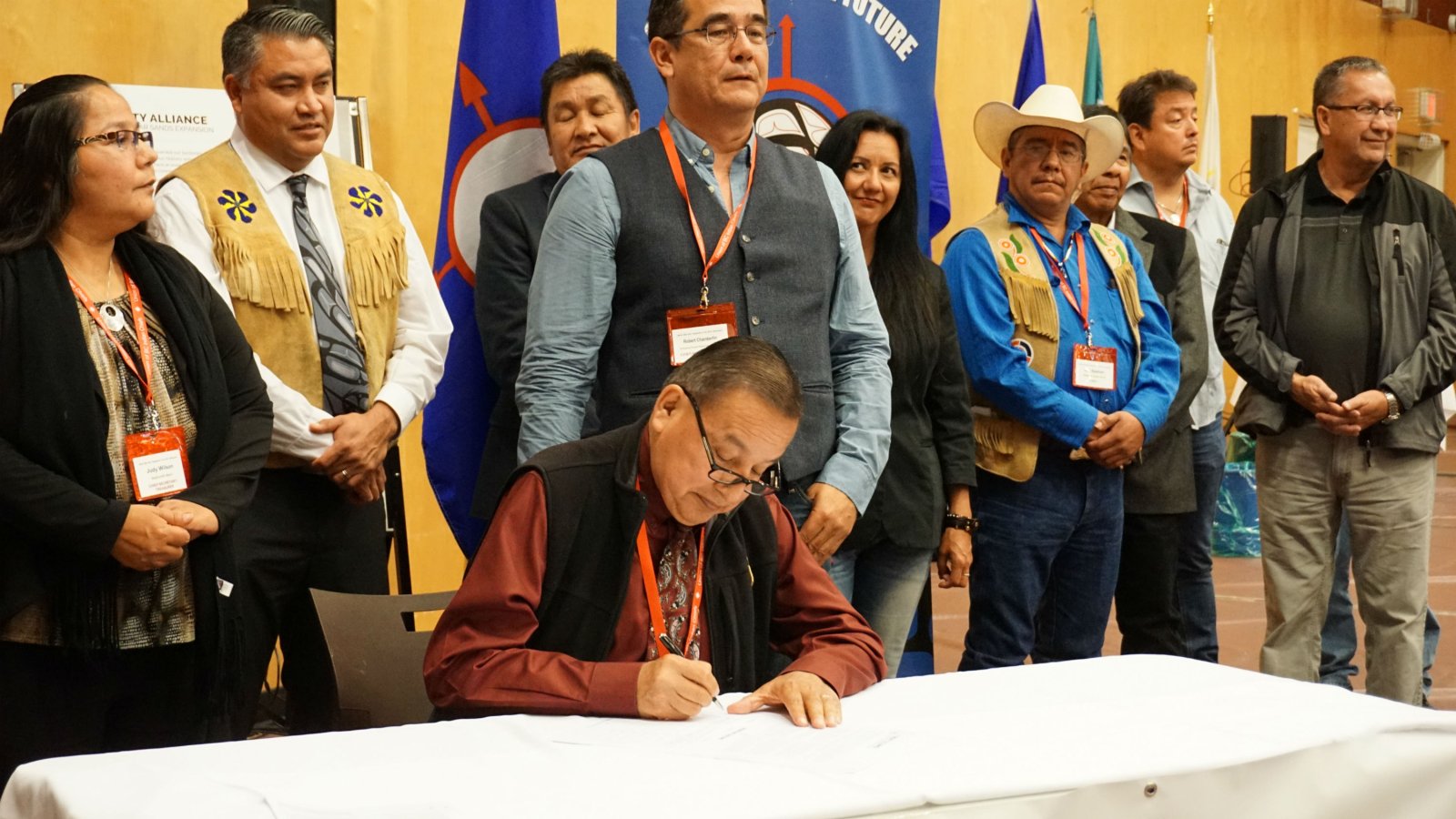

Grand Chief Stewart Phillip, Kinder Morgan, Trans Mountain expansion, Union of BC Indian Chiefs
Grand Chief Stewart Phillip of the Union of BC Indian Chiefs signs the Treaty Alliance Against Tar Sands Expansion in Vancouver, BC, on Thursday, September 22, 2016. Photo by Elizabeth McSheffrey.

Meeting the call to climate change duty

The document, called the Treaty Alliance Against Tar Sands Expansion, commits its signatories to assist one another when called upon in the battle against oilsands expansion, and to work in partnership to move society towards more sustainable lifestyles. By aligning themselves with other Indigenous nations across Canada and the northern U.S., participants hope to ensure that dangerous projects are not able to "escape" by using alternative routes.
“We have the right and the responsibility to stop these major threats to our lands, our waters and our peoples,” said Kanesatake Grand Chief Serge Simon. “For example, from Quebec, we will work with our First Nation allies in B.C. to make sure that the Kinder Morgan pipeline does not pass, and we know they’ll help us do the same against Energy East.”
It comes not only from a legal and cultural responsibility to protect their land, water, air, and climate from harm, said Grand Chief Derek Nepinak of the Assembly of Manitoba Chiefs, but a desire to safeguard a future for all peoples, indigenous and non-indigenous as well.
“We want to work with the Prime Minister and the government to develop a sustainable economy that does not marginalize our people,” he said. “This is a time of great spiritual awakening for our peoples as we reinvigorate our Nations and ensure a better tomorrow for all.”
While First Nations, environmentalists and other key stakeholders across North America argue that pipelines, tankers, and oil by rail increase the risk of catastrophic oil spills, threaten critical marine and terrestrial ecosystems, and put international climate targets out of reach, energy companies argue that they will revitalize struggling Canadian economies by bringing energy to overseas markets.
The energy companies also argue that their proposed projects promote responsible resources development. The Canadian Association of Petroleum Producers however, Canada's largest oil and gas lobby group, said the Treaty Alliance will not change the way its members do business with Indigenous communities.
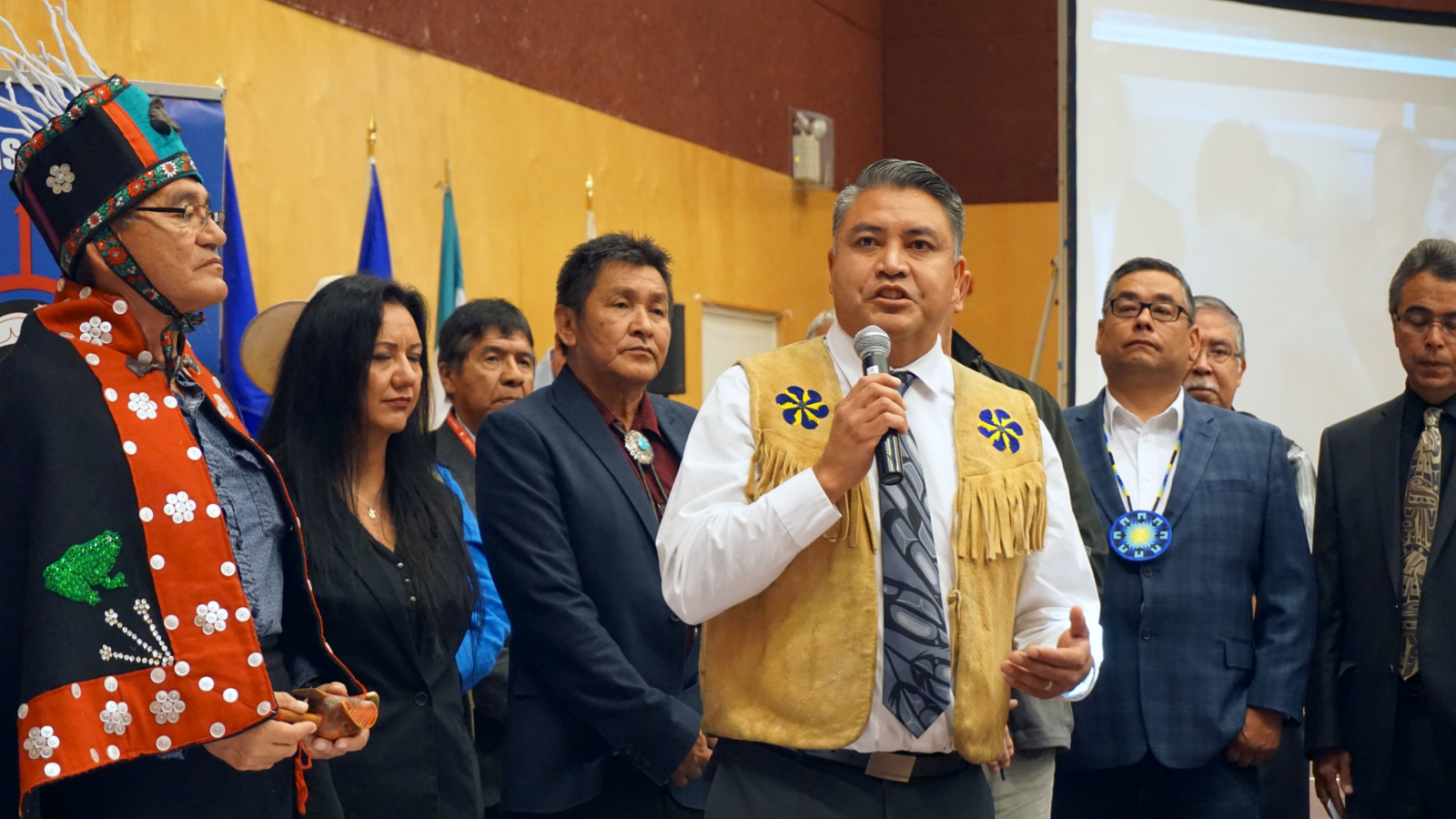

Chief Terry Teegee, Carrier Sekani Nation, Prince George
Chief Terry Teegee of the Carrier Sekani Tribal Council in Prince George, BC, calls all First Nations to stand together in the fight against oilsands expansion, Thursday, September 22, 2016, in Vancouver. Photo by Elizabeth McSheffrey.

Oil and gas industry to carry on

"Our member companies work with First Nations and Metis communities all the time, regularly, and have a long history of doing that," said Brian McGuigan, CAPP's manager of aboriginal policy. "We'll continue to work with them. Members work with them everyday and have very positive relationships... It's not always easy conversations, but they continue the dialogue."
He would not comment on whether he felt the newly-signed document would hinder CAPP's goal of getting Canadian oil to tidewater.
The new treaty builds on a series of major First Nations victories against oilsands expansion projects, including a Federal Court of Appeal decision in June that overturned the Harper government's approval of the Enbridge Northern Gateway project, and rallies across the continent that contributed to U.S. President Barack Obama's decision to kill the Keystone XL pipeline.
American signatories to the treaty include the Standing Rock Sioux, who are fighting the Dakota Access Pipeline, the Lummi Nation in Washington, which is currently fighting the Trans Mountain expansion, and the White Earth Nation in Minnesota, which has launched a legal complaint against the Enbridge Line 3 program. Canadian signatories include BC's Katzie First Nation, Tsleil-Waututh Nation, Carrier Sekani Tribal Council, Wet'suwet'en First Nation, and Heiltsuk First Nation, among others.
pipelines, oilsands, tar sands, Treaty Alliance Against Tar Sands expansion, Union of BC Indian Chiefs
A sample of pipeline projects affecting indigenous communities across North America. Graphic courtesy of the Treaty Alliance Against Tar Sands Expansion. [Note that the Dakota Access Pipeline is not shown on this map.]

Here's what the treaty says:

"Therefore, our Nations hereby join together under the present treaty to officially prohibit and to agree to collectively challenge and resist the use of our respective territories and coasts in connection with the expansion of the production of the Alberta Tar Sands, including for the transport of such expanded production, whether by pipeline, rail, or tanker.
As sovereign indigenous Nations, we enter this treaty pursuant to our inherent legal authority and responsibility to protect our respective territories from threats to our lands, waters, air and climate, but we do so knowing full well that it is in the best interest of all peoples, both indigenous and non-indigenous, to put a stop to the threat of Tar Sands expansion.
We wish to work in collaboration with all peoples and all governments in building a more equitable and sustainable future, one that will produce healthier and more prosperous communities across Turtle Island and beyond, as well as preserve and protect our peoples’ way of life."

WATCH: The signing ceremony in Vancouver

Indigenous chiefs from across BC sign a pan-continental Treaty Alliance Against Tar Sands Expansion in Vancouver on Thursday, September 22, 2016. Video by Elizabeth McSheffrey.
This report was made possible thanks to reader subscriptions. Please subscribe today.

http://www.nationalobserver.com/2016/09/22/news/first-nations-across-north-america-sign-treaty-alliance-against-oilsands

Wednesday, August 27, 2014

Steve Horn: State Dept. Overseers of Contentious Enbridge Tar Sands Pipeline Workaround Have Industry, Torture Ties

by Steve Horn, DeSmogBlog, August 27, 2014

The Sierra Club, National Wildlife Federation (NWF) and other green groups recently revealed that pipeline giant Enbridge got U.S. State Department permission in response to its request to construct a U.S.-Canada border-crossing tar sands pipeline without earning an obligatory Presidential Permit.
Enbridge originally applied to the Obama State Department to expand capacity of its Alberta Clipper (now Line 67) pipeline in November 2012, but decided to avoid a “Keystone XL, take two” — or a years-long permitting battle — by creating a complex alternative to move nearly the same amount of diluted bitumen (“dilbit”) across the border.
The move coincides with the upcoming opening for business of Enbridge's “Keystone XL” clone: the combination of the Alberta Clipper expansion (and now its alternative) on-ramp originating in Alberta and heading eventually to Flanagan, Ill., the Flanagan South pipeline running from Flanagan, Ill., to Cushing, Okla., and the Cushing, Okla., to the Port Arthur, Texas, Seaway Twin pipeline.
Together, the three pieces will do what TransCanada's Keystone XL hopes to do: move dilbit from Alberta's tar sands to Port Arthur's refinery row and, in part, the global export market.
Environmental groups have reacted with indignation to the State Department announcement published in the Federal Register on August 18, 2014. The public commenting period remains open until September 17, 2014.
Jim Murphy, senior counsel for NWF, referred to it as an “illegal scheme,” while a representative from 350.org says Enbridge has learned from the lessons of its corporate compatriot, TransCanada.
“When we blocked Keystone XL, the fossil fuel industry learned that they have a much stronger hand to play in back rooms than on the streets,” said Jason Kowalski, policy director for 350.org. “They will break the law and wreck our climate if that's what it takes for them to make a buck.”
But as the old adage goes, it takes two to tango. 
That is, influential State Department employees helped Enbridge find a way to smuggle an additional 350,000 barrels of tar sands per day across the border without public hearings or an environmental review. 
Thus far, those following the issue have described the Enbridge maneuver as some sort of bureaucratic snafu.
“If anyone who's high up in the State Department actually knew about this, they'd be up in arms,” 350.org's Kowalski said in a recent interview with EnergyWire in reaction to State's decision.
The reality, though, is more sordid. That is, higher-ups made this call, not just “bad apples.” 
One of them has a key tie to the oil and gas industry, while the other helped lay the groundwork for the controversial “extraordinary rendition” torture program as a Bush Administration State Department attaché.

Patrick Dunn's Industry Ties

On July 24, 2014, State Department staffer Patrick Dunn signed off on a letter rubber-stamping Enbridge's pipeline chess move. In giving Enbridge authorization on official State Department letterhead, Dunn claimed it was not a form of authorization.
“Enbridge's intended changes…do not require authorization from the U.S.Department of State,” Dunn wrote in the letter. “[W]e will consider [your] letter and its attachments to amend and to be part of your Presidential Permit for the capcity (sic) expansion in Line 67.”
Dunn's letter does not give his job title, perhaps leading NWF to write him off as simply a “mid-level State Department official” in an August 25 blog post. His current position and State Department background, however, tells a different story.
A February 2014 letter obtained by DeSmogBlog lists Dunn's role as deputy office director for the Bureaus of European Affairs, the Western Hemisphere and African Affairs.
More specifically, Dunn heads up the three regions' bureaus of energy resources, described as a “chief of staff” in an August 11 article published on Dominican Today. That article highlighted Dunn's efforts — alongside Vice President Joe Biden — to cut deals with the Dominican Republic's government, turning the country into an importer of gas obtained via hydraulic fracturing (“fracking”) in the U.S. 
Before working his way up to the powerful Bureau of Energy Resources, Dunn helped lead numerous U.S. Embassies abroad, including in Honduras and Angola as top economic adviser, and Cape Verde as deputy embassy director.
What came before any of that, though, may go a long way in explaining how he came to oversee such an important cross-border pipeline project in the first place.
“PESA's Foreign Service Officer Energy Industry Training Program was created in 1993 to increase the practical knowledge of energy attaches and economic officers with responsibility for oil and gas issues stationed in American embassies in countries where energy is a major issue,” reads a Program description.
A glance at PESA's website demonstrates that industry executives regularly serve as presenters at the Foreign Service Officer Energy Industry Training Program.

Deborah Klepp's Ties to Rendition, Corrupt Contracting

Though Dunn wrote the July 24 letter to Enbridge, he is not the only senior level State Department staffer overseeing the Enbridge Alberta Clipper file.
Deborah Klepp, whose name is listed at the very bottom of the State Department's August 12 announcement on the Alberta Clipper, currently serves as director of the Department of State's office of environmental quality and transboundary issues. 
In the past, she has helped to head up U.S. Embassies in Russia, Kyrgyzstan and Burkina Faso, as well as in Estonia and Poland.
While working as deputy director of the U.S. Embassy in Bishkek, Kyrgyzstan, on a two-year appointment starting in July 2001, Klepp knowingly or unknowingly got involved in what many would likely consider her most controversial work at the State Department: planting the seeds of the Bush Administration's “extraordinary rendition” torture program.
“Finnish authorities identified a single Miami Air flight…that travelled back and forth between Helsinki and Manas U.S. Air Force transit base in Kyrgyzstan in a single day in December 2002,” explains a February 2013 Open Society Foundation report titled, “Globalizing Torture: CIA Secret Detention and Extraordinary Rendition.”
The U.S. Embassy in Bishkek is only a 30-minute drive away from the Transit Center at Manas located at Manas International Airport, which served as a key U.S. military base from 2001-2009. After her time serving in Bishkek, Klepp wrote a paper for the National Defense University about how the U.S.established the base during her time working on the ground there.

Deborah Klepp and Guantanamo Bay

Beyond rendition and corruption at Manas, Klepp also had at least some knowledge of torture of prisoners at the Guantanamo Bay detention center in Cuba.
In a document obtained by the American Civil Liberties Union (ACLU) through the Freedom of Information Act (FOIA), then Secretary of State Colin Powell sent a cable in January 2002 to Klepp and James Boughner, at that time the deputy director of the U.S. Embassy in Tajikistan and now head of economic affairs for the U.S. Embassy in Germany.
Requesting the cable be passed onto then-U.S. assistant secretary of state for Europe and Eurasia, A. Elizabeth Jones, and her executive assistant at the time, Karen Decker, the cable discusses Guantanamo Bay (“GTMO”), “access to the detainees” and three congressional delegations (“CODELs”) to GTMO going on at the time.
That cable also discusses International Committee of the Red Cross (ICRC) “technical recommendations,” but the State Department redacted what those recommendations were.
The New York Times revealed in 2004 that a confidential ICRC memo stated the “American military [had] intentionally used psychological and sometimes physical coercion 'tantamount to torture' on prisoners at Guantanamo.”
Klepp's husband Mark B. Horowitz — determined by viewing property records — also formerly served as a senior-level State Department employee. A 2012 State Department telephone directory lists Horowitz as an employee of the Office of Information Resource Management, where he served as “ISSO (For S/ES Only).”
In the tech world, “ISSO” is shorthand for Information System Security Officer or Chief Information Security Officer, who oversees institutional computer system networks and online infrastructure.

“Local Corrupt Practices”

An October 2008 State Department diplomatic cable provided to Wikileaks by whistleblower Chelsea Manning discusses what Columbia University political scientist Alexander Cooley describes as the “local rules” of doing business in Kyrgyzstan and the Central Asian region at-large.
“[O]ne businessman said that doing business here is ‘like doing business in the Yukon’ in the nineteenth century, i.e., only those willing to participate in local corrupt practices are able to make any money,” explains the cable.
But the latest wheeling and dealing by Enbridge raises a troubling question: have the “local corrupt practices” conducted by State Department diplomats abroad snaked their way home in order to help the tar sands export industry?
Photo Credit: Wikimedia Commons

Thursday, July 31, 2014

Why First Nations Are Stopping Enbridge's Tar Sands Pipeline

'We're serious about our economy. We want to make sure that it's self-sufficient and doesn't harm the environment—so it lasts forever.'
First Nations protest against the Harper government's plans for oil sands expansion. Credit: Jen Castro
 6Share0 
British Columbia's First Nations have fought the proposed Northern Gateway oil sands pipeline that would cross their land for years, and they have no intention of letting up just because the federal government recently approved it. They've ignored the wishes of Canadian Prime Minister Harper, shrugged off oil industry promises of local jobs, and rejected offers of part ownership in what could be a lucrative and long-lived project.

In short, they've been impervious to the kinds of political pressure and financial enticements that routinely succeed in smoothing the way for oil-related projects in the United States. How come?

A big part of the defiance comes from the Coastal First Nations, an alliance of aboriginal groups in British Columbia that has no interest in allowing diluted bitumen from Alberta's oil sands to pass through their territories or get shipped through their fishing grounds. The environment is too important to their culture, to their economy and to a succession of generations to come.

And because most First Nations in British Columbia never signed treaties ceding their lands or development rights to the Canadian government, they have been challenging projects in court—and winning. The latest and most significant court victory came in June, when the Canadian Supreme Court upheld aboriginal land titles and rights, and suggested that in places where land claims are not subject to treaties, First Nations may have de facto veto rights over projects on their territorial lands.
Art Sterrit (on right) on a fact-finding visit to Florida after BP's Gulf spill. "That was the biggest oil spill cleanup in history, and they couldn't clean it up. That was the death knell for the Northern Gateway for us."Art Sterrit (on right) on a fact-finding visit to Florida after BP's Gulf spill. "That was the biggest oil spill cleanup in history, and they couldn't clean it up. That was the death knell for the Northern Gateway for us."

Art Sterritt, executive director of the Coastal First Nations, has been a key player in the Northern Gateway saga. At 66, he's a goldsmith, sculptor and carver of totem poles and masks. But in serving on a tribal council, then becoming a treaty negotiator, and then joining the Coastal First Nations, Sterritt is following a family history of civic duty and activism. His dad, who turns 101 in early August, is a chief. He's also trying to make the world a better place for his 18 grandchildren.

In an interview with InsideClimate News, Sterritt elaborated on what's driving the First Nations' opposition to the Northern Gateway and why they can't be won over. The interview has been edited for brevity and clarity.

ICN: What is the Coastal First Nations and why was it formed?

Sterritt: We're an association of First Nations. We came together because of what the forest industry was doing. We were acknowledged by the provincial B.C. government as being the government in the region. Now we have ecosystem-based management practices so that you don't log at a rate that will wipe out the forest.

All of our communities have a land use plan. We have a marine use plan. What that means is that we're serious about our economy. We want to make sure that it's self-sufficient based on what's there, and that it doesn't harm the environment—so it lasts forever.

ICN: Why is protecting the environment so important for Coastal First Nations?

Sterritt: The area that we live in represents 25% of the coastal temperate rainforest left on the planet. So this is a very, very significant area. It's an amazingly beautiful area. Tourism is a huge, huge draw. So our communities are moving themselves toward renewable industries—industries that don't destroy the environment. We have carbon offsets that we get out of the forest. As we protect the forest, there's the ability to sequester carbon, which helps with the environment, and in return for that, there's revenue coming in. 

ICN: How did Alberta's tar sands and the Northern Gateway project come into play?

Sterritt: We have invested, over the last 15 years, in excess of $400 million in this exercise [of planning for a sustainable economy]. We depend on the natural environment for the jobs that we have, and there's over 30,000 jobs on the coast of B.C. Right in the middle of all this arrives Northern Gateway, a project which actually jeopardizes everything. All those things we're doing, if you think about it, one oil spill, and all of those are over.

ICN: You don't think the pipeline and oil industry would protect your environment?

Sterritt: You're talking about an industry that doesn't have a culture of cleaning up their mess. Their culture is in covering up their mess with dispersants. We're still looking at what Enbridge did in the Kalamazoo River in Michigan. They haven't cleaned that up yet. They cleaned up 10-15% of the oil [from the Exxon Valdez] in Alaska. In the Gulf of Mexico, [BP] cleaned up something like six percent. They don't have the technology to clean up a spill in the ocean. It doesn't exist.

Click to enlargeClick to enlarge

ICN: What about the promise of jobs and the prospect of an equity interest in the Northern Gateway project?

Sterritt: We're not a bunch of poverty stricken, illiterate people. This is a highly developed society—a culture that's sophisticated in terms of respecting the environment, recognizing what you need to do in order to maintain it, and with a sophisticated art form and languages and everything else. That's what they didn't realize. They just figured, oh we'll flash a couple jobs and a couple bucks under their nose, and they'll just jump up and down. When you have all that, and somebody comes along and offers you a few jobs, it's just a joke. You'll jeopardize more jobs than you're creating.

ICN: What does it mean to have the Supreme Court of Canada recently uphold aboriginal territorial rights?

Sterritt: It's been groundbreaking. What that means is that you can't just ride roughshod over First Nations. They do have rights. They do have title. And the title and rights are enshrined in the Constitution of Canada. Over the last 30 or 40 years, there have been over 200 court cases that First Nations have won where it lays out their right to fish, their right to hunt, their right to an economy, their right to their culture and their societies.

ICN: What is the Coastal First Nations' position on other kinds of economic development?

Sterritt: We're not against development. We are involved in industries that don't have the potential to wipe us out. For First Nations, the first thing they deal with is the environment. If they look at a project and see that the project is going to do irreparable harm to the place they've lived in for tens of thousands of years, it's not going to happen. If a project comes along that is not going to destroy what we already have, you've got a pretty good chance of the project moving ahead. 

ICN: And you include liquefied natural gas (LNG) projects among those that could move ahead? 

Sterritt: We are actively involved in helping develop a responsible natural gas industry. Those ships are big, and they would disrupt some of our harvesting and fishing and stuff, so we're working together to make sure that's done properly. Are you emitting too much carbon into the atmosphere? Are you contaminating the local airsheds where our people live? If there are impacts, they have to be mitigated. That's a pretty good formula for starting a conversation.

ICN: I heard that you went on a fact-finding trip to Louisiana and several other oil states along the Gulf of Mexico in 2011 after the BP Spill. What was the purpose?

Sterritt: We were in the middle of making a decision on whether or not we could support the Northern Gateway project. We had seen that the industry couldn't clean up Alaska, and we figured if anyone could [clean up an ocean oil spill], we would see it there. That was the biggest oil spill cleanup in history, and they couldn't clean it up. That was the death knell for the Northern Gateway for us.

ICN: You talk about an "oil culture" on the U.S. Gulf Coast and elsewhere. What does that mean?

Sterritt: That's the culture that the oil industry is trying to introduce us to. It's one that tries to create dependency from people that live in the region, and once they've created that dependency, they can do whatever they want.

If you look at those oil states, that's what they've done. Some people, even some First Nations people, seem to think that somehow we have to become part of this oil culture. It's not true. We don't need it. We have a really amazing culture. We don't depend on anybody but our environment. That's what it's about for First Nations.

Alberta is heading down that road, and they don't have a plan. A group like Coastal First Nations—well, we have a plan. Our plan doesn't include any industry that jeopardizes the plan.

http://insideclimatenews.org/news/20140731/qa-why-first-nations-are-stopping-enbridges-tar-sands-pipeline

Friday, December 20, 2013

Senators Stabenow, Levin, Durbin question Enbridge's 60-year-old tar sands Line 5 under Straits of Mackinac, a high-consequence area

Senators Question Enbridge Over Aging Tar Sands Pipeline Beneath Great Lakes

from the Center for Health, Environment & Justice, EcoWatch, December 16, 2013Oil giant Enbridge experienced a major backlash this week after three Democratic senators released a joint letter questioning the integrity of Enbridge’s expansion of a crude oil pipeline on the Straits of Mackinac.
lakeFi
This National Wildlife Federation map simulates a 3-, 6- and 12-hour spill from the aging tar sands pipeline, Line 5, based on Enbridge spill response plans, average current speeds and “worse case” discharge estimates.
Line 5, according to the Petosky News, runs from Superior, WI, to Sarnia, Ontario, “passing through Michigan’s Upper Peninsula and crossing the Straits of Mackinac, a 5-mile-wide area where Lakes Huron and Michigan meet.” Earlier this year Enbridge boosted Line 5’s capacity by 2.1 million barrels above its previous threshold of 20 million.

The joint letter by Sen. Stabenow (D-MI), Sen. Levin (D-MI) and Sen. Durbin (D-IL) states that the pipeline “passes inland along environmentally sensitive areas and beneath the Straits of Mackinac, which PHMSA [the Pipeline and Hazardous Materials Safety Administration] has identified as a high-consequence area. The increase in oil transported adds pressure to the aging pipeline, which has undergone only a few upgrades since it was first installed in 1953 … We are particularly concerned with the risks a leak or break in the pipe could pose to the Straits of Mackinac given this area’s strong currents, variable water temperatures and connections to both Lake Michigan and Lake Huron.”

“We have worked for over three years on the investigation and levied the highest civil penalty in the agency’s history” for an Enbridge spill in the Kalamazoo River, PHMSA spokeswoman Patricia Klinger said. “In addition, PHMSA executed a consent agreement which imposed more stringent safety requirements for the entire Lakehead System, including Line 5.”

“When we’ve had to do any sort of dig on that pipeline for maintenance or repair, we’ve heard from the crews out on the field that the line still looks brand new,” said Janson Manshum, a spokesman for Enbridge, in a press conference.

Despite Enbridge’s assurance of the line’s integrity, a disastrous pipeline leak that occurred in 2010 where, along with the Kalamazoo spill, loom heavy over the Line 5 project. Coupled with the Mackinac Straits’ strong currents and wildly fluctuating temperatures, the growing backlash is beyond reasonable.