from NASA
Link: https://gracefo.jpl.nasa.gov/resources/33/
The mass of the Greenland ice sheet has rapidly declined in the last several years due to surface melting and iceberg calving. Research based on observations from the NASA/German Aerospace Center’s twin Gravity Recovery and Climate Experiment (GRACE) satellites indicates that between 2002 and 2016, Greenland shed approximately 280 gigatons of ice per year, causing global sea level to rise by 0.03 inches (0.8 millimeters) per year.
These images, created from GRACE data, show changes in Greenland ice mass since 2002. Orange and red shades indicate areas that lost ice mass, while light blue shades indicate areas that gained ice mass. White indicates areas where there has been very little or no change in ice mass since 2002.
In general, higher-elevation areas near the center of Greenland experienced little to no change, while lower-elevation and coastal areas experienced up to 13.1 feet (4 meters) of ice mass loss (expressed in equivalent-water-height: dark red) over a 14-year period. The largest mass decreases of up to 11.8 inches (30 centimeters) equivalent-water-height per year occurred along the West Greenland coast. The average flow lines (grey), created from satellite radar interferometry, of Greenland’s ice converge into the locations of prominent outlet glaciers and coincide with areas of high mass loss.
Showing posts with label deglaciation. Show all posts
Showing posts with label deglaciation. Show all posts
Saturday, June 3, 2017


Waves Rippled Through Greenland’s Ice. That’s Ominous
by Brian Kahn, Climate Central, May 26, 2017
 Rink Glacier from 34,000 feet. Credit: John Sonntag/NASA
 An animation showing horizontal bedrock motion in response to the solitary wave passing by.
Credit: Surendra Adhikari/NASA
On its surface, the Greenland ice sheet is a vast expanse of seemingly immovable ice. But beneath the monotonous stretch of white, scientists have discovered evidence of waves rippling through one of its outlet glaciers and roiling its innards.
The waves, observed during the two most intense melt seasons on record, sent an unprecedented cascade of ice and water rushing into the sea and warping the very bedrock upon which the ice sits. As temperatures continue to rise, scientists fear that massive waves of ice could expedite Greenland’s melt even further, pushing sea levels higher.
Rink Glacier from 34,000 feet. Credit: John Sonntag/NASA
It’s the latest piece of bad news about Greenland’s ice. The ice sheet has been pouring roughly 270 megatons of ice a year into the ocean via the glaciers that stretch out from its hulking mass since 2000. That’s a big uptick compared to preceding decades.
The new research, published earlier this week in Geophysical Research Letters shows a new way that climate change is taking a toll. Scientists at the NASA Jet Propulsion Laboratory, led by Surendra Adhikari, were looking at data from a series of GPS stations set up around the various outlet glaciers that tumble from Greenland’s ice sheet to the sea. Ironically, they were looking at the GPS data to see if it was worth maintaining the network of stations that rings Greenland.
They found evidence of a never-before-observed phenomenon affecting Rink Glacier, a glacier on the western flank of Greenland. The glacier usually sends about 11 gigatons of ice into the ocean each summer melt season.
But 2012 was different. A fast-moving (by glacial standards), massive wave rumbled through the glacier’s interior, causing an extra 6.7 gigatons of ice and water to slosh into the sea. That’s the equivalent of 55 million blue whales, the largest animal on earth.
The wave — dubbed a solitary wave because of its singular nature — traveled at 2.5 miles per month in the summer, picking up to 7.5 miles per month in the fall. Rink Glacier typically only moves a mile or two in a normal year.
Scientists picked up on the wave using GPS sensors, which shifted more than half an inch as it rolled by. That might not sound like much, but the sensor is sitting on stable Greenland bedrock, which isn’t exactly susceptible to perturbations.
A similar, though less extreme, wave passed by the sensor in 2010. The behavior is like nothing scientists have ever observed on Greenland.
“If you were to place a piece of plywood onto two sawhorses then place a large rock in the middle, the plywood would bend, sagging in the middle,” said Erik Ivins, a researcher at JPL who co-authored the study. “When the rock is removed, the plywood returns to the original potion.”
An animation showing horizontal bedrock motion in response to the solitary wave passing by.Credit: Surendra Adhikari/NASA
Though they’re still trying to understand exactly why it happened, there are a few major clues. Those clues don’t bode well for the future of Rink Glacier or the enormous amount of ice it’s holding back.
The melt seasons of 2010 and 2012 were two of the most extreme on record. In 2012, a prolonged summer heat wave coupled with soot from Siberian fires that cast a dark coat over the ice sheet resulted in 95% of the ice sheet going into meltdown.
Scientists suspect that that meltdown is responsible for the wave that tore through Rink Glacier. Meltwater from the interior created new pathways for water to move around and likely lubricated the based of the glacier where it meets the bedrock, priming it for the massive shudder of ice that moved through it.
Robin Bell, an ice researcher at Lamont-Doherty Earth Observatory, called the research a “beautiful study linking how the surface of the ice sheet melts and slides with how the surrounding mountains (solid earth) responds. (It’s) remarkable to see the earth lurch in a year when the ice changes more.”
Temperatures are likely to only keep rising due to climate change. Previous research has suggested that melt seasons like 2012 could become the norm by the end of the century, increasing the risk of more glacial waves in the coming century.
“We suspect that solitary waves may be unique to high melt years,” Adhikari said. “The more warming, the more surface meltwater available to trigger ‘extraordinarily’ dynamic behavior of glacier such as the one we discovered in Rink Glacier.”
Greenland’s melt is currently responsible for roughly 25% of observed sea level rise. That percentage could increase in the coming years if what happened at Rink Glacier spreads to other glaciers.
Thursday, April 14, 2016
Robert Schribbler: The Greenland Summer Melt Season Just Started in April
by Robert Schribbler, April 12, 2016
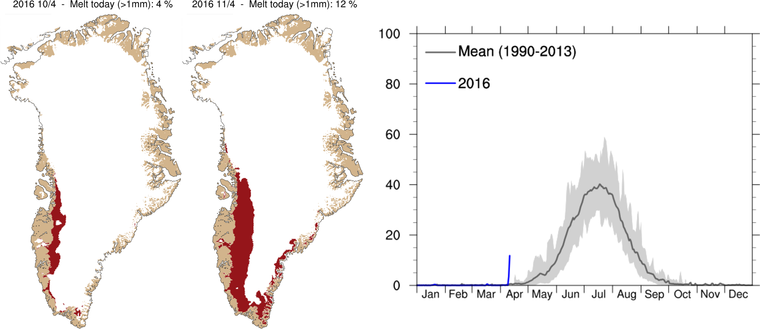
12 Percent. That’s how much of Greenland’s surface experienced melt yesterday according to a report from DMI’s Polar Portal as an unprecedented flow of warm, wet air slammed into its great ice sheets. 10 Percent. That’s how much of Greenland’s ice sheet surface is required to melt in order to mark an official start to the Summer melt season. Late May or early June. That’s when Greenland melt season typically begins.
In other words, a Greenland melt season that usually starts as May rolls into June, and has never initiated before May 5th, just began on April 11th of 2016. That’s 24 days ahead of the previous record, set only 6 years ago, and more than a month and a half ahead of the typical melt start. In other words — way too early. But in a rapidly heating world where monthly temperatures have now exceeded a range of 1.5 C above 1880s' levels, we could well expect Greenland melts to begin earlier, end later, and encompass more and more of the ice sheet surface at peak melt during July.
Record early start to Greenland’s ‘Summer’ melt season occurred on April 11, 2016, according to reports from DMI’s Polar Portal.
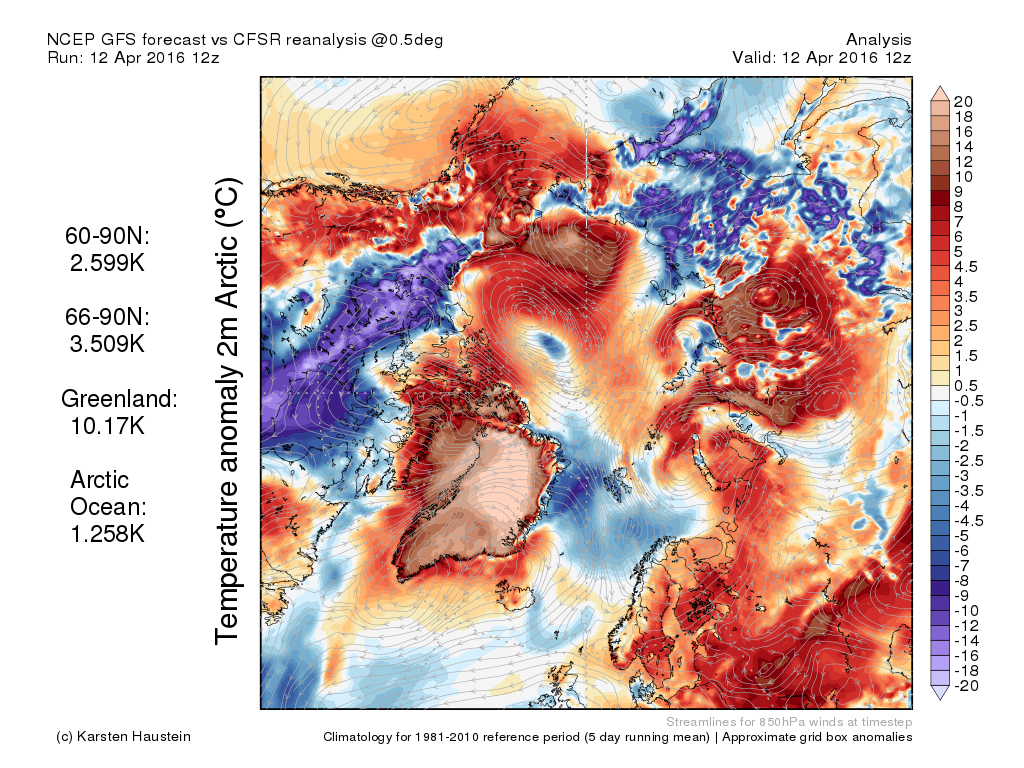
Yesterday’s new record early melt start occurred as extraordinarily warm temperatures in the range of 20-40 degrees Fahrenheit above average swept over southern, central and western Greenland. This flood of extremely warm temperatures for Greenland was accompanied by heavy rains and strong winds — gusting to gale or even hurricane force in some locations. In some areas, rain fell over the ice sheet itself. As recently as midday Tuesday, Dr. Jason Box — a prominent Greenland researcher — tweeted a report from a friend in Nuuk that the city was “close to drowning in water caused by rain and snow melt.”
Today, temperatures for the whole of Greenland — a 1.7-million square kilometer island containing enough ice to raise sea levels by more than 20 feet should it all melt — were measuring as high as 10.17 C above average (more than 18 F above average), with readings over much of northern and central Greenland spiking over 20 C (36 F) above normal (1980-2010) ranges. So it’s likely that Monday’s record early 12% surface melt will extend and possibly expand on through today (April 12).
Extreme warmth over much of Greenland on April 12th is continuing a new record early start to melt season for this up to two-mile-high pile of ice. Image source: Karsten’s Climate Maps. Data Source: NOAA/NCEP/GFS.
Over the coming week, temperatures across Greenland are expected to steadily fall back toward more normal ranges. However, it’s worth noting that much of the heat from this year’s record early melt spike will be baked into the ice — adding a kind of internal heat pressure as Spring gradually progresses into Summer.
During July of 2012, an unprecedented 95% of Greenland’s surface experienced melt. For 2016, unprecedented Arctic warming during Winter appears to have set the stage for a serious challenge to both 2012 Greenland and 2012 Arctic sea ice melt records. And with seasonal sea ice at or near new record lows even as Greenland is off to an amazingly early melt start, it appears that 2016 is now in a race to set a number of new benchmarks as Arctic ice continues its ominous and disruptive longer-term decline.
Tuesday, April 12, 2016


Wednesday, March 16, 2016
NASA: Greenland is melting and it's time to pay attention

One of NASA's modified G-III aircraft in the hangar at Armstrong Flight Research Center being prepped for a mission to study glaciers around Greenland.
Yes, yes, Greenland is melting. You already knew that…probably. And the giant flux of fresh water pouring out of the second largest ice sheet on the planet isn’t slowing down anytime soon. Greenland’s ice melt is actually accelerating. In the last decade alone, NASA’s twin GRACE satellites measured it shedding 2 trillion tons of ice like a fire hose pouring fresh water into the North Atlantic.
But it’s easier to focus on politics, celebrity gossip, reality TV and cat videos than on Earth’s climate. It seems like everyone’s all “Greenland? Who cares. Whatever. Next.” And that upsets me.
Is it really that easy to pretend the effects of global warming don’t exist?
We overlook Greenland ice loss at our own peril. It’s one of the largest contributors to accelerating sea level rise, and in the U.S. alone, nearly 5 million people live in 2.6 million homes at less than 4 feet above high tide. If you happen to be one of them, you should definitely pay attention to Greenland.
Fortunately for all of us, NASA is paying attention to Greenland in a big way. We’re so concerned about the amount of ice loss that we’ve named a Greenland observing expedition Oceans Melting Greenland, or OMG for short, because that's the most appropriate response to the phenomenon.
Instrument integration (a fancy word for attaching instruments to planes and making sure they work and don’t come loose) went down at NASA’s Armstrong Flight Research Center, and Principal Investigator Dr. Josh Willis, Project Manager Steve Dinardo, Co-Investigator Dr. Ian Fenty and I headed there to check it out.
Glaciers on the edge
As the technicians and engineers tweaked fistfuls of wires, we crawled in, under, through and around the aircraft. Then Dr. Ian Fenty (who helped design the flight plan) and I sat aboard our flying science lab and talked ice loss for a while. “We often find that a glacier that’s been retreating a lot might be in 1,000 feet of water,” he explained. “Whereas the glacier that’s not thinning very much is in water that’s only 100 or 200 feet deep.” That’s because the layers of ocean water around Greenland are in a very unique situation, where you have colder fresh glacier meltwater near the surface over salty ocean water that, due to climate change, has been warming. The water found at 600 feet and below is a relatively warm 4 degrees Celsius compared with the surface water, which is just near freezing at 0 degrees. This means that the “primary suspect” behind the acceleration of Greenland’s melting glaciers is the warming ocean waters that can get right up against the edge and interact with the glacier itself.
As the surface of lower elevation glaciers melts, the water percolates through the ice and forms giant subglacial channels, like a river system under the ice. If the ice running through these narrow rivers breaks off, the friction between the glacier and the substrate gets reduced a bit and literally stretches the ice so the glacier thins out. OMG’s GLISTIN-A radar is going to measure the height of the ice. “If we see a change in elevation from one year to the next, we can know how much ice is being lost and how much the movement of the glacier is speeding up.” Over the next five years OMG plans to go back to Greenland to look for more changes.
Find out more about Oceans Melting Greenland here.
Thank you for your comments.
Laura
Tuesday, October 27, 2015
SHOW THIS TO EVERYONE: NYT's INCREDIBLE ARTICLE ON THE DISINTEGRATION OF GREENLAND'S ICE SHEET
Dear Readers,
I don't know if the link will open for you if you are not a subscriber, but I suspect it will.
As shocking and dramatic as this report on Greenland's rapidly melting and disintegrating ice sheet is, everyone should see it and show it to all their friends and contacts.
I have never seen anything that shows what is going on in Greenland like this report.
At the very end, there is another video. Near the end, you can see in the lower right hand corner where the surface has even collapsed due to a sub surface channel. I had already heard of some much larger collapses due to the draining of subsurface lakes within the ice.
Link: http://www.nytimes.com/interactive/2015/10/27/world/greenland-is-melting-away.html?_r=0
I don't know if the link will open for you if you are not a subscriber, but I suspect it will.
As shocking and dramatic as this report on Greenland's rapidly melting and disintegrating ice sheet is, everyone should see it and show it to all their friends and contacts.
I have never seen anything that shows what is going on in Greenland like this report.
At the very end, there is another video. Near the end, you can see in the lower right hand corner where the surface has even collapsed due to a sub surface channel. I had already heard of some much larger collapses due to the draining of subsurface lakes within the ice.
Link: http://www.nytimes.com/interactive/2015/10/27/world/greenland-is-melting-away.html?_r=0
Wednesday, September 9, 2015
Jason Box: Earth's Ice Is Melting Much Faster Than Forecast. Here's Why That's Worrying
by Jason Box, Professor of Glaciology, Geological Survey of Denmark and Greenland, Huffington Post, September 4, 2015
COPENHAGEN -- For me it was only after 8 years of studying Greenland -- installing and maintaining a network of on-ice climate stations and examining how much snow evaporates from the island -- that I suddenly realized glaciology textbooks needed a major revision. This was in 2002. Prior to the epiphany, conventional knowledge held that the ice sheet was frozen at its bed, and so the reaction time of the ice sheet to climate warming was measured in tens of thousands of years. A heck of a long time.
Climate warming had just infiltrated Greenland glaciology in earnest. Summer melt water, it turned out, drains down quickly to the bed, lubricating the glacier's flow. Suddenly we realized an expanding melt season meant the ice sheet would be sliding faster, longer. It was not to be the only time our philosophy got hit with a major surprise that connected the ice sheet with climate change and the threat of abrupt sea level rise.
The next one came in 2006.
Somehow all marine-terminating glaciers across the southern half of Greenland doubled in speed simultaneously between 2000 and 2005. [Readers, this news is what caused me to begin this blog -- I had the one and only epiphany in my life when I read about this.] We didn't yet know why.
In the meantime, scientists tried defining a plausible upper limit for the contribution to sea level rise from Greenland's ice. That was at a time when surging glacier speeds -- ice flow -- was thought to be the dominant conveyer of ice loss, and would be for the foreseeable future. Well, surprise! It became clear that for six years in a row, starting in 2007, ice loss from surface meltwater runoff took over the lead position in the competition for biggest loser. [This was something I thought privately at the time -- that this must occur eventually, but I did not imagine that it would occur so soon. I never bought into the idea that the topography was a limit on glacial outflow and thus would restrain Greenland's contribution to sea level rise.] From 2007 to 2012, nearly each summer set higher and higher melt records, owing to persistent and unforeseen weather that by 2012 would become a signature of climate change.
The competition between how much ice is lost through glacier flows into fjords versus meltwater runoff is intimately synergistic with meltwater interacting with ice flow all along the way. Increasing melt sends more water down through the ice sheet, softening the ice so it flows faster. Once at the bed the water lubricates flow. Squirting out the front of glaciers into the sea, the meltwater drives a heat exchange that undercuts glaciers, promoting calving, loss of flow resistance and faster flow. Put it this way: in Washington, DC, to know what's happening, you follow the money; in Greenland you follow the meltwater.
Put it this way: in Washington, DC, to know what's happening, you follow the money; in Greenland you follow the meltwater.
Glaciologists became oceanographers when they realized, in 2008, the trigger effect for galloping glaciers was warm pulses of subtropical waters that undermine glaciers at great depth in the sea, at the grounding lines where this warm water can invade.
Indeed, ocean warming is arguably the climate change story. The planetary energy imbalance due to the enhanced greenhouse effect is loading far more heat into the oceans than the atmosphere or land. The world is 70% ocean-covered. after all. While there were signs of a warming hiatus in air temperatures from 1998 to 2012, the ocean continued to heat up, an equivalent of four Hiroshima bombs, per second, all day, every day. The increase is continuing as we load the atmosphere with CO2.
The fundamental climate heating issue is a problem of too much of a good thing. The natural greenhouse effect -- a good thing -- keeps temperatures tolerable at night. But it has been enhanced by more than a century of people externalizing the environmental costs of stupendous economic growth, loading the atmosphere now with 42% more carbon dioxide, 240% more methane, 20% more nitrous oxide, 42% more tropospheric ozone, etc. We have far too much gaseous carbon compounds now in our atmosphere, people. The carbon pollution is, by the way, making our oceans too acidic, threatening the base of the marine food chain. Would someone step forward and deny the changing ocean chemistry? Do I digress?
We have far too much gaseous carbon compounds now in our atmosphere, people.
The key question, as I see it, is how to project what the sea level will soon be due to ice sheet melting. But this is confounded by us not really knowing what to expect. We keep being surprised by nature being more sensitive and complex. As the science develops, we see more interconnection, where multiplying feedbacks produce surprisingly fast responses.
Will there be some saving self-regulation of human-induced climate warming and its melting land ice consequences? The enormous increase of heat in our oceans, from past decades of enhanced greenhouse effect, negates any hope that negative feedbacks or even solar output will prevent a much warmer world. The few negative feedbacks we have found for ice -- like more snow as a result of a warming climate, more reflective frost, more efficient sub-glacial water transmission -- are clearly being outdone. And at the global scale, despite some negative feedbacks like more clouds, clearly we are not seeing net cooling. Feedbacks, whether positive or negative, only do their thing after the initial effect. Negative feedbacks don't reverse the perturbation.
Seemingly the biggest issue with abrupt sea level rise comes from the now-unstoppable loss of key sectors of West Antarctic ice and the discovery of more marine instability than we thought elsewhere. Like glaciers thinning rapidly in East Antarctica. Or in Greenland, where improved bedrock maps reveal a marine connection an average of 40 kilometers further inland than previously thought. Or like how new fjord underwater mapping reveals greater fjord depths, increasing the odds that deep warm ocean water can communicate with more Greenland glaciers than previously thought. Surprise, surprise, surprise.
I'd say we are in for more surprises.
If the past decade of scientific inquiry is any indication, I'd say we are in for more surprises. That notion is further supported by the fact that the climate models used for projecting future temperatures lack key processes that likely reinforce warming or the effects of warming, not regulate it.
Despite decades of progress by many clever scientists engaged with climate modeling, climate models used to inform policymakers don't yet encode key pieces of physics that have ice melting so fast. They don't incorporate thermal collapse -- ice softening due to increasing meltwater infiltration.
Climate models also don't yet incorporate increasing forced ocean convection at the ocean fronts of glaciers that forces a heat exchange between warming water and ice at the grounding lines.
Climate models don't yet include ice algae growth that darkens the bare ice surface.
Climate models don't yet prescribe background dark bare ice from outcropping dust on Greenland from the dusty last ice age.
Climate models don't include increasing wildfire delivering more light-trapping dark particles to bright snow-covered areas, yielding earlier melt onset and more intense summer melting.
As a result of some of these factors and probably some as yet unknown others, climate models have under-predicted the loss rate of snow on land by a factor of four and the loss of sea ice by a factor of two.
Climate models also don't yet sufficiently resolve extended periods of lazy north-south extended jet streams that produce the kind of sunny summers over Greenland (2007-2012 and 2015) that resulted in melting that our models didn't foresee happening until 2100.
While individual climate models come close to observations on this or that piece of the complex big picture, what ends up in global assessment reports intended to help guide policy decisions and national discussions of climate change are very conservative averages of dozens of models that don't include the latest, higher sensitivity physics.
So, alas, when it comes to ice, how fast it can go and how fast the sea will rise, if I were a betting man, I'd put my money on it going faster than forecast.
Saturday, July 25, 2015

Wednesday, July 22, 2015
James Hansen: ‘Emergency Cooperation Among Nations’ Is Needed to Prevent Catastrophic Sea Level Rise

If a new scientific paper is proven accurate, the international target of limiting global temperatures to a 2 °C rise this century will not be nearly enough to prevent catastrophic melting of ice sheets that would raise sea levels much higher and much faster than previously thought possible.
According to the new study—which has not yet been peer-reviewed, but was written by former NASA scientist James Hansen and 16 other prominent climate researchers—current predictions about the catastrophic impacts of global warming, the melting of vast ice sheets and sea level rise do not take into account the feedback loop implications of what will occur if large sections of Greenland and the Antarctic are consumed by the world’s oceans.
A summarized draft of the full report was released to journalists on Monday, with the shocking warning that such glacial melting will “likely” occur this century and could cause as much as a 10 foot sea-level rise in as little as 50 years. Such a prediction is much more severe than current estimates contained in reports issued by the Intergovernmental Panel on Climate Change (IPCC) — the UN-sponsored body that represents the official global consensus of the scientific community.
“If the ocean continues to accumulate heat and increase melting of marine-terminating ice shelves of Antarctica and Greenland, a point will be reached at which it is impossible to avoid large scale ice sheet disintegration with sea level rise of at least several meters,” the paper states.
Separately, the researchers conclude that “continued high emissions will make multi-meter sea level rise practically unavoidable and likely to occur this century. Social disruption and economic consequences of such large sea level rise could be devastating. It is not difficult to imagine that conflicts arising from forced migrations and economic collapse might make the planet ungovernable, threatening the fabric of civilization.”
The Daily Beast‘s Mark Hertsgaard, who attended a press call with Dr. Hansen on Monday, reports that the work presented by the researchers is
"...warning that humanity could confront “sea level rise of several meters” before the end of the century unless greenhouse gas emissions are slashed much faster than currently contemplated.
This roughly 10 feet of sea level rise—well beyond previous estimates—would render coastal cities such as New York, London, and Shanghai uninhabitable. “Parts of [our coastal cities] would still be sticking above the water,” Hansen said, “but you couldn’t live there.”
This apocalyptic scenario illustrates why the goal of limiting temperature rise to 2 degrees Celsius is not the safe “guardrail” most politicians and media coverage imply it is, argue Hansen and 16 colleagues in a blockbuster study they are publishing this week in the peer-reviewed journal Atmospheric Physics and Chemistry. On the contrary, a 2C future would be “highly dangerous.”
If Hansen is right—and he has been right, sooner, about the big issues in climate science longer than anyone—the implications are vast and profound.
In the call with reporters, Hansen explained that time is of the essence, given the upcoming climate talks in Paris this year and the grave consequences the world faces if bold, collective action is not taken immediately. “We have a global crisis that calls for international cooperation to reduce emissions as rapidly as practical,” the paper states.
Hansen said he has long believed that many of the existing models were under-estimating the potential impacts of ice sheet melting, and told the Daily Beast: “Now we have evidence to make that statement based on much more than suspicion.”
Though he acknowledged the publication of the paper was unorthodox, Hansen told reporters that the research itself is “substantially more persuasive than anything previously published.”
For his part, Eric Holthaus, a meteorologist who writes about weather and climate for Slate, said the “bombshell” findings are both credible and terrifying. Holthaus writes:
To come to their findings, the authors used a mixture of paleoclimate records, computer models, and observations of current rates of sea level rise, but “the real world is moving somewhat faster than the model,” Hansen says.
[…] The implications are mindboggling: In the study’s likely scenario, New York City—and every other coastal city on the planet—may only have a few more decades of habitability left. That dire prediction, in Hansen’s view, requires “emergency cooperation among nations.”
In response to the paper, climate scientist Michael Oppenheimer of Princeton University affirmed: “If we cook the planet long enough at about two degrees warming, there is likely to be a staggering amount of sea level rise. Key questions are when would greenhouse-gas emissions lock in this sea level rise and how fast would it happen? The latter point is critical to understanding whether and how we would be able to deal with such a threat.”
The new research, Oppenheimer added, “takes a stab at answering the ‘how soon?’ question but we remain largely in the dark. Giving the state of uncertainty and the high risk, humanity better get its collective foot off the accelerator.”
And as the Daily Beast‘s Hertsgaard notes, Hansen’s track record on making climate predictions should command respect from people around the world. The larger question, however, is whether humanity has the capacity to act.
“The climate challenge has long amounted to a race between the imperatives of science and the contingencies of politics,” Hertsgaard concludes. “With Hansen’s paper, the science has gotten harsher, even as the Nature Climate Change study affirms that humanity can still choose life, if it will. The question now is how the politics will respond—now, at Paris in December, and beyond.”
Subscribe to:
Posts (Atom)

 Posts
Posts