Blog Archive

Showing posts with label Nitrous oxide. Show all posts

Sunday, April 21, 2019

Greenhouse Gas Emissions from thawing Arctic permafrost may be 12 times higher than thought, scientists say

'This needs to be taken more seriously than it is right now,’ says author of new study

Melting permafrost in Alaska caused by rising global temperatures.
Melting permafrost in Alaska caused by rising global temperatures. (Andrew Burton/Getty Images )

by Chiara Giordano, The Independent, April 20, 2019

READERS: here is the Barrow, Alaska, measuring site for CO2:

https://www.esrl.noaa.gov/gmd/dv/iadv/graph.php?code=BRW&program=ccgg&type=fi

Emissions from thawing Arctic permafrost may be 12 times higher than previously thought, scientists have discovered.
Permafrost is a mix of soil, rock or sediment that has been frozen for at least two years which is mostly found in the uppermost areas where temperatures are rising more quickly than the rest of the world.
When it thaws because of global warming, it releases large quantities of carbon dioxide and methane into the atmosphere, causing temperatures to rise and creating a perpetual cycle where more permafrost melts.
Nitrous oxide, a third greenhouse gas nearly 300 times more potent than carbon dioxide, stays in the atmosphere for an average of 114 years, according to the Environmental Protection Agency (EPA).
It has “conventionally been assumed to have minimal emissions in permafrost regions,” according to a fresh study published in the Atmospheric Chemistry and Physics journal.
However the research team behind the study, led by Harvard University scientists, has found that nitrous oxide emissions are 12 times higher than previously thought and therefore more of a threat.
The group used a small plane with a probe on its nose to measure greenhouse gases over 120 square miles of thawing permafrost in the North Slope of Alaska.
They found that nitrous oxide emissions reached what was previously thought to be the expected yearly limit within just one month in August 2013.
Nitrous oxide also poses a second threat because “up in the stratosphere, sunlight and oxygen team up to convert the gas into nitrogen oxides, which eat at the ozone,” Harvard University said in a statement.
Jordan Wilkerson, one of the authors of the study, said: “Much smaller increases in nitrous oxide would entail the same kind of climate change that a large plume of CO2 would cause.”
“This is widespread, pretty high emissions.”
He called for further research on the greenhouse gases, especially nitrous oxide, adding: “This needs to be taken more seriously than it is right now.”
https://www.independent.co.uk/environment/global-warming-greenhouse-gases-emissions-arctic-alaska-a8874456.html

Monday, November 23, 2015

Siberia's thawing permafrost fuels climate change


Frost mounds in Reindalen, Svalbard, form as permafrost confines groundwater, which is pushed up to the surface under hydrostatic pressure and re-freezes [Alfred Wegener Institute/Jaroslav Obu].
by Lowana Veal, Al Jazeera, November 23, 2015

Reykjavik, Iceland - Over the past year, a number of giant, mysterious holes have emerged in Siberia, some as deep as 200 metres.
Scientists say the craters may be emerging because the frozen ground, or "permafrost," that covers much of Siberia has been thawing due to climate change, allowing methane gases trapped underground to build up and explode.
Permafrost is ground that is permanently frozen, where the ground temperature has remained below 0 °C (32 °F) for at least two years. It covers about a quarter of the northern hemisphere's land surface.
When permafrost thaws, microbes digest the plant and animal remains that were locked in the permafrost and release greenhouse gases, carbon dioxide and methane into the atmosphere.
The phenomenon is a self-feeding cycle, explained Sarah Chadburn, from the University of Exeter.
"Permafrost soils contain vast amounts of carbon, nearly twice as much as is currently in the atmosphere. As the permafrost thaws in a warming climate, the soil decomposes and releases carbon to the atmosphere as carbon dioxide and methane. These are greenhouse gases, and they warm the Earth even more. This leads to more permafrost thawing, more carbon release, and so the cycle continues," Chadburn said.
At the recent Arctic Circle Assembly in Reykjavik, Iceland, Max Holmes from the US-based Woods Hole Research Center (WHRC) said in a presentation that the Siberian sinkholes "are an additional indication that vast changes are under way in the Arctic."
"I don't worry about them too much in and of themselves," the researcher said. "But they do reinforce the notion that big changes are already happening, and that we are likely to have more unpleasant surprises in the future."
Recent research has found that a third greenhouse gas, nitrous oxide (N2O), is also emitted in some areas covered by thawing permafrost.
"We now know that a lot of nitrogen is released during permafrost thaw and that the microbes responsible for N2O production are present in virtually all Arctic and boreal systems," said Ben Abbott, a France-based scientist who studies permafrost in Alaska.
He added that it was unclear whether nitrogen gas emissions from thawing permafrost are significant compared with those of carbon dioxide and methane.
Despite scientists' concern that thawing permafrost could exacerbate global warming, Chadburn noted that "most climate models do not include the warming aspect of permafrost emissions," including the models used by the Intergovernmental Panel on Climate Change (IPCC).
Although the IPCC has acknowledged that permafrost contributes to global warming, a lack of data on the phenomenon has meant that they have not been able to include it in their reports.
Chadburn estimated that thawing permafrost would raise global temperatures by an average of 0.3 °C but could be as much as 0.7 °C.
Given predictions that permafrost thaw could cause warming, Hugues Lantuit from the Alfred Wegener Institute in Germany said that "the objective for the COP21 climate summit should really be a temperature increase of no more than 1.7 °C  to take account of emissions from permafrost," referring to the annual global conference on climate change to be held next month in Paris.
Walter Oechel from San Diego State University and the Open University and Donatella Zona from the University of Sheffield have been measuring methane fluxes in the Arctic for more than a decade. "We expect methane emissions from the Arctic to increase dramatically with warming of the Arctic," they said.
"And, the potential is there for this release to become catastrophic."
Meanwhile, the frequency of fires has been intensifying in Arctic areas, noted Scott Goetz from WHRC. More than two million hectares of land have burned in Alaska this year, he said in his presentation at the Arctic Circle Assembly.
"Climate warming and drying are intensifying the fire regime. These fires burn roots and the trees then fall over… Fire disturbance deepens thaw depth and mobilises permafrost carbon," Goetz said.
In addition to contributing to global warming, thawing permafrost also affects wildlife and indigenous populations in the Arctic.
Courtney Price, of the Arctic Council's Conservation of Arctic Flora and Fauna organisation, said continued thawing of permafrost is one factor endangering thermokarst lakes. These lakes are formed by the thawing of permafrost and accumulation of surface water in the depression.
But if permafrost continues to thaw, there is no structure to hold the water, and the lakes can drain completely, Price said.
"Thermokarst lakes act as 'hot spots' of biological activity in northern regions… Such biologically productive systems are important to Arctic peoples for supporting traditional lifestyles, and for providing water to rural/urban communities and development, especially where groundwater resources are unavailable," she explained.
The phenomenon also affects public safety: Around 70% of the world's permafrost is found in Russia and, in Siberia, entire cities, of which Yakutsk is the largest, are built on permafrost. When permafrost thaws, buildings can tilt and become uninhabitable.
The solution? WHRC scientist Sue Natali said that "to save permafrost, we have to reduce fossil fuel use and manage forests globally to enhance carbon dioxide uptake by the biosphere."
Wednesday, October 30, 2013

Falling Colors: The Long Agony of Trees

by Tom Lewis, The Daily Impact, October 30, 2013

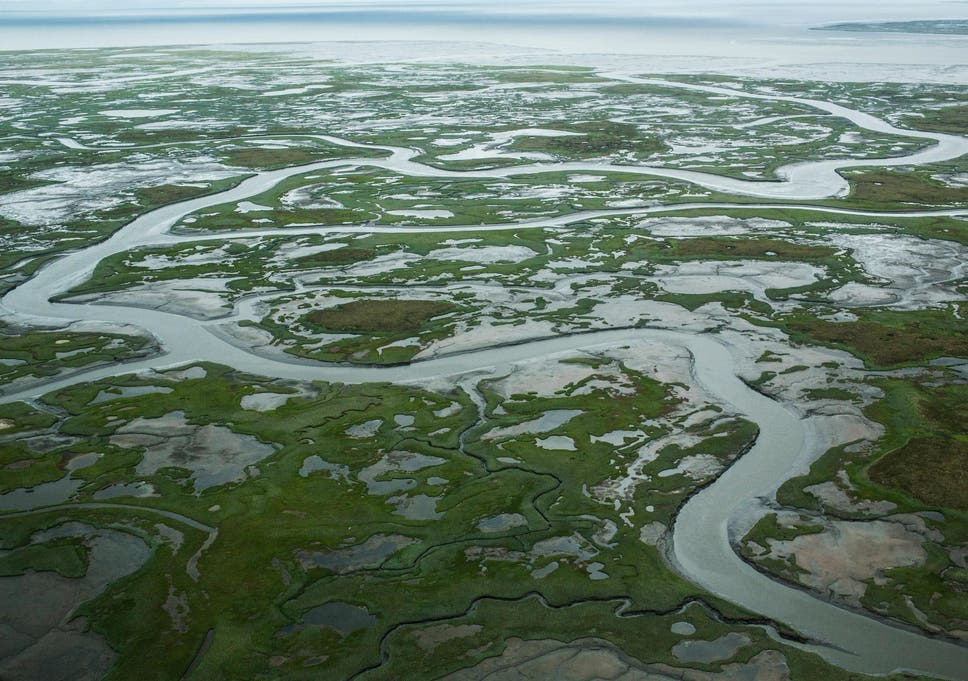
Spectacular? Not Really. The fall foliage season is increasingly pastel, washed out, as on Virginia’s Blue Ridge Mountains pictured here. The culprit is that visible, constant pall of pollution. (National Park Service Photo)
A long-time friend of, and commenter on, The Daily Impact, Gail Zawacki, has for years maintained a lonely vigil on behalf of trees. On her blog. Wit’s End, she chronicles the massive, mortal harm being done to trees all over the world by air pollution. They are, in fact, slowly dying, a fact that should be most strikingly obvious to everyone in the fall, when by the tens of thousands we drive our emissions-rich cars long distances to see the fall colors. Which, increasingly, aren’t there any more. In part because of the emissions from our cars. Yet no one (except Gail) seems able to see the sick trees for the pale forest.
Here’s a sampling of explanations offered by writers, broadcasters and bloggers throughout the Northeastern United States this year for the pathetic showing of the fall leaves:
  • “The deep reds didn’t appear this year, I think it was the lack of a killer frost.” — Vermont
  • “I was surprised how the the colors of the foliage on the Blue Ridge and in many areas of the [Shenandoah] Valley are fairly dull in color. Maybe it was the abnormally dry period before the deluge.” — Virginia
  • “A hard frost early in the season tends to turn the leaves brown,” says an AccuWeather meteorologist. “On the other hand, [you don’t want it to be] too warm; you want a bit of frost that tends to bring out the brighter colors.”
  • “The other factor besides dry was the cicadas which chomped branches and nutrients back in June.” — Virginia
  • “It does seem that maybe our extended dry stretch was a bit too much then mix that with the rainy stretch and you’ve got some issues.” — Virginia
  • “The best fall color for an area occurs during the shortening days of autumn when days are bright, sunny and cool, when nights are cool but not below freezing, and when there has been ideal rainfall.” — Maryland
So, to sum up then, the problem of the washed-out colors is caused by frost, or lack of frost; rain, or lack of rain, or too much rain, or too little rain for too long followed by too much; or cicadas.
The problem and its cause matter. Set aside for the moment the enormous wound to the living web of life that sustains us all that this represents. It should matter even to industrialists; the U.S. Forest Service estimates that fiery foliage generates $8 billion in tourism revenue annually for New England alone. Foliage season is so important to Vermont that the state employs a leaf forecaster. States throughout the eastern United States avidly harvest tourist dollars every fall foliage season. So they should want to know why the colors are washing out.
Gail Zawacki is trying to tell them:
“The trees are dying from air pollution. It’s a global issue. Trees absorb ozone through their leaves when they photosynthesize and it damages the stomates, because ozone is a highly reactive gas and especially toxic to vegetation. You can’t see ozone, but the background level is inexorably increasing in the lower atmosphere, as more and more precursors are emitted and travel around the world. When plants are injured from repeated, cumulative exposure they lose natural immunity to insects, disease and fungus. It’s a huge problem well known to scientists and agronomists, but they don’t like to publicize it because the only way to deal with it is to drastically curtail fuel emissions and agricultural chemicals.”
Industry is like Aesop’s scorpion, who stings to death the frog carrying him across a stream, thus ensuring his own death, because, he explains with his last breath, “It’s my nature.”

Thursday, October 10, 2013

Diesel exhaust stops honeybees from finding the flowers they want to forage

by environmentalresearchweb, October 7, 2013

Exposure to common air pollutants found in diesel exhaust pollution can affect the ability of honeybees to recognise floral odours, new University of Southampton research shows.
Honeybees use floral odours to help locate, identify and recognise the flowers from which they forage.
The Southampton team, led by Dr Tracey Newman and Professor Guy Poppy, found that diesel exhaust fumes change the profile of flora odour. They say that these changes may affect honeybees’ foraging efficiency and, ultimately, could affect pollination and thus global food security.
Published in Scientific Reports (3 October 2013) the study mixed eight chemicals found in the odour of oil rapeseed flowers with clean air and with air containing diesel exhaust. Six of the eight chemicals reduced (in volume) when mixed with the diesel exhaust air and two of them disappeared completely within a minute, meaning the profile of the chemical mix had completely changed. The odour that was mixed with the clean air was unaffected.
Furthermore, when the researchers used the same process with NOx gases (nitric oxide and nitrogen dioxide), which is found in diesel exhaust, they saw the same outcome, suggesting that NOx was a key facilitator in how and why the odour’s profile was altered. The changed chemical mix was then shown to honeybees, which could not recognise it.
Dr Newman, a neuroscientist at the University, comments: “Honeybees have a sensitive sense of smell and an exceptional ability to learn and memorize new odours. NOx gases represent some of the most reactive gases produced from diesel combustion and other fossil fuels, but the emissions limits for nitrogen dioxide are regularly exceeded, especially in urban areas. Our results suggest that that diesel exhaust pollution alters the components of a synthetic floral odour blend, which affects the honeybee’s recognition of the odour. This could have serious detrimental effects on the number of honeybee colonies and pollination activity.”
Professor Poppy, an ecologist at the University, adds: “Honeybee pollination can significantly increase the yield of crops and they are vital to the world’s economy - £430 million a year to the UK alone. However to forage effectively they need to be able to learn and recognize the plants. The results indicate that NOx gases — particularly nitrogen dioxide — may be capable of disrupting the odour recognition process that honeybees rely on for locating floral food resources. Honeybees use the whole range of chemicals found in a floral blend to discriminate between different blends, and the results suggest that some chemicals in a blend may be more important than others.”

Sunday, September 22, 2013

David Spratt: Is climate change already dangerous? Part III. Consequences from current greenhouse gas levels

by David Spratt, Climate Code Red, September 22, 2013

Third in a series

Danger from implied temperature increase


The current level of atmospheric CO2 only is sufficient to increase the global temperature at equilibrium by +1.5 °C, based on the standard assumption of near-term climate sensitivity of 3 °C for doubled CO2.

If all current greenhouse gases are taken into account, then: 
The observed increase in the concentration of greenhouse gases (GHGs) since the pre-industrial era has most likely committed the world to a warming of 2.4 °C (within a range of +1.4 °C to +4.3 °C) above the pre-industrial surface temperatures (Ramanthan and Feng).
And the 2007 IPCC Synthesis report (Table 5.1 on emission scenarios) also shows that for levels of greenhouse gases that have already been achieved (CO2 in the range of 350–400 ppm, CO2e in the range 445–490 ppm) and peaking by 2015, the likely temperature rise is in the range of 2–2.4 °C. 

These scenarios include short-lived gases such as methane, which degrades out of the atmosphere in a decade, and also nitrous oxide, which has an atmospheric lifetime of around a century. On the other hand, the fact that temperatures are not already much higher than they are today is due principally to the large-scale emission of very short-lived (10 days) aerosols, such as soot and exhaust from burning fossil fuels, industrial pollution, and dust storms, which are providing temporary cooling. The effect is known popularly as “global dimming,” because the overall aerosol impact is to reduce, or dim, the sun’s radiation, thus masking some of the heating effect of greenhouse gases. The aerosol impact is not precisely known, but Ramanthan and Feng estimate it as high as ~1 °C. As the world moves to low-emission technologies, most of the aerosols and their temporary cooling will be lost. Recent research finds that quickly eliminating all greenhouse gas emissions (and necessarily the associated aerosols) would produce warming of between 0.25 and 0.5 °C over the decade immediately following (Matthews and ZickfieldHansen, Sato et al.).

A practical consideration of “dangerous” can include the question as to whether there are tipping points or “concerns” activated for the elevated temperatures that we are generally considered to be already committed to: conservatively in the range say +1.5 to 2 °C and, more pragmatically, in the range of 2 to 2.4 °C if all current greenhouse gases are considered. A related question is whether the +1.5 °C goal advocated by the small island states and surveyed recently by Climate Action Network Europe and Climate Analytics would avoid “dangerous” climate change and significant tipping points.

This is a broad topic, but four recent important research findings on impacts for the current committed warming are arresting:

Greenland Ice Sheet tipping point

The tipping point for GIS has been revised down by Robinson, Calov et al. to +1.6 ºC (uncertainty range of +0.8 to +3.2 ºC) above pre-industrial, just as regional temperatures are increasing at three-to-four times faster than the global average, and the increased heat trapped in the Arctic due to the loss of reflective sea ice ensures an acceleration in the Greenland melt rate.  If the lower Greenland boundary in the uncertainty range turned out to be right, then with current warming of +0.8 ºC over pre-industrial we have already reached Greenland’s tipping point.  And, with temperature rises in the pipeline, the upward trajectory of annual greenhouse gas emissions, the projected future increases in fossil fuel use, and the continuing political impasse in international climate negotiations, we are very likely to hit the best estimate of +1.6 ºC within a decade or two at most.

Coral reefs

Frieler, Meinshausen et al. show that “preserving more than 10 per cent of coral reefs worldwide would require limiting warming to below +1.5 °C (atmosphere–ocean general circulation models (AOGCMs) range: 1.3–1.8 °C) relative to pre-industrial levels”.  Obviously at less than 10 per cent, the reefs would be remnant, and reef systems as we know them today would be a historical footnote.  Already, the data suggests that the global area of reef systems has already been reduced by half. A sober discussion of coral reef prospects can be found in Roger Bradbury’s “A World Without Coral Reefs” and Gary Pearce’s “Zombie reefs as a harbinger for catastrophic future.”  The opening of Bradbury’s article is to the point: 
It’s past time to tell the truth about the state of the world’s coral reefs, the nurseries of tropical coastal fish stocks.  They have become zombie ecosystems, neither dead nor truly alive in any functional sense, and on a trajectory to collapse within a human generation.  There will be remnants here and there, but the global coral reef ecosystem — with its storehouse of biodiversity and fisheries supporting millions of the world’s poor — will cease to be.
3c. Arctic carbon stores

As Climate Progress recently noted: “We’ve known for a while that ‘permafrost’ was a misnomer” because thawing permafrost feedback will turn the Arctic from a net carbon sink to a net source in the 2020s and defrosting permafrost will likely add up to 1 ºC to total global warming by 2100.   A 2012 UNEP report on policy implications of warming permafrost says the recent observations “indicate that large-scale thawing of permafrost may have already started.”  In February 2013, scientists using radiometric dating techniques on Russian cave formations to measure historic melting rates warned that a +1.5 ºC global rise in temperature compared to pre-industrial was enough to start a general permafrost melt.  Vaks, Gutareva et al. found that “global climates only slightly warmer than today are sufficient to thaw extensive regions of permafrost.” Vaks says that: “1.5 ºC appears to be something of a tipping point.”

Previously a study of East Siberian permafrost by Khvorostyanov, Ciais et al.  found that once mobilised, the process would be self-maintaining due to “deep respiration and methanogenesis” (formation of methane by microbes).  In other words, the microbial action that produces methane as the carbon stores melt would produce sufficient heat to maintain the process: “once active layer deepening in response to atmospheric warming is enough to trigger deep-soil respiration, and soil microorganisms are activated to produce enough heat, the mobilization of soil carbon can be very strong and self-sustainable.”

A sharp scientific debate has started on the stability of large methane clathrate stores just below the ocean floor on the shallow East Siberian Sea, following the publication in July 2013 of research by Whiteman, Hope and Wadhams which said that the release of a single giant “pulse” of methane from thawing Arctic permafrost beneath the East Siberian Sea could come with a $60 trillion global price tag. Wadhams says “the loss of sea ice leads to seabed warming, which leads to offshore permafrost melt, which leads to methane release, which leads to enhanced warming, which leads to even more rapid uncovering of seabed,” and this is not “a low probability event.”

Multiple targets reduce allowable warming

Steinacher, Joos et al. explore the interaction of targets in emissions reductions, focusing on the 2 ºC temperature goal. They find that when multiple climate targets are set (such as food production capacity, ocean acidity, atmospheric temperature), “allowable cumulative emissions are greatly reduced from those inferred from the temperature target alone.” In fact, “When we consider all targets jointly, CO2 emissions have to be cut twice as much as if we only want to meet the 2 ºC target.”

Lessons from climate history


Another fruitful line of inquiry on whether climate change is already “dangerous” is to look at the paleo-climate (climate history) record for circumstances analogous to present conditions to learn what planetary and climate conditions were like at that time.  With current CO2 levels at 400 ppm, a useful comparison is the Pliocene (3–5 million years ago).  The research body is large and growing in this area, but here are some examples:

Sea-levels

Rohling, Grant et al.  find that during the mid-Pliocene, when greenhouse gases were similar to today, sea levels were more than 20 metres higher than today “we estimate sea level for the Middle Pliocene epoch (3.0–3.5 Myr ago) – a period with near-modern CO2 levels – at 25 ±5 metres above present, which is validated by independent sea-level data.” Likewise Hansen, Sato et al. find that “during the middle-Pliocene… we find sea level fluctuations of 2040 metres associated with global temperature variations between today’s temperature and +3 °C.”

Speed of sea-level rise

The speed of sea-level rise may far exceed the current, rather reticent estimates that are used for policy purposes.  Blancon, Eisenhauer et al. examined the paleo-climate record and showed a sea-level rises of 3 metres in 50 years due to the rapid melting of ice sheets 123,000 years ago in the Eemian, when the energy imbalance in the climate system was less than at present. 

Polar feedbacks

Hansen, Sato et al. find that current temperatures are at least as high as the Holocene Maximum (i.e., as high as they have been over the last 10,000 years).  They sum up: 
Earth at peak Holocene temperature is poised such that additional warming instigates large amplifying high-latitude feedbacks.  Mechanisms on the verge of being instigated include loss of Arctic sea ice, shrinkage of the Greenland ice sheet, loss of Antarctic ice shelves, and shrinkage of the Antarctic ice sheets.  These are not runaway feedbacks, but together they strongly amplify the impacts in polar regions of a positive (warming) climate forcing…  Augmentation of peak Holocene temperature by even +1 ºC would be sufficient to trigger powerful amplifying polar feedbacks, leading to a planet at least as warm as in the Eemian and Holsteinian periods, making ice sheet disintegration and large sea level rise inevitable.
[It is relevant here to note that warming in the pipeline due to thermal inertia, plus warming associated with the loss of aerosols, is greater than +1ºC.]

And during the Pliocene, with atmospheric greenhouse levels similar to today, the northern hemisphere was free of glaciers and ice sheets and beech trees grew in the Transantarctic Mountains. There are also strong indications that permanent El Nino conditions prevailed.

4d. Arctic carbon stores

As discussed above, scientists using radiometric dating techniques on Russian cave formations to measure historic melting rates going back 500,000 years conclude that a +1.5 ºC global rise in temperature compared to pre-industrial is enough to initiate widespread permafrost melt.  

In May this year, Brigham-Grette, Melles et al. published evidence from Lake El’gygytgyn, in north-east Arctic Russia, showing that 3.6–3.4 million years ago, summer mid-Pliocene temperatures locally were ~8 °C warmer than today, when CO2 was ~400 ppm.  This is highly significant because researchers including Celia Bitz and Philippe Ciais have previously found that the tipping point for the large-scale loss of permafrost carbon is around +8 ºC  to 10 ºC regional temperature increase.  Caias told the March 2009 Copenhagen climate science conference that: “A global average increase in air temperatures of +2 ºC and a few unusually hot years could see permafrost soil temperatures reach the +8 ºC threshold for releasing billions of tonnes of carbon dioxide and methane.” So, if the current level of greenhouse gases is enough to produce Arctic regional warming of ~+8 °C and that is a likely tipping point for large-scale permafrost loss, we have reached a disturbing milestone.

Even more disturbing is new research from Ballantyne, Axford et al. which says that during the Pliocene epoch, when CO2 levels were ~400 ppm, Arctic surface temperatures were 1520 °C warmer than today’s surface temperatures. They suggest that much of the surface warming likely was due to ice-free conditions in the Arctic. Compared to the estimated tipping point for the large-scale loss of permafrost carbon of +8 ºC to 10 ºC regional warming, this research confirms both that the current level of greenhouse gases is sufficient to create both a sea-ice-free Arctic and Arctic warming more than sufficient to trigger large-scale loss of permafrost carbon.
Next post: Climate safety and the emissions reduction challenge 
http://www.climatecodered.org/2013/09/is-climate-change-already-dangerous-3.html 

Thursday, May 9, 2013

"Contrail ice particles in aircraft wakes and their climatic importance," by Ulrich Schumann et al., GRL (2013); doi:10.1002/grl.50539

Geophysical Research Letters, in press; doi:10.1002/grl.50539

Contrail ice particles in aircraft wakes and their climatic importance

  1. Ulrich Schumann1,*
  2. Philipp Jeßberger1, and 
  3. Christiane Voigt1,2
Abstract


Measurements of gaseous (NO, NOy, SO2, HONO) and ice particle concentrations in young contrails in primary and secondary wakes of aircraft of different sizes (B737, A319, A340, A380) are used to investigate ice particle formation behind aircraft. The gas concentrations are largest in the primary wake and decrease with increasing altitude in the secondary wake, as expected for passive trace gases and aircraft-dependent dilution. In contrast, the measured ice particle concentrations were found larger in the secondary wake than in the primary wake. The contrails contain more ice particles than expected for previous black carbon (soot) estimates. The ice concentrations may result from soot induced ice nucleation for a soot number emission index of 1015 kg-1. For a doubled ice particle concentration in young contrails, a contrail cirrus model computes about 60% increases of global radiative forcing by contrail cirrus because of simultaneous increases in optical depth, age and cover.

http://0-onlinelibrary.wiley.com.library.hct.ac.ae/doi/10.1002/grl.50539/abstract

Wednesday, January 30, 2013

MoJo: The surprising connection between fracking and food

by Tom Philpott, Mother Jones, January 29, 2013

A farmer spreads synthetic nitrogen fertilizer on a field. e
In a recent Nation piece, the wonderful Elizabeth Royte teased out the direct links between hydraulic fracturing, or fracking, and the food supply. In short, extracting natural gas from rock formations by bombarding them with chemical-spiked fluid leaves behind fouled water—and that fouled water can make it into the crops and animals we eat.
But there's another, emerging food/fracking connection that few are aware of. US agriculture is highly reliant on synthetic nitrogen fertilizer, and nitrogen fertilizer is synthesized in a process fueled by natural gas. As more and more of the US natural gas supply comes from fracking, more and more of the nitrogen fertilizer farmers use will come from fracked natural gas. If Big Ag becomes hooked on cheap fracked gas to meet its fertilizer needs, then the fossil fuel industry will have gained a powerful ally in its effort to steamroll regulation and fight back opposition to fracking projects.


The potential for the growth of fracked nitrogen (known as "N") fertilizer is immense. During the 2000s, when conventional US natural gas sources were drying up and prices were spiking, the US fertilizer industry largely went offshore, moving operations to places like Trinidad and Tobago, where conventional natural gas was still relatively plentiful. (I told that story in a 2010 Grist piece.) This chart from a 2009 USDA doc illustrates how rapidly the US shifted away from domestically produced nitrogen in the 2000s.
It was the N of the era: In the 2000s, nitrogen production moved offshore as US natural gas prices rose. Source: USDA
Today, Trinidad and Tobago, an island nation off the coast of Venezuela and our leading source of imported N, is in the same position the US found itself in the early 2000s: Its supply of conventional, easy-to-harvest natural gas is wearing thin. In 2012, the International Monetary Fund estimated (PDF) that at current rates of extraction, the nation had sufficient natural gas reserves to last until just 2019.
Meanwhile, the fracking boom has made US natural gas suddenly abundant—and driven prices into the ground. A Btu of US natural gas now now costs 75 percent less than it did in 2008, the New York Times recently reported. Meanwhile, nitrogen fertilizer prices remain stubbornly high, propped up by strong demand driven by high crop prices. Those conditions—low input prices plus elevated prices for the final product—mean a potential profit bonanza for companies that use cheap US natural gas to make pricy N fertilizer for the booming US market.
Not surprisingly, as Kay McDonald of the excellent blog Big Picture Agriculture shows, the industry is starting to move back to the United States to take advantage of the fracking boom. McDonald points to a $1.4 billion project announced in September by the Egyptian company Orascom Construction Industries to build a large new nitrogen fertilizer plant in Iowa close to a natural gas pipeline. According to the Wall Street Journal, "cheap U.S. natural-gas supplies and the nation's role as the world's most important food exporter" drew the Egyptian giant into the US market.
Fertilizer giant CF Industries won more than $70 million in tax incentives from the the state, and $161 million in property taxes over 20 years from the county that houses the plant.
That same month, US-owned agribusiness cooperative CHS announced it was investing $1.2 billion to build a nitrogen plant in North Dakota. An Associated Press article gave a taste of the potential profits in such an operation: "Natural gas prices are now at about $2.50 per thousand cubic feet. At those prices, it takes about $82 worth of natural gas to make a ton of anhydrous ammonia, which is selling for about $800 per ton."
And then there's US fertilizer giant CF Industries, which in November announced a $3.8 billion expansion of existing nitrogen fertilizer plants in Louisiana and Iowa, a move designed to "take advantage of low natural gas costs and high grain prices," MarketWatch reported.
Now, it should be noted that it isn't just the promise of windfall profits that are driving these investments. Energy prices are highly volatile, and the industry is wary of the risk involved with plunking down billions in hopes of future gain. Enter the taxpayer: These projects are being underwritten by public money at the national, state, and local levels. As a reward for expanding its Iowa plant, CF Industries won more than $70 million in tax incentives from the the state, and $161 million in property taxes over 20 years from Woodbury County, which houses the plant, the Sioux City Journal reports. Louisiana will chip in several million dollars in tax breaks for the company's expansion there, too.
As for Orascom Construction's Iowa plant, it's being financed through a federal loan program designed to help states recover economically from disasters—in this case, Iowa's 2008 floods. The loan program, which gives Orascom access to an interest rate much lower than it would find in the commercial market, is a de facto subsidy—it will likely save the company $360 million in interest payments on the construction, the Des Moines Register reported. And that's on top of $100 million in tax breaks the state of Iowa has committed to the project.
What are taxpayers getting in exchange for these goodies? In my view, not much. Industrial agriculture's reliance on plentiful synthetic nitrogen brings with it a whole bevy of environmental liabilities: excess nitrogen that seeps into streams and eventually into the Mississippi River, feeding a massive annual algae bloom that blots out sea lifeemissions of nitrous oxide, a greenhouse gas 300 times more potent than carbon; and the destruction of organic matter in soil.
By adding a "small grain" (oats or wheat) plus nitrogen-fixing cover crops, farmers can reduce their nitrogen needs by upwards of 80%.
Rather than prop up nitrogen use by subsidizing new megaprojects, public policy could be seeking encouraging farming practices that demand less nitrogen. One obvious strategy is diversification. The most prolific US crop, corn, is also the most nitrogen-intensive among major field crops. In a 2012 paper, researchers from Iowa State University's Leopold Center showed that by extending the typical Midwestern corn-soy crop rotation by adding a "small grain" (e.g., oats or wheat) plus nitrogen-fixing cover crops, farmers can reduce their nitrogen needs by upwards of 80%. Investing in policies that encourage such changes would likely, in the long run, be much smarter than subsidizing the fertilizer industry's move toward relying on fracked gas.
As they fight the expansion of fracking and push for tighter regulations on it, concerned citizens can count on an opponent nearly as powerful and monied as Big Oil: Big Ag. Already, the American Farm Bureau Federation, which essentially acts as a lobbyist for Big Ag firms, supports the controversial energy source: "Farm Bureau supports additional access for exploration and production of oil and natural gas, including the use of hydraulic fracturing," the group declared in an October 2012 policy statement (PDF). But the Farm Bureau and its agribiz allies haven't played much of a role in the fight over regulating fracking, yet. As the fertilizer industry becomes reliant on cheap US natural gas, that will likely change.

Tuesday, December 11, 2012

BBC: Ground-level ozone levels remain high in Europe

Jonathan Amosby Jonathan Amos, Science correspondent, BBC News, San Francisco, December 6, 2012


Chemical reactions that would normally remove ozone have been subdued. Scientists think they have identified one key reason why ground-level ozone remains stubbornly high in Europe.
They say it is the unfortunate but unintended consequence of what have otherwise been very successful efforts to improve air quality.
It turns out the filters put on vehicle exhausts to remove fine particulate material have also unbalanced the chemistry behind ozone formation.
The insight comes from a study looking at London's air quality records.
"Peak ozone levels have come down since the 1990s, but we haven't had the gains we expected on ozone," said Dr Erika von Schneidemesser from the Institute for Advanced Sustainability Studies, Potsdam, Germany.
"The data we've got from monitoring sites in London, and also the modelling work we have done, has helped us understand why ozone has behaved the way it has - at least in London," she told BBC News.
Dr von Schneidemesser was speaking here at the American Geophysical Union (AGU) Fall Meeting, the world's largest annual gathering of Earth scientists.
Disturbed cycle
Ozone in the lower atmosphere (troposphere) is regarded as a serious pollutant that can cause respiratory problems, and even damage masonry and agricultural crops.
The principal originating source is the emissions from road vehicles. These include the exhaust gases such as nitrogen oxides (NOx), non-methane volatile organic compounds (NMVOCs), and carbon monoxide (CO).
Ozone is the product of these gases' participation in a complex series of chemical reactions where sunlight and heat act as catalysts. Summer months are generally worse for O3.
They found that although the ozone precursors have been falling, the ratio of two NOx gases in the atmosphere has changed.Dr von Schneidemesser and colleagues used the data from London's dense network of air quality monitoring sites to try to assess the performance of the ozone-producing reactions over the past 15 years.
In constant conditions, there is a neat cycle in which nitrogen dioxide (NO2) helps to form ozone and nitric oxide helps to break it apart. This cycle appears to have been perturbed by control measures that were actually intended to remove the fine particles and black carbon (soot) in vehicle exhausts.
The measures achieved the desired outcome but also altered the relative emissions of the different NOx gases.
"There's this balance between the NO and nitrogen dioxide NO2, and the diesel filters that we've been retrofitting on to things like buses mean that we now have a larger amount of primary NO2 and so you get a reduction in NO that is much greater than the reduction in NO2. This means basically you are taking away some of the ozone suppression," said Dr von Schneidemesser, who is also affiliated to the University of Leicester, UK.
Whereas NO in the atmosphere has been reducing by 5-20% per year, NO2 has been falling by just 1-5% per year.
"As these levels continue to go down, we should then eventually see a reduction in ozone. It's just that the initial steps have had the opposite effect."
Nitrogen oxidesNitrogen oxides are produced from many sources including power stations, motor vehicles, and industrial and domestic heating systems
Further work is required, but the researchers' suspicion is that London's experience is not unique.
The big traffic-choked cities of Europe will all suffer from similar emissions inventories. The one rider here is that southern European cities will have more sunlight and heat to drive ozone producing reactions.
But the London observations are unlikely to be the whole story. Scientists say it's also that European ozone levels are being influenced by what is happening in other regions of the world.
"There is an import of ozone and precursors from outside, and this influences what we call background ozone; and that's going up as global pollutants, particularly in Asia, go up. And that's affecting European ozone levels," explained co-worker Prof Paul Monks at the University of Leicester.
"So, for something like ozone, we've probably got to move to a more global treaty-like situation. We've got to look at control measures in other countries as well as our own.
"Peak ozone has gone down since the 1990s, but it has bottomed out now; and it's remaining fairly flat despite emissions reductions."
Image of the ozone cycle
Ozone's NOx cycle
(1) The Sun's ultraviolet light breaks oxygen atoms off nitrogen dioxide molecules
(2) Oxygen atoms then react with oxygen molecules in the air to produce the ozone
(3) But ozone is destroyed by nitric oxide, reforming molecular oxygen and nitrogen dioxide