Blog Archive

Showing posts with label witch hunt. Show all posts

Sunday, October 11, 2015

New Witchhunt by GOP Lamar Smith (R-TX) initiates witchhunt against climate scientist who urged investigation of ExxonMobil for lying to the public and investors about climate change

Jagadish Shukla will be questioned by a Congressional committee after he and other scientists called for a racketeering probe of deliberate climate denial.


Rep. Lamar Smith (R-TX) announced he will be launching an investigation into a climate scientist who helped organize a call for a federal investigation of the fossil fuel industry. Credit: Lamar Smith/Facebook

A climate scientist who was the lead signatory on a letter urging President Obama to launch a federal investigation into whether fossil fuel companies "knowingly deceived the American people about the risks of climate change" is now facing an investigation by Congress because of his part in the letter.

Jagadish Shukla, a climate scientist at George Mason University in Virginia, received notice Oct. 1 that the non-profit research organization he runs, the Institute of Global Environment and Society (IGES), will soon be investigated by the House Committee on Science, Space and Technology for suspected misuse of federal funding.

Republican Rep. Lamar Smith of Texas, who chairs the House committee, requested that Shukla and IGES "preserve all e-mail, electronic documents, and data (‘electronic records’) created since January 1, 2009," according to the notice.

The investigation stems from Shukla's involvement in the letter to President Obama, Attorney General Loretta Lynch and White House science advisor John Holdren on Sept. 1. The letter's 20 signees—climate scientists from Columbia University, the National Center for Atmospheric Research, the University of Maryland and other institutions—asked the administration to explore whether energy companies could be prosecuted under the Racketeer Influenced and Corrupt Organizations Act (RICO) of 1970 for purposefully casting doubt on the scientific evidence for climate change. Federal prosecutors used the RICO Act in the 1990s and 2000s to sue tobacco companies for covering up the health impacts of smoking. ScienceInsider first reported Smith's investigation.

Shukla's research organization, IGES, posted a copy of the RICO letter to its website—a move that Smith told Shukla "raises serious concerns" over a taxpayer-funded scientific group "participating in partisan political activity." The research center has received funds from the National Science Foundation, National Oceanic and Atmospheric Administration and NASA.

"Promoting a lobbying effort and publicizing that effort on a website is not an appropriate use of federal research funds," an aide for the House Science, Space and Technology Committee told InsideClimate News.

"Additional questions have been raised regarding the fiscal management of federal grant dollars received by IGES and the transfer of IGES to George Mason University," the aide said. The committee will be looking into the salaries of Shukla and his wife Anastasia, who works as the organization's business manager.

"I signed this letter as a private citizen on personal time, urging action on climate change, and I have been shocked by the reaction," Shukla told InsideClimate News. "Any allegations of inappropriate behavior are untrue."

IGES said the letter was posted on its website inadvertently. It has since been removed.

"IGES's recent decision to remove documents from its website raises concerns that additional information vital to the Committee's investigation may not be preserved," Smith wrote. Smith informed Shukla he and his colleagues had until Oct. 8 to inform the House Committee on how IGES would comply with the request.

"The House Science Committee isn’t going after Dr. Shukla and his colleagues for their scientific work, but for their opinions as private citizens," said Michael Halpern, program manager of the Center for Science and Democracy at the Union of Concerned Scientists. "Scientists have the same right as anyone to engage in the political process and express their beliefs without fear of being hauled before Congress for their views." 

A History of Inquiries


Smith's investigation is just the latest in a long line of probes into climate scientists by conservative politicians. In 2005, Republican Rep. Joe Barton of Texas, who was then Chair of the House Committee on Energy and Commerce, examined the work of climate scientists Michael Mann of Penn State and Ray Bradley of the University of Massachusetts. Over the last decade, the scientific community has had to field an increasing number of public records requests from conservative groups looking to cast doubt on their research.

"Overall, scientists whose work is policy relevant are certainly under more scrutiny than ever before through a variety of means, from subpoenas to open records requests, and need to be prepared to respond to that scrutiny," said Halpern. Such investigations, he said, "can send the wrong message to researchers about how valuable their expertise is to society. We need scientists to engage in public conversations on science-based issues, no matter how contentious the topic." 

The biggest difference between Smith's investigation today and the one Mann and Bradley faced in 2005, Mann said, is that "back then, there were a number of moderate pro-science, pro-environment Republicans who came to my defense. Chief among them was Sherwood Boehlert—an old-school Republican from upstate New York."

"Unfortunately, we no longer have moderate republicans like Boehlert chairing the House science committee," said Mann.

Shukla and his colleagues' letter was sent three weeks before an eight-month investigation by InsideClimate News showed that ExxonMobil's own research confirmed fossil fuels' role in climate change in the 1970s and 1980s. The company then spent the next two decades funding a campaign to derail climate regulations and question climate science.

"If corporations in the fossil fuel industry and their supporters are guilty of the misdeeds that have been documented in books and journal articles, it is imperative that these misdeeds be stopped as soon as possible," Shulka and the other climate scientists wrote in the letter.

Holdren wrote back to the researchers that "the [Obama] administration shares the concern expressed in the letter about the seriousness of the threat posed by climate change," according to ScienceInsider.

ScienceInsider also reported that Shulka is not the only signatory of the letter facing backlash. Attorney Christopher Horner, a senior fellow at the Competitive Enterprise Institute, a Washington, DC-based libertarian think tank [funded by fossil-fuel interests], filed a public records request with several of the signatories' universities for emails contained the words "RICO, racketeer, racketeering, DOJ, prosecute or prosecution."

"If they believe this is part of their job, we will not dispute that, but instead would like to see how the institutions were used in this innovative application of public education resources," Horner told ScienceInsider.

Saturday, April 7, 2012

BOEM Inspector General's Office wastes millions of tax payer dollars in witch hunt instigated by Sen. Inhoax Inhofe against Arctic researcher, Charles Monnett -- in the meantime, Arctic polar bears are turning up with same mysterious disease with bloody skin lesions that has been killing sea lions and walruses

Arctic science probe looking more like witch hunt

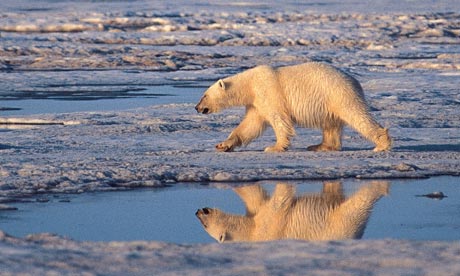
Polar bears in the Arctic. PHOTO COURTESY USGS.
Long-running investigation appears to be heading nowhere
SUMMIT COUNTY — Federal investigators last week continued to pursue what looks more and more like a witch hunt against scientists who are researching Arctic ecosystems by interviewing new witnesses.
The investigation, which has changed course and shifted shape several times since 2010, is now looking at data from a long-running bowhead whale survey program, but the main effect has been to leave some federal scientists fearful about potential career risks associated with overseeing Arctic Research projects, according to a whistle-blower protection and watchdog group.
“The lengths of this discredited probe suggest a vendetta rather than a fair-minded inquiry,” said Public Employees for Environmental Ethics director Jeff Ruch. PEER is providing legal representation for Charles Monnett and Jeffrey Gleason, the two researchers at the center of the probe. “Though I did not think it possible, this fishing expedition has managed to become even more attenuated and absurd,” Ruch said.
The Interior Department’s inspector general started the probe in 2010, after the scientists observed drowned polar bears in open Arctic waters, which led them to author a short article in the peer-reviewed journal Polar Biology.
PEER released part of an email that suggests the IG investigators are trying to determine whether  dead polar bears were documented in the Bowhead whale survey database between 1987- 2003. According to Ruch, the investigation is an apparent attempt to show that sightings of four drowned polar bears following a storm in 2004 was not remarkable.
According to PEER, the IG involvement has made scientists leery of criminalizing the peer review process in publishing research.  It has also made scientists who are overseeing research contracts uneasy, as well.  One side-street of the IG investigation looked at a polar bear study by the University of Alberta.  The IG raised issues about how the scientific merits of contracts were reviewed and approved.
Colleagues defended Dr. Monnett’s actions in the Alberta study and in overseeing a sizeable portfolio of Arctic research.  They confronted then-Bureau of Ocean Energy Management & Enforcement (BOEM) Michael Bromwich in asking him to provide some clarity.  Bromwich asked for a review which came back to him in late October 2011.  That review found “inconsistent guidance,” unclear delegation of authority, fear of signing invoices and a host of other impediments to a robust science program unresolved. Bromwich, who just opened a “crisis management” firm, left without addressing any of the requested reforms, leaving problems to fester from continued inattention.
“This seemingly endless review has needlessly disrupted the lives of the affected scientists and their work,” said Ruch, explaining that the IG has consistently refused to lay out specific charges for the scientists to rebut.
“If the Office of Inspector General cannot come to a point after more than two years, how many more years will it take to wrap this up?” Ruch concluded.

Thursday, April 5, 2012

Climate criminal Sen. James InHoax Inhofe's tax-money-wasting investigation (witch hunt) into polar bear study by Charles Monnett continues, scraping the barrel to once again find nothing, although perhaps after all this time "agent" Eric May may have learned how to calculate percentages (does the Fed. gov't give remedial arithmetic lessons to its employees?)

Feds Interview New Witnesses In Polar Bear Probe
Two polar bears spar on the shoreline of the Hudson Bay in November 2007.
EnlargePaul J. Richards/AFP/Getty Images
Two polar bears spar on the shoreline of the Hudson Bay in November 2007.
Federal agents interviewed new witnesses this week in an ongoing investigation of government scientists that's been called "polar bear-gate," according to the scientists' lawyer.
The controversial probe, now entering its third year, is looking into allegations of scientific misconduct related to a 2006 report by wildlife researchers Charles Monnett and Jeffrey Gleason, who described seeing dead polar bears floating in Arctic waters.
The apparently drowned bears raised concerns about the effect of melting ice in the Arctic, and they were mentioned in Al Gore's movie An Inconvenient Truth. Critics say the current probe is a witch hunt being conducted because the dead polar bears became potent symbols of climate change.
Earlier this week, the Department of the Interior's Office of Inspector General interviewed employees of the National Marine Mammal Laboratory in Seattle, says Jeff Ruch of Public Employees for Environmental Responsibility, who is providing legal representation for Monnett and Gleason.
Investigators were apparently interested in archived data from aerial surveys of bowhead whales. It was during one of those routine surveys in 2004 that Monnett and Gleason saw four bear carcasses floating in open water, according to their report in the journal Polar Biology. They stated that, in earlier surveys from 1987-2003, "no dead and floating polar bears were observed."
In January, special agent Eric May wrote an email to John Bengtson, the director of the National Marine Mammal Laboratory, and listed some questions he wanted to ask about the historical database on the whale surveys: "Specifically, we need to determine if dead polar bears were documented in the BWASP database between 1987-2003?" The email was obtained by PEER through the Freedom of Information Act.
Bengtson, when asked in late March about being contacted by the inspectors, told NPR via email, "Because this is an ongoing investigation, I have been advised that it would be inappropriate for me to respond to your questions."
The recent inquires by the Office of Inspector General suggest that the investigation remains focused on the scientific integrity of the polar bear paper, after veering into questions about whether Monnett violated laws that govern the management of federal contracts. Ruch has said his client's actions related to contracts were consistent with standard procedures in his office. The scientific integrity allegations regarding the journal article stem from a complaint made by a Department of the Interior employee in March of 2010, according to an August 2011 letter from the Office of Inspector General to Sen. James Inhofe, R-Okla., who had requested information on the probe.
The letter noted that although the office would like to be able to respond to allegations made by PEER and other outside entities, it could not do so until the investigation was complete, because to do otherwise would be unfair to all parties involved.
"As we have done in many previous cases, we will issue our final Report of Investigation only when the investigation is complete, regardless of notoriety or public pressure," the letter stated.

http://www.npr.org/2012/04/05/150075321/feds-interview-new-witnesses-in-polar-bear-probe

Sunday, August 28, 2011

Brian Angliss: NSF confirms results of Penn State investigation, exonerates Michael Mann of research misconduct


NSF confirms results of Penn State investigation, exonerates Michael Mann of research misconduct

by , Scholars & Rogues, August 27, 2011 


First in a series:


As a result of the illegal publication of CRU climate emails, the Pennsylvania State University (PSU) conducted an inquiry and investigation into allegations of research misconduct by Professor Michael Mann. The University exonerated Mann of all four allegations in July 2010, but the National Science Foundation Office of Inspector General (OIG) reviews such investigations for completeness and correctness. On August 15, 2011, the OIG released the results of their own review, agreeing with all of the conclusions of the PSU investigation and subsequently acquitting Mann of all the allegations of research misconduct made against him.


PSU published the results of an their internal investigation into alleged research misconduct by climatologist Michael Mann on July 1, 2010. As S&R reported, the university’s conclusions were that Mann did not falsify data over the course of his research, that he did not destroy any emails in possible breach of the Freedom of Information Act, that he did not misuse his position or abuse confidentiality agreements, and that he did not deviate from accepted practices of conduct for his field.


As required by law, PSU reported their results to the OIG for independent review. The OIG’s review was completed and closed on August 15, 2011, with the OIG writing:
Finding no research misconduct or other matter raised by the various regulations and laws discussed above, this case is closed.
The conclusion – that Mann is acquitted of research misconduct – is obviously significant. But the details in the OIG closeout memo are important because of what they show about the original PSU investigation. Specifically, the OIG closeout memo shows that the critics who labeled the PSU investigation a “whitewash” were wrong.


When the OIG received the inquiry and investigation reports from PSU, they reviewed the reports and a significant amount of additional documentation that PSU provided upon request. Based on the OIG’s review, they “were satisfied that the University adequately addressed its Allegations 3 and 4 (misusing privileged information and serious deviation from accepted practices).” The OIG also concluded that neither of these issues rose to the level of research misconduct as defined by the NSF Research Misconduct Regulation, 45 CFR §689.


The OIG also independently reviewed Mann’s emails and PSU’s inquiry into whether or not Mann deleted emails as requested by Phil Jones in the “Climategate” emails (aka Allegation 2). The OIG concluded after reviewing the the published CRU emails and the additional information provided by PSU that “nothing in [the emails] evidenced research misconduct within the definition of the NSF Research Misconduct Regulation.” 


Furthermore, the OIG accepted the conclusions of the PSU inquiry regarding whether Mann deleted emails and agreed with PSU’s conclusion that Mann had not.


The OIG did conclude that PSU didn’t meet the NSF’s standard for investigating the charge of data falsification because PSU “didn’t interview any of the experts critical of [Mann's] research to determine if they had any information that might support the allegation.” As a result, the OIG conducted their own independent investigation, reviewing both PSU’s documentation, publicly available documents written about Mann and his co-researchers, and “interviewed the subject, critics, and disciplinary experts” in reaching their conclusions. The details of what publicly available documents were reviewed and whom among Mann’s critics were interviewed is not mentioned in the closeout memo.


The OIG concluded as a result of their additional investigation that:
  1. [Mann] did not directly receive NSF research funding as a Principle Investigator until late 2001 or 2002.
  2. [Mann's] data is documented and available to researchers.
  3. There are several concerns raised about the quality of the statistical analysis techniques that were used in [Mann's] research.
  4. There is no specific evidence that [Mann] falsified or fabricated any data and no evidence that his actions amounted to research misconduct.
  5. There was concern about how extensively [Mann's] research had influenced the debate in the overall research field.
Point 1 essentially means that Mann’s work prior to 2001 or 2002 was not subject to NSF review, but that the NSF appears to have reviewed it regardless. Point 2 is significant because one of the allegations of Mann’s critics is that he refused to make his data available – even though the illegally published CRU emails make it clear that Mann had made his data publicly available. Point 5 is an observation on which the OIG offered no additional comment or analysis and is a subject of additional research by S&R.


Point 3 is significant because the OIG addresses this point specifically, writing that there is a lot of debate about “the viability of the statistical procedures [Mann] employed, the statistics used to confirm the accuracy of the results, and the degree to which one specific set of data impacts the statistical results.” But, the OIG says, “these concerns are all appropriate for scientific debate” and that “such scientific debate… does not, in itself, constitute evidence of research misconduct.”


Point 4 is the key conclusion – there is “no specific evidence that [Mann] falsified or fabricated any data” as some of his more vocal critics have contended. The OIG reached this conclusion after interviewing Mann’s critics, after reviewing the CRU emails, and after reviewing other “publically available documentation concerning both [Mann's] research and parallel research conducted by his collaborators and other scientists….” 


Furthermore, the OIG didn’t just limit their investigation to data fabrication as the PSU investigation did – the OIG did a full research misconduct investigation according to the NSF Research Misconduct Regulation. According to this regulation, research misconduct is defined as
fabrication, falsification, or plagiarism in proposing or performing research funded by NSF, reviewing research proposals submitted to NSF, or in reporting research results funded by NSF.
The regulation further define fabrication as “making up data or results” and falsification as “manipulating… or changing or omitting data or results” to lead to false conclusions. 


Mann’s critics have claimed that Mann manipulated the data he used in his papers, but the OIG specifically ruled that this was not the case. After all, the regulation states that “research misconduct does not include honest error or differences of opinion.”


Ultimately the OIG’s review and supplemental investigation agreed on all counts with the PSU inquiry and investigation – Mann did not falsify data, he did not destroy any emails, he did not misuse any privileged information, and he did not deviate from accepted scientific processes.


Other sites reporting on the OIG’s exoneration of Mann:

Joe Romm of ClimateProgress broke the story
Bloomberg
Climate Science Watch
Douglas Fischer at The Daily Climate
Richard Littlemore at DeSmogBlog
James Fallows of The Atlantic
Hank Campbell at Science 2.0
The Policy Lass
Eli at Rabbett Run
Centre Daily Times
Greg Laden at Science Blogs
Scott Mandia
the Unitarian-Universalist United Nations Office
Barry Bickmore
Andy Revkin at DotEarth
TPM Muckraker
The Summit County Voice
Bad Astronomy


Related posts (automated):

  1. PSU investigation clears Michael Mann of final research misconduct charge
  2. Three of four misconduct allegations against Michael Mann found to be without merit (updated)
  3. Experts say alleged PSU cover up of Mann misconduct “extremely unlikely”
  4. Final CRU email review considers, overwhelmingly rejects critics’ accusations of misconduct

Thursday, August 11, 2011

Letter of concern from the American Association of University Professors, American Geophysical Union, Climate Science Watch, and Union of Concerned Scientists to the president of the University of Virginia, Teresa A. Sullivan, wrt the fact that the American Tradition Institute will be allowed to look at all of Dr. Mann's correspondence in violation of the Family Educational Rights and Privacy Act


August 10, 2011 


VIA Fax & E‐‐‐Mail To: 
434‐924‐3792 
president.sullivan@Virginia.EDU 


Teresa A. Sullivan, President 
University of Virginia 
Madison Hall 
P.O. Box 400224 
Charlottesville, VA 22904 


Dear Dr. Sullivan: 

As you know, we are among many organizations and concerned citizens who have followed with great interest the University of Virginia's response to efforts by both Virginia Attorney General Kenneth Cuccinelli and the American Tradition Institute (ATI) to access personal email correspondence and other documents from Dr. Michael Mann and more than thirty other scientists. We appreciate the university’s decision to challenge Mr. Cuccinelli's Civil Investigative Demands. We also appreciate the commitment you made in your April 21, 2011, letter to the American Association of University Professors (AAUP) and other organizations to utilize “all available exemptions” in responding to ATI's request under the Virginia Freedom of Information Act.  

However, we are concerned that the May 24, 2011, agreement between the university and ATI gives ATI needless access to the requested documents. We believe the agreement is in conflict with the university’s previous statements and actions on this issue and that it threatens the principles of academic freedom protecting scholarly research. Furthermore, the agreement cuts against accepted practice in Virginia for responding to open records requests. The university should seek to improve the agreement to better protect scientists from harassment and intimidation. 

We fully embrace the university's responsibility to respond appropriately to open records requests. Freedom of information laws are critical for keeping public institutions and their employees accountable to the people who support them. We also support the university’s equally important obligation to protect its employees' privacy and preserve researchers' ability to privately and freely correspond with one another. 

Unfortunately, the university’s agreement with ATI does not adequately balance these two responsibilities. We find it troubling that the agreement would allow ATI lawyers, including the very individuals who filed the open records request, to review all documents in the university’s possession, including material which will ultimately be exempt from disclosure. While the agreement asserts that ATI representatives would be under a gag order regarding exempt documents, we are concerned that giving requesters this level of access sets an entirely new precedent and would create a chilling effect for current Virginia researchers.  

The established practice in Virginia Freedom of Information Act cases which involve privacy rights is to prepare an indexed summary of potentially exempt documents and the specific exemption that applies. Then, if there remains a dispute over the basis for the exemption, the judge can review the contested records privately, or in camera, and make a ruling without harming any privacy interests. This is the favored practice recommended by the Virginia Supreme Court in Paul C. Bland vs. Virginia State University, 272 Va. 198, 630 S.E.2d 525 (2006).  


Further, there is ample evidence that many if not all of the documents requested by ATI will ultimately be exempt from disclosure. The Washington Post in a May 29, 2011, editorial wrote that, “...a university spokesperson said that U-Va. anticipates that most of the documents at issue will be exempt under a statute that ‘excludes from disclosure unpublished proprietary information produced or collected by faculty in the conduct of, or as a result of, study or research on scientific or scholarly issues.’ ”

Additionally, the Virginia Freedom of Information Advisory Council has issued guidance regarding the working paper” exemption to records requests. This exemption protects from mandatory disclosure the working papers and correspondence of the presidents of Virginia’s public universities and other public officials. Like the scientific research exemption, the working paper exemption is grounded in the interests of privacy and the notion that internal communications and deliberations of public employees are protected to facilitate creativity and the free exchange of ideas.

According to the Advisory Council, “the working papers exemption was designed to provide an unfettered zone of privacy for the deliberative process…a policy determination that protecting decision-making creativity with an ongoing zone of privacy ultimately benefits the public by encouraging the free-flow of ideas by government employees and officials” (AO-17-04). It would be strange, indeed, if your own email correspondence is protected against disclosure but Dr. Mann’s emails are not.

Finally, the university should keep in mind that the agreement risks disclosing emails to ATI among Dr. Mann and his students. As you acknowledged in your letter to AAUP and other groups, the university has a commitment to protect certain correspondence under the Family Educational Rights and Privacy Act.

Moving forward with the agreement as it stands will send scientists at public institutions a message that communicating frankly with colleagues carries significant risk. Therefore, we hope the university will modify its agreement with ATI to adequately protect the privacy of scientists involved and uphold the principles of academic freedom which you have previously articulated.

We look forward to your timely response.


Sincerely yours,


American Association of University Professors
American Geophysical Union
Climate Science Watch
Union of Concerned Scientists


CC: Carol Wood, assistant vice president for public affairs
Richard Kast, associate general counsel
Susan Harris, secretary to the Board of Visitors


http://www.ucsusa.org/assets/documents/scientific_integrity/sullivan-letter-8-10-11.pdf

Union of Concerned Scientists, the American Association of University Professors, the American Geophysical Union and Climate Science Watch sent a letter to the president of the University of Virginia, Teresa A. Sullivan, asking her to not release Dr. Michael Mann's personal e-mails to lawyers from the American Tradition Institute


Groups concerned U.Va. will turn over documents in global warming case

Four groups say they are worried the University of Virginia may unnecessarily disclose private correspondence from scientists in the case involving the work of former professor Michael Mann.


The state’s flagship university has fought requests to release documents under Virginia's freedom of information laws to Attorney General Ken Cuccinelli (R), but the groups say they are now concerned about a May 24 agreement U.Va. made to provide some documents to the American Tradition Institute. Environmental Law Center.
The four groups — the Union of Concerned Scientists, the American Association of University Professors, the American Geophysical Union and Climate Science Watch — sent U.Va. a letter late Tuesday.
“We believe the agreement is in conflict with the university’s previous statements and actions on this issue and it threatens the principles of academic freedom protecting scholarly research,’’ they say in the letter.
U.Va. is slated to respond to the American Tradition Institute around Aug. 20. Carol Wood, a university spokeswoman, did not immediately respond to a message for comment.

In January. the American Tradition Institute asked the university to turn over documents, including e-mails Mann exchanged with other scientists while employed at the university, on behalf of Del. Bob Marshall (R-Prince William) and two other state residents.
The group seeks similar documents to those sought by Cuccinelli using a civil subpoena. The university has been fighting Cuccinelli's demand in court, arguing that his inquiry violates Mann's academic freedom and that the attorney general has singled out Mann because he does not agree with his research findings that the earth has experienced a rapid, recent warming.
Cuccinelli says he wants the documents to explore whether a fraud investigation is warranted. He is using subpoena power given to him under Virginia's Fraud Against Taxpayers Act, which empowers the attorney general to investigate instances in which public employees misuse tax dollars.
A judge in September set aside Cuccinelli's civil investigative demand because it did not state objective reasons why Cuccinelli believed fraud might have taken place. He rewrote the request and remains in litigation with the university over the issue.
Mann, who left the university in 2005 and now works at Pennsylvania State University, has been cleared of wrongdoing by several previous inquiries into his work. His research findings have also been upheld by other scientists.

Marshall made a similar request to U.Va. prior to Cuccinelli's subpoena. The university at first told Marshall it no longer had access to the documents he sought. But in response to Cuccinelli's subpoena, it has acknowledged that it has a backup server that contains some of the records.

Friday, July 29, 2011

Arctic scientist, Charles Monnett, who exposed climate threat to polar bear is suspended [is subject of a witch hunt]. US government conducts 'integrity inquiry' on federal biologist amid lobbying by oil firms for Arctic permits [Shell Oil, who has no spill plan]; Melissa Schwartz appears to flat out lie about what is really going on in her email


Arctic scientist who exposed climate threat to polar bear is suspended

US government conducts 'integrity inquiry' on federal biologist amid lobbying by oil firms for Arctic permits


Charles Monnett's co-paper on the risk of polar bears drowning due to melting Arctic sea ice galvanised campaigners concerned about climate change. Photograph: Subhankar Banerjee/AP
It was seen as one of the most distressing effects of climate change ever recorded: polar bears dying of exhaustion after being stranded between melting patches of Arctic sea ice.
But now the government scientist who first warned of the threat to polar bears in a warming Arctic has been suspended and his work put under official investigation for possible scientific misconduct.
Charles Monnett, a wildlife biologist, oversaw much of the scientific work for the government agency that has been examining drilling in the Arctic. He managed about $50m (£30.5m) in research projects.
Some question why Monnett, employed by the US Bureau of Ocean Energy Management, Regulation and Enforcement (BOEMRE), has been suspended at this moment. The Obama administration has been accused of hounding the scientist so it can open up the fragile region to drilling by Shell and other big oil companies.
"You have to wonder: this is the guy in charge of all the science in the Arctic and he is being suspended just now as an arm of the interior department is getting ready to make its decision on offshore drilling in the Arctic seas," said Jeff Ruch, president of the group Public Employees for Environmental Responsibility (PEER). "This is a cautionary tale with a deeply chilling message for any federal scientist who dares to publish groundbreaking research on conditions in the Arctic."
The group filed an official complaint on Monnett's behalf on Thursday, accusing the government of persecuting the (PDF) scientist andinterfering with his work. It seeks his reinstatement and a public apology.
Monnett was on a research flight tracking bowhead whales, in 2004, when he and his colleagues spotted four dead polar bears floating in the water after a storm. The scientists concluded the bears, though typically strong swimmers, had grown exhausted and drowned due to the long distances between patches of solid sea ice. It was the first time scientists had drawn a link between melting Arctic sea ice and a threat to the bears' survival.
Two years later, Monnett and a colleague published an article [a note] in the science journal Polar Biology, writing: "Drowning-related deaths of polar bears may increase in the future if the observed trend of regression of pack ice and/or longer open water periods continues."
The paper quickly heightened public concern for the polar bear. Al Gore, citing the paper, used polar bear footage in his film "An Inconvenient Truth." Campaigners focused on the bears to push George Bush to act on climate change, and in 2008, the government designated the animal a threatened species.
It was the first animal to be classed as a victim of climate change.
In 2010, the Obama administration began an investigation into his work. The scientist was suspended with pay on 18 July. He is said to be under a gag order and forbidden from communicating with his colleagues. The employee group's complaint alleges that the investigation is a thinly veiled attempt to disrupt scientific work on the Arctic.
Oil firms, which want to drill in the pristine environment of the Chukchi and Beaufort seas, have been complaining of delays caused by environmental reviews. This month Obama issued an order to speed up Arctic drilling permits.
A spokeswoman for the Bureau of Ocean Energy Management Regulation and Enforcement (BOEMRE) said the government would continue to carry out research on the potential impacts of Arctic drilling, despite Monnett's suspension. [this is total bull!]
"All of the scientific contracts previously managed by Mr Monnett are being managed by the highly qualified scientists at BOEMRE," Melissa Schwartz [liar!] said in an email. She noted that the investigation was being overseen by the inspector general, which is independent, and that it was being conducted according to the Obama administration's new guidelines on scientific integrity [also a complete lie!].
However, PEER argues the exercise is intended to discredit Monnett's brief paper on the polar bear.
Other organisations also accused the government agency of a long record of meddling in science. A 2009 report by the Government Accountability Office found huge gaps in BOEMRE's research on the impacts of drilling in the Arctic. And the Alaska Wilderness League stated: "Alaska BOEMRE has continued to ignore science and traditional knowledge in its decision-making about oil and gas development."
Documents posted on the League's website include a transcript of a conversation between investigators and Jeffrey Gleason, another government scientist on the 2004 trip. Gleason, who works for the government, in the Gulf of Mexico, said he did not necessarily share Monnett's conclusions that the polar bears were killed as a consequence of climate change. "It's something along the lines of the changing environment in the Arctic," he was quoted as saying. [This article seriously misconstrues and takes out of context what Gleason said during the interview. He didn't disagree with his colleague. They both agreed that the storm caught the bears out on the sea with little ice and they were probably exhausted and drowned.  The questions were leading questions.  Read the transcript.]

Thursday, July 28, 2011

Arctic Scientist Protests Witch Hunt on Polar Bear Paper


Arctic Scientist Protests Witch Hunt on Polar Bear Paper

Key Studies Disrupted as Supervising Federal Scientist Suspended from Duties

WASHINGTON - July 28, 2011 - One of the country’s top Arctic scientists is being hounded in a political attempt to impugn his observations on polar bears’ vulnerability to retreating sea ice, according to a scientific misconduct complaint filed today on his behalf by Public Employees for Environmental Responsibility (PEER) against Interior Department officials.  The scientist is now on administrative leave and forbidden from communicating with co-workers, thus disrupting a large portfolio of ongoing scientific research.

Dr. Charles Monnett, PhD, a wildlife biologist with the U.S. Bureau of Ocean Energy Management, Regulation and Enforcement (BOEM), coordinates a significant portion of all BOEM extramural research and a majority of BOEM research on Arctic wildlife and ecology.  The Interior Inspector General (IG) is apparently investigating a 2006 note authored by Dr. Monnett and a colleague published in the peer-reviewed journal Polar Biology which reported sightings of drowned polar bears in open waters following a storm.  This seven-page paper, which had undergone internal peer review, management review and outside peer review coordinated by journal editors, galvanized scientific and public appreciation for the profound effects that climate change may already be having in the Arctic.  

Although the IG probe has been going on for months, Dr. Monnett was suddenly suspended on July 18, 2011, due to the IG’s “on-going inquiry.”  He has not been informed of any specific charge or question relating to the scientific integrity of his work, nor is it clear why the IG has mounted a multi-month investigation of a five-year-old journal article.  IG interview transcripts do reveal, however, that –
  • The probe is being conducted by criminal investigators with no scientific training or background, who, based upon their questions, have little grasp of the scientific issues they are investigating;
  • They have rifled through all of Dr. Monnett’s e-mails and seized his papers and equipment, impeding his ability to work even before he was ordered to stay home; and
  • The investigators are seeking a link to former Vice President Al Gore, who referenced the polar bear paper in his book and movie, An Inconvenient Truth.
“Ever since this paper was published, Dr. Monnett has been subjected to escalating official harassment, culminating in his recent virtual house arrest,” stated PEER Executive Director Jeff Ruch, noting the huge economic stakes for oil companies seeking to open Arctic waters in suppressing scientific research.  “This is a cautionary tale with a deeply chilling message for any federal scientist who dares to publish groundbreaking research on conditions in the Arctic.”

Earlier this year, the Interior Department, the parent agency for BOEM, adopted its first ever scientific integrity policies designed to protect scientists from political interference.  The PEER complaint charges that officials within the IG and BOEM are violating these new policies in using Star Chamber-like tactics.

“Despite bold rhetoric about respecting science, this case illustrates that federal scientists working in controversial areas today are at greater risk than during the Bush administration,” added Ruch, pointing to heightened pressure on Alaska BOEM scientists to expedite offshore drilling approvals under President Obama.  “If Interior’s scientific integrity policies offer no protection to scientists like Dr. Monnett, they are not worth the paper on which they are printed.”