Blog Archive

Showing posts with label Paul Krugman. Show all posts

Sunday, August 10, 2014

Paul Krugman: The Empiricist Strikes Back

by Paul Krugman, "The Conscience of A Liberal," The New York Times, August 10, 2014

If climate change doesn’t scare you, and our failure to act doesn’t inspire despair, you’re not paying attention. And the great sin of the climate deniers is their role in delaying action, quite possibly until it’s too late.

But there are other, smaller evils; and one that strikes close to home for me is the campaign of personal destruction waged against Michael Mann.

Mann, as some of you may know, is a hard-working scientist who used indirect evidence from tree rings and ice cores in an attempt to create a long-run climate record. His result was the famous “hockey stick” of sharply rising temperatures in the age of industrialization and fossil fuel consumption. His reward for that hard work was not simply assertions that he was wrong — which he wasn’t — but a concerted effort to destroy his life and career with accusations of professional malpractice, involving the usual suspects on the right but also public officials, like the former Attorney General of Virginia.

As you can imagine, I find it easy to put myself in Mann’s shoes; obviously a lot of people would like to do something similar to me, although they haven’t (yet?) found a suitable line of attack.

Now for the slightly encouraging news: Mann filed suit against National Review for defamation. And as D.R. Tucker points out at Washington Monthly, the latest response from NR sounds very much like a publication running scared.

Also encouraging is the evident inability of NR to understand how you defend against a charge of defamation. You don’t repeat the false allegations — sorry, guys, but courts also have access to Google and Nexis, and can find that all the charges have been rejected in repeated inquiries. You try, instead, to show that you made the allegations in good faith. But of course they didn’t.

Good for Mann in standing up here; he’s doing all of us a service.

http://krugman.blogs.nytimes.com/2014/08/10/the-empiricist-strikes-back/

Monday, March 31, 2014

ROFL - Unnatural disaster: Roger Pielke, Jr.’s writing is an embarrassment to Nate Silver’s new venture

by David Auerbach, Slate, March 31, 2014

Nate Silver at SXSWi in 2009.
Nate Silver is still backing the wrong horse.
Photo courtesy Randy Stewart/Flickr
I come to praise Nate Silver, not to bury him. In this case, I want to congratulate him for taking the first step toward the eventual firing of Roger Pielke, Jr., author of one of the most heavily criticized pieces to date on Silver’s somewhat beleaguered new site, FiveThirtyEight. Pielke’s March 19, 2014, piece, “Disasters Cost More than Ever—But Not Because of Climate Change,” has been slammed for faulty data, ideological bias, and poor statistical work, leading Silver to publish a conditional defense of the article. Silver admits to some sloppiness in the piece and has said that FiveThirtyEight will publish a rebuttal. These are good steps, but Silver is still backing the wrong horse, and the sooner he dumps Pielke (who’s also a professor of environmental studies at the University of Colorado, Boulder), the better.

Issues around climate change and disaster statistics are so complicated—far more complicated than election polling—that you might be tempted to think that, as Silver says, “The debate is hard for us to adjudicate without turning to experts for help.” Silver is wrong. On Pielke’s own terms, even under the most charitable interpretation, his article is an embarrassment. It does not take a trained statistician to see what’s wrong with Pielke’s article, just some old-fashioned critical thinking.
Let’s assume, for the sake of argument, that Pielke’s stats on natural disaster frequency and natural disaster cost are absolutely right. (Granted, no one seems to think this.) Let’s only focus on Silver’s statement: “The central thesis of the piece was that although these costs are increasing, the rise can be accounted for by the growing wealth of the global population, rather than by a rise in the number of disaster events due to climate change.” The article fails to make a coherent case even for that modest thesis.
Here is Pielke’s “killer” graph, intended to show that disaster costs are not growing relative to GDP:
140331_$BOX_global-disaster-losses
This graph only spikes when bad things happen to white people. (Or Japan.)
Consider what is being measured: the aggregate total of disaster costs vs. the global GDP. As we all know, global wealth isn’t distributed evenly. “Wealthy countries hold all of the sway in worldwide cost estimates,” Pielke writes. The 2004 Indian Ocean earthquake and the 2010 Haiti earthquake, the two deadliest disasters by far during the time period of the graph—both in the hundreds of thousands of deaths—don’t produce any spikes whatsoever, and belong to “average” years. Hurricane Katrina, which resulted in around 2,000 deaths, produced that large 2005 spike. This graph isn’t measuring deaths, of course; just economic damage to property and productivity.
So let’s say Lex Luthor causes California to fall into the ocean. The graph will spike like mad. Let’s say Dr. Magneto causes half of Africa to fall into the ocean. The graph will show a mild bump. Pielke decided that aggregating all the costs together for world GDP vs. world disaster costs would be more illuminating than breaking it down even on a continent-by-continent basis. I won’t speculate on his motives here. (Everyone else has already done that for me: Climate Science Watch concludes his goal is to “dismiss the wide array of evidence linking climate change to extreme weather,” while climate scientist Dana Nuccitelli says Pielke is known for “downplaying the links between global warming and extreme weather.”) But this graph hardly seems like the most relevant measure of the impact of natural disasters.
In an attempt to make this graph meaningful (or at least less offensive), Pielke pulls a bait and switch. He writes that increased disaster costs mean that fewer people are dying: “The data show an inverse relationship between lives lost and property damage.” Pielke seems to be implying that as GDP goes up, property damage goes up—even assuming that the number of disasters stays constant—but the lives lost in disasters will go down. There is a correlation, Pielke says, between being rich and being safe in a disaster; the richer the country, the fewer the lives lost when a disaster hits.
“There is some good news to be found in the ever-mounting toll of disaster losses,” Pielke writes; richer countries are “better able to deal with disasters”—Pielke doesn’t say why, but presumably through better infrastructure, safer buildings, greater population mobility, early warning systems, and the like.
So what started as an argument that increased disaster costs aren’t as bad as they seem has turned into an argument that increased disaster costs are actively good. We should be happy if disasters are destroying more Fabergé eggs, because people with Fabergé eggs probably live in earthquake-proof houses.
So Pielke is arguing for two opposing theses: First, that disaster costs haven’t actually gone up that much (it’s not climate change’s fault!); and second, that disaster costs are still going up but that’s a good thing (fewer lives lost!). In other words, it’s a Goldilocks situation: Disaster costs are going up just right.
This is preposterous. The graph only shows two variables, while Pielke is making an argument about three variables: disaster cost, economic growth, and disaster occurrence. The graph conflates disaster cost with disaster occurrence, making it impossible to individuate trends in either. A spike shows that an expensive disaster happened (bad!) but that disaster costs went up (good!). No spike shows that only cheap disasters happened (also bad!), but disaster costs stayed down (also good!).
Compared to the Munich Re data or the IPCC report on which Pielke drew, Pielke’s graphs look closer to USA Today infographics than serious statistical work.
While Pielke is fiddling with GDP numbers and celebrating the wealthy, the second half of the IPCC report, just released yesterday, concludes that climate change risks destabilizing human society and that the projections are grave. Evidently that part didn’t grab Pielke.
140331_$BOX_temperature-anomaly
From the IPCC 2013 report
140331_$BOX_too-complicated
Too complicated for FiveThirtyEight?
From Munich Re
At first glance, Pielke just seems to be dumbing down the material, but the internal contradictions in his article make it look far closer to intellectual dishonesty, collapsing variables and muddying the waters. (For example, why is he using a graph whose two biggest spikes come from earthquakes when he’s ostensibly talking about climate change? Is he proposing a heretofore unknown link between earthquakes and climate? Scoop!) The good thing about intellectual dishonesty is that errors beget errors. Sneaky statistical manipulation often bubbles up into conceptual incoherency, as it did in Pielke’s article and now in Silver’s defense of it. There is no need to debate the evidence because the article collapses on its own terms.
Silver seems to realize that he fell down here, and so I hesitate to criticize him too heavily. Silver constitutes such an improvement on horserace journalism that you can bet Politico and Daily Caller are rubbing their hands with glee to see Paul Krugman and Nate Silver turning on each other—it’s even better than Twitter turning on Stephen Colbert. Statistics experts Cathy O’Neil and Deborah Mayo have made some serious criticisms of Silver’s own work, but given the state of much punditry today, the perfect remains the enemy of the good—or at least the enemy of the better-than-Politico. When Leon Wieseltier praises George Will (a pundit whose views on climate change make Roger Pielke look like Al Gore) as superior to Silver, it’s enough to make me drop to my knees and beg Silver not to throw in the towel. Please, Nate, cut Pielke loose and stay the course.
http://www.slate.com/articles/business/moneybox/2014/03/nate_silver_climate_change_denial_it_s_time_to_dump_fivethirtyeight_s_roger.html

Thursday, October 10, 2013

Elizabeth Kolbert: Lost in the Denialosphere: Climate change and Obamacare

un-climate-580.jpeg
by Elizabeth Kolbert, The New Yorker, October 3, 2013
Last week, in Stockholm, a group of scientists from around the world issued what should be, but of course will not be, the last word on climate change. Officially known as Working Group I’s contribution to the Fifth Assessment Report of the Intergovernmental Panel on Climate Change, the document offered a veritable flood of information—two thousand two hundred and sixteen pages’ worth. Many groups posted good summaries of the report’s central points, including Climate Central andRealClimate. But perhaps the best one I read came in an e-mail from a biologist who studies the effects of climate change in the Andes. “Spoiler alert,” he wrote. “Earth is getting warmer.”
For weeks leading up to the release of the report—several more will be issued in the next few months by other working groups of the I.P.C.C.—the denialosphere was working overtime. A group that calls itself, wittily enough, the Nongovernmental International Panel on Climate Change, published its own report, twelve hundred pages long, explicitly modelled on the I.P.C.C.’s but reaching entirely opposite conclusions. The N.I.P.C.C., as it happens, is sponsored by the Heartland Institute, which, in turn, is funded by a coven of tobacco companies, fossil-fuel producers, and right-wing foundations.
The goal of organizations like the N.I.P.C.C., it seems, is not to convince anyone that the science of global warming is faulty—their tactics are way too amateurish for that—but, rather, to provide cover for those already predisposed to prefer fairy tales over facts. This group turns out to be not only numerous but, as recent events have demonstrated, also quite powerful.
It seems oddly appropriate that a report warning that the time to move on climate change is today (yesterday, really) should arrive in the nation’s capital just as the government was preparing to shut down. Nothing signals inaction quite so eloquently as barricades around the Jefferson Memorial. The proximate cause of the shutdown is the refusal of the Republican-led House to continue financing the government unless Democrats agree to delay (or gut) Obamacare. But the deeper cause might be said to be the same kind of fairy-tale thinking that animates the N.I.P.C.C. Shuttering the government is a dumb idea under pretty much any circumstances. Still, the objections that Republicans in Congress raise to the health-care law might be worth considering if they bore any relationship to the law in question. Rarely do they.
Some lawmakers’ comments have been so off the wall that they defy parody. A few months ago, for example, Representative Michele Bachmann announced on the House floor that Obamacare needed to be repealed “before it literally kills women, kills children, kills senior citizens.”
“Let’s not do that,” she added helpfully. “Let’s love people.”
“All of this would be funny,” President Obama noted the other day, after bringing up the Bachmann line, “if it weren’t so crazy.”
The crazy list goes on and on. As the economist Paul Krugman has repeatedly pointed out in his Times column, congressional Republicans these days seem to think that they can override not just the laws of physics but also the rules of arithmetic. They insist that the federal budget is so bloated it could easily be cut by hundreds of billions of dollars. But when a transportation bill was drafted this summer that would have actually reduced spending, they refused to vote for it. (The bill had to be pulled from the floor.) It’s hard to cut the federal budget if you’re not willing to reduce the amount of money the government spends. “What Republicans really want to do,” Krugman wrote recently, is “repeal reality.”
This brings us back to climate change, which is really an issue of how we generate and use energy. Tuesday, just as the “Closed” signs were being posted on the steps of the National Gallery, Ron Binz, President Obama’s nominee to lead the Federal Energy Regulatory Commission, announced that he was withdrawing his name from consideration. Binz, who served on Colorado’s public-utilities commission for several years, is a strong advocate of replacing fossil fuels with renewable energy, which, as any schoolchild can tell you, is a critical part of any plan to reduce greenhouse-gas emissions. As far as Senate Republicans and also some Democrats were concerned, holding such rational and forward-thinking views disqualified Binz from service. “Mr. Binz’s record shows he strongly favors renewable over other energy sources,” Senator Joe Manchin, Democrat of West Virginia, said, and, remarkably enough, he meant this as an insult.
It’s been so long since reality has made much of a difference on Capitol Hill that it sometimes seems it genuinely has been repealed. But the thing you can always count on with reality is that it has staying power. At this point, it’s not clear whether there will be another assessment report from the I.P.C.C., because it’s hard to get more definitive than the one that was just released. But if there is a sixth assessment, four or five years from now, the summaries are, in a sense, already available. “Spoiler alert: Earth is getting warmer.”
Above: United Nations Secretary-General Ban Ki-moon addresses the Intergovernmental Panel on Climate Change via video link. Photograph by Jonathan Nackstrand/AFP/Getty.

Tuesday, February 12, 2013

Paul Krugman: The Ignorance Caucus


Photo of Paul Krugman by Fred R. Conrad/The New York Times

by Paul Krugman, The New York Times, February 10, 2013

Last week Eric Cantor, the House majority leader, gave what his office told us would be a major policy speech. And we should be grateful for the heads-up about the speech’s majorness. Otherwise, a read of the speech might have suggested that he was offering nothing more than a meager, warmed-over selection of stale ideas.


To be sure, Mr. Cantor tried to sound interested in serious policy discussion. But he didn’t succeed — and that was no accident. For these days his party dislikes the whole idea of applying critical thinking and evidence to policy questions. And no, that’s not a caricature: Last year the Texas G.O.P. explicitly condemned efforts to teach “critical thinking skills,” because, it said, such efforts “have the purpose of challenging the student’s fixed beliefs and undermining parental authority.”
And such is the influence of what we might call the ignorance caucus that even when giving a speech intended to demonstrate his openness to new ideas, Mr. Cantor felt obliged to give that caucus a shout-out, calling for a complete end to federal funding of social science research. Because it’s surely a waste of money seeking to understand the society we’re trying to change.
Want other examples of the ignorance caucus at work? Start with health care, an area in which Mr. Cantor tried not to sound anti-intellectual; he lavished praise on medical research just before attacking federal support for social science. (By the way, how much money are we talking about? Well, the entire National Science Foundation budget for social and economic sciences amounts to a whopping 0.01% of the budget deficit.)
But Mr. Cantor’s support for medical research is curiously limited. He’s all for developing new treatments, but he and his colleagues have adamantly opposed “comparative effectiveness research,” which seeks to determine how well such treatments work.
What they fear, of course, is that the people running Medicare and other government programs might use the results of such research to determine what they’re willing to pay for. Instead, they want to turn Medicare into a voucher system and let individuals make decisions about treatment. But even if you think that’s a good idea (it isn’t), how are individuals supposed to make good medical choices if we ensure that they have no idea what health benefits, if any, to expect from their choices?
Still, the desire to perpetuate ignorance on matters medical is nothing compared with the desire to kill climate research, where Mr. Cantor’s colleagues — particularly, as it happens, in his home state of Virginia — have engaged in furious witch hunts against scientists who find evidence they don’t like. True, the state has finally agreed to study the growing risk of coastal flooding; Norfolk is among the American cities most vulnerable to climate change. But Republicans in the State Legislature have specifically prohibited the use of the words “sea-level rise.
And there are many other examples, like the way House Republicans tried to suppress a Congressional Research Service report casting doubt on claims about the magical growth effects of tax cuts for the wealthy.
Do actions like this have important effects? Well, consider the agonized discussions of gun policy that followed the Newtown massacre. It would be helpful to these discussions if we had a good grasp of the facts about firearms and violence. But we don’t, because back in the 1990s conservative politicians, acting on behalf of the National Rifle Association, bullied federal agencies into ceasing just about all research into the issue. Willful ignorance matters.
O.K., at this point the conventions of punditry call for saying something to demonstrate my evenhandedness, something along the lines of “Democrats do it too.” But while Democrats, being human, often read evidence selectively and choose to believe things that make them comfortable, there really isn’t anything equivalent to Republicans’ active hostility to collecting evidence in the first place.
The truth is that America’s partisan divide runs much deeper than even pessimists are usually willing to admit; the parties aren’t just divided on values and policy views, they’re divided over epistemology. One side believes, at least in principle, in letting its policy views be shaped by facts; the other believes in suppressing the facts if they contradict its fixed beliefs.
In her parting shot on leaving the State Department, Hillary Clinton said of her Republican critics, “They just will not live in an evidence-based world.” She was referring specifically to the Benghazi controversy, but her point applies much more generally. And for all the talk of reforming and reinventing the G.O.P., the ignorance caucus retains a firm grip on the party’s heart and mind.

Monday, April 4, 2011

Paul Krugman: The Truth, Still Inconvenient

The Truth, Still Inconvenient

by Paul Krugman, The New York Times, April 3, 2011

So the joke begins like this: An economist, a lawyer and a professor of marketing walk into a room. What’s the punch line? They were three of the five “expert witnesses” Republicans called for last week’s Congressional hearing on climate science.
Fred R. Conrad/The New York Times
Paul Krugman


But the joke actually ended up being on the Republicans, when one of the two actual scientists they invited to testify went off script.
Prof. Richard Muller of Berkeley, a physicist who has gotten into the climate skeptic game, has been leading the Berkeley Earth Surface Temperature project, an effort partially financed by none other than the Koch foundation. And climate deniers — who claim that researchers at NASA and other groups analyzing climate trends have massaged and distorted the data — had been hoping that the Berkeley project would conclude that global warming is a myth.
Instead, however, Professor Muller reported that his group’s preliminary results find a global warming trend “very similar to that reported by the prior groups.”
The deniers’ response was both predictable and revealing; more on that shortly. But first, let’s talk a bit more about that list of witnesses, which raised the same question I and others have had about a number of committee hearings held since the G.O.P. retook control of the House — namely, where do they find these people?
My favorite, still, was Ron Paul’s first hearing on monetary policy, in which the lead witness was someone best known for writing a book denouncing Abraham Lincoln as a “horrific tyrant” — and for advocating a new secessionist movement as the appropriate response to the “new American fascialistic state.”
The ringers (i.e., nonscientists) at last week’s hearing weren’t of quite the same caliber, but their prepared testimony still had some memorable moments. One was the lawyer’s declaration that the E.P.A. can’t declare that greenhouse gas emissions are a health threat, because these emissions have been rising for a century, but public health has improved over the same period. I am not making this up.
Oh, and the marketing professor, in providing a list of past cases of “analogies to the alarm over dangerous manmade global warming” — presumably intended to show why we should ignore the worriers — included problems such as acid rain and the ozone hole that have been contained precisely thanks to environmental regulation.
But back to Professor Muller. His climate-skeptic credentials are pretty strong: he has denounced both Al Gore and my colleague Tom Friedman as “exaggerators,” and he has participated in a number of attacks on climate research, including the witch hunt over innocuous e-mails from British climate researchers. Not surprisingly, then, climate deniers had high hopes that his new project would support their case.
You can guess what happened when those hopes were dashed.
Just a few weeks ago Anthony Watts, who runs a prominent climate denialist Web site, praised the Berkeley project and piously declared himself “prepared to accept whatever result they produce, even if it proves my premise wrong.” But never mind: once he knew that Professor Muller was going to present those preliminary results, Mr. Watts dismissed the hearing as “post normal science political theater.” And one of the regular contributors on his site dismissed Professor Muller as “a man driven by a very serious agenda.”
Of course, it’s actually the climate deniers who have the agenda, and nobody who’s been following this discussion believed for a moment that they would accept a result confirming global warming. But it’s worth stepping back for a moment and thinking not just about the science here, but about the morality.
For years now, large numbers of prominent scientists have been warning, with increasing urgency, that if we continue with business as usual, the results will be very bad, perhaps catastrophic. They could be wrong. But if you’re going to assert that they are in fact wrong, you have a moral responsibility to approach the topic with high seriousness and an open mind. After all, if the scientists are right, you’ll be doing a great deal of damage.
But what we had, instead of high seriousness, was a farce: a supposedly crucial hearing stacked with people who had no business being there and instant ostracism for a climate skeptic who was actually willing to change his mind in the face of evidence. As I said, no surprise: as Upton Sinclair pointed out long ago, it’s difficult to get a man to understand something when his salary depends on his not understanding it.
But it’s terrifying to realize that this kind of cynical careerism — for that’s what it is — has probably ensured that we won’t do anything about climate change until catastrophe is already upon us.
So on second thought, I was wrong when I said that the joke was on the G.O.P.; actually, the joke is on the human race.

Saturday, March 26, 2011

Paul Krugman: Researchers Republicans Like (John Lott, noted liar)

Researchers Republicans Like


by Paul Krugman, The New York Times, March 25, 2011
Through some kind of synchronicity, at the same time that great scholar William Cronon finds himself under attack for being honest, an intellectual the right likes has added a new chapter to his illustrious career.
John Lott first attracted notoriety with a pro-gun-ownership study nobody else could duplicate; his original data, he said, was destroyed by a hard disk crash. In the furious discussion that followed, one frequent contributor to discussion boards, ardently defending Lott, was someone named Mary Rosh, who claimed to have been Lott’s student and glowed with praise for his teaching.
It eventually transpired that Mary Rosh was a pseudonym; her actual name was … John Lott.
So now Lott has gone on the warpath against Chris Brown of Media Matters, accusing Brown of misquoting and misrepresenting a blog entry. And sure enough, the quote in Media Matters doesn’t match what the post says … now. However, Brown saved a screenshot of what it originally said, which matches his quote.
So, it appears that Lott retroactively tried to put his original statement down the memory hole, then accused a critic of wronging him by quoting what he originally said. Now, that’s scholarship! If Cronon exhibited that kind of diligence, he wouldn’t be under attack.

Friday, February 25, 2011

Paul Krugman: Shock Doctrine, U.S.A.

Shock Doctrine, U.S.A.


Paul Krugman. Fred R. Conrad/The New York Times


Here’s a thought: maybe Madison, Wis., isn’t Cairo after all. Maybe it’s Baghdad — specifically, Baghdad in 2003, when the Bush administration put Iraq under the rule of officials chosen for loyalty and political reliability rather than experience and competence.

As many readers may recall, the results were spectacular — in a bad way. Instead of focusing on the urgent problems of a shattered economy and society, which would soon descend into a murderous civil war, those Bush appointees were obsessed with imposing a conservative ideological vision. Indeed, with looters still prowling the streets of Baghdad, L. Paul Bremer, the American viceroy, told a Washington Post reporter that one of his top priorities was to “corporatize and privatize state-owned enterprises” — Mr. Bremer’s words, not the reporter’s — and to “wean people from the idea the state supports everything.”
The story of the privatization-obsessed Coalition Provisional Authority was the centerpiece of Naomi Klein’s best-selling book, The Shock Doctrine, which argued that it was part of a broader pattern. From Chile in the 1970s onward, she suggested, right-wing ideologues have exploited crises to push through an agenda that has nothing to do with resolving those crises, and everything to do with imposing their vision of a harsher, more unequal, less democratic society.
Which brings us to Wisconsin 2011, where the shock doctrine is on full display.
In recent weeks, Madison has been the scene of large demonstrations against the governor’s budget bill, which would deny collective-bargaining rights to public-sector workers. Gov. Scott Walker claims that he needs to pass his bill to deal with the state’s fiscal problems. But his attack on unions has nothing to do with the budget. In fact, those unions have already indicated their willingness to make substantial financial concessions — an offer the governor has rejected.
What’s happening in Wisconsin is, instead, a power grab — an attempt to exploit the fiscal crisis to destroy the last major counterweight to the political power of corporations and the wealthy. And the power grab goes beyond union-busting. The bill in question is 144 pages long, and there are some extraordinary things hidden deep inside.
For example, the bill includes language that would allow officials appointed by the governor to make sweeping cuts in health coverage for low-income families without having to go through the normal legislative process.
And then there’s this: 
“Notwithstanding ss. 13.48 (14) (am) and 16.705 (1), the department may sell any state-owned heating, cooling, and power plant or may contract with a private entity for the operation of any such plant, with or without solicitation of bids, for any amount that the department determines to be in the best interest of the state. Notwithstanding ss. 196.49 and 196.80, no approval or certification of the public service commission is necessary for a public utility to purchase, or contract for the operation of, such a plant, and any such purchase is considered to be in the public interest and to comply with the criteria for certification of a project under s. 196.49 (3) (b).”
What’s that about? The state of Wisconsin owns a number of plants supplying heating, cooling, and electricity to state-run facilities (like the University of Wisconsin). The language in the budget bill would, in effect, let the governor privatize any or all of these facilities at whim. Not only that, he could sell them, without taking bids, to anyone he chooses. And note that any such sale would, by definition, be “considered to be in the public interest.”
If this sounds to you like a perfect setup for cronyism and profiteering — remember those missing billions in Iraq? — you’re not alone. Indeed, there are enough suspicious minds out there that Koch Industries, owned by the billionaire brothers who are playing such a large role in Mr. Walker’s anti-union push, felt compelled to issue a denial that it’s interested in purchasing any of those power plants. Are you reassured?
The good news from Wisconsin is that the upsurge of public outrage — aided by the maneuvering of Democrats in the State Senate, who absented themselves to deny Republicans a quorum — has slowed the bum’s rush. If Mr. Walker’s plan was to push his bill through before anyone had a chance to realize his true goals, that plan has been foiled. And events in Wisconsin may have given pause to other Republican governors, who seem to be backing off similar moves.
But don’t expect either Mr. Walker or the rest of his party to change those goals. Union-busting and privatization remain G.O.P. priorities, and the party will continue its efforts to smuggle those priorities through in the name of balanced budgets.

Tuesday, February 22, 2011

Paul Krugman: Wisconsin Power Play

Wisconsin Power Play

by Paul Krugman, New York Times, February 20, 2011

Last week, in the face of protest demonstrations against Wisconsin’s new union-busting governor, Scott Walker — demonstrations that continued through the weekend, with huge crowds on Saturday — Representative Paul Ryan made an unintentionally apt comparison: “It’s like Cairo has moved to Madison.”

Readers' Comments

Readers shared their thoughts on this article.
It wasn’t the smartest thing for Mr. Ryan to say, since he probably didn’t mean to compare Mr. Walker, a fellow Republican, to Hosni Mubarak. Or maybe he did — after all, quite a few prominent conservatives, including Glenn Beck, Rush Limbaugh and Rick Santorum, denounced the uprising in Egypt and insist that President Obama should have helped the Mubarak regime suppress it.
In any case, however, Mr. Ryan was more right than he knew. For what’s happening in Wisconsin isn’t about the state budget, despite Mr. Walker’s pretense that he’s just trying to be fiscally responsible. It is, instead, about power. What Mr. Walker and his backers are trying to do is to make Wisconsin — and eventually, America — less of a functioning democracy and more of a third-world-style oligarchy. And that’s why anyone who believes that we need some counterweight to the political power of big money should be on the demonstrators’ side.
Some background: Wisconsin is indeed facing a budget crunch, although its difficulties are less severe than those facing many other states. Revenue has fallen in the face of a weak economy, while stimulus funds, which helped close the gap in 2009 and 2010, have faded away.
In this situation, it makes sense to call for shared sacrifice, including monetary concessions from state workers. And union leaders have signaled that they are, in fact, willing to make such concessions.
But Mr. Walker isn’t interested in making a deal. Partly that’s because he doesn’t want to share the sacrifice: even as he proclaims that Wisconsin faces a terrible fiscal crisis, he has been pushing through tax cuts that make the deficit worse. Mainly, however, he has made it clear that rather than bargaining with workers, he wants to end workers’ ability to bargain.
The bill that has inspired the demonstrations would strip away collective bargaining rights for many of the state’s workers, in effect busting public-employee unions. Tellingly, some workers — namely, those who tend to be Republican-leaning — are exempted from the ban; it’s as if Mr. Walker were flaunting the political nature of his actions.
Why bust the unions? As I said, it has nothing to do with helping Wisconsin deal with its current fiscal crisis. Nor is it likely to help the state’s budget prospects even in the long run: contrary to what you may have heard, public-sector workers in Wisconsin and elsewhere are paid somewhat less than private-sector workers with comparable qualifications, so there’s not much room for further pay squeezes.
So it’s not about the budget; it’s about the power.
In principle, every American citizen has an equal say in our political process. In practice, of course, some of us are more equal than others. Billionaires can field armies of lobbyists; they can finance think tanks that put the desired spin on policy issues; they can funnel cash to politicians with sympathetic views (as the Koch brothers did in the case of Mr. Walker). On paper, we’re a one-person-one-vote nation; in reality, we’re more than a bit of an oligarchy, in which a handful of wealthy people dominate.
Given this reality, it’s important to have institutions that can act as counterweights to the power of big money. And unions are among the most important of these institutions.
You don’t have to love unions, you don’t have to believe that their policy positions are always right, to recognize that they’re among the few influential players in our political system representing the interests of middle- and working-class Americans, as opposed to the wealthy. Indeed, if America has become more oligarchic and less democratic over the last 30 years — which it has — that’s to an important extent due to the decline of private-sector unions.
And now Mr. Walker and his backers are trying to get rid of public-sector unions, too.
There’s a bitter irony here. The fiscal crisis in Wisconsin, as in other states, was largely caused by the increasing power of America’s oligarchy. After all, it was superwealthy players, not the general public, who pushed for financial deregulation and thereby set the stage for the economic crisis of 2008-9, a crisis whose aftermath is the main reason for the current budget crunch. And now the political right is trying to exploit that very crisis, using it to remove one of the few remaining checks on oligarchic influence.
So will the attack on unions succeed? I don’t know. But anyone who cares about retaining government of the people by the people should hope that it doesn’t.

Monday, February 7, 2011

Paul Krugman: Droughts, Floods and Food

Paul Krugman: Droughts, Floods and Food

Are we getting the "first taste" of the political and economic upheaval we'll face if we don't reduce greenhouse gas emissions?:
Droughts, Floods and Food, by Paul Krugman, Commentary, NY Times: We’re in the midst of a global food crisis — the second in three years. World food prices hit a record in January... These soaring prices have had only a modest effect on U.S. inflation, which is still low..., but they’re having a brutal impact on the world’s poor, who spend much if not most of their income on basic foodstuffs. 
The consequences of this food crisis go far beyond economics. After all, the big question about uprisings against corrupt and oppressive regimes in the Middle East isn’t so much why they’re happening as why they’re happening now. And there’s little question that sky-high food prices have been an important trigger for popular rage.
So what’s behind the price spike? American right-wingers (and the Chinese) blame easy-money policies at the Federal Reserve, with at least one commentator declaring that there is “blood on Bernanke’s hands.” Meanwhile, President Nicolas Sarkozy of France blames speculators, accusing them of “extortion and pillaging.” ...
Now, to some extent soaring food prices are part of a general commodity boom... But ...  food prices lagged behind the prices of other commodities until last summer. Then the weather struck. ...
The Russian heat wave was only one of many recent extreme weather events, from dry weather in Brazil to biblical-proportion flooding in Australia, that have damaged world food production.
The question then becomes, what’s behind all this extreme weather?
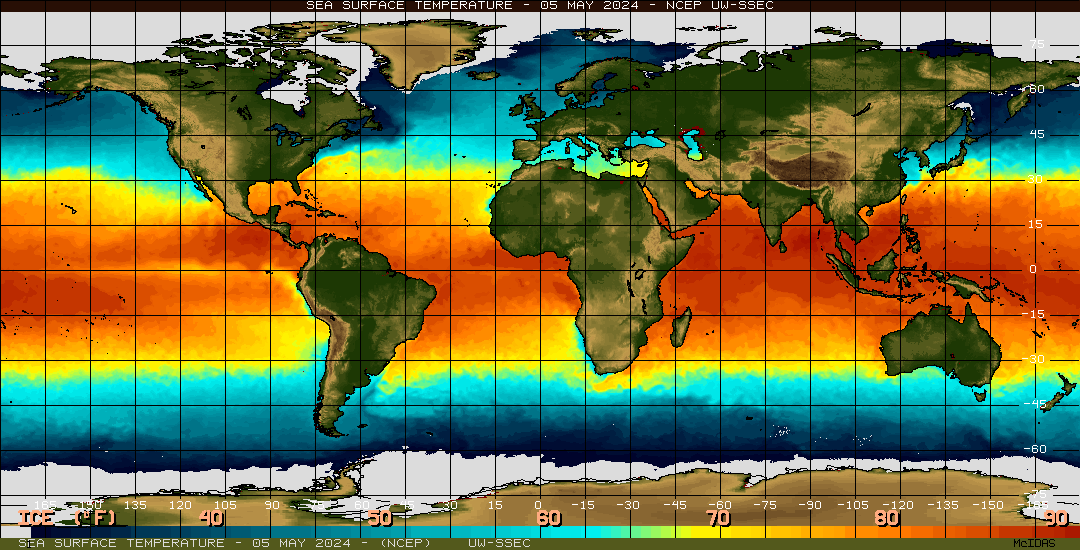
To some extent we’re seeing the results of a natural phenomenon, La Niña— a periodic event in which water in the equatorial Pacific becomes cooler than normal. La Niña events have historically been associated with global food crises...
But that’s not the whole story. ... As always, you can’t attribute any one weather event to greenhouse gases. But the pattern we’re seeing, with extreme highs and extreme weather in general becoming much more common, is just what you’d expect from climate change.
The usual suspects will, of course, go wild over suggestions that global warming has something to do with the food crisis; those who insist that Ben Bernanke has blood on his hands tend to be more or less the same people who insist that the scientific consensus on climate reflects a vast leftist conspiracy.
But the evidence does, in fact, suggest that what we’re getting now is a first taste of the disruption, economic and political, that we’ll face in a warming world. And given our failure to act on greenhouse gases, there will be much more, and much worse, to come.

http://economistsview.typepad.com/economistsview/2011/02/paul-krugman-droughts-floods-and-food.html

Sunday, February 6, 2011

Paul Krugman: Soaring Food Prices

Soaring Food Prices


by Paul Krugman, New York Times, February 5, 2011
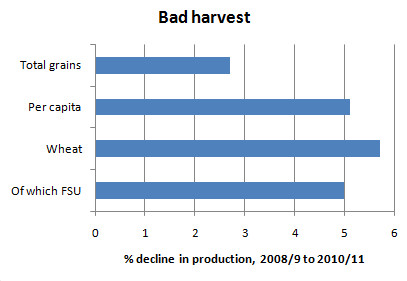
What’s behind the surge in food prices? The usual suspects have made the usual claims — it’s all about the Fed, or it’s all about speculators. But I’ve been looking at the USDA World supply and demand estimates, and what stands out from the data is mainly that we’ve had a huge global harvest failure.
Here are some percentage changes in world grain production between 2008/2009 and 2010/2011, according to the USDA estimates:
DESCRIPTIONUSDA
Overall grain production is down — and it’s down substantially more when you take account of a growing world population. Wheat production (this time not per capita) is way down.
You might ask why a production shortfall of 5% leads to a doubling of prices. Part of the answer is that some kinds of demand are growing faster than population — in particular, China is becoming a growing importer of feedto meet the demand for meat. But the main point is that the demand for grain is highly price-inelastic: it takes big price rises to induce people to consume less, yet collectively that’s what they must do given the shortfall in production.
Why is production down? Most of the decline in world wheat production, and about half of the total decline in grain production, has taken place in the former Soviet Union — mainly Russia, Ukraine, and Kazakhstan. And we know what that’s about: an incredible, unprecedented heat wave.
Obligatory disclaimer: no one event can be definitively assigned to climate change, just as you can’t necessarily claim that any one of the fender-benders taking place right now in central New Jersey was caused by the sheet of black ice currently coating our roads. But it sure looks like climate change is a major culprit. And it’s not just the FSU: extreme weather elsewhere, which again is the sort of thing you should expect from climate change, has played a role in bad harvest around the world.
Back to the economics: if you want to know why we’re having a spike in food prices, the data suggest that the key cause is terrible weather leading to bad harvests, especially in the former Soviet Union.
Update: The USDA has estimates of price elasticities. For the United States, they put the price elasticity of demand for breads and cereals at 0.04 — that is, it would take a 25% rise in price to induce a 1% fall in consumption.