Blog Archive

Showing posts with label Mark Boslough. Show all posts

Monday, October 14, 2013

No basis to deny global warming

by Mark Boslough, Albuquerque Journal, October 13, 2013


When I was a first-year graduate student at Caltech, my Ph.D. adviser published a paper called “Impact-induced energy partitioning.” He asked how an asteroid’s energy would change form if it collided with the Earth. He used computer models to estimate what fraction would go into lofting debris, heating, melting, vaporizing rocks, and so on.
This subject was not settled science then, and is still not. One thing is for sure, however. The laws of physics dictate that energy is conserved. If an asteroid is hurtling toward your city, you might not be concerned that scientists are not 100% certain about how its energy will be “partitioned.”
Global warming is no different.
Another one of my professors was Richard Feynman. In his famous “Feynman Lectures” he had a chapter called “Conservation of Energy” in which he says:
“There is a fact, or if you wish, a law, governing all natural phenomena that are known to date. There is no exception to this law – it is exact so far as we know. The law is called conservation of energy.”
He imagined a child with toy blocks that are indestructible and can’t be divided. His mother counts the blocks every day and discovers a phenomenal law – no matter what he does with the blocks, there is always the same number at the end of the day.
One day there is a missing block, but she investigates and finds one under the rug. Another day the number comes up two short, but she discovers an open window and two blocks are outside.
Then a surplus occurs, but it turns out a friend came over and left some blocks.
After that, mom locks the window and bans visits, but eventually the count comes up short again. There’s a toy box in the room but it’s locked and only her son has the key. So she weighs it. The changes in weight correlate exactly to the missing blocks from day to day.
Then the weight stops changing, but the water level in the dirty bathtub starts going up and down in a way that is exactly proportional to the difference in missing blocks.
Feynman even provides the equations that mom uses, and he beats the analogy into our heads. The blocks are like energy, which is neither created nor destroyed.
His punchline is this: Energy has different forms, and there is a formula for each one. “If we total up the formulas for each of these contributions, it will not change except for energy going in and out.”
Human-caused global warming is the inevitable consequence of this law of physics, because greenhouse gas pollution is causing more energy to come in than go out.
If the average surface temperature – which is only one way to measure global warming – doesn’t go up every year, it’s because the “blocks” are being hidden somewhere else, for now.
But energy changes forms, and sloshes back and forth between sub-systems. Ice will continue to melt and sea level will continue to rise as the water warms. A slowdown in one rate is compensated by a speedup in another until the cycle of natural variability reverses.
Scientists know that more energy is coming in than going out. We can measure it and there is no dispute.
Because of carbon pollution, the Earth is gaining energy at the rate of 400,000 Hiroshima atomic bombs every day of every year. And that rate is going up.
Not knowing exactly how energy is “partitioned” into its various forms at any given time is like not knowing how much melting an asteroid will cause, how small the pieces will be when a boiler explodes, how the victims of a drunk driver will die, or how many minutes it will take for the Titanic to sink.
Uncertainty in exactly how something happens does not translate into uncertainty that it is happening. There is no rational basis for denial of the reality, or the risks, of global warming.
And there is no excuse for ignoring it.
Mark Boslough is a physicist who uses computers to understand impacts, nuclear explosions and climate change.

Monday, April 1, 2013

Changing Seasons

by Mark Boslough, Huffington Post, April 1, 2013


Reported by KUNM Radio, EARTH EAR WAVES "Scientists Push to Change the Timing of the Seasons." Reprinted in full.
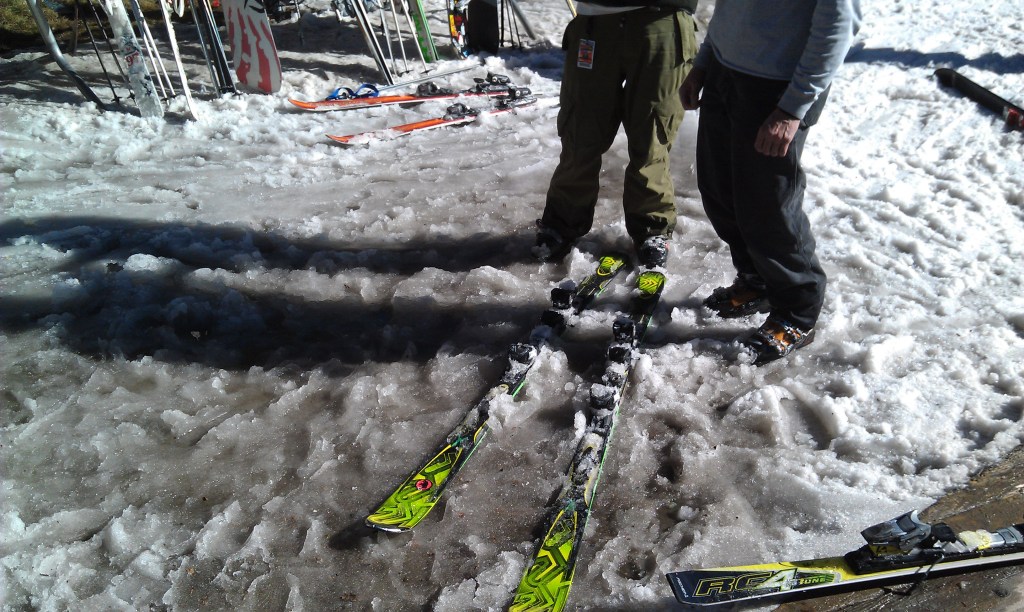
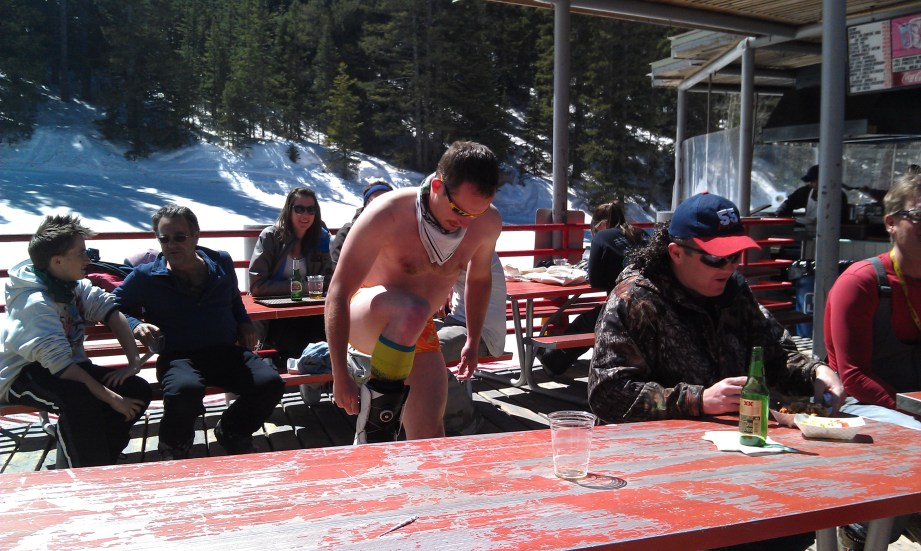
SANTA FE, NM - Local skiers were festive but disappointed on closing day, a full week earlier than originally planned. As temperatures in the state capital were expected to approach 80 degrees on the first day of April, rivulets of water cascaded into the ski area parking lots. Large patches of bare ground were exposed along with the bare skin of skiers and snowboarders who occupied Totamoff's deck to enjoy the sun and beer.
"When I first came to Santa Fe, it always snowed by Halloween and the ski area always opened by the end of November," observed Michael Wigley, a local skiing legend. "Now we are lucky if we have decent snow before Christmas."
2013-03-30-imag1003.jpg
Earliest closing day yet

Scientists and meteorologists have voiced growing concerns that the winter season is disappearing across much of the northern hemisphere. Dr. Jeff Masters put it bluntly, "Mother Nature has fast-forwarded past spring and gone straight to summer over the Midwest."
Now a group of scientists who see this trend as unstoppable have proposed changing the way we define seasons. Mark Boslough, a New Mexico physicist, explained, "We have chosen to define seasons in a very arbitrary way. Seasons are an artifact of human creation and it's time for an update." Boslough pointed out that astronomy went through a similar controversial redefinition in 2006, when the International Astronomical Union redefined the meaning of the word "planet" and removed Pluto from the list.
He and some of his colleagues are calling for an Intergovernmental Panel on Season Reform charged with renaming the seasons to reflect changes that are shortening ski seasons, and adjusting the calendar appropriately. The last time this happened was when the Gregorian Calendar was adopted in 1582 to correct for a drift in seasons due to a phenomenon that scientists call "precession." The fix was to add a leap year every four years. But now, according to some scientists, there is a "leap year drift" which caused this year's spring to start on the earliest date since 1896. As one scientist put it, "March 31 is the new April 1."
2013-03-30-imag1006.jpg
Occupying Totemoff's

Season reform campaigners openly acknowledge that such changes will not be without controversy. They have argued that seasons were never defined properly in the first place. According to some scientists, seasons are controlled by the tilt of the Earth's axis, which exposes the hemispheres to different amounts sunlight at different times of the year.
While the axis-tilt theory represents the consensus among many scientists, not everyone agrees. "Campaigners... state or imply that there is a scientific consensus on all of these things, when in fact there is none," according to the Viscount Monckton of Brenchley. Monckton debated Boslough at a recent climate conference in Santa Fe. Others dispute the claim that this is a particularly warm spring, pointing out that last night's low in Santa Fe was only 38 degrees. "The average high in Santa Fe in January is 43 degrees, so it's actually getting colder this spring," remarked one skeptic.
There is general agreement among season reformers that the vernal equinox should be the midpoint of spring, not the first day as currently defined. If this change is made, spring would always start on February 2nd, regardless of whether or not the groundhog sees his shadow.
Areas of disagreement center on the names of the seasons themselves. Many scientists want to adopt the old Latin names to make a clean break from the current system and avoid confusion. Some want the names to better reflect the warming climate (one suggested that winter be renamed "wimper"). Others have suggested getting rid of the name "winter" altogether and going directly from autumn to spring, while re-naming the two warm seasons "first summer" and "second summer" to compensate.
But the naming of the seasons was not a topic of conversation at the ski resort. Wigley summed up the debate succinctly, "January, February, Arbitrary... I don't give a damn what they call the months or seasons. I just want to ski."
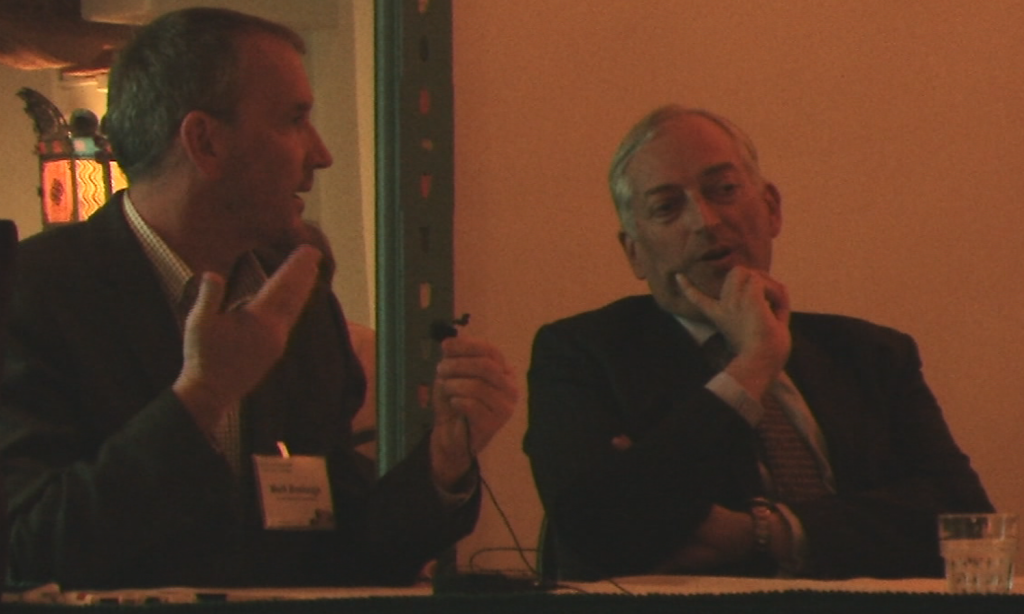
2013-03-30-bosloughmonckton4.png
Boslough debates Monckton in Santa Fe

See related stories in the Huffington Post.

Thursday, February 14, 2013

Valentine's Day at the Heartland Institute (faux "think" tank)

by Mark Boslough, physicist, Huffington Post, February 13, 2013


Al Capone was Chicago's most notorious gangster. He was ultimately convicted of tax fraud, but that wasn't his worst crime.
Chicago is famous for its mob history. In the early 1910's, goons from the Market Street Gang would beat up newsstand owners who refused to sell the right newspapers. Their battle to control the day's media allowed gang members to intimidate and influence politicians and journalists. They evolved into the powerful North Side Gang during the prohibition era by exploiting government corruption and engaging in illicit money laundering activities.
They did whatever it took until the famous Valentine's Day Massacre on Feb. 14, 1929, when some prominent members were gunned down. This event led to the downfall of Chicago mobsters, including Capone.
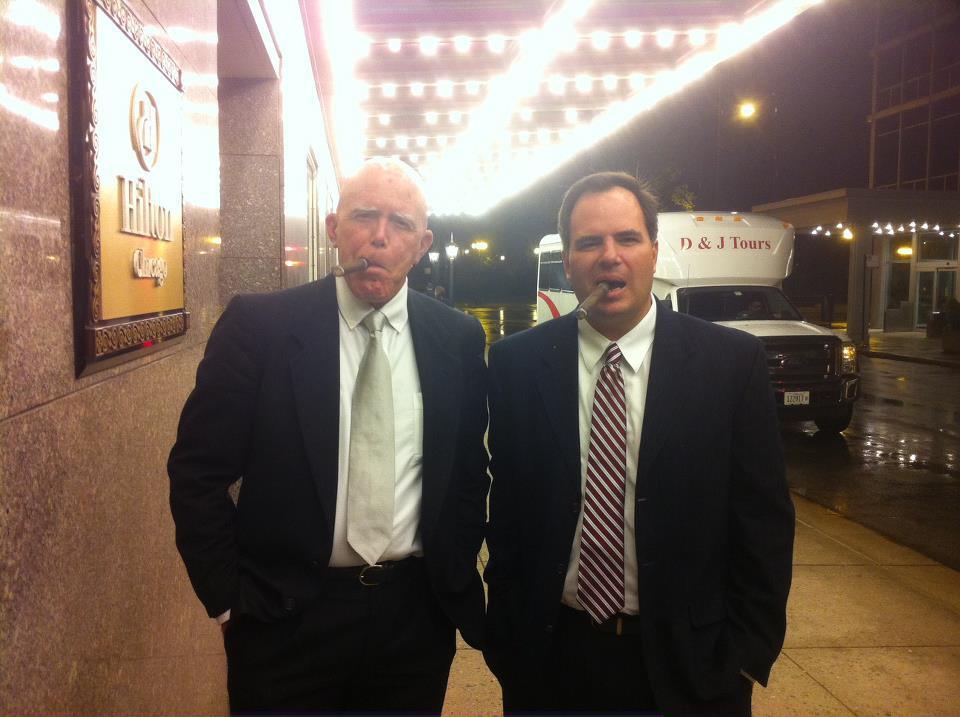
2013-01-29-heartlandcigarchompers.jpg
James M. Taylor (right) and an unidentified pal attending the Heartland Institute Fake Tank's 27th anniversary benefit dinner in Chicago. October 13, 2011.

A modern mob in Chicago -- the Heartland Institute -- was outed last year by whistleblower Peter Gleick, who tricked them into sending secret documents by assuming a false identity (a questionable tactic that is often employed by conservative journalists such as Andrew Breitbart and James O'Keefe). Such sneakiness appears to be an acceptable journalistic practice for right-wing activists and is rarely if ever criticized by conservatives. By contrast, Gleick was heavily censured for his behavior by some of his own colleagues and supporters, even though his scientific integrity and the quality of his research were never in question. It is clear which side has a double standard.
Nevertheless, Gleick exposed the Heartland institute for what it is: a manufacturer of fake science and fake educational materials. From its tax returns, it also appears to have gotten itself a fake 501(c)(3) tax status, resulting in a very real tax deductions (so honest taxpayers can take up the slack). In keeping with the naming convention for scandals, one might call Gleick's revelations "Fakegate." Indeed, Heartland preemptively bought the fakegate.com domain name in an apparent attempt at damage control.
Like the Market Street Gang, the Heartland Institute has been involved in its own war to control the media. They don't use Tommy guns, but politicians, journalists, and even some scientists are afraid of them. Last year the president of Heartland, Joseph Bast, derided me for exposing his organization's anti-science activities, fabrication of climate data, and defamation campaigns against scientists. Unlike the old Chicago gangs, they don't kill people. But they do engage in character assassination.
Heartland's thugs specialize in smearing scientists on their well-funded website and in the comments sections of newspapers. James M. Taylor is the editor of a Heartland publication, and it is his job to make up fake stuff about scientists. Last year, he was caught falsifying biographical information -- claiming, for example, that Ph.D. scientists don't actually have the degree they list on their resume.
Taylor's long hit list includes high-profile researchers like Prof. Michael Mann of Penn State, whose hockey-stick-shaped temperature graph convincingly showed that global warming is historically unprecedented. Heartland didn't like his science, so they attempted to destroy his career. And now, of course, Peter Gleick is Heartland's public enemy number one. Heartland cannot legitimately address the science, facts, or issues. So they attack individuals.
In the old-style Chicago racketeering days, those who kept their mouths shut were spared from such assaults. But those who spoke out were fair game. The old racketeers burned down stores of shopkeepers who tried to stand up to them. The modern anti-science mob torches reputations, which is the most valuable asset a scientist can own.
After Bast's screed was published in the Santa Fe New Mexican, the Heartland Institute bragged on its website, "The paper used the headline we put on the piece and ran it -- word for word -- as Bast wrote it. As a former op-ed editor for two newspapers, I can attest that such things are rarely done. Opinion-page staff don't like being told what to do by outsiders..." Bast is a powerful man.
February 14, 2012, may have marked the beginning of the end for Bast and the Heartland Institute, just as it did for Capone in 1929. That was the morning Gleick revealed Heartland's tax forms, lists of donors, and the Board of Directors (including Harrison Schmitt, who withdrew from his controversial appointment to New Mexico's energy and natural resources post in 2011).
The group's political activities outlined in the leaked "fakegate" documents strongly suggest that Heartland's donors may owe back taxes, just like Capone did. Heartland also pays generous stipends to a few scientists and weathercasters who are willing to deny the reality of global warming and generate fake research. Fred Singer, the president of SEPP (another fake science political advocacy group) confirmed to me last year that he gets $5000/month from the Institute, just as the leaked documents say.
Singer, who was in Albuquerque to speak to the fossil-fuel advocacy group, Energy Makes America Great, Inc. ($10 at the door), also spoke to a small science group where the audience was a bit more skeptical. University of New Mexico Prof. David Gutzler, a climate scientist, observed afterward, "...those temperature curves shown by Singer - mostly unlabelled, and all unanalyzed by him - are rising; that's why global warming is considered to be 'unequivocal' by the community that actually does analyze the data."
The documents also revealed that one of Heartland's secret projects is to develop a fake science curriculum for school children, using methods that are effective at dissuading teachers from teaching any science at all. Science teachers who teach factual climate science are next on Heartland's hit list.
Not long after the leak, in an apparent attempt to divert attention, Heartland doubled down by erecting billboards attempting to compare climate scientists to the Unibomber and other murderous criminals. It backfired.
Scientists have long known that the Heartland Institute is a fake science organization. Now we have the documentation to prove it. It's not a think tank. It's a fake tank. Thanks for the Valentine, Heartland!

Tuesday, January 22, 2013

Mark Boslough: Ben Franklin, Climate Science, and National Security


by Mark Boslough, physicist, Huffington Post, January 22, 2013
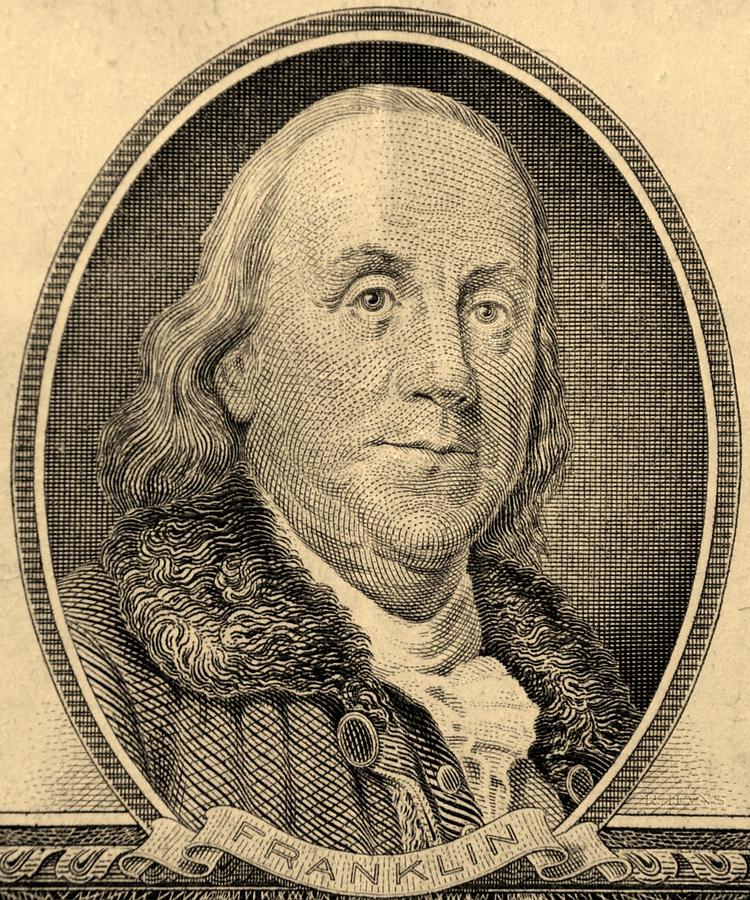
Benjamin Franklin, the first American Ambassador to France, was both a statesman and a scientist. On September 3, 1783, he co-signed the Treaty of Paris at the Hotel d'York, in which the British acknowledged the American Colonies to be free and independent States, ending the American Revolution.
Franklin's political eye was focused, but his scientific eye was attentive too. All was not well in the French countryside, where one of the worst environmental calamities of modern history was just beginning to unfold. That summer was the hottest on record, and a mysterious "dry fog" had settled across Europe. The combination of heat and air pollution was too much for the weak and elderly. Mortality spiked among farm workers and laborers across the continent.
2013-01-19-benfranklininsepiarobhans.jpg
According to British naturalist Gilbert White, "the sun, at noon, looked as blank as a clouded moon." When rising and setting, it was "particularly lurid and blood-coloured." The heat was so intense that meat went bad the day after it was butchered, and swarms of flies made life miserable.
The seeds of climate science in America were very possibly being planted as Franklin observed the changes 200+ years ago. Conditions went from bad to worse as Europe and North America were plunged into a deep freeze that winter. In its first peacetime year as an independent nation, the United States had to contend with more extreme weather than the colonies had ever experienced. New England suffered a record below-zero weather streak. The Mississippi River froze as far south as New Orleans. Ice appeared in the Gulf of Mexico.
Other parts of the world were also in trouble. Monsoons in Africa and India were extremely weak, and rain barely moistened the African Sahel. Agriculture collapsed in the Nile Valley leading to mass starvation. Volney, the French historian, wrote, "Soon after the end of November [1784], the famine carried off, at Cairo, nearly as many as the plague; the streets, which before were full of beggars, now afforded not a single one: all had perished or deserted the city." Within a year, Egypt had lost a sixth of its population.
Franklin watched this extreme weather with great interest and concern. In December 1784, he presented his ideas in a paper entitled "Meteorological Imaginations and Conjectures." He described the dry fog, even though he was uncertain of its source, "During several of the summer months of the year 1783, when the effect of the sun's rays to heat the earth in these northern regions should have been greatest, there existed a constant fog over all Europe, and great part of North America." He observed the effect the fog had on the sun's rays: "They were indeed rendered so faint in passing through it, that when collected in the focus of a burning glass, they would scarce kindle brown paper. Of course, their summer effect in heating the earth was exceedingly diminished."
He drew some important conclusions: "Hence the surface was early frozen. Hence the first snows remained on it unmelted, and received continual additions. Hence the air was more chilled, and the winds more severely cold. Hence perhaps the winter of 1783-4 was more severe, than any that had happened for many years." Franklin was arguably the first American scientist to recognize the sensitivity of climate to changes in radiative forcing, and to propose that the Earth can respond in a way that reinforces the change (now known as ice-albedo feedback).
Franklin speculated about the source of the fog. Maybe it was smoke "proceeding from the consumption by fire of some of those great burning balls or globes which we happen to meet with in our rapid course round the sun" or "long continuing to issue during the summer from Hecla in Iceland, and that other volcano which arose out of the sea near that island." He admitted that the source of the smoke, which "might be spread by various winds, over the northern part of the world," was yet uncertain.
Despite the uncertainty, Franklin saw the potential to apply this science to issues of security. "It seems however worth the enquiry, whether other hard winters, recorded in history, were preceded by similar permanent and widely extended summer fogs. Because, if found to be so, men might from such fogs conjecture the probability of succeeding hard winter, and of the damage to be expected by the breaking up of frozen rivers in the spring; and take such measures as are possible and practicable, to themselves and [their] effects from the mischiefs that attended the last."
Franklin's logic is clear. Changes in the atmosphere's radiative properties can affect weather and climate. The response of the Earth can amplify those changes. This can lead to problems, even if the details of the causes are uncertain. Resources should be spent on research to understand and predict changes to anticipate and avoid negative consequences to the extent we are able.
As it turns out, one of Franklin's guesses about the source of the fog was right. It wasn't a meteor, but an Icelandic volcano. On June 8th, three months before he was to sign the Treaty of Paris, a series of explosions unknown to most of the world had opened a fissure along the Laki crater, beginning the largest terrestrial eruption of the last millennium, and spewing dust, ash, and sulfuric acid into the air for many months.
Recent computer models have shown that the Laki eruption cooled the northern hemisphere's land masses by about 2 to 6 °F. This led to the extreme harsh winter, diminished the land-sea temperature contrast, weakened the Asian and African monsoons, and reduced water and food supplies in the most vulnerable parts of the world.
Just as Franklin understood, many present-day policymakers recognize that science should inform policy -- even in the face of uncertainty. Franklin didn't know whether the climate catastrophe of 1783-1784 was ultimately caused by a meteor or a volcano, but he had enough information to suggest that harsh winters follow dry fogs. He reasoned that climate change is real, that it is a potential threat, and that measures should be taken to mitigate the associated "mischiefs."
Climate science has made enormous progress since 1783. Politicians who ignore the science and delay action on global warming are putting our nation's security at risk. Franklin famously said, "An ounce of prevention is worth a pound of cure." A strong US research program in climate science -- and leaders who take climate change as seriously as Benjamin Franklin did -- is consistent with that advice.

Friday, June 8, 2012

Mark Boslough: Lord Monckton* attends the Heartland Institute Conference**


Lord Monckton* attends the Heartland Institute Conference**

by Mark Boslough, Puckerclust blog,  

* (not an actual Lord)   **(not an actual conference)
 
The Heartland Institute held its 7th International Conference on Climate Change a couple weeks ago in Chicago.  It wasn’t very well attended, and many of those who showed up were not actual scientists.  Unlike an actual scientific conference, those with dissenting views and who were willing to publicly criticize Heartland’s “research” were not invited.  So it was gathering of good old boys who reinforced one another’s beliefs and biases (e.g., the idea that scientists who accept the reality of global warming have a lot in common with the Unabomber).
The 3rd Viscount Monckton of Brenchley, was the biggest celebrity in attendance.  In a case of life imitating art, he put on a Borat act.  To the audible delight of his audience, he showed a fake Hawaiian birth certificate and claimed to be a US citizen.
Monckton
Borat
Peter Sinclair captured the hilarity in his own inimitable way.

Finally, to see the art that life is now imitating,  this send-up of the “Lord” is worth watching.

Sunday, June 3, 2012

Mark Boslough: Facts Are Not Negotiable


Facts are not negotiable

by Mark Boslough, Puckerclust blog, June 2, 2012
On April 25, 2012, I wrote a column for the Albuquerque Journal entitled “Climate Change Is Based Only on Fact.”  It was a direct refutation of factual errors in a column that had been published two days earlier called “Global Warming Is Just Propaganda.”  The previous author, Lewis Green, had made a number of incorrect statements (as well as errors of logic) in support of his claim that global warming is a conspiracy by left-wing activists.   I don’t understand why the Journal is willing to give space on their opinion page to absurd conspiracy theories that are demonstrably false (for an ironclad demonstration, see Peter Sinclair’s video showing that high-profile conservatives accept the reality of global warming).  I also listed several irrefutable facts:
♦ Fact: Global warming is real.
♦ Fact: Global warming was successfully predicted by physicists.
♦ Fact: Scientists accept the reality of global warming.
♦ Fact: Climate and weather are not the same thing.
♦ Fact: Global warming is not a left-wing conspiracy.
Unsurprisingly, my list of facts led to a flurry of letters.  Of the six letters published on May 15, four disputed the facts, or argued that they don’t matter.   I respond to those letters here.
Larry Harrah wrote “Full Disclosure Applies to Both Sides.”  I realize that letter titles are not written by the author, but by the opinion page editor, so I don’t blame Mr. Harrah for the faux balance implying the existence of “both sides” of some scientific debate.  The debate over the reality of global warming really is over.  Of 47,000 members of the American Physical Society, only 206 objected to the APS statementThe evidence is incontrovertible: Global warming is occurring.” Of those 206, only a handful have any expertise on climate science, and of those, none have published contrary evidence. Scientific debate is not about petitions and objections, it requires publications and data. By this definition, there is no debate.
Mr. Harrah wrote that my letter “…withheld some pertinent facts not supporting its thesis…”  These included:
  • Three recent reports that there has been no change in mean global temperature during the first decade of the 21st century.
  • Two periods of unusual warming and icecap melting in the fifth and sixth centuries and in the 11th and 12th centuries.
However, even if both of these facts were true, they would not constitute evidence against the facts I provided.  I do not know what reports Mr. Harrah is referring to or if they were published in the peer-reviewed scientific literature or not (and I welcome a comment from him with citations to published scientific research).  But regardless of what the reports say, here is a plot of the actual temperature data:
NASA GISS
Whatever the recent reports claim about no global mean temperature change during the first decade of this century, the data do not support it.  Much has been made about the anomalously high temperature during the super El Nino year of 1998 (when tropical Pacific surface temperatures were exceptionally warm, slowing the rate at which the ocean absorbs heat from the atmosphere).   Remarkably, the 2011 temperature, which nearly broke this record, was in a La Nina year with low sea surface temperatures, when the oceans are soaking up much more heat.  But these relative fluctuations are a measure of interannual variability, not climate.  A better measure of climatological temperature is indicated by the red curve, which is a five-year running average.  This climatological temperature has continued to increase (even 5 years is too short to represent the true climate, which is customarily defined as a 30-year average, and requires at least 17 years, according to recent research).
The other claim that there were two periods of unusual warming and icecap melting many years ago would not contradict any of the facts I cited, even if true, so I do not understand the relevance in this context.  It is worth noting that similar such claims have been made that have turned out not to be true.  For example, business advocate Raymond Keating—in testimony to House Small Business Committee (June 4, 1998)—said, “During the past 3,000 years, there have been five extended periods when it was distinctly warmer than today.”  It turns out that his testimony was quoting a Wall Street Journal opinion piece that was based on politician/activist Arthur Robinson’s misrepresentation of actual published data (this is why I require that claims made in Puckerclust comments include citations to peer-reviewed scientific literature).
Mr. Harrah also exhibits a misunderstanding of the role of water vapor in human-caused global warming.  He is correct that water vapor is actually the dominant greenhouse gas, but he is incorrect that it is not of our making.  The increased amount of water vapor is because the air is warmer, which is directly attributable to human-generated pollution consisting of non-condensible heat-trapping gases like CO2.  The CO2 causes a little warming, which evaporates more water, which causes a lot more warming in a vicious cycle of amplification.
I absolutely agree with Mr. Harrah’s final remark: “Politicizing science can lead to meaningless or even bad choices where we squander our resources!”   I have always argued that facts trump politics.  That goes for both conservatives and liberals.
Joseph Yardumian writes, in “Climate Change Predates Your Car,” that our planet has undergone a number of climate cycles over the last 50,000 years.  Again, this is not evidence against human-caused global warming.  Humans cause forest fires with careless use of matches and vehicles with faulty catalytic converters and spark arrestors.  There is published evidence for forest fires in North America before cars were invented and before humans even occupied the continent.  It would be equally absurd to use that as evidence that we don’t have to be careful not to start them now.
Burke E. Nelson says, “Don’t Panic: We’ve Been Here Before.”  He asserts without evidence that civilizations advanced and people prospered during times of warming, but not so during times of cooling (this would seem to contradict the fact that the Enlightenment, the founding of our nation, and the beginning of the industrial revolution all took place during the height of the Little Ice Age).
Dr. Nelson (who says he has a “Ph.D. in science”) reminds us that what is now New Mexico was covered by an inland sea.  What he fails to mention is that this was 100 million years ago, long before the Laramide orogeny (mountain-building event) that created the Rockies, and when North America occupied a different part of the globe (a bit closer to the tropics and much further east).  I suspect that Dr. Nelson would not want our pollution to return the Earth to the conditions of the Cretaceous, which were more amenable to habitation by dinosaurs and ferns than to people, livestock, and edible fruits and vegetables.  Fortunately, the earth hasn’t been continuously warming at the current rate since then, or it would be much hotter than the sun!
Dr. Nelson rightly points out the “warm Coke effect.”  As a little bit of CO2 pollution warms up the oceans, as it is now doing, the water exsolves (releases) more CO2 into the air, causing another dangerous cycle of reinforcement: another reason that a little bit of human-caused warming ends up doing a lot more damage than naively expected.
Dr. Nelson also sites Fred Singer and William Happer, both of whom are associated with political pressure organizations like the Heartland Institute and the George C. Marshall Institute, and have become better known for their activism than their science.   Fred Singer and the Heartland Institute (which distributed the book cited by Dr. Nelson) are also known for publishing fabricated climate data.  More recently, the Heartland Institute has been under fire for erecting billboards making nasty personal attacks against the scientific community.
Likewise, Prof. Happer has pushed hard to politicize the science (as indicated by the quotes cited by Nelson, in which he resorts to name-calling and comparing the mainstream scientific community to a “a cult”).  Prof. Happer has apparently abandoned publishing his disagreements in the scientific literature in favor of conservative online media like The American Thinker.
Finally, virtually any logical thinker understands why it is ludicrous to argue that CO2 cannot be harmful because it comprises less than one half of one percent our atmosphere.  Unless we argue that this concentration of other substances can be safely ignored, this idea is flat out silly.  Should we ignore this amount of:
  • fecal coliform bacteria in our drinking water?
  • drugs in our bloodstream?
  • asbestos fibers in the air we breathe?
  • members of the American Physical Society who dispute the incontrovertible evidence?
I suspect Dr. Nelson would say no.
William E. Keller, in “So-Called Facts Bear Closer Inspection,” challenges the facts that I listed.   Surprisingly, Dr. Keller appeals to the post-modern idea that there is no real objective reality.  In his attempt to refute my statement that climatological temperature continues to increase, he says, “it depends on whose thermometer you are using.”  But reality is not dependent on the means of measurement.  Either it is getting warmer, or it’s not.  In a bizarre crossing-over of conservative suspicion of mainstream science with liberal muddled thinking, Dr. Keller seems to adopt Deepak Chopra’s idea that “there is no objective reality ‘out there’ that is independent of the observer.”
Furthermore, Dr. Keller claims that we only know the temperature over land, and that “what is happening over the other 70 percent [of the Earth's surface] is not clear.”  What is remarkable is that someone who is so opinionated about a subject would be unaware of the massive amount of data, both direct measurements and remote sensing, on sea surface temperatures (which by the way, are also increasing).
Dr. Keller also claims that NASA satellites show that temperatures in the lower troposphere have remained quite constant for the last 25 years, but fails to cite any peer-reviewed literature.  On the contrary, a survey of publications in scientific journals reveals that there has been an increase (Skeptical Science has a nice summary).
Dr. Keller grasps at straws when he criticizes my mention of predictions in the 1950s because I don’t give temperature units.  It is customary when writing for an American audience in a U.S. newspaper to use degrees F (C is used outside the US).  If you don’t believe me, turn to the weather page and see if they give temperature units!  For the record, a good overview of this prediction is given by Gilbert Plass (1959) “Carbon Dioxide and Climate,” Scientific American, July, p. 41-47.  One can listen to an interview with the author here.
Dr. Keller speculates that I “might not have looked hard enough” to attract contrarians to my session at my annual climate session.  But I specifically invited them in a letter to the Heartland Institute.  Notably, my contact at Heartland suggested that I would need to pay for contrarians to attend (which is apparently how the sponsors of the Santa Fe conference were able to attract some of them).
Finally, Dr. Keller confuses stocks and flows, a common mistake among those who deny the facts.  He says that only 5.6% of the CO2 flux into the atmosphere comes from humans.  But if not all of this 5.6% (flow) is re-captured and sequestered by nature, the concentration (stock) will continue to increase, exactly as observed.  And according to the laws of physics, so will the temperature.

Saturday, May 19, 2012

Mark Boslough: The Banned Heartland Institute Presentation


The Banned Heartland Institute Presentation

This is the material I wanted to present at the Third Santa Fe Conference on Global and Regional Climate Change.  But it was rejected by the conference organizer, Petr Chylek, a Heartland Institute Expert.  Then I offered to present it at the Heartland Institute’s 7th International Conference on Climate Change.   But I was told by Jim Lakely, Heartland’s Director of Communciations, that I would not be allowed to speak.  Clearly the Heartland Institute does not want this information to be presented.  So I have now posted it on SkS.  I am re-posting it here in its entirety.
Climate change is debated in letters to the editor of hometown newspapers all over the world.   In the Las Cruces, New Mexico, Sun-News, one reader recently cited “a 1996 paper by Kiegwin (sic) in Science which showed that, despite the present having a CO2concentration of 388 PPM, the present temperature is cooler than the average of the last 3,000 years, and that it was considerably warmer than today during the Medieval Warm Period, the Roman Warm Period, and the Holocene climate Optimum.”  A few months later another reader asserted that “Keigwin, Science, 1996, shows present temperatures aren’t much different from the 3,000 year mean.”
Did the Keigwin paper really say that?  And how is it that two non-scientists from a mid-sized New Mexico city would be so confident that a scientific paper published a decade-and-a-half earlier supports their belief that the world was warmer during Medieval times?
First, let’s review Keigwin (1996).   The title “The Little Ice Age and Medieval Warm Period in the Sargasso Sea” might provide the first clue that it isn’t about global temperatures, but about one location on Earth:  the Sargasso Sea.  What Keigwin did was to use oxygen isotope measurements in plankton skeletons from sediment cores as a proxy to reconstruct the sea surface temperature (SST) of the past 3,000 years.   The cores were collected in 1990, and were divided into 50- to 100-year segments.  In the absence of mixing or bioturbation from below, the mid-point of the most recent 50-year-thick sample, whose value would represent the most recent paleotemperature, would be 1965.  In a perfect world, the bottom of the segment would date to 1940.  However, sediments in the real world are never completely undisturbed.  It is very likely that the most recent segment contained shells from the early 1900s or even from the previous century.  That means the last paleotemperature is really an average that probably includes values from before automobiles and light bulbs were invented.
Keigwin published a graph, as Figure 4b (K4B), of his best estimate of the resulting time series.
He also included several years of modern instrumental measurements at hydrographic station “S” in Bermuda, starting in 1954.  The modern year-to-year temperatures fluctuate significantly, but the mean is well above the 23 °C average of the entire proxy record.
It is unlikely that the Las Cruces letter writers ever read this paper, or they would have known it wasn’t about global temperatures.  It is highly cited in the contrarian literature as evidence against human-caused global warming, and turns up in many blogs and editorials without reference to the Sargasso Sea.  How did this happen?
The misuse appears to have started in the late 1990s, when Arthur P. Robinson of the Oregon Institute for Science and Medicine (OISM) started the so-called “Oregon Petition” to collect signatures of people opposed to the Kyoto Protocol.  With his son Zachary and two associates from the conservative George C. Marshall pressure group (Sallie Baliunas and Willie Soon), he self-published a paper called “Environmental Effects of Increased Atmospheric Carbon Dioxide” designed to look like a peer-reviewed article from the Proceedings of the National Academy of Sciences (US).  It was mailed out with the petition to many thousands of engineers, dentists, veterinarians, and even some scientists.  In January 1998, it appeared in a periodical published by the Association of American Physicians and Surgeons (AAPS), a political advocacy organization with a stated mission to “fight socialized medicine and to fight the government takeover of medicine.”  The executive director of AAPS is also member of Robinson’s OISM.  In it was their Figure 2, a modified version of Keigwin’s K4B.
Robinson and coauthors made several changes in representation and labeling.  First they inverted the axes so time runs from left to right, but they were unaware that when paleoclimate data are plotted “years before present”  means “years before 1950” so their data is shifted by about 50 years.   Second, they removed the data from hydrographic station “S” which showed that recent temperatures are above the long-term average.  Third, they neglected to label it as being a record for the Sargasso Sea.  Fourth, they called it a global temperature in the text, saying, “For the past 300 years, global temperatures have been gradually recovering. As shown in figure 2, they are still a little below the average for the past 3,000 years.”
This paper became the basis for statements in two influential Wall Street Journal opinion pieces.  The first, in 1997, was by Robinson and his son Zachary, called “Science Has Spoken:  Global Warming Is a Myth.”  They stated,
During the past 3,000 years, there have been five extended periods when it was distinctly warmer than today. One of the two coldest periods, known as the Little Ice Age, occurred 300 years ago. Atmospheric temperatures have been rising from that low for the past 300 years, but remain below the 3,000-year average.
The second editorial, with son Noah, was called “Global Warming is 300-Year-Old News.”  In that one, they stated that “Earth temperatures are now near the 3,000-year average and clearly not unusual.”  Their Oregon Petition figure was re-drafted with different temperature units, but the time scale was still wrong, and the current thermometer measurements were still missing.  Despite the misrepresentation in the text as “Earth temperatures” the graph this time was labeled “Temperature of the Sargasso Sea from 1000 BC to 1975 AD.”  The source of the year 1975 as the endpoint is unclear and did not come from Keigwin’s paper.
This Wall Street Journal version of the graph appears to have become the new “primary source” for those who argue that temperatures are actually lower now than they were in the past.  Award winning editorial cartoonist John Trever redrew it for an ironic dig at climate scientists who claim otherwise (including—with true irony—Lloyd Keigwin, the original author of the figure).
In 2004, I was asked by my management to review the original sources of these claims, and I wrote several messages to Arthur Robinson asking for some clarifications.   Because I was planning to write a report, I wanted to give him the courtesy of responding with any clarifications or corrections.  Among other questions, I included the following,
I’m wondering what is your basis for the statement, “During the past 3,000 years, there have been five extended periods when it was distinctly warmer than today.” (Robinson & Robinson, The Wall Street Journal (Dec. 4, 1997).  I’ve seen this quoted by others (often without attribution) but it looks like you were the first to say it.
Robinson responded,
I note that the Sargaso (sic) Sea curve shows five earlier periods where the temperature was above the mean and therefore warmer than today. This is probably the source of the statement.
Significantly, business advocate Raymond Keating—in testimony to House Small Business Committee (June 4, 1998)—said, “During the past 3,000 years, there have been five extended periods when it was distinctly warmer than today.”
I proceeded to ask Robinson some more difficult questions,
I can see that your Figure 2 was taken directly from the 1996 Keigwin paper, but with the post-1954 instrumental “Station S” SST data removed.  Was there a reason you took the directly measured temperature off?  What method did you use to calculate the 23 C mean?  Did you derive it from the original Keigwin data or was that simply an estimate to the nearest degree?
You incorrectly represented the graph as global temperature.  You stated, “For the past 300 years, global temperatures have been gradually recovering (11). As shown in figure 2, they are still a little below the average for the past 3,000 years.”
I plan to include these observations in my final writeup.  If you care to respond, I would be happy to include your comments.
To which Robinson replied,
Regarding the world data. We clearly labeled this data location. Since virtually all other available dats (sic) from other locations (see Soon and Baliunas) is similar, providing this example was entirely ethical.
It is too bad your employers could not find an objective scientist for this task. I will not be providing any additional comments, since I am quite sure they would not be presented in their enirety (sic) to your employers, any more than will those I have already written. You are clearly devoted to lifting selected things from their context.
Do not waste your time with additional email. It will be shunted to the unopened file here.
AR
For the record, I provided all his responses to my management in their entirety.
The most recent chapter of this story began when the periodical of the AAPS re-published an edited and colorized version of the paper in 2007 under a different author rotation (Baliunas was removed, and son Zachary was replaced by son Noah).  Perhaps because of my 2004 criticisms, an instrumental data point was added for year 2006, and the mean temperature was shifted.
The paper explained the source of the 2006 temperature thusly, “A value of 0.25 °C, which is the change in Sargasso Sea temperature between 1975 and 2006, has been added to the 1975 data in order to provide a 2006 temperature value.”
Unable to reproduce this temperature with the data I had, I wrote to Willie Soon in 2010 and asked for the source of the data.  He cordially responded and sent me the table, telling me,
…also about the most recent point at “2006″—sorry that I could not be more certain, but I am sure Noah has carefully included this updated SST series from station S that Dr. Keigwin sent me around July of 2007 (which as you can see from the file name was obtained by Dr. Ruth Curry of WHOI).
Graphing the Station S data with their data point for 2006 (blue) demonstrates that the 2006 is about a degree too low in Robinson et al. (2007).
If they had plotted the data they had, the way they said they did, it would have looked like this:
On Nov. 2, 2010, I presented this to a large audience at the Geological Society of America (GSA) meeting in Denver.  Always wanting to give others the benefit of the doubt, I wrote to Noah Robinson several times at his OISM address.  On Oct. 23, 2010, I wrote:
Willie & Noah,
Attached is a draft of a couple slides I plan to present, which strongly suggest that your team fabricated the 2006 data point to hide the increase in Sargasso Sea surface temperature.
You plotted your 2006 point too low by more than a degree C.  If this was an honest arithmetic mistake or silly drafting error, now would be the time to explain it and correct it.  If you let me know before my presentation, I will be happy to include your explanation.
Best regards,
Mark Boslough
I did not get a response.
The Heartland Institute, a fossil-fuel-funded political pressure group, reprinted a distorted version the latest OISM graph in their advocacy report, “Nature, Not Human Activity, Rules the Climate” (S. Fred Singer, editor).  This was published for an organization called the Nongovernmental International Panel on Climate Change (NIPCC), and was sent to American members of Congress and other policy makers.
In 2011, I submitted an abstract, coauthored by Lloyd Keigwin, to the Third Santa Fe Conference on Global and Regional Climate Change, so that we could present these findings.  According to the conference summary, it was “to focus on climate change and variability from observational and modeling perspectives.”  The chair of the conference, Petr Chylek, is affiliated with one of the sponsors (Los Alamos National Laboratory) as well as the Heartland Institute (as a “Heartland Expert”).  With many speakers affiliated with the Heartland Institute (it turned out to be at least nine), it seemed like a good opportunity to provide feedback.  Unfortunately, Keigwin and I received a rejection letter from Chylek, who told us,
This Conference is not a suitable forum for type of presentations described in submitted abstract. We would accept a paper that spoke to the science, the measurements, the interpretation, but not simply an attempted refutation of someone else’s assertions (especially when made in unpublished reports and blog site).
This was a puzzling rejection given that the “unpublished report” was the NIPCC document released by the Heartland Institute, which is widely cited by the many Heartland-affiliated speakers invited by Chylek.
Nevertheless, I was able to have a conversation with Fred Singer, the editor of the NIPCC report, about the Sargasso Sea graph.  At first, he told me that I should take it up with Robinson, but ultimately he assured me that it would be corrected in the next edition of the NIPCC.  He also revealed that he had been the one who had sent Keigwin’s paper to Robinson in the first place, back in the 90s.
In a final attempt to get my feedback directly to the Heartland Institute before writing this guest post, I offered in April 2012 to give a presentation at their annual meeting in Chicago in May.   My offer was rejected by Heartland’s Director of Communications, Jim Lakely, who told me in no uncertain terms, “you will not be getting an invitation to speak.”
I look forward to their response to this article.