Blog Archive

Showing posts with label Patrick Michaels. Show all posts

Thursday, March 5, 2015

Peter Dykstra: Doubling down on doubt

HeartlandTube/Youtube
Swift support from the denial community for Willie Soon reflects a disregard for self-policing.
by Peter Dykstra, Environmental Health News, The Daily Climate, March 5, 2015
The most remarkable aspect of Willie Soon’s soiled science scandal is that in the light of damning evidence of a serious ethical lapse, the climate denial camp shows no interest in self-policing.
When documents acquired through the Freedom of Information Act showed Soon was promising “deliverables” for climate research funded by fossil fuel affiliates, the judgment outside the climate denial sphere was swift, largely because the evidence was from Soon’s own hand.
But many who embrace climate denial not only saw nothing wrong with this, they circled the wagons around their embattled Man of Science.
Many who embrace climate denial not only saw nothing wrong with this, they circled the wagons around their embattled Man of Science. Soon crossed what most scientists believe are several inviolable ethical lines. While academia doesn’t generally disdain funding from parties who may have an economic or ideological stake in the outcome, transparency is key. Soon, via his unpaid climate-related research with the Harvard Smithsonian Center for Astrophysics, failed to reveal on multiple papers that his climate change-related publications were largely bankrolled by Exxon Mobil, Southern Company, and the Charles Koch Foundation.
He also gushed about how the results would please prospective funders. "I have a big super-duper paper soon to be accepted on how the sun affects the climate system,” he wrote to a Southern Company sponsor. Southern is the biggest electric utility in the Southeast U.S., is heavily coal-dependent, and clearly would have something to gain should a scientific paper throw the sun under the bus for what the vast majority of scientists believe to be fossil fuel-driven climate change.
The Heartland Institute
The Heartland Institute's Joe Bast called climate scientists and advocates "mental midgets."
The Climate Investigations Center and Greenpeace* obtained and released the documents. Some climate activists crowed. Editorial pages scowled. The Smithsonian promised a swift investigation.
Soon's defenders, meanwhile, pulled out what is now a reliable playbook for conservatives confronted with accusations of errors, omissions and downright lies: They doubled down and went on the attack.
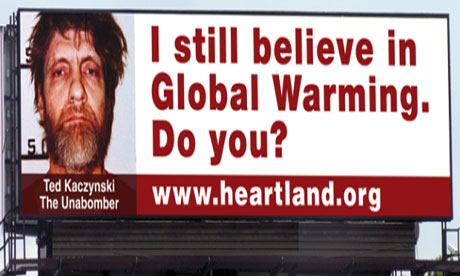
The Heartland Institute, which has listed Soon as an in-house expert, took the reins as his communications clearinghouse, releasing Soon’s official statement on its website along with a volley of counterattack. Heartland chief Joe Bast called climate scientists and advocates “mental midgets.” To be fair, that may signal a softening of Heartland’s hard line, since three years ago they were likening their foes to mass murderer Ted Kaczynski.
The Breitbart.com site was particularly unhinged in its response. The release of Soon’s own documents was a “crucifixion,” and reporting on the documents by The New York Times was a “hit piece” and a “smear.” Congressman Joe Sestak (D-Penn.) was singled out for the offense of re-tweeting the Times story. (Heartland’s Bast co-authored the “crucifixion” piece.)
Fox News took a more passive stance, deploying crickets. While Fox’s website lists multiple stories about sexual harassment allegations against R.K. Pachauri, the recently resigned head of the Intergovernmental Panel on Climate Change, Soon’s soiled science appears to have received only one brief mention on a Sunday talk show. The only other reference to climate change on Fox in recent weeks have centered on attempts to prove that a cold, snowy month in much of the U.S. is Exhibit A against climate change.
The World Affairs Council
 
Fox’s high-profile prime time host Bill O’Reilly (left) didn’t mention the scandal, either. O’Reilly once embraced climate science, telling "60 Minutes": “Global warming is here… all these idiots that run around and say it isn’t here, that’s ridiculous.” But as climate denial has embedded itself in conservative doctrine and in Fox’s Fair-and-Balanced reporting, O’Reilly no longer believes climate scientists.
O’Reilly might be excused for skipping the Soon story. Like Soon’s supporters, he’s busy doubling down to defend against his own accusers’ allegations that he embellished his own war-correspondent stories.
And in that is an illustrative lesson in how climate denial and American conservatism became inseparable: Doubling down against critics is the standard defense, no matter how demonstrable the evidence is against you. It’s what Dick Cheney did on his whirlwind media tour last December, in which he defended both the Iraq war and the use of torture by American intelligence officials. It’s what Pat Michaels, another widely-cited skeptical scientist, did when soliciting coal producers’ money back in 2006. And it’s what Oliver North, the Grandpappy of modern-day doubling down, did in the late 1980’s when he was caught at the center of the Iran-Contra arms-for-hostages scandal. He became a hero to millions of Americans.
To this day, Ollie North still hosts a weekend show on Fox News. So in the event that Willie Soon has to face the music because ethics outweighs doubling down, there may be an opening for a Fox News science show host. It would be Super-Duper.
*I used to work for Greenpeace in the 1980s. That’s full disclosure, Willie.

EHN welcomes republication of our stories, but we require that publications include the author's name and Environmental Health News at the top of the piece, along with a link back to EHN's version.

Tuesday, July 22, 2014

I CRASHED A CLIMATE CHANGE DENIAL CONFERENCE IN LAS VEGAS

by Brendan Montague, VICE, July 22, 2014

Alex Epstein, author of forthcoming The Moral Case for Fossil Fuels, sports his I Heart Fossil Fuels T-Shirt
I’ve been researching the climate denial industry for almost three years and the best way to gather information about this incredibly small yet influential clique is to hang out with them. I attended their 2012 conference of the Heartland Institute, an oil and tobacco funded free market think tank that spends a lot of time and effort trying to call bullshit on what is clearly not bullshit – the science of climate change. My presence was clearly unwelcome – but I guess they forgot to scrub me from their email invitation list, because I got invited again this year, to their 9th International Conference on Climate Change in the deep heat of the Nevada desert amid the chaos of Las Vegas casinos.
The choice of Vegas by Heartland seemed brilliantly provocative. A celebration of high-stakes capitalism in the very gambling dens where $92 billion is lost each year in pursuit of the American dream. The dazzling lights, the grotesquely oversized hotels, the free drinks.
Perhaps nowhere on earth is more profligate and wasteful of increasingly scarce natural resources than this twisted utopia. The Republican Party reportedly blackballed Vegas for its 2016 convention fearing its Christian supporters would be repelled by this den of iniquity – and that its legislators would be lured into its brothels and casinos. Scientists have explicitly stated we are “loading the dice” by raising temperatures so that extreme weather and deadly catastrophes will become more frequent – gambling with our future, basically. Joseph Bast, the president of Heartland, was surely thumbing his nose at his detractors.
Heartland has had a torrid two years. Dr Peter Gleick, a hydro-climatologist and author, took the unusual step of posing as a board member and tricking Heartland staff into sending him a trove of highly secret internal documents. The papers revealed that Heartland was working with a coal industry consultant in order to enter American schools and attack climate science.
Two months later, and just ahead of their 2012 conference in hometown Chicago, Heartland made the bizarre decision to erect a huge advertising billboard attacking climate science on the basis that the terrorist Unabomber, Ted Kaczynski, had apparently been concerned about global warming. This gave their archenemies Greenpeace US and Forecast the Facts the ammunition they needed to successfully lobby funders to withdraw.
The Vegas conference was going a good opportunity to enter this strange world again. But did I really want to spend a week in the middle of dustbowl America with three hundred climate cranks who would crowd around trying to tell me how wrong I am about everything if they knew the first thing about me?
24 hours later and I touched down at the Vegas airport in the dead of night, bathed in light. The Mandalay Bay Hotel and Casino, a gold-plated monument to excess, appeared to be next to the runway. Still it took 20 minutes and $20 dollars for a cab driver to get me there.
This sub-prime feeling hotel was the perfect setting for Heartland. The deregulated casinos glared as they took people’s money and the acrid smell of tobacco was pervasive. The hotel was brash, huge, and run down. All fur coat and moth eaten. There were loud renovations taking place when I arrived. The front desk had double booked my room, so when I finally got there I was confronted by a stout, hairy American wearing tight black underpants. Mercifully I was relocated.
The morning after my arrival I met Christopher Monckton, who had agreed to have breakfast with me. Within minutes I found myself almost entirely lost in confusing nonsense. Monckton repeated his claim to be a member of the House of Lords, which has been denied by the House of Lords, and having been the scientific advisor to Margaret Thatcher in the 1980s when she first championed climate science, which has also been debunked.
The aristocrat, a classically trained architect and one-time journalist, told me he had produced a very simple climate model that proved actual scientists had exaggerated the threat of climate science and that there was no evidence that heating the atmosphere was dangerous.
Monckton has worked closely with the ominous sounding neoliberal think tank, the Committee For A Constructive Tomorrow (CFACT). They even hired a plane so he could parachute uninvited into the Durban climate conference. CFACT has enjoyed significant funding from ExxonMobil and other oil and car industrialists. So I asked Monckton if he had benefited from ExMo’s largesse. “The cheque has not yet arrived in the post,” he joked, before asking if I was “left wing.”
Monckton then told me he attended climate conferences because it was better than sitting at home on his sofa and he cared for the future of society. He had refused his $1,000 Heartland fee. I asked him how this chimed with his belief in the free market, that rested on the idea that people only respond to financial incentives. He grinned.
After I had paid for his breakfast he said something that really surprised me. We were walking past the slot machines when I asked him what he thought of Vegas. He said he believed gambling to be immoral. The casinos were profiting from people’s lack of a good education and fundamental misunderstanding of mathematics. He said Heartland had, in fact, chosen Vegas to make the point that climate scientists had failed to understand risk.
Dr Willie Soon. He claims Albert Einstein would have been a sceptic and accused the Intergovernmental Panel on Climate Change as “gangter science” during his presentation.
Bearded Joseph Bast opened the conference that evening. He said, “Speaking of funding and for the record, except for $150 from the Illinois Coal Association and another $150 from Liberty Coin Service, a great little coin shop in Lansing, Michigan, owned by my old friend Pat Heller, no corporate money was raised for this conference. And no, not a nickel from the Koch brothers" – owners of Koch Industries, the largest privately held firm in the United States and a major player in the oil refinery industry. The humorously small donations were meant to prove that Big Oil was not behind this jamboree.
The remarks came seconds after he thanked his co-sponsors, who included the Media Research Center, Heritage Foundation, Competitive Enterprise Institute, CFACT, and the George C. Marshall Institute – many of which have been funded by oil corporations and some by Charles Koch foundations.
The fact checking website Media Matters for America put out a blog post about some of thespeakers’ various links to oil. But their website was blocked in the hotel and the Heartland delegates, all doughty defenders of free speech, were left in the dark.
Then the shadow-side of this comic dishonesty and hypocrisy became almost too much to bear. Dr S Fred Singer, a folk hero around here, was presented with the Lifetime Achievement Award. He in turn presented the Frederick Seitz Award. If one man can take credit for inventing climate denial it is Singer. The old man once claimed, rather brilliantly, that, “My connection to oil during the past decade is as a Wesson Fellow at the Hoover Institution; the Wesson money derives from salad oil.” Exxon had given Singer $10,000 in funding just a few years earlier.
The late Dr Seitz had many achievements in his lifetime. But the one I will remember him for was contributing indirectly to the deaths of millions of Americans. He sat on the medical research committee of the R. J. Reynolds Tobacco Company and oversaw $45 million in medical funding which his critics claimed “served the tobacco industry’s purposes.” Much of my close family has been wiped out by smoking related diseases, so this one sticks out for me.
The Heartland conference was now in full swing and my brain began to melt. There was the usual monotony of badly put together Powerpoint slides, rambling speeches and desperate attempts to resurrect climate science controversies buried by actual scientists almost three decades ago. The speakers were being paid around $1,000 to attend, plus flights and large hotel suites.
The hundreds of sceptics around me not once questioned the bizarre, the illogical, the poorly constructed claims that swirled in front of our eyes. This parody of science was a deadly hybrid of 1970s Open University programmes and sub-Cirque du Soleil.
In the intervals I managed to speak to some of the key deniers. Dr Patrick Michaels has been vilified by Greenpeace and was one of the early generation of scientists to take money from coal companies to argue against mainstream climate science. He once admitted on national television that 40% of his funding comes from the oil industry.
He told me how as a young scientist he challenged what he thought of as a monolithic orthodoxy of climate change only to see his government research grants dwindle. Believing himself to be among the most brilliant he was insulted that he was in fact one of the worst paid in his profession. Thankfully, car companies were willing to secretly pay him to help them fight environmental legal battles.
Later I spoke to Dr Willie Soon, one of the few professional scientists in the room. He was once funded by Exxon, the American Petroleum Institute and one way or another by Charles Koch. Greenpeace used Freedom of Information laws to expose his financial support from oil barons through his university. Soon told me Exxon broke off his funding, without so much as a kiss goodbye. Soon was another sad sack who seemed convinced of his own brilliance and dumbfounded at the lack of recognition. At Heartland he was given a glass trophy and a round of applause.
I was then witness to a suited Greenpeace activist dressing down Anthony Watts, the one-time weatherman who blogs at Watts Up With That?, in a hallway. Watts broke the story of Climategate, when thousands of private emails between climate scientists were hacked and published online. The emails were presented as evidence of a lurid and global conspiracy to fool the public into fearing global warming. They weren't.
Then I ran into James Delingpole, the one-time Telegraph Online journalist who spewed vitriol at climate scientists and their defenders. I was about to undergo the kind of nasty, bitter confrontation I wanted to avoid.
Delingpole went to Oxford University with the British Prime Minister David Cameron but his novels didn’t do brilliantly and he was never invited into London Society. Delingpole’s other claim to fame was being made to look a complete fool when Sir Paul Nurse, filming for the BBC, asked if he had read the abstract of any scientific papers (the short introduction which sets out the significance of the study). Delingpole, who claims to have found a remarkable global conspiracy to fake climate research, admitted he hadn’t. So I just asked James if he had read any abstracts since. “No.” I couldn’t quite believe it.
Delingpole has written off one of the most influential climate studies as “ludicrous, comedy” and claimed its author, Professor Michael Mann at Penn State University, has “little discernible talent.” But during our confrontation he confirmed he had never interviewed Mann, never read his book and never read any of his scientific papers. I was dumbfounded.
Delingpole was furious. He raged and spat and accused me of being a troll. He attacked my journalism, having not read any, and attacked my opinions, having not heard any. All of this was being filmed by two French filmmakers. I was shaking. More in anger than in sorrow. “Can I give you some friendly advice,” I said.
“I don’t want your friendly advice, Mr Montague,” he said.
“Why don’t you read the abstracts to three scientific papers. Then you won’t look like such a fool next time someone asks that question. It doesn’t take long.”
The argument fizzled out and we both went our separate ways, huffing. And then I felt sad for Delingpole. Why was he even at this conference? He could be at home with his family, playing Scrabble. It seems he is driven by ambition, but had made it no further than the basement conference hall of a faded hotel in Vegas.
The Heartland exhibition
After three days locked into this air-conditioned hell Wednesday was upon us and the conference finally drew to a close. And I remembered we were in Vegas. I buttonholed Joseph Bast and asked whether he had indeed chosen Vegas as a brilliantly daring provocation to his critics. The spin of the roulette wheel reminded me at least of the madness of sub-prime mortgages and credit default swaps that plunged millions of Americans into penury. Was it social commentary? “No,” he said. “The rooms were cheap.”
It would almost be possible to dismiss this whole crowd as a bunch of sad cranks. Somewhere between 9/11 Truthers and homeopathic doctors. Not just snake oil salesmen but snake oil customers at the same time. Immune to the accumulating evidence that free market economics is not only responsible for the economic crash of 2008, but also the ever-closer ecological catastrophe.
They would just be sad sacks if they were not also influential. Among the delegates swarm the sharks just as surely as they do in the Mandalay Bay Hotel aquarium. Myron Ebell of CEI who once conspired with a White House insider to downplay climate in a seminal government report. Senator James Inhofe who, by video call, told the troops to ready themselves to take Congress in November. They also influence lower level officials.
During one dinner I sat next to Rod Wright, a brilliantly funny and apparently savvy Democrat state senator from the environmentalist hotbed California. Rod, one of only two black people I saw out of a claimed 600 attendees, told me how he became suspicious of renewable energy, and then climate science more generally.
These suspicions were confirmed by the avalanche of literature he received from the Heartland Institute. His colleagues deserted him but he was steeled by the support of the free market think tank. “You have to sift information through your own filter”, he told me. “Their funding does not devalue their information. Everybody got money from somebody. Jesus said, ‘Let he without sin cast the first stone.’ ” He smiles, before adding, “I have looked at some of their work on insurance and I think they’re full of shit.” (I read later that Wright has been convicted of voter fraud.)
They are full of shit. But they are having a real influence on American politics. They are just one of the hundreds of Koch and Exxon funded think tanks and fake grassroots campaigns that have frustrated and blocked Obama’s administration at every turn. As I leave the conference I find it hard to reconcile what I have learned. These people are just cranks but they are perverting American politics. I did learn in Vegas that attacks from these people are not going to hurt me.
In the casino the tragedy of the American Dream continues. Hardworking Americans sit emotionless pouring their salaries into slot machines. Believing the dream. But investing every last dime in a desperate and, for the overwhelming majority, simply hopeless attempt to escape. I watch a guy burn $2,500 in 20 minutes during a spiral of roulette stupidity.
When you see the homelessness in Vegas, and the drug addiction, and you know there is no real welfare state over here, no safety net. These Heartland folk are just a few pay cheques from freefall. They're not going to get headhunted by Stanford University any time soon. They believe themselves too educated to survive McJobs. They are clinging on. They’re hustling. That’s what you do in Vegas.
Brendan Montague is a London-based investigative journalist who has published in The Sunday Times, The Mail on Sunday and The Guardian. He is founder of the Request Initiative, which boasts Greenpeace UK among its NGO clients.

Friday, November 8, 2013

Climate-change deniers more celebrities than actual climate scientists

Climate contrarians are more celebrity than scientist: 
A new study identifies climate contrarians as a keystone species in the denial ecosystem

by John Abraham, "Climate Consensus  The 97%," The Guardian, November 8, 2013

Billboards in Chicago paid for by The Heartland Institute along the inbound Eisenhower Expressway in Maywood, Illinois. Photograph: The Heartland Institute
Some climate contrarians have achieved celebrity status, but sometimes celebrity can be a bad thing, as with the Heartland Institute's Unabomber billboard. Photograph: The Heartland Institute

By now, we must all be aware that it no longer takes hard work and talent to become a celebrity. The media (and public) are drawn to loud and flamboyant caricatures, not careful and studious characters. To most this means not much more than the annoyance of hearing about the latest celebrity "scandal." But for all of us here on planet Earth, it has very real consequences.
New research clarifies exactly what those consequences are: Celebrities in scientists' lab coats have played a role in the public discourse on climate change that far outweighs their scientific credibility.
In the journal Celebrity Studies, Dr. Maxwell Boykoff and Shawn Olson trace the history of climate contrarians back to the 1980s and discuss their potential motivations and strategies. The study identifies these contrarians as a "keystone species"; climate contrarians are more influential than their scant numbers and limited expertise would suggest, and exert an outsized media impact. According to the authors, it's these keystone species that hold the ecosystem of climate denial together. Since, as we all know, 97% of climate scientists affirm the reality of human-caused climate change, what is it that motivates this handful of contrarians who make no small effort to attract so much more than 3% of the media's attention?
The 1960s and 1970s brought a wave of environmentalism through America. By the 1980s, conservatives were ready for their own counter-movement. Out of the earlier "Sagebrush Rebellion" and a desire to stem conservation efforts in the American west, the "Wise Use" movement gained prominence in 1988. The authors explain how members of trade organizations and off-roaders came together at a Christian-right conference to create "a unified platform aimed to 'destroy environmentalism.' "
This movement, the authors argue, marked the creation of the specious dichotomy of environment versus economy as well as an early example of astroturfing — when you present an organization funded and defined by corporate interests as supposedly grassroots. The "grassroots" Wise Use movement counted none other than President of the United States Ronald Reagan among its supporters.
The Wise Use movement claimed to fight distant urban elite environmentalists on behalf of everyday rural residents. In reality, the movement itself was closely tied to and funded by urban elites and their corporations, and the movement served the business interests of these institutions. Coalescing under the auspices of free-market ideology, Wise Use argued that environmental regulations threatened the profits of companies, and insisted  the residents of the environment being regulated had a right to speak out.
For those who have read about climate denial, the Wise Use language will be immediately recognizable. Accusations of "bad science," unsupported claims that environmental regulations have "been costly to people and harmful to the land," and the wholesale dismissal of the growing fields of ecology and environmental science were the staples of their rhetoric.
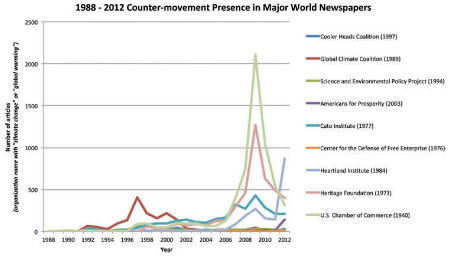
How has this toxic terminology fared over the years? To answer, the paper provides an interesting graph that tracks the media's coverage of various contrarian groups.
Climate countermovement presence in English-language news outlets, 1988–2012. This graphic represents nine of the 110 groups that were identified as the ‘core’ of the US climate countermovement. Years noted in parenthesis after each organization's name denotes the year of formation.Climate countermovement presence in English-language news outlets, 1988–2012. This graphic represents 9 of the 110 groups that were identified as the ‘core’ of the US climate countermovement. Years noted in parentheses after each organization's name denotes the year of formation.
One of note is the now discredited Heartland Institute, which saw a large spike in coverage during the summer of 2012. The research attributes the surge to a disastrous billboard comparing people who accept climate change to the Unabomber Ted Kaczynski. This event shattered what credibility Heartland had; its corporate sponsors and board members promptly fled the group, rescinding funding and crippling its reputation in the process.
One of the groups that has held on to some credibility is the CATO Institute. This libertarian group focuses on free-market capitalism and is generally opposed to environmental regulations (as well as most other regulations).
As the authors examine some of the psychological aspects of these contrarian celebrities an additional wrinkle appears. CATO's Pat Michaels, one of the few climate contrarians with appropriate credentials, describes the Koch-funded think tank as the first place where he was employed that "people actually like me."
Boykoff explains that this sense of belonging is a recurring theme of contrarian movements and of climate contrarianism specifically. After being marginalized by the rigors of independent and objective peer-reviewed academia, contrarians move to overtly free-market-focused think tanks where political beliefs trump the restrictions of scientific method and academic discourse. Through this process, they reject academic ethics and view their being ostracized as a badge of honor.
In a particularly egregious episode, the American Enterprise Institute, which is partially funded by Exxon Mobil, offered a $10,000 bounty for any papers that could cast doubt on the 2007 United Nation's Intergovernmental Panel on Climate Change report. Attempts to award a predetermined finding is so anti-science and unethical it would be unbelievable if not reported by an organization as respectable as The Guardian.
The authors also point to research by Dr. Myanna Lahsen that shows many of the most vocal climate contrarians came of age in the 1960s and 1970s and perceive anything (particularly computer modeling) that developed after their hay day as inaccurate and unreliable.
This paints a fairly compelling portrait of the current cast of celebrity contrarians: grumpy old timers (who are still afraid of the communists) bewildered by technological advances who are paid by wealthy industrialists to disparage environmentalism and protect profits against the scientifically supported need for regulation.
The study finds that the desire to maintain scientific credibility is outweighed by the "exhilaration from self-perceived academic martyrdom and a more general desire for notoriety."
So the next time a talking head on Fox News tells you that climate change is just a big hoax, remember this study and their motivations. Propped up by ideology and special interest funding, these relics of punch-card computing are seeking out fame and fortune, at the expense of their own forsaken academic integrity.

Wednesday, April 17, 2013

Hansen's New Climate Dice - Hot, Loaded, and Misunderstood


by Dana Nuccitelli, Skeptical Science, August 15, 2012

James Hansen's newest paper, Perception of climate change, has been published in the Proceedings of the National Academy of Sciences (PNAS).  In January 2012, Michael Sweet examined the draft version of this paper prior to its review and acceptance by PNAS.  The paper links increased heat wave frequency and intensity to human-caused climate change.  As a result, it has generated a great deal of mainstream media attention, and also a number of misinterpretations and misrepresentations which we will examine in this post.

Hansen's Findings

Hansen et al. examined the surface temperature record to determine how the distribution of temperatures has changed over the past six decades.  As we know, the average global temperature has increased approximately 0.7 °C over that period, so not surprisingly, the distribution of temperature anomalies has also shifted towards warmer values on average, as illustrated by the animation below and Figure 1.
SourceNASA/Goddard Space Flight Center GISS and Scientific Visualization Studio 
This changing temperature distribution is a wholly empirical result, and has also been observed by Donat and Alexander (2012):
"The results indicate that the distributions of both daily maximum and minimum temperatures have significantly shifted towards higher values in the latter period compared to the earlier period in almost all regions"
and
"...these changes have had the greatest impact on the extremes of the distribution and we conclude that the distribution of global daily temperatures has indeed become “more extreme” since the middle of the 20th century."
This was also shown by Meehl (2009), which examined how the ratio of hot to cold records in the United States has changed over the past six decades (Figure 1).
hot to cold ratio
Figure 1. Ratio of record daily highs to record daily lows observed at about 1,800 weather stations in the 48 contiguous United States from January 1950 through September 2009. Each bar shows the proportion of record highs (red) to record lows (blue) for each decade. The 1960s and 1970s saw slightly more record daily lows than highs, but in the last 30 years record highs have increasingly predominated, with the ratio now about two-to-one for the 48 states as a whole.
This main conclusion that we are seeing more and stronger heat waves as a consequence of global warming is a clear, expected, empirical result which we would hope nobody will dispute. The controversy comes in when these results are used to try and attribute individual heat waves to human-caused global warming.

Extreme Heat Waves - Anthropogenic and Natural

Martin Hoerling of NOAA criticized Hansen et al. for attributing several heat waves to global warming in the abstract of their paper:
"we can state, with a high degree of confidence, that extreme anomalies such as those in Texas and Oklahoma in 2011 and Moscow in 2010 were a consequence of global warming because their likelihood in the absence of global warming was exceedingly small."
"The change is so drastic, the paper says, that scientists can claim with near certainty that events like the Texas heat wave last year, the Russian heat wave of 2010 and the European heat wave of 2003 would not have happened without the planetary warming caused by the human release of greenhouse gases."
Hoerling responded in a separate NYT interview by stating that he had previously co-authored a paper which concluded that the Russian heat wave was largely a consequence of natural climate variability.  However, the paper in question is Dole et al. (2011), which contained some serious flaws, failing to account for a glitch in the Moscow July station temperature data, which saw an urban heat island correction erroneously applied, as discussed in detail by Stefan Rahmstorf at RealClimate.
Meanwhile the results of Hansen et al. are consistent with those of Rahmstorf and Coumou (2011), who concluded that the Moscow heat wave would likely not have broken the record without an assist from human-caused global warming.
"For July temperature in Moscow, we estimate that the local warming trendhas increased the number of records expected in the past decade fivefold, which implies an approximate 80% probability that the 2010 July heat record would not have occurred without climate warming."
Otto et al. (2012) found that the Moscow heat wave was so intense that the human-caused warming alone could not account for it -- in other words that it can be called "mostly natural."  However, they also found that the warming trend had caused a three-fold increase in the likelihood that the heat record would be broken (Figure 2); in that sense "supporting the assertion that the risk of the event occurring was mainly attributable to the external trend."
otto fig 4
Figure 2. Return periods of temperature-geopotential height conditions in the model for the 1960s (green) and the 2000s (blue) and in ERA-Interim for 1979-2010 (black). The vertical black arrow shows the anomaly of the Russian heat wave 2010 (black horizontal line) compared to the July mean temperatures of the 1960s (dashed line). The vertical red arrow gives the increase in the magnitude of the heat wave due to the shift of the distribution whereas the horizontal red arrow shows the change in the return period.  Figure 4 in Otto et al. (2012).
And Hansen's comments about the 2003 European heat wave are consistent with the results of Stott et al. (2004):
"we estimate it is very likely (confidence level >90%) that human influence has at least doubled the risk of a heatwave exceeding this threshold magnitude."

Drought Confusion

In his NYT interview, Hoerling claimed that Hansen's paper confused droughts with heat waves.  Patrick Michaels has also described Hansen's paper in similar terms:
"Hansen claims that global warming is associated with increased drought in the US....His hypothesis is a complete and abject failure."
It is a red flag when Patrick Michaels -- who has become famous for deleting inconvenient data and distorting other scientists' results -- agrees with your criticisms of another scientist's work.  It's an olympic-sized red flag when Anthony Watts also agrees.
Predictably, these claims are simply wrong, and entirely mischaracterize Hansen's paper, which focuses almost exclusively on temperature changes and barely even mentions droughts.  Watts' confusion came from this Associated Press article which does equate heat waves with drought several times.  However, nowhere in the article is Hansen quoted even mentioning drought.  Hoerling and Michaels may have confused Hansen's paper with his NYT op-ed, in which he said:
"Over the next several decades, the Western United States and the semi-arid region from North Dakota to Texas will develop semi-permanent drought, with rain, when it does come, occurring in extreme events with heavy flooding."
However, this comment came two paragraphs before Hansen began discussing his new paper, and note that the comment discusses future, not present droughts. Hansen's comments on this matter are supported by the scientific literature, for example Dai (2010), which projects changes in the Palmer Drought Severity Index (PDSI), shown in Figures 3 and 4, concluding:
"Regions like the United States have avoided prolonged droughts during the last 50 years due to natural climate variations, but might see persistent droughts in the next 20–50 years"
Figure 3. PDSI 2030-2039. (Courtesy UCAR)
Figure 4. PDSI 2060-2069. (Courtesy UCAR)
Wehner et al. (2011) (related presentation here) arrived at similar conclusions, as did a new paper by Dai (2012).  Joe Romm has a good roundup of relevant research.
Hoerling also quoted the IPCC Special Report on Managing the Risks of Extreme Events and Disasters to Advance Climate Change Adaptation (SREX) to support his point.  However, he quoted a section on floods instead of droughts. Here is what the SREX says about US droughts in the next few decades:
"There is medium confidence that droughts will intensify in the 21st century in some seasons and areas, due to reduced precipitation and/or increased evapotranspiration. This applies to regions including...central North America."
Again, this is consistent with Hansen's comments.

Tamino on Variability

Tamino has pointed out that the change in the distribution of surface temperatures may not be due to increased variability, as Hansen et al. conclude, but rather simply due to a combination of different regions warming at different rates, and when their data are combined, the result looks the same as it would if temperature variability were increasing.  In other words, we don't know how much of the increase in hot weather events is due to weather becoming more variable, and how much is simply due to average temperatures becoming hotter.
The results of Donat and Alexander (2012) lend some credibility to Tamino's comments regarding a lesser change in temperature variance, although they find that an increase in skewness (asymmetry) of the temperature distribution has probably contributed to the increased frequency of extreme heat events (Figure 5).
"The results indicate that the distributions of both daily maximum and minimum temperatures have significantly shifted towards higher values in the latter period compared to the earlier period in almost all regions, whereas changes in variance are spatially heterogeneous and mostly less significant.  However asymmetry appears to have decreased but is altered in such a way that it has become skewed towards the hotter part of the distribution."
donat fig 1
Figure 5. The differences in higher moment statistics of (a) mean, (b) variance, and (c) skewness for each grid box in HadGHCND for (left) daily minimum temperature anomalies and (right) daily maximum temperature anomalies for the two time periods shown. Hatching indicates changes between the two periods that are significant at the 10% level for the mean (using a Student’s t-test) and the variance (using an f-test) of the distribution. Figure 1 in Donat and Alexander (2012).
This is an issue we will be exploring in another post in the near future.  However, it does not impact the main result of Hansen et al., that global warming has caused extreme heat events to occur more frequently and to be more intense on average.  The question is more of a technical issue -- whether the increase in extreme heat events is due more to an increased temperature variability, to the warmer shift in average temperatures, or to increased skewness in the temperature distribution.  In any case, human-caused global warming is responsible. 

More Mischaracterizations of Hansen et al.

In addition to the misrepresentation of Hansen's results from Michaels and Hoerling, Roger Pielke, Sr., has endorsed an extremely poor critique of Hansen et al. by Mike Smith, which does not even address Hansen's new paper, but rather his 1988 paper, and does so by distorting reality as many others (including the aforementioned Patrick Michaels) have.  Hansen's paper created global warming projections based on three greenhouse gas emissions scenarios (A, B, and C).  Smith claims:
"Turns out that Scenario A turned out to be correct"
This is a false statement which we have debunked many times, most recently here, where we showed that Scenario A has actually turned out to be the furthest from reality (Figure 6).
updated GHG forcings
Figure 6. Radiative forcing contributions from 1988 to 2010 from CO2 (dark blue), N2O (red), CH4 (green), CFC-11 (purple), and CFC-12 (light blue) in each of the scenarios modeled in Hansen et al. 1988, vs. observations (NOAA).
Smith in turn (along with Watts, who also posted Michaels' strawman attack on Hansen et al.) endorsed another poor analysis of Hansen's work by Cliff Mass. Mass grossly oversimplified the situation, for example trying to parse out what percentage of the heat waves could be attributed to global warming vs. natural variability by examining the mean annual temperature increase without recognizing that this increase varies over different seasons, different local regions, and possibly even different types of weather events. A few people left good comments on Mass' post here and here, for further reading.
Mass generally misunderstood the arguments of Hansen et al. as well. In the end, Mass basically echoed part of the conclusion from Otto et al. (2012), that the heat waves could be described as "mostly natural." However, the main point of Hansen et al. is that heat waves like those in Moscow, Texas and Oklahoma will occur more frequently and on average be more intense than they would be without human-caused global warming.  As Tamino notes,
"Cliff Mass gives the impression that there’s nothing to worry about because our “3-sigma” events — the real killers — will only be one degree hotter, quite ignoring the fact that we’ll get 10 times as many of them."

Probability - the Language of Science

As the papers discussed here note, these issues boil down to probabilities. Global warming has obviously made temperatures warmer, on average, which in turn has increased the odds of extreme heat events.  Hansen's argument is that without global warming, the probability of the Moscow, Texas and Oklahoma heat waves being so hot is so small, that it's safe to say that global warming was a contributing factor -- that they would not have been as blisteringly hot in the absence of global warming. 
That's not to say that humans caused these heat waves -- we didn't. However, odds are very good that they wouldn't have been as hot or record-breaking without human influences, and human influences will also cause more frequent, hotter, record breaking heat waves in the future as global warming continues.
This is where the 'loading the dice' analogy comes in.  Hansen's point is that by increasing the average temperature, we are making the hotter temperatures more likely -- effectively weighting the hotter values of the climate dice.  As a result, today's extreme heat will become the norm a few decades from now, just as what we considered extreme heat a few decades ago has now become much more commonplace.  As Tamino put it in a recent post:
"When a 3-sigma event happens, it’s a problem but we can deal with it and recover from it. When 10 (or more) times as many 3-sigma events happen … we have a problem.
That means we’re already in trouble. The really bad news is that we’re already in trouble from just the warming we’ve already experienced, but it’s going to get worse because it’s going to get hotter. You think the 2011 Texas-Oklahoma heat wave was bad? You think this year’s corn-belt heat wave was bad? You think the 2010 Russian heat wave was very very bad? You ain’t seen nothin’ yet."

Hot and Heavy Dice

To summarize, Hansen et al. showed that extreme heat events have become more common and more intense as a result of global warming.  While Hansen correctly noted in a NYT op-ed that droughts are expected to become more frequent in parts of the USA in the coming decades, aside from a brief discussion of the link between extreme heat and drought, Hansen et al. (2012) does not address droughts or attribute them to global warming.
Hansen et al. have shown that a number of heat waves such as the 2010 Russian event are very unlikely to have been as intense or record-breaking if humans weren't causing global warming. Simply put, several recent heat waves have been so hot that the chances of a similarly intense heat wave happening several decades ago would have been very, very low.  We are loading the dice to make the chances of extreme heat waves happening much higher, which is why they are happening more frequently.
As Hansen et al. note, "public opinion about the existence and importance of globalwarming depends strongly on their perceptions of recent local climate variations."  This is undoubtedly why their paper has been the target of so many mischaracterizations by people who want public opinion to stay right where it is.