Blog Archive

Showing posts with label Stephan Lewanowsky. Show all posts

Friday, November 1, 2013

The subterranean war on science, by Stephan Lewandowsky, Michael E. Mann, Linda Bauld, Gerard Hastings & Elizabeth F. Loftus

by Stephan Lewandowsky, Michael E. Mann, Linda Bauld, Gerard Hastings, and Elizabeth F. Loftus, Association for Psychological Science, Observer, Vol. 26, No. 9, November 2013.
Science denial kills. More than 300,000 South Africans died needlessly in the early 2000s because the government of President Mbeki preferred to treat AIDS with garlic and beetroot rather than antiretroviral drugs (Chigwedere, Seage, Gruskin, Lee & Essex, 2008). The premature death toll from tobacco is staggering, and historians have shown how it was needlessly inflated by industry-sponsored denial of robust medical evidence (Proctor, 2011). The US now faces the largest outbreak of whooping cough in decades, in part because of widespread denial of the benefits of vaccinations (Rosenau, 2012). According to the World Health Organization, climate change is already claiming more than 150,000 [more recent research estimates 300,000 per year] lives annually (Patz, Campbell-Lendrum, Holloway & Foley, 2005), and estimates of future migrations triggered by unmitigated global warming run as high as 187 million refugees (Nicholls et al., 2011). A common current attribute of denial is that it side-steps the peer-reviewed literature and relies on platforms such as internet blogs or tabloid newspapers to disseminate its dissent from the scientific mainstream. In contrast, the publication of dissenting views in the peer-reviewed literature does not constitute denial.
The tragic track record of denial has stimulated research into its political, sociological, and psychological underpinnings (Dunlap, 2013; Jacobson, Targonski & Poland, 2007; Kalichman, 2009; Lewandowsky, Oberauer & Gignac, 2013; Lewandowsky, Gignac & Oberauer, 2013; Oreskes & Conway, 2010). Although research has focused on diverse issues — from HIV/AIDS to vaccinations to climate change — several common variables have been isolated that determine whether people are likely to reject well-established scientific facts. Foremost among them is the threat to people’s worldviews. For example, mitigation of climate change or public-health legislation threatens people who cherish unregulated free markets because it might entail regulations of businesses (Heath & Gifford, 2006; Kahan, 2010; Lewandowsky, Gignac & Oberauer, 2013; Rosenau, 2012); vaccinations threaten Libertarians’ conceptions of parental autonomy (Kahan, Braman, Cohen, Gastil & Slovic, 2010; Lewandowsky, Gignac & Oberauer, 2013); and evolution challenges people’s religious faiths (Rosenau, 2012). Another variable that appears to be involved in science denial is conspiracist ideation (Kalichman, 2009; Lewandowsky, Gignac & Oberauer, 2013; Lewandowsky, Oberauer & Gignac, 2013; Lewandowsky, Cook, Oberauer & Marriott, 2013; Smith & Leiserowitz, 2012). Thus, AIDS is thought to be a creation of the US Government (Kalichman, 2009), climate change is a “hoax” perpetrated by corrupt scientists (Inhofe, 2012), and research into the health effects of tobacco is conducted by a “cartel” that “manufactures alleged evidence” (Abt, 1983, p. 127).
The conspiratorial element of denial explains why contrarians often perceive themselves as heroic dissenters who — in their imagination — are following Galileo’s footsteps by opposing a mainstream scientific “elite” that imposes its views not on the basis of overwhelming evidence but for political reasons. Mainstream climate scientists are therefore frequently accused of “Lysenkoism,” after the Soviet scientist whose Lamarckian views of evolution were state dogma in the Soviet Union. Other contrarians appeal to Albert Einstein’s injunction “. . . to not stop questioning” to support their dissent from the fact that HIV causes AIDS (Duesberg, 1989).
This conspiratorial element provides a breeding ground for the personal and professional attacks on scientists that seemingly inevitably accompany science denial. The present authors have all been subject to such attacks, whose similarity is notable because the authors’ research spans a broad range of topics and disciplines: The first author has investigated the psychological variables underlying the acceptance or rejection of scientific findings; the second author is a paleoclimatologist who has shown that current global temperatures are likely unprecedented during the last 1,000 years or more; the third and fourth authors are public-health researchers who have investigated the attitudes of teenagers and young adults towards smoking and evaluated a range of tobacco control interventions; and the fifth author has established that human memory is not only fallible but subject to very large and systematic distortions.
This article surveys some of the principal techniques by which the authors have been harassed; namely, cyber-bullying and public abuse; harassment by vexatious freedom-of-information (FOI) requests, complaints, and legal threats or actions; and perhaps most troubling, by the intimidation of journal editors who are acting on manuscripts that are considered inconvenient by deniers. The uniformity with which these attacks are pursued across several disciplines suggests that their motivation is not scientific in nature.
In light of the lethal track record of denial, one might expect opprobrium to be reserved for those who deny the public’s right to be adequately informed about risks such as AIDS or climate change. Paradoxically, however, it is scientists whose research aims to inform the public of such risks who have been at the receiving end of hate mail and threats. Thus, the first author has been labeled a “Nazi zionist kike” and has been accused of “mass murder and treason.” The second author has been attacked on a neo-Nazi website and has received envelopes with a powdery white substance resembling Anthrax (Mann, 2012). The third author has received anonymous abusive emails and nighttime phone calls in her home. This abuse is at least in part orchestrated because the frequency of such emails tends to increase when scientists’ e-addresses are posted on contrarian websites.
Other attempts of intimidation have involved the solicitation of potentially compromising information from the first author by a non-existent internet “sock puppet” whose unknown creators pretended to be victimized by climate deniers — and who then splattered the private correspondence on the internet (Lewandowsky, 2011). At a public level, an American lobbying outfit has recently likened climate scientists to the Unabomber in a billboard campaign, and a British tabloid journalist entertained the execution of the second author by hanging in what passes for a “mainstream” newspaper in the UK (Delingpole, 2013).
Another common tool of harassment involves FOI requests. Under many legislations around the world, email correspondence by an academic is subject to almost unconditional release. During the last 9 months, the first author has been subject to numerous requests for correspondence and other documents, including trivial pedantry such as the precise time and date stamps of blog posts. In a paradoxical twist, accusations of impropriety were launched against the first author when an FOI-release confirmed that inconvenient research (Lewandowsky, Oberauer & Gignac, 2013) was conducted with ethics approval. The allegations — by bloggers unaccountable to any form of review or ethical scrutiny — cited the fact that ethics approval was granted expeditiously (for details, see Lewandowsky, Cook et al., 2013). The second author and his former university endured vexatious demands for the release of personal email correspondence by Virginia’s Attorney General. Those actions attracted national and international attention and were labeled a “witch hunt” by Nature (2010). The demands were ultimately rejected with prejudice by the Virginia Supreme Court. Other attacks on the second author involved front groups like the “American Tradition Institute” and the “Competitive Enterprise Institute” which sought access to his personal emails, professional notes, and virtually every imaginable document from his entire career. The third and fourth authors’ research center on tobacco control has been subject to a number of extensive FOI requests from a tobacco giant, Philip Morris International, for confidential interview records involving teenaged participants. Notably, the identity of Philip Morris was disguised during the first FOI request, which was launched with a law firm serving as a front group (Hastings, MacKintosh & Bauld, 2011). The information requested included “all primary data,” “all questionnaires,” “all interviewers’ handbooks and/or instructions,” “all data files,” “all record descriptions,” and so on.
The use of FOI to obtain correspondence or research data mirrors legislative attempts by the tobacco industry to gain unhindered access to epidemiological data (Baba, Cook, McGarity & Bero, 2005). At first glance, it might appear paradoxical that the tobacco industry would sponsor laws ostensibly designed to ensure transparency of research, such as the Data Access Act of 1998. However, the reanalysis of inconvenient results by obtaining the raw data is a known tool in the arsenal of vested interests: Michaels (2008) shows how epidemiological data have been subjected to industry-sponsored re-analysis because of their regulatory implications, such as the link between tobacco and lung cancer or the link between bladder cancer and chemicals used in dye production. Re-analyses by industry bodies often fail to detect such well-established links (e.g., Cataldo, Bero & Malone, 2010; Proctor, 2011). Similarly, results by the first (see Lewandowsky, Cook, et al., 2013), second (see Mann, 2012), and third (Sims, Maxwell, Bauld & Gilmore, 2010) author have been reanalyzed on internet blogs (sometimes by the same individuals). Those reanalyses used various tricks, such as the violation of strong statistical conventions relating to the inclusion of principal components, to attenuate the inconvenient implications of the research—specifically, that the warming from greenhouse gas emissions is historically unprecedented (Mann, Bradley, & Hughes, 1998) and that those who oppose this scientific fact tend to engage in conspiracist ideation (Lewandowsky, Oberauer, & Gignac, 2013; Lewandowsky, Gignac, & Oberauer, 2013). Another tactic to discredit “inconvenient” peer-reviewed results involves publishing alternative versions of “the evidence” using different sources that proport to be equally legitimate. For example, the third author’s review of the impact of smoke-free legislation in England, published by the UK government (Bauld, 2011) was the subject of a report by Imperial Tobacco, the world’s fourth-largest tobacco company. Entitled “The Bauld Truth” as a play on the third author’s name (Imperial Tobacco, 2011), it presented alternative, non peer-reviewed evidence as more viable and opened with the statement that the third author’s review was “lazy and deliberately selective”. Anyone familiar with climate disinformation on the internet will recognize those rhetorical tools as the standard fare of dismissal of inconvenient science.
A further line of attack involves complaints by members of the public to scientists’ host institutions with allegations of research misconduct. The format of those complaints ranges from brief enraged emails to the submission of detailed, elaborately-formatted multi-page dossiers. The scientific literature on querulous complainants (e.g., Lester, Wilson, Griffin, & Mullen, 2004; Mullen & Lester, 2006) explicates the nature of the majority of such complaints. However, not all complaints to universities are from querulous individuals: The tobacco industry, specifically Philip Morris, used complaints to scientists’ deans or department heads as part of their action plan to discredit researchers who investigated the health risks of smoking (Landman & Glantz, 2009).
The fifth author has experienced a particularly chilling legal attack based on an article that disputed the legitimacy of the claim by an individual (whose name was not released) that she had with the help of a psychiatrist recovered a “repressed childhood memory” of sexual abuse by her mother (for a review of the case, see Geis & Loftus, 2009). Although the suit was ultimately settled, the complaints to the university delayed publication—or indeed any public mention—of the research by several years (Loftus, 2003).
Those attacks on scientists by personal abuse, vexatious use of FOI and the complaints process, and legal proceedings, have not only consumed valuable time, thereby delaying research, but have also taken an emotional toll. Those attacks have caused considerable trauma among some junior scientists known to us. However, the problem does not end there. Even more concerning is another line of attack that directly targets the integrity of the scientific process: We are concerned about the activities of individuals outside the scientific community and of little scientific standing, who systematically insert themselves into the peer-review and publication process to prevent the publication of findings they deem inconvenient. Those insertions typically involve emails to editors which have been described as “bullying” by some parties involved. Far from being isolated incidents, at last count we have identified 7 editors of several journals who have been subject to such bullying tactics across two disciplines; viz. climate science and psychology.
Once again, precedents for those attempts to subvert the scientific process involve the tobacco industry. A 1995 Philip Morris action plan explicitly devised strategies to interfere with funding of health research. Those strategies included approaches to the appropriations committee of Congress (albeit without raising the profile of the tobacco industry), and the writing of letters critical of public-health research to the editors of scientific journals by associates of the industry’s Tobacco Institute (without necessarily revealing their associations). Landman and Glantz (2009) show how this plan was translated into action.
What are the consequences of such insertions by external parties into the scientific process? There is little doubt that pressure from the tobacco industry affected the course of medical research, if only by consuming massive amounts of scientists’ time that could otherwise have been devoted to research (Landman & Glantz, 2009; Proctor, 2011). It also delayed the translation of that research into interventions and policies that could have saved lives by reducing smoking rates. There is also a growing body of literature which suggests that the aggressive efforts by climate deniers have adversely affected the communication and direction of climate research (Brysse, Oreskes, O’Reilly, & Oppenheimer, 2013; Freudenburg & Muselli, 2010; Lewandowsky, Oreskes, Risbey, Newell, & Smithson, 2013), and allegations of defamation have led to the re-examination of one of the first author’s papers to eliminate legal risks that is ongoing at the time of this writing (Lewandowsky, Cook, et al., 2013).
How should the scientific community respond to the events just reviewed? As in most cases of intimidation and bullying, we believe that daylight is the best disinfectant. This article is a first step in this effort towards transparency. Knowledge of the common techniques by which scientists are attacked, irrespective of their discipline and research area, is essential so that institutions can support their academics against attempts to thwart their academic freedom. This information is also essential to enable lawmakers to improve the balance between academic freedom and confidentiality of peer review on the one hand, and the public’s right to access information on the other. Finally, this knowledge is particularly important for journal editors and professional organizations to muster the required resilience against illegitimate insertions into the scientific process.

Thursday, February 21, 2013

DELICIOUS! Justin Gillis: Unlocking the Conspiracy Mind-Set

by JUSTIN GILLIS, The New York Times, February 21, 2013

Green: Politics
When I first met the NASA climate researcher Gavin Schmidt a few years ago, we discussed the proliferation of material on the Internet attacking mainstream climate science. I asked him whether he thought climate contrarians were flirting with conspiracy theory in their views.
WND Books
“Flirting?” he said. “No. They’ve already had conspiracy theory out on a hot date, and now it’s the morning after and they’re sitting up in bed, having coffee.”
I happened to recall that conversation the other day as I read the latest chapter of a remarkable back-and-forth between mainstream researchers and climate contrarians.
It all started last year, when a social scientist named Stephan Lewandowsky, of the University of Western Australia, and two colleagues published a rather provocative paper. It was based on an anonymous Internet survey of the readers of climate blogs.
The title alone will give you a sense of the findings: “NASA Faked the Moon Landings – Therefore (Climate) Science is a Hoax.” The subtitle was “An Anatomy of the Motivated Rejection of Science.”
The strongest finding in the survey was that ideological belief in an unregulated free market tended to be a predictor of someone’s willingness to reject the findings of mainstream climate research. No great surprise there. It was the secondary findings that set off a brouhaha.
Dr. Lewandowsky’s survey results suggested that people who rejected climate science were more likely than other respondents to reject other scientific or official findings and buy into assorted fringe theories: that NASA faked the moon landing, that the Central Intelligence Agency killed Martin Luther King, Jr., that the AIDS virus was unleashed by the government, and so forth.
This piece of research appeared in a specialized journal in psychological science, but it did not take long to find its way onto climate skeptics’ blogs, setting off howls of derision.
A theory quickly emerged: that believers in climate science had been the main people taking Dr. Lewandowsky’s survey, but instead of answering honestly, had decided en masse to impersonate climate contrarians, giving the craziest possible answers so as to make the contrarians look like whack jobs.
So, a paper about a tendency among this group to believe in conspiracy theories was met by … a conspiracy theory.
Dr. Lewandowsky and his collaborators were taken aback, but not for long. As far-fetched ideas about the survey ricocheted around the Internet, they realized that manna was falling on them from heaven.
They started collecting the relevant blog posts, attempting to trace ideas to their origin, and observing how readily new conspiracy theories were embraced by the contrarians.
The result is yet another paper [this is a hysterical read!], just out recently. Again, the title tells the tale: “Recursive fury: Conspiracist ideation in the blogosphere in response to research on conspiracist ideation.”
Now, I will confess to being a bit of a skeptic myself about the value of Internet surveys, which tend to draw a self-selected population of respondents. And the only science I follow closely these days is physical research into the climate system, so I will let others with more expertise in the social sciences judge the merits of these papers.
But for sheer entertainment, they are both great reads – especially the second one, with its long passages about how the minds of conspiracy theorists work to seal off doubt and contrary evidence.
The heart of the second paper is a narrative of the eruption of various theories regarding the first paper, with elements of conspiratorial thinking explicitly identified in each case. Before the fever died down, one blogger was comparing Australian climate research to Soviet political repression, spinning a web of treachery that involved the Australian government, the University of Western Australia, the Australian Broadcasting Corporation and other groups.
(Judging from some of the e-mail I get, The New York Times is also seen in some quarters as part of a global plot to foist a scientific hoax on the public.)
Parts of this second paper remind me of the timeless Richard Hofstadter essay, “The Paranoid Style in American Politics,” which is, by the way, essential reading for anyone trying to understand the influence of climate denialism on modern American or Australian or British politics. It was written in the early 1960s and contains not a word about climate change, but anyone who has followed the climate wars closely will recognize a lot of the themes in the essay.
When I recently reminded Dr. Schmidt of our conversation from a few years back, he replied that it was “worth pointing out that just because an argument is used by a conspiracy theorist doesn’t make it wrong, and that just because someone agrees with a conspiracy theorist on something, it doesn’t make them a crank.”
Indeed, some of the strongest online reaction to Dr. Lewandowsky’s original paper came from intelligent climate contrarians who were offended at being labeled part of the tinfoil hat brigade. Whatever you think of their position on global warming, some of them have remarkable statistical skills and have made contributions, generally modest, to the scientific literature.
And yet, in other corners of the climate contrarian movement, words like “conspiracy” and “hoax” keep cropping up. Sen. James Inhofe, an Oklahoma Republican who is the standard-bearer for the climate contrarians in Congress, scored a double last year in the title of a book he published: “The Greatest Hoax: How the Global Warming Conspiracy Threatens Your Future.”

http://green.blogs.nytimes.com/2013/02/21/unlocking-the-conspiracy-mindset/

Tuesday, February 5, 2013

Wonderfully humorous article on conspiracist thinking in climate science denial circles by Lewandowsky et al., doi: 10.3389/fpsyg.2013.00073


Frontiers in Psychology 4(73) 2013; doi: 10.3389/fpsyg.2013.00073

Recursive fury: Conspiracist ideation in the blogosphere in response to research on conspiracist ideation

  • 1Psychology, University of Western Australia, Australia
  • 2Global Change Institute, The University of Queensland, Australia
  • 3Psychology, University of Zurich, Switzerland
  • 4 Climate Realities Research, Australia
Abstract

Conspiracist ideation has been repeatedly implicated in the rejection of scientific propositions, although empirical evidence to date has been sparse. A recent study involving visitors to climate blogs found that conspiracist ideation was associated with the rejection of climate science and the rejection of other scientific propositions such as the link between lung cancer and smoking, and between HIV and AIDS (Lewandowsky, Oberauer & Gignac, in press; LOG12 from here on). This article analyzes the response of the climate blogosphere to the publication of LOG12. We identify and trace the hypotheses that emerged in response to LOG12 and that questioned the validity of the paper's conclusions. Using established criteria to identify conspiracist ideation, we show that many of the hypotheses exhibited conspiratorial content and counterfactual thinking. For example, whereas hypotheses were initially narrowly focused on LOG12, some ultimately grew in scope to include actors beyond the authors of LOG12, such as university executives, a media organization, and the Australian government. The overall pattern of the blogosphere's response to LOG12 illustrates the possible role of conspiracist ideation in the rejection of science, although alternative scholarly interpretations may be advanced in the future.

http://www.frontiersin.org/Personality_Science_and_Individual_Differences/10.3389/fpsyg.2013.00073/abstract

Provisional pdf file of complete article at link above.

Climate science heroes John Cook and Stephan Lewandowsky on the right in the photo below (Kevin Judd and Matt Hipsey on the left):


Thursday, January 10, 2013

Stephan Lewandowsky: One world, two realities: BigAussieHeat


by Stephan Lewandowsky (Winthrop Professor, School of Psychology, University of Western Australia), Shaping Tomorrow's World, January 11, 2013
Australia is experiencing the mother of all heat waves. Records are tumbling everywhere: For the first time in recorded climatic history, the country experienced 7 consecutive days above 39 C (90 F). Extremes are everywhere, and the Bureau of Meteorology issued a special climate statement.

As stated by Bureau of Meteorology's manager of climate monitoring and prediction, David Jones, ''The current heatwave -- in terms of its duration, its intensity and its extent -- is unprecedented in our records. Clearly, the climate system is responding to the background warming trend. Everything that happens in the climate system now is taking place on a planet which is a degree hotter than it used to be.''

It's so hot, the Bureau had to add another color to the temperature map -- Burning Deep Purple:


This actually means something.
It means that people suffer, like the heroic grandparents who saved their children from a bushfire, taking pictures because they thought they might never see them again alive:

It means freakish dust storms off the coast of Western Australia, awe inspiring in their beauty:


That is what climate change means.

But this reality is not shared by everyone. There are some politicians who live in an alternate reality. Just today, one of them reiterated their commitment to abolishing Australia's price on carbon, because it allegedly fails to cut emissions and because "genuine domestic emission reductions can be achieved without taxing electricity."

And therein lies the problem. We have one world, one reality, and an alternate fantasy world inhabited mainly by politicians, mining magnates, and their enablers in the media.

In reality, there is some evidence that the price of carbon, however imperfect a first step it may be, is having an effect on emissions.

http://www.shapingtomorrowsworld.org/lewandowsky2realities2.html

Tuesday, January 1, 2013

SkS: 2012 in Review - a Major Year for Climate Change

by Dana Nuccitelli, Skeptical Science, January 1, 2012
With 2012 now in the books, let's take a look back at some of the biggest climate-related events of the year.  Here we'll examine some of the most significant scientific papers, debunked myths, climatic events, and steps taken towards solving the climate problem, as determined in part by the most widely-viewed Skeptical Science blog posts of 2012.  Let's begin with two of the most significant climatic events of the year.

Climatic Events of 2012 - Sea Ice Record and Sandy

There are two clear climatic event frontrunners in terms of impacts on people, the climate, and public awareness of climate change: the record-shattering Arctic sea ice melt, and Hurricane Sandy

Record Arctic Sea Ice Melt

"The scientific literature is clear that the current record Arctic sea ice decline is beyond what has occurred due to natural variability for at least the past several millennia, certainly beyond what occured circa 1940, and that human influences are primarily responsible for the rapid rate of the death spiral."
The extent of the record is illustrated in the Arctic sea ice Escalator:

sea ice escalator

Figure 1:  NSIDC September Arctic sea ice extent (blue diamonds) with "recovery" years highlighted in red, vs. the long-term sea ice decline fit with a second order polynomial, also in red.
The 2012 Arctic sea ice melt was so large, that it became clear that We're gonna need a bigger graph to keep track of the death spiral.
In Lessons from Past Climate Predictions: Arctic Sea Ice Extent 2012 Update, we also saw that statistical predictions of annual Arctic sea ice minimum extent based on the long-term Arctic sea ice death spiral are more accurate and realistic than denial-based optimistic predictions that sea ice will somehow magically recover to previous levels.

Hurricane Sandy

In Hurricane Sandy and the Climate Connection, we looked at the scientific evidence regarding how we know human-caused global warming made the hurricane's impacts worse.  As John Cook put it,
storm fuel
Peter Sinclair put together an excellent Yale Forum Video: A ‘Play-by-Play’ on Sandy with Kerry Emanuel
We also debunked several myths associated with the Arctic sea ice record and Hurricane Sandy - more on these below.

New Climate Research in 2012

There was of course an immense body of new climate research in 2012, only a small selection of which we were able to examine at Skeptical Science.

Global Warming Caused by Humans

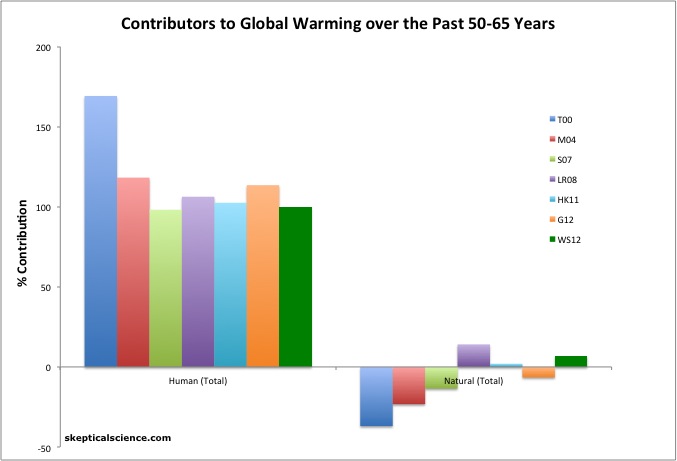
Gillett et al. (2012) and Wigley and Santer (2012) both added to the body of scientific literature determining the causes of global warming.  The Wigley and Santer results were added to the graphics created in the 2nd-most widely-read Skeptical Science post of 2012, A Comprehensive Review of the Causes of Global Warming.  All of the global warming attribution research has found that humans are responsible for close to 100% of the observed global warming over the past half century (Figure 2).
attribution 50 yr
Figure 2: Net human and natural percent contributions to the observed global surface warming over the past 50-65 years according to Tett et al. 2000 (T00, dark blue), Meehl et al. 2004 (M04, red), Stone et al. 2007 (S07, light green), Lean and Rind 2008 (LR08, purple), Huber and Knutti 2011 (HK11, light blue), Gillett et al. 2012 (G12, orange), and Wigley and Santer 2012 (WS12, dark green).

Ocean Heat Content Shows Global Warming Continues

Because over 90% of global warming goes into heating the oceans, the improved ocean heat content measurements in Levitus et al. (2012) were an important climate advancement.  These results were also used in the first Skeptical Science team scientific publication, Nuccitelli et al. (2012), which produced this useful figure showing that global warming continues to rise:
Fig 1
Figure 3: Land, atmosphere, and ice heating (red), 0-700 meter OHC increase (light blue), 700-2,000 meter OHC increase (dark blue).  From Nuccitelli et al. (2012).
In fact, the warming of the oceans since 1961 consists of a heat accumulation equivalent to two Hiroshima bomb detonations per second, every second over the past 50 years, and an even faster rate over the past two decades.

Review of Misinformation Research

The same week as Nuccitelli et al. was published, John Cook was co-author on another paper, Lewandowski et al. (2012), which provided a comprehensive review of research into misinformation.

The CO2-Temperature Lag Clarified

Shakun et al. (2012) Clarified the CO2-Temperature Lag.  We summarized the intriguing results of this paper:
"...the initial warming was indeed triggered by the Milankovitch cycles, and that small amount of orbital cycle-caused warming eventually triggered the CO2 release, which caused most of the glacial-interglacial warming.  So while CO2 did lag behind a small initial temperature change (which mostly occurred in the Southern Hemisphere), it led and was the primary driver behind most of the glacial-interglacial warming.
According to the Shakun et al. data, approximately 7% of the overall glacial-interglacial global temperature increase occurred before the CO2 rise, whereas93% of the global warming followed the CO2 increase."

Anomalous Sea Level Rise

SkS provided a video of Jerry Mitrovica's popular talk about his research into sea level rise, and the fact that the current rate of rise is faster than at any time over the past 10,000 years, since the last ice age ended.

The Biggest Climate Myths of 2012

Global Warming due to Humans, not the Sun

The 3rd-most widely-read Skeptical Science post of 2012 was a recent one, debunking a new myth by showing that the 'leaked' IPCC report explains why Global Warming is NOT Due to the Sun (Figure 4).
Figure 4: Global temperature (red, NASA GISS) and Total solar irradiance (blue, 1880 to 1978 from Solanki, 1979 to 2009 from PMOD), with 11-year running averages.

Continued Global Warming Over the Past 16 Years

Perhaps the contrarians' favorite climate myth in 2012 was that global warming magically stopped 16 years ago. This myth was first invented in an article by David Rose which included an interview with Judith Curry, but the myth had conveniently been Pre-Bunked by Nuccitelli et al. (2012) just days earlier. Nevertheless, Rose and Curry Doubled Down on their Global Warming Denial via the common denial practice of cherrypicking, which we also debunked.
The denialist use of myth of course did not stop there; it was most recently repeated by Christopher Monckton, and we were forced to give Monckton and Co. a lesson about what "global warming" is.

Gish Gallops Galore

The 'global warming stopped' myth was also repeated in The Latest Pre-Bunked Denialist Letter in Lieu of Real Science and a previous Denialist Plea for Climate Change Inaction, along with a great many other myths in true Gish Gallop fashion.  We also debunked a Gish Gallop from former Greenpeace figure Patrick Moore, and two by Bob Carter and Ian Plimer (published in the same week!), as well as Matt Ridley's nonsense in WIRED magazine.  Another Gish Gallop letter by some former NASA employees was also published and debunked, as were Fritz Vahrenholt's Gish Gallop interview in Der SpiegelJohn Christy's congressional testimony myths, and Lindzen's London Illusions.
Clearly publishing massive quantities of misinformation in the mainstream media remains the climate contrarians' favorite way to dispute mainstream climate science, whereas their efforts to publish real scientific research through the standard peer-review method remain quite infrequent.

Curry's Uncertainty Ewok

Interestingly, by far the most widely-read Skeptical Science post of 2012 was in regards to Judith Curry's Certainty Monster vs. The Uncertainty Ewok, debunking the myth that there is too much uncertainty about human-caused global warming to take action. Gunnar also examined how Curry has misused the Italian Flag approach in evaluating climate uncertainty.

Watts Up With Misinformation

We also critiqued the fundamental flaws in Anthony Watts' draft paper, which wrongly attempted to argue that contrary to Watts' own prior research, the surface temperature record is significantly influenced by the urban heat island effect. There has been no word about that draft paper since we exposed its flaws. That didn't stop Watts from going on PBS False Balance Hour and claiming the surface temperature record is unreliable, amongst other myths.

Big Year for The Escalator

After its creation in late 2011The Escalator became Skeptical Science's most popular myth debunking tool.  Speaking of PBS, The Escalator was featured in the program Climate of Doubt.  It was most recently used on the floor of the US Senate in an excellent speech by Senator Sheldon Whitehouse.
The Escalator has also undergone several revisions, the latest of which will be announced in a blog post in the near future. In addition to being used in a great many of Skeptical Science's own myth debunkings, The Escalator was used by many other websites and news outlets. We also created Vanishing Arctic Sea Ice: Going Up the Down Escalator. All of Skeptical Science's animated graphics are free for reuse, and available on our Animations page.

Sandy and Sea Ice Myths Debunked

As noted above, we also debunked the myth that climate change did not impact Hurricane Sandy in WSJ, Sandy, and Global Warming - Asking the Right Questions.  We also debunked the myth that summer Arctic Storm caused the Record Sea Ice Minimum.

IPCC Temperature Projections On the Money, Contrarians Not So Much

While we recently saw that the IPCC has been remarkably accurate in projecting global surface temperature changes, we also saw that John McLean's prediction was remarkably wrong, and his fellow climate contrarians have not performed very well either.
Predictions Comparison
Figure 5: IPCC temperature projections (red, pink, orange, green) and contrarian projections (blue and purple) vs. observed surface temperature changes (average of NASA GISS, NOAA NCDC, and HadCRUT4; black and red) for 1990 through 2012.

Climate Change Linked to Extreme Weather

While certain climate contrarians tried to muddy the waters linking climate change to extreme weather, we showed that the scientific literature has found a clear link between human-caused global warming and the frequency and/or intensity of many types of extreme weather.

Human-Caused CO2 Increase Cleudo

In Climate Change Cluedo: Anthropogenic CO2, we went step-by-step through the evidence that shows why it's settled science that humans have caused the increase in the amount of CO2 in the Earth's atmosphere.

The Climate Problem, and Solving it

"If we continue forward on our current path, catastrophe is not just a possible outcome, it is the most probable outcome.  And an intelligent risk management approach would involve taking steps to prevent a catastrophic scenario if it were a mere possibility, let alone the most probable outcome."
Despite the the lack of progress at the Doha international climate conference, there is some Hopeful News.  Many countries and regions took steps to implement greenhouse gas emissions reductions policies in 2012, including Mexico, Australia, California, Japan, South Korea, China, and Québec. Although we're running out of time, it's not yet too late to avert a climate crisis, and although international negotiations continue to progress far too slowly, that is not preventing many countries and regions from acting. 
We must continue this progress in 2013 to get our greenhouse gas emissions under control as soon as possible. We at Skeptical Science will continue our efforts to aide in that goal by communicating climate science and debunking myths in the coming year. 
The good news is that climate realists appear to have surpassed climate denialists in terms of communication, as the Climategate debacle has not been repeated in the past three years. Instead, new myths have been rapidly debunked before they've spread through the media into the public awareness, and mainstream media willingness to cover the climate issue appears to be on the rise.  We must continue and accelerate this progress, raising public awareness of the climate threat in 2013, and putting pressure on leaders to take serious steps to solve the problem.

Sunday, December 9, 2012

The real debate on climate happened in San Francisco

2zmnxzbw-1354831653Want to know what’s going on with the atmosphere? Ask the American Geophysical Union. Climate talks in Doha are unlikely to yield a breakthrough. Instead, the can will most likely be kicked further down the road, at considerable future cost.


by Stephan Lewandowsky, The Conversation, December 7, 2012

The Doha negotiations coincide with the annual meeting of the American Geophysical Union (AGU) in San Francisco, a five-day conference attended by 20,000 scientists, myself included, which provides a glimpse at the leading edge of climate research around the world. This is the research that helps us understand the reality of climate change.
The Doha meetings are also accompanied by signals from the fantasy world of climate denial, as usual expressed not in the peer-reviewed literature but as an “open letter” by purported climate experts to the UN Secretary General, Ban Ki-Moon. The letter claims that current scientific knowledge requires no action on climate change.
To understand why climate denial inhabits a fantasy world we need to look no further than a few of the purported luminaries who sign such letters.
For example, there is retiree Nils-Axel Mörner whose psychedelic intuitions include the claim that sea levels are not rising. Never mind that the horrendous damage caused by Hurricane Sandy was undoubtedly made worse by the fact that sea levels in New York are now 20 cm higher than they were a century ago. Mörner probably missed out on that because he was distracted by his famed paranormal abilities to find water by dowsing. Or perhaps he was distracted by his earlier “research” which located the Hong Kong of the Greeks in Sweden?
Then there is retiree and former scientist (among other things) Oliver Manuel, who believes that climate science is the result of “secret, fear-driven agreements by the winners of the Second World War in 1945.” Those agreements also somehow involve “Kissinger, Zhou En-Lai, Chairman Mao, Brezhnev and Nixon in 1971” — oh yes, and 9/11 was also part of the climate conspiracy.
You can’t make this stuff up.
Those are the characters who tell the UN and the public not to worry about climate change.
No point in wasting time on the other signatories — suffice it to say that most of them belong to the same troupe of cranks straight out of central casting.
So what is the real state of the science being presented at the AGU meeting in San Francisco? What do the geophysicists tell us about the state of the climate and of our planet?
The program for a single day of this meeting consists of a 50-page broadsheet that lists literally thousands of events: you can follow along online here. Talks, workshops, scientific posters, keynote addresses, all running in multiple parallel sessions in three buildings. Even with the help of the daily program booklet and the AGU iPad app it takes an hour every morning simply to navigate the smorgasbord of science and to select interesting sessions to attend.
There was the session on The Climate of the Common Era, or the presentations of the New Atmospheric Sciences Fellows. Then there was the particularly interesting session on Construing Uncertainty in Climate Science (maybe that one was particularly interesting because I chaired it).
There was the keynote address by Sir Robert Watson, who explored the implications of our current emissions path, and the fact that we are likely heading for a world that is 4 or 5 degrees warmer by 2100 than it was before industrialisation, with consequences that are alarming rather than alarmist.
There are thousands and thousands of talks, posters, discussions, and workshops.
Science is debate, and the AGU meeting is the biggest annual debate of climate scientists in the world. It is a debate that extends over five days, each filled with 12 hours or more of non-stop science.
There is, however, one issue that is not being debated: Nowhere is there a debate about the fundamental facts that the globe is rapidly warming and that human greenhouse gas emissions are responsible for that warming.
That scientific debate ceased decades ago.
It is only in the fantasy world of climate denial that ignorant chatter about those physical fundamentals continues, to the detriment of the public which would be better served without such distracting noise.
Among the 20,000 geophysicists and scientists from other disciplines in attendance at the AGU meeting, there is no mention of the denialist troupe of cranks who do “science” by writing letters to the editor.
With one exception.
Dr. Jim Hansen, one of the world’s foremost climate scientists, who first alerted the world to the risks from climate change decades ago, gave a presentation on Tuesday night. A patrician figure, he was greeted with a standing ovation even though the message he had to deliver, based on the latest available science, was far from encouraging. Decades ago, Dr. Hansen predicted events such as Hurricane Sandy, and he has been warning about the implications of climate change ever since.
Dr. Hansen expressed the view that the professional dis-informers who facilitate and encourage climate denial, and who obstruct and delay a solution to the problem at great cost in dollars and human lives in support of their own short-term greed or ideological agenda, ought to be tried for crimes against humanity.

Sunday, November 4, 2012

A storm of stupidity? Sandy, evidence and climate change

by Stephan Lewandowsky (University of Western Australia), The Conversation, November 4, 2012

“It’s global warming, stupid” – Bloomberg’s Businessweek cover last week left little doubt about their opinion concerning “Frankenstorm” Sandy. The accompanying tweet anticipated that the cover might “generate controversy, but only among the stupid.”

These frank words about the Frankenstorm are perhaps long overdue in light of the general failure of American politicians to show leadership on this issue.

But is it really a matter of mere “stupidity” to deny the link between climate change and Sandy’s fury — a link that has been drawn carefully but quite explicitly by scientists around the world, including in Australia?

No, it is not a matter of stupidity.

On the contrary, it takes considerable, if ethically disembodied, intelligence to mislead the public about the link between climate change and Sandy as thoroughly as our national “news”paper has done for the umpteenth time.

It is not a matter of stupidity. It is a matter of ideology.

People who subscribe to a fundamentalist conception of the free market will deny climate change irrespective of the overwhelming strength of the scientific evidence. They will deny any link between climate change and events such as the unprecedented Frankenstorm Sandy, or the unprecedented Texas drought, or the unprecedented series of Derechos, or the unprecedented flooding in Tennessee, or the unprecedented Arctic melt, or the unprecedented retreat of Alpine glaciers, or the unprecedented tripling of extreme weather events during the last 30 years.

There is no longer any reasonable doubt that climate change is happening all around us. There is also no doubt that ideology is the principal driver of climate denial.

So what effect will Sandy have on public opinion?

On the one hand, the deniers will likely double down and their claims will become ever more discordant with the reality on this planet. Their denial will continue even if palm trees grow in Alaska and if storms such as Sandy — or far worse — have become commonplace.

On the other hand, the vast majority of people who are not in the clutches of a self-destructive ideology will likely wake up and smell the science. Even before Sandy, a recent Pew poll (PDF) revealed that acceptance of climate change among the American public rebounded by 10 percentage points in the last few years. There is every reason to expect that Sandy will accelerate this trend towards acceptance of the dramatic changes our planet is undergoing.

Much research has shown that people’s attitude towards climate change depends on specific events and anecdotal evidence. For example, people are more likely to endorse the science on a hot day than on a cool day, all other things being equal. Even a seemingly trivial stimulus such as a dead plant in an office can enhance people’s acceptance of the science (three dead plants are even better). This human tendency to focus on scientifically irrelevant anecdotes rather than on data can be unfortunate, especially because it lends itself to exploitation by propagandists who haul out every cool day in Wagga Wagga as “evidence” that climate change is a hoax.

However, people’s propensity to learn from specific events rather than scientific data and graphs can also be beneficial. For example, a national survey in the UK revealed that people who personally experienced flooding expressed more concern over climate change and, importantly, felt more confident that their actions will have an effect on climate change. Similar data have been reported in Australia. Respondents who attributed salient events to climate change were found to be better adapted to climate change, they reported greater self-efficacy, and they were more concerned with climate change.

There is little doubt that Americans, too, will connect the dots between Frankenstorm Sandy and the reality of climate change. They will also likely recognise how drastically wrong the deniers were when they shrugged off sea level rise and how it might contribute to a flooding of New York City.

The moment the public recognises the link between climate change and Sandy, they will clamor for action. Just like New York City’s mayor, Michael Bloomberg, when he endorsed President Obama for re-election because he was more likely to address climate change.

Salient events carry a message.

People understand that message.

After all, it’s global warming, stupid.

Stephan Lewandowsky does not work for, consult to, own shares in or receive funding from any company or organisation that would benefit from this article, and has no relevant affiliations.

https://theconversation.edu.au/a-storm-of-stupidity-sandy-evidence-and-climate-change-10492
The Conversation