by Alex Kirby, Climate News Network, December 20, 2015
LONDON – Scientists in the US who have been checking on the health of the Arctic over the last year are worried by what they’ve learned: it’s warmer, has less ice, and some of its animals and fish are facing new stresses.
And in a surprise finding , which they cannot yet explain, the scientists discovered that green vegetation over much of the Arctic began a few years ago to turn an uncharacteristic brown.
Plenty of what they detail in the Arctic Report Card − published annually to document the sometimes rapidly changing conditions in the region − comes as no great surprise.
The latest Report Card, sponsored by the US National Oceanic and Atmospheric Administration (NOAA), shows the air temperature continuing its warming trend. In 2015, it was well above average across the Arctic, with temperature anomalies over land more than -0.16 °C above average − the highest since records began in 1900.
The report reveals increases not only in air but also in sea surface temperatures, decreasing sea ice extent and Greenland ice sheet mass, and changes to the behaviour of fish and walruses.
“Now in its 10th year, the Arctic Report Card is a key tool to understanding changes in the Arctic and how those changes may affect communities, businesses, and people around the world,” NOAA’s chief scientist, Dr Rick Spinrad, told journalists at the annual American Geophysical Union fall meeting.
“The Arctic is warming twice as fast as other parts of the planet, which has ramifications for global security, climate, commerce, and trade.”
Lowest on record
The average annual air temperature over land areas between October 2014 and September 2015 was 1.3 °C above average, and a 3 °C increase since the beginning of the 20th century.
Maximum sea ice extent in the Arctic Ocean was the lowest recorded since records began in 1979. The minimum extent, which was the fourth lowest in the satellite record since 1979, has been declining at 13.4% per decade (relative to the 1981-2010 average).
First-year ice now dominates the winter ice cover. It made up about 70% of the March 2015 ice pack, compared to about half that in the 1980s, when older, thicker ice was more prevalent. The thinner, younger ice is more vulnerable to melting in the summer.
Across the Arctic, terrestrial snow cover extent in April was above average, but in June, in both the North American and Eurasian regions of the Arctic, it was the second lowest in the satellite record that began in 1967. Arctic-wide June snow extent has declined 18% per decade since 1979.
For the first time since the exceptional melt of 2012, significant melting (more than 50% of the area) occurred on the surface of the Greenland ice sheet in 2015.
The Report Card says that as sea ice retreats in summer, sea surface temperature (SST) in all the seas of the Arctic Ocean is increasing.
The melting and retreat of sea ice during spring is leading to an increase in sunlight reaching the upper layers of the ocean, promoting photosynthesis and stimulating the growth of algae − the tiny marine plants that form the base of the food chain. “Widespread and exceptional” phytoplankton blooms were seen in several parts of the Arctic in 2015.
In one of the more surprising parts of the Report Card, the authors say that Arctic tundra greenness − a measure of the productivity and biomass of live vegetation such as grasses, sedges, mosses, lichens, and shrubs − had been increasing over the past two to three decades, as shown by the satellite record. But, “for reasons that remain to be identified,” tundra greenness has been declining, or browning, consistently for the past two to four years.
Not only plants but also fish and animals are responding to changes in the warmer environment. Walruses, which traditionally use sea ice for mating, giving birth, finding food and shelter from storms and predators, face a fast-changing habitat.
In recent years, large numbers of walrus have been forced to haul out on land in north-west Alaska, creating problems such as overcrowding and stampedes that have killed calves, and difficulty finding food.
Subarctic fish, including cod, have been moving north into Arctic waters, where they may cause problems for smaller Arctic fish already there.
And in another sign of change, 2014 and the first seven months of 2015 saw the combined discharge of fresh water from eight Eurasian and North American rivers into the Arctic Ocean rise by 10% above the level from 1980 to 1989. Scientists attribute the rise to increasing precipitation linked to global warming.
A 2011 study said the addition of more fresh water to the Arctic could cause unpredictable changes to the climate, not only in the Arctic but also in the Atlantic.



CORVALLIS, Ore. – The vast reservoir of carbon stored in Arctic permafrost is gradually being converted to carbon dioxide (CO2) after entering the freshwater system in a process thought to be controlled largely by microbial activity.
However, a new study – funded by the National Science Foundation and published this week in the journal Science – concludes that sunlight and not bacteria is the key to triggering the production of CO2 from material released by Arctic soils.
The finding is particularly important, scientists say, because climate change could affect when and how permafrost is thawed, which begins the process of converting the organic carbon into CO2.
“Arctic permafrost contains about half of all the organic carbon trapped in soil on the entire Earth – and equals an amount twice of that in the atmosphere,” said Byron Crump, an Oregon State University microbial ecologist and co-author on the Science study. “This represents a major change in thinking about how the carbon cycle works in the Arctic.”
Converting soil carbon to carbon dioxide is a two-step process, notes Rose Cory, an assistant professor of earth and environmental sciences at the University of Michigan, and lead author on the study. First, the permafrost soil has to thaw and then bacteria must turn the carbon into greenhouse gases – carbon dioxide or methane. While much of this conversion process takes place in the soil, a large amount of carbon is washed out of the soils and into rivers and lakes, she said.
“It turns out, that in Arctic rivers and lakes, sunlight is faster than bacteria at turning organic carbon into CO2,” Cory said. “This new understanding is really critical because if we want to get the right answer about how the warming Arctic may feedback to influence the rest of the world, we have to understand the controls on carbon cycling.
“In other words, if we only consider what the bacteria are doing, we’ll get the wrong answer about how much CO2 may eventually be released from Arctic soils,” Cory added.
The research team measured the speed at which both bacteria and sunlight converted dissolved organic carbon into carbon dioxide in all types of rivers and lakes in the Alaskan Arctic, from glacial-fed rivers draining the Brooks Range to tannin-stained lakes on the coastal plain. Measuring these processes is important, the scientists noted, because bacteria types and activities are variable and the amount of sunlight that reaches the carbon sources can differ by body of water.
In virtually all of the freshwater systems they measured, however, sunlight was always faster than bacteria at converting the organic carbon into CO2.
“This is because most of the fresh water in the Arctic is shallow, meaning sunlight can reach the bottom of any river – and most lakes – so that no dissolved organic carbon is kept in the dark,” said Crump, an associate professor in Oregon State’s College of Earth, Ocean, and Atmospheric Sciences. “Also, there is little shading of rivers and lakes in the Arctic because there are no trees.”
Another factor limiting the microbial contribution is that bacteria grow more slowly in these cold, nutrient-rich waters.
“Light, therefore, can have a tremendous effect on organic matter,” University of Michigan’s Cory pointed out.
The source of all of this organic carbon is primarily tundra plants – and it has been building up for hundreds of thousands of years, but doesn’t completely break down immediately because of the Arctic’s cold temperatures. Once the plant material gets deep enough into the soil, the degradation stops and it becomes preserved, much like peat.
“The level of thawing only gets to be a foot deep or so, even in the summer,” Crump said. “Right now, the thaw begins not long before the summer solstice. If the seasons begin to shift with climate change – and the thaw begins earlier, exposing the organic carbon from permafrost to more sunlight – it could potentially trigger the release of more CO2.”
The science community has not yet been able to accurately calculate how much organic carbon from the permafrost is being converted into CO2, and thus it will be difficult to monitor potential changes because of climate change, they acknowledge.
“We have to assume that as more material thaws and enters Arctic lakes and rivers, more will be converted to CO2,” Crump said. “The challenge is how to quantify that.”
Some of the data for the study was made available through the National Science Foundation’s Arctic Long-Term Ecological Research project, which has operated in the Arctic for nearly 30 years.
Other authors on the study are Collin Ward and George Kling of the University of Michigan.


 Permafrost terraces in Alaska.
 Coastal erosion reveals the ice-rich permafrost underlying the Arctic Coastal Plain in the National Petroleum Reserve in Alaska.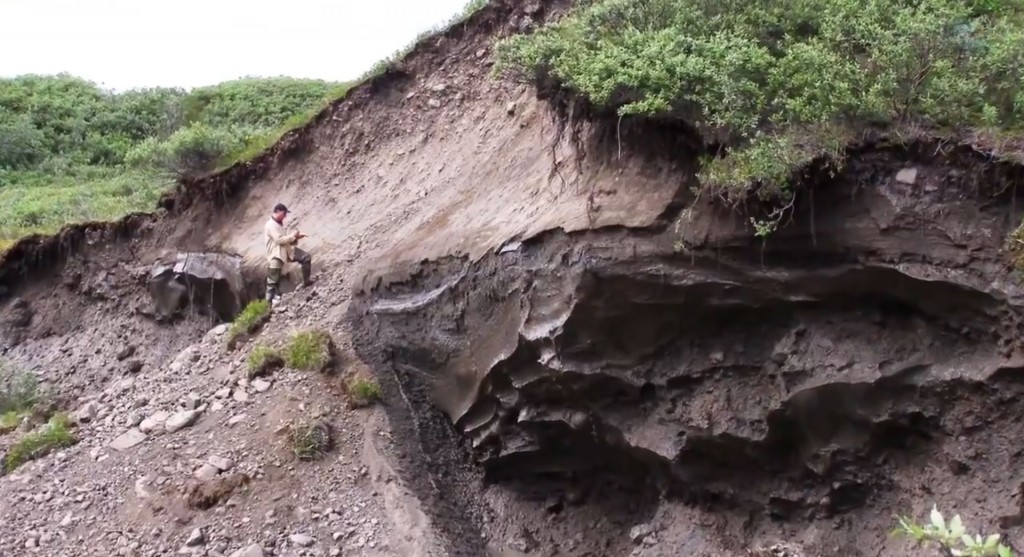

 Posts
Posts