Blog Archive

Showing posts with label Andrew Dessler. Show all posts

Friday, February 12, 2016

Peter Sinclair video: Paris Climate Agreement - A Good Start

by Peter Sinclair, Yale Climate Communications, February 10, 2016


I was at the American Geophysical Union Fall Meeting in San Francisco when news of the Paris agreement came through, so had the chance to collect fresh reactions from some of the best climate experts on the planet.

Generally, hopeful reactions, mixed with a warning.  And, Jeff Goodell of Rolling Stone on the difference between “should” and “shall.”

Link:  http://climatecrocks.com/2016/02/10/new-vid-scientists-on-the-paris-agreement/

Saturday, February 28, 2015

Peter Sinclair: What Climate Deniers Learned from Big Tobacco [MUST SEE VIDEOS - BOTH OF THEM!!!!!]

by Peter Sinclair, This Is Not Cool, February 26, 2015


Above, my newest “This is Not Cool” video focuses on the backstory behind “Merchants of Doubt,” the new documentary inspired by Naomi Oreskes’ and Eric Conway’s book of the same name.  The centerpiece of the book is the story of how techniques of science denial perfected in the tobacco industry have been adapted to the broader war on inconvenient science.

MODsmallThis week’s media firestorm centering on Dr. Willie Soon, a high-profile prop at many a gathering of climate deniers, was kicked off by Justin Gillis’ piece in the New York Times on Sunday.

It’s not insignificant that Gillis put the affair in a larger context, something that happens rarely in media coverage of the climate issue.
The documents shed light on the role of scientists like Dr. Soon in fostering public debate over whether human activity is causing global warming. The vast majority of experts have concluded that it is and that greenhouse emissions pose long-term risks to civilization.
Historians and sociologists of science say that since the tobacco wars of the 1960s, corporations trying to block legislation that hurts their interests have employed a strategy of creating the appearance of scientific doubt, usually with the help of ostensibly independent researchers who accept industry funding. 
Fossil-fuel interests have followed this approach for years, but the mechanics of their activities remained largely hidden. 
“The whole doubt-mongering strategy relies on creating the impression of scientific debate,” said Naomi Oreskes, a historian of science at Harvard University and the co-author of “Merchants of Doubt,” a book about such campaigns. “Willie Soon is playing a role in a certain kind of political theater.”
I was able to include parts of detailed interviews from scientists who were very much a part of the story, including Dr. Oreskes, who was the target of a massive climate denier attack after she published a key paper on the scientific consensus around climate change, in 2004.  

In addition, I include part of our interview with Dr. Ben Santer  who sheds light on the role of tobacco and climate science denier Fred Singer – and Stanton Glantz, who appears in the film and was an early, and combative, critic of the tobacco industry’s war on reality, and connects the tactics, and even the combatants,  to the climate issue.

The movie adaptation of Dr. Oreskes’ book is due in theaters next week. I’ve seen it, and I think, especially in light of the recent revelations, it will become a starting point for a lot of conversations.  

I’m sure that editors and reporters at the New York Times would have seen the movie and been aware of it too, so it causes one to wonder if there is a bit of calculation behind the recent story.
Merchants of Doubt trailer below.

Friday, January 16, 2015

Seth Borenstein, AP: Earth warms like a broken record; for 3rd time in 10 years, globe sets mark for hottest year

by Seth Borenstein, AP Science Writer, The Republic, January 16, 2015

PHOTO: FILE - In this July 25, 2014 file photo, a roofer works under the mid-day sun in Gilbert, Ariz. Federal science officials announced Friday that for the third time in a decade, the globe sizzled to the hottest year on record. Both the National Oceanic and Atmospheric Administration and NASA calculated that in 2014 the world had its hottest year in 135 years of record-keeping. Earlier, the Japanese weather agency and an independent group out of University of California Berkeley also measured 2014 as the hottest on record. (AP Photo, File)
FILE - In this July 25, 2014, file photo, a roofer works under the mid-day sun in Gilbert, Ariz. Federal science officials announced Friday that for the third time in a decade, the globe sizzled to the hottest year on record. Both the National Oceanic and Atmospheric Administration and NASA calculated that in 2014 the world had its hottest year in 135 years of record-keeping. Earlier, the Japanese weather agency and an independent group out of University of California Berkeley also measured 2014 as the hottest on record. (AP Photo, File)

WASHINGTON — For the third time in a decade, the globe sizzled to the hottest year on record, federal scientists announced Friday.

Both the National Oceanic and Atmospheric Administration and NASA calculated that in 2014 the world had its hottest year in 135 years of record-keeping. 

Earlier, the Japanese weather agency and an independent group out of University of California Berkeley also measured 2014 as the hottest on record.

NOAA said 2014 averaged 58.24 degrees Fahrenheit (14.58 degrees Celsius), 1.24 degrees (0.69 degrees Celsius) above the 20th-century average.

But NASA, which calculates temperatures slightly differently, put 2014's average temperature at 58.42 degrees Fahrenheit (14.68 degrees Celsius) which is 1.22 degrees (0.68 degrees Celsius) above the average of the years 1951-1980.

Earth broke NOAA records set in 2010 and 2005. The last time the Earth set an annual NOAA record for cold was in 1911.

NOAA also said last month was the hottest December on record. Six months in 2014 set marks for heat. The last time Earth set a monthly cold record was in December 1916.

"The globe is warmer now than it has been in the last 100 years and more likely in at least 5,000 years," said climate scientist Jennifer Francis of Rutgers University, who wasn't part of either research team. "Any wisps of doubt that human activities are at fault are now gone with the wind."

Texas A&M University climate scientist Andrew Dessler and other experts said the latest statistics should end claims by non-scientists that warming has stopped. It didn't, as climate denial sites still touted claims that the world has not warmed in 18 years.

2014's heat was driven by record warmth in the world's oceans that didn't just break old marks: It shattered them. Record warmth spread across far eastern Russia, the western part of the United States, interior South America, much of Europe, northern Africa and parts of Australia. One of the few cooler spots was in the central and eastern United States.

"Every continent had some aspect of record high temperatures" in 2014, said Tom Karl, director of NOAA's National Climatic Data Center.

Nine of the 10 hottest years in NOAA global records have occurred since 2000. The odds of this happening at random are about 1 in 650 million, according to University of South Carolina statistician John Grego. Two other statisticians confirmed his calculations.

Climate scientists say one of the most significant parts of 2014's record is that it happened during a year where there was no El Nino weather oscillation. During an El Nino, when a specific area of the central Pacific warms unusually and influences weather worldwide, global temperatures tend to spike. Previous records, especially in 1998, happened during El Nino years.

Every year in the 21st century has been in the top 20 warmest years on record, according to NOAA.

Temperatures have risen by about 1.6 degrees Fahrenheit (0.9 degrees Celsius) since the mid-19th century and pre-industrial times, said Gavin Schmidt, director of NASA's Goddard Institute for Space Studies, where the space agency tracks warming temperatures.

"We are witnessing, before our eyes, the effect of human-caused climate change," said Pennsylvania State University professor Michael Mann.

Some non-scientists who deny man-made global warming have pointed to satellite temperature records — which only go back to 1979 — which show a warming world, but no record this year and less of a recent increase than the longer-term ground thermometers. 

But Mann, Dessler, Francis and others say there have been quality and trustworthy issues with some satellite measurements and they only show what's happening far above the ground. 

They said ground measurements are also more important because it is where we live.

University of Alabama Huntsville scientist John Christy, who measures temperature via satellite, puts 2014 in a cluster of warm years behind 2010 and 1998. He said he is "puzzled that this difference between surface and deep atmosphere continues to occur as it has now for 36 years. Our theories can't explain it. I don't know what is going on."

Georgia Tech professor Judith Curry, who is not in the mainstream of climate scientists, wrote that talk about the record implies that temperatures will get warmer, something she says won't happen for at least another decade. But she added in a blog post in response to the NOAA announcement: "I'm not willing to place much $$ on that bet, since I suspect Mother Nature will manage to surprise us."

NASA's Schmidt says temperatures will continue to rise with year-to-year variations and he wouldn't be surprised if 2015 breaks 2014's record: "The increase in greenhouse gases is unrelenting and that in the end is going to dominate most things going on."

This was the 38th year in a row that the world was warmer than the 20th century average, according to NOAA data. Most people in the world and the United States were born after 1976 and have never lived in a cooler than normal year.

"You want to understand what that (cooler) world is like and you wonder are you ever to going to experience that," said Victor Gensini, a 28-year-old meteorology professor at the College of DuPage in Illinois.

http://www.therepublic.com/view/story/d7375a310ef6475c9841accc756c4ba4/US--SCI--Hottest-Year

Saturday, February 1, 2014

Corrections to Curry's Erroneous Comments [Senate testimony] on Ocean Heating

by Dana Nuccitelli and Rob Painting, Skeptical Science, January 30, 2014

Committed to the Cause Pause

Recently, Georgia Tech climate scientist Judith Curry, along with Texas A&M climate scientist Andrew Dessler, testified before a US Senate committee on the subject of climate change.  While Dessler's testimony was excellent and well-supported by the body of scientific evidence, Curry's contained a number of errors (i.e., see The Guardian on global warming attributionEli Rabett on Antarctic sea ice, and Tamino on Arctic warming and sea level rise, for starters).
Curry's main and most flawed argument was that information in the latest IPCC report should decrease our confidence in human-caused global warming; an argument she based in large part on the supposed global warming 'pause,' which is itself a fictional creation.  While the warming of average global surface temperatures has slowed (though not nearly as much as previously believed), the overall amount of heat accumulated by the global climate has not, with over 90% being absorbed by the oceans.
A few days after her Senate testimony, Curry took to her blog to dispute these data, essentially arguing that the amount of heat absorbed by the oceans has also 'paused,' which would then support her arguments.  However, in evaluating the ocean heat content data and scientific literature, Curry made a number of mistakes.  This gives us an excellent opportunity to properly evaluate the science on rising ocean heat content and see what it tells us.  The key points are:
  • The deep oceans are warming rapidly in every data set that measures them (including those referenced by Curry).
  • Sea levels are rising consistent with rapid ocean warming.
  • The rate of ocean warming is consistent with the global energy imbalance.
  • The geographic distribution of ocean warming is consistent with natural variability superimposed on a warming background state forced by the increased greenhouse effect.
  • The global warming 'pause' is a fictional product of wishful thinking.

Deep Ocean Warming is a Reality

The following quote from her blog articulates Curry's primary misunderstanding on the subject of rising ocean heat content.
"The only data set that appears to provide support for ocean sequestration is the ocean reanalysis ... All in all, I don’t see a very convincing case for deep ocean sequestration of heat."
The ocean reanalysis Curry refers to is Balmaseda et al. (2013).  A reanalysis is a climate, ocean or weather model simulation of the past that incorporates data from historical observations.  However, as we recently discussed, the increase in deep ocean heat content is a robust result in data sets that do not include reanalysis.  In fact, in her blog post Curry discusses a new paper by Lyman and Johnson (2013) that directly contradicts her assertion.  The paper relies on observational, not reanalysis data, and concludes,
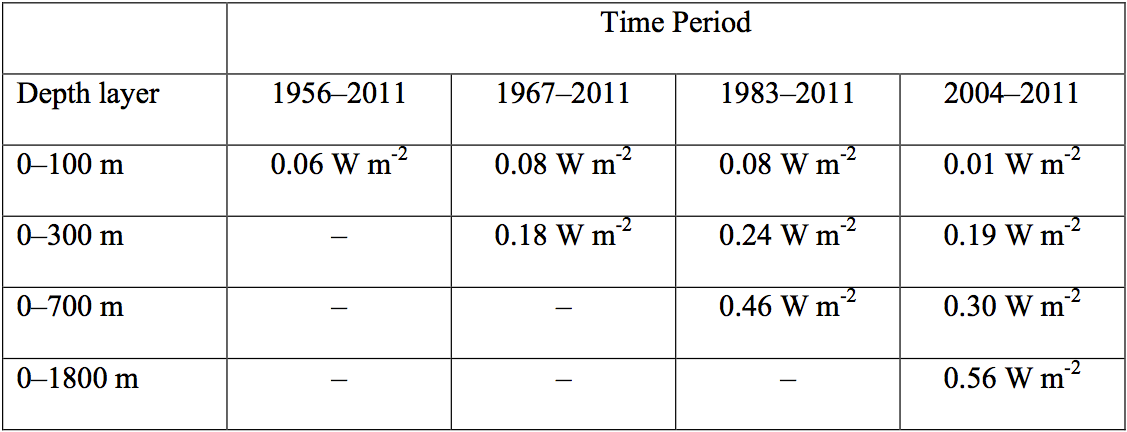
"In recent years, from 2004 to 2011, while the upper ocean is not warming, the ocean continues to absorb heat at depth (e.g., Levitus et al. 2012; von Schuckman and Le Traon 2011), here estimated at a rate of 0.56 W m-2 when integrating over 0–1,800 m."
The paper also includes this useful table illustrating that according to observational data, ocean heat content has indeed accumulated rapidly in the deep oceans in recent years.  Of the heat accumulating in the upper 1,800 meters of oceans for 2004–2011, 46% was sequestered in the deep oceans (below 700 meters).
LJ13 Table 1
To be clear, there's nothing wrong with using reanalysis data.  In fact, the Balmaseda et al. (2013) study fills in gaps in observations most comprehensively by utilizing all kinds of data, as well as using ocean models.  The fact that they're able to resolve volcanic eruptions and El Niño events suggests that the reanalysis may be more accurate than purely observational data sets that cannot resolve these events. However, the key point here is that the observational data, including Curry's own reference, contradict her point by finding substantial deep ocean heat sequestration over the past decade.

Science Isn't Done by Eyeball

Another problem with Curry's analysis is that she simply eyeballs the ocean heat content graph in Lyman and Johnson (2013) and concludes that since 2003, the data look flat. 
LJ13 OHC Figure
Time series of annual average global integrals of upper ocean heat content anomaly (1021 J, or ZJ) for (a) 0–100 m, (b) 0–300 m, (c) 0–700 m, and (d) 0–1,800 m.  Thin vertical lines denote when the coverage (Fig. 3) reaches 50% for (a) 0–100 m, (b) 100–300 m, (c) 300–700 m, and (d) 900–1,800 m.  From Lyman and Johnson (2013)
Scientists don't rely on their eyeballs because our senses can introduce bias and deceive us.  The data in the figure above may look relatively flat after 2003, but as the table above shows, they are not.  For 2004–2011, the data show the oceans accumulating heat at a rate of 0.19 W/m2 (3 x 10²¹ J/yr) in the upper 300 meters, 0.30 W/m2 (5 x 10²¹ J/yr) in the upper 700 meters, and 0.56 W/m2 (9 x 10²¹ J/yr) in the upper 1,800 meters.  The latter number is equivalent to 4.5 Hiroshima atomic bomb detonations per second – a far cry from a global warming 'pause.'

Ocean Heat Accumulation Consistent with Satellite Observations

We also know from satellite observations that the planet is accumulating heat due to a global energy imbalance (measured at the top of the atmosphere).  A new paper by Trenberth et al. (2014) notes that the amount of heat accumulating in the global climate (most of which is absorbed by the oceans) is generally consistent with the observed global energy imbalance (see the previous post for further details).  If the ocean were to stop warming as Curry suggests, it would require an explanation of where the energy from the global imbalance is going.
Curry also suggests that because they're not globally uniform, recent changes in ocean heat content "most likely reflects natural internal variability.  It doesn’t look like an AGW signal."  Again, if heat were simply shifting between ocean basins naturally, it would require an explanation of where the energy from the global imbalance is going.  The problem with breaking the data out into individual ocean basis as Curry does is that it's easy to then lose sight of the global picture.  The oceans as a whole are building up a lot of heat.  That long-term global ocean heat buildup has to be caused by an external forcing like the increased greenhouse effect.  The oceans aren't just going to naturally start accumulating zetajoules of heat – that heat has to come from somewhere.
As for the variation in heat content gain in each basin; this is no great surprise, as there is an exchange of water masses between the ocean basins. Most of the deep ocean warming is occurring in the subtropical ocean gyres  vast rotating masses of water in each ocean basin where near-surface currents converge and are forced downward into the ocean interior. When the tropical easterly trade winds strengthen, as they have from the year 2000 onwards, this whole wind-driven ocean circulation becomes more vigorous, the South Pacific subtropical gyre spins up, and the western arm of the gyre exports more tropical water through the Indonesian archipelago into the Indian Ocean. Likewise, the more vigorous ocean circulation forced by stronger trade winds forces more heat to be exported from the Indian Ocean, around the southern tip of Africa, into the South Atlantic.
Although it cannot be discounted that long-term warming is affecting this circulation in some way, a large part of this recent behavior is likely to be natural variation associated with the vigorous or sluggish phases of the ocean circulation. Whenever the wind-driven ocean circulation switches phase in the future, the current basin-scale warming pattern will change. Weak export of tropical water out of the Pacific during that phase should see a build-up of heat in the Pacific basin.  In other words, what we are seeing is probably natural variability in this circulation against a warming background ocean state forced by the increased greenhouse effect.
OHC by region  
Ocean heat content by region in the ORAS4 reanalysis by Balmaseda et al. (2013). NXTRP = northern extratropics, SXTRP = southern extratropics, TROP = +/30° latitude, TRATL = tropical Atlantic, TRPAC = tropical Pacific, and TRIND = tropical Indian ocean. Units are in 1022 Joules. Despite short-term variability in ocean heat content storage, each region has experienced long-term warming.

Early-Mid 20th Century Ocean Heat Content and Sea Level Rise

Curry also argues that the rate of sea level rise during 1930–1950 was similar to that in recent years, according to the IPCC, which suggests that ocean heat content was increasing at a similar rate to today.  She then argues that this can't be attributed to human-caused global warming, which presumably implies something about the current rise in ocean heat content.
First, while the early 20th century warming was likely predominantly naturally-caused (i.e. low volcanic activity and increasing solar activity), there was also a significant human contribution as greenhouse gasemissions began to ramp up.  Second, according to most estimates, the rate of sea level rise today is higher than the rate during 1930–1950 as shown in the IPCC report and Rahmstorf et al. (2012).  Third, tide gauge coverage 70 years ago was not as good as today's, and much of the variability is simply due to noise and factors like coverage bias, as discussed by Rahmstorf et al. (2012) and Tamino.
Fourth and most importantly, the argument is a non sequitur – the conclusion doesn't follow from the premise of the argument.  Yes, global warming events have occurred naturally in the past, and sea level rose as a consequence, but that doesn't tell us anything about the causes of the current global warming.  This is akin to seeing a dead body with a knife sticking out the back and arguing that it must have been a natural death because people have died naturally in the past. 

The Pause is Imaginary, Real Heat Will Come Back to Haunt Us

The bottom line is that all available ocean heat content data show that the oceans and global climate continue to build up heat at a rapid pace, consistent with the global energy imbalance observed by satellites.  In recent years, much of that heat has accumulated in the deep oceans.  Curry misunderstands the importance of this fact.
"even if the heat from surface heating of the ocean did make it into the deep ocean, presumably the only way for this to happen involves mixing (rather than adiabatic processes), so it is very difficult to imagine how this heat could reappear at the surface in light of the 2nd law of thermodynamics."
Nobody is arguing that the heat sequestered in the deep ocean will suddenly return to the surface.  Some fraction of it, from the upper ocean, may reappear as an El Niño event, but some is irreversibly mixed and forms part of the inevitable warming and equilibration of the ocean to a warming climate.
While the warming of global surface temperatures in recent years has slowed in large part due to the more efficient heat transfer to the deep oceans, that can't last forever.  When that trend reverses, as past observations suggest it will, we'll experience an acceleration of warming at the Earth's surface.

Tuesday, January 21, 2014

Climate scientists, facing skeptics' demands for personal emails, learn how to cope

by Stephanie Paige Ogburn, E&E reporter, January 21, 2014
esday, January 21, 2014
In the spring of 2012, Andrew Dessler, a climate scientist at Texas A&M University, received a somewhat unusual request: The American Tradition Institute, a conservative group, wanted to search through his emails.

The group was seeking emails with specific phrases, although many of the words in question were not relevant to his research.

"They had terms like 'Michael Mann.' I know Mike; I don't collaborate with him. 'Hockey stick'; I don't work on that. 'Tobacco'; I don't smoke," Dessler told a room full of scientists last month, at the American Geophysical Union meeting in San Francisco.

Panelists
Three climate scientists -- from left, Kevin Trenberth, Michael Mann and Andrew Dessler -- talked about how to deal with harassment last month at the American Geophysical Union meeting in San Francisco. Photo by Scott Mandia, courtesy of the Climate Science Legal Defense Fund.

Dessler, who works for a state-funded university, had become the subject of a public records request, filed under his state's Public Information Act.

He recounted this tale at a workshop where researchers presented on some of the legal issues they had faced. The roomful of attendees, mostly scientists, paid close attention, some taking notes, others nodding in agreement.

"The goal was, they were trying to find something embarrassing," Dessler continued.

The ATI is known for its attempts to discredit climate science, and this made Dessler, who had never received such a request before, nervous.

He knew he might be required to turn over hundreds, maybe thousands of emails that he had once considered private. "If I took 10 years of your emails, I could probably find some emails that weren't phrased the best way," Dessler explained.

The researcher experienced a brief, panicked moment when he considered deleting all of the emails -- an illegal act. "That would have been a terrible idea," he told the scientists.

Instead, he went seeking for advice. "I sent out some emails and said, 'This has happened to me,' and I got a bunch of emails back. I think Gavin Schmidt [a NASA climate scientist] emailed me back and said don't panic," Dessler recalled.

Schmidt and a number of others had already been on the receiving end of such requests and could offer lessons from their experiences. The advice helped Dessler calm down, and the scientist soon began the tedious process of searching, reviewing and turning over the requested correspondence.

Dessler's experience, while hardly the norm for a scientist, is becoming increasingly common. In recent years, the American Tradition Institute has filed various Freedom of Information Act (FOIA) requests against climate scientists working at public institutions.

Starting a legal defense fund

In response, the climate science community is organizing to support scientists who find themselves the subjects of such requests and training others to be aware that they could become targets.

In late 2011, Suffolk Community College professor Scott Mandia started the Climate Science Legal Defense Fund, which has raised money to support scientists challenging the legality of certain FOIA requests. The fund is now looking to hire an executive director and expand its work on behalf of scientists.

Along with other groups, like the Union of Concerned Scientists and Public Employees for Environmental Responsibility, it is also offering support to scientists who have either experienced such requests or feel they might.

Logo
The logo for the Climate Science Legal Defense Fund. Courtesy of the fund.

As scientists increasingly work to share their research findings with the public, it has also increased their visibility and made them targets, said Mandia.

"We're asking them to get out there, and when they get out there, boom, they're just shot," said Mandia. "So we want them to know that they have protection."

Public records requests, also often referred to as Freedom of Information Act requests, typically apply to researchers working at taxpayer-funded institutions, either at the state or federal level.

Chris Horner, who has filed many of the requests on behalf of ATI (ATI was recently renamed the Energy & Environment Legal Institute, or E&E Legal), is a senior fellow at both E&E Legal and the Competitive Enterprise Institute (CEI).

In filing such requests, said Horner, he is seeking to find evidence of scientists at publicly funded institutions using taxpayer resources inappropriately.

"[FOIA requests] always involved their use of a taxpayer-funded, FOIA-covered position and resources for advocacy, e.g., Intergovernmental Panel on Climate Change, Union of Concerned Scientists work [or work] with certain ideologically aligned reporters," Horner wrote in an email.

Echoes of 'Climategate'?

Others have suggested that the FOIAs amount to fishing expeditions, as climate skeptic groups seek to replicate the experience of "Climategate," an episode in late 2009 when emails from researchers were stolen from computers at the University of East Anglia.

Excerpts from those emails were published in an attempt to discredit the scientists. Skeptics said the emails showed that scientists were conspiring to hide data showing that the Earth was not in fact warming, although later inquiries exonerated scientists from charges of data manipulation.

Jeff Ruch, director of the group Public Employees for Environmental Responsibility (PEER), has seen an uptick in such requests since then. "Climategate sort of created a template that others are following," Ruch said.

Over the past few years, skeptic groups have filed requests against scientists at NASA, the University of Virginia; Texas A&M; Texas Tech University; the University of Alabama, Huntsville; the University of Delaware; and the University of Arizona.

If a request is filed with a state institution, state law varies on what scientists have to make available.

Dessler's home state of Texas, for example, has a very open public records law. So in most cases, scientists working at state-funded universities there are required to turn over all of what is sought in freedom of information requests with a few exemptions.

The openness of Virginia's public records law and whether it requires researchers to turn over certain email communications are the subjects of an ongoing lawsuit between the University of Virginia and ATI.

The lawsuit, which has reached the state's Supreme Court, hinges on whether climate scientist Michael Mann and other researchers at the university are required to turn over parts of their email correspondence in response to ATI's records request.

In September 2013, the ATI also sued the University of Arizona over its response to a public records request filed in 2011 against climate researchers at that university.

Defense and education efforts

Last month's meeting was fertile ground for Mandia's Climate Science Legal Defense Fund. First organized to support Mann's fight against the ATI's FOIA against him, it has since branched out to education efforts and, at the meeting, also offered one-on-one legal consultations with worried scientists.

Along with PEER, under which the Climate Science Legal Defense Fund obtained nonprofit status, the group has put on workshops about Mann's experience and helped scientists understand the laws on which documents they must keep to meet legal requirements of FOIA and which they can throw away.

The workshop Dessler spoke at was one such offering. It also included Ruch, of PEER, and researchers Mann, Kevin Trenberth, Ben Santer and Naomi Oreskes, who have all experienced attacks because of their work.

Mann praised the fund's efforts. "They have provided critical support for legal representation of scientists who would otherwise have to dig into their own personal finances to defend themselves against the onslaught of attacks by industry front groups," he wrote in an email.

In Dessler's case, Mandia said he was able to provide the researcher with access to legal counsel and contacts at PEER and the Union of Concerned Scientists.

"I can't tell you how helpful Scott was. He put me in touch with a few other people to talk to, and they basically talk you off the ledge," said Dessler. He ended up turning over a large number of emails to Horner. Afterward, he waited to see what would happen. But nothing did.

"It just disappeared into Chris Horner's hard disk," Dessler said.

Dessler also ended up on one of his favorite television shows, the PBS program "Frontline," which had decided to do a story on such requests. The researcher also used the opportunity to study Texas' public records law.

What he learned was that he can legally delete as many emails as he wants, and after that, they are no longer subject to public records requests. Now, he said, he deletes most of his emails after reading them.

When ATI's Horner realized "Frontline" had picked up Dessler's story, he submitted another records request. This one sought emails from "Frontline" and other journalists Dessler had communicated with, including reporters at The New York Times, the Associated Press and The Guardian.

But this time, Dessler was ready. "When they asked for my emails from 'Frontline,' there were none. Those were all gone," he said.

Monday, January 20, 2014

Eli Rabett: Curry vs. Curry

by Eli Rabett, "Rabett Run," January 20, 2014

Dana NuccitelliAnd ThenSou and Bart have comments on last week's Senate Environmental and Public Works Committee testimony by Prof Andy Dessler and Prof. Judith Curry.

Prof. Curry has issued a challenge to those (Mike Mann usw) who think she was being economical with the truth:
Since you have publicly accused my Congressional testimony of being ‘anti-science,’  I expect you to (publicly) document and rebut any statement in my testimony that is factually inaccurate or where my conclusions are not supported by the evidence that I provide.
Now some, not Eli to be sure, might point out that there is more than a bit of lawerly verbage in there given the cherry orchard that the evidence that somebunny provides can omit, but the bunnies are forgiving beasts.

In Prof. Judith Curry's testimony she claimed that

However, several key elements of the AR5 WGI report point to a weakening of the case for attributing most of the warming to human influences, relative to the previous assessment
  • Lack of warming since 1998 and the growing discrepancies between observations and climate model projections
  • Evidence of decreased climate sensitivity to increases in atmospheric CO2 concentrations
  • Evidence that sea level rise during 1920-1950 is of the same magnitude as in 1993-2012
  • Increasing Antarctic sea ice extent
Permit the Rabett to start at the bottom.  Eli and the Weasel previously noted Prof. Curry really does not believe that increasing Antarctic sea ice extent casts any doubt on the AR5's conclusions because she knows why the sea ice in Antarctica has been increasing (or perhaps not increasing as much, that may be another interesting tale of whom do you believe, theory or observation, as a recent preprint casts doubt on the magnitude).  In a 2010 PNAS paper, "Accelerated warming of the Southern Ocean and its impacts on the hydrological cycle and sea ice" Prof. Curry's abstract reads: 
The observed sea surface temperature in the Southern Ocean shows a substantial warming trend for the second half of the 20th century. Associated with the warming, there has been an enhanced atmospheric hydrological cycle in the Southern Ocean that results in an increase of the Antarctic sea ice for the past three decades through the reduced upward ocean heat transport and increased snowfall. The simulated sea surface temperature variability from two global coupled climate models for the second half of the 20th century is dominated by natural internal variability associated with the Antarctic Oscillation, suggesting that the models’ internal variability is too strongleading to a response to anthropogenic forcing that is too weak. With increased loading of greenhouse gases in the atmosphere through the 21st century, the models show an accelerated warming in the Southern Ocean, and indicate that anthropogenic forcing exceeds natural internal variability. The increased heating from below (ocean) and above (atmosphere) and increased liquid precipitation associated with the enhanced hydrological cycle results in a projected decline of the Antarctic sea ice. (emphasis added)
Of course the Weasel thinks the entire paper is the stadium wave in forecasting form, but Eli will be generous given that Prof. Curry thinks that the paper was a good thing given her comments over at Stoat's. (The paper has vanished from the Ga Tech cache btw.)  OTOH, a forecast of growth of sea ice through increased snow fall has a pretty simple and obvious mechanism going back to at least the 1990s.  The range of temperature at which snow falls is rather small basically because there has to be a significant amount of water vapor in the atmosphere, and when it gets really cold there ain't, so the only way for snow to fall is transport from warmer areas.  This makes sense if the Southern Ocean is warming, which cannot be gainsaid (Skeptical Science has two useful debunkers which demystify Prof. Curry's claim in depth from which the next two images are borrowed):


and, of course, while there may be more sea ice, Antarctica itself is losing mass at a furious rate due to warming


But perhaps Prof. Curry's position has now shifted to that enunciated by Mark B:
Liu and Curry, defended by The Team, selected inappropriate data and time periods, ignored data that doesn’t match the IPCC message, manipulated results, clearly engaged in misconduct, dismissed dissenting views, and ultimately pushed the notion that Antarctic Sea Ice will melt, based on fudged computer models, when data clearly shows otherwise. Read ‘The Antarctic Ice Illusion: CurryGate and the Corruption of Science’ by Montfork. It’s one of the best books written on climate science, though I can’t personally vouch for any of its conclusions.
Prof. Curry appears to have publicly documented and rebutted Prof. Curry's statement in Prof. Curry's testimony about Antarctic sea ice increase weakening the evidence for man made climate change. Many thanks.

While Antarctic sea ice increase is taking place, according to Prof. Curry, it is inaccurate to say that it is evidence against man-caused climate change, but according to her own published work, and that of others dating back to decades before her work, it is actually evidence for man-made climate change because of the forecast increase in snow fall. Prof. Curry's own work contradicts her own testimony.  Bunnies can now debate to what extent she gets an out by demanding that such a demystification be limited to the evidence that Prof. Curry provided, given that Prof. Curry probably provided Prof. Curry's CV with a list of publications as part of the evidence.  Moreover, this appears to be another case of where the models are too optimistic, as Prof. Curry herself states in Prof. Curry's paper.

To paraphrase Richard Alley: Prof. Curry looks at one part of the data, ignores much and and advises nulo problemo; Prof. Dessler looks at the entire picture and says, hey the models tell us we got a problem, we need to do something quick, and the Earth is over in the corner screaming bloody murder.


http://rabett.blogspot.com/2014/01/curry-vs-curry.html

Comments hilarious:
Joshua said...
I think that you're missing a key point. The Professor Curry who wrote that paper is not an activist - in fact she thinks that scientists being activists is undermines science. The Professor Curry who testified before Congress is an activist, who appeared at the behest of Republican politicians so as to boost the viability of the policies they support. And don't forget that the Professor Curry who blogs strongly opposes any appeal to authority, whereas the Professor Curry who is making highly public statements about climate change feels that it is important for Professor Curry to lend her qualifications and professional recognition to the cause of climate "skepticism."

I hope that clears things up a bit.
EliRabett said...
Eli's head is spinning.