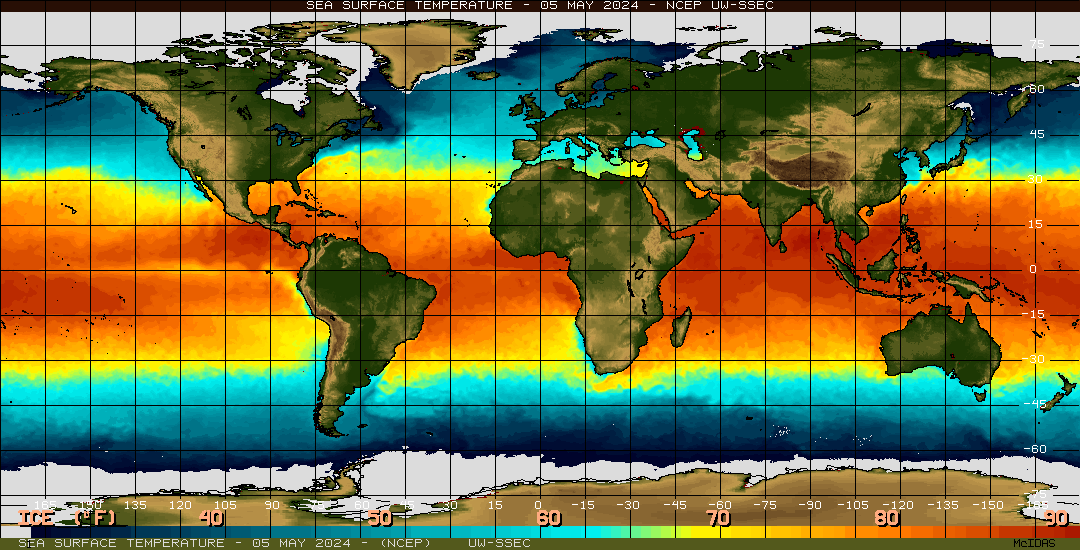
When we see records being broken and unprecedented events such as this, the onus is on those who deny any connection to climate change to prove their case. Global warming has fundamentally altered the background conditions that give rise to all weather. In the strictest sense, all weather is now connected to climate change. Kevin Trenberth
HIT THE PAGE DOWN KEY TO SEE THE POSTS
Now at 8,800+ articles. HIT THE PAGE DOWN KEY TO SEE THE POSTS
California Democrats on the House Oversight and Government Reform Committee requested a Department of Justice investigation into ExxonMobil on Wednesday, writing that the company's behavior "is similar to cigarette companies that repeatedly denied harm from tobacco and spread uncertainty and misleading information to the public." There have always been pronounced parallels between the tobacco and oil industry—both working to undermine regulatory action that could hamper profit—but a federal investigation may mean they share the same fate, as well.
In 1999, the DOJ investigated and eventually sued big tobacco for spreading misleading evidence about the connection between cigarettes and cancer. The companies violated the Racketeer Influenced and Corrupt Organizations (RICO) Act, and faced repercussions for lying to the public about science. Now, Congressmen Ted Lieu and Mark DeSaulnier of California say it could be Exxon's turn.
"We ask that the DOJ similarly investigate ExxonMobil for organizing a sustained deception campaign disputing climate science and failing to disclose truthful information to investors and the public," they wrote, according to a letter provided to New Republic. "We request the DOJ investigate whether ExxonMobil violated RICO, consumer protection, truth in advertising, public health, shareholder protection, or other laws.
“The apparent tactics employed by Exxon are reminiscent of the actions employed by big tobacco companies to deceive the American people about the known risks of tobacco,” according to the letter, signed by California congressmen Ted Lieu and Mark DeSaulnier.
Two investigations undertaken by Los Angeles Times and Inside Climate News show that Exxon scientists accepted the role fossil fuels play in driving global warming in the 1970s and 80s, and briefed corporate executives on the need for “major reductions in fossil fuel combustion.” In the years that followed, executives spearheaded efforts to cast doubt on the science community’s findings to halt action on climate change. Exxon financed the Global Climate Coalition, which worked against climate action in the 1990s before disbanding in 2002. Eight years ago, the company also promised to stop funding climate deniers, yet continues today contribute to prominent skeptics, including Oklahoma Senator James Inhofe.
And this attitude appears to have seeped into the DNA of Exxon itself. Just this spring, Exxon CEO Rex Tillerson questioned climate change: “What if everything we do, it turns out our models are lousy, and we don’t get the effects we predict?” Tillerson said. “Mankind has this enormous capacity to deal with adversity, and those solutions will present themselves as those challenges become clear.” While other major oil companies have endorsed a global climate deal to tackle emissions that will come together in Paris at the end of the year, Exxon opted out of pushing for climate action.
Activists, including Bill McKibben of 350.org and R.L. Miller of the Climate Hawks Vote PAC, have been pushing for a more formal investigation and prosecution of Exxon. "In the 28 years I’ve been following the story of global warming, this is the single most outrageous set of new revelations that journalists have uncovered," he posted to Tumblr. On Thursday, McKibben was arrested for protesting at an Exxon station in Burlington, Vermont.
For years, activists and scientists have charged Exxon with taking the world down an irresponsible path, rejecting climate science in favor of increased fossil fuel consumption and profits. Lieu and DeSaulnier believe it's illegal, too.
Willie Soon does not accept that rising greenhouse gas emissions cause climate change, instead blaming the sun. Photograph: Dimitar Dilkoff/AFP/Getty Imagesby Suzanne Goldenberg, The Guardian, February 21, 2015
A prominent academic and climate change denier’s work was funded almost entirely by the energy industry, receiving more than $1.2 million from companies, lobby groups and oil billionaires over more than a decade, newly released documents show.
Over the last 14 years Willie Soon, a researcher at the Harvard-Smithsonian Centre for Astrophysics, received a total of $1.25 million from Exxon Mobil, Southern Company, the American Petroleum Institute (API) and a foundation run by the ultra-conservative Koch brothers, the documents obtained by Greenpeace through freedom of information filings show.
According to the documents, the biggest single funder was Southern Company, one of the country’s biggest electricity providers that relies heavily on coal.
The documents draw new attention to the industry’s efforts to block action against climate change – including President Barack Obama’s power-plant rules.
Unlike the vast majority of scientists, Soon does not accept that rising greenhouse gas emissions since the industrial age are causing climate changes. He contends climate change is driven by the sun.
In the relatively small universe of climate denial Soon, with his Harvard-Smithsonian credentials, was a sought after commodity. He was cited admiringly by Senator James Inhofe, the Oklahoma Republican who famously called global warming a hoax. He was called to testify when Republicans in the Kansas state legislature tried to block measures promoting wind and solar power. The Heartland Institute, a hub of climate denial, gave Soon a courage award.
Soon did not enjoy such recognition from the scientific community. There were no grants from NASA, the National Science Foundation or the other institutions which were funding his colleagues at the Center for Astrophysics. According to the documents, his work was funded almost entirely by the fossil fuel lobby.
Advertisement
“The question here is really: ‘What did API, ExxonMobil, Southern Company and Charles Koch see in Willie Soon? What did they get for $1m-plus,” said Kert Davies, a former Greenpeace researcher who filed the original freedom of information requests. Greenpeace and the Climate Investigations Center, of which Davies is the founder, shared the documents with news organisations.
“Did they simply hope he was on to research that would disprove the consensus? Or was it too enticing to be able to basically buy the nameplate Harvard-Smithsonian?”
From 2005, Southern Company gave Soon nearly $410,000. In return, Soon promised to publish research about the sun’s influence on climate change in leading journals, and to deliver lectures about his theories at national and international events, according to the correspondence.
The funding would lead to “active participations by this PI (principal investigator) of this research proposal in all national and international forums interested in promoting the basic understanding of solar variability and climate change”, Soon wrote in a report to Southern Company.
In 2012, Soon told Southern Company its grants had supported publications on polar bears, temperature changes in the Arctic and China, and rainfall patterns in the Indian monsoon.
ExxonMobil gave $335,000 but stopped funding Soon in 2010, according to the documents. The astrophysicist reportedly received $274,000 from the main oil lobby, the American Petroleum Institute, and $230,000 from the Charles G Koch Foundation. He received an additional $324,000 in anonymous donations through a trust used by the Kochs and other conservative donors, the documents showed.
Greenpeace has suggested Soon also improperly concealed his funding sources for a recent article, in violation of the journal’s conflict of interest guidelines.
“The company was paying him to write peer-reviewed science and that relationship was not acknowledged in the peer-reviewed literature,” Davies said. “These proposals and contracts show debatable interventions in science literally on the behalf of Southern Company and the Kochs.”
In letters to the Internal Revenue Service and Congress, Greenpeace said Soon may have misused the grants from the Koch foundation by trying to influence legislation.
Soon did not respond to requests for comment. But he has in the past strenuously denied his industry funders had any influence over his conclusions.
“No amount of money can influence what I have to say and write, especially on my scientific quest to understand how climate works, all by itself,” he told the Boston Globe in 2013.
As is common among Harvard-Smithsonian scientists, Soon is not on a salary. He receives his compensation from outside grant money, said Christine Pulliam, a spokeswoman for the Center for Astrophysics.
The Center for Astrophysics does not require scientists to disclose their funding sources. But Pulliam acknowleged that Soon had failed to meet disclosure requirements of some of the journals that published his research. “Soon should have followed those policies,” she said.
Harvard said Soon operated outside of the university – even though he carries a Harvard ID and uses a Harvard email address.
“Willie Soon is a Smithsonian staff researcher at the Harvard-Smithsonian Center for Astrophysics, a collaboration of the Harvard College Observatory and the Smithsonian Astrophysical Observatory,” a Harvard spokesman, Jeff Neal, said.
“There is no record of Soon having applied for or having been granted funds that were or are administered by the University. Soon is not an employee of Harvard.”
Both Harvard and the Smithsonian acknowledge that the climate is changing because of rising levels of greenhouse gas concentrations caused by human activities.
Pulliam cast Soon’s association with the institutions as an issue of academic freedom: “Academic freedom is critically important. The Smithsonian stands by the process by which the research results of all of its scholars are peer reviewed and vetted by other scientists. This is the way that the scientific process works. The funding entities, regardless of their affiliation, have no influence on the research.”
Wei-Hock Soon of the Harvard-Smithsonian Center for Astrophysics, whose articles have been tied to corporate funding.Credit
Pete Marovich by Justin Gillis and John Schwartz, The New York Times, February 21, 2015 For years, politicians wanting to block legislation on climate change
have bolstered their arguments by pointing to the work of a handful of
scientists who claim that greenhouse gases pose little risk to humanity.
One
of the names they invoke most often is Wei-Hock Soon, known as Willie, a
scientist at the Harvard-Smithsonian Center for Astrophysics who claims
that variations in the sun’s energy can largely explain recent global
warming. He has often appeared on conservative news programs, testified
before Congress and in state capitals, and starred at conferences of
people who deny the risks of global warming.
But
newly released documents show the extent to which Dr. Soon’s work has
been tied to funding he received from corporate interests.
He
has accepted more than $1.2 million in money from the fossil-fuel
industry over the last decade while failing to disclose that conflict of
interest in most of his scientific papers. At least 11 papers he has
published since 2008 omitted such a disclosure, and in at least eight of
those cases, he appears to have violated ethical guidelines of the
journals that published his work.
Senator James M. Inhofe, Republican of Oklahoma, praising scientists like Dr. Soon.Credit
CSPAN
The
documents show that Dr. Soon, in correspondence with his corporate
funders, described many of his scientific papers as “deliverables” that
he completed in exchange for their money. He used the same term to
describe testimony he prepared for Congress.
Though
Dr. Soon did not respond to questions about the documents, he has long
stated that his corporate funding has not influenced his scientific
findings.
The documents were obtained by Greenpeace, the environmental group, under the Freedom of Information Act. Greenpeace and an allied group, the Climate Investigations Center, shared them with several news organizations last week.
The
documents shed light on the role of scientists like Dr. Soon in
fostering public debate over whether human activity is causing global
warming. The vast majority of experts have concluded that it is and that
greenhouse emissions pose long-term risks to civilization.
Historians
and sociologists of science say that since the tobacco wars of the
1960s, corporations trying to block legislation that hurts their
interests have employed a strategy of creating the appearance of
scientific doubt, usually with the help of ostensibly independent
researchers who accept industry funding.
Fossil-fuel interests have followed this approach for years, but the mechanics of their activities remained largely hidden.
“The
whole doubt-mongering strategy relies on creating the impression of
scientific debate,” said Naomi Oreskes, a historian of science at
Harvard University and the co-author of “Merchants of Doubt,” a book about such campaigns. “Willie Soon is playing a role in a certain kind of political theater.”
Environmentalists
have long questioned Dr. Soon’s work, and his acceptance of funding
from the fossil-fuel industry was previously known. But the full extent
of the links was not; the documents show that corporate contributions
were tied to specific papers and were not disclosed, as required by modern standards of publishing.
“What
it shows is the continuation of a long-term campaign by specific
fossil-fuel companies and interests to undermine the scientific
consensus on climate change,” said Kert Davies, executive director of
the Climate Investigations Center, a group funded by foundations seeking
to limit the risks of climate change.
Charles
R. Alcock, director of the Harvard-Smithsonian Center, acknowledged on
Friday that Dr. Soon had violated the disclosure standards of some
journals.
“I think that’s inappropriate behavior,” Dr. Alcock said. “This frankly becomes a personnel matter, which we have to handle with Dr. Soon internally.”
Dr. Soon is employed by the Smithsonian Institution, which jointly sponsors the astrophysics center with Harvard.
“I am aware of the situation with Willie Soon, and I’m very concerned about it,” W. John Kress, interim under secretary for science at the Smithsonian in Washington, said on Friday. “We are checking into this ourselves.”
Dr.
Soon rarely grants interviews to reporters, and he did not respond to
multiple emails and phone calls last week; nor did he respond to an
interview request conveyed to him by his employer. In past public
appearances, he has reacted angrily to questions about his funding
sources, but then acknowledged some corporate ties and said that they
had not altered his scientific findings.
“I
write proposals; I let them decide whether to fund me or not,” he said
at an event in Madison, Wis., in 2013. “If they choose to fund me, I’m
happy to receive it.” A moment later, he added, “I would never be
motivated by money for anything.”
The
newly disclosed documents, plus additional documents compiled by
Greenpeace over the last four years, show that at least $409,000 of Dr.
Soon’s funding in the past decade came from Southern Company Services, a
subsidiary of the Southern Company, based in Atlanta.
Southern
is one of the largest utility holding companies in the country, with
huge investments in coal-burning power plants. The company has spent
heavily over many years to lobby against greenhouse-gas regulations in
Washington. More recently, it has spent significant money to research ways to limit emissions.
“Southern
Company funds a broad range of research on a number of topics that have
potentially significant public-policy implications for our business,”
said Jeannice M. Hall, a spokeswoman. The company declined to answer
detailed questions about its funding of Dr. Soon’s research.
Dr.
Soon also received at least $230,000 from the Charles G. Koch
Charitable Foundation. (Mr. Koch’s fortune derives partly from oil
refining.) However, other companies and industry groups that once
supported Dr. Soon, including Exxon Mobil and the American Petroleum
Institute, appear to have eliminated their grants to him in recent
years.
As the oil-industry contributions fell, Dr. Soon started receiving hundreds of thousands of dollars through Donors Trust,
an organization based in Alexandria, Va., that accepts money from
donors who wish to remain anonymous, then funnels it to various
conservative causes.
The Harvard-Smithsonian Center for Astrophysics,
in Cambridge, Mass., is a joint venture between Harvard and the
Smithsonian Institution, housing some 300 scientists from both
institutions. Because the Smithsonian is a government agency, Greenpeace
was able to request that Dr. Soon’s correspondence and grant agreements
be released under the Freedom of Information Act.
Though
he has little formal training in climatology, Dr. Soon has for years
published papers trying to show that variations in the sun’s energy can
explain most recent global warming. His thesis is that human activity
has played a relatively small role in causing climate change.
Many
experts in the field say that Dr. Soon uses out-of-date data, publishes
spurious correlations between solar output and climate indicators, and
does not take account of the evidence implicating emissions from human
behavior in climate change.
Gavin A. Schmidt, head of the Goddard Institute for Space Studies
in Manhattan, a NASA division that studies climate change, said that
the sun had probably accounted for no more than 10 percent of recent
global warming and that greenhouse gases produced by human activity
explained most of it.
“The science that Willie Soon does is almost pointless,” Dr. Schmidt said.
The
Harvard-Smithsonian Center for Astrophysics, whose scientists focus
largely on understanding distant stars and galaxies, routinely distances
itself from Dr. Soon’s findings. The Smithsonian has also published a statement accepting the scientific consensus on climate change.
Dr.
Alcock said that, aside from the disclosure issue, he thought it was
important to protect Dr. Soon’s academic freedom, even if most of his
colleagues disagreed with his findings.
Dr.
Soon has found a warm welcome among politicians in Washington and state
capitals who try to block climate action. United States Senator James M. Inhofe, an Oklahoma Republican who claims that climate change is a global scientific hoax, has repeatedly cited Dr. Soon’s work over the years.
In
a Senate debate last month, Mr. Inhofe pointed to a poster with photos
of scientists questioning the climate-change consensus, including Dr.
Soon. “These are scientists that cannot be challenged,” the senator
said. A spokeswoman for the senator said Friday that he was traveling
and could not be reached for comment.
As
of late last week, most of the journals in which Dr. Soon’s work had
appeared were not aware of the newly disclosed documents. The Climate
Investigations Center is planning to notify them over the coming week.
Several journals advised of the situation by The New York Times said
they would look into the matter.
Robert
J. Strangeway, the editor of a journal that published three of Dr.
Soon’s papers, said that editors relied on authors to be candid about
any conflicts of interest. “We assume that when people put stuff in a
paper, or anywhere else, they’re basically being honest,” said Dr.
Strangeway, editor of the Journal of Atmospheric and Solar-Terrestrial
Physics.
Dr. Oreskes,
the Harvard science historian, said that academic institutions and
scientific journals had been too lax in recent decades in ferreting out
dubious research created to serve a corporate agenda.
“I
think universities desperately need to look more closely at this
issue,” Dr. Oreskes said. She added that Dr. Soon’s papers omitting
disclosure of his corporate funding should be retracted by the journals
that published them.
The new Congress may be the most boldly anti-science body since the time of the Scopes Monkey Trial
by Peter Dykstra, Environmental Health News, January 3, 2014
The 114th Congress convenes this week. The last time a Congressional anti-science caucus was this strong may have been during the Scopes Monkey Trial ninety years ago. But that’s not the worst part of it: The folks who want to gut government research and deny climate change are virtually guaranteed perpetual re-election and jobs for life.
Let’s get straight to the moral of this story: Entrenched anti-science isn’t going away. Not soon, maybe not in our lifetimes. Every one of the most ardent congressional climate deniers who chose to run won re-election, mostly by runaway margins, and probably have jobs for as long as they want them. A landscape of gerrymandered “safe” districts and wide-open campaign cash spigots make their futures even safer, even as their behavior helps make our own a little more bleak.
More examples than you may care to know about
Chris Stewart handily won a second term for his Utah congressional seat over a state senator. As a freshman, he chaired the House Environmental Subcommittee. In 2013, he dismissed human-influenced climate change in the Salt Lake Tribune, citing scientific uncertainty, “questionable” claims, and the motives of “radical environmentalists” as drivers behind a dubious debate.
Entrenched anti-science isn't going away. Not soon, maybe not in our lifetimes.But Stewart’s 27-point win was a squeaker compared to his committee boss. Lamar Smith is a veteran congressman from San Antonio who ran the full House Science Committee for the last two years. While Smith embraces the language of climate denial, his portfolio is wider than that. Otherwise a solid opponent of Big Government intervention, Smith has targeted about 40 National Science Foundation grants for congressional scrutiny. Democrats couldn’t muster a candidate to run against him in November, and he swamped two third-party candidates by capturing over 70% of the vote. Smith’s Science Committee Vice Chair is Dana Rohrabacher of California. The veteran scientist-kicker romped by 29 points.
When it comes to sneering at science and cringing at climate claims, the Texas Congressional delegation is in a league of its own. Joe Barton, who famously issued an apology to BP after its 2010 oil spill, is pushing a bill to open up oil exports. He powered to a 25% win over his Democratic challenger.
Lamar Smith begins his second term as chair of the House Science Committee.
Departing from Congress is Steve Stockman, the East Texas firebrand who failed to unseat John Cornyn in this spring’s Senate primary. Stockman turned up at the 2009 Copenhagen climate summit sporting a theatrical red blindfold, suggesting, I suppose, that climate action advocates were Blind Commies.
His replacement is dentist Brian Babin, an enthusiast for both energy independence and the Keystone XL pipeline. The Texas 36th district could benefit mightily from approval of the Keystone, which would have a terminal refinery in Port Arthur - a perfect spot to undercut energy independence by exporting Keystone’s oil. Just like Joe Barton wants. Newly elected Rep. Babin drilled Democratic opponent Michael Cole: 76% to 22%.
Just north of Babin’s district is that of Louie Gohmert. Let’s just be nice and say he may be the most colorful member of Congress, new inductees pending. Louie is a staple of The Daily Show, and has warned that a loosely patrolled border would lead to a brisk import trade in “terror babies.” But for Rep. Gohmert, “crackpot” is too polite a moniker. In October, he lashed out at the Obama Administration, whom he characterized as so overwrought about climate change that they were willingly allowing Ebola to eat us alive. A month later, Gohmert beat his Democratic challenger by 55 points.
Then, there’s the rookie field. New congressman Glenn Grothman may have only won his Wisconsin seat by a relatively paltry 16%, but he’s busting out of the gate on this “environment stuff,” including the War on Coal and “global warming, which doesn’t exist anyway.”
"Rich countries solve their own problems"
In Virginia, conservative college professor Dave Brat trounced another college professor by 24 points after ousting House Majority Leader Eric Cantor in the primary. Brat believes climate change isn’t a big deal because “rich countries solve their own problems.”
Here in Georgia, we’re losing an anti-science giant. In 2012, Paul Broun became a viral video congressman when he told a small-town gathering thatevolution was “lies straight from the pit of hell.” Like Stockman, Broun's leaving because his Primary attempt for the Senate failed. That’s Paul Broun, physician, by the way, so he couldn’t even take the trendy dodge that he’s not a scientist.
Georgia will not miss a beat; in fact, Broun’s replacement may well be an anti-science upgrade. Jody Hice is a conservative radio talk show host who doesn’t stop at denying climate change – he denies that Islam is a religion, but acknowledges that it’s well on its way to overthrowing America. Voters rewarded him with a two-to-one margin of victory. I strongly suggest you keep regular track of his congressional pronouncements by watching the The Daily Show.
Grand finale: Senator James Inhofe (left), the grandpappy of climate denial, won reelection by nearly forty points. He next runs, if he wants, in 2020, just before his 86th birthday. Martha Blackburn, the Tennessee congresswoman who waged war on energy-efficient lightbulbs, unplugged her Democratic challenger by 44 points -- and in December, got a rider attached to the huge Omnibus spending bill to block DOE's new lightbulb efficiency standards. John Shimkus of Illinois, who famously dismissed the possibility of climate change by quoting the Book of Genesis on the House Floor, crushed an obscure Democrat by a three-to-one margin. Jason Chaffetz of Utah, new chair of the Government Oversight Committee and a 50-point victor in November, will give the Benghazi treatment to EPA and other agencies via a newly-created subcommittee. Wyoming's Cynthia Lummis, freshly-reelected by a 3-to-1 margin, will chair the new government entity responsible for limiting government growth. Her pet cause during the last Congress was dismantling the Endangered Species Act.
Defying science, even in clumsy and ignorant ways, carries no political consequence for many American officeholders. Until it does, the consequences are ours to own.
by Mark Hertsgaard, Business Week, October 22, 2014
Photograph by Robert Stolarik/The New York Times/Redux
On patrol in Brooklyn during Hurricane Sandy in October 2012
The idea that climate change poses serious risks to U.S. national security, long contested in conservative circles, is now an integral part of Pentagon planning. On Oct. 13, Secretary of Defense Chuck Hagel made it official with the release of the Pentagon’s 2014 Climate Change Adaptation Roadmap, a 16-page document that lays out the effects of extreme weather events and rising temperatures on military training, operations, acquisitions, and infrastructure. Two previous editions, issued in 2012 and 2013, treated climate change as a future threat, but this year’s cast it as a reality that must be dealt with quickly. “Climate change will affect the Department of Defense’s ability to defend the Nation and poses immediate risks,” the document begins.
The Pentagon’s move sets up a showdown between the military, a cautious institution run by some of the most conservative people in the U.S. government, and congressional Republicans, who continue to deny that climate change is real, let alone that it requires action. In May, House Republicans passed an amendment to the annual National Defense Authorization Act forbidding the Defense Department from spending money on any climate-related initiatives, including planning programs. “This amendment will ensure we maximize our military might without diverting funds for a politically motivated agenda,” Representative David McKinley of West Virginia, who sponsored the amendment, wrote in a letter to members of Congress asking for a yes vote. The amendment failed in the Democratic-controlled Senate.
“Climate change is a threat multiplier because it has the potential to exacerbate many of the challenges we already confront.”—Chuck Hagel
Hagel, a former Republican senator from Nebraska, moved to counter that argument in his foreword to the new road map. “Politics or ideology must not get in the way of sound planning,” he wrote. Hagel is backed by 16 retired generals and admirals who sit on the military advisory board of the CNA Corp., a government-funded nonprofit military research organization. A CNA report issued in May called climate change a “catalyst for conflict,” arguing that the civil war in Syria was rooted in part in a record drought that drove peasants off the land and into cities, where they were susceptible to being recruited by extremist groups. “People are going to have less water, less food,” says Ron Keys, a retired four-star general who commanded all Air Force aircraft and personnel worldwide and now serves on CNA’s military advisory board. “There are going to be huge regional wars around those issues.”
Pentagon planners have sounded alarms about their climate concerns for at least a decade. In 2004, Fortune reported the existence of a secret document that warned climate change could push powers such as China, India, and Pakistan into nuclear war over fresh water supplies. Until now the military has been relatively quiet about its climate concerns, partly “because the Department of Defense gets its money from Congress, and we know where the House is on this issue,” says David Titley, a retired rear admiral and member of CNA’s military advisory board. Hagel’s personal involvement in releasing the 2014 road map suggests the Pentagon has decided it can’t wait any longer.
Photograph by Gabriella Demczuk/The New York Times/ReduxChuck Hagel
Not all Republicans are as wedded to climate-change denial as their public statements suggest, according to retired military officials and Republican Hill staff. “If you talk with them privately, without any media around, the vast majority of congressional Republicans know perfectly well that climate change is real,” Titley says. “But they won’t say so publicly because they don’t want to end up like Bob Inglis.”
Inglis, a Republican, represented South Carolina’s 4th congressional district for six terms, amassing a perfect voting record in the eyes of the National Rifle Association and other conservative groups. In 2010, a Tea Party challenger ousted him after seizing on what Inglis has half-jokingly referred to in the press as his “heresy”: insisting that climate change is real. He’s now executive director of the Energy and Enterprise Initiative, a nonprofit based at George Mason University that advocates a free-market approach to addressing climate change. “A lot of people on Capitol Hill are down in their foxholes” on the climate issue, Inglis says. “They’re afraid of getting their heads blown off if they head up the hill.”
To provide political cover, Keys, Titley, and other retired military brass have been traveling the country to explain to ordinary Americans why the military cares about climate change and what extreme weather will mean for their communities. The goal is to shift the political conversation in Washington by changing what voters are willing to hear their leaders say. Since August, Keys has visited Iowa, Pennsylvania, Ohio, New Hampshire, and North Carolina to take his message to local Rotary Clubs and businesses, such as a solar electrical co-op run out of a hog house in Dubuque, Iowa. Keys, who says he is “politically very conservative, just to the right of Genghis Khan,” meets with state legislators, mayors, business leaders, civic groups, and “mom and pop on Main Street.” His pitch is simple: Ignoring climate change means leaving Americans exposed to danger. “If I were a bad guy,” Keys says, “I’d look at a moment like Hurricane Katrina as a good time to sneak into the U.S. and try something.”
Oklahoma Republican Senator James Inhofe, a leading denier of climate change, has dismissed CNA’s effort. “There is no one more in pursuit of publicity than a retired military officer,” Inhofe told the New York Times after CNA issued its report in May. Keys says he won’t be deterred. “I spent 40 years as a fighter pilot,” he says. “You’re going to have to come at me with facts.”
Alex Epstein, author of forthcoming The Moral Case for Fossil Fuels, sports his I Heart Fossil Fuels T-Shirt
I’ve been researching the climate denial industry for almost three years and the best way to gather information about this incredibly small yet influential clique is to hang out with them. I attended their 2012 conference of the Heartland Institute, an oil and tobacco funded free market think tank that spends a lot of time and effort trying to call bullshit on what is clearly not bullshit – the science of climate change. My presence was clearly unwelcome – but I guess they forgot to scrub me from their email invitation list, because I got invited again this year, to their9th International Conference on Climate Change in the deep heat of the Nevada desert amid the chaos of Las Vegas casinos.
The choice of Vegas byHeartland seemed brilliantly provocative. A celebration of high-stakes capitalism in the very gambling dens where$92 billion is lost each year in pursuit of the American dream. The dazzling lights, the grotesquely oversized hotels, the free drinks.
Perhaps nowhere on earth is more profligate and wasteful of increasingly scarce natural resources than this twisted utopia. The Republican Party reportedlyblackballed Vegas for its 2016 convention fearing its Christian supporters would be repelled by this den of iniquity – and that its legislators would be lured into its brothels and casinos. Scientists have explicitly stated we are “loading the dice” by raising temperatures so that extreme weather and deadly catastrophes will become more frequent – gambling with our future, basically. Joseph Bast, the president of Heartland, was surely thumbing his nose at his detractors.
Heartland has had a torrid two years. DrPeter Gleick, a hydro-climatologist and author, took the unusual step of posing as a board member and tricking Heartland staff into sending hima trove of highly secret internal documents. The papersrevealedthat Heartland was working with a coal industry consultant in order to enter American schools and attack climate science.
Two months later, and just ahead of their 2012 conference in hometown Chicago, Heartland made the bizarre decision to erect ahuge advertising billboard attacking climate science on the basis that the terrorist Unabomber, Ted Kaczynski, had apparently been concerned about global warming. This gave their archenemies Greenpeace US and Forecast the Facts the ammunition they needed to successfully lobby funders to withdraw.
The Vegas conference was going a good opportunity to enter this strange world again. But did I really want to spend a week in the middle of dustbowl America with three hundred climate cranks who would crowd around trying to tell me how wrong I am about everything if they knew the first thing about me?
24 hours later and I touched down at the Vegas airport in the dead of night, bathed in light.The Mandalay Bay Hotel and Casino, agold-plated monument to excess, appeared to be next to the runway. Still it took 20 minutes and $20 dollars for a cab driver to get me there.
This sub-prime feeling hotel was the perfect setting for Heartland. The deregulated casinos glared as they took people’s money and the acrid smell of tobacco was pervasive. The hotel was brash, huge, and run down. All fur coat and moth eaten. There were loud renovations taking place when I arrived. The front desk had double booked my room, so when I finally got there I was confronted by a stout, hairy American wearing tight black underpants. Mercifully I was relocated.
The morning after my arrival I metChristopher Monckton, who had agreed to have breakfast with me. Within minutes I found myself almost entirely lost in confusing nonsense. Monckton repeated his claim to be a member of the House of Lords, which has beendenied by the House of Lords, and having been the scientific advisor to Margaret Thatcher in the 1980s when she first championed climate science,which has also been debunked.
The aristocrat, a classically trained architect and one-time journalist, told me he had produced a very simple climate model that proved actual scientists had exaggerated the threat of climate science and that there was no evidence that heating the atmosphere was dangerous.
Monckton hasworkedclosely with the ominous sounding neoliberal think tank, theCommittee For A Constructive Tomorrow (CFACT). They even hired a plane so he couldparachute uninvited into the Durban climate conference.CFACT has enjoyed significant funding from ExxonMobil and other oil and car industrialists. So I asked Monckton if he had benefited from ExMo’s largesse. “The cheque has not yet arrived in the post,” he joked, before asking if I was “left wing.”
Monckton then told me he attended climate conferences because it was better than sitting at home on his sofa and he cared for the future of society. He had refused his $1,000 Heartland fee. I asked him how this chimed with his belief in the free market, that rested on the idea that people only respond to financial incentives. He grinned.
After I had paid for his breakfast he said something that really surprised me. We were walking past the slot machines when I asked him what he thought of Vegas. He said he believed gambling to be immoral. The casinos were profiting from people’s lack of a good education and fundamental misunderstanding of mathematics. He said Heartland had, in fact, chosen Vegas to make the point that climate scientists had failed to understand risk.
Dr Willie Soon. He claims Albert Einstein would have been a sceptic and accused the Intergovernmental Panel on Climate Change as “gangter science” during his presentation.
Bearded Joseph Bastopenedthe conference that evening. He said, “Speaking of funding and for the record, except for $150 from the Illinois Coal Association and another $150 from Liberty Coin Service, a great little coin shop in Lansing, Michigan, owned by my old friend Pat Heller, no corporate money was raised for this conference. And no, not a nickel from the Koch brothers" – owners of Koch Industries, the largest privately held firm in the United States and a major player in the oil refinery industry. The humorously small donations were meant to prove that Big Oil was not behind this jamboree.
The remarks came seconds after he thanked his co-sponsors, who included theMedia Research Center, Heritage Foundation, Competitive Enterprise Institute, CFACT, and the George C. Marshall Institute – many of which have been funded by oil corporations and some by Charles Kochfoundations.
The fact checking websiteMedia Matters for America put out a blog post about some of thespeakers’ various links to oil. But their website was blocked in the hotel and the Heartland delegates, all doughty defenders of free speech, were left in the dark.
Then the shadow-side of this comic dishonesty and hypocrisy became almost too much to bear.Dr S Fred Singer, a folk hero around here, was presented with theLifetime Achievement Award. He in turn presented theFrederick Seitz Award. If one man can take credit for inventing climate denial it is Singer. The old man once claimed, rather brilliantly, that, “My connection to oil during the past decade is as a Wesson Fellow at the Hoover Institution; the Wessonmoney derives from salad oil.” Exxon hadgivenSinger $10,000 in fundingjust a few years earlier.
The late Dr Seitz had many achievements in his lifetime. But the one I will remember him for was contributing indirectly to the deaths of millions of Americans. He sat on the medical research committee of theR. J. Reynolds Tobacco Company and oversaw $45 million in medical funding which his critics claimed “served the tobacco industry’s purposes.” Much of my close family has been wiped out by smoking related diseases, so this one sticks out for me.
The Heartland conference was now in full swing and my brain began to melt. There was the usual monotony of badly put together Powerpoint slides, rambling speeches and desperate attempts to resurrect climate science controversies buried by actual scientists almost three decades ago. The speakers were being paid around $1,000 to attend, plus flights and large hotel suites.
The hundreds of sceptics around me not once questioned the bizarre, the illogical, the poorly constructed claims that swirled in front of our eyes. This parody of science was a deadly hybrid of 1970s Open University programmes and sub-Cirque du Soleil.
In the intervals I managed to speak to some of the key deniers.Dr Patrick Michaels has been vilified by Greenpeace and was one of the early generation of scientists to take money from coal companies to argue against mainstream climate science. He once admitted on national television that40% of his funding comes from the oil industry.
He told me how as a young scientist he challenged what he thought of as a monolithic orthodoxy of climate change only to see his government research grants dwindle. Believing himself to be among the most brilliant he was insulted that he was in fact one of the worst paid in his profession. Thankfully, car companies were willing to secretly pay him to help them fight environmental legal battles.
Later I spoke toDr Willie Soon, one of the few professional scientists in the room. He was oncefunded by Exxon, the American Petroleum Institute and one way or another by Charles Koch. Greenpeace used Freedom of Information laws to expose his financial support from oil barons through his university. Soon told me Exxon broke off his funding, without so much as a kiss goodbye. Soon was another sad sack who seemed convinced of his own brilliance and dumbfounded at the lack of recognition. At Heartland he was given a glass trophy and a round of applause.
I was then witness to a suited Greenpeace activist dressing downAnthony Watts, the one-time weatherman who blogs atWatts Up With That?, in a hallway. Watts broke the story of Climategate, when thousands of private emails between climate scientists were hacked and published online. The emails were presented as evidence of a lurid and global conspiracy to fool the public into fearing global warming.They weren't.
Then I ran intoJames Delingpole, the one-time Telegraph Online journalist who spewed vitriol at climate scientists and their defenders. I was about to undergo the kind of nasty, bitter confrontation I wanted to avoid.
Delingpole went to Oxford University with the British Prime Minister David Cameron but his novels didn’t do brilliantly and he was never invited into London Society. Delingpole’s other claim to fame was beingmade to look a complete fool when Sir Paul Nurse, filming for the BBC, asked if he had read the abstract of any scientific papers (the short introduction which sets out the significance of the study). Delingpole, who claims to have found a remarkable global conspiracy to fake climate research, admitted he hadn’t. So I just asked James if he had read any abstracts since. “No.” I couldn’t quite believe it.
Delingpole has written off one of the most influential climate studies as “ludicrous, comedy” and claimed its author, Professor Michael Mann at Penn State University, has “little discernible talent.” But during our confrontation he confirmed he had never interviewed Mann, never read hisbook and never read any of his scientific papers. I was dumbfounded.
Delingpole was furious. He raged and spat and accused me of being a troll. He attacked my journalism, having not read any, and attacked my opinions, having not heard any. All of this was being filmed by two French filmmakers. I was shaking. More in anger than in sorrow. “Can I give you some friendly advice,” I said.
“I don’t want your friendly advice, Mr Montague,” he said.
“Why don’t you read the abstracts to three scientific papers. Then you won’t look like such a fool next time someone asks that question. It doesn’t take long.”
The argument fizzled out and we both went our separate ways, huffing. And then I felt sad for Delingpole. Why was he even at this conference? He could be at home with his family, playing Scrabble. It seems he is driven by ambition, but had made it no further than the basement conference hall of a faded hotel in Vegas.
The Heartland exhibition
After three days locked into this air-conditioned hell Wednesday was upon us and the conference finally drew to a close. And I remembered we were in Vegas. I buttonholed Joseph Bast and asked whether he had indeed chosen Vegas as a brilliantly daring provocation to his critics. The spin of the roulette wheel reminded me at least of the madness of sub-prime mortgages and credit default swaps that plunged millions of Americans into penury. Was it social commentary? “No,” he said. “The rooms were cheap.”
It would almost be possible to dismiss this whole crowd as a bunch of sad cranks. Somewhere between 9/11 Truthers and homeopathic doctors. Not just snake oil salesmen but snake oil customers at the same time. Immune to the accumulating evidence that free market economics is not only responsible for the economic crash of 2008, but also the ever-closer ecological catastrophe.
They would just be sad sacks if they were not also influential. Among the delegates swarm the sharks just as surely as they do in the Mandalay Bay Hotel aquarium.Myron Ebell of CEI who onceconspired with a White House insider to downplay climate in a seminal government report. Senator James Inhofe who, by video call, told the troops to ready themselves to take Congress in November. They also influence lower level officials.
During one dinner I sat next to Rod Wright, a brilliantly funny and apparently savvy Democrat state senator from the environmentalist hotbed California. Rod, one of only two black people I saw out of a claimed 600 attendees, told me how he became suspicious of renewable energy, and then climate science more generally.
These suspicions were confirmed by the avalanche of literature he received from the Heartland Institute. His colleagues deserted him but he was steeled by the support of the free market think tank. “You have to sift information through your own filter”, he told me. “Their funding does not devalue their information. Everybody got money from somebody. Jesus said, ‘Let he without sin cast the first stone.’ ” He smiles, before adding, “I have looked at some of their work on insurance and I think they’re full of shit.” (I read later that Wright has been convicted of voter fraud.)
They are full of shit. But they are having a real influence on American politics. They are just one of the hundreds of Koch and Exxon funded think tanks and fake grassroots campaigns that have frustrated and blocked Obama’s administration at every turn. As I leave the conference I find it hard to reconcile what I have learned. These people are just cranks but they are perverting American politics. I did learn in Vegas that attacks from these people are not going to hurt me.
In the casino the tragedy of the American Dream continues. Hardworking Americans sit emotionless pouring their salaries into slot machines. Believing the dream. But investing every last dime in a desperate and, for the overwhelming majority, simply hopeless attempt to escape. I watch a guy burn $2,500 in 20 minutes during a spiral of roulette stupidity.
When you see the homelessness in Vegas, and the drug addiction, and you know there is no real welfare state over here, no safety net. These Heartland folk are just a few pay cheques from freefall. They're not going to get headhunted by Stanford University any time soon. They believe themselves too educated to survive McJobs. They are clinging on. They’re hustling. That’s what you do in Vegas.
Brendan Montague is a London-based investigative journalist who has published in The Sunday Times, The Mail on Sunday and The Guardian. He is founder of theRequest Initiative, which boasts Greenpeace UK among its NGO clients.


 Posts
Posts