Blog Archive

Showing posts with label decarbonization. Show all posts

Sunday, June 3, 2018

Europe's Largest Asset Manager Sees 'Tipping Point' on Climate Risk Pricing

The world’s deepest-pocketed investors are starting to take climate change seriously, according to Amundi SA.

by Anna Hirtenstein, Bloomberg, May 30, 2018

“We are really observing a tipping point among the institutional investors on climate change,” said Frederic Samama, co-head of institutional clients at the Paris-based firm. “Until recently, that question was not on their radar screen. It’s changing, and it’s changing super fast.”
Risks from global warming range from damage to physical assets from extreme weather to falling prices on fossil fuel-related assets, as the world moves away from burning coal and oil. Bank of England governor Mark Carney has repeatedly warned that these risks are not priced in adequately and that investors may have exposure to a “climate Minsky moment” if they don’t take action.
Amundi’s remarks hold weight because it has 1.4 trillion euros ($1.6 trillion) under management, making it the largest asset manager in Europe. It runs the world’s largest green bond fund with the International Finance Corp. and is planning to deploy $2 billion into emerging markets. Mainstream investors are beginning to recognize both the threats and opportunities coming from climate-related issues, Samama said.
“If we have this major shift required in terms of how we manage the planet, for sure it will impact the asset prices,” he said. “Can we evaluate the automakers without taking into account the new bans of diesel cars? Can we evaluate the fossil fuel industry without taking into account the risks of regulation related to the drop of the price of renewable energy?”
The Paris climate deal reached by representatives from nearly 200 countries in 2015 sent a signal to the global economy that decarbonization was on the agenda. As just about every industry comes under pressure to become greener, the rules will change for the asset owners as well. France was the first country to make it mandatory for investors to disclose the carbon footprint of their portfolios, mandating it in a law the same year.
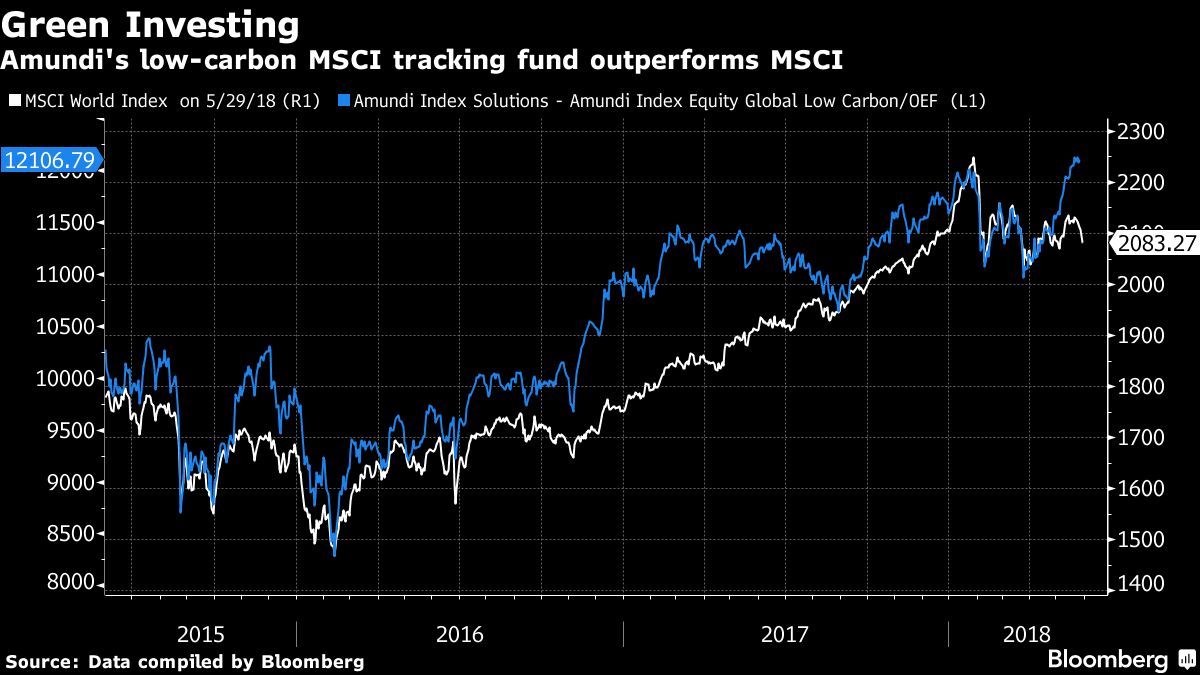
Another reason that institutional investors’ views are evolving is the availability of green financial instruments, according to Amundi. The asset manager developed low-carbon equity indexes, removing the polluting companies from commonly-used ones such as the S&P 500 and MSCI indexes. Investors from the California State Teachers’ Retirement System to Japan’s Government Pension Investment Fund are shifting their portfolios to these indexes, according to Samama.
“It means that if nothing happens, you have the market returns and that if the opposite, if polluting companies are getting penalized, they will bring the index down and if you have excluded them, you will outperform,” he said.
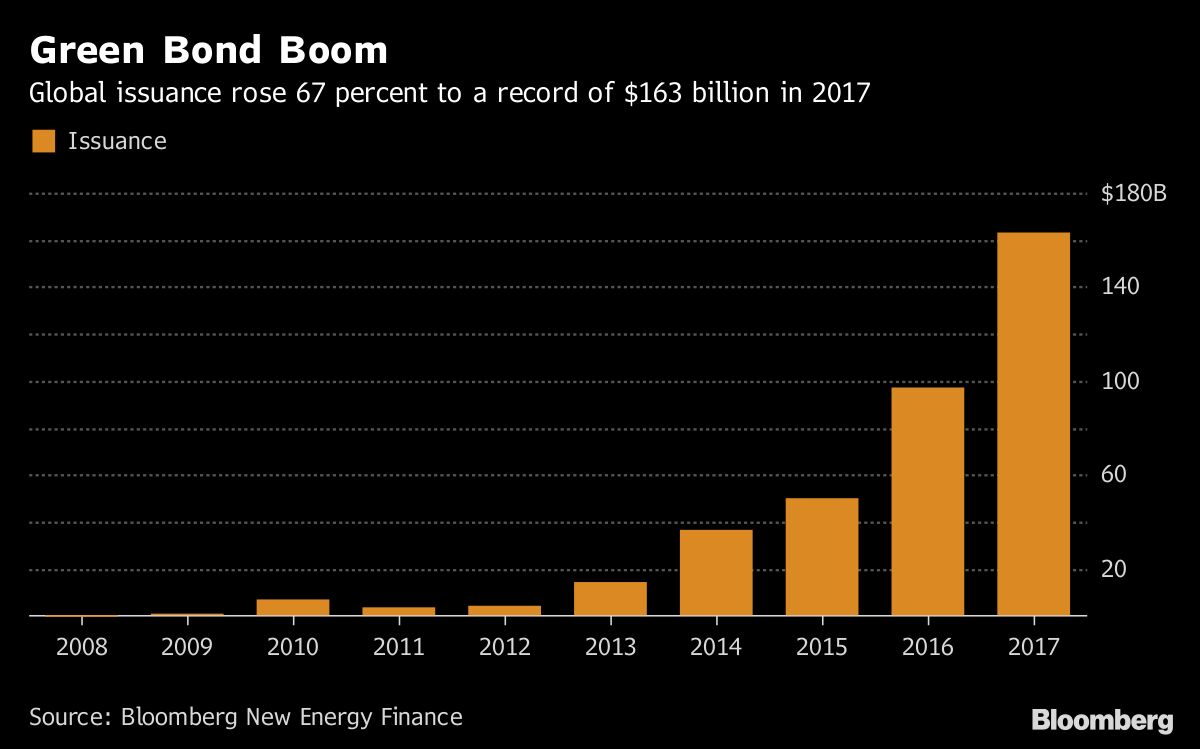
Green bonds are another avenue for redirecting institutional capital into environmental projects. The industry has soared from non-existence just over a decade ago to global issuance of $163 billion last year.
©2018 Bloomberg L.P.

Tuesday, July 22, 2014

Deep Decarbonization: Truly facing the climate challenge

by Jonathan Koomey, Ph.D., Research Fellow, Steyer-Taylor Center for Energy Policy and Finance, Stanford University, Climate Science Watch, July 22, 2014
On July 8, 2014, an International group of experts presented the United Nations with an interim report on “Deep Decarbonization” [1]. This study is important because it takes seriously the commitment to keep the Earth’s temperature from rising more than 2 Celsius degrees from preindustrial times, a goal that the world’s major countries accepted in 2009 in Copenhagen. It then carries through an analysis of the technical potential for radically reducing emissions by 2050 in 15 major countries necessary to stay under that warming limit.
What the Deep Carbonization report finds should not be surprising to serious students of the climate problem [2], and it’s consonant with what leading analysts have known about this issue since the late 1980s [3]. The report concludes that
  • Allowing business-as-usual emissions trends to continue endangers the future orderly development of human civilization in the 21st century.
  • Achieving a low emissions world and fostering sustainable development go hand in hand.
  • Meeting the 2 C degree warming limit will require drastic reductions in greenhouse gas emissions in the next few decades, but few countries have analyzed the implications of such reductions for their economies, and few politicians have fully understood those implications.
  • Capturing substantial emissions reductions is possible using existing technologies, but achieving climate stabilization will require new technologies to be developed and deployed.
  • Solving the climate problem requires international commitments, because any one of the major emitting countries or regions could by themselves emit enough to make climate stabilization impossible.
  • Country by country analysis is an essential complement to global analyses of emissions reductions, because they yield technical and policy insights, but also because they foster a strategic conversation [4] among affected countries, groups, and citizens about how to achieve the needed emissions reductions.
As we’ve known for decades, we have “on the shelf” existing technologies that can achieve substantial reductions in GHG emissions [5, 6]. The issue is that society has not yet come to grips with what the 2 C limit implies: a World War II level commitment to emissions reductions over the next few decades. Current policies are simply not adequate to meet the challenge.
The US, for example, has an “all of the above” energy strategy that is inconsistent with climate stabilization and that reflects the political class’s unwillingness to grapple with the implications of the 2 C warming limit.