Blog Archive

Showing posts with label Rick Piltz. Show all posts

Saturday, April 4, 2015

Rick Piltz's legacy to continue

by Climate Science and Policy Watch, April 2, 2015

As recent events in Florida clearly show, the issues around which Rick Piltz fought so passionately have not gone away. Instead, they still surface at an alarming rate. His timeless voice has never been more crucial, and the Government Accountability Project (GAP) is committed to continuing this fight in his name.  A post from Louis Clark, President of the Government Accountability Project and Michael Termini is Climate Science & Policy Watch Interim Director and GAP’s Corporate & Financial Accountability Deputy Director...

We miss our dear friend, heroic client and wise colleague Rick Piltz. He was a rational voice who would routinely distill and translate scientific complexities into understandable language without doing harm to their meaning. He made climate change science accessible to concerned people across the globe who simply want to know what is happening to their climate and environment, who or what is responsible, and how to evaluate the extraordinarily well-financed propaganda that climate science denialists – a word that Rick coined – continue to pump into the public discussion and decision-making on climate policy.

As patrons of Climate Science Watch well know – now renamed Climate Science & Policy Watch and soon to be expanded in accordance with Rick’s vision for the program – Rick was a Senior Associate in the Climate Change Science Program during the George W. Bush presidency. He was responsible for digesting the science findings on billions of dollars worth of climate science research from thirteen different federal agencies and turning those into comprehensible reports for Congress and the public. On the darker side of that job, he was likewise required by top agency officials to incorporate secret White House edits into the final drafts of those reports. Some of the reports that the agency slipped over to the Bush White House came back with hundreds of hand-written edits penned by Philip Cooney, a former chief lobbyist from the Petroleum Institute – a corporate lawyer, not a scientist. These edits changed the reports substantially, making the actual results appear less definitive about whether climate change was even occurring and if human activity was the cause of that change. In one report, pages of disturbing evidence from the Arctic were crossed out altogether – in effect, shredded.

As is now well known, Rick collected these White House edits, and in June, 2005, he made history by revealing them. According to an Oxford University study, his disclosure influenced the way in which journalists reported about climate science thereafter: Rick shifted the discussion away from a battle of so-called experts toward recognizing scientific consensus. Rick’s laudatory obituaries last fall in The New York TimesThe Washington Post, and other publications described this history in detail. In some of these pieces and elsewhere, however, Rick was referred to as a “firebrand” because of his truth-telling. Although he would not have minded that characterization, most of us who knew him well experienced him as humorous, soft-spoken, and quite exacting in his language – certainly not a strident firebrand. Regardless, “tenacious and uncompromising truth-teller” seems more apropos. Rick was one of us and we must remember that so others will also find the courage to come forward.

As a powerful example, in a video filmed in the GAP studio (short version;full length version) Rick reflected upon why he did what he did. In a soft voice, he described his outrage at being required to incorporate inappropriate and political edits from an oil industry huckster into official government reports about the results of this nation’s investment in climate research at the very agency responsible for compiling, reporting and disseminating the results of vast sums of taxpayer research funds. He passionately said:

“When this guy’s edits came to me, there was part of me that said: ‘Who do you think you’re dealing with? Do you think I’m one of you? I’m not one of you.’”

Which brings us to an equally important question, “Who are these people who do go along with these types of demands?” For every whistleblower like Rick, there are hundreds of civil servants and corporate employees who remain silent and quietly follow dishonest orders. Recently, the Florida Center for Investigative Reporting broke a story that employees and contractors working for state environmental agencies were prohibited from using terms such as “climate change” and “global warming” because the Governor of the state did not “believe in it,” as if the scientific data were an ideology or a religious doctrine.

For years, hundreds, if not thousands, of individuals apparently went along with this practice of substituting “faux science” for scientific reality. Given that Florida is arguably amongst the most likely places to suffer the greatest impact from rising sea levels in the United States, it is remarkable that we are into the second term of Governor Rick Scott’s tenure before this secret climate change denialist practice has come to light. Encouraged by Rick and these new Florida whistleblowers, hopefully others now will grasp the courage to come forward with new revelations. It is critical that these new voices join the warning chorus before it is too late.

We should all applaud these former employees and contractors who are stepping forward to expose this policy and practice. This time, perhaps we should spend less time analyzing or questioning what it is about the whistleblowers that compelled them to speak up. It is time to examine this governor, those state agencies and all those people who went along with the practices that allowed the climate denialist charade to thrive. It is time to follow the trail of breadcrumbs – why are people hiding the truth and what do they have to gain from lying to the public? And if they do benefit from hiding the truth, why are they in power?

Or to use Rick’s words: “Who do you think you’re dealing with?” The silence of so many is indeed
an indictment of them and of their state organizations. Who did the Governor think they were? It is obvious. Sheep.

As recent events in Florida clearly show, the issues Rick Piltz fought so passionately have not gone away. Instead, they still surface at an alarming rate. His timeless voice has never been more crucial, and GAP is committed to continuing this fight in his name. Stay tuned for new developments and program updates as we re-launch the latest vision of Rick’s Climate Science & Policy Watch this spring.

Louis Clark is President of the Government Accountability Project. Michael Termini is Climate Science & Policy Watch Interim Director and GAP’s Corporate & Financial Accountability Deputy Director.

Sunday, March 15, 2015

Rick Piltz: Protecting the Science of Climate Change

A scientist recalls the politically motivated editing of climate change science in government reports, offering insight into why the reality of climate change was hard for officials to accept.


by Alan D. Hecht, EOS, February 23, 2015


Rick Piltz, a “whistleblower” who decried the politically motivated editing of climate change science in government reports, died on 18 October 2014. Piltz’s death reminded me that getting government officials to accept the reality of climate change was a challenge over the past decades.
During my tenure on the Council on Environmental Quality(CEQ) from 2001 to 2003, I witnessed firsthand the fight to protect scientific integrity in government documents. You may ask, Why did the government edit research reports? In my judgment, the editing reflected an overriding fear that regulating greenhouse gas emissions would create economic burdens [Hecht, 2009]. The recession of 1992 likely contributed to George H. W. Bush’s loss of the presidential race to Bill Clinton, which might account for such anxieties in George W. Bush’s administration.
A decade later, this lingering fear remains an obstacle to any serious discussion of actions to address climate change.

Piltz’s Legacy

During his career as a House Science Committee aide, Piltz helped write the 1990 Global Change Research Act, which called for periodic national climate change assessments, a 10-year climate research plan, and annual progress updates for Congress.
The act also created the U.S. Global Change Research Program (USGCRP), which coordinates climate activities across all federal agencies. Piltz held a key position in the USGCRP, and in this role he became aware that the Bush administration was editing government research reports to downplay any links between human activity and climate change.
Piltz left the USGCRP in 2005, citing his frustration with the Bush administration. The Washington Post’s obituary noted that he was disturbed by the “altered descriptions of climate research written by government scientists and their supervisors with the apparent intent of raising doubts where many climate experts thought there were none” [Eilperin, 2014]. Piltz leaked many of these edits to the New York Times, which eventually forced the resignation of a key Bush administration official.

The Politics of Climate Change

In 2003 I had firsthand experience with politically driven editing of government research while I was on detail to the White House as assistant director for sustainable development at CEQ. During that period, U.S. Environmental Protection Agency (EPA) administrator Christie Todd Whitmanwas attempting to launch the first EPA Report on the Environment (RoE). This landmark document aimed to provide the American public with a current snapshot of U.S. environmental conditions while also establishing a set of environmental indicators to track changes over time.
The RoE ran into considerable difficulties because of disagreements among federal agencies. In January 2003, a frustrated EPA chief of staff came to visit CEQ chairman Jim Connaughton and asked for help in finalizing the report. Chairman Connaughton was supportive and directed me to resolve the interagency disputes.
One major issue in the RoE was the chapter on climate change. CEQ’s initial view was that such a chapter was unnecessary because so many other climate reports were available. I argued with Connaughton that an EPA RoE without a chapter on climate change would not be credible. In the end he agreed but made it clear that the chapter should reflect the state of knowledge as described in publicly available documents.
I circulated the draft RoE to all federal agencies and executive offices and resolved nearly all outstanding issues except the chapter on climate change. On 27 January 2003, I received an email from staff at the Office of Science Policy and Technology advising that “this chapter should be thoroughly reviewed for content and usefulness of that content. The section ‘What are the contributors to climate change?’ is not balanced and virtually ignores any mention of natural variability…if this cannot be balanced, it needs to be removed.”
The situation only got worse when the Office of Management and Budget (OMB) sent a note to CEQ chief of staff Phil Cooney on 4 March 2003 saying, “Phil, I don’t know whether you have reviewed the Climate Section of the EPA report, but I think you and Jim need to focus on it before it goes final. Even though the information is generally not new, I suspect this will generate negative press coverage.”

The Final Straw

I worked with EPA and CEQ to try to resolve all concerns about the tone and conclusions of the chapter, although CEQ was trying to overplay the uncertainty of results. This focus became clear to me when Phil Cooney brought me a controversial science paper [Soon and Baliunas, 2003] and asked me to include an illustration from the paper in the RoE. This paper clearly contradicted the published accounts of historical climate trends. It concluded that “the 20th century is probably not the warmest nor a uniquely extreme climatic period of the last millennium.”
I quickly canvassed the scientific community about the paper and received strong rebuttals. Eventually, in an 8 July 2003 Eos article [Mann et al., 2003], 13 of the authors cited in this paper refuted the interpretation of their work. The Soon and Baliunas paper eventually led to serious criticism of the journal editors and its publication. EPA, of course, refused to include the paper in its RoE, and I informed Cooney about this impasse.
As I worked though this issue, it was clear to me that Cooney was under pressure from others in the White House who wanted nothing in the RoE that could be used to justify regulation of greenhouse gas emissions. Four versions of the chapter went back and forth between CEQ and EPA. CEQ was clearly frustrated by the process and in April gave me a final version with instructions to tell EPA “to take it or leave it.”
On 23 May 2003, after several days of internal EPA discussions, EPA staff called me and reported that EPA administrator Whitman had yanked the climate chapter from the report. Whitman’s position was that the chapter—as edited—would diminish EPA’s credibility as an environmental agency. According to her immediate staff, the benefits of removing the chapter were that “it would provide little content for attacks on EPA’s science and that removing it may be the only way to meet White House and EPA needs.” Although politics may dominate much of our lives, principles must also be protected. In this case, much to her credit, Whitman put science above politics and protected the integrity of EPA.

Public Disclosure in 2003 and 2005

After the EPA RoE was published in 2003, an unidentified person leaked to the New York Timescopies of the text before and after editing. News on the front page of the New York Times on 19 June 2003 said that White House officials had tried to force EPA to substantially alter the report’s section on climate change [Revkin and Seelye, 2003].
As noted by the Union of Concerned Scientists, the unidentified White House officials demanded so many qualifying words such as “potentially” and “may” that the result would have been to insert “uncertainty…where there is essentially none.”
That was in 2003. Two years later, on 8 June 2005, more examples of White House editing were reported in the New York Times. They had been leaked by Piltz, who had resigned from his government position a week earlier. In this case a report prepared by the National Oceanic and Atmospheric Administration had been heavily edited. Unlike the edits in 2003, the editor was now clearly identified as Cooney—the New York Times actually printed reproductions of his handwritten edits [Revkin, 2005].
Two days after this leak, Cooney resigned and joined Exxon Mobil. Two years later, Congress held hearings on the White House editing of climate science in government documents. In December 2007, the U.S. House of Representatives’ Committee on Oversight and Government Reformproduced its analysis of the Bush administration’s relationship to climate change issues.According to the report [U.S. House of Representatives, Committee on Oversight and Government Reform,2007], these findings “led to one inescapable conclusion: the Bush Administration has engaged in a systematic effort to manipulate climate change science and mislead policymakers and the public about the dangers of global warming.”

Science Integrity Upheld

Piltz’s commitment to protecting science led him to found the group called Climate Science Watch, a nonprofit organization devoted to promoting the integrity of climate science. Today we do not see the kind of editing showcased in the period between 2003 and 2007. However, the debate on human-induced climate change continues.
The battle over climate science has gone on for decades [Hecht, 2014]. Today the science provides a compelling case that human-­induced climate change is real. This was affirmed by the 2013 Intergovernmental Panel on Climate Change Fifth Assessment Report and the 2014 National Climate Assessment report, which concluded that global warming over the past 50 years is primarily due to human activities, predominantly the burning of fossil fuels.
Impacts related to climate change, already evident in many sectors, are expected to become increasingly disruptive across the nation throughout this century and beyond. Many U.S. states, Native American tribes, and local communities have begun to take action to reduce greenhouse gas emissions and adapt to the impacts of climate change, which are disproportionately felt by poor and disadvantaged communities.
Sadly, it has taken more than 40 years to reach the point where the urgency of action on climate change is acknowledged in both the federal government and most of the private sector. Congress has yet to catch up.

Protecting Scientific Integrity Requires Courage

During his more than 20 years in Washington, Piltz’s primary focus was the collision of climate science with the reality of climate politics and policy. Many government and university scientists were part of this battle and often were subject to personal attacks. However, the integrity of science was protected by courageous officials, including Piltz and Whitman.
Unfortunately, the debate on climate change is not over. Building a national consensus on how to mitigate greenhouse gas emissions and adapt to the threats of climate change remains an ongoing challenge. As political tides shift, overcoming these challenges will surely require the courage of more people who are unafraid to stand up for scientific integrity.

References

Eilperin, J. (2014), Rick S. Piltz, whistleblower on federal climate policy, dies at 71, Washington Post, 21 Oct.
Hecht, A. (2009), Resolving the climate wars, Sustainable Dev. Law Policy, 9, 4–15.
Hecht, A. (2014), Past, present and future: Urgency of dealing with climate change, Atmos. Clim. Sci., 4, 779–795.
Mann, M., et al. (2003), On past temperatures and anomalous late-20th-century warmth, Eos Trans. AGU, 84(27), 256, doi:10.1029/2003EO270003.
Revkin, A. C. (2005), Bush aide softened greenhouse gas links to global warming, New York Times, 8 June.
Soon, W., and S. Baliunas (2003), Proxy climatic and environmental changes of the past 1000 years, Clim. Res., 23, 89–110.
U.S. House of Representatives, Committee on Oversight and Government Reform (2007), Political interference with climate change science under the Bush administration, report, Washington, D. C.
—Alan D. Hecht, Office of Research and Development, U.S. Environmental Protection Agency; Washington, D. C.; email:hecht.alan@epa.gov
Views expressed in this article are those of the author and do not necessarily reflect the views or policies of the U.S. Environmental Protection Agency.
Citation: Hecht, A. D. (2015), Protecting the science of climate change, Eos, 96, doi:10.1029/2015EO024701. Published on 23 February 2015.
https://eos.org/opinions/protecting-the-science-of-climate-change

Monday, October 20, 2014

Remembering Rick Piltz, Scientific Integrity Advocate


by Michael Halpern, "The Equation," Union of Concerned Scientists, October 20, 2014

Rick Piltz, founder of Climate Science Watch and revered whistleblower who exposed political interference in climate science, succumbed to cancer over the weekend. He took a brave and unusual path from civil servant to scientific integrity advocate and climate activist that inspired many of us. His memory will continue to motivate me and many others to work tirelessly for a better world where science more freely informs public policy.

I first met Rick in 2005. A senior official with the U.S. Global Change Research Program, he had grown tired of working in an environment under the Bush administration where political interference in the work of climate scientists had become routine. He resigned from government service and the Government Accountability Project agreed to represent him as a whistleblower.
He came to the UCS offices to talk about everything he knew about the politicization of climate science. Quite frankly, the amount of information he shared exhausted me. We talked for more than three hours. He was completely open with what he knew, and very interested in exploring strategies for bringing attention to what was happening.
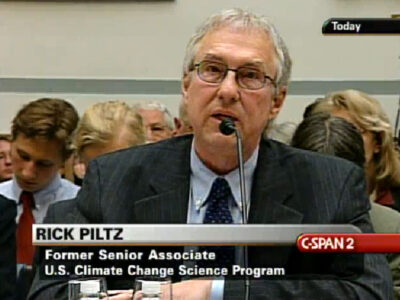
Description: photo of Rick Piltz testifying before Congress
Tireless whistleblower and scientific integrity advocate Rick Piltz testifies at a January 2007 congressional hearing on political interference in climate science. Former UCS Senior Scientist Francesca Grifo also testified at the hearing, where UCS released a survey of government climate scientists showing pervasive political pressures on their work. Screengrab from C-SPAN.
Rick became a minor celebrity when The New York Times published an article based on documents Rick provided showing that a high-ranking Bush administration official and former American Petroleum Institute lobbyist had rewritten government scientific reports to downplay the link between human activity and climate change. The official, Phil Cooney, quicklyleft the administration to work for ExxonMobil. (Yup, sometimes you can’t even make this stuff up).

“Rick was one of the few people brave enough to speak on the record about the distortion and suppression of climate science during the Bush administration despite the possible repercussions for him and his work,” said UCS senior writer Seth Shulman, who investigated many cases of the abuse of science at the time. “Speaking out the way he did still took a lot of courage because he was uncertain about his future in the field. I greatly admired him for that.”
Indeed, it takes a ton of courage to become a whistleblower. You risk your livelihood and often take a big financial hit. You (and your family) often become subject to attacks by powerful interests. You may enjoy some protection from retribution, but even then, the deck is often stacked against you. But Rick soldiered on.
“Rick was a public servant in the truest sense, both while he was in the government and after he made the principled decision to resign and to start up Climate Science Watch,” said Alden Meyer, director of strategy and policy for UCS.
For the next decade, Climate Science Watch paid close attention to the use and misuse of science in government and attacks on climate science and scientists. I knew that whenever I called on Rick, the answer would be an enthusiastic YES. He helped us conceptualize theextensive UCS report on political interference in climate science that was the subject of the House Committee on Government Reform’s first hearing on the topic in 2007 (and testified at that hearing). He contributed ideas that helped us write Federal Science and the Public Good, which remains our basic blueprint for restoring scientific integrity to federal policymaking. He would always be willing to join me to a meeting with an administration official, or meet for coffee to give advice, or send an email to make sure I was aware of a new challenge.

While some deprioritized work on scientific integrity once President Obama took office, Rick knew, personally, that the system that allowed for such rampant abuses of science was still in effect. He did not shy away from criticizing the Obama administration on all kinds of issues when he felt that it was failing to meet the president’s pledge to “restore science to its rightful place” (see herehereherehere, and here for just a few recent posts).

Rick also saw the danger of attacking the work of climate scientists through criminal statutes and open records requests and public defamation. His organization signed on to numerous letters pushing back on such attacks, and he blogged regularly about developments.

Once he stood up, Rick Piltz never again sat down. He never took his eyes off of the prize, which for him was a world responsive to the consequences of climate change, and a democracy that respected the work of experts who devote their lives to public service.
“He has been such a guiding light for truth as we all have been navigating through calm and stormy waters,” UCS’s Brenda Ekwurzel wrote to me this morning. “I can think of no better way of honoring Rick than by continuing the fight he so bravely met head on.”
Those of us who knew him will always remember his soft-spoken manner, his methodical approach, his wry sense of humor, and his strong sense of justice.
So long, Rick. So many of us will miss you, and do our best to carry your passion forward.

Saturday, October 18, 2014

Climate Patriot Rick Piltz -- full interview


YouTube.com, published on December 18, 2013
Rick Piltz is a former senior associate in the coordination office of the U.S. Climate Change Science Program. In 2005, he blew the whistle on the White House's improper editing and censorship of science program reports on global warming intended for the public and Congress. GAP, which represented Piltz, released edited reports to The New York Times that documented the actual hand-editing -- by White House Counsel on Environmental Quality Chief of Staff Philip Cooney, a lawyer and former climate team leader with the American Petroleum Institute -- which was done to downplay the reality of human-driven global warming and its harmful impacts, and exaggerate scientific uncertainty. This scandal sparked a media frenzy that resulted in the resignation of Cooney, who found a job at ExxonMobil days later.


Very difficult to see that the article below was written by Andrew Revkin -- he must have been body snatched in the interim:

Bush Aide Softened Greenhouse Gas Links to Global Warming 

by Andrew Revkin, The New York Times, June 8, 2005

A White House official who once led the oil industry's fight against limits on greenhouse gases has repeatedly edited government climate reports in ways that play down links between such emissions and global warming, according to internal documents.

In handwritten notes on drafts of several reports issued in 2002 and 2003, the official, Philip A. Cooney, removed or adjusted descriptions of climate research that government scientists and their supervisors, including some senior Bush administration officials, had already approved. In many cases, the changes appeared in the final reports.

The dozens of changes, while sometimes as subtle as the insertion of the phrase "significant and fundamental" before the word "uncertainties," tend to produce an air of doubt about findings that most climate experts say are robust.


Mr. Cooney is chief of staff for the White House Council on Environmental Quality, the office that helps devise and promote administration policies on environmental issues.

Before going to the White House in 2001, he was the "climate team leader" and a lobbyist at the American Petroleum Institute, the largest trade group representing the interests of the oil industry. A lawyer with a bachelor's degree in economics, he has no scientific training.
The documents were obtained by The New York Times from the Government Accountability Project, a nonprofit legal-assistance group for government whistle-blowers.

The project is representing Rick S. Piltz, who resigned in March as a senior associate in the office that coordinates government climate research. That office, now called the Climate Change Science Program, issued the documents that Mr. Cooney edited.

A White House spokeswoman, Michele St. Martin, said yesterday that Mr. Cooney would not be available to comment. "We don't put Phil Cooney on the record," Ms. St. Martin said. "He's not a cleared spokesman."

In one instance in an October 2002 draft of a regularly published summary of government climate research, "Our Changing Planet," Mr. Cooney amplified the sense of uncertainty by adding the word "extremely" to this sentence: "The attribution of the causes of biological and ecological changes to climate change or variability is extremely difficult."

In a section on the need for research into how warming might change water availability and flooding, he crossed out a paragraph describing the projected reduction of mountain glaciers and snowpack. His note in the margins explained that this was "straying from research strategy into speculative findings/musings."

Other White House officials said the changes made by Mr. Cooney were part of the normal interagency review that takes place on all documents related to global environmental change. Robert Hopkins, a spokesman for the White House Office of Science and Technology Policy, noted that one of the reports Mr. Cooney worked on, the administration's 10-year plan for climate research, was endorsed by the National Academy of Sciences. And Myron Ebell, who has long campaigned against limits on greenhouse gases as director of climate policy at the Competitive Enterprise Institute, a libertarian group, said such editing was necessary for "consistency" in meshing programs with policy.

But critics said that while all administrations routinely vetted government reports, scientific content in such reports should be reviewed by scientists. Climate experts and representatives of environmental groups, when shown examples of the revisions, said they illustrated the significant if largely invisible influence of Mr. Cooney and other White House officials with ties to energy industries that have long fought greenhouse-gas restrictions.

In a memorandum sent last week to the top officials dealing with climate change at a dozen agencies, Mr. Piltz said the White House editing and other actions threatened to taint the government's $1.8 billion-a-year effort to clarify the causes and consequences of climate change.

"Each administration has a policy position on climate change," Mr. Piltz wrote. "But I have not seen a situation like the one that has developed under this administration during the past four years, in which politicization by the White House has fed back directly into the science program in such a way as to undermine the credibility and integrity of the program."

A senior Environmental Protection Agency scientist who works on climate questions said the White House environmental council, where Mr. Cooney works, had offered valuable suggestions on reports from time to time. But the scientist, who spoke on the condition of anonymity because all agency employees are forbidden to speak with reporters without clearance, said the kinds of changes made by Mr. Cooney had damaged morale. "I have colleagues in other agencies who express the same view, that it has somewhat of a chilling effect and has created a sense of frustration," he said.

Efforts by the Bush administration to highlight uncertainties in science pointing to human-caused warming have put the United States at odds with other nations and with scientific groups at home.

Prime Minister Tony Blair of Britain, who met with President Bush at the White House yesterday, has been trying to persuade him to intensify United States efforts to curb greenhouse gases. Mr. Bush has called only for voluntary measures to slow growth in emissions through 2012.

Yesterday, saying their goal was to influence that meeting, the scientific academies of 11 countries, including those of the United States and Britain, released a joint letter saying, 
"The scientific understanding of climate change is now sufficiently clear to justify nations taking prompt action."

The American Petroleum Institute, where Mr. Cooney worked before going to the White House, has long taken a sharply different view. Starting with the negotiations leading to the Kyoto Protocol climate treaty in 1997, it has promoted the idea that lingering uncertainties in climate science justify delaying restrictions on emissions of carbon dioxide and other heat-trapping smokestack and tailpipe gases.

On learning of the White House revisions, representatives of some environmental groups said the effort to amplify uncertainties in the science was clearly intended to delay consideration of curbs on the gases, which remain an unavoidable byproduct of burning oil and coal.

"They've got three more years, and the only way to control this issue and do nothing about it is to muddy the science," said Eileen Claussen, the president of the Pew Center on Global Climate Change, a private group that has enlisted businesses in programs cutting emissions.

Mr. Cooney's alterations can cause clear shifts in meaning. For example, a sentence in the October 2002 draft of "Our Changing Planet" originally read, "Many scientific observations indicate that the Earth is undergoing a period of relatively rapid change." In a neat, compact hand, Mr. Cooney modified the sentence to read, "Many scientific observations point to the conclusion that the Earth may be undergoing a period of relatively rapid change."

A document showing a similar pattern of changes is the 2003 "Strategic Plan for the United States Climate Change Science Program," a thick report describing the reorganization of government climate research that was requested by Mr. Bush in his first speech on the issue, in June 2001. The document was reviewed by an expert panel assembled in 2003 by the National Academy of Sciences. The scientists largely endorsed the administration's research plan, but they warned that the administration's procedures for vetting reports on climate could result in excessive political interference with science.

Another political appointee who has played an influential role in adjusting language in government reports on climate science is Dr. Harlan L. Watson, the chief climate negotiator for the State Department, who has a doctorate in solid-state physics but has not done climate research.

In an October 4, 2002, memo to James R. Mahoney, the head of the United States Climate Change Science Program and an appointee of Mr. Bush, Mr. Watson "strongly" recommended cutting boxes of text referring to the findings of a National Academy of Sciences panel on climate and the Intergovernmental Panel on Climate Change, a United Nations body that periodically reviews research on human-caused climate change.
The boxes, he wrote, "do not include an appropriate recognition of the underlying uncertainties and the tentative nature of a number of the assertions."

While those changes were made nearly two years ago, recent statements by Dr. Watson indicate that the administration's position has not changed.

"We are still not convinced of the need to move forward quite so quickly," he told the BBC in London last month. "There is general agreement that there is a lot known, but also there is a lot to be known."

http://www.nytimes.com/2005/06/08/politics/08climate.html?_r=0&pagewanted=all