Blog Archive

Showing posts with label Amazon rainforest. Show all posts

Sunday, March 8, 2020

Tropical forests may be heating Earth by 2035

by Tim Radford, Climate News Network, March 6, 2020


Bayaka people in the Central African Republic rainforest. Image: By JMGRACIA100, via Wikimedia Commons
Climate change so far has meant more vigorous forest growth as greenhouse gases rise. The tropical forests may soon change that.
LONDON, 6 March, 2020 – Within about fifteen years, the great tropical forests of Amazonia and Africa could stop absorbing atmospheric carbon, and slowly start to release more carbon than growing trees can fix.
A team of scientists from 100 research institutions has looked at the evidence from pristine tracts of tropical forest to find that – overall – the foliage soaked up the most carbon, most efficiently, more than two decades ago.
Since then, the measured efficiency of the forests as a “sink” in which carbon is sequestered from the atmosphere has been dwindling. By the last decade, the ability of a tropical forest to absorb carbon had dropped by a third.
All plant growth is a balancing act based on sunshine and atmospheric carbon and rainfall. Plants absorb carbon dioxide as they grow, and surrender it as they die.
In a dense, undisturbed wilderness, fallen leaves and even fallen trees are slightly less likely to decompose completely: the atmospheric carbon in leaf and wood form has a better chance of being preserved in flooded forests as peat, or being buried before it can completely decompose.
The forest becomes a bank vault, repository or sink of the extra carbon that humans are now spilling into the atmosphere from car exhausts, factory chimneys and power station furnaces.
Theory and practice
And in theory, as more and more carbon dioxide gets into the atmosphere, plants respond to the more generous fertilization by growing more vigorously, and absorbing more carbon.
But as more carbon gets into the atmosphere, the temperature rises and weather patterns begin to become more extreme. Summers get hotter, rainfall more capricious. Then trees become vulnerable to drought, forest fire and invasive diseases, and die more often, and decompose more completely.
Wannes Hubau, once of the University of Leeds in the UK and now at the Royal Museum for Central Africa in Belgium, and more than 100 colleagues from around the world, report in the journal Nature that they assembled 30 years of measurement from more than 300,000 trees in 244 undisturbed plots of forest in 11 countries in Africa, and from 321 plots of forest in Amazonia, and did the sums.
In the 1990s, intact tropical forests removed around 46 billion tonnes of carbon dioxide from the atmosphere. By the 2010s, the uptake had fallen to around 25 billion tonnes. This means that 21 billion tons of greenhouse gas that might otherwise have been turned into timber and root had been added to the atmosphere.
This is pretty much what the UK, France, Germany and Canada together spilled into the atmosphere from fossil fuel combustion over a 10-year period.
“We’ve found one of the most worrying impacts of climate change has already begun. This is decades ahead of even the most pessimistic climate models”
“Extra carbon boosts tree growth, but every year this effect is being increasingly countered by the negative impacts of higher temperatures and droughts which slow growth and can kill trees,” said Dr Hubau.
“Our modeling shows a long-term decline in the African sink and that the Amazon sink will continue to rapidly weaken, which we predict will become a carbon source in the mid-2030s.”
Tropical forests are an integral factor in the planetary carbon budget – a crude accounting system that climate scientists rely upon to model the choice of futures that face humankind as the world heats up.
Around half of Earth’s carbon is stored in terrestrial vegetation and the tropical forests account for about a third of the planet’s primary productivity. So how forests respond to a warmer world is vital.
Because the Amazon region is being hit by higher temperatures, and more frequent and prolonged droughts than forests in tropical Africa, Amazonia is weakening at a faster rate.
But decline has also begun in Africa. In the 1990s, the undisturbed tropical forests alone inhaled 17% of human-made carbon dioxide emissions. In the decade just ended, this proportion fell to 6%.
Catastrophic prospect
In roughly the same period, the area of intact forest fell by 19%, and global carbon dioxide emissions rose by 46%. Even so, the tropical forests store 250 billion tonnes of carbon in their trees alone: 90 years of fossil fuel emissions at the present rate. So their sustained loss would be catastrophic.
“Intact tropical forests remain a vital carbon sink but this research reveals that unless policies are put in place to stabilize the Earth’s climate, it is only a matter of time until they are no longer able to sequester carbon,” said Simon Lewis, a geographer at the University of Leeds, and one of the authors.
“One big concern for the future of humanity is when carbon-cycle feedbacks really kick in, with nature switching from slowing climate change to accelerating it.
“After years of work deep in the Congo and Amazon rain forests, we’ve found one of the most worrying impacts of climate change has already begun.
“This is decades ahead of even the most pessimistic climate models. There is no time to lose in tackling climate change.” 

Thursday, May 4, 2017

In controversial move, Brazil may outsource Amazon deforestation monitoring


Fires and deforestation in the Amazon, as seen by a sensor aboard a NASA satellite. NASA Earth Observatory
by Erik Stokstad, Science Magazine,
With reporting by Herton Escobar.

In a major change, Brazil's Ministry of the Environment is looking for a company to help it monitor deforestation in the Amazon. "This is a surprise for everyone … crazy stuff," says Tasso Azevedo, coordinator of the Greenhouse Gas Emission Estimate System and Observatório do Clima in São Paulo and former head of the Brazilian Forest Service. The controversial proposal led to the firing of one of the ministry's top scientists, who is a vice president of the Intergovernmental Panel on Climate Change (IPCC).  

Since 1988, the ministry has relied on the National Institute of Space Research (INPE) to analyze land cover changes in the Amazon, which holds the world’s largest intact swaths of forest. Efforts to combat deforestation there have been the focus of worldwide interest, in large part because of the region’s rich biodiversity and the forest’s role in shaping regional climate.

The ministry says INPE will continue to monitor the Amazon, but researchers worry that the $25 million annual contract will result in significant duplication of effort, a waste of scarce resources, possible confusion over deforestation rates, and create an apparent conflict of interest for the ministry. 

The data from INPE's remote sensing analyses helped the ministry create and enforce policies that slashed deforestation by 72% between 2004 and 2016. The flagship effort at INPE is the Program for Monitoring Deforestation of the Amazon by Satellite (PRODES), in which technicians analyze LANDSAT data to identify clear-cuts larger than 6.25 hectares and produce a yearly estimate of deforestation in the Amazon.

Since 2004, INPE has added techniques to detect smaller patches of illegal cutting, and also created a program called DETER to provide monthly and weekly updates that could be used for enforcement. The long track record with PRODES and INPE's newer approaches have won praise from international experts. "Brazil is the leading country in terms of monitoring deforestation," says Matthew Hansen of the University of Maryland in College Park. "No one touches Brazil."

But on 20 April, the ministry quietly issued a 160-page request for proposals for "contracting specialized services of support to the infrastructure of geoprocessing and remote sensing activities to meet the demands of environmental monitoring and geoprocessing." The 2-week deadline for proposals closes Thursday, after which the ministry will consider any bids for up to 60 days. The 12-month contract could be extended for up to 5 years. News of the proposal request was first reported Wednesday by Estadão magazine.  

The decision to hire a commercial firm to do remote-sensing analysis was disputed within the ministry. The head of the program to combat deforestation, mathematician Thelma Krug, who helped create PRODES, reportedly objected to the decision. She was dismissed from her position on 19 April, the day before the request for proposals was issued. In a statement, the ministry said she wanted to spend more time on her work for IPCC. "She's a scientist who knows better than anyone in Brazil what's going on with measuring deforestation in the Amazon," says Paulo Moutinho, an ecologist at the Amazon Environmental Research Institute in Brasília. Her firing was "not good news for Brazilian society or those trying to protect the forest."  

In a statement yesterday, the ministry said that the purpose of the contract is to add technology, such as radar imagery, not available from INPE. The space agency will continue to monitor and estimate deforestation in the Amazon, the ministry said, and disputed that work done under the contract would be redundant with INPE’s activities. But Raoni Rajão, a social scientist at the Federal University of Minas Gerais in Belo Horizonte, says that much of the work called for by the bid request is already being done by INPE, so hiring a contractor to replicate it is "basically a waste of money." The contract would eat up 18% of the ministry's budget, which was cut 51% in March to $142 million. That's money that could be better spent fighting illegal logging, which rose 29% last year, says Carlos Souza, a remote sensing expert with Imazon, a research institute in Belém.

There's also the potential for conflict of interest, critics say. The ministry would be paying a company to evaluate deforestation, which is one measure of how well the ministry is doing its job. That raises important questions, Souza says: "How transparent will the system be? Can it be verified by civil society?"

INPE's methods are transparent and its analysis independent of the ministry, experts say. "If you want to save the Amazon," says Moutinho, "we need a very robust monitoring system of deforestation."
Rajão, who has created an online petition to ask the ministry to cancel the request, also worries that the ministry could cherry-pick deforestation data from the contractor or INPE and highlight the better-looking numbers. Multiple sources of government information could create confusion over the status and trends of deforestation, he says.
A big value of INPE’s annual deforestation estimates is that they offer a simple, clear indicator about how the world's largest rainforest is faring, says tropical ecologist Dan Nepstad of the Earth Innovation Institute in San Francisco, California. "It's become part of the national narrative on the Amazon," he says.

Tuesday, October 6, 2015

Threat to Brazil’s indigenous reserves raises climate and health concerns as studies show that reduced deforestation leads to lower CO2 emissions and better air quality

by Jan Rocha, Climate News Network, October 1, 2015

SÃO PAULO − Environmental organisations warn that a bill now going through the Brazilian Congress to transfer responsibility for demarcating indigenous reserves from federal government experts to politicians could lead to an increase of 110 million tonnes of CO2 emissions by 2030.

The Amazon Environmental Research Institute (IPAM) calculates that the accumulated carbon stock inside indigenous reserves in the Amazon basin amounts to 47 billion tonnes − or more than a year’s worth of global emissions.

Studies have shown that rainforest located in indigenous reserves is almost always preserved, even when much of the land around it has been cleared for farming.

But the controversial bill that might soon be voted into law could radically change that situation by giving Congress responsibility for demarcating indigenous reserves − which critics liken to asking the fox to look after the chicken house.

The 2014 elections in Brazil produced a very reactionary chamber of deputies, many of them belonging to the “bullet, bull and bible” lobbies defending law and order, agribusiness and conservative moral issues, with very little sympathy for, or understanding of, Brazil’s hundreds of indigenous groups.

Formally recognised

At present, indigenous lands are formally recognised only after detailed anthropological, archaeological and historical studies conducted by the National Indian Foundation (FUNAI), the government agency for policies relating to indigenous peoples, which then physically demarcates their territory.

It is a slow and painstaking process that allows for the compensation of farmers who have settled in good faith − sometimes with land titles dating back to Brazil’s imperial government in the 19th century.

The 698 indigenous reserves occupy 13% of Brazil’s total land area, almost all (98%) of it in the Amazon basin. Two-thirds have been officially recognised, while another 228 await demarcation, but the bill could include a clause making even recognised reserves open to revision.

If the demarcation process were transferred to congress, environmental groups such as the Socioenvironmental Institute (ISA), a well-respected Brazilian NGO, fear that forested indigenous areas will be opened up “to high impact activities like mining, dams, oil and gas pipelines, waterways, railways, roads, and non-indigenous settlements and farming activities.”

“It is worth emphasising the strategic importance of indigenous lands for environmental conservation,” ISA says.

The accumulated deforestation in indigenous territories in Amazonia is just 1.9% of the original forested area within them, compared to overall deforestation of 22.8% of the total original forested area, according to figures produced for 2013 by the Program to Calculate Deforestation in the Amazon (PRODES), the monitoring project of Brazil’s National Institute for Space Research.

“Even outside Amazonia, where indigenous reserves are much smaller in area, they have played an important role in safeguarding biodiversity,” ISA adds.

If the new bill is approved by Congress, IPAM reckons that the probable changes could lead to an extra 110 million tonnes of carbon emissions by 2030.

The Brazilian government is committed [watch what they do, not what they say!] to zero illegal deforestation in the Amazon by 2030, but embattled president Dilma Rousseff is currently too busy fighting the threat of impeachment to take on another fight with some of the Congress members she needs to keep on her side.

Criminal loggers

The government has mounted a number of successful law enforcement operations to crack down on criminal loggers, and deforestation rates have been falling. But if indigenous areas stop being protected, and fall into the hands of farmers, loggers and mining companies, the Forest Code allows for 20% of the acquired area to be cleared.

According to a recent study published in Nature Geoscience, falling deforestation rates are not only good for reducing CO2 emissions, but have also contributed to saving lives by improving air quality.

The study found that the 40% reduction in Brazil’s deforestation rates since 2004 is preventing 1,060 premature adult mortalities annually across South America, because of the consequent reduction in fire emissions and, therefore, of particulate matter (PM).

The study says: “Inhalation of PM from fires has adverse impacts on human health, including increased hospital admissions and premature mortality.”

It estimates that deforestation fires alone cause an average of 2,906 premature deaths annually across South America from cardiopulmonary disease and lung cancer. 

*Jan Rocha, a freelance journalist living in Brazil, is a former correspondent there for the BBC World Service and The Guardian.

Sunday, March 29, 2015

Amazon rainforest is taking up a third less carbon than a decade ago

by Robert McSweeney, Carbon Brief, March 18, 2015

Amazon at dawn | P. van der Sleen
The amount of carbon that the Amazon rainforest is absorbing from the atmosphere and storing each year has fallen by around a third in the last decade, says a new 30-year study by almost 100 researchers.
This decline in the Amazon carbon sink amounts to one billion tonnes of carbon dioxide - equivalent to over twice the UK's annual emissions, the researchers say.
If this pattern exists in other forests around the world, deeper cuts in human-caused carbon dioxide emissions are needed to meet climate targets, the researchers say.
Three billion trees
The Amazon rainforest is the largest rainforest in the world. Spanning nine countries in South America, it's 25 times the size of the UK.
Using a process known as photosynthesis, the Amazon's three billion trees convert carbon dioxide, water and sunlight into the fuel they need to grow, locking up carbon in their trunks and branches.
As they grow, Amazon trees account for a quarter of the carbon dioxide absorbed by the land each year.  Studies suggest that as human-caused carbon dioxide emissions increase, forests will absorb and store more carbon, assuming they have enough water and nutrients to grow.
But a new study, published today in Nature, suggests the Amazon has passed saturation point for how much extra carbon it can take up.
Diminishing carbon sink
A team of almost 500 people monitored trees in more than 300 sites across eight countries. Between 1983 and 2011, the researchers measured the trees in each plot, recording the number, size and density to calculate how much carbon each one stored.
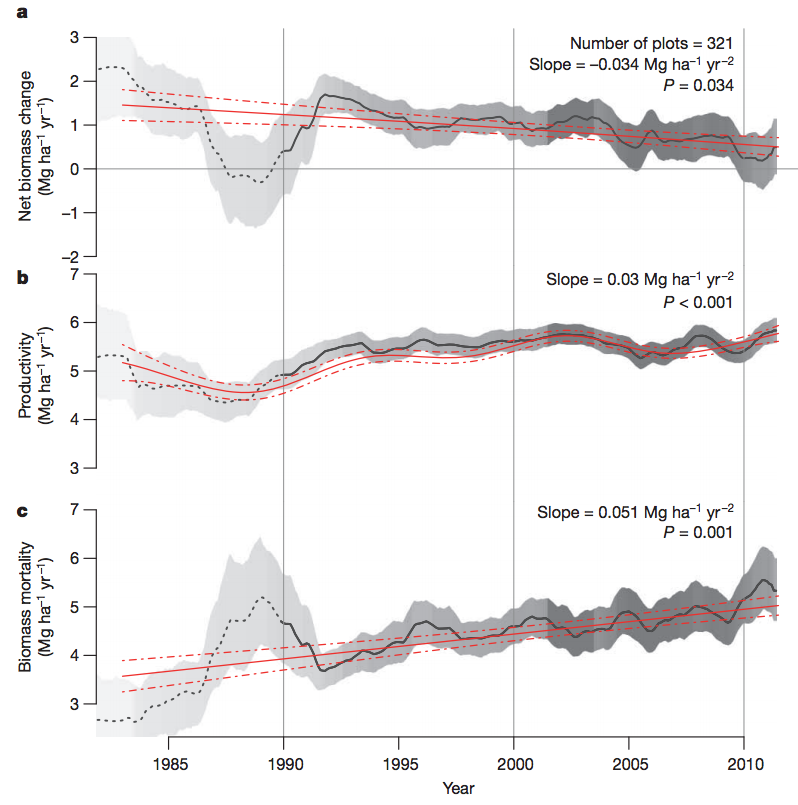
The trees took up more carbon and grew more quickly during the 1990s, before levelling off since the year 2000. You can see this in the middle chart below.
Brienen Et Al (2015) Fig1
Top graph shows trend in biomass (i.e. the amount of carbon stored), middle graph shows trend in productivity (i.e. tree growth), and the bottom graph shows trend in biomass mortality (i.e. tree deaths). Data before 1990 (dotted black line) was from a small number of sites, so there is more variation in these years. Source: Brienen et al. (2015)
But during this growth spurt, Amazon trees have been dying off more quickly, as the bottom graph shows.
The combination of flat growth rate and increasing tree deaths means the amount of carbon the Amazon stores has declined by around 30% since the 1990s, the researchers say. You can see this in the top graph.
Live fast, die young
So what is causing more trees to die? Co-author Prof Oliver Phillips from the University of Leeds, tells Carbon Brief it could be down to the growth spurt fuelled by rising carbon dioxide levels:
"The faster trees grow, the sooner they reach maturity, and the sooner they may eventually age. "
As tall trees are more vulnerable to high winds and drought, faster growth may also be putting trees at risk from weather extremes, Phillips says. During the Amazon droughts in 2005 and 2010, for example, the researchers found short-term peaks in deaths of large trees. Though the overall trend of more trees dying began before either drought, the researchers say.
In an accompanying News & Views articleProf Lars Hedin, professor of ecology and evolutionary biology at Princeton University, also points to drought as a possible underlying reason for declining carbon storage:
"A more likely explanation is that the influence of one or more constraining factors, such as water availability, temperature stress or nutrient limitation, has increased as forest biomass has expanded."
But the exact causes don't change the overarching finding that the forest is storing less carbon, says lead author Dr Roel Brienen, also from the University of Leeds:
"Regardless of the causes behind the increase in tree mortality, this study shows that predictions of a continuing increase of carbon storage in tropical forests may be too optimistic."
Carbon sinking
We won't see an immediate effect of declining Amazon carbon storage on atmospheric carbon dioxide levels, the researchers say. The carbon from dead trees is released slowly as they decompose. But apart from the fraction of carbon that ends up in the soil on the forest floor, the rest will eventually reach the atmosphere.
The key question now is whether carbon uptake is falling in other forests too, says Prof Peter Smith from the University of Aberdeen, coordinating lead author of the Agriculture, Forestry and Other Land Use chapter of the latest Intergovernmental Panel on Climate Change report:
"It is not known if this trend is replicated more widely across tropical forests, but it does show that we need more measurements to quantify this elsewhere."
If declining carbon storage does turn out to be more widespread, that would spell bad news for the climate, Smith says:
"Until now, the biosphere has been re-absorbing a proportion of the carbon dioxide we have released through fossil fuel burning and land use change. If that re-absorption declines as suggested here, more carbon dioxide will remain in the atmosphere, thereby accelerating climate change."
Forests have been doing as a huge favour for decades, says Phillips. But the new study shows forests' capacity to buffer climate change is shrinking, which means the need to reduce emissions is rising at the same time.
Brienen, R.J.W et al. (2015) Long-term decline of the Amazon carbon sink, Nature,doi:10.1038/nature14283
Hedin, L.O. (2015) Signs of saturation in the tropical carbon sink, Nature, doi:10.1038/519295a
http://www.carbonbrief.org/blog/2015/03/amazon-rainforest-is-taking-up-a-third-less-carbon-than-a-decade-ago/

Sunday, November 2, 2014

Amazon rainforest losing ability to regulate climate, scientist warns

Report says logging and burning of Amazon might be connected to worsening droughts – such as the one plaguing São Paulo

amazonin
Smoke billows as an area of the Amazon rainforest is burned to clear land for agriculture near Novo Progresso, Para State. Photograph: Nacho Doce/Reuters
by Jonathan Watts in Rio de Janeiro, The Guardian, October 31, 2014

The Amazon rainforest has degraded to the point where it is losing its ability to benignly regulate weather systems, according to a stark new warning from one of Brazil’s leading scientists.
In a new report, Antonio Nobre, researcher in the government’s space institute, Earth System Science Centre, says the logging and burning of the world’s greatest forest might be connected to worsening droughts – such as the one currently plaguing São Paulo – and is likely to lead eventually to more extreme weather events.
The study, which is a summary drawing from more than 200 existing papers on Amazonian climate and forest science, is intended as a wake-up call.
“I realised the problem is much more serious than we realised, even in academia and the reason is that science has become so fragmented. Atmospheric scientists don’t look at forests as much as they should and vice versa,” said Nobre, who wrote the report for a lay audience. “It’s not written in academic language. I don’t need to preach to the converted. Our community is already very alarmed at what is going on.”
A draft seen by The Guardian warns that the “vegetation-climate equilibrium is teetering on the brink of the abyss.” If it tips, the Amazon will start to become a much drier savanna, which calamitous consequences.
The Amazon works as a giant pump, channeling moisture inland via aerial rivers and rainclouds that form over the forest more dramatically than over the sea, the author says. It also provides a buffer against extreme weather events, such as tornados and hurricanes.
In the past 20 years, the author notes that the Amazon has lost 763,000 sq km, an area the size of two Germanys. In addition another 1.2m sq km has been estimated as degraded by cutting below the canopy and fire.
As a result, the report notes, the deterioration of the rainforest – through logging, fires and land clearance – has resulted in a decrease in forest transpiration and a lengthening of dry seasons. This might be one of the factors of the severe drought affecting south-east Brazil. São Paulo – the biggest city in South America – is facing its worst water shortages in almost a century. October, which is usually the start of the rainy season, was drier than at any time since 1930, leaving the volume of the Cantareira reservoir system down to 5% of capacity.
“Studies more than 20 years ago predicted what is happening with lowering rainfall. Amazon deforestation is altering climate. It is no longer about models. It is about observation,” said Nobre. “The connection with the event in São Paulo is important because finally people are paying attention.”
Nobre calls for a “war effort” to reverse the damage and secure the global climate and security of future generations. This would involve a ramped-up effort to immediately halt existing deforestation and a major new project to replant trees.
Whether the government listens, however, is another matter. Forest clearance has accelerated under Brazil’s president, Dilma Rousseff, after efforts to protect the Amazon were weakened. Last month, satellite data indicated a 190% surge in deforestation in August and September. The influence of the “ruralista” agribusiness lobby in Congress has also grown in recent years, making it harder for the authorities to push through new legislation to demarcate reserves.
“They have taken good action in the past,” says Nobre. ““I hope they will listen now.”

Sunday, September 14, 2014

Amazon rainforest deforestation in Brazil drastically reducing rain for agriculture and drinking

Scientists in Brazil believe the loss of billions of litres of water released as vapour clouds by Amazon rainforest trees is the result of continuing deforestation and climate change – leading to devastating drought.

by Jan Rocha, Climate News Network, September 14, 2014

SÃO PAULO − The unprecedented drought now affecting São Paulo, South America’s giant metropolis, is believed to be caused by the absence of the “flying rivers” − the stream of water vapor clouds from the Amazon that normally bring rain to the centre and south of Brazil.

Some Brazilian scientists say the absence of rain that has dried up rivers and reservoirs in central and southeast Brazil is not just a quirk of nature, but a change brought about by a combination of the continuing deforestation of the Amazon and global warming.

This combination, they say, is reducing the role of the Amazon rainforest as a giant “water pump,” releasing billions of litres of humidity from the trees into the air in the form of water vapor.

Meteorologist Jose Marengo, a member of the Intergovernmental Panel on Climate Change, first coined the phrase “flying rivers” to describe these massive volumes of atmospheric water vapor that rise from the rainforest, travel west, and then − blocked by the Andes − turn south.

Satellite images from the Centre for Weather Forecasts and Climate Research of Brazil’s National Space Research Institute (INPE) clearly show that, during January and February this year, the flying rivers failed to arrive, unlike the previous five years.

Alarming proportions

Deforestation all over Brazil has reached alarming proportions: 22% of the Amazon rainforest (an area larger than Portugal, Italy and Germany combined), 47% of the Cerrado in central Brazil, and 91.5% of the Atlantic forest that used to cover the entire length of the coastal area.

Latest figures from Deter, the Real Time Deforestation Detection System based on high frequency satellite images used by INPE, show that, after falling for two years, Amazon deforestation rose again by 10% between August 2013 and July 2014. The forest is being cleared for logging and farming.

Tocantins, Pará and Mato Grosso, three states in the Greater Amazon region that have suffered massive deforestation, are all registering higher average temperatures.

As long ago as 2009, Antonio Nobre, one of Brazil’s leading climate scientists, warned that, without the “flying rivers,” the area that produces 70% of South America’s GNP would be desert.

In an interview with the journal Valor Economica, he said: “Destroying the Amazon to advance the agricultural frontier is like shooting yourself in the foot. The Amazon is a gigantic hydrological pump that brings the humidity of the Atlantic Ocean into the continent and guarantees the irrigation of the region.”

“Of course, we need agriculture,” he said. “But without trees there would be no water, and without water there is no food.

"A tonne of soy takes several tonnes of water to produce. When we export soy we are exporting fresh water to countries that don’t have this rain and can’t produce. It is the same with cotton, with ethanol. Water is the main agricultural input. If it weren’t, the Sahara would be green, because it has extremely fertile soil.”

Underestimated

Like other climate scientists, Nobre thinks the role of the Amazon rainforest in producing rain has been underestimated. In a single day, the Amazon region evaporates 20 billion tons of water vapor − more than the 17 million tonnes of water that the Amazon river discharges each day into the Atlantic.

“A big tree with a crown 20 metres across evaporates up to 300 litres a day, whereas one square metre of ocean evaporates exactly one square metre,” he said. “One square metre of forest can contain eight or 10 metres of leaves, so it evaporates eight or 10 times more than the ocean. This flying river, which rises into the atmosphere in the form of vapor, is bigger than the biggest river on the Earth.”

The fear is that if the Amazon rainforest continues to be depleted at the present rate, events like the unprecedented drought of 2010 will occur more often. The fires set by farmers to clear areas for planting or for cattle-raising make it more vulnerable.

Nobre explained: “The smoke from forest fires introduces too many particles into the atmosphere, dries the clouds, and they don’t rain. During the dry period, of the fires, the forest always maintained a little rain that left it humid and non-flammable, but now two months go by without rain, the forest gets very dry, and the fire gets into it. Amazon trees, unlike those of the Cerrado, have no resistance to fire.”

Nobre’s warning in 2009 was that if deforestation did not stop, there would be a catastrophe in five or six years time. Five years on, his words are now proving to be prophetic as São Paulo and all Brazil’s centre and southeast suffer their worst ever drought, with devastating effects on agriculture, energy and domestic water supplies.

Friday, September 12, 2014

Brazil says rate of Amazon deforestation up for first time in years


Rainforest of Maranhao

by Vincent Bevins, The Los Angeles Times, September 11, 2014

Belo Horizonte, Minas Gerais, Brazil -- The  deforestation of the Amazon in Brazil increased by 29% in the last recorded year, according to figures released Wednesday by the country's National Institute for Space Research (INPE). 

According to the study, carried out by satellite imaging, the Brazilian region of the world's largest rain forest lost 2,275 square miles, nearly five times the area of the city of Los Angeles, from August 2012 through July 2013.

“The result indicates there is effectiveness in combating deforestation, particularly since the 2004 creation of the Action Plan for the Prevention and Control of Deforestation in the Legal Amazon,” the report says. 

Marina Silva
Marina Silva, presidential candidate of Brazil's Socialist Party, speaks to reporters during a visit to a public school in Sao Paulo on Monday. (Andre Penner / Associated Press)

Brazil's environment minister in 2004 was Marina Silva, who is now narrowly ahead in polls and poised to defeat incumbent Dilma Rousseff for the presidency next month. If she wins, she would be considered Brazil's first environmentalist president as well as the first president from the Amazon region.

But despite a relative slowing of the speed of destruction in the last decade, the Amazon has continued to shrink every year. Some of its trees are cleared for timber, but more are cleared to create grazing land for agriculture.

The rate of deforestation increased recently most quickly in the states of Mato Grosso, in the middle of Brazil's soy boom, and Maranhao, where armed indigenous residents recently captured and expelled illegal loggers from their land.

In 2012, Brazil's Congress passed a new forestry code governing the Amazon and deforestation. The law was seen as a step forward from the lawlessness that preceded it but was criticized by environmental groups that disagreed with provisions that would give amnesty to illegal Amazon destroyers.

Most analysts consider the pro-development agricultural bloc the most powerful alliance in Brazil's legislature.

http://www.latimes.com/world/mexico-americas/la-fg-brazil-amazon-deforestation-rises-20140910-story.html

Saturday, June 14, 2014

Climate Roulette: Elmar Kriegler et al.

Climate roulette

by James Dacey, physicsworld.com, March 16, 2009

Mankind is playing a Russian roulette with the climate, according to a study published today in the Proceedings of the National Academy of Sciences.

Elmar Kriegler, of the Potsdam Institute for Climate Impact Research, and his colleagues sought to find out what leading scientists really think will happen to the climate.

So Kriegler surveyed 43 scientists to gauge the impact of rising temperatures on five major components of the global climate system.

They calculate a 1-in-6 chance that a “tipping event” will occur if the temperature increases by 2-4 C in the next 200 years.

The 5 systems concerned are:

  • Major changes in the North Atlantic Ocean circulation
  • The Greenland and West Antarctic ice sheets
  • The Amazon rainforest and El Nino

They define a tipping point as “the event of initiating the transition, or making its future initiation inevitable.” 

Essentially they are saying that beyond these points the climate will reach a kind of elastic limit -- beyond which, we will feel the wrath of the climate, and there’ll be nothing we can do about it.

Realizing that previous surveys have been met with a fair degree of apathy, they used “imprecise probabilities” -- a part of Bayesian statistics.

This new mathematics has been controversial, but advocates say it can weigh up a given hypothesis in a more rounded way than classical statistics.

Developed in the 1980s and 1990s, Bayesian statistics seem to have gained most traction in the field of operations research and economic decision making.

“The currently discussed long-term targets of 50% reduction globally by 2050 (and 80% reduction for the industrial countries), with a continuing reduction after 2050, is an important step in this direction, but does not guarantee the reaching of the 2 degree target,” Kriegler told physicsworld.com.

This may sound like a very gloomy forecast, but Kriegler was a bit more pragmatic about taking coordinated international action:

“Nevertheless, these [targeted reductions] are a useful benchmark to focus the minds of politicians and society. Reaching this goal requires at least the following -- in the order of importance:

  1. A massive decarbonization of the energy system, starting in the electricity sector
  2. A strong increase in energy efficiency
  3. A stop to tropical deforestation, and an increase of the forest area in the tropics in the long run
  4. A massive reduction of CH4 and N2O emissions from the agricultural sector

http://www.iop.org/mt4/mt-tb.cgi/2860

Sunday, December 29, 2013

Amazon deforestation threatens food, water, energy, health security in Bolivia, Brazil, Columbia, Ecuador and Peru

Amazon forest loss threatens five countries

FOR IMMEDIATE RELEASE

by Paul Brown, Climate News Network, December 29, 2013

Water, food supplies and energy production are all in jeopardy as the Amazon forest is felled for profit, campaigners say - and the damage is spreading beyond Amazonia itself.

LONDON, 29 December 2013 -- The continued destruction of the Amazon to exploit its resources for mining, agriculture and hydro-power is threatening the future of the South American continent, according to a report by campaigning groups using the latest scientific data.

Five countries -- Bolivia, Brazil, Colombia, Ecuador and Peru -- share the Amazon, and for all of them the forest area occupies more than 40% of their territory. All face threats to their water supply, energy production, food and health.

In addition, the report says, because of the over-exploitation of the region rainfall will fall by 20% over a heavily-populated area far to the south of Amazonia known as the La Plata basin, covering parts of Argentina, Brazil, Bolivia, Paraguay and Uruguay.

Last month it was reported that deforestation in Amazonia had increased by almost a third in the past year, with an area equal to 50 football pitches destroyed every minute since 2000.

The report, the Amazonia Security Agenda, authored by the Global Canopy Programme  and CIAT, the International Centre for Tropical Agriculture, says the prosperity of the region is based on the abundance of water.

There always seemed to be an endless supply of water, but the combination of industrial and agricultural pollution and droughts is creating a once unthinkable vulnerability for the five countries of Amazonia.

Profits syphoned off

The huge wealth being generated from the forests comes with large-scale environmental and social costs. Local people do not benefit, and the profits from minerals, mining and agriculture are syphoned out of the region.

The large-scale economic development of the region causes deforestation. That in turn is threatening not only the wellbeing of the local people but the economic stability of the industries themselves.

Climate change is adding to both the uncertainty and the instability. Increasing temperatures, as much as 3.5 °C in the near future, changing rainfall patterns and more intense and frequent extreme weather events will have further impacts on the health and well-being of the population. Energy supply from hydro-electric dams will decline.

Big bill coming

Among those welcoming the report is Manuel Pulgar, Peru's environment minister.  He will play a leading part when the country’s capital, Lima, hosts the 20th summit of the UN Framework Convention on Climate Change in December 2014. http://unfccc.int/2860.php

He said: “Climate change is a global problem, but one that will multiply local and regional problems in unforeseeable ways. In Latin America, we have taken Amazonia and its seemingly limitless water and forests as a given. But recent unprecedented droughts have shown us just what happens when that water security falters...”

The report says the impacts of environmental degradation that have so far been felt in other parts of the world are now likely to be felt in Amazonia, threatening economic development and security.

Governments in the region, it says, need to recognize that development cannot continue without recognising the damage caused to the water supply and the climate both globally and locally.  Policy makers need scientists to monitor changes to conditions and the economic risks they pose.

Trillions of tons of water

These findings must be shared between academic institutions and governments so that they can decide how to remedy the problem. Annual reviews of dangerous hotspots are also needed, and cross-border groups of experts who could help both national and regional development plans to be worked out.

Carlos Klink, Brazil’s national secretary for climate change and environmental quality, endorsed these findings. “We are understanding more and more how interdependent water, food, energy and health security are across our continent.

“There is also interdependence between the countries that share the Amazon, which recycles trillions of tons of water that all our people and economies rely on.

"The challenge that we are just beginning to recognise and act upon is one of transitioning to a more sustainable economy -- one that values the role of a healthy Amazonia in underpinning long-term security and prosperity.”

Monday, October 21, 2013

Dry season lengthening increases risk of Amazon rainforest dieback

Amazon 'is at higher risk of tree loss'by Alex Kirby, Climate News Network, October 21, 2013

Part of the Amazon rainforest may be more vulnerable to the effects of climate change than first thought, US researchers say.

LONDON, 21 October - Researchers say the southern part of the Amazon rainforest is at a far higher risk of dieback than the models used in the most recent report by the Intergovernmental Panel on Climate Change (IPCC).

The research team, led by Professor Rong Fu of the University of Texas, say that this is because the forest is drying out much quicker than projected.

If the damage is severe enough, they say the loss of rainforest could cause the release of large volumes of carbon dioxide into the atmosphere, and could also disrupt plant and animal communities in one of the world's most biodiversity-rich regions, as outlined in the Proceedings of the National Academy of Sciences.

The team used ground-based rainfall measurements from the past three decades. Findings showed that since 1979, the dry season in southern Amazonia lasted about a week longer in each decade.

At the same time, the annual fire seasons have become longer. The researchers say the most likely explanation for the increasingly longer dry seasons is global warming.

“The dry season over the southern Amazon is already marginal for maintaining rainforest,” says Professor Fu. “At some point, if it becomes too long, the rainforest will reach a tipping point."

She says the length of the dry season is the most important climate factor controlling the southern Amazon rainforest. If it is too long, the forest will not survive.

A study published earlier this year suggested that rainforests worldwide might be able to withstand the impacts of climate change more successfully than thought.

The new results also contrast sharply with forecasts made by the models used by the IPCC: even under future scenarios in which greenhouse gases rise dramatically, those models project the southern Amazon dry season will be at most 10 days longer by the end of the century, and that the risk of climate change-induced rainforest dieback should therefore be relatively low.


Rainfall limited

Professor Fu and her colleagues say the water stored in the forest soil at the end of each wet season is all that the trees have to last them through the dry months. The longer that lasts - regardless of how wet the wet season was - the more stressed the trees become and the more susceptible they are to forest fires.

They say the most likely explanation for the lengthening dry season in recent decades is human-caused greenhouse warming, which inhibits rainfall in two ways: It makes it harder for warm, dry air near the surface to rise and freely mix with cool, moist air above; and it blocks incursions by cold weather fronts from outside the tropics which could trigger rainfall.

The team says the IPCC's climate models represent these processes poorly, which might explain why they project only a slightly longer Amazonian dry season.

The Amazon rainforest normally acts as a carbon sink, removing atmospheric CO2 and storing it. But during a severe drought in 2005 it went into reverse, releasing one petagram of carbon (one billion tonnes - about one-tenth of annual human emissions) to the atmosphere.

Fu and her colleagues estimate that if dry seasons continue to lengthen at just half the rate seen in recent decades, the 2005 Amazon drought could become the norm rather than the exception by the end of this century.

Some scientists think the combination of longer dry seasons, higher surface temperatures and more fragmented forests caused by deforestation could eventually convert much of southern Amazonia from rainforest to savanna.

Earlier studies have shown that human-caused deforestation in the Amazon can alter rainfall patterns. But the researchers did not see a strong sign of that in the pattern of increasing dry season length. That was most pronounced in the south-western Amazon, while the most intense deforestation occurred in the south-east.

Because the north western Amazon has much higher rainfall and a shorter dry season than the south, the researchers think it is much less vulnerable to climate change.