Blog Archive

Showing posts with label resilience. Show all posts

Monday, January 22, 2018

Maize, rice, wheat: alarm at rising climate risk to vital crops leading to widespread famine

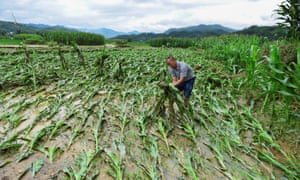
A villager lifts up fallen corn plants after a flood at a farm in Jianhe county, Guizhou province, China in July 2017.

by Robin McKie, Observer Science Editor, The Guardian, July 15, 2017
Governments may be seriously underestimating the risks of crop disasters occurring in major farming regions around the world, a study by British researchers has found.
The newly published research, by Met Office scientists, used advanced climate modelling to show that extreme weather events could devastate food production if they occurred in several key areas at the same time. Such an outcome could trigger widespread famine.
The scientists, led by Chris Kent, of the Met Office, focused their initial efforts on how extreme weather would affect maize, one of the world’s most widely grown crops. Heat and drought were the prime risks, although flooding was also included in the analysis.
The group found there is a 6% chance every decade that a simultaneous failure in maize production could occur in China and the US – the world’s main growers – which would result in widespread misery, particularly in Africa and south Asia, where maize is consumed directly as food.
“The impact would be felt at a global scale,” Kent told the Observer. “This is the first time we have been able to quantify the risk. It hasn’t been observed in the last 30 years, but the indications are that it is possible in the current climate.”
An example of the kind of disaster that could occur is provided by the maize harvests that failed last year in Africa. Communities in Zambia, Congo, Zimbabwe, Mozambique and Madagascar were affected and six million people were left on the brink of starvation. A joint failure of China and America’s maize harvest would have a far greater impact.
Having studied the risks facing maize production, the group is now following up this work by studying climate impacts on the world’s other staple crops – in particular rice, wheat and soy beans – in order to assess how weather extremes could affect their production.
According to the UN Food and Agriculture Organisation, maize, rice and wheat together make up 51% of the world’s calorie intake. Billions of people rely on these crops for survival. Any disruption to their production would have calamitous consequences.
The trouble is that crop-growing methods and locations have changed considerably over time, as has the climate and the probability of extreme events, Kent told the Observer. “This means the number of relevant observations to the present-day growing of stable crops has been reduced, and that limits our ability to have useful estimates of the risks to the growing of these crops.”
To get round this problem, the team ran 1,400 climate model simulations on the Met Office’s new supercomputer to understand how climate might vary in the next few years and found that the probability of severe drought was higher than if estimated solely from past observations. The scientists concluded that current agricultural policies could considerably underestimate the true risk of climate-related shocks to maize growing and food supply.
The particular risk outlined by the study envisaged simultaneous catastrophic disruptions in China and the US. In 2014, total world production of maize was around 1 billion tonnes, with the US producing 360 million tonnes and China growing 215 million. If production in these two countries were hit by simultaneous extreme weather events, most likely droughts, more than 60% of global maize production would be hit.
A double whammy like this has never happened in the past, but the work by the Met Office indicates that there is now a real risk. In addition, there may be risks of similar events affecting rice, wheat or soy bean harvests. These are now being studied by the Met Office, which is also working with researchers in China in a bid to understand climate risks that might affect agricultural production.
“We have found that we are not as resilient as we thought when it comes to crop growing,” said Kirsty Lewis, science manager for the Met Office’s climate security team. “We have to understand the risks we face or there is a real danger we could get caught out. For now we don’t have the means to quantity the risks. We have to put that right.”

Friday, February 14, 2014

Coastal flooding ‘may cost $100,000 billion a year by 2100′

The only way is up: A rapid start on cutting emissions is essential Image: Jan Smith via Wikimedia Commons
The only way is up: A rapid start on cutting emissions is essential
Image: Jan Smith via Wikimedia Commons
by Tim Radford, Climate News Network, February 11, 2014
On the world’s present course, the cost by 2100 of tackling coastal flooding could be beyond the reach of the poorest countries – and ruinously expensive for richer ones.
LONDON – If global warming continues on its present ominous path, and if no significant adaptation measures are launched, then coastal flooding could be costing the planet’s economies $100,000 billion a year by 2100.
And perhaps 5% of the people on the planet – up to 600 million people – could be hit by coastal flooding by the end of the century, according to new research in the Proceedings of the National Academy of Sciences.
Jochen Hinkel from the Global Climate Forum in Berlin and colleagues have compiled, for the first time, global simulation results on future flood damage to buildings and infrastructure on the world’s coastal flood plains.
They expect drastic increases in economic damage because, as sea levels rise with the decades, so will population and investment: there will be more people with more to lose.
Right now, coastal floods and storm surge damage cost the world between $10 billion a year and $40 billion. But as the megacities grow – think of Lagos, or Shanghai, or Manila – more people will be at risk, and, among them, greater than ever numbers of the poorest.
“If we ignore this problem, the consequences will be dramatic,” says Hinkel. “Countries need to take action and invest in coastal protection measures, such as building or raising dykes, amongst other options.”
Provoking a response

And his co-author Robert Nicholls from the University of Southampton warns: “If we ignore sea level rise, flood damages will progressively rise and presently good defences will be degraded and ultimately overwhelmed, hence we must start to adapt now.”
All such projections involve assumptions about the future that cannot be tested, so the authors spread their bets: they considered a range of scenarios involving crude population growth, levels of economic growth with time, and a series of predictions of sea level rise, as icecaps and glaciers melt, and as the oceans warm and expand according to predictable physical laws.
What they could not predict – because such things require political decisions of the kind they hope to provoke with their forecasts – would be the civic and political responses in the next eight decades as storms become more violent and floods more frequent.
Nor did they try to incorporate the natural consequences of human settlement: how much subsidence, for instance, would occur as humans pumped groundwater from aquifers or quarried strata for building material, all things that would lower the levels of the land already at risk from invasion by the sea.
But their predictions, while alarming, are only reinforcements of earlier investigation. In August, a World Bank team calculated that floods would be routinely costing coastal cities $1 trillion a year by 2050.
In July last year, a team from Stanford University in California looked at the challenge of building sea defences and proposed that by far the most efficient solutions would all be natural: dune systems, mangrove forests, reefs, water meadows, kelp forests and natural estuary ecosystems provided the best protection for many people in many circumstances.
And in December scientists from the University of Massachusetts considered the devastation wreaked on New York and other American cities by Superstorm Sandy in October 2012 and warned that such things could happen again and that, once again, natural systems might provide the most efficient  buffers against the buffetings of the weather.
Huge losses

The PNAS authors consider for the purpose of their argument only the increasing costs of either maintaining sea barriers such as dykes or raising them.
By 2100, global average sea level rise could be as low as 25 cm, or as high as 123 cm; between 0.2% and 4.6% of the world’s population could be affected by flooding each year; and losses could be as low as 0.3% or as high as 9.3% of global gross domestic product.
It doesn’t matter very much whether by the end of the century the losses hit the low end of these projections, or the high. They will always be huge. “Damages of this magnitude are very unlikely to be tolerated by society and adaptation will be widespread,” the authors warn.
And there will be tracts of land that no dykes could ever save from the rising waters. The poorest countries are in any case unlikely to be able to meet the costs of sustained protection from the sea.
“If we do not reduce greenhouse gases swiftly and substantially, some regions will have to seriously consider relocating significant numbers of people in the longer run,” says Hinkel. He and his co-authors want to see some significant long-term thinking.
His colleague Professor Nicholls adds: “This long-term perspective is however a challenge to bring about, as coastal development tends to be dominated by short-term interests of, for example, real estate and tourism companies, which prefer to build directly on the waterfront with little thought about the future.” 

Wednesday, February 12, 2014

Worst-case dollar cost of a few feet of rising seas could reach $100 trillion every year, according to the most rigorous scientific study of its kind

by John H. Cushman, Jr., InsideClimate News, February 12, 2014


The world needs to invest tens of billions of dollars a year in beefing up shoreline defenses against rising oceans or it will face mind-boggling costs in the decades to come, according to new research published this week in the Proceedings of the National Academy of Sciences.

If nations don't build up dikes, levees and sea walls, harden existing infrastructure, and preserve natural sponges like wetlands and barrier islands—and if they also do nothing to cut the emissions of greenhouse gases that cause global warming and are driving sea levels higher—the damages could be almost beyond comprehension, the researchers warned.

In a worst case, almost five percent of the world's population could be exposed to flooding at the start of the next century, and the damage could surpass 9% of future global GDP each year.

This future damage from floods, they wrote, "may be one of the most costly aspects of climate change."

Rounded off, this worst-case dollar cost of rising sea levels could reach $100 trillion by the year 2100, they estimated. That's no typo: It's one hundred thousand billions.

Even taking into account the uncertainties in any such work, which the authors recognize, that is a pretty impressive cost to be paid for a few feet of rising seas. And its publication in such a prestigious peer-reviewed journal means it is not to be lightly shrugged off.

They called for a better understanding of the future costs of today's emissions, saying this is "essential for supporting efforts to reduce emissions driving sea-level rise as well as for designing strategies to adapt to increased coastal flood risk."

If their assessment holds up, global average storm surge damages, on a business-as-usual track, would have increased from between roughly $10 and $40 billion per year today to up to $100 trillion a year by the end of century.

The authors, from the Berlin-based think-tank Global Climate Forum and Britain's University of Southampton, said their study described for the first time the findings of a comprehensive global simulation of future flood damages to buildings and infrastructure in coastal flood plains.

Quoted in a press release from the University of Southampton, Jochen Hinkel of GCF, the chief author, said: "If we ignore this problem, the consequences will be dramatic."

He warned that "if we do not reduce greenhouse gases swiftly and substantially, some regions will have to seriously consider relocating significant numbers of people in the longer run."

What's most striking, though, is not the unfathomable figure they cited as their high-end cost. It is that by investing between $10 billion and $70 billion a year, the world could cut back the damages to a mere $80 billion or so a year in the early 22nd century.

Cutting dollar damages from rising seas from $100,000 billion to $80 billion a year would be a hearty return on investment, and well worth the expense, the authors argued.

Robert Nicholls of the University of Southampton, a co-author of the paper, said: "If we ignore sea-level rise, flood damages will progressively rise and presently good defenses will be degraded and ultimately overwhelmed. Hence we must start to adapt now, be that planning higher defenses, flood proofing buildings and strategically planning coastal land use."

"Poor countries and heavily impacted small-island states are not able to make the necessary investments alone, they need international support," he said.

But Nicholls questioned whether nations were capable of acting now to stave off devastation a hundred years from now.

"This long-term perspective is however a challenge to bring about, as coastal development tends to be dominated by short-term interests of, for example, real-estate and tourism companies, which prefer to build directly at the waterfront with little thought about the future," he said.

The full paper:
DOCUMENT
PAGES
Zoom
p. 1
p. 2
p. 3

http://insideclimatenews.org/content/report-describes-unfathomable-cost-inaction-rising-seas

Monday, November 21, 2011

Brad Johnson: IPCC Report: We Are Poisoning Our Weather

IPCC Report: We Are Poisoning Our Weather


The world’s climate scientists agree that humanity is poisoning the weather with fossil fuel pollution, making extreme weather more dangerous and deadly. 

Drought in Kenya.

The cavalcade of catastrophe of recent years — epic floods, heat waves, droughts, and storms — is only a foretaste of our planet’s future, because of the unceasing buildup of carbon pollution from the burning of oil, coal, and other fossil fuels. A special report from the Intergovernmental Panel on Climate Change summarizes some of the latest scientific findings, which paint a dire picture of increasing disaster for a largely unprepared civilization:
We need to be worried,” said one of the study’s lead authors, Maarten van Aalst, director of the International Red Cross/Red Crescent Climate Centre in the Netherlands.
The report calls for mobilization in climate resilience, in particular approaches that reduce the exposure to climate disasters while also improving economic well-being and lowering pollution. Areas that need focus include systems that warn people of impending disasters; changes in land use planning; sustainable land management; ecosystem management; improvements in health surveillance, water supplies, and drainage systems; development and enforcement of building codes; and better education and awareness.
Climate disasters strike the rich and poor very differently. In short, climate disasters harm the economies of developed countries, but kill the people in developing countries. From 1970 to 2008, over 95% of natural-disaster-related deaths occurred in developing countries. For some, the only risk management from disasters like sea level rise and drought will be relocation.
Scientists recently found that day-to-day weather has grown increasingly erratic and extreme, with significant fluctuations in sunshine and rainfall affecting more than a third of the planet.
In a new, bi-weekly video report, BBC reporter Martine Croxall reviews the most recent extreme weather from around the globe. In the first episode of this Vestas-sponsored venture, she discusses the freak polar hurricaneflash floods in ItalySnowtober, and the Thailand floods:
Losses from climate disasters are already high, running at as much as $200 billion a year, said Michael Oppenheimer of Princeton University, a study author. “Global warming is increasing the risk of disaster and already makes dealing with several types of disaster, like heat waves, more difficult. The risk will become greater as the future gets hotter,” he said. “Governments are not doing a good job now protecting us from disaster in the current climate.”