Showing posts with label Thermokarst lakes. Show all posts
Showing posts with label Thermokarst lakes. Show all posts
Monday, May 22, 2017


Monday, November 23, 2015
Siberia's thawing permafrost fuels climate change

Reykjavik, Iceland - Over the past year, a number of giant, mysterious holes have emerged in Siberia, some as deep as 200 metres.
Scientists say the craters may be emerging because the frozen ground, or "permafrost," that covers much of Siberia has been thawing due to climate change, allowing methane gases trapped underground to build up and explode.
Permafrost is ground that is permanently frozen, where the ground temperature has remained below 0 °C (32 °F) for at least two years. It covers about a quarter of the northern hemisphere's land surface.
When permafrost thaws, microbes digest the plant and animal remains that were locked in the permafrost and release greenhouse gases, carbon dioxide and methane into the atmosphere.
The phenomenon is a self-feeding cycle, explained Sarah Chadburn, from the University of Exeter.
"Permafrost soils contain vast amounts of carbon, nearly twice as much as is currently in the atmosphere. As the permafrost thaws in a warming climate, the soil decomposes and releases carbon to the atmosphere as carbon dioxide and methane. These are greenhouse gases, and they warm the Earth even more. This leads to more permafrost thawing, more carbon release, and so the cycle continues," Chadburn said.
At the recent Arctic Circle Assembly in Reykjavik, Iceland, Max Holmes from the US-based Woods Hole Research Center (WHRC) said in a presentation that the Siberian sinkholes "are an additional indication that vast changes are under way in the Arctic."
"I don't worry about them too much in and of themselves," the researcher said. "But they do reinforce the notion that big changes are already happening, and that we are likely to have more unpleasant surprises in the future."
Recent research has found that a third greenhouse gas, nitrous oxide (N2O), is also emitted in some areas covered by thawing permafrost.
"We now know that a lot of nitrogen is released during permafrost thaw and that the microbes responsible for N2O production are present in virtually all Arctic and boreal systems," said Ben Abbott, a France-based scientist who studies permafrost in Alaska.
He added that it was unclear whether nitrogen gas emissions from thawing permafrost are significant compared with those of carbon dioxide and methane.
Despite scientists' concern that thawing permafrost could exacerbate global warming, Chadburn noted that "most climate models do not include the warming aspect of permafrost emissions," including the models used by the Intergovernmental Panel on Climate Change (IPCC).
Although the IPCC has acknowledged that permafrost contributes to global warming, a lack of data on the phenomenon has meant that they have not been able to include it in their reports.
Chadburn estimated that thawing permafrost would raise global temperatures by an average of 0.3 °C but could be as much as 0.7 °C.
Given predictions that permafrost thaw could cause warming, Hugues Lantuit from the Alfred Wegener Institute in Germany said that "the objective for the COP21 climate summit should really be a temperature increase of no more than 1.7 °C to take account of emissions from permafrost," referring to the annual global conference on climate change to be held next month in Paris.
Walter Oechel from San Diego State University and the Open University and Donatella Zona from the University of Sheffield have been measuring methane fluxes in the Arctic for more than a decade. "We expect methane emissions from the Arctic to increase dramatically with warming of the Arctic," they said.
"And, the potential is there for this release to become catastrophic."
Meanwhile, the frequency of fires has been intensifying in Arctic areas, noted Scott Goetz from WHRC. More than two million hectares of land have burned in Alaska this year, he said in his presentation at the Arctic Circle Assembly.
"Climate warming and drying are intensifying the fire regime. These fires burn roots and the trees then fall over… Fire disturbance deepens thaw depth and mobilises permafrost carbon," Goetz said.
In addition to contributing to global warming, thawing permafrost also affects wildlife and indigenous populations in the Arctic.
Courtney Price, of the Arctic Council's Conservation of Arctic Flora and Fauna organisation, said continued thawing of permafrost is one factor endangering thermokarst lakes. These lakes are formed by the thawing of permafrost and accumulation of surface water in the depression.
But if permafrost continues to thaw, there is no structure to hold the water, and the lakes can drain completely, Price said.
"Thermokarst lakes act as 'hot spots' of biological activity in northern regions… Such biologically productive systems are important to Arctic peoples for supporting traditional lifestyles, and for providing water to rural/urban communities and development, especially where groundwater resources are unavailable," she explained.
The phenomenon also affects public safety: Around 70% of the world's permafrost is found in Russia and, in Siberia, entire cities, of which Yakutsk is the largest, are built on permafrost. When permafrost thaws, buildings can tilt and become uninhabitable.
The solution? WHRC scientist Sue Natali said that "to save permafrost, we have to reduce fossil fuel use and manage forests globally to enhance carbon dioxide uptake by the biosphere."
Monday, July 20, 2015
Beneath the permafrost, fountains wait to burst forth

by Ned Rozell, Alaska Dispatch, June 27, 2015
While tight-roping on tussock heads in a bog off the Chandalar River, two companions and I heard a waterfall. Strange.
Looking through binoculars, we saw a knee-high fountain of clear water in the tundra. The flow was as thick as your leg. We squished over to investigate.
The three of us had never seen water spewing from the ground in such a way. The clear water was so cold it burned, forcing us to pull our hands back after a second or two.
A few days later, on our flight out of the Bush, pilot Dirk Nickisch said yes, he had seen tundra "hydrants" in a few Arctic valleys. When I got back, local experts watched this video.
A fountain in a tussock bog near the Middle Fork Chandalar River.
They theorized that we had seen the effect of high-pressure groundwater finding a way through permafrost.
They theorized that we had seen the effect of high-pressure groundwater finding a way through permafrost.
Permafrost pressure
Dan White is a hydrologist by trade who wears his Xtratuf boots less often now as the University of Alaska's vice president of academic affairs and research. He thinks the hydrant may be an artesian well pressurized by a permafrost barrier.
"Looks like water entering the subsurface from higher on the mountain," he wrote in an email. "That is just the place it found to get out through the frozen ground. My guess is that water is channeling though a thawed ice wedge or something."
The gusher is about 75 miles north of the Arctic Circle, on the south slope of the Brooks Range. That part of northern Alaska has remained cold enough to preserve permafrost — ground that remains frozen through the heat of at least two summers (it often has endured thousands of summers). The area featured other permafrost-related landforms, such as a house-size pingo. We ate lunch on top of the mound one day, noticing the birch trees that grew on it were rare in the surrounding spruce forest.
Permafrost researcher Kenji Yoshikawa said sometimes pingos and frost blisters generate fountains. He thinks what we saw might be related to a frost blister, a pimple caused when freezing ground in early winter blocks groundwater already restricted from beneath by permafrost. The fountain we saw might be what happened when the pimple popped.
'Uncontrolled artesian well'
Water held under pressure by permafrost can be a problem if we try to use it. In 1946, workers for the Army Corps of Engineers drilled a well near the eastern end of Farmers Loop in Fairbanks. They penetrated a permafrost layer and the non-frozen layer beneath it. At about 100 feet, they hit water. It was under so much pressure that a 4-foot gusher erupted from the drill hole.
Water flowed around the well casing in what engineers called an "uncontrolled artesian well." Corps workers pumped cement down the casing to seal the well. They topped it with a 10-foot square of concrete that was 1 foot thick.
"In August 1948, the final loss of control occurred," wrote geologist Troy Péwé in the chilling publication Geologic Hazards of the Fairbanks Area. "Water began escaping from beneath the 10-foot square, and during the summer of 1949 the slab collapsed into an enormous, water-filled thermokarst cavity. Eventually the slab sank as much as 50 feet below the surface."
Two years later, engineers injected refrigerant brine in the ground and installed freeze probes around the wellhead. That refroze the well shaft and reestablished the permafrost seal.
Thirty years later, a drilling company sunk a well in the same area. It flowed out of control all winter, covering a portion of Farmers Loop with 2 feet of ice and inspiring lawsuits from local homeowners whose houses and cars became glaciated.
Ned Rozell is a science writer at the University of Alaska Fairbanks Geophysical Institute. Used with permission.
Wednesday, May 7, 2014
Joe Romm: Is This Why Heat-Trapping Methane Emissions Are On The Rise?
by Joe Romm, Climate Progress, May 2, 2014

CREDIT: AP PHOTO/EDWARD SCHUUR, UNIVERSITY OF FLORIDA
A new international study offers a worrisome answer to the question of why global levels of methane — one of the most potent heat-trapping greenhouse gases — have begun rising again in recent years.
The study, “A synthesis of methane emissions from 71 northern, temperate, and subtropical wetlands,” finds that the rise “likely stems from wetland emissions.”

The news here is that while scientists had thought methane emissions from the wetlands would be largest in the tropics, in fact northern wetlands (such as the fens, Canada’s most common form of wetland) are also major contributors, as the 19-author study concludes. The lead author, Canadian Prof. Merritt Turetsky, explained:
“But our analyses show that northern fens, such as those created when permafrost thaws, can have emissions comparable to warm sites in the tropics, despite their cold temperatures … Not only are fens one of the strongest sources of wetland greenhouse gases, but we also know that Canadian forests and tundra underlain by permafrost are thawing and creating these kinds of high methane-producing ecosystems.”
This is exceedingly worrisome for three reasons. First, the permafrost contains twice as much carbon as the atmosphere does today. Second, the Intergovernmental Panel on Climate Change (IPCC) reported last year that methane (CH4) is a far more potent greenhouse gas than we had previously realized — a stunning 86 times more potent than carbon dioxide over a 20-year time frame. Third, since warming permafrost releases methane that in turn increases the rate of global warming, this process represents a positive or amplifying carbon cycle feedback.
Turetsky noted:
The permafrost carbon feedback is one of the important and likely consequences of climate change, and it is certain to trigger additional warming … Instead of reducing emissions, we currently are on track with the most dire scenario considered by the IPCC.
So permafrost thawing is “certain to trigger additional warming” — and yet the super-conservative IPCC modelers ignored any warming impact from the permafrost! This in spite of the fact that the IPCC itself concluded in its recent assessment of climate science:
It is virtually certain that near-surface permafrost extent at high northern latitudes will be reduced as global mean surface temperature increases. By the end of the 21st century, the area of permafrost near the surface (upper 3.5 m) is projected to decrease by between 37% (RCP2.6) to 81% (RCP8.5) for the model average.
While the IPCC modelers failed to incorporate this catastrophic loss of the top ten feet of permafrost, other researchers didn’t. One major 2012 study found that the carbon feedback alone from thawing permafrost will add up to 1.5 °F to total global warming by 2100.
This new research is yet more evidence that given our do-little path climate policy, we are headed towards 10 °F warming compared to preindustrial levels, which is terra incognita for terra firma and its inhabitants.
Saturday, May 3, 2014
"Synthesis of methane emissions from 71 northern, temperate, and subtropical wetlands," by Merritt R. Turetsky et al., GCB (2014); doi: 10.1111/gcb.12580
Global Change Biology, (28 April 2014); doi: 10.1111/gcb.12580
A synthesis of methane emissions from 71 northern, temperate, and subtropical wetlands
Abstract
http://onlinelibrary.wiley.com/doi/10.1111/gcb.12580/abstract
A synthesis of methane emissions from 71 northern, temperate, and subtropical wetlands
Abstract
Wetlands are the largest natural source of atmospheric methane. Here, we assess controls on methane flux using a database of approximately 19,000 instantaneous measurements from 71 wetland sites located across subtropical, temperate, and northern high-latitude regions. Our analyses confirm general controls on wetland methane emissions from soil temperature, water table, and vegetation, but also show that these relationships are modified depending on wetland type (bog, fen, or swamp), region (subarctic to temperate), and disturbance. Fen methane flux was more sensitive to vegetation and less sensitive to temperature than bog or swamp fluxes. The optimal water table for methane flux was consistently below the peat surface in bogs, close to the peat surface in poor fens, and above the peat surface in rich fens. However, the largest flux in bogs occurred when dry 30-day averaged antecedent conditions were followed by wet conditions, while in fens and swamps, the largest flux occurred when both 30-day averaged antecedent and current conditions were wet. Drained wetlands exhibited distinct characteristics, e.g., the absence of large flux following wet and warm conditions, suggesting that the same functional relationships between methane flux and environmental conditions cannot be used across pristine and disturbed wetlands. Together, our results suggest that water table and temperature are dominant controls on methane flux in pristine bogs and swamps, while other processes, such as vascular transport in pristine fens, have the potential to partially override the effect of these controls in other wetland types. Because wetland types vary in methane emissions and have distinct controls, these ecosystems need to be considered separately to yield reliable estimates of global wetland methane release.
http://onlinelibrary.wiley.com/doi/10.1111/gcb.12580/abstract
Friday, May 2, 2014
Climate Central: Methane emissions from thawing Arctic permafrost: ‘Certain to Trigger Warming’
by Bobby McGill, Climate Central, May 1, 2014
 Permafrost terraces in Alaska.
Credit: U.S. Fish and Wildife Service Alaska/flickr
 Coastal erosion reveals the ice-rich permafrost underlying the Arctic Coastal Plain in the National Petroleum Reserve in Alaska.
Credit: USGS
As climate change melts Arctic permafrost and releases large amounts of methane into the atmosphere, it is creating a feedback loop that is "certain to trigger additional warming," according to the lead scientist of a new study investigating Arctic methane emissions.
The study released this week examined 71 wetlands across the globe and found that melting permafrost is creating wetlands known as fens, which are unexpectedly emitting large quantities of methane. Over a 100-year timeframe, methane is about 35 times as potent as a climate change-driving greenhouse gas than carbon dioxide, and over 20 years, it's 84 times more potent.
Permafrost terraces in Alaska.Credit: U.S. Fish and Wildife Service Alaska/flickr
Methane emissions come from agriculture, fossil fuel production and microbes in wetland soils, among other sources. The study says scientists have assumed that methane emissions from wetlands are high in the tropics, but not necessarily in the Arctic because of the cold temperatures there.
But a spike in global methane concentrations in the atmosphere seen since 2007 can be traced back to the formation of fens in areas where permafrost once existed, according to the study, led by University of Guelph (Ontario, Canada) biology professor Merritt Turetsky.
The methane emissions stemming from melting permafrost could be critical to determining how fast the climate will change in the future.
| RELATED | Sources of Methane Emissions Still Uncertain: Study Huge Methane Leaks Add Doubt on Gas as ‘Bridge’ Fuel Nearing a Tipping Point on Melting Permafrost? |
|---|
“Methane emissions are one example of a positive feedback between ecosystems and the climate system,” Turetsky said. “The permafrost carbon feedback is one of the important and likely consequences of climate change, and it is certain to trigger additional warming.”
Warming and thawing permafrost stimulate methane release, which enhances the greenhouse effect, creating a feedback loop, she said.
“Even if we ceased all human emissions, permafrost would continue to thaw and release carbon into the atmosphere,” Turetsky said. “Instead of reducing emissions, we currently are on track with the most dire scenario considered by the IPCC. There is no way to capture emissions from thawing permafrost as this carbon is released from soils across large regions of land in very remote spaces.”
The Intergovernmental Panel on Climate Change projected in its fifth assessment on climate change report that the earth’s average temperatures could warm by as much as 8.64 °F above 1986-2005 temperatures if nothing is done to curb greenhouse gas emissions.
Coastal erosion reveals the ice-rich permafrost underlying the Arctic Coastal Plain in the National Petroleum Reserve in Alaska.Credit: USGS
Turetsky’s study shows that fens in the northern latitudes created when permafrost thaws can have emissions similar to wetlands in the tropics. Emissions from fens are generally higher than bogs and some other wetland types because fens, fed by groundwater, have higher nutrient levels and more grasses than bogs, leading to more methane production.
“Our study highlights that northern wetlands without permafrost emit more methane than wetlands with permafrost,” U.S. Geological Survey research ecologist and study co-author Kimberly Wickland said.
“When permafrost is absent, wetlands can be more connected to groundwater, allowing for wetter conditions — the main ingredient for methane production,” she said. “It is possible that methane emissions from wetlands will continue to increase with continued permafrost thaw, but that will depend primarily on whether wetlands stay wet. If they dry, then methane emissions will decline.”
Gavin Schmidt, a climate scientist at NASA's Goodard Institute for Space Studies in New York and not part of the study, said it's too soon to draw conclusions about how much wetland methane emissions will impact global warming, though scientists widely agree that the amplified feedback is generally going to increase.
The paleo record shows that the Arctic was several degrees warmer during the last interglacial period 120,000 years ago, and there is no evidence of increased levels of methane in the atmosphere during that period, he said.
"It's not to say at some point it won't become an issue," Schmidt said, adding that there is evidence of many "methane burps" across the globe in the very distant past.
"The planet is very capable of surprising us," he said.
By surveying many wetland sites across the globe as Turetsky and her team have, scientists can gain a much broader understanding of the source of methane emissions from melting permafrost and their role in the feedback loop, Schmidt said. Many previous studies have examined just a single site whereas Turetsky's team examined numerous sites across the globe.
"The work these people are doing in terms of trying to synthesize that information and bring it all together, I think it's certainly going in the right direction," he said.
Turetsky's study, “A synthesis of methane emissions from 71 northern, temperate, and subtropical wetlands,” was published this week in the journal Global Change Biology.
Tuesday, August 14, 2012
"Modeling sub-sea permafrost in the East Siberian Arctic Shelf: The Laptev Sea Region," JGR (2012), by Dmitry J. Nicolsky, Vladimir E. Romanovsky, Nicolai Romanovskii, Alexander Lvovich Kholodov, Natalia Shakhova & Igor P. Semiletov; doi:10.1029/2012JF002358
Journal of Geophysical Research, doi:10.1029/2012JF002358
Modeling sub-sea permafrost in the East Siberian Arctic Shelf: The Laptev Sea Region
Key Points
- Review of the underlying assumptions of previous models
- Development of an up-to-date model of sub-sea permafrost in Laptev Sea
- Development of open taliks underneath submerged thaw lakes on the shelf
Models of sub-sea permafrost evolution vary significantly in employed physical assumptions regarding the paleo-geographic scenario, geological structure, thermal properties, initial temperature distribution, and geothermal heat flux. This work aims to review the underlying assumptions of these models as well as to incorporate recent findings, and hence develop an up-to-date model of the sub-sea permafrost dynamics at the Laptev Sea shelf. In particular, the sub-sea permafrost model developed here incorporates thermokarst and land-ocean interaction theory, and shows that the sediment salinity and a temperature-based parametrization of the unfrozen water content are critical factors influencing sub-sea permafrost dynamics. From the numerical calculations, we suggest development of open taliks may occur beneath submerged thaw lakes within a large area of the shelf.
Received 24 January 2012; accepted 30 July 2012.
Citation: (2012), Modeling sub-sea permafrost in the East Siberian Arctic Shelf: The Laptev Sea Region, J. Geophys. Res., doi:10.1029/2012JF002358, in press.
Monday, May 21, 2012
"Geologic methane seeps along boundaries of Arctic permafrost thaw and melting glaciers," by Katey Walter Anthony et al., Nature Geoscience (May 20, 2012)
Nature Geoscience, (May 20, 2012)
Geologic methane seeps along boundaries of Arctic permafrost thaw and melting glaciers
Katey M.Walter Anthony1*, Peter Anthony1, Guido Grosse2 and Jeffrey Chanton3
Abstract
Geologic methane seeps along boundaries of Arctic permafrost thaw and melting glaciers
Katey M.Walter Anthony1*, Peter Anthony1, Guido Grosse2 and Jeffrey Chanton3
Abstract
Methane, a potent greenhouse gas, accumulates in subsurface hydrocarbon reservoirs, such as coal eds and natural gas deposits. In the Arctic, permafrost and glaciers form a ‘cryosphere cap’ that traps gas leaking from these reservoirs, restricting flow to the atmosphere. With a carbon store of over 1,200 Pg, the Arctic geologic methane reservoir is large when compared with the global atmospheric methane pool of around 5 Pg. As such, the Earth’s climate is sensitive to the escape of even a small fraction of this methane. Here, we document the release of 14C-depleted methane to the atmosphere from abundant gas seeps concentrated along boundaries of permafrost thaw and receding glaciers in Alaska and Greenland, using aerial and ground surface survey data and in situ measurements of methane isotopes and flux. We mapped over 150,000 seeps, which we identified as bubble-induced open holes in lake ice. These seeps were characterized by anomalously high methane fluxes, and in Alaska by ancient radiocarbon ages and stable isotope values that matched those of coal bed and thermogenic methane accumulations.Younger seeps in Greenland were associated with zones of ice-sheet retreat since the Little Ice Age. Our findings imply that in a warming climate, disintegration of permafrost, glaciers and parts of the polar ice sheets could facilitate the transient expulsion of 14C-depleted methane trapped by the cryosphere cap.
Wednesday, April 11, 2012
Triggering permafrost meltdown is closer than we think by Climate Code Red
Triggering permafrost meltdown is closer than we think
by Climate Code Red, April 10, 2012
- Current levels of atmospheric carbon dioxide are probably sufficient to trigger large-scale permafrost carbon feedbacks and global warming that human effort would be unable to contain.
- The time to slash emissions was a long time ago but now is still much, much better than later, which may, as new studies suggests, simply become too late.
 |
| Thawing permafrost |
The last time carbon dioxide levels were apparently as high as they are today — and were sustained at those levels — global temperatures were 3 to 6 degrees Celsius higher than they are today, the sea level was approximately 25 to 40 metres higher than today, there was no permanent sea ice cap in the Arctic and very little ice on Antarctica and Greenland.
One impact is ocean acidification (increasing atmospheric carbon dioxide is well-mixed with the ocean, to form carbonic acid and thus increasing water acidity) and rising ocean temperatures. Given that carbon dioxide emissions over the next two decades are being determined (more than we would wish!) by existing energy infrastructure, we are not far from disaster:
So the big question is how far we are from triggering large-scale permafrost release.
One impact is ocean acidification (increasing atmospheric carbon dioxide is well-mixed with the ocean, to form carbonic acid and thus increasing water acidity) and rising ocean temperatures. Given that carbon dioxide emissions over the next two decades are being determined (more than we would wish!) by existing energy infrastructure, we are not far from disaster:
- Oceans are more acidic than they have been for at least 20 million years, and they are acidifying 10 times faster today than 55 million years ago when a mass extinction of marine species occurred. It is predicted 10 per cent of the Arctic Ocean will be corrosively acidic by 2018, and 50% by 2050.
- By 2030 (with atmospheric CO2 around 450ppm) the Southern Ocean will have reached a tipping point; and tiny pteropods at the base of the food chain in the southern ocean are likely to have hit a tipping point where they can no longer maintain their shells, says Dr Donna Roberts of the University of Tasmania.
- In January 2010, the prestigious journal Nature reported that scientists have found a 40% decline in phytoplankton since 1950 linked to the rise in ocean sea surface temperatures. Phytoplankton are the foundation of the marine food chain, suck up harmful carbon dioxide and produce half the world’s oxygen. This may be the most devastating impact yet documented of human-caused global warming.
- And in June 2011 a global panel of scientists concluded that marine life facing mass extinction "within one human generation."
So the big question is how far we are from triggering large-scale permafrost release.
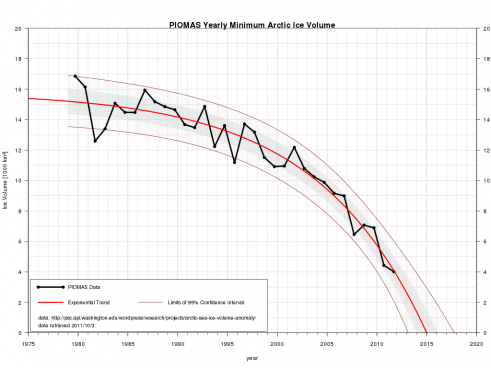 |
| PIOMAS yearly minimum Arctic ice volume (click to enlarge) |
- The first point to note is that the Arctic has already proved to be more sensitive to global warming that expected. It is now acknowledged that the Arctic has passed the tipping point for sea-ice-free summers. The lack of summer sea-ice will increase Arctic warming (already double the global average) as heat-reflecting ice is replaced by dark, heat-absorbing open seas. There may well be a summer sea-ice-free Arctic by around 2015 (see chart).
- Those circumstances will increase the rate of melting of the Greenland ice sheet, which is already accelerating. And now the tipping point for Greenland's ice sheet (eventual sea level rise of 7 metres) has been revised down from around 3 ºC to just 1.6 ºC (uncertainty range of 0.8-3.2 ºC). At the current temperature rise of 0.8 ºC we may have already reached Greenland's tipping point, and with temperature rises in the pipeline (global emissions still rising, no reasonable agreement to reduce them), we are very likely to hit 1.6 ºC in two to three decades.
- Global average temperatures have warmed just less than 1 ºC since the Industrial Revolution, but average temperatures in Siberia, Alaska and western Canada are now 3-4 ºC warmer than 50 years ago. In parts of northern Canada, Greenland and the surrounding ocean during the 2010-2011 northern winter, temperatures were more than 6 ºC warmer than the baseline temperature average for the period of 1951-1980, and 7 to 9 ºC above average over the Chukchi Sea. So by mid-century the regional increase increase could easily be 4-6 ºC.
- Predictions in 2011 suggested that as soon as 2020 carbon emissions from melting permafrost could be close to a billion tonnes a year. Researchers said that this positive permafrost carbon feedback will “will change the Arctic from a carbon sink to a source after the mid-2020s and is strong enough to cancel 42–88% of the total global land sink.”
- Work by Celia Bitz, Philippe Ciais and others suggests that the tipping point for the large-scale loss of permafrost carbon is around 8–10 ºC regional temperature increase. As temperatures rise, it is projected that Arctic amplification (the multiple by with the Arctic warms compared to the global average) would be approximately times three, so around a 3 ºC increase in global temperature is probably more than enough to detonate the permafrost timebomb. This feedback in the carbon cycle would drive temperatures significantly higher. Caias told the March 2009 Copenhagen science conference that: “A global average increase in air temperatures of 2 ºC and a few unusually hot years could see permafrost soil temperatures reach the 8 ºC threshold for releasing billions of tonnes of carbon dioxide and methane.”
RELATED POSTS
- Implications of the Arctic permafrost thaw
- Hot pink climate no laughing matter
- Bubbling our way to the apocalypse
The take-home message is that current levels of atmospheric carbon dioxide are probably sufficient to trigger large-scale permafrost carbon feedbacks and global warming that human effort would be unable to contain.
And now comes a new study which shows a sudden and extreme global warming events 55 million years ago known as the Palaeocene–Eocene Thermal Maximum (PETM) is characterized by a massive input of Antarctic permafrost carbon, ocean acidification and an increase in global temperature of about 2 degrees Celsius within a few thousand years. The study's author, Rob DeConto, says the implications of the study appear dire for the long-term future as polar permafrost carbon deposits have begun to thaw due to burning fossil-fuels:
The lead author, climate scientist Rob DeConto, explains in a news release:
In short, whatever we do, we don’t want to duplicate the conditions of the PETM. But, tragically, we are. Indeed, a 2011 study that found humans are releasing carbon to the atmosphere 10 times faster now than during the PETM. “Rather than the 20,000 years of the PETM which is long enough for ecological systems to adapt, carbon is now being released into the atmosphere at a rate 10 times faster,” one of the authors of that study explained. “It is possible that this is faster than ecosystems can adapt.”
 |
| In the Pliocene 3 million years ago conditions were 11–16 degrees Celsius warmer, at atmospheric carbon dioxide levels similar to today. |
Similar dynamics are at play today. Global warming is degrading permafrost in the north polar regions, thawing frozen organic matter, which will decay to release CO2 and methane into the atmosphere. This will only exacerbate future warming in a positive feedback loop.Here's more on the new study from Joe Romm's Climate Progress:
Nature Bombshell: ‘Past Extreme Warming Events Linked To Massive Carbon Release From Thawing Permafrost’
So begins an article in the journal Nature that offers an unsettling explanation for one of the great climate mysteries: What caused the PETM? The article’s title gives away the answer: “Past extreme warming events linked to massive carbon release from thawing permafrost” (subs. req’d).The lead author, climate scientist Rob DeConto, explains in a news release:
The standard hypothesis has been that the source of carbon was in the ocean, in the form of frozen methane gas in ocean-floor sediments,” DeConto says. “We are instead ascribing the carbon source to the continents, in polar latitudes where permafrost can store massive amounts of carbon that can be released as CO2 when the permafrost thaws."Indeed, the recent scientific literature suggests that the permafrost is poised to be a major amplifying feedback if we are self-destructive enough to ignore yet another dire warning and stay anywhere near our current path of unrestricted carbon pollution:
The new view is supported by calculations estimating interactions of variables such as greenhouse gas levels, changes in the Earth’s tilt and orbit, ancient distributions of vegetation, and carbon stored in rocks and in frozen soil.
While the amounts of carbon involved in the ancient soil-thaw scenarios was likely much greater than today, implications of the study appear dire for the long-term future as polar permafrost carbon deposits have begun to thaw due to burning fossil-fuels, DeConto adds. “Similar dynamics are at play today. Global warming is degrading permafrost in the north polar regions, thawing frozen organic matter, which will decay to release CO2 and methane into the atmosphere. This will only exacerbate future warming in a positive feedback loop.”
- Nature: Climate Experts Warn Thawing Permafrost Could Cause 2.5 Times the Warming of Deforestation!
- NSIDC: Thawing permafrost feedback will turn Arctic from carbon sink to source in the 2020s, releasing 100 billion tons of carbon by 2100
In short, whatever we do, we don’t want to duplicate the conditions of the PETM. But, tragically, we are. Indeed, a 2011 study that found humans are releasing carbon to the atmosphere 10 times faster now than during the PETM. “Rather than the 20,000 years of the PETM which is long enough for ecological systems to adapt, carbon is now being released into the atmosphere at a rate 10 times faster,” one of the authors of that study explained. “It is possible that this is faster than ecosystems can adapt.”
Here’s more on this important new study:
[DeConto] and colleagues at Yale, the University of Colorado, Penn State, the University of Urbino, Italy, and the University of Sheffield, U.K., designed an accurate model―elusive up to now―to satisfactorily account for the source, magnitude and timing of carbon release at the PETM and subsequent very warm periods, which now appear to have been triggered by changes in the Earth’s orbit.
Earth’s atmospheric temperature is a result of energy input from the sun minus what escapes back to space. Carbon dioxide in the atmosphere absorbs and traps heat that would otherwise return to space. The PETM was accompanied by a massive carbon input to the atmosphere, with ocean acidification, and was characterized by a global temperature rise of about 5 degrees C in a few thousand years, the researchers point out.
Until now, it has been difficult to account for the massive amounts of carbon required to cause such dramatic global warming events.
To build the new model, DeConto’s team used a new, high-precision geologic record from rocks in central Italy to show that the PETM and other hyperthermals occurred during periods when Earth’s orbit around the sun was both highly eccentric (non-circular) and oblique (tilted). Orbit affects the amount, location and seasonality of solar radiation received on Earth, which in turn affects the seasons, particularly in polar latitudes, where permafrost and stored carbon can accumulate.
They then simulated climate-ecosystem-soil interactions, accounting for gradually rising greenhouse gases and polar temperatures plus the combined effects of changes in Earth orbit. Their results show that the magnitude and timing of the PETM and subsequent hyperthermals can be explained by the orbitally triggered decomposition of soil organic carbon in the circum-Arctic and Antarctica.
This massive carbon reservoir at the poles “had the potential to repeatedly release thousands of petagrams of carbon to the atmosphere-ocean system once a long-term warming threshold was reached just prior to the PETM,” DeConto and colleagues say. Until now, Antarctica, which today is covered by kilometers of ice, has not been appreciated as an important player in such global carbon dynamics.
In the past, “Antarctica and high elevations of the circum-Arctic were suitable locations for massive carbon storage,” they add.
“During long-term warming, these environments eventually reached a climatic threshold,” with permafrost thaw and the sudden release of stored soil carbon triggered during the Earth’s highly eccentric orbits coupled with high tilt…
Overall, they conclude, “an orbital-permafrost soil carbon mechanism provides a unifying model accounting for the salient features of the hyperthermals that other previously proposed mechanisms fail to explain.” Further, if the analysis is correct and past extreme warm events can be attributed to permafrost loss, it implies that thawing of permafrost in similar environments observed today “will provide a substantial positive feedback to future warming.”The time to slash emissions was a long time ago but now is still much, much better than later, which may, as this study suggests, simply become too late.
Subscribe to:
Posts (Atom)

 Posts
Posts