Blog Archive

Showing posts with label Neela Banerjee. Show all posts

Wednesday, April 13, 2016

#ExxonKnew -- CO2's Role in Global Warming Has Been on the Oil Industry's Radar Since the 1960s

Historical records reveal early industry concern with air pollutants, including smog and CO2, and unwanted regulation
Documents reveal that the risks of climate change were being discussed in the inner circles of the oil industry in the 1960s, earlier than previously documented. Credit: Photo of Exxon's Bayway oil refinery in New Jersey by the Environmental Protection Agency
The oil industry's leading pollution-control consultants advised the American Petroleum Institute in 1968 that carbon dioxide from burning fossil fuels deserved as much concern as the smog and soot that had commanded attention for decades.
Carbon dioxide was "the only air pollutant which has been proven to be of global importance to man's environment on the basis of a long period of scientific investigation," two scientists from the Stanford Research Institute (SRI) told the API.
This paperalong with scores of other publications, shows that the risks of climate change were being discussed in the inner circles of the oil industry earlier than previously documented. The records, unearthed from archives by a Washington, DC, environmental law organization, the Center for International Environmental Law (CIEL), reveal that the carbon dioxide question—an obscure corner of research for much of the 20th century—had been closely studied since the 1950s by some oil company researchers.
By the 1960s, the CO2 problem was gaining wider scientific recognition, especially as President Lyndon B. Johnson's science advisers and leading experts brought it to the attention of the White House in 1965.
"If CO2 levels continue to rise at present rates, it is likely that noticeable increases in temperature could occur," SRI scientists Elmer Robinson and R.C. Robbins wrote in their 1968 paper to API.
"Changes in temperature on the world-wide scale could cause major changes in the earth's atmosphere over the next several hundred years including change in the polar ice caps."
Ten years later, the world's leading oil company, Exxon, would launch an ambitious in-house research program into the emerging science of climate change, as detailed by InsideClimate News last year in an investigative series. Beginning in 1978, Exxon researchers hoped their work would identify the risks climate change posed to the company's business and earn it a seat at the table when policymakers moved to limit CO2 emissions, according to internal documents. By the late 1980s, the company and its allies would instead challenge the scientific basis for strong action on climate change.
In a new series of articles, ICN begins to examine how the industry confronted pollution concerns during the infancy of climate research in the mid-20th century. It is based on hundreds of public documents assembled by CIEL, along with others gathered by ICN.
The documents trace early academic research into rising carbon dioxide levels. They show how the oil industry monitored that published work, and help explain the beginnings of its own research. They also show how industry's reaction to mid-century regulation to curtail other forms of air pollution, such as smog, helped shape its approach toward the risks of carbon dioxide.
The documents reveal a deep and persistent interest by industry in the CO2 issue, according to Carroll Muffett, a lawyer who is president of CIEL. If it is shown that oil companies knew fossil fuels posed dangers to the public, he said, the industry might become vulnerable to product liability complaints.
"From a products liability perspective, these documents raise potential claims that oil companies failed to warn consumers about a potentially serious risk linked to their products," he said.
Muffett's institute, an advocacy group that provides policy research and legal counsel on energy and environmental matters, is releasing its findings just as several state attorneys general have begun investigating how much oil companies knew about climate change and what they decided to do with their knowledge.
"Once the companies learned this science, they can't unlearn it," Muffett said. "Everything they did after this is done against the backdrop of the information they have from at least the 1950s onward.
"This to me is a critical point," he said. "When Exxon and other companies are funding climate change denial in later stages and focusing on uncertainties, how does what they are saying now compare with what they knew at a much earlier stage?"
Exxon has responded that its scientists at the time found that "many important questions about climate change remained unanswered and more research was needed." A spokesman for API did not respond to requests for comment.
Pollution Concerns Begin Rising
By the late 1940s, industrial pollution from the wartime surge and post-war boom began alarming the public. In particular, smog increasingly plagued Los Angeles, garnering the attention of the press and new pollution-control agencies. The sky turned a pale yellow, residents routinely became nauseous and their eyes burned, children were forced to play indoors, and acres of crops withered.
Members of the Highland Park Optimist Club in Northeast L.A. are seen here wearing smog-gas masks
Members of the Highland Park Optimist Club in northeast Los Angeles wear smog-gas masks at a banquet, circa 1954. Credit: Los Angeles Times photographic archive, UCLA Library
By the early 1950s, new science pointed to the oil industry as a major culprit, showing that nitrogen oxide emissions and uncombusted hydrocarbons from car tailpipes and refineries formed smog when exposed to sunlight.
As new agencies spawned new regulations, API and similar organizations set up a task force called the Smoke and Fumes Committee to monitor air pollution research and to commission projects by a handful of key consultants, including SRI. Originally affiliated with Stanford University, it was the industry's main pollution consultant, and eventually became an independent firm in 1970.
The work of the Smoke and Fumes Committee armed the industry for a prolonged struggle against what it considered overzealous regulation, which was based on what the oil companies and SRI called flawed science.
Meanwhile, a growing number of academics had turned their attention to rising CO2 concentrations in the atmosphere, tracing where the gas came from and the role that certain "sinks," such as the oceans and forests, played in absorbing it.
Roger Revelle, the director of the Scripps Institution of Oceanography, and his colleague Hans E. Suess published a landmark paper in 1957 about increasing CO2emissions and the role of the oceans in absorbing some of it. The media, including The New York Times and Time magazine, sporadically wrote stories about increasing COin the atmosphere.
Scripps scientist Charles David Keeling installed machines at the Mauna Loa Observatory in Hawaii to measure carbon dioxide levels on a regular basis.
The years between 1957, when Revelle first concluded that the oceans would not absorb all industrial CO2 emissions, and 1960, when Keeling accurately measured atmospheric concentrations and showed that they were definitely increasing, ushered in a new age of expanding climate research.
Already, some oil company scientists were conducting basic CO2 research, including several with Humble Oil, which eventually became part of Exxon.
By then, it was generally accepted that the burning of fossil fuels had released significant quantities of additional CO2into the atmosphere, with some studies putting manmade emissions at 13% above natural levels since the Industrial Revolution began.
Humble's researchers studied the fingerprints of fossil fuel emissions in the wood of growing trees. Only a small fraction of the CO2 from fossil fuels showed up. Deciphering what was happening to the rest—mostly absorption into the oceans—was a major focus of research into the carbon cycle then.
As Humble's scientists explored issues like whether the varying climate in wet and dry conditions might influence the rate of carbon uptake by trees, their work intertwined with the rapidly evolving field of climate studies.
paper by independent scientists in 1958 determined that Revelle and Suess had probably underestimated how much CO2 would build up by the year 2000. The rise could be enough, they noted in passing, to have considerable implications for planetary warming.
A Presidential Spotlight
The report by Robinson and Robbins to API in 1968 was an unusually plainspoken assessment of the risks of CO2emissions within the walls of industry. It is significant not as original research, but as confirmation that the industry recognized a consensus reaching the highest levels of government.
"It seems ironic," the report said, "that given this picture of the likely result of massive CO2 emissions, so little concern is given to CO2 as an important air pollutant."
The SRI report emerged after the carbon dioxide problem had caught the attention of the White House.
President Lyndon B. Johnson
President Lyndon B. Johnson/Credit: Yoichi Okamoto
Acting on a warning from his science advisers, Johnson became the first president to publicly mention rising CO2 levels as a problem on par with smog or bomb test fallout. In a message to Congress in February 1965, he declared: "Air pollution is no longer confined to isolated places. This generation has altered the composition of the atmosphere on a global scale through radioactive materials and a steady increase in carbon dioxide through the burning of fossil fuels."
SRI's report was mostly based on a paper, "Atmospheric Carbon Dioxide," that was part of a volume prepared by the President's Science Advisory Committee (PSAC) in November 1965.
That 20-page paper, written by Revelle, Keeling and three other top climate scientists, was submitted to the president at a time when environmental concerns were just blossoming into a policy priority. It said that the latest science suggested the increase in CO2 "may be sufficient to produce measurable and perhaps marked changes in climate." Citing a growing body of published research, it discussed the implications for melting polar ice and rising sea levels in the centuries to come.
That SRI was inserting carbon dioxide into a report mainly about conventional pollutants like smog suggests industry had to deal with this new aspect of pollution now that even the president was pointing it out.
"At the point where these issues are matters of public debate, industry has to be looking at them," Muffett said.
In the SRI report's section on CO2, Robinson and Robbins identified it as "the most commonly emitted air pollutant." Still, they noted that CO2 was so ubiquitous that regulators didn't even consider it to be pollution.
"This is perhaps fortunate for our present mode of living, centered as it is around carbon combustion," they wrote. "However, this seeming necessity, the CO2 emission, is the only air pollutant which has been proven to be of global importance to man's environment on the basis of a long period of scientific investigation."
The report also dealt with other uncertainties, such as a possible cooling effect caused by an increase in particulate matter. It noted that the long-term trend of particulate pollution could neutralize warming caused by CO2, but on balance said "the prospect for the future must be of serious concern."
"Although there are other possible sources for the additional CO2 now being observed in the atmosphere, none seems to fit the presently observed situation as well as the fossil fuel emanation theory," the authors wrote.
The SRI paper explored in detail the possible rates of emission, how concentrations might increase and how much temperatures might rise.
The finding—which matched Revelle's—that about half the CO2 emitted seemed to stay in the atmosphere was confirmed later by more sophisticated research. It helped explain why emissions over decades of increased reliance on fossil fuels would lead to a doubling of atmospheric CO2concentrations from pre-industrial times.
SRI also said that unlike local pollutants such as smog, carbon dioxide would last a long time in the global atmosphere. "The natural scavenging processes for removing CO2 from the atmosphere are not sufficient to maintain a stable equilibrium in the atmosphere in the presence of this increase in emissions."
The paper said that better models were needed to estimate more accurately how the increased atmospheric CO2 might boost global temperatures. (The Revelle report had predicted in 1965 that better models might come along in just a few years.)
SRI also repeated Revelle's assertions that if the earth's temperatures rose substantially, it could lead to significant risks for the planet.
"It is clear that we are unsure as to what our long-lived pollutants are doing to our environment; however, there seems to be no doubt that the potential damage to our environment could be severe," SRI said.
The assessment's frank tone contrasted with the more measured rhetoric Robinson and industry representatives would use in later public reports.
In a paper presented at the World Petroleum Congress in Moscow in June 1971, Robinson wrote that increasing carbon dioxide levels might pose a serious problem. He also said estimating the impact rising CO2 could have on global temperatures would be difficult because of the complexity of atmospheric science.
"The simple conclusion that an increase in absorbed radiation would provide a significantly warmer atmosphere and perhaps would melt the ice caps does not seem to be justified," Robinson wrote.
The National Petroleum Council, an advisory body including top officials of many oil companies, submitted a report to the government in 1972 entitled "Environmental Conservation." The NPC report cited the work of Robinson and Robbins but hewed to a more cautious line, quoting from a review of the emerging research written by the American Association for the Advancement of Sciences.
"If at the end of this century, the average temperature has continued to rise and, in addition, measurement shows that the amount of atmospheric carbon dioxide has also increased, this will add validity to the idea that carbon dioxide is a determining factor in causing climate change," the NPC report said.
It continued to say that it would take until at least 2000 to decide whether global temperatures were rising significantly.
"If indications at that time are that major changes are required," it said, "society can meet that requirement as it has met its challenges throughout history by developing alternative social or technological solutions."
But this seemed to evade what was becoming increasingly clear to atmospheric scientists: If the problem of global warming emerged as their calculations suggested, it meant shifting away from fossil fuels.
In one footnote, the petroleum council cited not only the work of Robinson, but also a paper by an official at the federal Bureau of Land Management, Eugene K. Peterson, who had written a comprehensive overview of climate science and its ecological implications for the journal Environmental Science and Technology in 1969.
Peterson cited projections of increases in the atmospheric concentration of CO2, and early estimates of the resulting temperature rise. He also speculated on side effects such as acute water shortages, increased forest fires, and impacts on fisheries.
And he concluded that if current estimates proved to be correct, the time would eventually arrive —"if it has not already been reached"—that "additional CO2 input through the burning of fossil fuels should cease."
The increasing blanket of CO2 in the atmosphere, he warned, "could prove to have such an effect upon the environment that it will be a major limiting factor for several centuries upon both industrial development and world population."
It would be several more years before a National Academy of Sciences review panel chaired by Revelle would sound a similar warning in 1977—catching the attention of an Exxon employee, Henry Shaw, who helped lead the company's broad climate research in the decade that followed.
But the industry as a whole was already on notice.
Part II.  In the 1940s and 1950s, the oil industry questioned research that pointed to fossil fuel emissions as the main ingredients of smog, a record that reads like an early draft of its later approach to climate change.   

Friday, October 30, 2015

Exxon's conflicting concerns about climate change: A tale of 2 investigations

by Malavika Vyawahare, E&E reporter, ClimateWire, October 28, 2015

Many environmentalists believe that the oil and gas major Exxon, now known as Exxon Mobil Corp., is on the wrong side of history when it comes to climate change. Two new investigations into the company's early history of climate research have deepened the antagonism toward the company.
In recent weeks, these probes into the corporation's early climate research have painted a picture of a behemoth that not only led path-breaking research on climate, but in the process became aware of the financial risks to its own business from climate change decades ago. Then, it decided to take measures to protect its business interests while publicly claiming that uncertainty about climate change was too great to warrant immediate action.
"Almost uniquely, Exxon could have short-circuited 25 years of faux debate. Had they merely acknowledged that the scientists spreading the alarm were right, the world could have gotten to work," said Bill McKibben, one of the more vocal critics of Exxon's behavior. The investigations even generated a Twitter hashtag: #Exxonknew.
Gas prices
Exxon Mobil Corp.'s fortunes flourished in April 2014, when this picture was taken in Brownsville, Texas. Since then, gasoline prices and Exxon's reputation have taken some hits. Photo by Brad Doherty, courtesy of AP Images.
In recent years, media attention focused on the company's vociferous doubts about the emerging climate science, but the earlier chapter of its research history has remained buried till now. It came to light because of the efforts of two groups of highly qualified and competitive groups of journalists who had the patience to piece together the oil giant's outside messaging and its trail of conflicting internal research.
On Thursday, InsideClimate News (ICN), an independent, nonprofit, news organization, published the last dispatch in its six-part series "Exxon: The Road Not Taken." The next day, the Los Angeles Times, in collaboration with the Columbia University Graduate School of Journalism, published the second installment in their series about Exxon that is anchored around the same premise. The first piece of the Times-Columbia series was posted October 9, 2015. It explored Exxon's climate research in the Arctic and detailed how it kept both the public and its own shareholders in the dark about the perceived business threat from climate change.
The Columbia project was a yearlong excavation of hundreds of documents housed in university archives and other institutions of public record, review of research papers, and interviews with experts and former employees at Exxon. The reporting, mostly carried out by recent graduates of the journalism school, is led by Susanne Rust, an investigative journalist who was a Pulitzer Prize finalist in 2009 for her reporting on the presence of bisphenol A, an industrial chemical also known as BPA, in everyday household items.
Among the professors overseeing the project is the dean of Columbia Journalism School, Steve Coll, a two-time Pulitzer winner who is also the author of "Private Empire: Exxon Mobil and American Power."
As early as 2012, Coll suggested that there was a backstory to Exxon's public position on climate change. In an interview with PBS's "Frontline," he observed: "In time, perhaps we will understand what the internal reaction among scientists within Exxon Mobil was to this campaigning, because there's some evidence that within Exxon Mobil, there was study going on about how global warming could affect oil discovery, for example."
He later suggested in the same interview that the company could become the target of litigation by victims of climate change, which would uncover internal records about what its own scientists were telling the company about climate change.

Columbia's probe begins in the fall of 2014

No major litigation of that nature was brought against Exxon. However, inspired by Coll's findings, Columbia Journalism School launched a reporting project in the fall of 2014 to investigate exactly this aspect of Exxon's research. "Much of the inspiration was from his previous reporting," Rust said, explaining why the school started to look into Exxon. "But of course, a year into it, the story ideas, lines of investigation, have evolved as information has come in."
InsideClimate News is a small, Brooklyn-based outfit of about a dozen journalists that won the Pulitzer Prize for national reporting in 2013. It is funded in part by the Rockefeller Brothers Fund, Ford Foundation and the Marisla Foundation, and ICN launched its own project earlier this year. Its team stumbled upon the story, according to Neela Banerjee, one of the key reporters on the project. As she described it, it was "almost by accident." Banerjee is a veteran environment reporter who has spent many years at The Wall Street JournalThe New York Times and most recently at the Los Angeles Times, where she covered environment and energy before joining ICN in December 2014.
"At the beginning of the year, we were looking into early climate research by academics and the government," she said. "In the process, speaking to some scientists, someone mentioned, I can't remember who, I wasn't involved in the project then, that Exxon had scientists who had submitted peer-reviewed papers in the early 1980s."
The big break for her came in the form of a 1979 congressional hearing transcript. "I got, unrelated to the project, a transcript of a 1979 congressional hearing on climate change," Banerjee said, "As a lark, I was just sitting there, procrastinating or something, and I decided to search the PDF to see if someone from Exxon was there, too," she said. As luck would have it, she hit a name: Henry Shaw.
Shaw, it turned out, was heading an in-house effort at Exxon to measure carbon dioxide concentrations in seawater and the atmosphere. According to part of his biography that is available on the ICN website, he was collaborating with Columbia University's Lamont-Doherty Geological Observatory on this project that involved equipping one of Exxon's oil tankers with instruments for sampling carbon dioxide.
Banerjee made this discovery in February of this year, and, according to her, for the next seven months, the ICN team set out to unearth everything it could about Exxon's early climate research program. During the process of hopscotching from one source to the other, Banerjee said, the team became aware that a team at Columbia was working on a similar project. "We weren't surprised, we knew that they were working on it," Banerjee said of her reaction to the story in the Times.

Crisscrossing each other's paths

"When we called our sources, some of them would ask, 'Are you from Columbia J-School?' so we knew," said John H. Cushman, Jr., the principal editor for the Exxon project at ICN. In a recent interview, he described it as hearing the "footsteps" of another journalist, which sometimes happens in the world of investigative journalism. "Later, we heard that they [Columbia] had partnered with the LA Times and that they were going to publish in spring of 2016," Banerjee said. ICN wasted no time in getting its reporting together, according to Cushman. The knowledge that another team was in hot pursuit of the same story lent its project a sense of urgency.
The Times published the first part of its series earlier than expected, less than three weeks after ICN came out with its first story. "The time was ripe for this kind of reporting. It's not at all surprising other journalists were looking into this. Climate change is arguably the most important environmental issue -- if not straight-up issue -- of our time," Rust said of the Times and Columbia's work, adding that after a year of reporting they believed they had enough to run the story.
Despite being centered on the same company, the reporting from the two series follows different document trails that intersect at some points. In the work that has been published till now, they zoom in on different eras of the company's research. The ICN series tracks an arc that starts in the late 1970s and '80s and traces it into the early 2000s, when the company had established a reputation as a climate change opponent, at least in its public posturing.
The first part of the Times-Columbia series takes off from the 1990s, when it would seem the gulf between what Exxon was practicing in its business and what it was saying with regard to climate change was already very wide. The second part scrutinizes how the company pivoted from being a leader in climate change research to a leader among the skeptics.
The stories seemed to have hit their mark, and not just with environmentalists. The revelations sparked calls for investigations into Exxon Mobil for potential fraud for concealing what it knew about climate change. Presidential hopeful Sen. Bernie Sanders (I-Vt.) shot off a letter to Attorney General Loretta Lynch asking for a task force to determine if the executives could be prosecuted. Two House Democrats also wrote to the attorney general asking for a probe into the company's actions under the Racketeer Influenced and Corrupt Organizations Act.
Ken Cohen, vice president of public and government affairs at Exxon, characterized the fallout as political theater and has maintained that Exxon did not suppress its early research and that it has continued to invest in climate change research. He accused both ICN and the Times of cherry-picking documentary evidence to fit a narrative. "We take great exception to what is contained in the ICN piece and the LA Times, they are taking great liberties with the facts, the allegations are inaccurate, and it appears to me that they are deliberately misleading," Cohen said in a recent interview.
Banerjee dismissed the argument that ICN's reporting was selective. "If we had cherry-picked, we would have just included the quotes," she said. The Times did a story on Exxon and the Arctic but did not digitize the documents, she added, but "we did." The trove of almost 30 digitized documents, available on ICN's website, however, does not include the 1979 transcript that led it to investigate Exxon.
"We are happy that the LA Times investigation reached the same conclusion," Cushman at ICN said, emphasizing that both ICN's and the Times' series complement each other. He went on to compare the way the two teams made inquiries into Exxon to how one of the biggest scientific breakthroughs in human history was made. "Charles Darwin and Alfred Russel Wallace both discovered evolution," he said.
Twitter: @MalavikaVy Email: malavikav@eenews.net

http://www.eenews.net/stories/1060027024

Tuesday, January 20, 2015

What do Americans think about global warming? Tony Leiserowitz can tell you. It’s not what you might expect

by Neela Banerjee,  Yale Alumni Magazine, January?February 2015
Neela Banerjee ’86 covers energy and environmental issues for the Los Angeles Times.

Mark Ostow

Mark Ostow

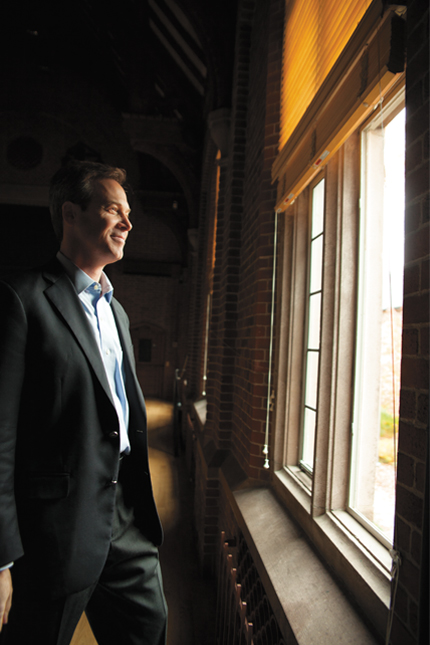
Yale professor Anthony Leiserowitz studies "human perception and human choices" about global warming. View full image

Michael Sloan

Michael Sloan

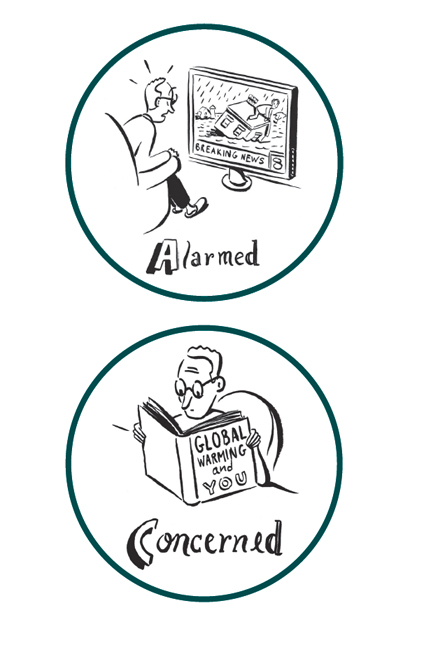
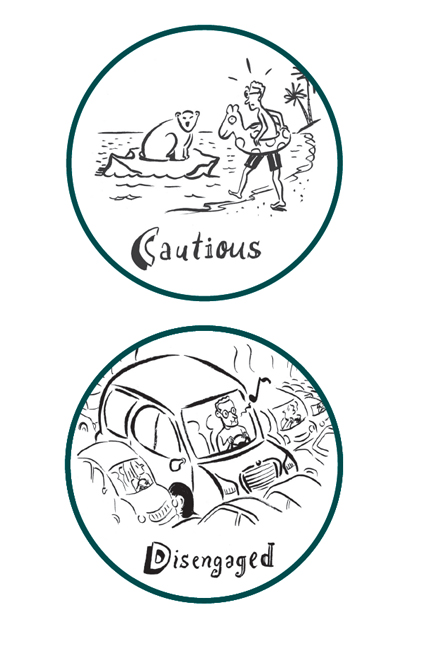
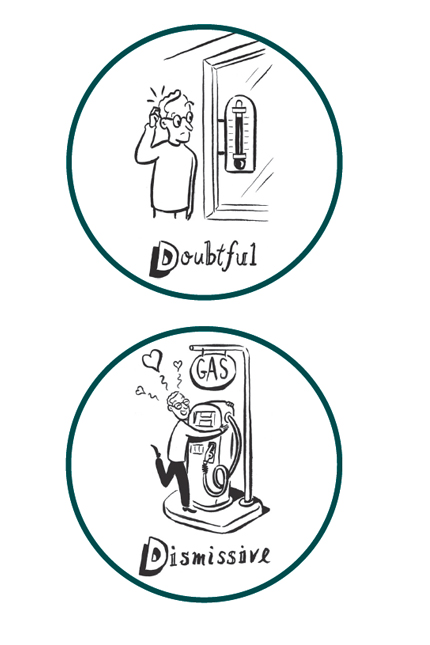
"Alarmed," "Concerned," and the drawings that follow, are the Yale Alumni Magazine's cartoons of the six groups Leiserowitz identified along the spectrum of US attitudes to climate change. View full image

What’s so funny about climate change?
Not a whole lot—judging by the comedians and writers who gathered one autumn afternoon in New York City to figure out, as one speaker put it, whether comedy has “the chutzpah to say what other media won’t” about global warming. Fake news shows and sitcoms boldly go to places that much of mainstream media avoids, sending up America’s views of politics, sex, and money. The panel, organized by the Writers Guild of America–East, aimed to help comics do the same for the upcoming UN Climate Summit. But climate change is so controversial, admitted the comedy writers on the panel, that they are as skittish about the issue as politicians running for re-election.
Sitcoms today avoid discussing real problems, said Norman Lear, creator of All in the Family. The New Yorker would rather have “insult jokes” between husbands and wives than cartoons about climate change, said cartoonist Sidney Harris. “People like to laugh at what they agree with, and they don’t like to laugh at what they don’t agree with,” said Rory Albanese, a former writer and executive producer of the Daily Show. Maybe the way to reach people on climate change, he mused, is to draw them to fake websites. “The trick has to be it can’t be associated with the left,” he said. “The website has to be, like, ‘MachineGuns.com.’”
Sitting next to Albanese and politely listening to the unanimous lament was Anthony Leiserowitz (pronounced lizer-witz), director of the Yale Project on Climate Change Communication and the only member of the panel who wasn’t part of the entertainment industry. It fell to him, in a room full of funny people, to lighten things up and breathe a little optimism into the discussion.
“The perception among many in the media, in politics, and so on—that you can’t talk about this because half the country is against you?—it’s false, it’s wrong,” Leiserowitz said, his voice rising slightly. “It’s only 15 percent. They’re a really loud 15 percent, and they have convinced much of the country it’s not safe to talk about it, but it’s just not true.”
Leiserowitz’s certainty comes from a decade’s worth of research that reveals a far more nuanced picture of American attitudes toward climate change than previously thought—or even widely held now, for that matter.
The Yale Project on Climate Change Communication digs deeply into public attitudes toward climate change, mapping the public mind and exploring why Americans think the way they do. One of the project’s most far-reaching findings: the American public is not divided evenly between those who accept climate change and those who don’t. Rather, there is a range of views that can be captured in six categories—what the Yale Project and its partner, the George Mason University Center for Climate Change Communication, call “Global Warming’s Six Americas.” According to their research, about 66 percent of Americans think global warming is happening. Only 16 percent of Americans say it is not happening, according to an October 2014 national survey.
Their findings also suggest that most Americans’ views on climate change are fluid and can be informed by certain kinds of evidence, narratives, and messengers. This idea is not without controversy: other social scientists contend that people are too locked into their tribal values to rethink their views on climate change.
Still, Leiserowitz says the project aims to shed light on “the psychological, cultural, and political factors that shape people’s understanding and handling of responses” to climate change. Already, its findings are informing the way scientists, corporations, environmentalists, and others talk about climate change and even how some policy makers frame it.
“There is no such thing as a general audience,” says Mike Casey, president of Tigercomm, a Virginia-based clean-tech marketing firm with clients such as billionaire environmental activist Tom Steyer ’79 and alternative energy companies. “The project does an important service in telling people like me what I need to know to do my work. If you go to Ohio or Florida or Virginia, and you’re going to talk about climate change, the Six Americas tells you who you are going to be talking to and who is interested in what.”
Mark Zurolo ’01MFA. Source: <em>American's Knowledge of Climate Change</em> (2010), by A. Leiserowitz, N. Smith, and J. R. Marlon.

Mark Zurolo ’01MFA. Source: American's Knowledge of Climate Change (2010), by A. Leiserowitz, N. Smith, and J. R. Marlon.

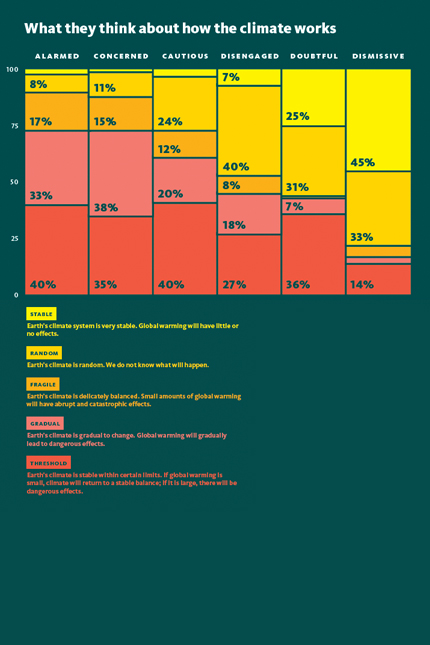
In their 2010 survey, Leiserowitz and his colleague Ed Maibach probed Americans' views of how susceptible the Earth's climate is to change. Survey respondents reviewed the five descriptions shown above, which offer different models of the climate, and were asked which one best represented their own conception. 

The graph above sorts the respondents' answers according to their places in the "Six Americas," the six main categories of opinion about climate change that Leiserowitz and Maibach have identified—from the "Alarmed" to the "Dismissive." Not surprisingly, those who are "Dismissive" and "Doubtful" as to whether the climate is changing are also the most likely to think that the climate is highly stable. View full image

In the last five years, scientific research has delivered more fine-grained and confident forecasts about global warming’s impact. Once considered a phenomenon that would be felt in the distant future, climate change is playing out today—intensifying extreme weather and affecting every state in the country, according to the 2014 National Climate Assessment, a sweeping report mandated by Congress and published every four years. Downpours are heavier, heat waves longer and more intense, coastal flooding more routine, and the oceans more acidic and less hospitable to many species as they absorb greater amounts of carbon dioxide.
Yet the world’s biggest polluters—China, the United States, and India—have been slow to address the problem, and last year, more heat-trapping greenhouse gases were in the atmosphere than at any other time in human history. In the United States, the dawdling has stemmed in part from the absence of a public outcry over global warming. It hasn’t helped that fossil fuel industries have funded think tanks and a handful of outspoken scientists who have successfully sown doubt among the public about the science, similar to the campaign waged decades earlier against tobacco warnings.
In terms of public opinion and action, says Leiserowitz, global warming is “a public policy problem from hell. You almost couldn’t find a problem that is a worse fit for our underlying psychology, politics, and culture.” Climate change is caused by invisible pollutants, making it harder for people to understand than oil slicks or smog. Its effects can be diffuse: scientists can show that a particular chemical plant polluted the groundwater in a given area, but they cannot say that a killer storm was caused solely by climate change—just that a hotter atmosphere worsens, and worsens the odds of, extreme weather. Finally, cutting greenhouse gases enough to avert the worst effects of climate change in the future requires collective action, such as a domestic carbon tax and international cooperation. But many in the United States bridle at the notion of new taxes and multilateral agreements.
Michael Sloan

Michael Sloan

View full image

Leiserowitz has made it his work to explore, in depth, Americans’ views of the “public policy problem from hell.” “His work was groundbreaking,” says Ed Maibach, director of the George Mason Center for Climate Change Communication. Eight years ago, when Maibach first read Leiserowitz’s research, Leiserowitz “had already been thinking a long time about why Americans weren’t concerned about this enormous, if not existential, threat.”
Leiserowitz grew up on a 79-acre farm in south-central Michigan. His parents are well-known Midwestern sculptors, and his father taught at Michigan State University in East Lansing, where Leiserowitz got his undergraduate degree. After college, Leiserowitz followed a friend to Aspen, Colorado. He planned to be a ski bum, earn money, and travel the world; instead, he took a job at the Aspen Global Change Institute in the early 1990s, organizing major international conferences attended by top climatologists. As he learned more of the science of climate change from the researchers he met, he felt a growing frustration that the root cause—human activity—was not being adequately addressed.
The epiphany came one evening when he hiked up to a pass in the Colorado mountains. “I was looking west, and there was this blanket of tiny white tundra flowers,” he remembers, speaking in his office up in the eaves of a Yale environment school building. “The tundra had retreated as the world emerged from the last ice age, from the valley below to just the tops of our mountains. But I started to think about what else could be made to retreat now, like island countries that could disappear into the ocean as sea levels rise. And as the world warms, the tundra zone I was looking at could get pushed off the mountaintops.” The moment made him feel the urgency of the climate change problem. “The reason we have this problem,” he says, “is because of human perception and human choices. What is it that causes us to perceive and act toward the natural world as we do? Because the solutions to climate change rest with us.”
Chart: Mark Zurolo ’01MFA. Source: A. Leiserowitz, 2014.

Chart: Mark Zurolo ’01MFA. Source: A. Leiserowitz, 2014.

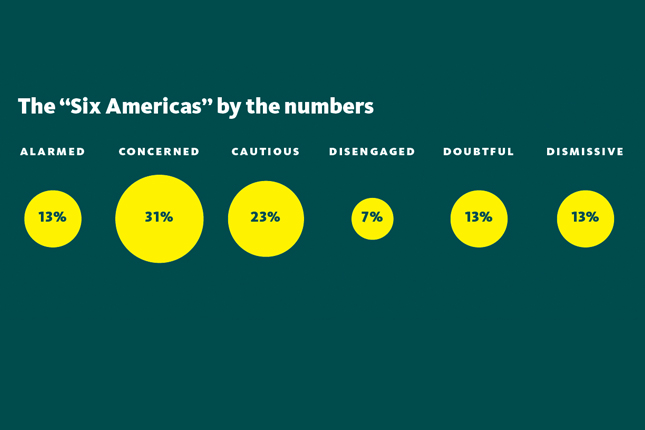
Leiserowitz's most recent study found that those who are "Alarmed" and "Concerned" about climate change—plus the "Cautious," who are inclined to think climate change is real—make up 67 percent of the US population. View full image

Leiserowitz went to graduate school to train as a human geographer—someone who studies the interactions among humans, and between humans and the natural world, in places around the globe. He got his doctorate at the University of Oregon in environmental science studies and policy, under the psychologist Paul Slovic, a pioneer in the study of risk perception. Leiserowitz came to Yale in 2007 at the invitation of James Gustave Speth ’64, ’69LLB, then dean of the School of Forestry and Environmental Studies, who gave him wide latitude to assess what needed to be done to engage American society on climate change.
When Leiserowitz and Maibach began their collaboration in 2008, Maibach notes, the perception was that there were two camps on human-caused climate change: those who accepted it and those who didn’t. But in his research, Leiserowitz found that people perceive risk and make decisions based on multiple influences, such as their politics or their underlying cultural values. “You have to know something about people if you want to engage different individuals,” he says. “Even when I was working on my dissertation about perceptions of global warming, I saw that among the naysayers, there were so many different reasons for denying it. The question is, what are the implications of the problem at hand for people’s worldview?”
Leiserowitz decided to analyze the spectrum of American attitudes toward climate change. In 2009, Yale and George Mason issued the first study—Global Warming’s Six Americas. They had interviewed a statistically representative sample of 2,164 American adults in depth on their climate change beliefs, behavior, and policy preferences. They have refreshed the study every six months since then, surveying 1,000 people at a time, most recently in October 2014. (The report is being released in January 2015.)
The groups extend from those most strongly convinced and with the greatest concern about climate change—the “Alarmed”—to their polar opposite, the “Dismissive.” In October 2014, 13 percent of all Americans fell into the Alarmed group. The Dismissive, those convinced the issue is a hoax, were also 13 percent.
The biggest group was the “Concerned,” at 31 percent: “moderately certain that global warming is occurring, harmful, and human-caused.” Still, the Concerned believe that climate change is not a personal threat, but one that will affect future generations and other countries. The “Cautious,” at 23 percent the second-biggest group, are inclined to think climate change is real but are not sure what causes it and have given it little thought. About 7 percent are “Disengaged”; they know little about the issue and generally have the least education and income of all groups. Finally, the “Doubtful,” at 13 percent, are uncertain if climate change is happening—but if it is, they attribute it to natural causes.
The percentages of the groups have shifted over time. In the first report, in 2009, the Alarmed and Concerned made up 51 percent of the population; they fell away by 2010 to only 39 percent—due to a variety of factors, including the recession and a fall in media coverage—but they totaled 44 percent in the most recent report. The Cautious have largely held steady around 25 percent, and the Dismissive and Doubtful have decreased slightly since 2010. The survey’s margin of error is three points.
“Six Americas has defined the landscape for everybody,” says Jeff Nesbit, executive director of Climate Nexus, a communications group that works with climate scientists. “In a funny way, it’s actually given scientists a great deal of comfort. The scientific community felt attacked on this issue. The Six Americas showed that there are millions of people ready to be engaged.”
Michael Sloan

Michael Sloan

View full image

The shifting percentages of the categories, and the reasons why people change their minds, interest many scientists and environmentalists. While no one expects that a single slogan or line of argument will communicate the urgency of climate change, explains Nesbit, the Yale Project’s research could show “how we can get there sooner rather than later.”
The Yale Project generates a steady flow of reports and peer-reviewed papers to try to bring into clearer focus the shadings of public perceptions. A May 2014 report, for example, indicates that the phrase “global warming” resonates with people more than does “climate change.” Scientists and environmentalists prefer “climate change,” because it encompasses the swings predicted for extreme weather events, including snowstorms and record cold. But the survey found that men, liberals, and Generation Xers in particular responded to the term “global warming” with greater certainty that the phenomenon is happening than when it is called “climate change.”
Leiserowitz also looks at how people respond to different kinds of communication. A July 2014 paper he coauthored tested public awareness of the fact that 97 percent of climatologists have concluded that global warming is happening and is driven largely by humans’ use of fossil fuels. The finding: only one in ten Americans knew of the scientific consensus. The researchers then conducted experiments to find out what kind of message most effectively conveyed the overwhelming consensus—metaphor, descriptive text, or pie charts. The pie chart, they found, was especially effective with all groups, especially Republicans. The paper concluded: “These results suggest it is possible to improve public understanding of the scientific consensus on climate change in a way that does not trigger political polarization. In particular, our findings suggest that scientists, NGOs [nonprofit organizations], and policy makers should communicate the scientific consensus using short, simple declarative sentences or simple pie charts. Ultimately, better communication of the scientific consensus on human-caused climate change can contribute to improved public understanding and engagement with the issue.”
Some of this messaging research has drawn criticism from other academics. Dan Kahan is a professor of law and psychology at the Yale Law School who studies risk perception. “It is a mistake,” he argues, “to think that a ‘scientific-consensus social marketing campaign’ responds to the source of public conflict on this issue.” He adds that climate advocates’ social marketing can be partisan and antagonizing.
Kahan and some other social scientists contend that people tend to interpret risk based on their social “tribe”—liberal, conservative, free-market, communitarian. It’s a phenomenon he calls “cultural cognition,” and what it implies, he says, is that doling out more information will not help sway the public toward greater acceptance of climate change. Rather, people will selectively “credit or dismiss evidence of risk” depending on personal filters of ideology, faith, and biases that are tied up with their cultural identities. Kahan says his disagreement is not with Leiserowitz’s research as much as it is with those who interpret that research to mean that the right slogan will change public opinion.
“What accounts for people’s positions is something other than what they know,” Kahan says. “The question isn’t whether they know what’s going on. There is something that interferes with their receptivity to the issue.”
Leiserowitz gets it. He knows that for a long time scientists and environmentalists thought if you just gave people more information, then they would understand that climate change is the crisis of our times. That didn’t happen. Still, his research has shown that certain kinds of information, delivered to a specific audience a certain way or by trusted messengers, matters. “My bottom line is that information is necessary but it’s not sufficient.”
He believes that the relatively rapid cultural acceptance of gay people and same-sex marriage offers some hope. For a long time, gay people evoked feelings such as outrage and disgust among some Americans, he notes—“very strong feelings to overcome.” But proximity helped change those feelings, as more straight people realized that some close family and friends were gay. Similarly, it will help if people come to see climate change as something in their own backyard—not a phenomenon that will affect only polar bears or faraway countries or their great-grandchildren.
One way to drive that proximity home, the project’s research has shown, is to discuss the health effects of climate change. Global warming is expected to worsen respiratory ailments such as asthma and widen or change the territory of certain diseases carried by insects: mosquito-borne dengue fever, for instance, may move from the Caribbean to Florida. Such information engaged the Cautious in the middle without alienating the Doubtful, Leiserowitz says.
Finding the right messengers helps. Leiserowitz believes weather forecasters, for instance, are well positioned to communicate the effects of climate change. They are part of many people’s daily lives, and they’re trusted community figures. Some weathercasters deny climate science—but hundreds of others surveyed by George Mason and the Yale Project have said they would like to discuss global warming more often but lack the materials or expertise. The researchers are now providing climate change information to television weathercasters.
Adam Clark of KBJR in Duluth took a free seminar in Minnesota because he had been “on the fence” about climate change in graduate school and appreciated the chance to hear what climatologists said. The seminar convinced him that climate change was happening, he says, and gave him the resources to talk about it during his broadcasts. As the weather gets stranger, he gets more questions from viewers; he was able to explain, for instance, last winter’s polar vortex—how a shift in the jet stream, possibly due to climate change, brought brutal Arctic cold farther south. He hasn’t gotten any negative feedback, and he believes that’s because the seminar helped him shape his message. “Having a current idea of public opinion is really beneficial to understanding how best to relay that message. Do I need to sugarcoat a bit more, or can I say, ‘This is awful?’ If you go all doom and gloom, people lose hope, and then they’re like, ‘There’s nothing you can do.’ And you definitely don’t want to do that.”
It’s all about understanding your target audience’s worldview, Leiserowitz might say. At the September comedy panel, he described how the Sierra Club of Georgia and the Atlanta Tea Party teamed up to quash the state utility’s campaign against residential solar power. “Why? Because the Sierra Club cared about climate change,” he said. “The Tea Party didn’t care about climate change, but they cared a lot about consumer choice and individual freedom and your own right to be self-reliant. There are occasions  when you can get the strangest of bedfellows to work together.”
“It’s almost like a rebranding of the problem,” Albanese said, “if you sell solar power or wind energy as the libertarian right to screw over the Man.”
“Windmills and guns,” said Lizz Winstead, another panelist and cocreator of The Daily Show.

“Yeah, windmills and guns, whatever it takes,” Albanese said. “People need to find their own rationale to make the changes.”
https://www.yalealumnimagazine.com/articles/4018/what-do-americans-think-about-global-warming