Blog Archive

Showing posts with label Peter Sinclair. Show all posts

Sunday, April 2, 2017

Peter Sinclair: If You’re Losing Fox News, You’re Losing

by Peter Sinclair, Climate Denial Crock of the Week, April 2, 2017


Even Fox News can’t believe that the head of the Environmental Protection Agency, Scott Pruitt, doesn’t accept the basic scientific finding that carbon dioxide is a primary contributor to recent global warming. 
To promote President Trump’s disastrous plan to gut the EPA and U.S. climate action, Pruitt has been pushing his dangerous beliefs on all the major networks. 
Pruitt may have thought the Murdoch-owned network that has led the way on attacking climate science for two decades would be a friendly audience. He was wrong. 
Fox News Sunday anchor Chris Wallace thoroughly debunked Pruitt for defending his absurd claim that CO2 is not “a primary contributor to the global warming that we see.” 
Wallace will have none of it: “Mr. Pruitt, there are all kinds of studies that contradict you.” He quotes the conclusion of the world’s leading climate scientists in the U.N.’s 2013 assessment of the scientific literature that there’s a 95 to 100 percent chance “human influence has been the dominant cause of the observed warming since the mid-20th century.” 
Pruitt hems and haws and tries to gloss over his statement. Wallace then blasts him for “sugarcoating what you said,” and reduces the question to its simplest form. “What if you are wrong?” asks Wallace. 
“What if, in fact, the earth is warming, what if it is causing dramatic climate change and we as humans through carbon emissions are contributing to it? Simple question, what if you are wrong?” 
Pruitt can’t admit that possibility, so he hides behind the tiny mistake Wallace makes in an otherwise outstanding grilling of Pruitt. Wallace only asks what if humans are “contributing” to climate change, rather than hitting Pruitt on his denial that humans are the “primary” contributor. 
This allows Pruitt to concede CO2 makes some contribution, assert “the issue is how much we contribute to it,” and sidestep the fact that the overwhelming majority of climate scientists — over 97 percent of them — understand that humans are the primary cause of climate change and thus are the primary solution. 
As an important aside, the UN assessment of climate science that Fox News cited states clearly, “The best estimate of the human-induced contribution to warming is similar to the observed warming over this period.” That is, the best estimate by scientists is that humans are responsible for all of the warming we have suffered since 1950! Every major government in the world signed off on this finding. 
Still, kudos to Chris Wallace for dismantling Pruitt’s lies. What a topsy-turvy world it is where Fox News takes on the role of defender of climate science. It seems even they draw the line at certain alternative facts.
https://climatecrocks.com/2017/04/02/if-youre-losing-fox-news-youre-losing/

Monday, October 17, 2016

Peter Sinclair: 2016 Arctic Sea Ice (new video!)

by Peter Sinclair, Climate Denial Crock of the Week, October 17, 2016


I included interviews here with David Barber, one of the truly important experts in the area, that I conducted on the first leg of this year’s crowd funded Dark Snow Field work, at a meeting in Lund, Sweden.

You’ll also see Ted Scambos, lead scientist at the National Snow and Ice Data Center

Important points: although this year did not set a new record low for sea ice minimum, the kind of ice loss we did see, and the mechanism of that loss, show that, even in a year when the months of greatest insolation, July and August, were not particularly conducive to melt, we can still see dramatic losses.

Also, important fun fact – although we generally assume that since the ice is melting, it automatically makes human endeavors in polar regions easier and safer. Not so.
Barber points out some counter-intuitive processes that make the Arctic more unpredictable, and at least for now, just as challenging if not more so than in the past.

https://climatecrocks.com/2016/10/17/new-video-2016-arctic-sea-ice/

Tuesday, December 29, 2015

“Most Terrifying” Weather Ends a Hot 2015 by Peter Sinclair and Eric Holthaus

by Peter Sinclair, This Is Not Cool, December 29, 2015

decstorm2small

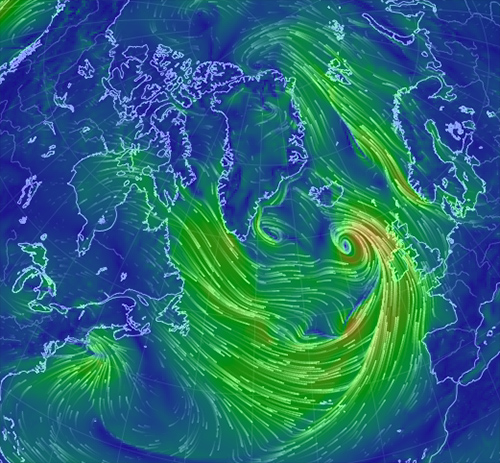
The storm that rampaged thru Texas and wreaked havoc across the south and midwest is winding up to deliver a hot blow to a suddenly vulnerable-even-in-December  Arctic.

As it departs North America this week, the storm will rapidly intensify over the northern reaches of the Gulf Stream and draw tremendous amounts of warm air northward from Spain and the Mediterranean Sea toward the Arctic. As the storm approaches Iceland, it will have strengthened to the equivalent of some of the strongest hurricanes ever recorded in terms of atmospheric pressure. Intensely high pressure over western Russia, perhaps boosted by melting sea ice, will aid in setting up the tropics-to-pole atmospheric superhighway. 
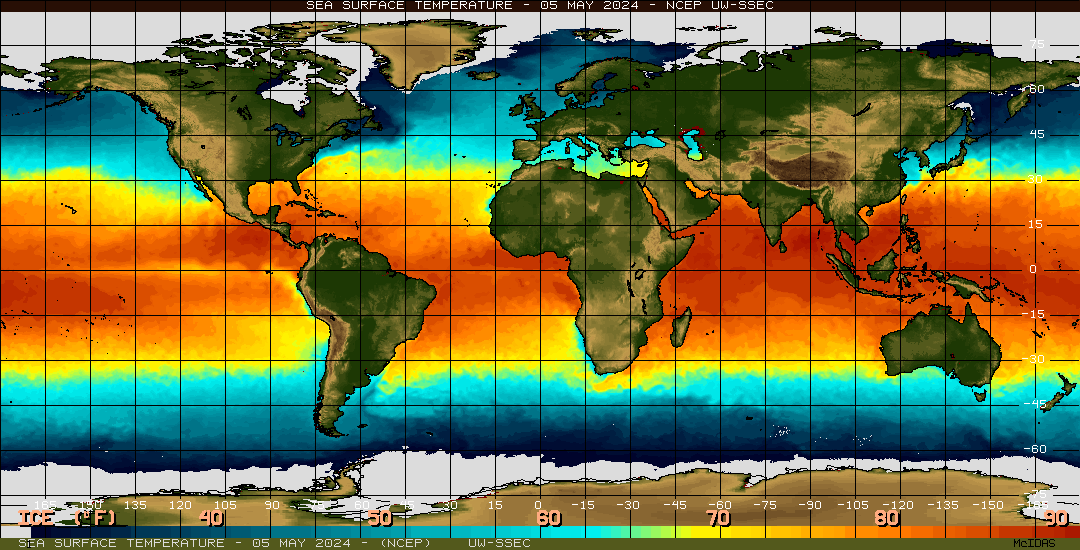
Unlike other recent episodes of extreme weather around the planet, this storm is probably not related to El Niño, which has limited influence in Europe. The storm will be strengthening over the exact spot that North Atlantic temperatures have been cooling over recent years, an effect that scientists have linked to a slowdown of the basin’s circulation triggered in part by melting sea ice—the same scenario that was highly dramatized in the movie The Day After Tomorrow. This year, there’s been a notable increase in the sharp contrast between this cold patch and record warm ocean temperatures in the tropical Atlantic, an effect that leads to stronger ocean storms—like this one. 
decstorm1 
The remarkable storm will briefly boost temperatures in the Arctic basin to nearly 10 degrees Fahrenheit warmer than normal—and the North Pole itself will be pushed above the freezing point, with temperatures perhaps as warm as 40 degrees. That’s absolutely terrifying and incredibly rare. Keep in mind: It’s late December and dark 24 hours a day at the North Pole right now. The typical average high temperature this time of year at the North Pole is about minus 15 to minus 20 degrees. To create temperatures warm enough to melt ice to exist in the dead of winter—some 50 or 60 degrees warmer than normal—is unthinkable. 
For some perspective, I contacted a team of climate scientists at the University of Washington who maintain a fleet of weather monitoring equipment near the North Pole. James Morison, the principal investigator of the North Pole Environmental Observatory, said he’s “never heard of” temperatures above freezing in the wintertime there. Looking closer at the weather data, it appears this event is in fact unprecedented during the time period from late December through late April. 
On Wednesday, the North Pole will be warmer than Western Texas, Southern California, and parts of the Sahara.
http://climatecrocks.com/2015/12/29/most-terrifying-weather-ends-a-hot-2015/

Monday, June 22, 2015

Cardinal Donald Wuerl speaks so beautifully, Chris Wallace of Fox News has nowhere to go

from Peter Sinclair's "This Is Not Cool," June 22, 2015


Cardinal Donald Wuerl came on Fox News Sunday show, yesterday, and showed how its done.
At 4:10, deftly and with a kindly clerical smile, he bodyslams Rush Limbaugh.

During the rest of the interview he handles Chris Wallace’s predictable talking points as smoothly as a ninja sushi chef.

More Please.

UPDATE:
On the first Sunday after Pope Francis issued a landmark document on the environment, Roman Catholics attending Mass in Kenya, France, MexicoPeru and the United States said they were thankful that he was using his pulpit to address climate change, pollution and global inequality. 
But few priests or bishops — other than in parts of Latin America — used their own pulpits on Sunday to pass on the pope’s message, according to parish visits, interviews with Catholic leaders and reports from Catholics after Mass. Despite the urgent call to action in Francis’ document and the international attention it received, it will take some time to know whether Catholic clergy are familiar or comfortable enough with its themes to preach them to the faithful. 
It traditionally takes months for papal teaching documents, known as encyclicals, to be read, understood and disseminated. And this one, “Laudato Si’,” or “Praise Be to You: On Care for Our Common Home,” is long, nearly 200 pages, and intricately weaves spiritual and moral teachings with economic, scientific and political analysis. It includes a forceful denunciation of a global economic system that the pope says plunders the resources of the poor for the benefit of the rich, leaving the poor to disproportionately suffer the consequences, including the effects of climate change.
http://climatecrocks.com/2015/06/21/cardinal-baffles-fox-host-with-calm-defense-of-pope/

Sunday, June 21, 2015

Peter Sinclair: A Nasty Surprise in the Greenhouse

by Peter Sinclair, This Is Not Cool, March 23, 2015


The disaster movie “The Day After Tomorrow” was based on long-term scientific concerns about global warming’s impact on the North Atlantic Current, also called the Atlantic Meridional Overturning Circulation – what most people think of as “The Gulf Stream” – although that is a simplification.

The movie was obviously over the top in terms of the projected impacts, but after a decade in which science has downplayed the possibility of such an event, a new paper shows that the circulation is indeed slowing down.

This could signal potential impacts on weather, the food chain, and circulation of oxygen and nutrients throughout the ocean.


I’ve been interviewing key authors of the paper: lead author Stefan Rahmstorf, as well as paleoclimate expert Mike Mann, and glaciologist Jason Box.

This is a paper that could have substantial impact, and might very well be distorted or sensationalized,  – so bookmark this post as a damper for overhyped speculation, as well as a warning about real impacts.

The North Atlantic between Newfoundland and Ireland is practically the only region of the world that has defied global warming and even cooled. Last winter there even was the coldest on record – while globally it was the hottest on record. Our recent study (Rahmstorf et al., 2015) attributes this to a weakening of the Gulf Stream System, which is apparently unique in the last thousand years. 
The whole world is warming. The whole world? No! A region in the subpolar Atlantic has cooled over the past century – unique in the world for an area with reasonable data coverage (Figure 1). So what’s so special about this region between Newfoundland and Ireland?
amoctemptrend
Figure 1. Linear temperature trend from 1900 to 2013. The cooling in the subpolar North Atlantic is remarkable and well documented by numerous measurements – unlike the cold spot in central Africa, which on closer inspection apparently is an artifact of incomplete and inhomogeneous weather station data.
It happens to be just that area for which climate models predict a cooling when the Gulf Stream System weakens (experts speak of the Atlantic meridional overturning circulation or AMOC, as part of the global thermohaline circulation). That this might happen as a result of global warming is discussed in the scientific community since the 1980s – since Wally Broecker’s classical Nature article “Unpleasant surprises in the greenhouse?” Meanwhile evidence is mounting that the long-feared circulation decline is already well underway.
Difficult to measure 
Climate models have long predicted such a slowdown – both the current 5th and the previous 4th IPCC report call a slowdown in this century “very likely,” which means at least 90% probability. When emissions continue unabated (RCP8.5 scenario), the IPCC expects 12% to 54% decline by 2100 (see also the current probabilistic projections of Schleussner et al., 2014). But the actual past evolution of the flow is difficult to reconstruct owing to the scarcity of direct measurements. Therefore, in our study we use data on sea surface temperatures in order to infer the strength of the flow: we use the temperature difference between the region most strongly influenced by the AMOC and the rest of the Northern Hemisphere.
northatcurrent
Figure 2. Schematic of the Atlantic circulation. Surface currents in red, deep currents in blue, sea-ice cover in winter in white. (Source: Rahmstorf, Nature, 1997.) 
Now we are not the first to have inferred from temperature data that the flow must have weakened. Evidence for this was already presented by Dima and Lohmann, 2010, or Drijfhout et al., 2012, among others (for further references see the introduction of our paper). 
What is new is that we have used proxy reconstructions of large-scale surface temperature (Mann et al., 2009) previously published by one of us (study co-author and RealClimate co-founder Mike Mann) that extend back to 900 AD (see “What we can learn from studying the last millennium (or so)”) to estimate the circulation (AMOC) intensity over the entire last 1100 years (Fig. 3). This shows that despite the substantial uncertainties in the proxy reconstruction, the weakness of the flow after 1975 is unique in more than a thousand years, with at least 99% probability. This strongly suggests that the weak overturning is not due to natural variability but rather a result of global warming.
paleo500
Figure 3. Time series of the temperature difference between the subpolar North Atlantic and the entire northern hemisphere, which can be interpreted as an indicator of the strength of the Atlantic circulation.
Also in 2014 we again find a remarkable cold bubble over the northern Atlantic – as a look at the NASA website shows. 2014 was globally the warmest year on record, 1 °C warmer than the average for 1880-1920. But the subpolar Atlantic was 1-2 °C colder than that baseline! And even more recently, NOAA last week released the stunning temperature analysis for the past winter shown in Figure 4. That winter was globally the warmest since records began in 1880. But in the subpolar North Atlantic, it was the coldest on record! That suggests the decline of the circulation has progressed even further now than we documented in the paper.
noaa_2014
While global surface temperatures are increasingly dominated by warm anomalies, a conspicuous area of cold has persisted south of Greenland and Iceland visible at the ocean surface in sea surface temperature observations. The abnormal cold there has been more anomalous than the US northeast winter. While the most recent northern winter was the warmest on record globally, the ocean surface area south of Greenland & Iceland had the lowest temperatures in the 136-year record. How could this be? 
A new study estimates the Atlantic Meridional Overturning Circulation (AMOC) using the sea surface temperature difference at that cold spot south of Greenland/Iceland with the Northern Hemispheric temperature from NASA-GISS instrumental records since the 1880s (Hansen and others, 1999) and from coral-based proxies after Sherwood and others (2011) that span years since 500 AD. 
Based on this AMOC reconstruction, the study finds that the slowdown of the Atlantic Meridional Overturning Circulation (AMOC) after 1975. 
1. appears unprecedented in the past millennium;
2. is expected to continue, even intensify through year 2100, as simulated with the MPI-ESM-MR global climate model of the Max Planck Institute in Hamburg (Jungclaus and others, 2013)
3. may result to a large degree from Greenland melting.
My contribution was my work of 6 years, a 172-year Greenland mass balance
reconstruction published in a 3 part series in the Journal of Climate (Box and others, 2013; Box, 2013; Box and Colgan, 2013), enabling Greenland melting to be brought more into context of its ocean thermohaline perturbation.
box_runoff
Mass Balance terms of the Greenland Ice Sheet. Data from Box and Colgan. Cumulative anomaly relative to the mean over 1840-1900, a pre-industrial period during which the Greenland Ice Sheet was approximately in balance.
Melt from Greenland produces water that is lighter and colder than the sea surface waters. The meltwater is light enough to float above the saltier sea surface waters. Because Atlantic surface waters flow northward (see map below), an increasing ice melt freshwater supply (blue line in the figure above) may pile up near the sea surface, capping or backing up the Gulf Stream North Atlantic Drift current that (a) delivers warmth to northwestern Europe and (b) is part of a global ocean heat conveyer. While Bamber and others (2012) set the stage with “Recent large increases in fresh- water fluxes from Greenland into the North Atlantic,” the new study more directly quantifies the possible impact from Greenland on the ocean thermohaline circulation.
northatcurrent
Why should we care?
The North Atlantic ocean circulation is an important part of a global ocean circulation that exchanges heat from the equatorial surplus to the poles where the energy is lost by thermal radiation to space. A slowed global oceanic ‘conveyer belt’ may further destabilize our changing global climate. We expect no new ice-age – but major negative effects are possible. The effects could be on global climate, fisheries, or also for example storminess. 
Influence on weather?
The study will stimulate discussion and research on how the large area of negative sea surface temperatures anomalies south of Greenland and Iceland may influence European and downstream weather. Given some heat exchange between a warm air mass with an anomalously cold North Atlantic sea surface, some strengthening of winds, lowering of central pressure of cyclonic systems, should result from increased “baroclinic instability” (see, for example, Holton et al., 1992) arising from an increased temperature difference between sea surface and atmosphere. As the subpolar North Atlantic cools and the atmosphere warms, the physics are set to strengthen cyclonic circulation in warm air masses. Conversely, cold air masses drifting off of North America would be less prone to baroclinic deepening. In any case, the perturbation may be felt not just in that part of the world, but downstream, and like the proverbial butterfly (seagull) flapping its wings, alters atmospheric and oceanic flow, with certain though hard to predict downstream consequences.
UPDATE: Washington Post now covering another aspect of this story.
However, there are many other effects, ranging from dramatic impacts on fisheries to, perhaps most troubling of all, the potential for extra sea level rise in the North Atlantic region. 
That may sound surprising, but here’s how it works. We’re starting out from a situation in which sea level is “anomalously low” off the U.S. east coast due to the motion of the Gulf Stream. This is for at least two reasons. First, explains Rahmstorf’s co-author Michael Mann of Penn State University, there’s the matter of temperature contrast: waters to the right or east of the Gulf Stream, in the direction of Europe, are warmer than those on its left or west. Warm water expands and takes up more area than denser cold water, so sea level is also higher to the right side of the current, and lower off our coast. 
“So if you weaken the ‘Gulf Stream’ and weaken that temperature contrast…sea level off the U.S. east coast will actually rise!” explains Mann by e-mail. 
But there’s another factor, too, involving what is called the “geostrophic balance of forces” in the ocean. This gets wonky, but the bottom line result is that “sea surface slope perpendicular to any current flow, like the Gulf Stream, has a higher sea level on its right hand side, and the lower sea level on the left hand slide,” says Rahmstorf. 
We’re on the left hand side of the Gulf Stream. So weaken the flow, and you also raise the sea level. (For further explanation, see here and here.) 
Indeed, researchers recently found a sudden, 4-inch, sea-level rise of the U.S. East Coast in 2009 and 2010, which they attributed to a slowdown of the Atlantic overturning circulation. Rahmstorf says that “for a big breakdown of the circulation, [sea level rise] could amount to one meter, in addition to the global sea level rise that we’re expecting from global warming.”
http://climatecrocks.com/2015/03/23/a-nasty-surprise-in-the-greenhouse-new-paper-new-video/ 

Saturday, March 21, 2015

Peter Sinclair: A warning from Jason Box and a Tale of Two Arctics

by Peter Sinclair, This Is Not Cool, March 16, 2015

boxoslo1At last week’s Arctic Summit in Oslo, put on by The Economist magazine, the atmosphere was sober.
Dark Snow Project founder Dr. Jason Box was the only scientist on the agenda, his presentation subtitled A Warning.”

After a morning of presentations crafted to put a positive spin on the realization that an Arctic oil, minerals, and shipping Bonanza was not as imminent as once hoped, Dr. Box captured the attention of the assembled ministers, magnates, and academics. The whole room seemed to lean closer with each ever-more-ominous graph.

Climate change was a constant gorilla in the room, but there was another one, a bigger one, even more frightening to many of the players, — the creeping idea that energy prices, oil prices in particular, might have gone off script, and no one quite knows if they  are going to behave anymore as in the past.
boxoslo2
There was agreement that energy development in the arctic is dormant for now due not only to oil prices, but to the recognition that the engineering and logistical barriers are far more difficult than imagined a few years ago. Shipping as well is under a cloud, not least because of questions about Russian intentions and behavior.

It’s not getting any more predictable up there.

A fall in oil prices may help long-term exploitation of fossil fuels in the Arctic by averting a short-lived “gold rush” into the vulnerable icy region, Norway’s Foreign Minister Boerge Brende said on Thursday. 
Exploitation of oil and gas required long planning to safeguard the fragile environment, which is heating up faster than the world average because of global warming, he said. 
“It is safe to assume that Arctic gas will have its day,” he said in a speech at an Arctic conference, saying that burning natural gas emitted half the amount of heat-trapping carbon dioxide as coal. 
Brende said some projections for an opening of the Arctic to shipping, oil and gas exploration and mining had been too optimistic amid a thaw that has cut the extent of winter sea ice on the Arctic Ocean close to a record low this month. 
“We should be very happy that there was not a ‘gold rush,’ ” he told reporters in Oslo. “A ‘gold rush’  is not positive, it’s throwing oneself at resources at breakneck speed.” 
“The Arctic is a very vulnerable area where we have to go step by step” with strong environmental rules, he said. 
Still, he said that fossil fuels would continue to dominate the world’s energy mix and would be needed from more Arctic areas. 
Statoil’s Snoehvit gas field, in the Barents Sea, is so far Norway’s only Arctic offshore field. Eni’s Goaliat field is due to start producing oil in mid-2015. 
Brent oil futures traded at $58 a barrel on Thursday, slightly more than half its average of around $110 from 2011-13. The fall has discouraged investments in the high-cost Arctic.
Meanwhile, at yet another conference on the future of the Arctic, the same week,  a more euphoric “Chamber of Commerce” atmosphere prevailed.

ROVANIEMI, Finland—In one of this nation’s northernmost cities and at the close of a winter that citizens here have called unusually mild, foreign ambassadors spoke of their nations’ hope to do business in the Arctic, Finnish spokesmen outlined their plans to attract international money, and business owners burnished their cases for investment in the polar north. 
“Nordic lights is a good example of business actually nowadays,” Juha Mäkimattila, the chairman of the Lapland Chamber of Conference, said at a dinner for foreign guests, Wednesday, with a slideshow of aurora borealis photographs thrumming behind him. “We can actually make money on the northern lights from people from new parts of the world.” 
At the two-day Arctic Business Forum, hosted by the Lapland chamber, delegations from more than 20 nations, most which do not border the Arctic Circle, said the tone reflected a robust appetite for economic expansion, natural resource extraction and an optimistic prognosis for strong tourist spending. 
Meeting in a city that advertises itself on its website as “The Official Hometown of Santa Claus,” most speakers alluded to environmental management but didn’t get into the problems of melting permafrost or the additional threats of future oil spills or the loss of species. 
On both days, the tone was bullish. Diplomats from global trade and economic powers signaled their governments’ growing interest in Arctic transit and heavy shipping in the Arctic Ocean.
http://climatecrocks.com/2015/03/16/a-tale-of-two-arctics/

Saturday, February 28, 2015

Peter Sinclair: What Climate Deniers Learned from Big Tobacco [MUST SEE VIDEOS - BOTH OF THEM!!!!!]

by Peter Sinclair, This Is Not Cool, February 26, 2015


Above, my newest “This is Not Cool” video focuses on the backstory behind “Merchants of Doubt,” the new documentary inspired by Naomi Oreskes’ and Eric Conway’s book of the same name.  The centerpiece of the book is the story of how techniques of science denial perfected in the tobacco industry have been adapted to the broader war on inconvenient science.

MODsmallThis week’s media firestorm centering on Dr. Willie Soon, a high-profile prop at many a gathering of climate deniers, was kicked off by Justin Gillis’ piece in the New York Times on Sunday.

It’s not insignificant that Gillis put the affair in a larger context, something that happens rarely in media coverage of the climate issue.
The documents shed light on the role of scientists like Dr. Soon in fostering public debate over whether human activity is causing global warming. The vast majority of experts have concluded that it is and that greenhouse emissions pose long-term risks to civilization.
Historians and sociologists of science say that since the tobacco wars of the 1960s, corporations trying to block legislation that hurts their interests have employed a strategy of creating the appearance of scientific doubt, usually with the help of ostensibly independent researchers who accept industry funding. 
Fossil-fuel interests have followed this approach for years, but the mechanics of their activities remained largely hidden. 
“The whole doubt-mongering strategy relies on creating the impression of scientific debate,” said Naomi Oreskes, a historian of science at Harvard University and the co-author of “Merchants of Doubt,” a book about such campaigns. “Willie Soon is playing a role in a certain kind of political theater.”
I was able to include parts of detailed interviews from scientists who were very much a part of the story, including Dr. Oreskes, who was the target of a massive climate denier attack after she published a key paper on the scientific consensus around climate change, in 2004.  

In addition, I include part of our interview with Dr. Ben Santer  who sheds light on the role of tobacco and climate science denier Fred Singer – and Stanton Glantz, who appears in the film and was an early, and combative, critic of the tobacco industry’s war on reality, and connects the tactics, and even the combatants,  to the climate issue.

The movie adaptation of Dr. Oreskes’ book is due in theaters next week. I’ve seen it, and I think, especially in light of the recent revelations, it will become a starting point for a lot of conversations.  

I’m sure that editors and reporters at the New York Times would have seen the movie and been aware of it too, so it causes one to wonder if there is a bit of calculation behind the recent story.
Merchants of Doubt trailer below.

Wednesday, December 3, 2014

NASA: Antarctic Melt Loss Triples in a Decade

by Peter Sinclair, Climate Crocks, December 3, 2014
Evidence is piling up indicating the planet will be extremely fortunate to stay on the lower end of sea level rise estimates.

And remember, this study covers just one area of Antarctica, where we have good instrument coverage.

A comprehensive, 21-year analysis of the fastest-melting region of Antarctica has found that the melt rate of glaciers there has tripled during the last decade. 
The glaciers in the Amundsen Sea Embayment in West Antarctica are hemorrhaging ice faster than any other part of Antarctica and are the most significant Antarctic contributors to sea level rise. This study by scientists at the University of California, Irvine (UCI), and NASA is the first to evaluate and reconcile observations from four different measurement techniques to produce an authoritative estimate of the amount and the rate of loss over the last two decades.
This work extends the work of Eric Rignot, who stunned the ice sheet community last spring with his “holy shit moment” paper on unstoppable Antarctic melting – discussed here in a very important video, if you have not seen it.


“The mass loss of these glaciers is increasing at an amazing rate,” said scientist Isabella Velicogna, jointly of UCI and NASA’s Jet Propulsion Laboratory, Pasadena, California. Velicogna is a coauthor of a paper on the results, which has been accepted for publication in the journal Geophysical Research Letters. 
Lead author Tyler Sutterley, a doctoral candidate at UCI, and his team did the analysis to verify that the melting in this part of Antarctica is shifting into high gear. “Previous studies had suggested that this region is starting to change very dramatically since the 1990s, and we wanted to see how all the different techniques compared,” Sutterley said. “The remarkable agreement among the techniques gave us confidence that we are getting this right.” 
The researchers reconciled measurements of the mass balance of glaciers flowing into the Amundsen Sea Embayment. Mass balance is a measure of how much ice the glaciers gain and lose over time from accumulating or melting snow, discharges of ice as icebergs, and other causes. Measurements from all four techniques were available from 2003 to 2009. Combined, the four data sets span the years 1992 to 2013.
Worth watching this video from a year ago if you have not yet, backgrounder on the movement of large ice sheets.

The glaciers in the embayment lost mass throughout the entire period. The researchers calculated two separate quantities: the total amount of loss, and the changes in the rate of loss. 
The total amount of loss averaged 83 gigatons per year (91.5 billion U.S. tons). By comparison, Mt. Everest weighs about 161 gigatons, meaning the Antarctic glaciers lost an amount of water weight equivalent to Mt. Everest every two years over the last 21 years. 
The rate of loss accelerated an average of 6.1 gigatons (6.7 billion U.S. tons) per year since 1992.
During the period when the four observational techniques overlapped, the melt rate increased an average of 16.3 gigatons per year — almost three times the rate of increase for the full 21-year period. The total amount of loss was close to the average at 84 gigatons. 
The four sets of observations include NASA’s Gravity Recovery and Climate Experiment satellites, laser altimetry from NASA’s Operation IceBridge airborne campaign and the earlier ICESat satellite, radar altimetry from the European Space Agency’s Envisat satellite, and mass budget analyses using radars and the University of Utrecht’s Regional Atmospheric Climate Model. 
The scientists noted that glacier and ice sheet behavior worldwide is by far the greatest uncertainty in predicting future sea level. “We have an excellent observing network now. It’s critical that we maintain this network to continue monitoring the changes,” Velicogna said, “because the changes are proceeding very fast.”
This is just Antarctica. At the other pole, Greenland is also vulnerable, and estimates of how fast it can shed mass keep increasing. Below, see Dr. Jeff Masters' analysis of that loss, and Dr. James Hansen’s take on what an accelerating Greenland loss might mean to the world.
Dr. Jeff Masters at Weather Underground:
Human-caused global warming has set in motion an unstoppable slow-motion collapse of the glaciers in West Antarctica capable of raising global sea level by 4 feet (1.2 meters) in a few hundred years, said NASA in a May 2014 press release. What’s more, one of the glaciers involved, the Thwaites Glacier, acts as a linchpin on the rest of the ice sheet, which contains enough ice to cause a total of 10 to 13 feet (3 to 4 meters) of global sea level rise over a period of centuries. This unstoppable collapse makes saving Greenland “absolutely essential,” said glaciologist Richard Alley in a May 2014 interview in Mother Jones. 
Greenland’s ice sheet holds enough water to raise global sea levels by 7.36 meters (24.15 feet) were it all to melt, and civilization would be hard-pressed to deal with 10–13 feet of sea level rise from West Antarctica, let alone another 20+ feet from Greenland. “If we’ve committed to 3.3 meters (10.8') from West Antarctica, we haven’t committed to losing Greenland, we haven’t committed to losing most of East Antarctica,” said Alley. “Those are still out there for us. And if anything, this new news just makes our decisions more important, and more powerful.” 
Unfortunately, the Greenland Ice Sheet is much more vulnerable to melting than previously thought, found a May 2014 study by Morlighem et al., "Deeply incised submarine glacial valleys beneath the Greenland ice sheet." The researchers found that widespread ice-covered valleys extend much deeper below sea level and farther inland than previously thought, and would likely melt significantly from steadily warming waters lapping at Greenland’s shores.

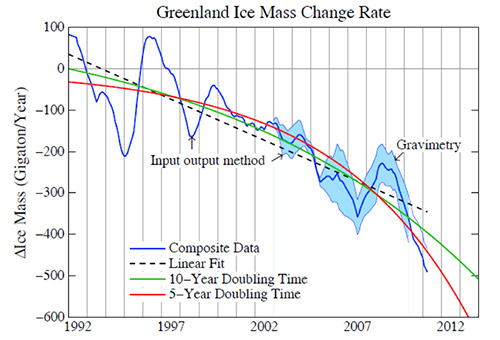
Figure 2. Monthly changes in the total mass (in gigatons) of the Greenland ice sheet estimated from GRACE satellite measurements between March 2002–July 2013. The blue and orange asterisks denote April and July values, respectively. Note that the decline in ice mass lost from Greenland is not a straight line – it is exponential, meaning that, in general, more ice loss is lost each year than in the previous year. However, the mass loss during the 2013 summer melt season was probably smaller than during 2012, said the 2013 Arctic Report Card.

Fig. 1 shows that Greenland has been losing mass at a faster and faster rate over the past decade, with the recent rate corresponding to ~1 mm sea level per year (1 mm sea level = 360 Gt ice). The linear fit to the Shepherd et al. data in Fig. 1 yields a Greenland contribution to global sea level of about 30 cm by 2100.
Fig. 1. Annual mass change of Greenland ice sheet based on the input-output method, an analysis of gravity measurements, and a best-estimate composite (Shepherd et al., 2012).
Fig. 1. Annual mass change of Greenland ice sheet based on the inputoutput method, an analysis of gravity measurements, and a best-estimate composite (Shepherd et al., 2012).
The increasing Greenland mass loss in Fig. 1 can be fit just as well by exponentially increasing annual mass loss, a behavior that Hansen (2005, 2007) argues could occur because of multiple amplifying feedbacks as an ice sheet begins to disintegrate. A 10-year doubling time would lead to 1 meter sea level rise by 2067 and 5 meters by 2090. The dates are 2045 and 2057 for 5-year doubling time and 2055 and 2071 for a 7-year doubling time.
http://climatecrocks.com/2014/12/03/nasa-antarctic-melting-triples/ 

Saturday, October 4, 2014

Peter Sinclair: Shell Oil drilling platform, Noble Discoverer, continues Arctic follies -- wants weakened rules

Shell wants to drill in the Arctic. What could possibly go wrong?

[Readers, note that there is no such thing as a spill cleanup in the Arctic, and Shell doesn't want to be forced to keep emergency equipment nearby (well, what would they be able to use it for, anyway?).]

by Peter Sinclair, Climate Crocks, October 3, 2014


http://climatecrocks.com/2014/10/03/shell-oil-drilling-platform-continues-arctic-follies/

Wednesday, October 1, 2014

Jason Box: Greenland is the new black

by Peter Sinclair, Climate Crocks, October 1, 2014

Jason Box returned to Greenland for a few days late in August, and was able to shoot the video above. Newest observations show the lowest reflectivity on record for Greenland’s Upper elevations.
jason_dktwitter
And there’s this.

NBC News:
Spongy sediments under Greenland’s ice sheet may accelerate its flow into the sea — an effect that previous estimates of ice loss failed to account for, according to University of Cambridge researchers. They said that means the ice sheet may be more sensitive than previously thought to overall climate change, along with short-term events like heavy rain and heat waves. 
The researchers said it was thought that Greenland’s extensive ice fields rested on hard bedrock, but new evidence shows that soft sediments also are present. Those sediments weaken as they soak up water from seasonal melt, allowing the sheet to move faster to the sea, the researchers said. Greenland’s ice sheet covers 660,000 square miles (1.7 million square kilometers) to a depth of nearly 2 miles (3 kilometers) at its thickest. A 2012 study found that the sheet’s melting was accelerating, and a 2013 study estimated that because of melting in Greenland and Antarctica, sea levels could be 2 feet higher when today’s preschoolers are grandparents. The research was funded by the Natural Environment Research Council and published Monday in the journal Nature Communications.
http://climatecrocks.com/2014/10/01/august-2014-greenland-is-the-new-black/ 

Wednesday, September 17, 2014

Peter Sinclair: Jason Box, "We're f'd"

by Peter Sinclair, Climate Crocks, September 16, 2014


Above – reposting, first Greenland 2014 piece from last week.

After unpacking a few clean clothes, grabbing long showers, and sharing a few moderate adult beverages, Jason Box and I eased back into the media sphere, after almost 2 weeks on the Greenland sheet. Robin Williams was dead. That hit us both at the same time. I checked email. Jason checked twitter. And took on a startled look.

An unusually blunt statement from usually soft spoken Box had gone viral. [In my experience, when scientists start swearing, they are really feeling the import of what is going on.]

Brian Merchant had a piece on Motherboard, here’s part of it:
This week, scientists made a disturbing discovery in the Arctic Ocean: They saw “vast methane plumes escaping from the seafloor,” as the Stockholm University put it in a release disclosing the observations. The plume of methane—a potent greenhouse gas that traps heat more powerfully than carbon dioxide, the chief driver of climate change—was unsettling to the scientists. 
But it was even more unnerving to Dr. Jason Box, a widely published climatologist who had been following the expedition. As I was digging into the new development, I stumbled upon his tweet, which, coming from a scientist, was downright chilling:
effed
Box, who is currently a professor of glaciology at the Geological Survey of Denmark and Greenland, has been studying the Arctic for decades. His accolade-packed Wikipedia page notes that he’s made some 20 expeditions to the Arctic since 1994, and served as the lead author on the Greenland section of NOAA’s State of the Climate report from 2008-2012. He also runs the Dark Snow project and writes about the latest findings in the field at his blog, Meltfactor. 
In other words, Box knows the Arctic, and he knows climate change—and the methane plumes had him blitzed enough to bring out the F bombs. 

Now, the scientists in the Arctic didn’t fully understand why the plumes were occurring. But they speculated that a warmer “tongue” of ocean current was destabilizing methane hydrates on the Arctic slope. 
I called the scientist at his office in Copenhagen, and he talked frankly and emphatically about the new threat, and about the specter of climate change in general. He also swore like a sailor, which I’ve often wondered how climatologists refrain from doing, given the urgency of the problem—it’s certainly an entirely accurate way to communicate the climate plight. 
Salon had a piece. Jason’s twitter feed had more than tripled. His interview with Bill Maher was online.

Jason’s wife called. A Hungarian acquaintance had told her that Jason was front page news in Budapest.

The ice in Greenland this year isn’t just a little dark—it’s record-setting dark. Box says he’s never seen anything like it. I spoke to Box by phone earlier this month, just days after he returned from his summer field research campaign. 
 “I was just stunned, really,” Box told me. 
The photos he took this summer in Greenland are frightening. But their implications are even more so. Just like black cars are hotter to the touch than white ones on sunny summer days, dark ice melts much more quickly. 
As a member of the Geological Survey of Denmark and Greenland, Box travels to Greenland from his home in Copenhagen to track down the source of the soot that’s speeding up the glaciers’ disappearance. He aptly calls his crowdfunded scientific survey Dark Snow. 
There are several potential explanations for what’s going on here. The most likely is that some combination of increasingly infrequent summer snowstorms, wind-blown dust, microbial activity, and forest fire soot led to this year’s exceptionally dark ice. A more ominous possibility is that what we’re seeing is the start of a cascading feedback loop tied to global warming. Box mentions this summer’s mysterious Siberian holes and offshore methane bubbles as evidence that the Arctic can quickly change in unpredictable ways. 
This year, Greenland’s ice sheet was the darkest Box (or anyone else) has ever measured. Box gives the stunning stats: “In 2014 the ice sheet is precisely 5.6 percent darker, producing an additional absorption of energy equivalent with roughly twice the US annual electricity consumption.” 
Perhaps coincidentally, 2014 will also be the year with the highest number of forest fires ever measured in Arctic.
http://climatecrocks.com/2014/09/16/slate-why-greenlands-dark-snow-should-worry-you/