Blog Archive

Showing posts with label divestment. Show all posts

Monday, February 22, 2016

108 scientists call on world’s largest Earth science organization (the American Geophysical Union) to reject ExxonMobil sponsorship


FOR IMMEDIATE RELEASE
February 22, 2016
Contact: Ben Scandella, 206-276-2699, bscand@gmail.com

108 scientists call on world’s largest Earth science organization
to reject ExxonMobil sponsorship

Cambridge, MA Today, more than 100* geoscientists sent a letter (also attached) to the President of the American Geophysical Union (AGU) - the world’s largest association of Earth scientists - calling for an end to ExxonMobil sponsorship of AGU in a stand against climate science disinformation.

Signatories include leading AGU-member scientists such as former Director of the NASA Goddard Institute for Space Studies and renowned climatologist Professor James E. Hansen, former President of the American Association for the Advancement of Science and Harvard Professor James J. McCarthy, Penn State’s Earth System Science Center director Michael E. Mann, and author of Merchants of Doubt and Harvard Professor Naomi Oreskes, as well as other concerned geoscientists including Professor Hans Schellnhuber, CBE, who currently serves as Chair of the German government’s Advisory Council on Global Change and as a climate advisor to the Pope.

“As Earth scientists, we are deeply troubled by the well-documented complicity of ExxonMobil in climate denial and misinformation…By allowing Exxon to appropriate AGU’s institutional social license to help legitimize the company’s climate misinformation, AGU is undermining its stated values as well as the work of many of its own members,” states the letter.

In fact, AGU’s own Organizational Support Policy states that “AGU will not accept funding from organizational partners that promote and/or disseminate misinformation of science, or that fund organizations that publicly promote misinformation of science.” Despite this claim, the nearly 24,000 attendees of the AGU 2015 Fall meeting were greeted by a prominent display of gratitude for Exxon’s sponsorship.

Asked why she signed the letter, Harvard Professor Naomi Oreskes - whose work has been instrumental in exposing the corporate-financed public relations efforts to sow confusion about scientific issues ranging from tobacco smoke to climate change - explained, “The scientific community has been clear and articulate in communicating the reality and threat of global warming. However, accepting sponsorship from ExxonMobil undermines that message. We cannot say that climate change is real and demonstrated, and at the same time turn a blind eye to the real and demonstrated nature of ExxonMobil’s anti-scientific activities.”

The letter comes amid the ExxonMobil climate denial scandal, with the company currently under investigation by the New York and California Attorneys General as to whether it lied to the public and its shareholders about climate change risks.

Leading climatologist Michael Mann, a signatory whose “hockey stick” global warming graph has made him a well-known target of attacks by climate deniers, remarked, “While I recognize that it is a contentious matter within the diverse AGU community, I just don't see how we can, in good conscience, continue to accept contributions from a company that has spent millions of dollars over several decades funding bad faith attacks on scientists within our community whose scientific findings happen to be inconvenient for fossil fuel interests.”

“As the largest and most respected society of Earth scientists in the world, the AGU should not be invested in nor take money from a corporation that places its profits above the health and well-being of our global society,” commented Cornell University Professor Charles Greene, another signatory of the letter.

The letter is the most recent example of a growing trend of scientists stepping out of their traditional roles to advocate for stronger climate action and to counter climate science disinformation in response to the urgency of climate change. For example, through the recently launched Climate Feedback project, scientists are evaluating the credibility of climate science presented in the popular press. Last Spring, dozens of the world’s top scientists released a letter urging science museums to cut ties to fossil fuel interests. They subsequently led a campaign to remove David Koch from the board of New York’s American Museum of Natural History. Mr. Koch resigned from his board position in December.

*Note: A few signatories prefer to not disclose their names in the online version of the letter.

###

RELEVANT LINKS:

  1. The letter follows an editorial by three AGU members, published in January, calling on AGU to reject Exxon’s sponsorship of its future scientific conferences: http://www.theguardian.com/environment/climate-consensus-97-per-cent/2016/jan/06/why-is-the-largest-earth-science-conference-still-sponsored-by-exxon

Thursday, October 8, 2015

California pension funds to drop coal-mining companies

Kevin de León

by Chris Megerian, The Los Angeles Times, October 8, 2015

Gov. Jerry Brown on Thursday signed legislation forcing California’s pension systems, the two largest public funds in the country, to divest from coal companies.

The measure, SB 185 by state Senate leader Kevin de León (D-Los Angeles), requires the funds to sell their holdings in companies that derive at least half of their revenue from mining coal used to generate electricity.
The deadline for divestment is July 1, 2017, and new investments will be prohibited.
The new law will affect $58 million held by the California Public Employees' Retirement System and $6.7 million in the California State Teachers Retirement System, a tiny fraction of their overall investments. The funds are responsible for providing benefits to more than 2.5 million current and retired employees.

De León pitched the measure as a way to emphasize more secure, environmentally friendly investments.
“Coal is a losing bet for California retirees and it’s also incredibly harmful to our health and the health of our environment," he said in a statement.
The University of California has already taken similar steps. Last month, it sold off its $200 million in investments in coal and oil sands companies.

Tuesday, October 6, 2015

World’s most influential banker says an orderly switch from fossil fuels to renewables is needed to avoid turmoil on world stock markets

by Paul Brown, Climate News Network, October 2, 2015

LONDON − A warning that climate change might make the world’s stock markets and banks unstable and lead to a financial crash has come from Mark Carney, chairman of the G20 countries’ Financial Stability Board.

Carney, who is also Governor of the Bank of England, particularly warns about the effects on the market if panic selling occurs and there is a plunge in value of shares in fossil fuel companies and industries that produce a lot of carbon dioxide.

These companies, some of the world’s largest, control one-third of stock market assets. If investors realise these stocks are overvalued and try to sell them all at once, it will cause chaos, Carney said. [hmm, I think he just let the cat out of the bag.]

The stark warning is a “remarkable intervention” from one of the world’s most conservative and influential bankers, who says he will be advising the world’s richest nations at the G20 summit in November to put policies in place to prevent climate change causing future severe turmoil in the markets.

Unpaid loans

He warned that banks might become unstable because the billions of dollars in loans they have made to fossil fuel companies might not be repaid.

Carney suggests that there will be a switch of investments from carbon-intensive industries to renewables. He says investments in fossil fuel companies might be seen as overvalued because, to avoid dangerous climate change, between one-fifth and one-third of all fossil fuels will need to be left in the ground.

Carney’s warning is in stark contrast to the policies of George Osborne, the UK’s chancellor of the exchequer, who appointed him to his role as Bank of England governor in 2012.

Osborne has this year been demolishing the UK’s on-shore wind and solar subsidy programme, while providing tax breaks to North Sea oil companies to find more reserves and giving the go-ahead for fracking gas over large areas of England.

Carney did not comment on this policy rift, saying it was up to governments not bankers to make decisions about how to move to a low-carbon economy, but he said they must manage the transition in a way that did not cause market shocks.

Speaking to Lloyd's of London, one of the biggest insurance markets in the world, he said giving investors maximum information would allow them to make sensible decisions about when to disinvest in fossil fuels.

Politicians had to manage this without suddenly revealing that some stocks were overvalued because company assets would be “stranded” because oil coal and gas would always have to remain in the ground.

He said he was going to recommend to G20 countries in November, ahead of the UN climate change conference in Paris the following month, that they start setting a carbon price so that investors could see how large companies emitting carbon dioxide would be affected.

Carney told the BBC: “The point is the risks build with time, and they build more rapidly with inaction, so climate change is a function of cumulative emissions, so the slower the action is today, the bigger the action has to be in the future.

“That would mean more abrupt change, that would mean bigger shocks to the value of financial assets, bigger strains on banks and insurance companies that are exposed to those assets, so what we’re trying to do is to promote as smooth an adjustment as possible. We think it can be done, and we think it can be done by providing better information.”

Zero emissions

He called for the setting up of a Climate Disclosure Task Force so that all companies would have to declare how much carbon they emitted or produced, and how they were going to proceed to zero emissions in the future. Since the G20 countries are responsible for 85% of emissions, they would be a good starting point.

“Our societies face a series of profound environmental and social challenges,” he said. “The combination of the weight of scientific evidence and the dynamics of the financial system suggest that, in the fullness of time, climate change will threaten financial resilience and longer-term prosperity.

“While there is still time to act, the window of opportunity is finite and shrinking.”

Jeremy Leggett,  founder of Solarcentury, the largest UK solar electricity company, and chairman of the CarbonTracker thinktank, described it as “a momentous announcement when such an eminent banker tells the world that climate change is the biggest issue of the future”.

He said: “Carney’s remarkable statement of position also raises the remarkable corollary that George Osborne might well now be party to the sabotage of the capital markets.” 

Saturday, October 3, 2015

MIT Climate Change Conversation Report

Thank You
The MIT Climate Change Conversation Committee would like to thank the hundreds of students, faculty, staff, and MIT community members who shared their input during the year long conversation on how MIT can play a role in addressing the climate challenge.  The Committee submitted a report of final recommendations to MIT senior leadership in June 2015.  Archived materials from the conversation can be found on the website.
Over the summer months of 2015 the Conversation Leadership - Marty Schmidt, Provost, Vice President for Research Maria Zuber, MITEI Director Bob Armstrong, and Environmental Solutions Initiative Interim Director Susan Solomon – will review the report. A final set of recommendations will be presented to President Reif, who will announce a plan for community-wide MIT action on climate change in Fall 2015.

Stay in Touch 

Archived Videos

Download the Report
MIT and the Climate Challenge
MIT Climate Change Conversation Report, June 2015 
Submitted June 2015
The open forum phase of the Climate Conversation was completed in June 2015.
 

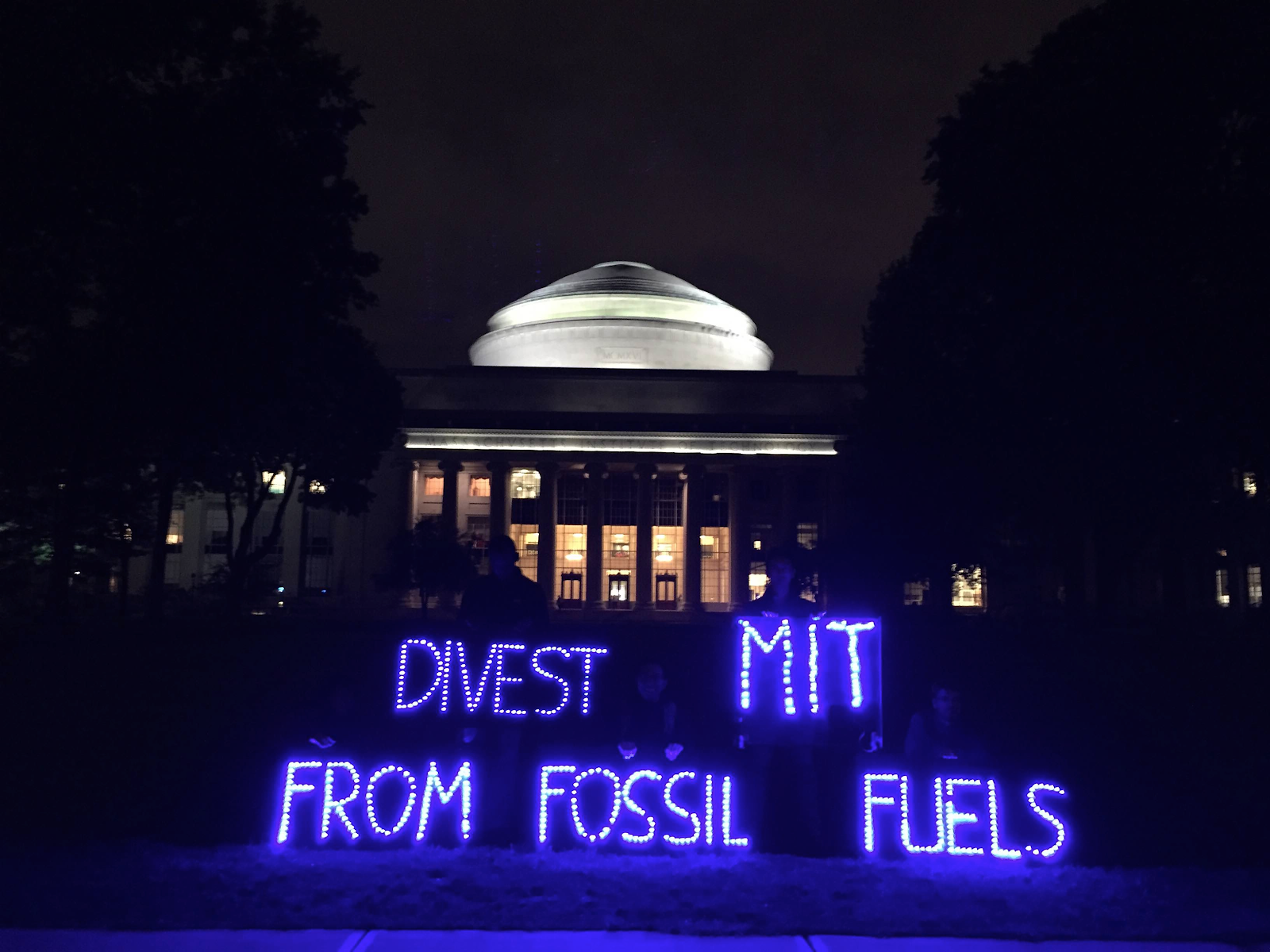
Over 100 MIT nerds-turned-activists rally and march for fossil fuel divestment and climate action as MIT Board of Trustees - including David Koch - meet on campus

Credit: Ploy Achakulwisut

FOR IMMEDIATE RELEASE: October 2, 2015. Contact: Geoffrey Supran (+1) 617-899-8482, gjsupran@mit.edu

Over 100 MIT nerds-turned-activists rally and march for fossil fuel divestment and climate action 
as MIT Board of Trustees - including David Koch - meets on campus
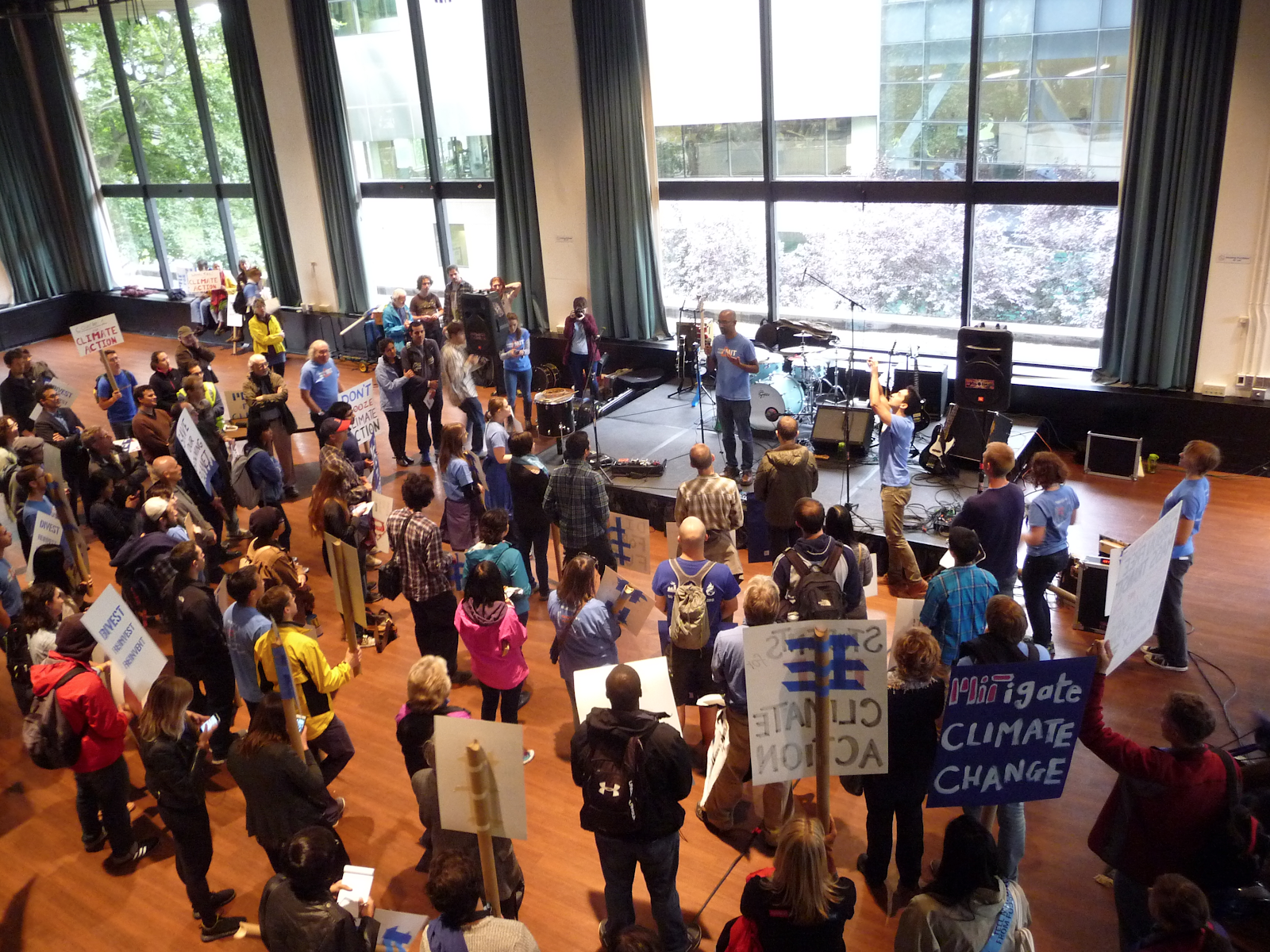
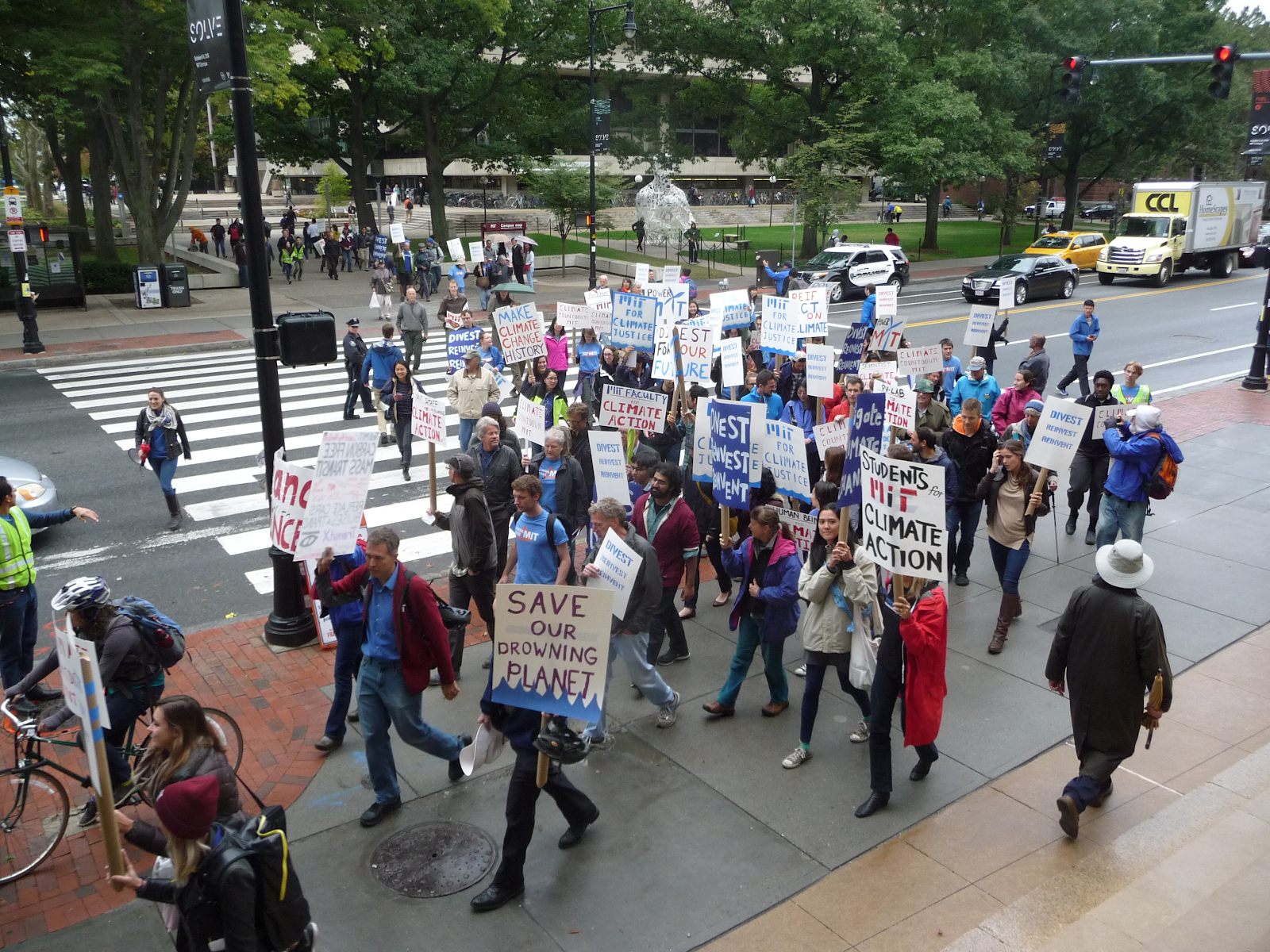
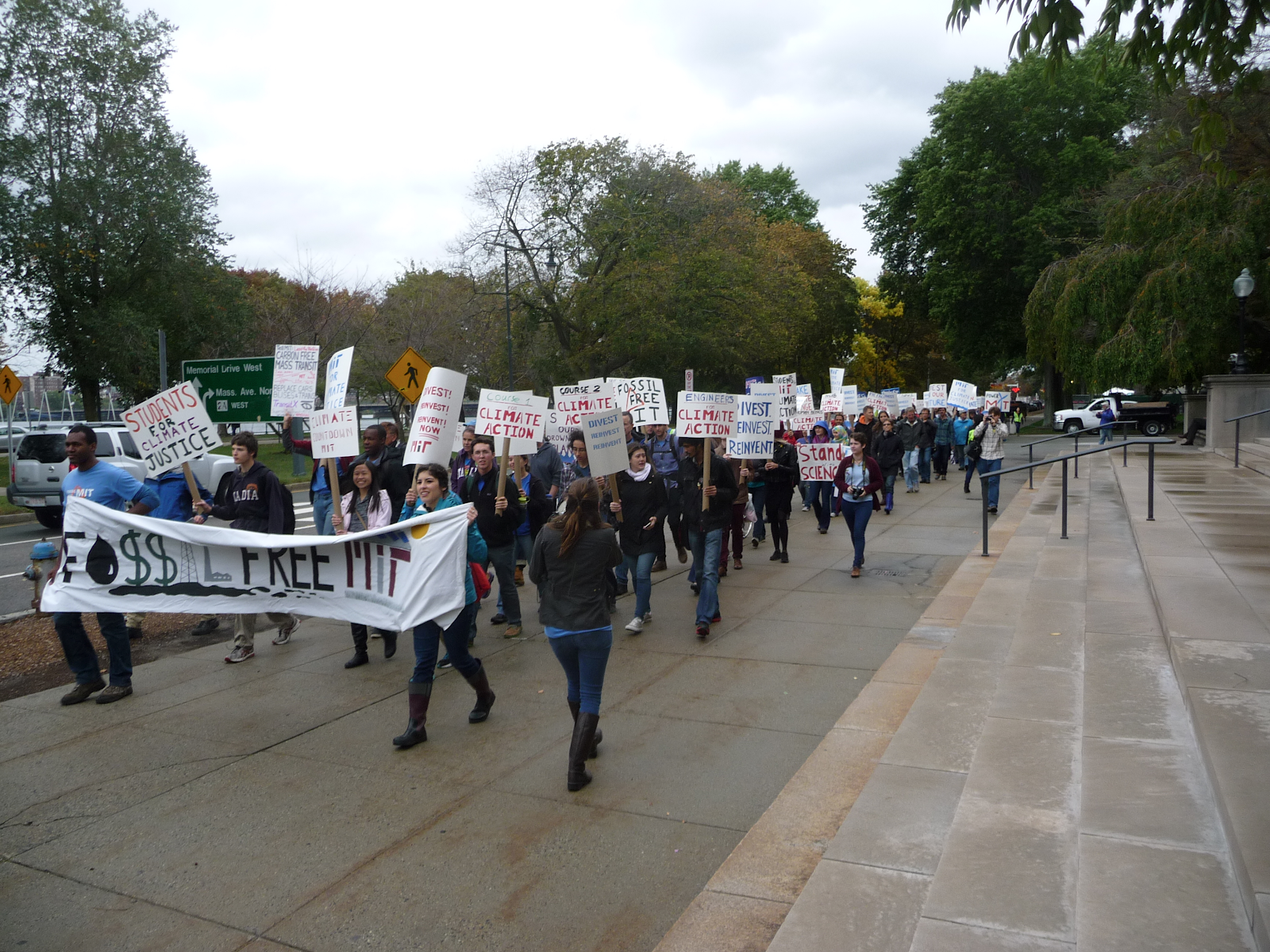
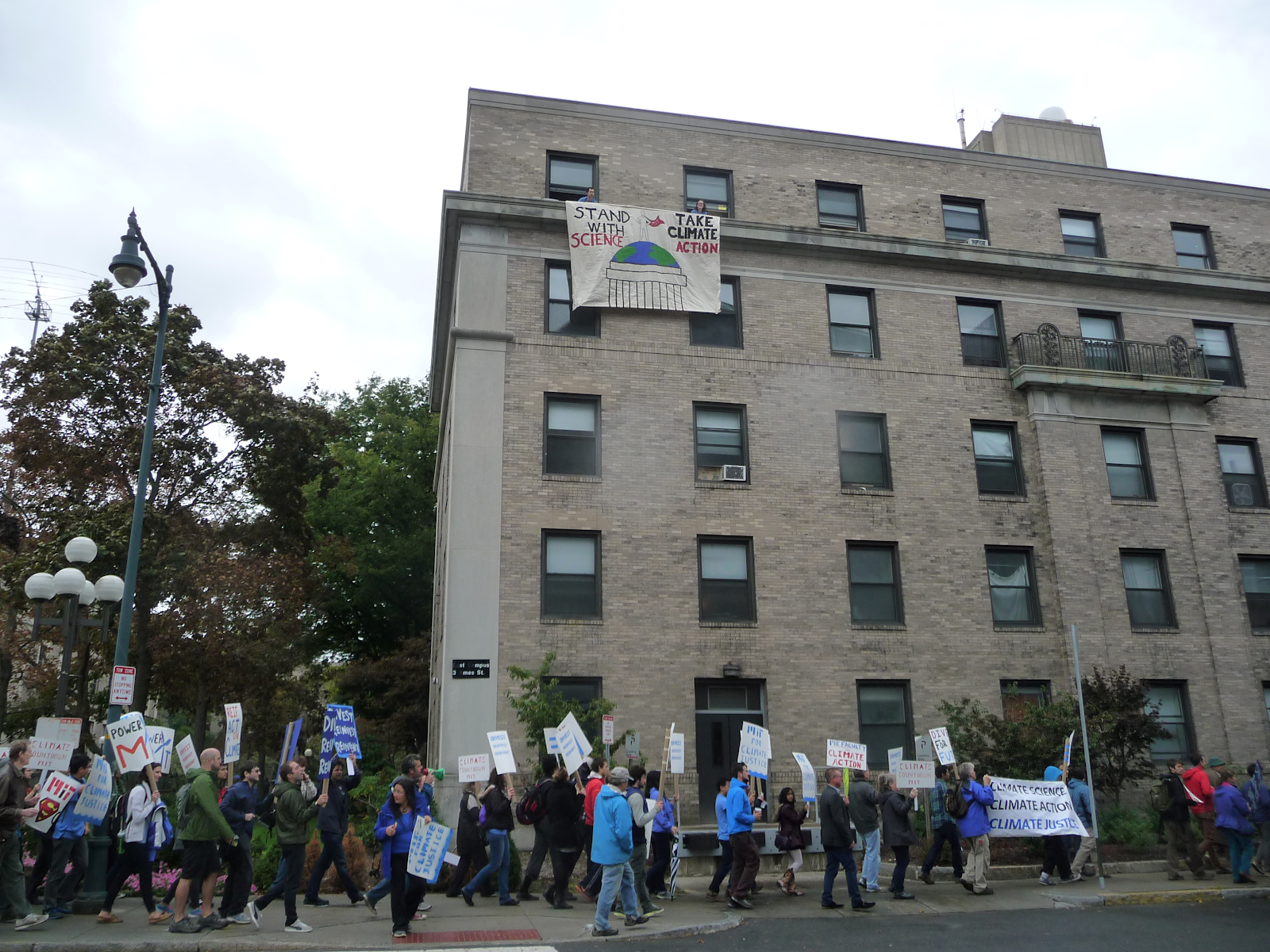
Cambridge, MAToday, more than 100 MIT students, staff, faculty, alumni, and local community members rallied in the heart of campus in support of an MIT climate action plan, including divestment of the Institute’s $13.5 billion endowment from fossil fuel companies and climate-denying corporations. The activists then marched across campus, where, across from the building in which MIT’s Board of Trustees - among them David Koch - convened for their annual meeting, they dropped a banner reading “Stand with Science. Take Climate Action.”

The rally follows recommendations by the MIT President’s own committee to divest from coal, tar sands, and climate-denying corporations, and comes on the eve of the President’s promised decision on how the Institute will act against climate change.

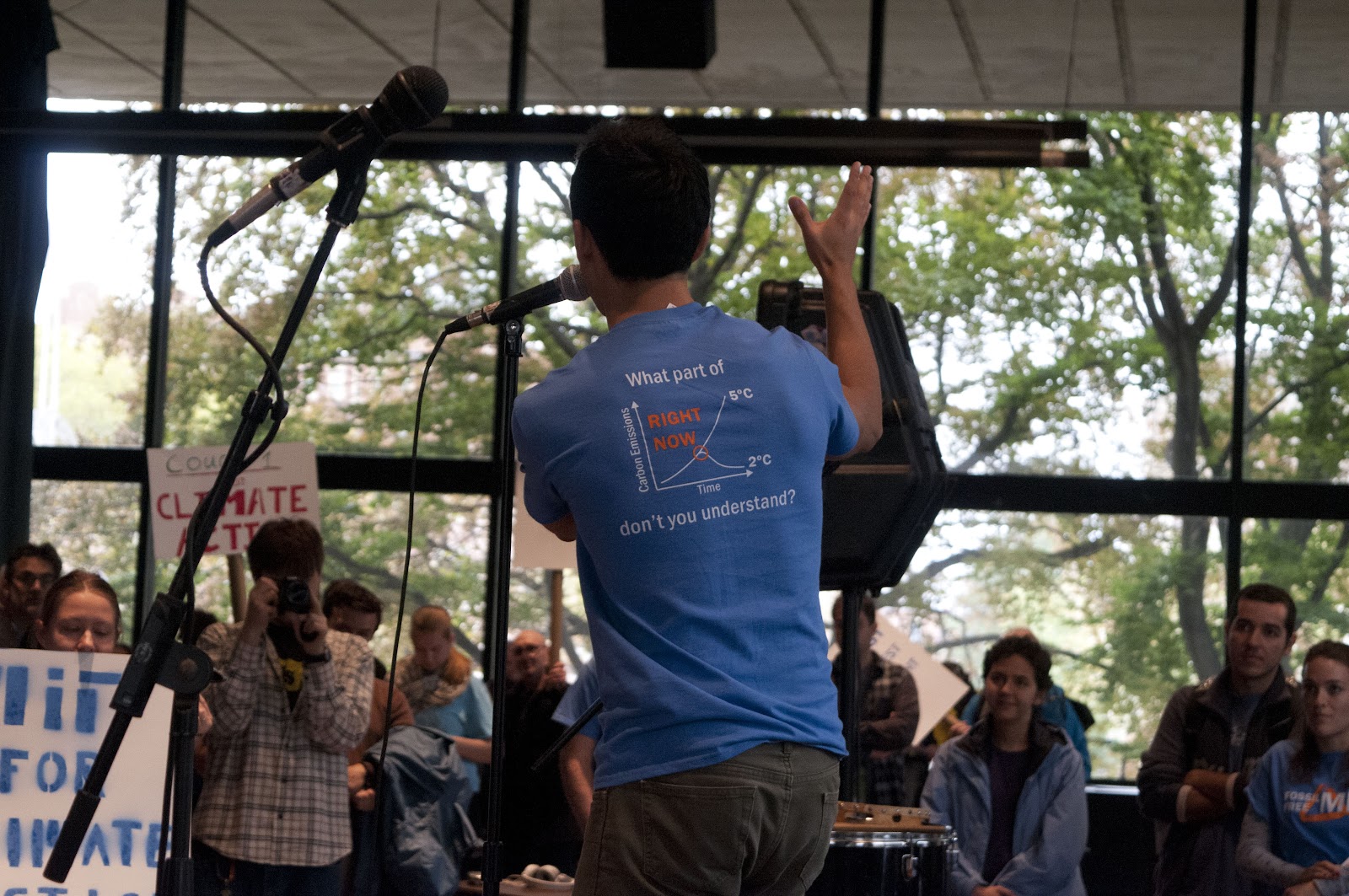
Speaking at the rally, MIT PhD student and divestment advocate Geoffrey Supran highlighted MIT’s closing window of opportunity: “MIT’s moment of decision is now. Right now, a few blocks from here, our President and our Board gather. And as they meet, we gather here united behind bold multi-faceted MIT climate action. We gather here united to call on our president to divest from fossil fuels, to reinvest in sustainability, and to reinvent MIT’s approach to climate action, research and education.”

“Scientist for climate action,” “Divest for our future,” and “MIT for climate justice” were just three of the messages brandished on signs carried by marchers. In full view of the building where MIT’s Board was meeting, a banner was dropped from a student dorm just as marchers congregated, cheering at the top of their lungs in the hope that their leaders would hear their calls for action.

But with MIT more dependent on industry funding than almost any other university in the country, student organizers say “the climate question is far from a done deal.”

Wielding a sign reading “MIT Faculty for Climate Action,” MIT Professor Ian Condry said at the rally, “My concern is that when the announcement happens, it won’t be enough, and that it will be the beginning of the next stage of our fight, not the end.” Yet, he encouraged, “If we can build our social network...and build the movement from below, then eventually it becomes impossible to ignore.”

The rally is the closing action of a week-long series of events called MIT Climate Countdown, organized by student activists. These events brought together dozens of climate and sustainability focused student groups on campus, but also alumni, faculty and staff working in these areas.

Two weeks ago, climatologist James Hansen, actor Mark Ruffalo, MIT professor Noam Chomsky, and Rockefeller Brothers Fund president Stephen Heintz were among 33 prominent signatories to an open letter urging MIT divestment. This followed 3,400 MIT petition signers, open letters from 89 MIT faculty members and 29 student groups, and a resolution of Cambridge City Council.

Credit: Patrick Brown

Credit: Patrick Brown

Credit: Patrick Brown

Credit: Emily Kellison-Linn

Saturday, September 26, 2015

As momentum builds for a new deal on climate change, investors are becoming increasingly nervous about having their cash in fossil fuels

by Kieran Cooke, Climate News Network, September 24, 2015

LONDON – A worldwide movement aimed at encouraging institutions and individuals to turn their backs on fossil fuel investment and so head off serious climate change is on a roll.

Altogether more than 430 investment firms and companies, and over 2,000 individuals, have so far pledged to withdraw investments from fossil fuels. That adds up to US$2.6 trillion in assets, says a report by Arabella Advisors, a US group which helps foundations and wealthy individuals make investment decisions.

The report says that a growing realisation of the risks involved in fossil fuel investments has created a surge in divestment activity over the past 12 months. A similar report produced by Arabella in September 2014 estimated that divestments from fossil fuels then stood at around $50 billion.

The latest report, based on data collected from investment firms and individuals around the world, says growing numbers of pension funds, local governments, religious groups and private companies are pulling their cash out of the fossil fuel sector.

Backing for renewables

Those who have recently pledged to withdraw all or part of their investments in fossil fuels include the California Public Employees’ Retirement System, the Norway Pension Fund, the Canadian Medical Association and the World Council of Churches.

At the same time, says the report, investments in renewable energies are increasing – with clean energy investments around the world reaching $310bn last year.

“The Arabella report shows that more and more investors are reducing their carbon risk today and diversifying their portfolios with the goal to harness the upside in the sustainable clean growth industries of the future,” says Thomas Van Dyck of the SRI Wealth Management Group.

“That underscores what I see every day as a financial advisor – that demand for fossil-free investment products is increasing.”

Clear choice

Christiana Figueres, the executive secretary of the UN Framework Convention on Climate Change, has been among those pushing for a shift in investments from fossil fuels to clean energies.

“Investing at scale in clean, efficient power offers one of the clearest no-regret choices ever presented to human progress,” said Figueres via video link at the New York launch of the Arabella report.

Various funds, foundations and individuals have adopted differing approaches to withdrawing their cash from fossil fuels. Some have divested entirely, while others are divesting from the worst polluters – and the greatest threat to the climate – such as coal companies and those involved in oil produced from tar sands.

Leonardo DiCaprio, the actor, who heads an environmental foundation, is among those who announced that they were withdrawing fossil fuel investments.

Message to leaders

“Climate change is severely impacting the health of our planet and all of its inhabitants, and we must transition to a clean energy economy that does not rely on fossil fuels, the main driver of this global problem,” said DiCaprio.

“Now is the time to divest and invest to let our world leaders know that we, as individuals and institutions, are taking action to address climate change, and we expect them to do their part this December in Paris at the UN climate talks.”

Analysts caution that, while there are signs that investors are becoming increasingly wary about putting their cash into fossil fuels, the industry is powerful and is not about to fade away.

A recent report by the Organisation for Economic Co-operation and Development points out that governments around the world are still providing between $160bn and $200bn of support each year for the production and consumption of fossil fuels. 

Friday, June 19, 2015

Sierra Club Foundation Makes Significant Investments in Climate Solutions

Joining White House Initiative, Foundation Invests 20% of Endowment - $4M

WASHINGTON, D.C. -- Along with scores of other major institutional investors, and as part of Tuesday’s White House Clean Energy Investment Summit, The Sierra Club Foundation announced that it is investing 20% of its endowment, or $4 million, in the clean energy economy.

“Today, we’re putting our money where our mouth is by investing in the rapidly growing future of clean energy” said Peter Martin, The Sierra Club Foundation Executive Director. “Coal stocks are plummeting and the clean energy economy is expanding rapidly. Given the inherent risk of long term investments in all fossil fuels in a world where the G7 nations just committed to complete decarbonization over the course of the century, we are confident that this new commitment will meet our investment return expectations over the long term. At the same time, our best hope of tackling the climate crisis will be achieved only by transitioning the global economy to a clean energy future that protects workers, our communities and our air and water--and these investments support that core mission directly.”

Tuesday’s White House Clean Energy Summit is designed as a forum for foundations, family offices, and institutional investors to share ideas and insights on scaling private sector investment in solutions to climate change, including innovative technologies to reduce carbon pollution.

For many years, The Sierra Club Foundation has been funding work to shut down dirty power plants, stop the construction of new plants, and reduce dependence on fossil fuels that pollute our air, water and climate through its charitable grant-making. At the same time, the Foundation has funded aggressive advocacy to encourage development of clean energy solutions.

In 2010, the Foundation’s efforts were expanded to include mission-aligned investing and shareholder engagement on issues related to its mission, which led to the decision to become one of the initial signers to the Divest-Invest initiative in 2013.

“While institutional and foundation divestment from fossil fuels is an important step, an even more important need is investment in clean energy, efficiency, and innovative technologies that will contribute to climate solutions” said Martin, “The Sierra Club Foundation has already invested $6 million in clean energy and green bonds. Now, this additional $4 million commitment will go toward more targeted investments that will help accelerate the growth of the clean energy economy.”
 
About The Sierra Club Foundation
The Sierra Club Foundation is a 501(c)(3) tax-exempt public charity governed by an independent board of directors which promotes efforts to educate and empower people to protect and improve the natural and human environment.

We partner with individual and institutional donors to align financial resources with strategic outcomes, provide flexible funding for innovation, build capacity in the environmental movement, and create partnerships with a broad spectrum of allied organizations around shared values and goals. As the fiscal sponsor of the charitable programs of the Sierra Club, we provide resources to it and other nonprofit organizations to support scientific, educational, literary, organizing, advocacy, and legal programs that further our goals.

Sunday, April 12, 2015

Stephen Mulkey: Divestment from fossil fuels: An ethical imperative for higher education

group-monument1
by Stephen Mulkey, Environmental Century, April 10, 2015
On November 5, 2012, the Unity College Board of Trustees voted unanimously to divest our $15 million endowment from the top 200 fossil fuel companies, making Unity the world’s first institution of higher learning to explicitly target – using Carbon Tracker, a financial think tank – companies that produce these carbon-based fuels. Since our action, hundreds of campuses have started divestment movements. An increasing number, including Pitzer, Stanford and Syracuse, have voted to divest billions from fossil fuels.
Arguably, our small endowment is considerably more sensitive to bad investment choices than those of elite institutions such as Harvard, Princeton, and others. To date, our investments have thrived. But, as I will explain, divestment is largely immaterial to returns and fees.
With so much at stake for our financial well-being, why would Unity take such bold action? I believe the answer is that our Board viewed divestment as obligatory if the College is to honor the overarching mission of higher education. To be sure, the fiduciary responsibility of boards of trustees extends well beyond financial considerations, and legally requires them to act in the ethical interests of their institution. You might think the ethical imperative derives from the fact that we are an institution informed by the U.S. National Academy concept of sustainability science. But, this aspect of our academic mission is largely irrelevant to this decision; we believe divestment is obligatory, as both an ethical imperative and a fiduciary responsibility for all institutions of higher learning.
The overarching mission of higher education is the maintenance and renewal of civilization. By contrast, the continued business of fossil fuel extraction will, with high certainty, result in significant decline of civilization in the latter half of this century. This derives from the fact that climate change, driven by emissions from these fuels, is an extreme and unique category of threat to our children and all future generations. Although there are compelling arguments to divest from tobacco stocks or companies that did business with apartheid dominated South Africa, the costs of inaction on climate change are staggeringly high. Continued business as usual will result in irrevocable consequences on a millennial time scale.
Put simply, we must leave the carbon in the ground. Generous estimates suggest we can burn only about 20% of conventional reserves without pushing atmospheric warming beyond the putative 2-degree-Celsius guardrail the United Nations Framework Convention on Climate Change determined as the threshold for “dangerous” climate change. As climate science has advanced, we now know that this rather arbitrary limit is not safe for the maintenance and renewal of civilization in its current form because of the enhanced biogenic sources of emissions that will ensue as the atmosphere warms. Presently, we are on a trajectory that will warm the planet between 4 and 6 degrees C by 2100, a condition that would be catastrophic for humanity and many of the Earth’s living systems.
As the consequences of climate change continue to unfold, governing boards will want to be in the strongest ethical position to preserve the relevance and value propositions of their institutions. Accordingly, the first step in deciding divestment is for stakeholders, leadership, and governance to reach a consensus about the ethical imperative of divestment and its relation to the values of the institution.  It is my experience that financial experts should not be engaged until the ethical imperative has been accepted or rejected by the institution’s governing body.
In the near to intermediate term, there is a very pragmatic reason for divestment. If we assume that humanity will wake up in time to avoid catastrophic climate change, most of the carbon reserves of these companies will become stranded assets and this will significantly diminish their assessed value. If mitigation of climate change is to be effective, these assets must become stranded within no more than 15 years. Once regulation of carbon emissions begins in earnest, the perception that these assets are of dubious value will occur long before they are likely to be mined. This drop in value will be a direct threat to the value of the institution’s portfolio.
Most portfolios have holdings that commingle desirable and undesirable assets, so it is necessary that divestment be executed over a considerable period. The approach that works best is to progressively reduce exposure to the top 200 fossil fuel companies over a period as long as five years. This should not require additional fees, because it does not involve extraordinary trading or management. Divestment simply adds a new criterion to routine portfolio management.
One way to accomplish divestment is to avoid the energy sector entirely. This approach, taken by Unity College, cut exposure to the 200 targeted companies to less than 1 percent of overall returns in less than two years. There has been no apparent opportunity cost with respect to returns because there are thousands of financial products that can replace, replicate, and sometimes even outperform the energy sector. Moreover this process is becoming easier as institutional clients continuously push the financial industry to create new fossil fuel free products.
When such a direct approach is not possible for large endowments, slow and steady reduction of exposure over longer horizons achieves the same result, realizing that, because of derivatives trading and the interdependence of holdings within equities, “absolute zero” exposure will be elusive – even unlikely – in most scenarios.
It is important to understand that returns on a divested portfolio are largely unrelated to the act of divestment. Returns are primarily determined by the overall performance of the market and asset selection by savvy management. Studies have shown a small tracking error in returns of a divested portfolio relative to major market indices primarily because, periodically, the energy sector can drive overall market performance.
As higher education faces extreme disruption during the coming years, risk – particularly fiduciary risk — will manifest in many forms. Remember that divestment and returns are not automatically correlated, and higher education must meanwhile make clear statements and be public about ethical values. Unity views this articulation of values as an essential market position, and views the downside fiduciary risk of divesting as less challenging than the risk of not upholding its unimpeachable moral imperative to distinguish itself as an ethical bulwark for higher education in the marketplace of this, the Environmental Century.
As president of the first college to divest, I am enormously proud of our visionary board, faculty, and students. Unity College has entered a new era in which our brand and ethos are a national province. Parents and students look to us an example of what higher education can be. We are all in this together to develop a model in which financial risk is mitigated by investing choices that are ethically and financially sound while – most importantly – nurturing a civilization on which all our endeavors depend.

Friday, October 24, 2014

Wen Stephenson: Letter to Harvard President Drew Faust


President Drew Gilpin Faust
Harvard University
Massachusetts Hall
Cambridge, MA  02138

Dear President Faust:

Earlier this week, the leadership of Hong Kong’s undemocratic government participated in a live, televised forum with student protesters about the future of democracy in the territory. At the very same time, throughout this week, students calling for fossil-fuel divestment at Harvard University have been engaged in a conscientious and well-organized fast—supported by many students, faculty, and alumni—after their legitimate calls for an open public dialogue with you, over the course of more than two years now, have been rejected. It appears that an open debate about democracy is less threatening to the leaders in Hong Kong and Beijing than the prospect of an open debate about fossil-fuel divestment—and the corrupting influence of fossil-fuel corporations on our American democracy—is to the administration of Harvard University.

I have a personal stake in this debate. I am a member of the Harvard College Class of 1990, deeply engaged in the Divest Harvard campaign, and as I write this, amazing as it may sound, I stand effectively banned from Harvard’s campus because I dared to protest peacefully against your administration’s position on fossil-fuel divestment and your lack of public dialogue with the students. My purpose here is to respectfully inform you that this Sunday, October 26, I’m coming back to campus in an open and conscientious violation of that ban.

On May 30 of this year, as I’m sure you will remember, I and three of my fellow Harvard alumni—holding degrees from the Business School, the Divinity School, the Law School and Kennedy School, and the College—stood silently in front of the stage where you were sitting in Sanders Theater, as you were about to address several hundred Harvard graduates attending their class reunions. With the support of many fellow alums engaged in the divestment campaign, we held a banner with the words “Harvard Alumni For Divestment.” We stood in solidarity with the students of Divest Harvard, and we stood for the kind of action necessary to address climate change, the greatest and most urgent human rights struggle of our time.

As we stood with our banner, we were immediately approached by a plain-clothes security officer—who discreetly attempted (but failed) to rip the banner from my hands—and were told that we would have to leave. When we quietly and respectfully declined to move, uniformed Harvard Police were called in, and we were ushered out of the theater. The whole thing, you will recall, lasted perhaps two minutes. As I walked out, I noticed that you were smiling.

You must admit that we went peacefully. Indeed, everything about our action was peaceful. It’s worth noting that we very purposely did not interrupt your speech, and that as far as we could tell, nothing about our action prevented you from speaking or members of the audience from hearing what you had to say. We were there simply to make our presence and our message known, in a way that could not be ignored, and to bear silent witness to the proceedings—a Harvard reunion event that, as everyone knows, is central to the university’s fundraising operations and therefore of the utmost relevance to the call for divestment.

But this is where it gets interesting, President Faust. Once outside the theater, in the foyer of Memorial Hall, the Harvard Police officers—who were nothing but courteous and professional, simply doing their jobs—informed us that we would not be arrested. At least, not that day. We could have been: Harvard certainly might have arrested us, charged us with trespassing or whatnot, and been done with it—just another civil disobedience protest on an American university campus.

But that isn’t what happened, is it? As we waited quietly, the officer in charge spoke on his phone with someone, presumably a superior officer, and when the call was finished, he told us that we were free to go—with one catch. If we came back onto Harvard property for any reason, he said, we would be subject to arrest. However, he said, if we made an appointment to speak with the chief of the Harvard University Police Department (vested with real police powers in the City of Cambridge), and asked his permission to return to campus, the police chief might agree to rescind this order. It was made very clear that the decision would be the chief’s.

In other words, Harvard appears to have delegated to the chief of its police force the power to decide whether or not four peaceful alumni activists can return to campus for any reason—including to engage in further political speech.

This SundayHarvard Faculty for Divestment—the group of more than 160 faculty members who have signed a resolution calling on the university to divest from fossil fuels—is holding a “Faculty Forum on Divestment” in Fong Auditorium. The event is billed as “free and open to the public,” and I plan to be there and to participate in the discussion. I have informed the faculty organizers that I am coming, but they have declined to take a position, one way or the other, as to whether they support my presence there.

I am not asking anyone’s permission to come back to Harvard’s campus for this event. Specifically, I do not recognize the authority of Harvard’s police chief to decide whether or not I can participate in this free and open discussion on the campus of my alma mater. While Harvard may or may not have the legal right to prevent me or to arrest me once I’m there—an interesting question in itself—I firmly believe, along with many others, that in terms of academic values, this order is an illegitimate use of a university’s police powers, clearly intended to intimidate and to suppress speech on this issue.

Whatever happens on Sunday, I and the other banned alumni—like the divestment campaign and the larger climate movement of which we’re a part—are not going away. We’ll be back on campus, with or without permission, to continue engaging in this most important of debates. It would restore some of my faith in this university if you would personally join us, openly and publicly, in this debate.

My wife, also a member of the class of 1990, will be there on Sunday to support me. Together, we have been engaged in the life of the university for 25 years. For the past five years, we and our children, age 10 and 14, have served as a host family for incoming international students. One of them is a current sophomore from Beijing, a place where political freedoms are less than perfect. Another, our newest undergraduate friend, is a freshman from South Africa—a country whose history is a testament to the power of principled political struggle.  These students are inheriting a world ravaged by our climate catastrophe. Whether any semblance of a just society remains possible for them and future generations depends on the actions we take today.

I only wish that my action at Harvard this Sunday were unnecessary—that I didn’t have to show my young friends what it takes to defend the principles of free and open speech at the great American university they have worked so hard to attend.

Yours sincerely,