Blog Archive

Showing posts with label Hans Joachim Schellnhuber. Show all posts

Saturday, October 6, 2018

Graham Readfearn: Earth's climate monsters could be unleashed as temperatures rise

As a UN panel prepares a report on 1.5 C global warming, researchers warn of the risks of ignoring ‘feedback’ effects

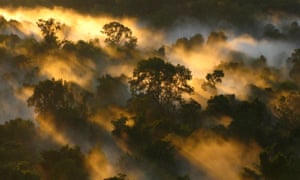
Amazon forest

 Fundamental questions are being raised about the ability of governments to stop the Earth from spiraling into a ‘hothouse’. Photograph: Peter van der Sleen/University o/PA

by Graham Readfearn, The Guardian, October 6, 2018

This week, hundreds of scientists and government officials from more than 190 countries have been buzzing around a convention centre in the South Korean city of Incheon.

They are trying to agree on the first official release of a report – the bit called the Summary for Policymakers – that pulls together all of what’s known about how the world might be affected once global warming gets to 1.5 C.
What will happen to coral reefs? How will extreme weather events and droughts change? What about heatwaves? And then, what are the different “pathways” that economies could choose to keep temperatures to 1.5 C?
On Monday morning, the summary document is expected to be released, and there will be a cascade of headlines around the world.
The report, being pulled together by the United Nations Intergovernmental Panel on Climate Change, was one tiny part of the Paris climate change agreement.
As things stand, if you add up all the things that the 190-plus countries have committed to do as part of that Paris deal, global temperatures will probably go well above 3 C.
We’re already at 1 C of warming, so the extra half a degree isn’t far away – many scientists will say it’s already locked in, while others say there are plausible ways to stabilize temperatures at that level.
But in August, one of the world’s leading scientific journals – the Proceedings of the National Academy of Sciences – published a “perspective” article that has become known as the “hothouse earth” paper.
There was no new science in the paper and while it was speculative, it did raise fundamental questions about the ability of governments around the world to stop the Earth from spiraling into a “hothouse.”
One of the report’s authors, Professor Will Steffen, of Australian National University and the Stockholm Resilience Centre, talked me through it.
The problem lies with “feedbacks” – in the “supplementary information” attached to the paper, Steffen and colleagues actually listed 10 of them. With each, they include estimates of how much extra CO2 and temperature they could add once you hit about 2 C of global warming.
For example, the ability of the land and ocean to keep soaking up CO2 could weaken, giving you an extra 0.25 C of warming. Dieback of trees in the Amazon and subarctic could give us another 0.1 C.
Permafrost, which is already starting to defy its name by not being all that permanent, could release ever more methane and carbon that might add a bit more warming again (0.09 C is the estimate there).
The point is that once you add them all up, you get close to 0.5 C of warming by the end of the century. Given we’re already at 1 C of global warming, that makes the job of keeping warming “well below 2 C” or even holding it at 1.5 C much, much harder than it already is.
And there’s the rub.
While governments have the means to affect how much CO2 gets released through policies that radically cut the use of fossil fuels, it would be much harder to get a grip on thawing permafrost, mass forest collapses, or the loss of polar sea ice.
By failing to get a grip on a thing that’s feasibly under your control, we end up risking the release a whole gang of other monsters that we can’t.
This gets us to another big issue, says Steffen, because climate models don’t include some of these feedbacks. In essence, the warmer things get, the less reliable the models become. He tells me:
“I think the dominant linear, deterministic framework for assessing climate change is flawed, especially at higher levels of temperature rise.
So, yes, model projections using models that don’t include these processes indeed become less useful at higher temperature levels. Or, as my co-author John Schellnhuber says, we are making a big mistake when we think we can “park” the Earth System at any given temperature rise – say 2 C – and expect it to stay there.”
For those who understand the idea of a carbon budget – where scientists have calculated him much CO2 you could emit before hitting certain temperature rises – it looks even meaner than before if Steffen and his colleagues are right.
But as they also point out, several of these feedbacks might have “tipping points” that then set off a cascade of other issues. Steffen says:
“Even at the current level of warming of about 1 C above pre-industrial, we may have already crossed a tipping point for one of the feedback processes (Arctic summer sea ice), and we see instabilities in others – permafrost melting, Amazon forest dieback, boreal forest dieback and weakening of land and ocean physiological carbon sinks.
And we emphasize that these processes are not linear and often have built-in feedback processes that generate tipping point behavior. For example, for melting permafrost, the chemical process that decomposes the peat generates heat itself, which leads to further melting and so on.”
For the record, Steffen thinks the assumptions in climate models that cuts in fossil fuel emissions will deliver relative cuts in temperatures “is OK for perhaps lower temperature rises of 1.5 or 2 C,” but beyond that, he’s sceptical.

The paper has received a bit of pushback from scientists, largely, it appears, because of the sensational headlines it attracted.

For example, Professor Richard Betts, of the UK’s MetOffice, has a measured perspective that’s well worth a look.

Dr Glen Peters, an Australian scientist and climate modeller based at the Centre for International Climate Research in Norway, also thought some of the media coverage went too far with the doomsday vibe.

But he told me that, while it was true that many of the feedbacks in the paper were not well covered by climate models, this was partly because they were not that well understood. I’ll leave you with his thoughts:
“The hothouse earth paper conjectures that many of these feedbacks may interact like a domino effect, lead the Earth system to spiral out of control to reach a new steady state very different from today, and these processes may even start if we are successful at meeting the goals of the Paris Agreement.
“There is also an important timescale question, are we talking decades or millennia, and that is very important for how society may respond. While all the claims made in the hothouse earth paper are justified, we simply don’t have the data to verify if those claims are true. While the paper put in plenty of language to indicate its exploratory nature … many headlines and statements went too far, indicating we had already gone too far and there was no turning back.”
https://www.theguardian.com/environment/planet-oz/2018/oct/06/earths-climate-monsters-could-be-unleashed-as-temperatures-rise

Saturday, July 22, 2017

Asian temperatures could rise disastrously

Profligate fossil fuel use could cause Asian temperatures to rise by 6 °C, bringing floods and food shortages for hundreds of millions.
by Tim Radford, Climate News Network, July 21, 2017

LONDON 
– Unrestrained climate change could have serious consequences by forcing Asian temperatures drastically upwards; it could limit economic growth and reverse recent human advances for hundreds of millions, according to a new study.
The Asian Development Bank and the Potsdam Institute for Climate Impact Research say in a new report that if humans continue to burn fossil fuels under the “business as usual” scenario, then global average temperatures could rise by 4 °C.
But over the landmass of Asia, summer temperatures could rise by 6 °C and high mountain nations such as Afghanistan, Tajikistan, Pakistan, and northwest China could register summer rises of 8 °C above historic levels. Heat-related deaths among the elderly are predicted to rise by 52,000 cases by 2050.
These devastating temperatures would be accompanied by more rain – although Pakistan and Afghanistan could become much drier – and greater vulnerability to flooding as typhoons and tropical cyclones increase in intensity.

Child hunger

Global flood losses, set at $6bn a year in 2005, could rise to $52bn by 2050, and 13 Asian cities are among the 20 worldwide that can expect the greatest flood losses in the next 30 years.
Food production could be hit and rice yields in south-east Asia, for example, could drop by 50%. Food shortages could increase the count of malnourished children in south Asia by 7m.
Coral reefs in the region could be devastated by mass bleaching. Sea levels could rise by 1.4 metres by 2100 and go on rising over the centuries by more than five metres.
“The global climate crisis is arguably the biggest challenge human civilisation faces in the 21st century, with the Asia and Pacific region at the heart of it all," said Bambang Susantono, of the Asian Development Bank.

“The Asian countries hold Earth's future in their hands. If they choose to protect themselves against dangerous climate change, they will help to save the entire planet”

“Home to two-thirds of the world's poor, and regarded as one of the most vulnerable regions to climate change, countries in Asia and the Pacific are at the highest risk of plummeting into deeper poverty – and disaster – if mitigation and adaptation efforts are not quickly and strongly implemented.”
Over the last 25 years, per capita income in Asia and the Pacific has grown tenfold: so too have the cities. The world has 71 cities with more than 5m inhabitants, and 33 of these are in Asia. These 33 are now home to 348m people. By 2030, they could be sheltering 483bn, a 40% growth in 15 years. By 2030, there could be another eight megacities, four in India.
But as wealth has increased, so has inequality. The poorest are most likely to be the greatest victims of unrestrained climate change.
“The Asian countries hold Earth's future in their hands. If they choose to protect themselves against dangerous climate change, they will help to save the entire planet,” said Hans Joachim Schellnhuber, director of the Potsdam Institute.

Crucial actor

“The challenge is twofold. On the one hand, Asian greenhouse gas emissions have to be reduced in a way that the global community can limit planetary warming to well below 2 °C, as agreed in Paris 2015.  
“Yet even adapting to 1.5 °C temperature rise is a major task. So, on the other hand, Asian countries have to find strategies for ensuring prosperity and security under unavoidable climate change within a healthy global development,” Professor Schellnhuber said.
“But note that leading the clean industrial revolution will provide Asia with unprecedented economic opportunities. And exploring the best strategies to absorb the shocks of environmental change will make Asia a crucial actor in 21st Century multilateralism.”

Monday, May 8, 2017

Joe Romm: Carbon pollution is suffocating ocean life and speeding up the next mass extinction

Oxygen levels ‘falling 2 to 3 times faster than predicted’ in our warming oceans, study finds


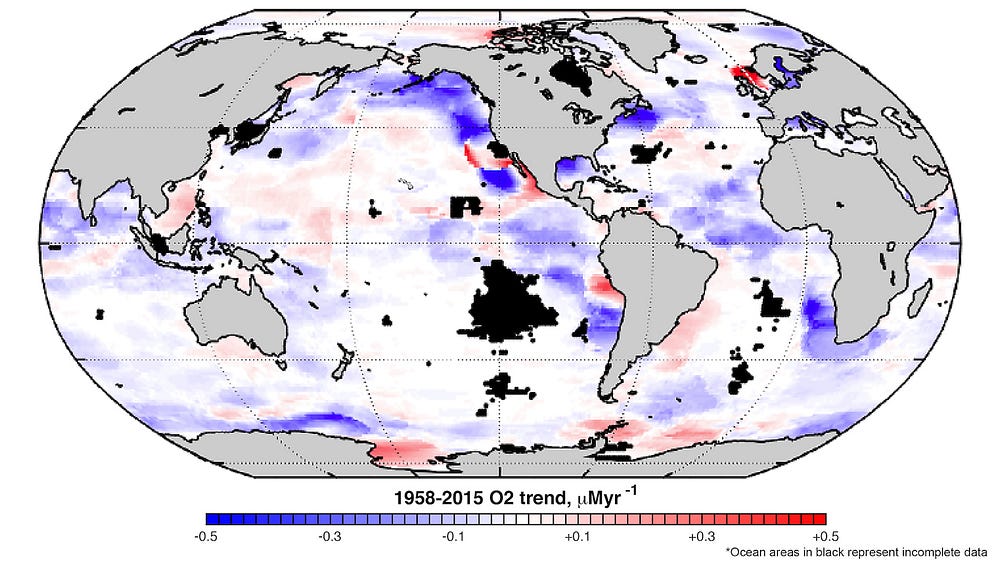
Much of the ocean is seeing sharp drops in oxygen levels (purple). CREDIT: Georgia Tech.

by Joe Romm, Climate Progress, May 8, 2017
Depletion of dissolved oxygen in our oceans, which can cause dead zones, is occurring much faster than expected, a new study finds.
And by combining oxygen loss with ever-worsening ocean warming and acidification, humans are re-creating the conditions that led to the worst-ever extinction, which killed over 90% of marine life 252 million years ago.
Researchers at Georgia Institute of Technology reviewed ocean data going back to 1958 and “found that oxygen levels started dropping in the 1980s as ocean temperatures began to climb.”
Scientists have long predicted that as carbon pollution warms the globe, the amount of oxygen in our oceans would drop, since warmer water can’t hold as much dissolved gas as colder water. And, Georgia Tech researchers point out, falling oxygen levels have recently led to more frequent low-oxygen events that “killed or displaced populations of fish, crabs and many other organisms.”
But what is especially worrisome about this new research is how quickly it is happening. “The trend of oxygen falling is about two to three times faster than what we predicted from the decrease of solubility associated with the ocean warming,” said lead researcher Prof. Taka Ito. “This is most likely due to the changes in ocean circulation and mixing associated with the heating of the near-surface waters and melting of polar ice.”
Global warming drives ocean stratification — the separation of the ocean into relatively distinct layers. This in turn speeds up oxygen loss, as explained in this 2015 video.


2011 study, “Rapid expansion of oceanic anoxia immediately before the end-Permian mass extinction,” found that rapid and widespread anoxia (absence of oxygen) preceded “the largest mass extinction in Earth history, with the demise of an estimated 90 percent of all marine species.”
As National Geographic reported in 2015, we’re already starting to see the impacts of anoxia. “The waters of the Pacific Northwest, starting in 2002, intermittently have gotten so low in oxygen that at times they’ve smothered sea cucumbers, sea stars, anemones, and Dungeness crabs,” the magazine reported.
Finally, a 2015 study found there is no techno-fix to prevent a catastrophic collapse of ocean life for centuries if not millennia if we continue current CO2 emissions trends through 2050.
If we don’t start slashing carbon pollution, then, as co-author John Schellnhuber put it, “we will not be able to preserve ocean life as we know it.”
Thanks to Samantha Page.

Wednesday, September 25, 2013

David Spratt: Is climate change already dangerous? Part IV. Tipping points and climate modelling

by David Spratt, Climate Code Red, September 24, 2013
Fourth in a series

A tipping point may be understood as a step change, or passing of a critical threshold, in a major earth-climate system component, where a small perturbation (a small push or change) unleashes a bigger change in the component.  Potsdam Institute Director, Prof. Hans Joachim Schellnhuber, says that tipping points “identify the most vulnerable components (tipping elements) of the Earth System, the critical warming thresholds where the respective Earth System elements flip into a qualitatively new state.”  These elements include ecosystems, major ocean and atmospheric circulation patterns, the polar ice sheets, and the land- and ocean-based carbon stores.
This process is often tied to positive feedbacks, where a change in a component leads to other changes that eventually “feed back” onto the original change to amplify it.  The classic case in global warming (or, in reverse, cooling) is the ice-albedo feedback, where decreases (increases) in the ice cover area change surface reflectivity (albedo), trapping more (less) heat and producing further ice loss (gain).


In some cases, passing one threshold will trigger further threshold events, for example where substantial releases from permafrost carbon stores increase warming, releasing more permafrost carbon but also pushing other systems, for example parts of the Antarctic ice sheet, past a threshold point.
Once a tipping point is crossed, it is irreversible (under natural conditions) within certain time frames, so the consequence is to significantly affect the earth’s climate and ecosystems, for example by raising temperatures or greenhouse gas levels, or changing the efficiency of the land and ocean carbon sinks.  Given enough time and the right conditions, most processes (but not extinctions, for example) can be reversed.

In a period of rapid warming, most major tipping points once crossed (ice sheet loss, large-scale land carbon store releases such as permafrost) are irreversible on human time frames running to a few generations, principally due to the longevity of atmospheric CO2 (several thousand years). Large-scale human interventions in slow-moving earth system tipping points might allow a tipping point to be reversed (for example, a large-scale atmospheric CO2 drawdown program, or solar radiation management).

There is discussion, for example, that Arctic sea-ice loss is “easily reversible” in a cooling world, but that is easier said than done.  That would require greenhouse gas levels to be reduced significantly, below the level equivalent to the temperature at which the sea-ice system tipped in 2007, to produce a sufficiently cooler world.  This would be around 300–325 ppm CO2, compared to the present level of 400 ppm, so it is not so “easy” in the real world.

The scientific literature on tipping points is relatively recent, with a significant contribution by Lenton, Held et al. in 2008 on “Tipping elements in the Earth’s climate system” in an issue of the journal Proceedings of the National Academy of Sciences devoted to the subject. However, our knowledge is limited because “a system-level understanding of critical Arctic processes and feedbacks is still lacking” (Maslowski, Kinney et al.) and “no serious efforts have been made so far to identify and qualify the interactions between various tipping points” (Schellnhuber).
 
Climate models are not yet good at dealing with tipping points. This is partly in the nature of tipping points, where a particular and complex confluence of factors suddenly change a climate system characteristic and drives it to a different state. To model this, all the contributing factors and their forces have to well identified, as well as their particular interactions, plus the interactions between tipping points. Duarte, Lenton et al. conclude that “complex, nonlinear systems typically shift between alternative states in an abrupt, rather than a smooth manner, which is a challenge that climate models have not yet been able to adequately meet.”

The classic case was the Arctic sea ice “big melt” in 2007. Many models, including those on which the 2007 IPCC report had relied to conclude that Arctic sea-ice was pretty much likely to remain till the end of the century, did not fully capture the dynamics of sea-ice loss. Thus when in 2007 the summer sea-ice extent dropped radically compared to previous years, some model-oriented researchers exclaimed that the Arctic was melting “a hundred years ahead of schedule.”

Even today, papers are still being published with modelling that suggests a sea-ice free Arctic will not occur till mid-century. Given the observations, it’s difficult not to conclude that given a choice between their models and real-world observations, some modellers will always choose the former. 

In an overview of the current state of Arctic climate research, Maslowski, Kinney et al. conclude that: “Model limitations are hindering our ability to predict the future state of Arctic sea ice,” and that the majority of general climate models (GCMs) including those used in IPCC (2007) “have not been able to adequately reproduce observed multi-decadal sea-ice variability and trends in the pan-Arctic region,” and their ensemble mean trend in September Arctic sea-ice extent “is approximately 30 years behind the observed trend.”

For example, what would be the impact of a sea-ice-free Arctic summer and the consequent amplified regional warming on the stability of the Greenland Ice Sheet (GIS)? Research does not yet provide a robust framework for considering such questions, yet most scientists if asked for their expert elicitation would probably say that it is hard to imagine the GIS doing anything other than melting at an accelerating rate and passing a critical tipping point in such circumstances.

The sea-ice model that has performed best (acronym NAME), is one of a new range of more specialised regional climate models developed by Dr Wieslaw Maslowski and colleagues. Maslowski is highly regarded, in part because his position at the American Naval Postgraduate School has given him unique access to half a century of Arctic sea-ice thickness scans from polar US military submarines. Maslowski told BBC News:

In the past… we were just extrapolating into the future assuming that trends might persist as we’ve seen in recent times. Now we’re trying to be more systematic, and we’ve developed a regional Arctic climate model that’s very similar to the global climate models participating in IPCC assessments. We can run a fully coupled model for the past and present and see what our model will predict for the future in terms of the sea ice and the Arctic climate. 
He emphasizes “the need for detailed analyses of changes in sea ice thickness and volume to determine the actual rate of melt of Arctic sea ice,” and concludes that:
The modeled evolution of Arctic sea ice volume appears to be much stronger correlated with changes in ice thickness than with ice extent as it shows a similar negative trend beginning around the mid-1990s. When considering this part of the sea ice–volume time series, one can estimate a negative trend of −1,120 km3 year−1 with a standard deviation of +/-2,353 km3 year−1 from combined model and observational estimates for October–November 1996–2007. Given the estimated trend and the volume estimate for October–November of 2007 at less than 9000 km3, one can project that at this rate it would take only 9 more years or until 2016 +/-3 years to reach a nearly ice-free Arctic Ocean in summer. Regardless of high uncertainty associated with such an estimate, it does provide a lower bound of the time range for projections of seasonal sea ice cover.
The point cannot be emphasized enough that the best-performing Arctic sea-ice model projects 2016 +/-3 years to reach a nearly ice-free Arctic Ocean.

Arctic sea ice volumes estimates from observations and from the NAME model
(Maslowski, Kinney et al., 2012, Figure 9)
 The non-linear problem still plagues many Arctic GCMs, and indeed parts of the IPCC process which largely excludes tipping points and carbon cycle feedbacks from consideration, exemplified by the 2007 IPCC’s reticence on sea level rises. Several fundamental projections found in IPCC reports have consistently underestimated real-world observations in at least eight key areas.  In its February 2007 report on the physical basis of climate science, the IPCC said that Arctic sea-ice was responding sensitively to global warming: ‘While changes in winter sea-ice cover are moderate, late summer sea-ice is projected to disappear almost completely towards the end of the twenty first century.’ And apparently the forthcoming 2013 IPPC AR5 has omitted consideration of permafrost feedbacks – another glaring example of that body’s scientific reticence (Romm, 2012).

http://www.climatecodered.org/2013/09/is-climate-change-already-dangerous-4_24.html

Tuesday, March 5, 2013

"Quasiresonant amplification of planetary waves and recent Northern Hemisphere weather extremes," by V. Petoukhov, S. Rahmstorf, S. Petri & H. J. Schellnhuber, PNAS (2013); doi: 10.1073/pnas.1222000110

Proceedings of the National Academy of Sciences, published online before print March 1, 2013; doi:10.1073/pnas.1222000110 


Quasiresonant amplification of planetary waves and recent Northern Hemisphere weather extremes

  1. Hans Joachim Schellnhubera,b,*
  1. Contributed by Hans Joachim Schellnhuber, January 16, 2013 (sent for review June 15, 2012)

Abstract

In recent years, the Northern Hemisphere has suffered several devastating regional summer weather extremes, such as the European heat wave in 2003, the Russian heat wave and the Indus river flood in Pakistan in 2010, and the heat wave in the United States in 2011. Here, we propose a common mechanism for the generation of persistent longitudinal planetary-scale high-amplitude patterns of the atmospheric circulation in the Northern Hemisphere midlatitudes. Those patterns —with zonal wave numbers m = 6, 7, or 8 — are characteristic of the above extremes. We show that these patterns might result from trapping within midlatitude waveguides of free synoptic waves with zonal wave numbers k ≈ m. Usually, the quasistationary dynamical response with the above wave numbers m to climatological mean thermal and orographic forcing is weak. Such midlatitude waveguides, however, may favor a strong magnification of that response through quasiresonance.

Tuesday, February 26, 2013

Weather extremes provoked by trapping of giant waves in the atmosphere

            
by the Potsdam Institute for Climate Impact Research, February 25, 2013
 
The world has suffered from severe regional weather extremes in recent years, such as the heat wave in the United States in 2011 or the one in Russia 2010 coinciding with the unprecedented Pakistan flood. Behind these devastating individual events there is a common physical cause, propose scientists of the Potsdam Institute for Climate Impact Research (PIK). The study will be published this week in the US Proceedings of the National Academy of Sciences and suggests that man-made climate change repeatedly disturbs the patterns of atmospheric flow around the globe's Northern Hemisphere through a subtle resonance mechanism.
 
Weather extremes provoked by trapping of giant waves in the atmosphere
Meridional windfield over four different timespans. 
      
“An important part of the global air motion in the mid-latitudes of the Earth normally takes the form of waves wandering around the planet, oscillating between the tropical and the Arctic regions. So when they swing up, these waves suck warm air from the tropics to Europe, Russia, or the US, and when they swing down, they do the same thing with cold air from the Arctic,” explains lead author Vladimir Petoukhov.

“What we found is that during several recent extreme weather events these planetary waves almost freeze in their tracks for weeks. So instead of bringing in cool air after having brought warm air in before, the heat just stays. In fact, we observe a strong amplification of the usually weak, slowly moving component of these waves,” says Petoukhov. Time is critical here: two or three days of 30 degrees Celsius are no problem, but 20 or more days lead to extreme heat stress. Since many ecosystems and cities are not adapted to this, prolonged hot periods can result in a high death toll, forest fires, and dramatic harvest losses.

Anomalous surface temperatures are disturbing the air flows

Climate change caused by greenhouse-gas emissions from fossil-fuel burning does not mean uniform global warming – in the Arctic, the relative increase of temperatures, amplified by the loss of snow and ice, is higher than on average. This in turn reduces the temperature difference between the Arctic and, for example, Europe, yet temperature differences are a main driver of air flow. Additionally, continents generally warm and cool more readily than the oceans. “These two factors are crucial for the mechanism we detected,” says Petoukhov. “They result in an unnatural pattern of the mid-latitude air flow, so that for extended periods the slow synoptic waves get trapped.”

The authors of the study developed equations that describe the wave motions in the extra-tropical atmosphere and show under what conditions those waves can grind to a halt and get amplified. They tested their assumptions using standard daily weather data from the US National Centers for Environmental Prediction (NCEP). During recent periods in which several major weather extremes occurred, the trapping and strong amplification of particular waves – like “wave seven” (which has seven troughs and crests spanning the globe) – was indeed observed. The data show an increase in the occurrence of these specific atmospheric patterns, which is statistically significant at the 90% confidence level.

The probability of extremes increases – but other factors come in as well

“Our dynamical analysis helps to explain the increasing number of novel weather extremes. It complements previous research that already linked such phenomena to climate change, but did not yet identify a mechanism behind it,” says Hans Joachim Schellnhuber, director of PIK and co-author of the study. “This is quite a breakthrough, even though things are not at all simple – the suggested physical process increases the probability of weather extremes, but additional factors certainly play a role as well, including natural variability.” Also, the 32-year period studied in the project provides a good indication of the mechanism involved, yet is too short for definite conclusions.

Nevertheless, the study significantly advances the understanding of the relation between weather extremes and man-made climate change. Scientists were surprised by how far outside past experience some of the recent extremes have been. The new data show that the emergence of extraordinary weather is not just a linear response to the mean warming trend, and the proposed mechanism could explain that.

Article: Petoukhov, V., Rahmstorf, S., Petri, S., Schellnhuber, H. J. (2013): Quasi-resonant amplification of planetary waves and recent Northern Hemisphere weather extremes. Proceedings of the National Academy of Sciences (Early Edition) [doi:10.1073/pnas.1222000110]

Weblink to the article (once it is published):
www.pnas.org/cgi/doi/10.1073/pnas.1222000110

Wednesday, May 16, 2012

David Spratt, CCR: review of The Politics of Climate Change (2nd edn.) by Anthony Giddens

From the review of The Politics of Climate Change (2nd edn.) by Anthony Giddens


by David Spratt, Climate Code Red blog, May 16, 2012


... Many specialists in the field view recent climate change policies as far from ambitious. Prof. Hans Joachim Schellnhuber, director of the Potsdam Institute, who has been climate adviser to both Chancellor Merkel and the European Union, and has been engaged in international climate politics for many years, says that “we are on our way to a destabilisation of the world climate that has advanced much further than most people or their governments realise.” He observes that "if political reality (on climate) is not grounded in physical reality, it is useless,” as we mournfully witness.


Last year, Schellnhuber told the “4 degrees or more: Australia in a hot world” conference in Melbourne that there were limits to what the policymakers could bear to hear. “If you speak the inconvenient truth, people will not listen,” said Schellnhuber, adding that if you are too frank, you “risk losing everything.”


This is why climate politics is characterised by cognitive dissonance, a delusion about the scale and urgency of the problem that allows policymakers and advocates at both a national and global level to continue to engage in the fantasy that they are working to contain global warming to a “reasonable” two degrees Celsius. In fact, the lack of action means we are now headed to around four degrees of warming this century (and a probable carrying capacity of the planet of under one billion people), whereas a safe target is under one degree. That the delusional character of climate policy-making makes no appearance in a title the publishers claim to be “the only book that looks at the political issues posed by global warming” is disturbing. At the heart of this work, I sense a void.

NASA climate chief James Hansen convincingly argues that the goal of “limiting human-made warming to two degrees (is a) prescription for disaster” because today, at less than one degree of warming, we are “poised such that additional warming instigates large amplifying high-latitude feedbacks” will come into play in the next one degree of warming. These will make “ice sheet disintegration and large sea level rise inevitable”* amongst many devastating impacts. This is not part of the today’s climate policy frame.


The problem, quite simply, is that what needs to be done cannot be achieved by contemporary politics in today’s deregulated capitalist economies, so the ruling elites have chosen to live a lie. They create the appearance of solving the problem, when they are not. Giddens says he accepts “up to a point” that “coping with climate change is too difficult a problem to be dealt with within the confines of orthodox politics,” but does not follow up on this observation.


Take the emissions reductions necessary to keep warming in the long run to a safe level of under one degree. Hansen shows that fossil fuel emissions would need to be cut by 6% a year beginning in 2012, plus 100 billion tonnes of carbon reforestation drawdown in the 2031-2080 period, if the world is to be back to the one-degree target by century’s end. If global emissions do not peak till 2020, then to limit warming to the (unsafe) two-degree range, the rate of emissions reduction hits 9-10% a year, and requires total de-carbonisation by 2035-45.
      

By comparison, emissions reductions of more than one percent a year have been pushed, in the words of the Stern Report, only by “recession or upheaval.” The commentator David Roberts notes: “The total collapse of the USSR knocked five percent off its emissions. So 10% a year is like … well, it’s not like anything in the history of human civilisation” (2011: online). This is the core driver of the climate policy delusion: those at the centre of the process believe they cannot do what is necessary, but (as yet) haven’t been game to admit it in public.
      

The politics is this: we have to do something we have never done before and quickly create a decarbonised economy, a rapid whole-of-society transition. Not possible, say most of those in power. But there are examples of very quick social and economic change, both under the current (ostensibly) communist leadership in China, and in the evolution of the Asian “tiger” economies where a strong state and a capitalist elite transformed the character and economies of nations such as Singapore and South Korea in short periods. It can be done, by strong state intervention and planning, and constraining unnecessary consumption to free resources for investment. In the climate case, it would also require stranding a lot of capital embedded in obsolete, fossil-dependent technologies, and reshaping how and where we live, travel and maintain food and water security. But in the cases cited here, democracy hasn’t been a strong point.
      

There is no political model of how this could be achieved in the advanced capitalist nations (except for the war economy of 1939-1945), nor the timeframe to overturn capitalism en masse before starting the process. The plethora of rapid transition plans that have appeared in the last few years are strong on the technology and the financing, but weak on the politics, because none of us have found a practical way out of the political dead-end in which climate policy is trapped.
     

Giddens observes that we need to “generate widespread political support from citizens,” but how is that to be done when that support must necessarily be for radical change and significant dislocation in peoples’ lives in the developed economies? In the 1939-1945 war, stern measures including rationing were accepted by the population because they were seen to be fair and necessary. Perhaps we need to convince people once again that the path we must go down will be difficult but worthwhile (because the other option is ecocide), that strong, democratic state management in a rapid transition to a post-carbon future is “fair and necessary.”
     

The choice is between some significant disruptions now while we make the transition quickly, or a state of permanent and escalating disruption as the planet’s climate heads into territory where most people and most species will not survive. Our task now is to chart the “least-worst” outcome; delaying action for three decades has now made climate, in bureaucratic terms, a “wicked problem.” ...


http://www.climatecodered.org/2012/05/void-at-heart-of-anthony-giddens.html