Blog Archive

Showing posts with label Kerry Emanuel. Show all posts

Thursday, April 14, 2016

Kerry Emanuel: "AGU makes a mockery of its bylaw" as AGU continues to accept dirty money from ExxonMobil, even tho it is clear that Exxon promotes and disseminates misinformation of science

FOR IMMEDIATE RELEASE
April 14, 2016
Contact: Ben Scandella, 206-276-2699, bscand@gmail.com

World’s largest Earth science organization to continue accepting ExxonMobil sponsorship despite calls from 250+ geoscientists

Cambridge, MA Today, the President of the American Geophysical Union (AGU)  the world’s largest association of Earth scientists  announced the AGU Board’s decision to continue accepting sponsorship from ExxonMobil, despite calls for an end to this relationship from more than 250 geoscientists owing to ExxonMobil’s past and present climate science disinformation.

The AGU’s 2015 Organizational Support Policy states that “AGU will not accept funding from organizational partners that promote and/or disseminate misinformation of science, or that fund organizations that publicly promote misinformation of science,” and that Organizational Partners are bodies that “share a vested interest in and commitment to advancing and communicating science and its power to ensure a sustainable future.

MIT climate scientist Kerry Emanuel sees the AGU’s decision as “a mockery of its own bylaw,” stating that, “If the AGU cannot turn down a mere $35K from a high-profile disinformer like Exxon, then it is hard to imagine it ever adhering to its bylaw. I am considering withdrawing from the AGU.”

Emanuel was one of the 108 geoscientists who sent an open letter to the AGU President on February 22, 2016, urging the association to end its sponsorship deal with ExxonMobil. Since then, more than 170 geoscientists worldwide have signed on. The AGU President initially responded that “The AGU Board of Directors will take up the questions raised in this letter at their upcoming meeting in April.” At this meeting, the AGU Board passed a motion approving the continuation of its “current engagement between ExxonMobil and AGU including acceptance of funding from ExxonMobil.”

In light of the AGU’s decision and reasoning, Former President of the American Association for the Advancement of Science and Harvard Professor James J. McCarthy, another letter signatory, commented, "My jaw dropped when I read that ‘Ultimately, we concluded that it was not possible to determine conclusively whether or not ExxonMobil is currently participating in misinformation about science, either directly or indirectly.’ A new report just this week show that ExxonMobil is still spending tens of millions obstructing climate legislation. How much more is on the ‘indirect’ ledger?"

Indeed, the AGU’s decision appears to ignore the consilience of evidence demonstrating ExxonMobil’s ongoing support of climate science misinformation. Originators of the open letter submitted a report documenting ExxonMobil’s present involvement in climate misinformation for the Board’s consideration (a copy of the report is available for download here). The report provides specific examples of how ExxonMobil is “in violation of AGU’s Policy because it remains a leading sponsor of think tanks, advocacy groups, and trade associations that promote climate science misinformation. Moreover, ExxonMobil financially supports more than 100 climate-denying members of Congress and continues to generate its own misinformative comments about climate science.” Such examples include: (1) during ExxonMobil’s 2015 Annual Meeting of Shareholders, ExxonMobil CEO Rex Tillerson cast doubt about the reliability of climate models by remarking: “we don’t really know what the climate effects of 600 ppm versus 450 ppm [of atmospheric CO2] will be because the models simply are not that good”; (2) at the ExxonMobil-sponsored 2015 Annual Conference of the American Legislative Exchange Council (ALEC), Stephen Moore, a member of ALEC’s Private Enterprise Advisory Board, asserted that: “The biggest scam of the last 100 years is global warming...It’s no surprise that when you give these professors $10 billion, they’re going to find a problem.”

In addition to Emanuel and McCarthy, many other signatories of the open letter voiced their disappointment and concern over the AGU’s decision. Cornell Professor Charles Greene stated, “At what level does the behavior of a corporate sponsor become sufficiently reprehensible for AGU to refuse its support? I guess that a corporation like ExxonMobil, which has deceived the general public for decades while placing human society at great risk, has not achieved that level. The only conclusion to be drawn is that AGU will accept money from just about any corporate entity, no matter how unethical its behavior. I certainly will not attend an ExxonMobil-sponsored Fall Meeting, and I hope that every AGU member who feels the same way about this lapse in judgement will consider sending a similar message.”

What was called for was an exercise of judgment. Instead, the AGU avoided taking a principled stand by claiming it is not possible for it to make a judgement. The leadership seems prepared to accept some loss of membership, but what it may not be prepared for is the redoubled commitment of members who won't relent in shining an even brighter light on the inconsistency of the AGU's mission of a sustainable planetary future with its endorsement of ExxonMobil's past and current activities,” said Nathan Phillips, Professor of Earth and Environment at Boston University.

Friday, February 12, 2016

Peter Sinclair video: Paris Climate Agreement - A Good Start

by Peter Sinclair, Yale Climate Communications, February 10, 2016


I was at the American Geophysical Union Fall Meeting in San Francisco when news of the Paris agreement came through, so had the chance to collect fresh reactions from some of the best climate experts on the planet.

Generally, hopeful reactions, mixed with a warning.  And, Jeff Goodell of Rolling Stone on the difference between “should” and “shall.”

Link:  http://climatecrocks.com/2016/02/10/new-vid-scientists-on-the-paris-agreement/

Sunday, June 28, 2015

Most Extreme Weather Has Climate Change Link, Study Says

Global warming has created a 'new normal,' scientists say, and the old hesitance to attribute extreme weather to climate change is outdated.

In the wake of major hurricanes, floods and heat waves, scientists are quick to say that no single weather event can be attributed to climate change until careful analysis draws that conclusion. Now, a new study argues that thinking is backwards, that all extreme weather has a link to climate change.

The default position has been holding science back in connecting weather and climate, concludes the authors of a peer-reviewed paper published Monday in Nature Climate Change.

This "could be a game changer in how these studies are done in [the] future," lead author Kevin Trenberth said in an email.

Trenberth is a senior scientist at the National Center for Atmospheric Research (NCAR), and one of three researchers behind the study.

The paper presents a new research technique that grew out of an idea Trenberth first proposed at a conference in 2010. It also provides scientists examples of how to apply the method, and challenges the conclusions of a 2014 paper that found no climate influence in the massive floods that swept Boulder, Colo., in 2013.

Trenberth said his approach is new, and conventional research methods still dominate the field.

Traditionally, researchers begin with a default assumption that the extreme weather event they're examining is not influenced by human-caused climate change. They then run computer models or other tests to see if global warming has increased the intensity or likelihood of that event.

But Trenberth's team says this method can lead to "false negatives" that underestimates the role of climate change. It's particularly problematic when scientists are studying extreme weather driven by atmospheric circulation—factors such as weather patterns and storm patterns—when it's difficult to separate the influence of climate change from natural variability.

Trenberth's paper instead suggests focusing on thermodynamic changes caused by global warming, such as increased sea-surface temperatures, humidity and sea level rise. Unlike atmospheric circulation patterns, scientists have a much better understanding of how climate change affects thermodynamic shifts, said study co-author John Fasullo, a NCAR project scientist.

According to the study, these warming-fueled changes play an important role in increasing the intensity of storms and the impact of storm surges, creating "a new normal" in the underlying conditions that influence all weather events.

"Because global warming is real and present, it is not a question as to whether it is playing a role, but what that role is," the authors wrote.

"We're not even interested in the question of the cause," Fasullo explained. "We're trying to understand the influence climate change will have on extreme weather events."

In fact, Fasullo says, even the term "new normal" can be misleading, because it implies that the climate is no longer changing, when in reality the climate won't stabilize until greenhouse gas concentrations in the atmosphere level off.

Trenberth said he expects pushback from scientists who favor the older methods, but he believes "a sea change is in order with the conservative scientists and we need to stop proving over and over again that climate change is having effects...I hope that it leads to more fruitful studies and better communications with the public."

Higher Seas, Higher Temps

The Earth had droughts and hurricanes long before humans, but we're "changing the way these events unfold," Fasullo said. "So from our point of view, this default assumption of no climate change [influence] is a poor place to start the quantitative analysis. You wouldn't want to assume nothing is changing."

Kerry Emanuel, a professor of atmospheric science at the Massachusetts Institute of Technology who wasn't involved in study, agreed that a lot of evidence now points to conditions changing because of global warming. But, he said, many scientists would prefer to stick with the default assumption that extreme weather events are not influenced by climate change until proven otherwise.

"The real crux of the matter is not fooling yourself" into a false sense of confidence, he said. "Scientists are very guarded about that possibility."

The study gives several examples of how to use the new method. Supertyphoon Haiyan, which hit the Philippines in November 2013, was driven in large part by the natural variability of sea surface temperatures in the Pacific Ocean. But the storm surge was made worse by an increase in local sea levels, which were nearly 12 inches higher than they were in 1993.

Another example is the "snowmageddon" storm that hit Washington, D.C., in February 2010. The intensity of the blizzard—which dropped up to three feet of snow in the mid-Atlantic region—was influenced by high sea-surface temperatures in the tropical Atlantic (2.7 degrees Fahrenheit above normal), which brought large amounts of moisture into the storm.

In a third example, Trenberth's paper disputed the conclusions of a 2014 study published in the Bulletin of the American Meterological Society, which found that the 2013 Boulder floods were caused by an extremely rare concurrence of weather patterns that brought a huge amount of moisture over the region—and climate change played no discernible factor in that setup. But Trenberth's team said the excessive moisture was enabled by unusually high sea-surface temperatures off the coast of Mexico.

'Preparing for the Last Disaster'

Emanuel said Trenberth's new approach isn't wrong, but it's open to misinterpretation because it doesn't consider all aspects of climate change's possible impacts.

For instance, the research method might show that a storm identical to Haiyan would have had a smaller impact if it had hit the Philippines 100 years ago. That information is useful, but it has to be interpreted correctly in a limited context, Emanuel said. "It is a very narrowly posed and narrowly answered question."

Further analysis would be required to answer other related questions, such as, what is the probability that Haiyan would have formed at all under the lower sea-surface temperatures of the past? And is it more or less likely to have followed Haiyan's exact same storm track? Those answers would provide a more complete picture of global warming's impacts, he said.

The study also has implications for disaster planning. If climate change exerts an even bigger influence on extreme weather than previously thought, then it emphasizes how the U.S. is "woefully underprepared in regards to climate adaptation planning," said Melanie Gall, a University of South Carolina professor who studies disaster risk and emergency management.

"All of our current planning is so retrospective," Gall said. "We always prepare for the last disaster" instead of looking at future risks and how conditions will change with global warming, she said.

Many of the states that are most vulnerable to extreme weather—including Texas, Louisiana, Mississippi and Florida—are politically conservative, and don't consider climate change on a state level, she said. "I think what this study shows," she added, "is we need to plan for it, and it needs to be recognized, and not wait until we have the perfect evidence."

http://insideclimatenews.org/news/23062015/most-extreme-weather-has-climate-change-link-study-says-global-warming-trenberth-ncar-sea-levels

Saturday, March 21, 2015

Kerry Emanuel, Real Climate: Severe Tropical Cyclone Pam and Climate Change

by Kerry Emanuel, guest post, Real Climate, March 18, 2015

In the past 16 months, two exceptionally intense tropical cyclones, Haiyan and Pam, have struck the western Pacific with devastating effect. Haiyan may have had the highest wind speeds of any tropical cyclone on record, but we will never know for sure because we do a poor job estimating the intensity of storms that are not surveyed by aircraft. (Currently, only North Atlantic tropical cyclones are routinely reconnoitered by aircraft, and only if they threaten populated regions within a few days.) Pam’s analyzed intensity puts it within 10 knots of the most intense storms on record in the South Pacific, but here again this is within the error bars of satellite-derived intensity estimates.

pam2

Pam’s high intensity and terrible impact on Vanuatu have invariably raised the question of the possible effect of global warming on its characteristics. For example, Vanuatu’s President Baldwin Lonsdale blamed the disaster partly on climate change. Just as predictable is the backlash to the effect that no single event can be attributed to climate variations of any kind. What can we say about the effects of climate change on South Pacific tropical cyclones?

We can begin by looking at the record of tropical cyclones in that region. Unfortunately, for the reasons discussed above, these records are poor and those that exist only go back to about 1980, though there are longer records of storms making landfall in Australia. Perhaps the best existing analysis of South Pacific tropical cyclones is that of Kossin et al. (2013), who homogenized the satellite data record from 1982 to 2009 to create a temporally consistent record, and compared that to the problematic historical data base of storms over the world. While the historical data in the South Pacific region show a highly significant upward trend in the incidence of high intensity events, the satellite-based record shows a less prominent and significant trend of 2.5 m/s per decade with a value of 0.09. Thus there is some evidence of a trend toward higher intensity of high category tropical cyclones in the South Pacific over the period 1982-2009, but it is not conclusive and in any event spans a limited time interval.

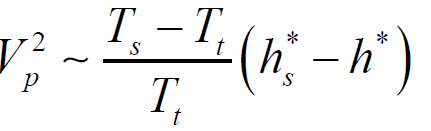
We can also look at trends in important environmental factors that are known to influence tropical cyclones. The usual suspect among these is sea surface temperature (SST) and there has been much talk about the elevated SST’s in the region where Pam developed. But SST by itself is not the main factor in the existing theory for the upper bound on tropical cyclone intensity, known as the potential intensity; instead, the potential intensity depends more nearly in the difference between SST and a measure of the bulk temperature of the troposphere as well as the temperature of the tropopause. An expression of the potential intensity, measured in maximum possible wind speed, is

igiffacj

where Vp is the potential maximum wind speed, Ts is the surface temperature, Tt is the tropopause temperature, hs* is the saturation moist static energy of the sea surface, and h* is the saturation moist static energy of the free troposphere, which is nearly uniform with height if the lapse rate is moist adiabatic. In the deep tropics, temperature is nearly uniform on pressure surfaces because there is not enough Coriolis acceleration to balance strong pressure gradients, thus h*, which is just a function of pressure and temperature, is horizontally as well as vertically uniform in the free troposphere. 

Therefore, the potential intensity depends mostly on variations of SST (which controls hs*) for climate variations that do not affect the mean temperature of the troposphere. But global warming very definitely does affect the temperature of the tropical free troposphere, so it is not possible to conclude, as alas many have, that increasing SST per se means increasing tropical cyclone intensity (though it usually does signify more TC-related rain).

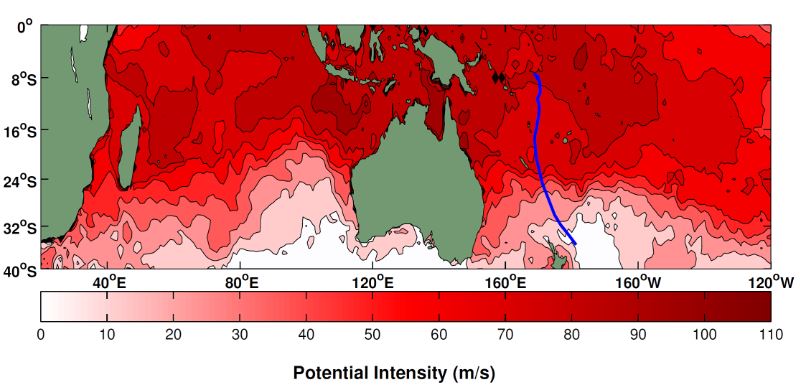
It is not difficult to calculate the actual potential intensity from SST and atmospheric soundings, and this can be done as well for reanalysis and global model data sets. The map below shows the potential intensity at 12 GMT on 7 March, 2015, calculated from the NCEP operational analysis at that time. 

The track of PAM is superimposed in blue.
pam_pi

Pam traversed a region of potential intensities around 75 m/s, consistent with the storm’s estimated peak intensity. These values are not unusual in this region, but for the past few decades they have been increasing, if the reanalyses are to be believed. I calculated potential intensity trends over the period 1980-2012 using three different reanalysis products: NASA’s MERRA, the European Center’s ERA Interim, and the NCAR/NCEP reanalysis. The MERRA and ERA Interim reanalyses show upward trends of around 2 m/s per decade in the region where Pam formed, while NCEP’s trend is closer to 3 m/s per decade; all these trends have values less than 0.1. These trends are broadly consistent with the Kossin et al. (2013) trend of 2.5 m/s per decade in the observed intensity of high category tropical cyclones in this region.

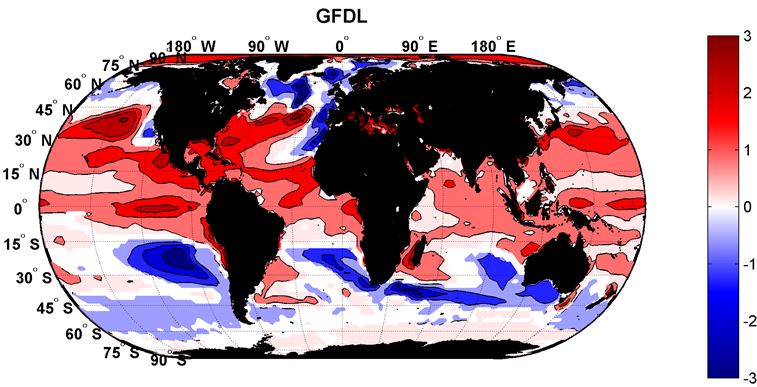
Thus the weight of evidence points to increasing potential intensity in the region where Pam developed, and consistent with this, increasing intensity of the highest category storms based on satellite-derived measurements. But to what do we attribute such increases? The roughly 30-year period over which we have reliable reanalyses and satellite measurements is too short to rule out the influence of natural climate variability, such as the Pacific Decadal Oscillation. We can at least check to see what kinds of trends climate models produce. I looked at eight CMIP 5 models whose output I had ready access to and calculated linear trends of potential intensity over the period 2006-2100 under the RCP 8.5 emissions pathway. The eight models were the NCAR CCSM4, a super-parameterized version of the same, referred to as SP-CAM, The GFDL CM3, the UKMO HADGEM-ES, the IPSL CM5A-LR, the Max Planck MPI-ESM-MR, the CCSR/NIES/JAMEST MIROC5, and the Meteorological Research Institute’s MRI-CGCM3. Of these, two models showed insignificant trends in the region in which Pam developed, and the rest showed positive trends averaging around 0.5 m/s per decade, considerably less than the observed trend over the last 30 years. The largest trend was produced by the GFDL model, whose global trend distribution is shown below. (White areas represent p values less than 0.1., and the units are m/s per decade.)

gfdl-pi

It is interesting that the largest increases are at the polar peripheries of the tropics, indicating a general expansion of the regions that are thermodynamically favorable for tropical cyclone development; this general feature is present in most of the model potential intensity trends as well as the reanalysis trends over the past 30 years, and may be behind the poleward migration of the latitudes at which observed tropical cyclones reach their peak intensity, as documented by Kossin et al. (2014).

The disparity between the reanalysis potential intensity trends over the past 30 years and the projected trends over this century suggests either that most of the observed increase in potential intensity (and actual intensity of high category storms) is due to natural variability, that decreasing anthropogenic aerosol loading over that period may have played a role, or that the model projections are too conservative. Yet the projected increase is not insignificant, amounting to about 5 m/s over 100 years. Note from the figure above that there are somewhat larger increases elsewhere, particularly in the northern hemisphere.

All of this is consistent with the strengthening consensus that the frequency of high category tropical cyclones should increase as the planet warms (Knutson et al., 2010). Basic theory and a variety of numerical simulations support this, as well as the projection that tropical cyclones should produce substantially more rain, owing to the increased moisture content of the tropical atmosphere. This is important because most destruction and loss of life are caused by high category storms and their attendant storm surges, and by freshwater flooding from torrential rains. Most of the disagreement in the literature on tropical cyclone projections concerns the incidence of weak storms, but these are usually far less consequential in spite of being more numerous.

Besides the oft-discussed issues of TC frequency and intensity, changes in genesis locations and tracks are potentially very important, as are the diameters of TCs, which affect the area covered by strong winds and which greatly affect the magnitudes of storm surges. In the present climate, the diameter of storms, as measured by the radius at which their circular wind component becomes indistinguishable from environmental winds, appears to be log normally distributed, with a mean around 420 km (Chavas and Emanuel, 2010). There is some indication from modeling studies that the size of the dangerous inner core scales with the potential intensity divided by the Coriolis parameter (Khairoutdinov and Emanuel, 2014). If this turns out to be true in nature, then storm inner core dimensions should increase over time.

While Pam and Haiyan, as well as other recent tropical cyclone disasters, cannot be uniquely pinned on global warming, they have no doubt been influenced by natural and anthropogenic climate change, and they do remind us of our continuing vulnerability to such storms. Destructive TCs in any one place tend to be generational…enough time for people to forget them and go back to risky behavior, including over-development of coastal regions. We adapt more successfully to the more frequent events which are always in the back of our minds (and often in the front). But this human adaptation time scale may be longer than the time over which climate change affects storms, so that comparatively small changes in the frequency of generational events can have large social consequences. When a 100-year event becomes a 50-year event, it may take a few destructive hits before we adapt to the new reality. This is of particular concern with tropical cyclones, where the application of existing damage models to projected changes in tropical cyclone activity predict large increases in damage, as documented, for example, in the recent Risky Business report commissioned by Michael Bloomberg, Hank Paulson, and Thomas Steyer*.

Now if only we could better measure tropical cyclones to record how they may change in coming years.
_________
* [Update, 1pm ET] It has been pointed out that in my reference to the Risky Business report, I might have mentioned that I contributed synthetic hurricane event sets that were used by Risk Management Solutions, Inc., to estimate damages from tropical cyclones.

References
Chavas, D. R., and K. A. Emanuel, 2010: A QuickSCAT climatology of tropical cyclone size.Geophys. Res. Lett.37. 10.1029/2010GL044558.
Khairoutdinov, M. F., and K. Emanuel, 2014: Rotating radiative-convective equilibrium simulated by a cloud-resolving model. J. Adv. Model. Earth Sys.5, In press.
Knutson, T. R., and Coauthors, 2010: Tropical cyclones and climate change. Nature Geosci.3,157-163.
Kossin, J. P., T. L. Olander, and K. R. Knapp, 2013: trend analysis with a new global record of tropical cyclone intensity. J. Climate26, 9960-9976.
Kossin, J. P., K. A. Emanuel, and G. A. Vecchi, 2014: The poleward migration of the location of tropical cyclone maximum intensity. Nature509, 349-352.

http://www.realclimate.org/index.php/archives/2015/03/severe-tropical-cyclone-pam-and-climate-change/

Saturday, October 18, 2014

Kerry Emanuel and Susan Solomon rebut Koonin's Wall Street Journal op-ed

by Dr. Kerry Emanuel and Dr. Susan Solomon, (Professors, Massachusetts Institute of Technology, Cambridge, MA), The Union of Concerned Scientists, October 16, 2014

Stephen Koonin’s recent Wall Street Journal op‐ed illustrates the importance of distinguishing scientific fundamentals from numerical details, and keeping the distinction between science and values clear in discussions of risk.  
Koonin notes several key scientific fundamentals. He does not deny that climate is changing, that human activities are at least partly responsible for it, or that policy formulation should take climate change into account. But the headline statement—that not enough is known about climate to warrant significant action given the risks—is a statement of values and does not follow from the scientific substance of the essay. The phrase in the essay’s title, “Settled Science,” repeated elsewhere, is often used by journalists and environmentalists, but we have yet to hear it used by an actual climate scientist. Although the first sentence refers to its use in “popular and policy discussions,” later in the essay Koonin argues that uncertainty “should not be confined to hushed sidebar conversations at academic conferences.”
This claim amazed us, because uncertainty is a major and perhaps the major focus of scientific research on climate change and on attempts to formulate sensible policy. In the Summary for Policymakers of the latest IPCC Assessment Report, the word uncertain or uncertainty appears 36 times, and graphs pertaining to climate projections have hefty uncertainty limits and error bars. It is hard to claim that uncertainty is being hushed up. “Settled Science” is a red herring when it comes to the actual practice and publication of climate science.
We are used to hearing that “climate is always changing” as a means of downplaying current climate change; rather like a murder defendant telling the judge that “people are always dying.” Climate changes on many time scales, and if that were not the case, there would be little basis for worrying about our own influence, because the evidence would point to a large intrinsic stability of the climate system. There is no significant doubt that the earth’s past climate has responded dramatically to relatively small changes in Earth’s energy balance in the past, such as changes in sunlight and its distribution with latitude, as well as to changes in atmospheric composition. This is hardly comforting. Koonin gets it wrong when he states that the impact of human activity appears comparable to natural intrinsic variability; in point of fact, many studies using independent data sets have demonstrated that human signals have clearly emerged from the noise on global and regional scales over the past fifty years. What is at issue here is not just the total global temperature change, but the rate at which we are changing the energy balance of our planet, which over the last half century has been far in excess of anything evident in paleo climate data for many thousands of years, at least.
Elsewhere, Koonin falls prey to some of the most common misconceptions about climate science. One of the most widely held is the idea that predictions of climate change rest solely on highly complex computer models. This is far from the case; basic physics and very simple models all show that increasing greenhouse gas concentrations lead to nontrivial warming. In 1906, the Swedish chemist Svante Arrhenius estimated that doubling CO2concentrations would increase average global surface temperature by around 4 oC; his calculations were done with paper and pencil. If the computer had never been developed, climate science would still have identified the substantial risk incurred by changing by hundreds of percent the concentrations of long-lived greenhouse gases.  That is what we are on track to do within this century if current rates of growth of human greenhouse gas emissions continue.
Koonin states that the human impact on the greenhouse effect is a small percentage of the total greenhouse effect. While strictly correct, Koonin’s use of this information in his essay is deeply misleading. While the most important greenhouse gas in the atmosphere is water vapor, the residence time of a water molecule in the atmosphere is about two weeks. Global water vapor concentration therefore responds to changes in global temperature rather than forcing them. The water vapor greenhouse effect is a fast feedback driven by other changes in the system, as is universally recognized (going back at least to Arrhenius), and as Koonin acknowledges later in his essay. By contrast, a portion of the human addition of CO2 to our atmosphere lasts hundreds to thousands of years; thus on such time scales it is properly considered a forcing. Despite a nominally small contribution to the total planetary greenhouse effect, it is well established that eliminating all atmospheric CO2 would drop the Earth’s mean surface temperature to below freezing, demonstrating its key role; doubling its concentration can similarly be expected to influence our climate.
The hiatus in the upward trend of surface temperature is a fascinating and important puzzle for climate science, and is not entirely consistent with our present understanding of natural variability. Uncertainties in forcing by changes in atmospheric pollution and volcanic particles may also play an important role. Whole workshops are devoted to this issue. In dealing with it, one must be conscious of the fact that roughly 90% of the planetary energy imbalance caused by upward trends in long-lived greenhouse gases is used to heat the oceans, rather than the atmosphere, and the best available measurements show that ocean heat content has continued its inexorable climb even while the atmospheric temperature has leveled off. It does not take much heat exchange between the oceans and atmosphere to cause large swings in the temperature of the latter. We do not fully understand the natural causes of such exchanges.
Finally we come to what we regard as the most egregious part of Koonin’s essay; namely, his implication that scientific uncertainties dictate that we do nothing. Outside the radical environmental movement and lesser media outlets, no one is claiming that uncertainty in climate projections is small. In spite of their flaws, projections based partially on the ensemble of complex climate models run by many groups internationally is well grounded in basic physics going back to the time of Arrhenius, and represent civilization’s current best shot at the problem; anything else is mere conjecture. These projections portray time-evolving probability distributions of climate variables such as precipitation and global mean surface temperature, which experts in risk analysis convert to probability distributions of various kinds of risk. These risk analyses are taken very seriously by business enterprises (e.g., the reinsurance industry) and many government organizations (e.g., the Department of Defense; the city of New York) and are used constructively in planning.
While it is challenging, many citizens are beginning to understand how to think about risk and uncertainties in climate change too. The median CO2-doubling temperature increase of about 2.5 oC already poses serious risks, while the not-so-improbable higher tail of the distribution would likely be very serious, even catastrophic, for civilization. And if nothing is done to curb emissions, we are on our way to tripling CO2 by the end of this century, and quadrupling it not long after. Even low-end estimates of the climate response to such forcing entail very serious risk. Barring major improvements in technology for extracting CO2 from the atmosphere and sequestering it, decisions on whether and how much to reduce emissions cannot be postponed owing to the very long residence time of anthropogenic CO2 in the atmosphere.
Koonin’s point that decisions on how to deal with this important problem should be made democratically seems obvious to us, but the events of the last decade or so show that the main threat to democratic decision making is not overweening climate scientists (yes, there are some!) but rather wealthy interests vested in the status quo, that seem to exercise undue influence in today’s politics. The rising oligarchy naturally tries, as a means of diversion, to alarm the public with the specter of a technocracy.
Reasonable people may disagree about the best course of action given an uncertain but potentially very serious threat. It should be up to citizens to decide how much to spend now to mitigate such a threat. But ignoring or slanting the risks does a disservice to science and the public.
About the authors: 
Dr. Kerry Emanuel is the Cecil and Ida Green professor of atmospheric science at the Massachusetts Institute of Technology, where he has been on the faculty since 1981, after spending three years on the faculty of UCLA. He is a co-director of MIT’s Lorenz Center, a climate think tank devoted to basic, curiosity-driven climate research. 
Dr. Susan Solomon is the Ellen Swallow Richards Professor of atmospheric chemistry and climate science at the Massachusetts Institute of Technology and the Founding Director of the MIT Environmental Solutions Initiative. Prior to that, she was a scientist at NOAA in Boulder, Colorado, from 1981-2011, and an adjunct professor at the University of Colorado.

Wednesday, August 20, 2014

Eric Holthaus: Why I'm a climate change alarmist

187560503-two-young-boys-look-at-the-devastation-in-the-aftermath
Typhoon Haiyan hit the Philippines with the strongest tropical cyclone landfall ever recorded. Photo by Dondi Tawatao/Getty Images

by Eric Holthaus, Slate, August 19, 2014
I’m sick of having to hide it, so here goes: I’m a climate change alarmist.
There, I said it. After years of fighting off Internet trolls and being ridiculed on Fox News for caring about the Earth and its inhabitants enough to make big changes to my life, I’ve had enough. It’s time that we climate change alarmists reclaim this dismissive term and defend ourselves.
Many of us have been lambasted for talking about the fundamental health of the planet. Climate scientist Kerry Emanuel has written “those interested in treating the issue as an objective problem in risk assessment and management are labeled ‘alarmists,’ a particularly infantile smear considering what is at stake.”
Now, I’m also an optimist. I’m convinced that humanity has the ability to tackle the problem and come to international agreement on how to do so in a fair way. It simply must happen. But for something so serious, it seems like there’s a general lack of alarm, a lack of emotion, and—to be blunt—a lack of ambition to act with the scale and urgency the issue requires.
Tragically, there’s a vast mismatch between our actions to date and what’s needed. This isn’t just another big environmental issue. When the ozone hole was discovered decades ago, the world got together and agreed to change the chemical used in making refrigerators cold. In hindsight, that seems incredibly easy compared to this. Climate change cuts to the core of who we are as a civilization and what kind of world we want to create for our kids. Perhaps understandably, that’s meant that a lot of smart people are really pessimistic about our future.
I may be optimistic, but I’m not naive. I know that the vast majority of humans don’t make daily decisions based on analyzing scientific charts and graphs. The climate change alarmism community has made some strategic mistakes by incessantly focusing on the science and expecting grand changes. In my view, to make any sort of real progress, we’ve instead got to embrace our humanity—and yes, that means shedding the occasional tear when the reality of our situation really hits home.
Last year, days after watching his home country, the Philippines, utterly destroyed by Typhoon Haiyan—the strongest tropical cyclone landfall ever recorded worldwide—climate commissioner Yeb Saño broke down in the middle of the United Nations’ international climate change negotiations, saying “we cannot sit and stay helpless staring at this international climate stalemate. It is now time to take action.” His tears motivated an impromptu global movement. At this point, we need fewer lightbulb-changing PSAs and more of this.
As a scientist and journalist, I’m not supposed to have emotions. I’m supposed to calmly report researchers’ findings as if my family and I weren’t also being affected. But looking at the data in as much detail as I have, it’s impossible not to be alarmed. On an average day, I’m also disgusted, terrified, and angry.
So why aren’t more people outraged?
Few things are more important to human life than the environment, but hundreds of generations of experience have baked in a reasonable assurance that the future will be approximately like the past.
For the first time in human history, it won’t.
Save the specter of nuclear war or an Armageddon-style asteroid strike, there’s really not much that could wipe us out as quickly as climate change. Those two things haven’t happened (yet), but global warming is happening, right now.
The biggest problem with responding to climate change is that at the human scale, it’s impossible to fathom what’s happening. The problem isn’t how hot it’s getting (it’s been hotter before for different reasons) but the sheer rate of change. In a sentence, here’s what’s happening: Carbon-storing rocks, gas, and oil that took millions of years to accumulate are being returned to the atmosphere over a period of a few decades—almost instantaneously. That’s producing geologic-timescale changes in the span of a single human lifetime.
If you’re a piece of basalt, maybe you can think on geologic timescales. I can’t.
Within our lifetimes, we’ll almost assuredly enter a climate phase that hasn’t been seen since before humans even existed. And the scarier thing, for me, is what’s needed to get back on track. The scale of the problem demands a revolution in thought and action. Pioneering climate scientist James Hansen, who recently quit his job at NASA so he could protest more effectively, is calling for a “human tipping point.”
A lot of us get a mental short circuit when we think about climate change. It’s so crazy, it can’t possibly be happening, right?
The most visible manifestation of this is the debate between hard-core climate activists and vocal skeptics who deride the scientific consensus. I think this is distracting, so I’ve tried to largely remove myself from it. (Don’t feed the trolls, right?) There’s been a fascinating line of research lately that examines something called “stealth denial.” It’s become clear that vast sections of society—including people who can really make a difference—have largely tuned out climate change. This seems to be happening for three reasons: They believe they don’t contribute to the problem that much, they believe that the problem is so scary that they hope it goes away, or they believe their individual actions to help out won’t matter that much anyway. Here’s what our message should be: You can make a difference. In fact, you’re our best hope.
In last week’s Slate Culture Gabfest podcast, there was a fabulous discussion of talking about the weather. In conversations with friends, it’s clear that there’s a growing realization that something is somehow different. In the Gabfest, Dana Stevens said she thought that weather and climate has recently re-entered public discourse in a way that’s new: “The two things are woven together in ways we can't extricate.” John Swansburg lamented the loss of the traditionally easy conversation starter: “Talking about the weather brings up all these fears and anxieties that maybe it didn’t in the past.” The hard part is turning that fear and anxiety into real change.
It’s clear to me the status quo isn’t working anymore. It’s time to shake things up. Our actions for the next few years and decades will determine if basic things like agriculture and coastal living can continue on for the next hundreds of years in vast stretches of the planet. More importantly, it’s time for us to embrace the range of emotions we feel when confronted with the realization that the planet we’ve known for generations is fundamentally changing. Right now, with calm, clear rationality, big corporations and their friends in Congress continue to claim that they've got everything under control.

Wednesday, July 16, 2014

Salon: New York Times’ climate skeptic debacle: How a profile of John Christy sets back science

Paper of record issues bizarrely sympathetic treatment of prominent skeptic John Christy, totally misses the point


by Lindsay Abrams, Salon, July 16, 2014

New York Times' climate skeptic debacle: How a new profile sets back scienceEnlarge(Credit: Reuters/Brendan McDermid)
The New York Times missed the mark big time in its new profile of John Christy, a professor of atmospheric science at the University of Alabama, Huntsville, and prominent climate skeptic who “finds himself a target of suspicion” — and derision, and sometimes even insults — from his peers. Ostensibly, it’s an examination of the way that climate science has become politicized, to the extent that those with dissenting views are silenced or attacked by the cult of mainstream climate science. In reality, it’s an overly credulous and sympathetic portrayal of someone who, his claims having been almost completely discredited, is trying to spin the story in a way that makes him out to be a victim.
Perhaps, writer Michael Wines speculates, the reason why other climate scientists are so mean to Christy (people drew mean cartoons about him!) is because he’s “providing legitimacy to those who refuse to acknowledge” that the consequences of climate change are likely to be dire. The use of the word “legitimacy” is questionable: Unlike those who contest the scientific consensus on climate change with little or no background in climate science themselves, Christy does boast a bevy of credentials, as Wines is careful to denote. Christy’s actual research, on the other hand, along with the data that he insists, in the profile, to be beholden to — well, that’s been deflated, disproven and debunked by all manner of other, highly qualified experts. A dispute over his inaccurate climate models that Wines dismisses as a “scientific tit for tat,” meanwhile, is seen by others as a conscious attempt to misinform the public, in the interest of promoting climate skepticism.
A difference in perspective, perhaps. But in downplaying the many and legitimate issues with Christy’s research, Wines fails to treat this “skeptic” with much skepticism of his own. And worse still, the profile plays into an image that Christy has been working to build — one not of an anti-science “denier,” but instead of a modern-day Galileo, one who dares to contradict mainstream opinion and who will be vindicated by history — in this case, when the effects of climate change turns out to not be so bad, after all. See, for example, the Wall Street Journal Op-Ed Christy authored this February with fellow skeptic Richard McNider. In response to comments by Secretary of State John Kerry, who accused climate skeptics of belonging to the “Flat Earth Society,” they wrote:
But who are the Flat Earthers, and who is ignoring the scientific facts? In ancient times, the notion of a flat Earth was the scientific consensus, and it was only a minority who dared question this belief. We are among today’s scientists who are skeptical about the so-called consensus on climate change. Does that make us modern-day Flat Earthers, as Mr. Kerry suggests, or are we among those who defy the prevailing wisdom to declare that the world is round?
This interpretation of history, as Joe Romm pointed out at the time, is yet another misconception, as the flat Earth myth was a pre-scientific belief, disproven by — you guessed it — science. Christy and McNiders’ inflated perception of themselves only serves to further confuse the public’s understanding of the scientific consensus on climate change. Their rhetoric, while appealing, falls apart upon examination.
As for the contention, among environmentalists, that Christy may be “a pawn of the fossil-fuel industry who distorts science to fit his own ideology”? Wines dismisses that in a parenthetical comment from Christy (“I don’t take money from industries”), and leaves it at that. This, again, plays right into Christy’s desire to be seen as misunderstood — he’s been careful to avoid associations not just with polluting industries, but with most of the groups dedicated to spreading climate denial. He doesn’t attend the Heartland Institute’s annual climate denial conferences, he told the Times’ Andrew Revkin several years back, because he wants to avoid “guilt by association.”
Yet Christy’s perspective on global warming — that the effects will be mild, and potentially even beneficial — is more or less aligned with those voiced by the participants in Heartland’s most recent conference, which took place last week. Aside from a few remaining loonies, most deniers have by now conceded the two most basic facts of climate change: that the climate is changing, and that man-made emissions of greenhouse gases are at least partially responsible. Christy’s not special in this regard. Instead, he’s part of a growing movement that Will Oremus, writing in Slate, describes as an effort to rebrand climate denial as “climate optimism”: the idea that climate change, while real, isn’t something worth worrying about — and certainly not worth making an effort to mitigate. In some ways, this is even more dangerous than flat-out denial, which is at least easy to shut down; climate optimism, instead, conflates science with conservative political ideology, as Oremus explains:
In fact, it’s not unreasonable to see the climate fight as part of a much broader ideological war in American society, says Anthony Leiserowitz, director of the Yale Project on Climate Change Communication. The debate over causes is often a proxy for a debate over solutions, which are likely to require global cooperation and government intervention in people’s lives. Leiserowitz’s research shows that climate deniers tend to be committed to values like individualism and small government while those most concerned about climate change are more likely to hold egalitarian and community-oriented political views.
That doesn’t mean, of course, that the evidence on both sides is equal. There’s a reason the climate deniers are losing the scientific debate, and it isn’t because academia is better funded than the energy industry. All of which helps to explain how climate optimism might be a more appealing approach these days than climate denial. Models of how climate change will impact society and the economy are subject to far more uncertainty than the science that links greenhouse gas emissions to the 20th-century warming trend. The costs of mitigating those emissions are more readily grasped: higher energy bills, government spending on alternative energy projects, lost jobs at coal plants.
Accepting climate change, but not accepting that we should do anything about it: It’s that ideologically driven belief, and not a debate over science itself, that is the real way in which climate change has become politicized.
None of this is to suggest that there shouldn’t be a debate about science, or that all climate science is settled. Most of what we know about the future effects of climate change, including just how severe they will be, remains decidedly unsettled, and will remain so until they actually come to pass. Because 97% of scientists agree that human activity is contributing to changes in our climate, the debate now can and should be about what the evidence suggests, and what we ought to do about it. But the reason why Christy has attracted so much vitriol is because he’s on the radical fringe of both of those conversations: he’s using error-laden research and misleading claims to advocate for some adaptation and zero mitigation. The American Association for the Advancement of Science compares such a strategy to barreling down the highway without the benefit of seat belts or airbags; more colorfully, in Wines’ article, MIT professor Kerry Emanuel suggests “It’s kind of like telling a little girl who’s trying to run across a busy street to catch a school bus to go for it, knowing there’s a substantial chance that she’ll be killed. She might make it. But it’s a big gamble to take.”
Christy’s supporters are already up in arms about that one. But the comparison is apt, and it’s the reason why, even if history does turn out to vindicate Christy, he won’t be remembered as an anti-establishment hero. He’ll just be someone who, against all evidence to the contrary, got really, really lucky, and put not just a little girl, but the entire world at risk in the process.