Blog Archive

Showing posts with label Permafrost. Show all posts

Wednesday, January 22, 2020

Evidence that an ice-free Arctic Ocean allowed ancient CO2 and methane emissions


Speleothems like these form fastest when the permafrost has thawed. Image: By James St John, via Wikimedia Commons
As the world warms, more greenhouse gas will enter the atmosphere. Researchers now think an ice-free Arctic Ocean explains how and why.

by Tim Radford, Climate News Network, January 10, 2020

LONDON – Deep in a cave in Siberia, Israeli, Russian and British scientists have identified evidence of periodic losses of carbon from the permafrost. And the unexpected link is not simply with peak periods of bygone global warming, but with an ice-free Arctic Ocean. The escape into the atmosphere of prodigious volumes of methane and carbon dioxide from the thawing soils is in step not with average planetary temperature rise, but with long periods when the Arctic Ocean is free of ice every summer.

Fact one: about one quarter of land in the northern hemisphere is now, and has been for much of the last half million years, permanently frozen, and with it about twice as much atmospheric carbon – in the form of peat and preserved vegetation – as there exists freely in the planetary atmosphere.

Fact two: in the most recent decades, sea ice has been both thinning and dwindling rapidly, and the polar ocean could by 2050 become almost entirely ice-free in the summer months. “This discovery about the behaviour of the permafrost suggests that the expected loss of Arctic sea ice will accelerate melting of the permafrost presently found across much of Siberia” And this twist in the tale of a rapidly-warming Arctic is preserved in stalagmite formations in a cave deep beneath the rim of the Arctic Circle in Siberia.

The chronology of stalagmite and stalactite development can be established precisely by the pattern of uranium and lead isotope deposits in formations, built up imperceptibly by the steady drip of water from, and through, the soils far above. That is, the speleothems – a geologist’s catch-all word for both stalactite and stalagmite – form fastest when the permafrost has thawed. And unexpectedly, the periods of thaw did not match the peaks of interglacial warming during the last 1.35 million years. They did however coincide with periods when the Arctic was ice-free in the summer.

“This discovery about the behaviour of the permafrost suggests that the expected loss of Arctic sea ice in the future will accelerate melting of the permafrost presently found across much of Siberia,” said Gideon Henderson of the University of Oxford, and one of the authors of a new study in the journal Nature.

The argument goes like this: if there is no sea ice then more heat and moisture is delivered from the ocean to the atmosphere, with warmer air flowing over Siberia, and therefore more autumn snowfall. A blanket of snow insulates the soil beneath from the extreme winter cold, so ground temperatures go up, to unsettle the permafrost and start a thaw that leads to accelerated plant decay and ever-increasing escape of carbon dioxide and methane that would otherwise have been frozen into the permafrost. So the stalagmites endure as evidence of these warmer soils and survive as a direct link to periods of ice-free ocean.

“If these processes continue during modern climate change, future loss of summer Arctic sea ice will accelerate the thawing of Siberian permafrost,” the scientists say. 

https://climatenewsnetwork.net/ice-free-arctic-ocean-allowed-ancient-carbon-leaks/

Sunday, April 21, 2019

Greenhouse Gas Emissions from thawing Arctic permafrost may be 12 times higher than thought, scientists say

'This needs to be taken more seriously than it is right now,’ says author of new study

Melting permafrost in Alaska caused by rising global temperatures.
Melting permafrost in Alaska caused by rising global temperatures. (Andrew Burton/Getty Images )

by Chiara Giordano, The Independent, April 20, 2019

READERS: here is the Barrow, Alaska, measuring site for CO2:

https://www.esrl.noaa.gov/gmd/dv/iadv/graph.php?code=BRW&program=ccgg&type=fi

Emissions from thawing Arctic permafrost may be 12 times higher than previously thought, scientists have discovered.
Permafrost is a mix of soil, rock or sediment that has been frozen for at least two years which is mostly found in the uppermost areas where temperatures are rising more quickly than the rest of the world.
When it thaws because of global warming, it releases large quantities of carbon dioxide and methane into the atmosphere, causing temperatures to rise and creating a perpetual cycle where more permafrost melts.
Nitrous oxide, a third greenhouse gas nearly 300 times more potent than carbon dioxide, stays in the atmosphere for an average of 114 years, according to the Environmental Protection Agency (EPA).
It has “conventionally been assumed to have minimal emissions in permafrost regions,” according to a fresh study published in the Atmospheric Chemistry and Physics journal.
However the research team behind the study, led by Harvard University scientists, has found that nitrous oxide emissions are 12 times higher than previously thought and therefore more of a threat.
The group used a small plane with a probe on its nose to measure greenhouse gases over 120 square miles of thawing permafrost in the North Slope of Alaska.
They found that nitrous oxide emissions reached what was previously thought to be the expected yearly limit within just one month in August 2013.
Nitrous oxide also poses a second threat because “up in the stratosphere, sunlight and oxygen team up to convert the gas into nitrogen oxides, which eat at the ozone,” Harvard University said in a statement.
Jordan Wilkerson, one of the authors of the study, said: “Much smaller increases in nitrous oxide would entail the same kind of climate change that a large plume of CO2 would cause.”
“This is widespread, pretty high emissions.”
He called for further research on the greenhouse gases, especially nitrous oxide, adding: “This needs to be taken more seriously than it is right now.”
https://www.independent.co.uk/environment/global-warming-greenhouse-gases-emissions-arctic-alaska-a8874456.html

Sunday, January 21, 2018

Climate Code Red: What we learned about the climate system in 2017 that should send shivers down the spines of policy makers


by David Spratt, Climate Code Red, January 15, 2018

Much of what happened in 2017 was predictable: news of climate extremes became, how can I put it … almost the norm. There was record-breaking heat on several continents, California’s biggest wildfire (extraordinarily in the middle of winter), an ex-tropical cyclone hitting Ireland (yes, Ireland) in October, and the unprecedented Hurricanes Harvey, Irma and Maria that swept through the Atlantic in August. The US government agency, the NOAA, reported that there were 16 catastrophic billion-dollar weather/climate events in the USA during 2017.

And 2017 “marks the first time some of the (scientific) papers concluded that an event could not have occurred — like, at all — in a world where global warming did not exist. The studies suggested that the record-breaking global temperatures in 2016, an extreme heat wave in Asia and a patch of unusually warm water in the Alaskan Gulf were only possible because of human-caused climate change,” Reuters reported.


At both poles, the news continues to be not good. At the COP23 in Bonn, Pam Pearson, Founder and Director of the International Cryosphere Climate Initiative, warned that the cryoshere is becoming “an irreversible driver of climate change.” She said that most cryosphere thresholds are determined by peak temperature, and the length of time spent at that peak, warning that “later, decreasing temperatures after the peak are largely irrelevant, especially with higher temperatures and longer duration peaks.” Thus “overshoot scenarios,” which are now becoming the norm in policy-making circles (including all 1.5 °C scenarios) hold much greater risks.

As well, Pearson said that 2100 is a misleading and minimizing measure of cryosphere response: “When setting goals, it is important to look to new irreversible impacts and the steady state circumstances. The end of the century is too soon to show that before but inevitable response especially for sea level rises.” Pearson added that: “What keeps cryosphere scientists up at night are irreversible thresholds, particularly West Antarctica and Greenland. The consensus figure for the irreversible melting of Greenland is at 1.6 °C.”

So what did we learn about the climate system in 2017? Here’s three that stand out, that should send shivers down the spines of policy makers. 


1.  2017 was the second hottest year on record and the hottest non-El Nino year on record

Whilst not all sources have yet released data on annual warming for last year, the Copernicus Climate Change Service, the first major international weather agency to report global 2017 temperatures, said they averaged 1.2 °C above pre-industrial times. 2017 was slightly cooler than the warmest year on record, 2016, and warmer than the previous second warmest year, 2015, Reuters reported.

Other organisations have unofficial figures which either agree with this assessment, or say that 2017 has tied with 2015. And last year was Australia's third-warmest year on record.

It is no surprise that the last three years have been the hottest on the instrumental record. What is remarkable is that 2017 was as hot, or hotter than 2015, because 2015 and 2016 were both El Nino years, and the evidence shows that El Nino years are, on average, about 0.15 °C warmer than La Nina years.In fact, a remarkably hot 2017 crushed the old record for hottest non-El Niño year (2014) by an astounding 0.17 °C.

The underlying temperature trend is being driven by continuing high levels of climate pollution: The UN says carbon dioxide levels grew at record pace in 2016. The atmospheric carbon dioxide  averaged 403.3 parts per million (ppm) over the year, up from 400 ppm in 2015. The growth rate was 50% faster than the average over the past decade.

And global carbon emissions are headed up again after three years in which human-caused emissions appeared to be leveling off. A 2% increase is projected overall, with the highest rise coming in China, according to new research presented at the climate talks in Bonn.

In 2017, we also learned that there was no pause in global warming: the so-called ’slow down' in climate change between 1998 and 2012 was caused by a lack of data from the Arctic.

2. It is likely to get hotter than we think

Two significant pieces of work released towards the end of 2017 suggest that warming is likely to be greater than the projections of the Intergovernmental Panel on Climate Change (IPCC), on which climate policy-making and carbon budgets are generally based. 

This is because what is called Equilibrium Climate Sensitivity (ECS), an estimate of how much the planet will warm for a doubling in the level of greenhouse gases, is higher than the median of the IPCC’s modelling analysis. 

In “Greater future global warming inferred from Earth’s recent energy budget” published in Nature in December 2017, Brown and Caldeira compared the performance of a wide range of climate models (raw model projections) with recent observations (especially on the balance of incoming and outgoing top-of-the-atmosphere radiation that ultimately determines the Earth’s temperature), in order to assess which models perform best.

The models that best capture current conditions (the “observationally-informed” models) produce 15% more warming by 2100 than the IPCC suggests, hence reducing the “carbon budget” by around 15% for the 2C target.

 For example, they find the warming associated by the IPCC with RCP 4.5 emissions scenario would in fact “follow the trajectory previously associated with (higher emissions) RCP 6.0” scenario. 

They also find that the observationally-informed ECS prediction has a mean value of 3.7 °C (for a doubling of the atmospheric greenhouse gas level), compared to 3.1 °C used in raw models, and in the carbon budget analyses widely used by the IPCC, the UN and at climate policy conferences.

In “Well below 2C: Mitigation strategies for avoiding dangerous to catastrophic climate changes,” published in September 2017, Xu and Ramanathan look at what are called the “fat tail” risks. These are the low-probability, high-impact (LPHI) consequences (“fat tails”) of future emission scenarios; that is, events with a 5% probability at the top end of the range of possible outcomes. 

These “top end” risks are more likely to occur than we think, so “it is important to use high-end climate sensitivity because some studies have suggested that 3D climate models have underestimated three major positive climate feedbacks: positive ice albedo feedback from the retreat of Arctic sea ice, positive cloud albedo feedback from retreating storm track clouds in mid-latitudes, and positive albedo feedback by the mixed-phase (water and ice) clouds.” 

When these are taken into account, the researchers find that the ECS is more than 40% higher than the IPCC mid-figure, at 4.5-4.7 °C. And this is without taking into account carbon cycle feedbacks (such as melting permafrost and the declining efficiency of forests carbon sinks), and increase methane emissions from wetlands, which together could add another 1 °C to warming be 2100. 

This work complements other recent work which also suggests a higher climate sensitivity:
  • Fasullo and Trenberth found that the climate models that most accurately capture observed relative humidity in the tropics and subtropics and associated clouds were among those with a higher sensitivity of around 4 °C.
  • Zhai et al. found that seven models that are consistent with the observed seasonal variation of low-altitude marine clouds yield an ensemble-mean sensitivity of 3.9 °C. 
  • Friedrich et al. show that climate models may be underestimating climate sensitivity because it is not uniform across different circumstances, but in fact higher in warmer, inter-glacial periods (such as the present) and lower in colder, glacial periods. Based on a study of glacial cycles and temperatures over the last 800,000 years, the authors conclude that in warmer periods climate sensitivity averages around 4.88 °C. Professor Michael Mann, of Penn State University, says the paper appears "sound and the conclusions quite defensible."
  • Lauer et al. found that climate models that most accurately simulate recent cloud cover changes in the east Pacific point to an amplifying effect on global warming and thus a more sensitive climate. 
And the bottom line?  If this work is correct, then the pledges made under the Paris Accord would not produce warming of around 3 °C as is widely discussed, but a figure closer to and even above 4 °C. And the total carbon budget would a quarter smaller than is generally accepted, or even less.

3. Climate models under-estimate future risks

This year, the Breakthrough Centre for Climate Restoration in Melbourne, published What Lies Beneath, on the scientific understatement of climate risks. The report found that human-induced climate change is an existential risk to human civilization, yet much climate research understates climate risks and provides conservative projections. Reports from the Intergovernmental Panel on Climate Change that are crucial to climate policymaking and informing public narrative are characterized by scientific reticence, paying limited attention to lower-probability, high-risk events that are becoming increasingly likely. (Disclosure: I was a co-author of this report.) 

But don’t take my word.  At the climate policy conference in Bonn, Phil Duffy, the Director of the Woods Hole Institute, explained the scientific reticence regarding the biggest system feedback issues:

"The best example of reticence is permafrost…  It’s absolutely essential that this feedback loop not get going seriously, if it does there is simply no way to control it… The scientific failure comes in because none of this is in climate models and none of this is considered in the climate policy discussion… climate models simply omit emissions from the warming permafrost, but we know that is the wrong answer because that tacitly assumes that these emissions are zero and we know that’s not right…"

And the problems of underestimation of future climate impacts from current models was explicitly recognized by the US government in its Climate Science Special Report: Fourth National Climate Assessment. In a chapter on “Potential Surprises: Compound Extremes and Tipping Element,” two key findings were:

Positive feedbacks (self-reinforcing cycles) within the climate system have the potential to accelerate human-induced climate change and even shift the Earth’s climate system, in part or in whole, into new states that are very different from those experienced in the recent past (for example, ones with greatly diminished ice sheets or different large-scale patterns of atmosphere or ocean circulation). Some feedbacks and potential state shifts can be modeled and quantified; others can be modeled or identified but not quantified; and some are probably still unknown. (Very high confidence in the potential for state shifts and in the incompleteness of knowledge about feedbacks and potential state shifts).
  • While climate models incorporate important climate processes that can be well quantified, they do not include all of the processes that can contribute to feedbacks, compound extreme events, and abrupt and/or irreversible changes. For this reason, future changes outside the range projected by climate models cannot be ruled out (very high confidence). Moreover, the systematic tendency of climate models to underestimate temperature change during warm paleoclimates suggests that climate models are more likely to underestimate than to overestimate the amount of long-term future change (medium confidence).
  • The problem is that the notion that future climate changes may be faster and hotter than those projected by climate models is one rarely understood by climate policy-makers, and rarely discussed by those who do understand.
If climate policymaking is to be soundly based, a re-framing of scientific research within an existential risk-management framework is now urgently required. This must be taken up not just in the work of the IPCC, but also in the UN Framework Convention on Climate Change negotiations if we are to address the real climate challenge.

http://www.climatecodered.org/2018/01/what-we-learned-about-climate-system-in.html

Saturday, July 29, 2017

USGS Projects Large Loss of Alaska Permafrost by 2100 (and it won't stop there!)


Using statistically modeled maps drawn from satellite data and other sources, U.S. Geological Survey scientists have projected that the near-surface permafrost that presently underlies 38% of boreal and arctic Alaska would be reduced by 16-24% by the end of the 21st Century under widely accepted climate scenarios.
from the USGS, November 30, 2015
Using statistically modeled maps drawn from satellite data and other sources, U.S. Geological Survey scientists have projected that the near-surface permafrost that presently underlies 38% of boreal and arctic Alaska would be reduced by 16-24% by the end of the 21st century under widely accepted climate scenarios. Permafrost declines are more likely in central Alaska than northern Alaska. 
Northern latitude tundra and boreal forests are experiencing an accelerated warming trend that is greater than in other parts of the world. This warming trend degrades permafrost, defined as ground that stays below freezing for at least two consecutive years. Some of the adverse impacts of melting permafrost are changing pathways of ground and surface water, interruptions of regional transportation, and the release to the atmosphere of previously stored carbon. 
“A warming climate is affecting the Arctic in the most complex ways,” said Virginia Burkett, USGS Associate Director for Climate and Land Use Change. “Understanding the current distribution of permafrost and estimating where it is likely to disappear are key factors in predicting the future responses of northern ecosystems to climate change.” 
In addition to developing maps of near-surface permafrost distributions, the researchers developed maps of maximum thaw depth, or active-layer depth, and provided uncertainty estimates. Future permafrost distribution probabilities, based on future climate scenarios produced by the Intergovernmental Panel on Climate Change (IPCC), were also estimated by the USGS scientists. Widely used IPCC climate scenarios anticipate varied levels of climate mitigation action by the global community. 
These future projections of permafrost distribution, however, did not include other possible future disturbances in the future, such as wildland fires. In general, the results support concerns about permafrost carbon becoming available to decomposition and greenhouse gas emission. 
[Below, be sure to check out the size of the blue area in the north.]
The research has been published in Remote Sensing of Environment. The current near-surface permafrost map is available via ScienceBase.
Current probability of near-surface permafrost in Alaska. Future scenarios.

Wednesday, April 26, 2017

'It scares me': Permafrost thaw in Canadian Arctic sign of global trend

Buildings in Inuvik being demolished because of shaky foundations

by David Michael Lamb, CBC News,April 17, 2017

Jim McDonald, the mayor of Inuvik, stands in front of a warehouse that’s slated for demolition due to melting permafrost, which has shifted the building's foundation.
Jim McDonald, the mayor of Inuvik, stands in front of a warehouse that’s slated for demolition due to melting permafrost, which has shifted the building's foundation. (David Michael Lamb/CBC)
Canada is melting.
Like a popsicle taken out of the freezer and left on the counter, the permanently frozen ground in the northern reaches of this country is thawing at an ever faster rate.
Half of Canada is blanketed in some form of permafrost, including patches in the northern reaches of Ontario and the Prairie provinces.
But in many places, including around Inuvik, NWT, as much as 90 per cent of this "ground" is actually frozen water. (The rest is dirt, rocks and decomposed organic material that was once trees, shrubs, even animals.)
For years now, buildings in Inuvik have been gradually sinking into the ground as it softens. Others are so unstable, they are literally sliding off their foundations.
Unstable building
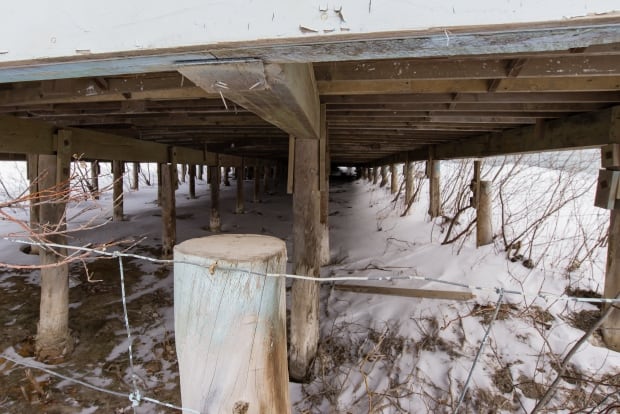
This building is now set to be torn down. Some of the stilts that support it have sunk and others have heaved up, leaving the building dangerously unstable. (David Michael Lamb/CBC)
"You can really see the effect of the permafrost," said Inuvik mayor Jim McDonald, standing in front of two warehouses built in the 1980s that are now unsafe to enter and are slated for demolition.
"The seasonal thaw is getting deeper now, and that wreaks havoc."
This is where a local problem becomes a global concern.
Scientists in the Northwest Territories, Alaska and Siberia are now realizing that as the ground under them melts, it will not only make life harder for the people living in the Arctic, but will in fact speed up climate change around the globe.

Temperature swings

The World Meteorological Organisation says the globe is now in uncharted territory, with temperatures in 2016 the hottest ever recorded.
Effects of climate change can be difficult to spot for most Canadians, but not in Inuvik.
Mackenzie Delta landscape
The landscape of the Mackenzie Delta is a maze of small lakes and rivers. This waterlogged environment has always been one of constant change, but the melting permafrost is now transforming it in ways no one has ever seen. (David Michael Lamb/CBC)
Jim McDonald has lived here his whole life — his father helped build the town when it was created from scratch in the 1950s.
He said that in the Mackenzie River Delta, the cold used to set in by October and stay that way into May. Temperatures would regularly dip to -40 and remain there for weeks at a time.
But McDonald said that in recent years, winters are much warmer and much shorter. It's also more unpredictable. Wild temperature swings are common.
The thaw is destroying buildings, forcing construction crews to change their methods. Buildings used to be hoisted on stilts sunk five or six metres into the ground. Nowadays, said McDonald, "they're finding that they have to go down in the 15- or 20-metre range to get a stable enough foundation."
In melting the permafrost, the changing climate is not only unsettling buildings but making transportation in the region more difficult.
For decades, the community of Tuktoyaktuk, on the shore of the Arctic Ocean, has relied on an ice road from Inuvik in winter. But because of warmer temperatures, the road's season is shorter and faces periodic closures as the ice shifts and becomes unstable.
This spring it will close for good, to be replaced by a permanent gravel road that will be known as the Inuvik-Tuktoyaktuk Highway.

'It scares me'

Above the Arctic Circle, the permafrost hasn't melted since at least the last Ice Age, more than 10,000 years ago. 
Kumari Karunaratne
Kumari Karunaratne, a permafrost expert who works with the NWT Geological Survey, says the effects of climate change in the north are 'scary.” (David Michael Lamb/CBC)
No one knows exactly what it will unleash when it melts. But no one thinks it will be good.
At the very least, it's changing the landscape. The Mackenzie Delta is a maze of small lakes and broad hillsides. People who live in Inuvik say they don't have to travel far from town in the summer to see craters that formed when the surface layer of land simply collapsed. 
They also see entire hillsides that have slid away, and have found entire lakes that have drained — as well as others that have been newly formed.
When permafrost thaws, all the organic material previously trapped in it releases methane into the atmosphere.
Permafrost slump
When permafrost melts, it can cause the land to collapse in dramatic fashion. In this scene from last summer, a drone captured the effects, which included the partial draining of a lake. (NWT Geological Survey)
"It scares me," said Kumari Karunaratne, a permafrost expert who works for the Northwest Territories Geological Survey. "This methane that's being released is being released over huge areas across the north. And it's continually seeping out."
Methane is a greenhouse gas that is 25 times more potent than carbon dioxide. So, as climate change speeds up the permafrost melt, the permafrost melt will exacerbate climate change.
By exactly how much, it's impossible to say. Karunaratne won't even try to guess, because measuring it is difficult and imprecise. The area where it's happening is vast and much of it remains uninhabited and unexplored.
But there are dramatic examples that show just how much methane is bubbling up from underground. Some lakes in the Arctic are so full of it, if you punch a hole in the ice you can light the escaping gas on fire.
YouTube has videos of researchers and others doing it in Alaska and Siberia. But the same thing is happening in the Northwest Territories.

Unleashing other problems

There are other problems, too.
Last summer in Siberia, the unusually intense summer heat melted the permafrost, exposing a reindeer carcass that had been embedded in it. 
That carcass was infected with anthrax, a deadly bacteria that had been locked in the ice. A 12-year-old boy died after being infected and at least eight others were sickened.
It opens up the possibility that other dangers could be unleashed.
Siberian researchers say a gravesite in one town contains bodies of people who died of smallpox in the 1890s. They were buried in the soil just above the permafrost, which is now melting. That's raising fears that smallpox, which was eradicated globally in 1977, could make a comeback.
RUSSIA-YAMAL/NENETS
A woman stands with reindeer in the Yamal-Nenets region of Siberia, Russia, where a 12-year-old boy died and 20 people were infected in 2016 after an anthrax outbreak. An unusually intense summer had melted the permafrost, exposing a reindeer carcass containing anthrax. (Denis Sinyakov/Reuters)
Sergey Netesov, chief of the virology laboratory at Novosibirsk State University, told the Siberian Times newspaper that there are thousands of graves in the region — some human, some cattle. 
The recent anthrax outbreak, he said, is "reason enough to finance research into the diagnostics and prevention of exceptionally dangerous infections."
Whether that happens or not, people in the Northwest Territories know they have no power to stop climate change. 
Global temperatures are already at record levels and the polar regions are feeling the effects more dramatically than anywhere else.
"There are really remarkable changes that are happening in a short amount of time," said Karunaratne.
And there's likely more to come.

Thursday, March 3, 2016

Frozen peatlands in a warming world

by Tom Roland, Bogology, January 22, 2016

Peatlands grow in any region where decomposition of the plant matter they contain is slowed down, typically by waterlogging or cool temperatures. Of course, there are significant amounts of peat in the warm and wet tropical regions. Carbon-rich peat provides a lush carpet for many of the world’s most famous rainforests in, for example, the Amazon, Indonesia and – as you may have seen in the news – central Africa, where researchers recently found a colossal peatland. However, the amount of carbon stored in these vast peatlands still pales in comparison to that which is found in the ‘circum-Arctic’ – the vast area of land that wraps around the high-latitudes of the Northern Hemisphere. Owing to the relative imbalance in the distribution of landmass between the Northern (68%) and Southern Hemispheres (32%), particularly in terms of the colder and relative moist higher latitudes, the North possesses a far greater area of land conducive to the development of peat.
bnz_permafrost_fig1a
The distribution of permafrost in the Northern Hemisphere.
The peatlands in the circum-Arctic contain nearly 300 GtC, almost half of all the carbon stored in the entire world’s peatlands [2] and remain frozen as permafrost for most or all of the year. Whilst frozen, the carbon in these peatlands is rendered ‘inert,’ locked in and protected from decomposition, which would otherwise lead to it being lost into the atmosphere in the form of carbon dioxide and methane – compounding already dangerous levels of greenhouse gases in our atmosphere.
Unfortunately this huge frozen carbon store is at serious and increasing risk.
The effects of global warming are now well documented across the world, but what many people may not realise is that different areas of the world are warming at different rates. The northern high-latitudes and the ecosystems within them are considered more at risk of rising temperatures than many other areas of the world. As a result of this on-going warming, zones of permafrost have retreated rapidly polewards in recent decades, leaving in their wake evidence of peatland degradation in the form of collapsed peat domes and thaw lakes as the land melts. The ultimate fate of permafrost peatlands and the carbon they contain remains uncertain, however, owing to a complex set of feedbacks between peat growth, hydrology and vegetation.
Our recent paper, led by Graeme Swindles at the University of Leeds and published in Nature Scientific Reports aims to improve our understanding of permafrost peatland response to climate warming [3]. Because instrumental and observational records only go back a few decades in the region, we took peat cores spanning between 100 and 200 years from peatlands suffering at various stages of the thaw-driven degradation process in the Abisko region of northern Sweden. Here, we looked at how carbon accumulation had varied over this time period and by examining the shells, or ‘tests,’ of moisture-sensitive testate amoebae that live in the water films of peatland plants, we were able to reconstruct how water tables had fluctuated alongside these changes in peatland accumulation.
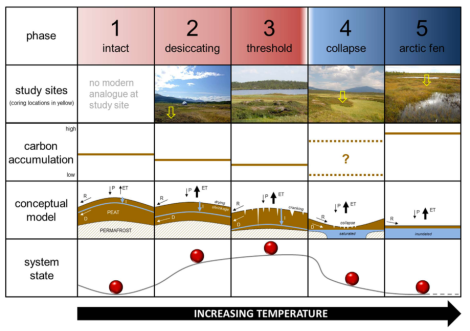
The Abisko region is a classic example of the damage being done by the warming climate. Here the average annual temperature is now above freezing – the permafrost is melting rapidly, and will eventually disappear completely. Our longer-term palaeoecological perspective on this process allowed us to produce a five-phase model outlining how we think permafrost peatlands are likely to respond to continued climate warming. Under increasing temperatures we found that intact permafrost peatlands begin to dry, with water tables and carbon accumulation both decreasing. At some point in this process a threshold state is reached and the peatland begins to degrade – cracking in the peat surface occurs and the link between climate and the peatland’s water table breaks down, lowering carbon accumulation further. At this point, the thaw has reached such a level that the peat dome collapses and becomes saturated by the underlying water table. This leads to the development of the final phase and common end point for thawing permafrost peatlands – an inundated arctic fen.
Screen Shot 2016-01-21 at 15.29.19
Our five-phase model for permafrost peatland response to increasing temperatures. © Nature Publishing Group.
Interestingly, we found that carbon accumulation in these new systems was relatively high. That news might sound good, but it is offset by bad – the waterlogged conditions experienced in these fens are highly likely to cause elevated methane emissions. Methane is 28 times more potent a greenhouse gas than carbon dioxide [4] and subsequently these increased emissions could well lead to increased climate warming. We often call these sorts of processes ‘climate-feedback mechanisms,’ but the phrase ‘vicious circle’ would do just as well.
References