Blog Archive

Showing posts with label Richard Alley. Show all posts

Tuesday, April 2, 2019

Ice-cliff failure via retrogressive slumping doi.org/10.1130/G45880.1

Geology, (2019) ; https://doi.org/10.1130/G45880.1

Ice-cliff failure via retrogressive slumping


Abstract

Retrogressive slumping could accelerate sea-level rise if ice-sheet retreat generates ice cliffs much taller than observed today. The tallest ice cliffs, which extend roughly 100 m above sea level, calve only after ice-flow processes thin the ice to near flotation. Above some ice-cliff height limit, the stress state in ice will satisfy the material-failure criterion, resulting in faster brittle failure. New terrestrial radar data from Helheim Glacier, Greenland, suggest that taller sub-aerial cliffs are prone to failure by slumping, unloading submarine ice to allow buoyancy-driven full-thickness calving. FullStokes diagnostic modeling shows that the threshold cliff height for slumping is likely slightly above 100 m in many cases and roughly twice that (145–285 m) in mechanically competent ice under well-drained or low-melt conditions.


https://pubs.geoscienceworld.org/gsa/geology/article/569567/ice-cliff-failure-via-retrogressive-slumping

Saturday, February 16, 2019

Chris Mooney, WaPo: Earth Is 'Missing' at Least 20 Ft of Sea Level Rise. Antarctica Could Be The Time Bomb

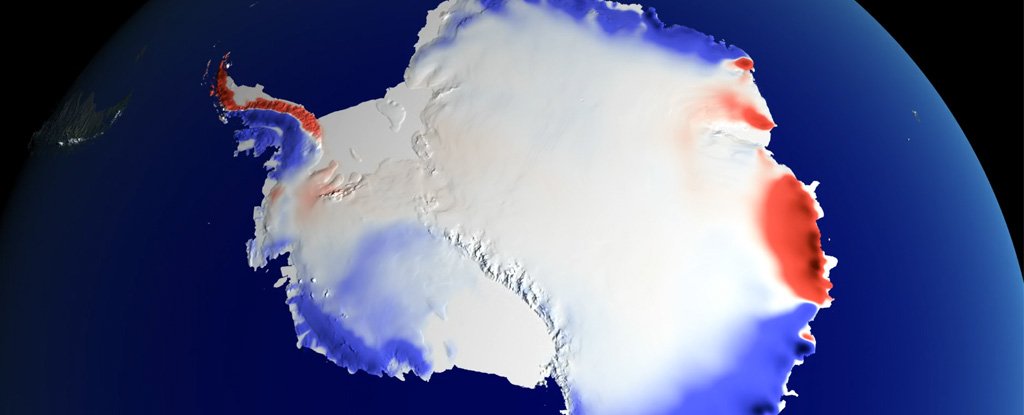
main article image

by Chris Mooney, The Washington Post, February 12, 2019

Some 115,000 years ago, Homo sapiens were still living in bands of hunter gatherers, largely confined to Africa. We still shared the globe with the Neanderthals, although it's not clear we had met them yet.

And though these various hominids didn't know it, the Earth was coming to the end of a major warm period. It was one that's quite close to our current climate, but with one major discrepancy - seas at the time were 20 to 30 feet (6 to 9 metres) higher.
During this ancient period, sometimes called the Eemian, the oceans were about as warm as they are today.
And last month, intriguing new research emerged suggesting that Northern Hemisphere glaciers have already retreated just as far as they did in the Eemian, driven by dramatic warming in Arctic regions.
The finding arose when a team of researchers working on Baffin Island, in northeastern Canada, sampled the remains of ancient plants that had emerged from beneath fast-retreating mountain glaciers.
And they found that the plants were very old indeed, and had probably last grown in these spots some 115,000 years ago.
That's the last time the areas were actually not covered by ice, the scientists believe.
"It's very hard to come up with any other explanation, except that at least in that one area where we're working ... the last century is as warm as any century in the last 115,000 years," said Gifford Miller, a geologist at the University of Colorado in Boulder who led the research on Baffin Island.
But if Miller is right, there's a big problem. We have geological records of sea levels from the Eemian. And the oceans, scientists believe, were 20 to 30 feet (6 to 9 metres) higher.
Some extra water likely came from Greenland, whose ice currently contains over 20 feet (6 metres) of potential sea level rise. But it couldn't have been just Greenland, because that entire ice sheet did not melt at the time.
That's why researchers also suspect a collapse of the most vulnerable part of Antarctica, the West Antarctic ice sheet. This region could easily supply another 10 feet (3 metres) of sea level rise, or more.
"There's no way to get tens of meters of sea level rise without getting tens of meters of sea level rise from Antarctica," said Rob DeConto, an Antarctic expert at the University of Massachusetts.
Trying to understand how Antarctica will fall
Scientists are now intensely debating precisely which processes could have played out then — and how soon they'll play out again. After all, West Antarctica has already been shown, once again, to be beginning a retreat.
Some researchers, including DeConto, think they have found a key process - called marine ice cliff collapse - that can release a lot of sea level rise from West Antarctica in a hurry.
But they're being challenged by another group, whose members suspect the changes in the past were slow - and will be again.
To understand the dispute, consider the vulnerable setting of West Antarctica itself.
Essentially, it's an enormous block of ice mostly submerged in very cold water. Its glaciers sit up against the ocean in all directions, and toward the center of the ice sheet, the seafloor slopes rapidly downward, even as the surface of the ice sheet itself grows much thicker, as much as two miles thick in total.
As much as a mile and a half of that ice rests below the sea level, but there is still plenty of ice above it, too.
So if the gateway glaciers start to move backward - particularly a glacier named Thwaites, by far the largest of them - the ocean would quickly have access to much thicker ice.
The idea is that during the Eemian, this whole area was not a block of ice at all, but an unnamed sea. Somehow, the ocean got in, toppling the outer glacial defenses, and gradually setting all of West Antarctica afloat and on course to melting.
DeConto, with his colleague David Pollard, built a model that looked to the Eemian, and another ancient warm period called the Pliocene, to try to understand how this could happen.
In particular, they included two processes that can remove glaciers. One, dubbed 'marine ice sheet instability,' describes a situation in which a partially submerged glacier gets deeper and thicker as you move toward its center.
In this configuration, warm water can cause a glacier to move backward and downhill, exposing ever thicker ice to the ocean - and thicker ice flows outward faster.
So the loss feeds upon itself.
Marine ice sheet instability is probably underway already in West Antarctica, but in the model, it wasn't enough. DeConto and Pollard also added another process that they say is currently playing out in Greenland, at a large glacier called Jakobshavn.
Jakobshavn is moving backward down an undersea hill slope, just in the way that it is feared the much larger Thwaites will drift. But Jakobshavn is also doing something else. It is constantly breaking off thick pieces at its front, almost like a loaf of bread, dropping slice after slice.
That's because Jakobshavn no longer has an ice shelf, a floating extension that used to grow out over the ocean at the front of the glacier and stabilize it. The shelf collapsed as Greenland warmed in the past two decades.
As a result, Jakobshavn now presents a steep vertical front to the sea. Most of the glacier's ice is under the water, but more than 100 meters (330 feet) extend above it - and for DeConto and Pollard, that's the problem. That's too much to be sustained.
Ice is not steel. It breaks. And breaks. And breaks.
This additional process, called 'marine ice cliff collapse,' causes an utter disaster if you apply it to Thwaites. If Thwaites someday loses its own ice shelf and exposes a vertical front to the ocean, you would have ice cliffs hundreds of meters above the surface of the water.
DeConto and Pollard say that such cliffs would continually fall into the sea. And when they added this computation, it not only recreated Eemian sea level rise, it greatly increased their projection of how much ice Antarctica could yield in this century - more than three feet.
Since there are other drivers of sea level rise, like Greenland, this meant that we could see as much as six feet in total in this century, roughly double prior projections. And in the next century, the ice loss would get even worse.
"What we pointed out was, if the kind of calving that we see in Greenland today were to start turning on in analogous settings in Antarctica, then Antarctica has way thicker ice, it's a way bigger ice sheet, the consequences would be potentially really monumental for sea level rise," DeConto said.
Moreover, the process, he argues, is essential to understanding the past - and thus how we could replicate it.
"We cannot recreate six meters of sea level rise early in the Eemian without accounting for some brittle fracture in the ice sheet model," said DeConto.
A massive debate over marine ice cliffs
Tamsin Edwards is not convinced. A glaciologist at Kings College London, she is lead author - with a number of other Antarctic experts - of a study published Wednesday in Nature (the same journal that published DeConto and Pollard in 2016) that disputes their model, in great detail.
Using a statistical technique to examine the results, Edwards and her collaborators find that the toppling of ice cliffs is not necessary to reproduce past warm periods after all.
They also present lower sea level rise possibilities from Antarctica in this century. If they're right, the worst case is back down to about 40 centimeters, or a little over a foot, rather than three to four feet.
"Things may not be as absolutely terrible as that last study predicted," Edwards said. "But they're still bad."
It is a new science, she said, and without more modeling it's unclear how ice cliffs will ultimately affect sea level rise.
But then what happened in the Eemian? Edwards thinks it just took a long time to lose West Antarctica. That it wasn't fast. After all, the entire geologic period was thousands of years long.
"We're an impatient lot, humans, and the ice sheets don't respond in a decade, they're slow beasts," she said.
DeConto says he's learned something from the critique.
"The Edwards study does illustrate the need for more in-depth statistics than we originally applied to our 2016 model output, but the models are evolving rapidly and they have already changed considerably since 2016," he said in a written statement.
But he's not backing down on marine ice cliffs. The new critique, DeConto said, implies that "these processes aren't important for future sea level rise. And I think to me, that's kind of a dangerous message."
He certainly has his allies. Richard Alley, a well known glaciologist at Penn State University who has published with DeConto and Pollard, wrote in an email that "cliff retreat is not some strange and unexpected physical process; it is happening now in some places, has happened in the past, and is expected wherever sufficiently high temperatures occur in ocean or air around ice flowing into the ocean."
The Eemian - but worse?
There's one important thing to consider - the Eemian occurred without humans emitting lots of greenhouse gases.
Atmospheric carbon dioxide was far lower than it is today. The event was instead driven by changes in the Earth's orbit around the sun, leading to more sunlight falling on the northern hemisphere.
The big difference, this time around, is that humans are heating things up far faster than what is believed to have happened in the geologic past.
And that makes a key difference, said Ted Scambos, an Antarctic researcher who is leading the US side of an international multimillion dollar mission to study Thwaites Glacier, and who is a senior researcher at the National Snow and Ice Data Center in Colorado.
"The current pace of climate change is very fast," Scambos said, and the rate of warming might cause glaciers to behave differently than they did in the past.
Accordingly, Scambos says he sees the current debate as fruitful - "it's the discussion that needs to happen" - but that it doesn't lessen his worry about the fate of Thwaites Glacier if it retreats far enough.
"There's no model that says the glacier won't accelerate if it gets into those conditions," said Scambos. "It just has to."
Humans were nowhere near the Antarctic in the Eemian - and we have never, in the modern period, seen a glacier as big as Thwaites retreat. It's possible something is going to happen that we don't have any precedent or predictions for.
Just last week, for instance, scientists reported a large cavity opening beneath one part of the glacier - something they said models could not have predicted.
There is a massive stake involved now in at least trying to figure out what could happen - before it actually does. It will help determine whether humans, now organized and industrialized and masters of fossil fuels, are poised to drive a repeat of our own geological history.
2019 © The Washington Post

Monday, July 20, 2015

Updated ice sheet model matches wild swings in past sea levels: Changes make Antarctica lose more ice, faster

by Scott K. Johnson, arstechnica, January 25, 2015


Map showing portions of Antarctica's land surface that are actually below sea level, which makes the glacial ice there (which is much too thick to float) more vulnerable to retreat.
It has been a bit of a head scratcher. Records of sea level during the last few million years tell us that there have been some warm periods where sea level may have been as much as 20 meters higher than it is today. When fed the conditions that prevailed at the time, however, our computer models of ice sheets haven’t been able to reproduce such a swelling of the ocean.
The models can simulate that much sea level rise, but it requires temperatures much higher than were seen during those warm periods. Realistic losses of ice from Greenland and the fragile, western part of Antarctica (the West Antarctic Ice Sheet) could only provide something in the neighborhood of 3 to 10 meters of sea level rise. That leaves 10 to 17 meters for the East Antarctic Ice Sheet—the largest and most stable ice sheet—to chip in. Convincing the miserly East Antarctic Ice Sheet to be that generous with its contents isn’t easy, which is why the models required such high temperatures.

Updating the models

So what are the models missing? Penn State’s David Pollard and Richard Alley, and University of Massachussetts, Amherst’s Robert DeConto had an idea for something to try. Two things to try, really. They added a pair of physical processes to an ice sheet model that weren’t simulated previously. The first was hydrofracturing. When water reaches the ice sheet from rain or ice melt at the surface, it fills crevasses in the ice.
If they're filled to a great enough depth, the water pressure forces the crevasse to open even deeper—that's termed hydrofracturing. The other process results from the simple fact that a sheer cliff of ice can only be so tall before it collapses under its own weight—a condition not encountered in too many places today.
One place it does occur is where floating glaciers calve large icebergs. These occur on the coastal outlet glaciers at the edges of ice sheets that are the most vulnerable to warming. The glacier thins towards its outer edge, and at some point it grows thin enough that it begins to float. The point at which it floats off the bottom is called the “grounding line”—from there out to the end of the ice is called an ice shelf. Ice shelves that grind against the shore (think of it floating in a bay or fjord) act to hold back the flow of ice behind them. These shelves gradually melt from below as they float in their seawater bath. But they can also melt from above and shed large bergs of ice at their outer edge.
Both hydrofracturing and cliff failure can increase the shedding of icebergs from shelves, hastening their demise and uncorking the glacier behind them. Once these things are happening near the grounding line, though, they can really accelerate its retreat if it's in an unstable configuration where the ground surface drops as you head inland. (Significant portions of Antarctica match that description.) Once you start retreating in that situation, the glacier may have to retreat a long way to find a stable position again.

A hasty retreat

Having added representations of these two processes to the model, the researchers simulated a sudden change from modern conditions to warmer conditions like those past periods of very high sea level. Then they watched the virtual Antarctic glaciers respond.
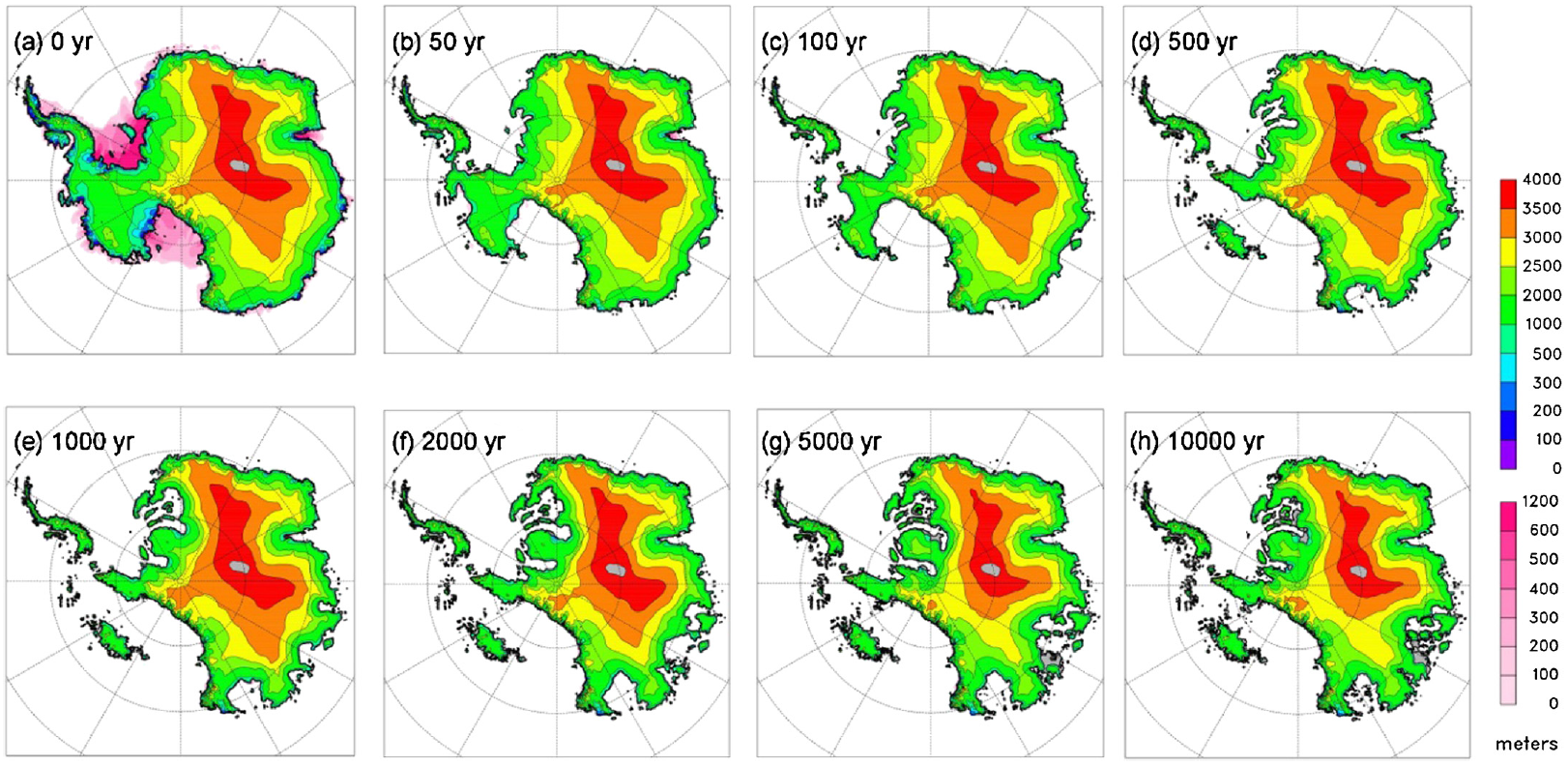
The results were dramatic. The new processes combined to have a huge impact. Instead of about 2 meters of sea level rise, Antarctica lost enough ice to raise global sea level 17 meters over several thousand years. The fragile West Antarctic Ice Sheet collapses in a matter of decades, rather than centuries or millennia. There’s 5 meters of sea level rise in the first two centuries, after which retreat in portions of the East Antarctic Ice Sheet really get going.

Enlarge / Results after the change to warmer conditions in the model. The rainbow color scale shows the elevation of the ice surface on land, while the pink scale shows thickness of floating ice. Pollard, DeConto, and Alley, Earth and Planetary Science Letters
Much more work will be required to make sure these new processes are being simulated accurately, but the early returns show it could put researchers in the ballpark of solving the puzzle of past high sea levels.
The relevance for our present situation is less direct, as the warming in the simulation was not realistic, but the possibility that West Antarctica could lose ice faster than we thought is a serious one. Richard Alley, whose work on this possibility we’ve covered before, explained to Ars via email, “I believe (and I suspect many people do) that it is important for us as scientists to provide not only the most-likely future outcome, but also the range of possibilities, including some sort of assessment of best-case and worst-case outcomes. Best-case is fairly easy, I believe, but worst-case is not; however, providing both is likely to be useful to many people.”
“The physical knowledge that too-tall cliffs fail is very old and familiar to every miner or quarry-worker. The physical knowledge that ice is not the strongest rock on the planet is also rather old. And, the suggestion that cliff failure could affect West Antarctic stability dates back to 1962,” Alley wrote. “We now have stronger evidence that sufficient West Antarctic retreat could lead to a higher calving front than any on Earth today, and higher than a stability limit suggested by recent papers. Putting that understanding into projections of the future, as in our new paper, has implications for the worst-case scenario. And, testing against the paleoclimatic record provides support for that understanding.”
He continued, “It is still too early to say that this is an accurate worst-case scenario. Step-application of the [warming] is too extreme, clearly… but, it is within the realm of possibility that for the time-scale of collapse, the true worst worst-case scenario could be even a bit faster than modeled here; the renewed interest in this topic is recent, and the number of scientific papers exploring the physics remains low.”
Earth and Planetary Science Letters, 2014. DOI: 10.1016/j.epsl.2014.12.035  

Tuesday, March 17, 2015

WaPo: The melting of Antarctica was already really bad. It just got worse

by Chris Mooney, The Washington Post, March 16, 2015

This story has been updated.
A hundred years from now, humans may remember 2014 as the year that we first learned that we may have irreversibly destabilized the great ice sheet of West Antarctica, and thus set in motion more than 10 feet of sea level rise.
Meanwhile, 2015 could be the year of the double whammy — when we learned the same about one gigantic glacier of East Antarctica, which could set in motion roughly the same amount all over again. Northern Hemisphere residents and Americans in particular should take note — when the bottom of the world loses vast amounts of ice, those of us living closer to its top get more sea level rise than the rest of the planet, thanks to the law of gravity.
The findings about East Antarctica emerge from a new paper just out in Nature Geoscience by an international team of scientists representing the United States, Britain, France and Australia. They flew a number of research flights over the Totten Glacier of East Antarctica — the fastest-thinning sector of the world’s largest ice sheet — and took a variety of measurements to try to figure out the reasons behind its retreat. And the news wasn’t good: It appears that Totten, too, is losing ice because warm ocean water is getting underneath it.
“The idea of warm ocean water eroding the ice in West Antarctica, what we’re finding is that may well be applicable in East Antarctica as well,” says Martin Siegert, a co-author of the study and who is based at the Grantham Institute at Imperial College London.
The floating ice shelf of the Totten Glacier covers an area of 90 miles by 22 miles. It it is losing an amount of ice “equivalent to 100 times the volume of Sydney Harbour every year,” notes the Australian Antarctic Division.
That’s alarming, because the glacier holds back a much more vast catchment of ice that, were its vulnerable parts to flow into the ocean, could produce a sea level rise of more than 11 feet — which is comparable to the impact from a loss of the West Antarctica ice sheet. And that’s “a conservative lower limit,” says lead study author Jamin Greenbaum, a PhD candidate at the University of Texas at Austin.
In its alignment with the land and the sea, the Totten Glacier is similar to the West Antarctic glaciers, which also feature ice shelves that slope out from the vast sheet of ice on land and extend into the water. These ice shelves are a key source of instability, because if ocean waters beneath them warm, they can lose ice rapidly, allowing the ice sheet behind them to flow more quickly into the sea.
The researchers used three separate types of measurements taken during their flights — gravitational measurements, radar and laser altimetry — to get a glimpse of what might be happening beneath the massive glacier, whose ice shelves are more than 1,600 feet thick in places. Using radar, they could measure the ice’s thickness. Meanwhile, by measuring the pull of the Earth’s gravity on the airplane in different places, the scientists were able to determine just how far below that ice the seafloor was.
The result was the discovery of two undersea troughs or valleys beneath the ice shelf — regions where the seafloor slopes downward, allowing a greater depth of water beneath the floating ice. These cavities or subsea valleys, the researchers suggest, may explain the glacier’s retreat — they could allow warmer deep waters to get underneath the ice shelf, accelerating its melting.
In this particular area of Antarctica, Greenbaum says, a warmer layer of ocean water offshore is actually deeper than the colder layers above it, because of the saltwater content of the warm water (which increases its density). And the canyons may allow that warm water access to the glacier base. “What we found here is that there are seafloor valleys deeper than the depth of the maximum temperature measured near the glacier,” Greenbaum says.
One of these canyons is three miles wide, in a region that was previously believed to simply hold ice lying atop solid earth. On the contrary, the new study suggests the ice is instead afloat.
The availability of warm water, and the observed melting, notes the study, “support the idea that the behaviour of Totten Glacier is an East Antarctic analogue to ocean-driven retreat underway in the West Antarctic Ice Sheet (WAIS). The global sea level potential of 3.5 m flowing through Totten Glacier alone is of similar magnitude to the entire probable contribution of the WAIS.”
For Richard Alley, a glaciologist at Penn State University, the new research hints at a possible solution to a question that scientists have long had about the planet’s past — and in particular the Pliocene epoch, beginning 5.3 million years ago, when sea levels were dramatically higher, by as much as 40 meters.
“The sea-level indicators from the Pliocene have suggested that an important amount of ice came out of East Antarctica into the ocean,” says Alley. “Sedimentary records offshore pointed in the same way, and recent modeling…shows the strong potential for this to have happened.  This new paper adds to the evidence — the pieces are fitting together.”
One limitation of the study is that the scientists were not able to directly measure the temperature of ocean water that is reaching the glacier itself. While this could be done with robotic underwater vehicles or other methods, that wasn’t part of the study at this time. Thus, the conclusions are more focused on inferring the vulnerability of the glacier based on a number of different pieces of evidence — topped off by the fact that the glacier is, indeed, retreating.
“What we need now is a confirmation of the findings of the paper from oceanographic data, because it  is one thing to find potential pathways for warm water to intrude the cavity, it is another to show that this is actually happening,” observes Eric Rignot, an Antarctica expert at the University of California, Irvine. “This paper comes short of the latter, but other research efforts are underway to get critical oceanographic information near Totten.”
Maximum Antarctic sea ice 2014(0:42)
An animation of the Antarctic sea ice between March 21 and September 19, 2014, when the sea ice reached its maximum extent. The red extent line shows the average of the annual maximum extents from 1979 through 2014. (NASA)
For residents of the United States — and indeed, the entire Northern Hemisphere — the impact of major ice loss from Antarctica could be dire. If Antarctica loses volumes of ice that would translate into major contributions to sea level rise, that rise would not be distributed evenly around the globe. The reason is the force of gravity. Antarctica is so massive that it pulls the ocean toward it, but if it loses ice, that gravitational pull will relax, and the ocean will slosh back toward the Northern Hemisphere — which will experience additional sea level rise.
For the United States, the amount of sea level rise could be 25 percent or more than the global average.
Much as with the ocean-abutting glaciers of West Antarctica, just because a retreat has been observed — and because the entirety of the region implies a sea level rise of 11 or more feet were all ice to end up in the ocean — does not mean that we’ll see anything near that much sea level rise in our lifetimes. These processes generally are expected to play out over hundreds of years or more. They would reshape the face of the Earth – but we may never see it.
The problem, then, is more the world we’re leaving to our children and grandchildren — because once such a gigantic geophysical process begins, it’s hard to see how it comes to a halt. “With warming oceans, it’s difficult to see how a process that starts now would be reversed, or reversible, in a warming world,” Siegert says.
UpdateThis article was updated to correct the size of the Totten Glacier. According to Greenbaum (but contrary to this press release), its floating portion (or ice shelf) is 90 miles by 22 miles in size. 

Wednesday, December 3, 2014

NASA: Antarctic Melt Loss Triples in a Decade

by Peter Sinclair, Climate Crocks, December 3, 2014
Evidence is piling up indicating the planet will be extremely fortunate to stay on the lower end of sea level rise estimates.

And remember, this study covers just one area of Antarctica, where we have good instrument coverage.

A comprehensive, 21-year analysis of the fastest-melting region of Antarctica has found that the melt rate of glaciers there has tripled during the last decade. 
The glaciers in the Amundsen Sea Embayment in West Antarctica are hemorrhaging ice faster than any other part of Antarctica and are the most significant Antarctic contributors to sea level rise. This study by scientists at the University of California, Irvine (UCI), and NASA is the first to evaluate and reconcile observations from four different measurement techniques to produce an authoritative estimate of the amount and the rate of loss over the last two decades.
This work extends the work of Eric Rignot, who stunned the ice sheet community last spring with his “holy shit moment” paper on unstoppable Antarctic melting – discussed here in a very important video, if you have not seen it.


“The mass loss of these glaciers is increasing at an amazing rate,” said scientist Isabella Velicogna, jointly of UCI and NASA’s Jet Propulsion Laboratory, Pasadena, California. Velicogna is a coauthor of a paper on the results, which has been accepted for publication in the journal Geophysical Research Letters. 
Lead author Tyler Sutterley, a doctoral candidate at UCI, and his team did the analysis to verify that the melting in this part of Antarctica is shifting into high gear. “Previous studies had suggested that this region is starting to change very dramatically since the 1990s, and we wanted to see how all the different techniques compared,” Sutterley said. “The remarkable agreement among the techniques gave us confidence that we are getting this right.” 
The researchers reconciled measurements of the mass balance of glaciers flowing into the Amundsen Sea Embayment. Mass balance is a measure of how much ice the glaciers gain and lose over time from accumulating or melting snow, discharges of ice as icebergs, and other causes. Measurements from all four techniques were available from 2003 to 2009. Combined, the four data sets span the years 1992 to 2013.
Worth watching this video from a year ago if you have not yet, backgrounder on the movement of large ice sheets.

The glaciers in the embayment lost mass throughout the entire period. The researchers calculated two separate quantities: the total amount of loss, and the changes in the rate of loss. 
The total amount of loss averaged 83 gigatons per year (91.5 billion U.S. tons). By comparison, Mt. Everest weighs about 161 gigatons, meaning the Antarctic glaciers lost an amount of water weight equivalent to Mt. Everest every two years over the last 21 years. 
The rate of loss accelerated an average of 6.1 gigatons (6.7 billion U.S. tons) per year since 1992.
During the period when the four observational techniques overlapped, the melt rate increased an average of 16.3 gigatons per year — almost three times the rate of increase for the full 21-year period. The total amount of loss was close to the average at 84 gigatons. 
The four sets of observations include NASA’s Gravity Recovery and Climate Experiment satellites, laser altimetry from NASA’s Operation IceBridge airborne campaign and the earlier ICESat satellite, radar altimetry from the European Space Agency’s Envisat satellite, and mass budget analyses using radars and the University of Utrecht’s Regional Atmospheric Climate Model. 
The scientists noted that glacier and ice sheet behavior worldwide is by far the greatest uncertainty in predicting future sea level. “We have an excellent observing network now. It’s critical that we maintain this network to continue monitoring the changes,” Velicogna said, “because the changes are proceeding very fast.”
This is just Antarctica. At the other pole, Greenland is also vulnerable, and estimates of how fast it can shed mass keep increasing. Below, see Dr. Jeff Masters' analysis of that loss, and Dr. James Hansen’s take on what an accelerating Greenland loss might mean to the world.
Dr. Jeff Masters at Weather Underground:
Human-caused global warming has set in motion an unstoppable slow-motion collapse of the glaciers in West Antarctica capable of raising global sea level by 4 feet (1.2 meters) in a few hundred years, said NASA in a May 2014 press release. What’s more, one of the glaciers involved, the Thwaites Glacier, acts as a linchpin on the rest of the ice sheet, which contains enough ice to cause a total of 10 to 13 feet (3 to 4 meters) of global sea level rise over a period of centuries. This unstoppable collapse makes saving Greenland “absolutely essential,” said glaciologist Richard Alley in a May 2014 interview in Mother Jones. 
Greenland’s ice sheet holds enough water to raise global sea levels by 7.36 meters (24.15 feet) were it all to melt, and civilization would be hard-pressed to deal with 10–13 feet of sea level rise from West Antarctica, let alone another 20+ feet from Greenland. “If we’ve committed to 3.3 meters (10.8') from West Antarctica, we haven’t committed to losing Greenland, we haven’t committed to losing most of East Antarctica,” said Alley. “Those are still out there for us. And if anything, this new news just makes our decisions more important, and more powerful.” 
Unfortunately, the Greenland Ice Sheet is much more vulnerable to melting than previously thought, found a May 2014 study by Morlighem et al., "Deeply incised submarine glacial valleys beneath the Greenland ice sheet." The researchers found that widespread ice-covered valleys extend much deeper below sea level and farther inland than previously thought, and would likely melt significantly from steadily warming waters lapping at Greenland’s shores.

Figure 2. Monthly changes in the total mass (in gigatons) of the Greenland ice sheet estimated from GRACE satellite measurements between March 2002–July 2013. The blue and orange asterisks denote April and July values, respectively. Note that the decline in ice mass lost from Greenland is not a straight line – it is exponential, meaning that, in general, more ice loss is lost each year than in the previous year. However, the mass loss during the 2013 summer melt season was probably smaller than during 2012, said the 2013 Arctic Report Card.

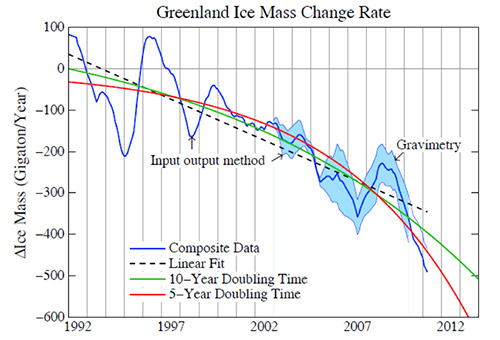
Fig. 1 shows that Greenland has been losing mass at a faster and faster rate over the past decade, with the recent rate corresponding to ~1 mm sea level per year (1 mm sea level = 360 Gt ice). The linear fit to the Shepherd et al. data in Fig. 1 yields a Greenland contribution to global sea level of about 30 cm by 2100.
Fig. 1. Annual mass change of Greenland ice sheet based on the input-output method, an analysis of gravity measurements, and a best-estimate composite (Shepherd et al., 2012).
Fig. 1. Annual mass change of Greenland ice sheet based on the inputoutput method, an analysis of gravity measurements, and a best-estimate composite (Shepherd et al., 2012).
The increasing Greenland mass loss in Fig. 1 can be fit just as well by exponentially increasing annual mass loss, a behavior that Hansen (2005, 2007) argues could occur because of multiple amplifying feedbacks as an ice sheet begins to disintegrate. A 10-year doubling time would lead to 1 meter sea level rise by 2067 and 5 meters by 2090. The dates are 2045 and 2057 for 5-year doubling time and 2055 and 2071 for a 7-year doubling time.
http://climatecrocks.com/2014/12/03/nasa-antarctic-melting-triples/ 

Sunday, July 20, 2014

Peter Sinclair: Point of No Return, Deglaciation of West Antarctica, Meltwater Pulse 2B


by Peter Sinclair, This Is Not Cool, June 2, 2014


Today’s news will be dominated by discussion of new carbon regulations proposed by the Obama administration.  My contribution is to summarize the most recent evidence for why those regs are needed today, if not 25 years ago.

It’s not often that a scientific research paper generates the kind of media attention and scientific community buzz that resulted from a recent study on the apparent inevitability of substantial Antarctic glacial melting.
The early May research headed by lead author Eric Rignot of NASA called attention to melting now under way in Antarctica that CBS News anchor Scott Pelley reported “cannot be stopped.”
“Scientists say the situation is almost certainly unstoppable,” NBC News Anchor Brian Mitchell reported.
Rignot cautioned that the research indicates “we’ve passed the point of no return … It’s just a matter of time before these glaciers disappear to the sea.” While he indicated that the full melt, at the current pace, might not occur for two centuries, he pointed too to evidence suggesting the likelihood of an accelerating pace.
rignot
“There’s probably nothing that can be done to stop this,” Rignot said.
“This is really happening,” lead NASA lead polar ice researcher Tom Wagner said. “This weak underbelly of Antarctica is in fact starting to float out into the sea, and there’s not a lot to hold it back.”
A “This is Not Cool” video on the report by independent videographer Peter Sinclair is the first to be posted under the new Yale Climate Connections name, formerly The Yale Forum on Climate Change & The Media. The official transition to that newly named site is to get underway over the next few weeks, initially with a largely cosmetic rebranding, then to be followed by a substantial overhaul and a more multi-media emphasis aimed at better reaching the general public.
Note: link to the Guardian piece referenced in the video is here. Errata – I neglected to thank the European Space Agency for important video animations. Deepest apologies.

UPDATE: Per Stefan Rahmstorf, newly published study adds complexity.
“Conventional thinking based on past research is that the Antarctic Ice Sheet has been relatively stable since the last ice age, that it began to melt relatively late during the deglaciation process, and that its decline was slow and steady until it reached its present size,” said lead author Michael Weber, a scientist from the University of Cologne in Germany.
“The sediment record suggests a different pattern — one that is more episodic and suggests that parts of the ice sheet repeatedly became unstable during the last deglaciation,” Weber added.
The research also provides the first solid evidence that the Antarctic Ice Sheet contributed to what is known as meltwater pulse 1A, a period of very rapid sea level rise that began some 14,500 years ago, according to Peter Clark, an Oregon State University paleoclimatologist and co-author on the study.
The largest of the 8 episodic pulses outlined in the new Nature study coincides with meltwater pulse 1A.
“During that time, the sea level on a global basis rose about 50 feet in just 350 years — or about 20 times faster than sea level rise over the last century,” noted Clark, a professor in Oregon State’s College of Earth, Ocean, and Atmospheric Sciences. “We don’t yet know what triggered these eight episodes or pulses, but it appears that once the melting of the ice sheet began it was amplified by physical processes.”
The researchers suspect that a feedback mechanism may have accelerated the melting, possibly by changing ocean circulation that brought warmer water to the Antarctic subsurface, according to co-author Axel Timmermann, a climate researcher at the University of Hawaii at Manoa.
“This positive feedback is a perfect recipe for rapid sea level rise,” Timmermann said.
Some 9,000 years ago, the episodic pulses of melting stopped, the researchers say.
“Just as we are unsure of what triggered these eight pulses,” Clark said, “we don’t know why they stopped. Perhaps the sheet ran out of ice that was vulnerable to the physical changes that were taking place. However, our new results suggest that the Antarctic Ice Sheet is more unstable than previously considered.”
http://climatecrocks.com/2014/06/02/new-video-meltwater-pulse-2b/http://climatecrocks.com/2014/06/02/new-video-meltwater-pulse-2b/

Monday, May 12, 2014

Breaking, NYT: Scientists Warn of Inexorably Rising Oceans as Antarctic Ice Melts

by Justin Gillis and Kenneth Chang, The New York Times, May 12, 2014


The collapse of large parts of the ice sheet in West Antarctica appears to have begun and is almost certainly unstoppable, with global warming accelerating the pace of the disintegration, two groups of scientists reported Monday.

The finding, which had been feared by some scientists for decades, means that a rise in global sea level of at least 10 feet may now be inevitable. The rise may continue to be relatively slow for at least the next century or so, the scientists said, but sometime after that it will probably speed up so sharply as to become a crisis.

“This is really happening,” said Thomas P. Wagner, who runs NASA’s programs on polar ice and helped oversee some of the research. “There’s nothing to stop it now. But you are still limited by the physics of how fast the ice can flow.”

Two papers scheduled for publication this week, in the journals Science and Geophysical Research Letters, attempt to make sense of an accelerated flow of glaciers seen in parts of West Antarctica in recent decades.


Various measurements have captured the West Antarctic ice sheet changing very rapidly in the region where it flows into the Amundsen Sea. Credit Landsat        


In this graphic, the red regions are areas where  temperatures have increased the most during the last 50 years, particularly in West Antarctica, The dark blue regions have had a lesser degree of warming. Temperature changes are measured in degrees Celsius [per decade]. Credit NASA/GSFC Scientific Visualization Studio.

Both papers conclude that warm water upwelling from the ocean depths has most likely triggered an inherent instability that makes the West Antarctic ice sheet vulnerable to a slow-motion collapse. And one paper concludes that factors some scientists had hoped might counteract such a collapse will not do so.

The new finding appears to be the fulfillment of a prediction made in 1978 by an eminent glaciologist, John H. Mercer of the Ohio State University. He outlined the uniquely vulnerable nature of the West Antarctic ice sheet and warned that the rapid human release of greenhouse gases posed “a threat of disaster.” He was assailed at the time, but in recent years scientists have been watching with growing concern as events have unfolded in much the way Dr. Mercer predicted. (He died in 1987.)

Scientists said the ice sheet was not melting because of warmer air temperatures, but rather because of the relatively warm water, which is naturally occurring, from the ocean depths. That water is being pulled upward and toward the ice sheet by intensification of the winds around Antarctica.


West Antarctic Glacier Ice Flows and Elevation Change Video by NASA.gov


Most scientists in the field see a connection between the stronger winds and human-caused global warming, but they say other factors are likely at work, too. Natural variability of climate may be one of them. Another may be the ozone hole over Antarctica, caused by an entirely different environmental problem, the human release of ozone-destroying gases.


The basic problem is that much of the West Antarctic ice sheet sits below sea level in a kind of bowl-shaped depression the earth. As Dr. Mercer outlined in 1978, once the part of the ice sheet sitting on the rim of the bowl melts and the ice retreats into deeper water, it becomes unstable and highly vulnerable to further melting.

Richard B. Alley, a climate scientist at Pennsylvania State University who was not involved in the new research but has studied the polar ice sheets for decades, said he found the new papers compelling. Though he has long feared the possibility of ice-sheet collapse, when he learned of the new findings, “it shook me a little bit,” Dr. Alley said.

He added that while a large rise of the sea may now be inevitable from West Antarctica, continued release of greenhouse gases will almost certainly make the situation worse. The heat-trapping gases could destabilize other parts of Antarctica as well as the Greenland ice sheet, causing enough sea-level rise that many of the world’s coastal cities would eventually have to be abandoned.

Correction: May 12, 2014
An earlier version of this article misstated the surname of the lead author of a paper in Science about the accelerated flow of glaciers in West Antarctica. He is Ian Joughin, not Joaquin.

http://www.nytimes.com/2014/05/13/science/earth/collapse-of-parts-of-west-antarctica-ice-sheet-has-begun-scientists-say.html