Blog Archive

Showing posts with label Currygate. Show all posts

Tuesday, February 14, 2012

Brendan DeMelle: Heartland Institute Exposed: Internal Documents Unmask Heart of Climate Denial Machine

Heartland Institute Exposed: Internal Documents Unmask Heart of Climate Denial Machine
Email this story
Comment on this Story


by Brendan DeMelle, desmogblog, February 14, 2012


Internal Heartland Institute strategy and funding documents obtained by DeSmogBlog expose the heart of the climate denial machine – its current plans, many of its funders, and details that confirm what DeSmogBlog and others have reported for years. The heart of the climate denial machine relies on huge corporate and foundation funding from U.S. businesses including Microsoft, Koch Industries, Altria (parent company of Philip Morris) RJR Tobacco and more.
We are releasing the entire trove of documents now to allow crowd-sourcing of the material. Here are a few quick highlights, stay tuned for much more.

-Confirmation that Charles G. Koch Foundation is again funding Heartland Institute’s global warming disinformation campaign. Greenpeace’s Koch reports show the last time Heartland received Koch funding was in 1999.

The January 2012 Confidential Memo: 2012 Heartland Climate Strategy states:
We will also pursue additional support from the Charles G. Koch Foundation. They returned as a Heartland donor in 2011 with a contribution of $200,000. We expect to push up their level of support in 2012 and gain access to their network of philanthropists, if our focus continues to align with their interests. Other contributions will be pursued for this work, especially from corporations whose interests are threatened by climate policies.”
-Heartland Institute’s global warming denial machine is chiefly – and perhaps entirely – funded by one Anonymous donor:
Our climate work is attractive to funders, especially our key Anonymous Donor (whose contribution dropped from $1,664,150 in 2010 to $979,000 in 2011 - about 20% of our total 2011 revenue). He has promised an increase in 2012…”
-Confirmation of exact amounts flowing to certain key climate contrarians. 
funding for high-profile individuals who regularly and publicly counter the alarmist AGW message. At the moment, this funding goes primarily to Craig Idso ($11,600 per month), Fred Singer ($5,000 per month, plus expenses), Robert Carter ($1,667 per month), and a number of other individuals, but we will consider expanding it, if funding can be found.”
-As Brad Johnson reported today at ThinkProgress, confirmation that Heartland is working with David Wojick, a U.S. Energy Department contract worker and coal industry consultant, to develop a ‘Global Warming Curriculum for K-12 Schools.’
-Forbes and other business press are favored outlets for Heartland’s dissemination of climate denial messages, and the group is worried about maintaining that exclusive space. They note in particular the work of Dr. Peter Gleick:
Efforts at places such as Forbes are especially important now that they have begun to allow high-profile climate scientists (such as Gleick) to post warmist science essays that counter our own. This influential audience has usually been reliably anti-climate and it is important to keep opposing voices out.” (emphasis added)
Note the irony here that Heartland Institute – one of the major mouthpieces behind the debunked ‘Climategate’ email theft who harped about the suppression of denier voices in peer-reviewed literature – now defending its turf in the unscientific business magazine realm.
-Interesting mentions of Andrew Revkin as a potential ally worth “cultivating,” along with Judith Curry.
Efforts might also include cultivating more neutral voices with big audiences (such as Revkin at DotEarth/NYTimes, who has a well-known antipathy for some of the more extreme AGW communicators such as Rornm, Trenberth, and Hansen) or Curry (who has become popular with our supporters).”
-Confirmation that skeptic blogger Anthony Watts is part of Heartland’s funded network of misinformation communicators.
We have also pledged to help raise around $90,000 in 2012 for Anthony Watts to help him create a new website to track temperature station data.”
Stay tuned for more details as DeSmogBlog and others dig through this trove of Heartland Institute documents. The Heartland Institute's legacy of evasion of this level of transparency and accountability has now been shattered. 
Read the documents [all PDF]:
More to come - hit refresh  

Wednesday, February 23, 2011

BEST (Get S.M.A.R.T.) climate joke: Hockey Stick fight at the you’re-not-OK Corral. Judith Curry repeats Richard Muller's smear that paleoclimate reconstructions were "dishonest," and NASA's Gavin Schmidt eviscerates her (again)


Curry repeats Muller's smear that paleoclimate reconstructions were "dishonest," and NASA's Schmidt eviscerates her (again)


by Joseph Romm, Climate Progress, February 23, 2011

BEST is now a joke, officially, thanks to Dr. Judith Curry.  Sure, B.E.S.T.  seemed laughable from the start — see “Richard Muller, Charles Koch, Judith Curry and the implosion of the Berkeley Earth Surface Temperature Study (BEST).”
How could an effort to restore  the supposedly lost credibility of the global temperature record be run by one climate confusionist (Muller),  have as its sole ‘climate expert’ perhaps the leading confusionist (see “Curry abandons science“), and be funded in part by the world’s  biggest funder of climate disinformation!  And  I haven’t even blogged on the head-exploding conflict of interest of having Muller, who runs a for-profit climate consulting business, installing his daughter as B.E.S.T. project manager when she is the CEO of that business!
But that’s not funny.  What’s funny is that Curry had been advertising herself as some sort of a peace-making, I’m-ok-you’re-ok, why-can’t-we-all-just-get-along bridge builder among scientists — a reconciler, as it were (see “Fred Pearce jumps the shark“).
Now, however, she has devoted an entire post at her blog Climate etc. — judithcurry.com — to defending Muller’s claim (in this youtube clip) that “hide the decline” means the paleoclimate re-constructors of the Hockey Stick were “dishonest.”  For the record, the House of Commons vindication of climate scientists involved in the stolen emails  explicitly stated:
… insofar as we have been able to consider accusations of dishonesty—for example, Professor Jones’s alleged attempt to “hide the decline”—we consider that there is no case to answer.
Similarly, Michael Mann has  been through multiple vindications that specifically looked at all of these e-mails.  See also RealClimate (here).
NASA’s Gavin Schmidt  showed up on Curry’s blog to make some incisive comments, and, with Curry’s help, demonstrated that, using her standard, her own work is “dishonest.”  Curry also made clear that her days of reconciliation are over.  She has gone native — or, rather, gone tribal — the full disinformer, as they say.
WattsUpWithThat has, typically, tried to make Schmidt look bad with one piece of not-terribly-damning quote mining, but  I will endeavor to pull out all of the relevant comments (including some by Curry and others).  The whole post and comment chain  is only worth reading if you like unintentional humor and ‘credibility seppuku’:

Gavin | February 22, 2011 at 7:31 pm | Reply
You have gone significantly over the line with this post. Accusations of dishonesty are way beyond a difference of opinion on how a graph should be displayed.
If you thought that a single, smoothed graph of estimates of paleo-temperature told the whole story of paleo-climate reconstructions is far more a failing at your end than it is the authors involved. How can a single graph say everything that can possibly be said?
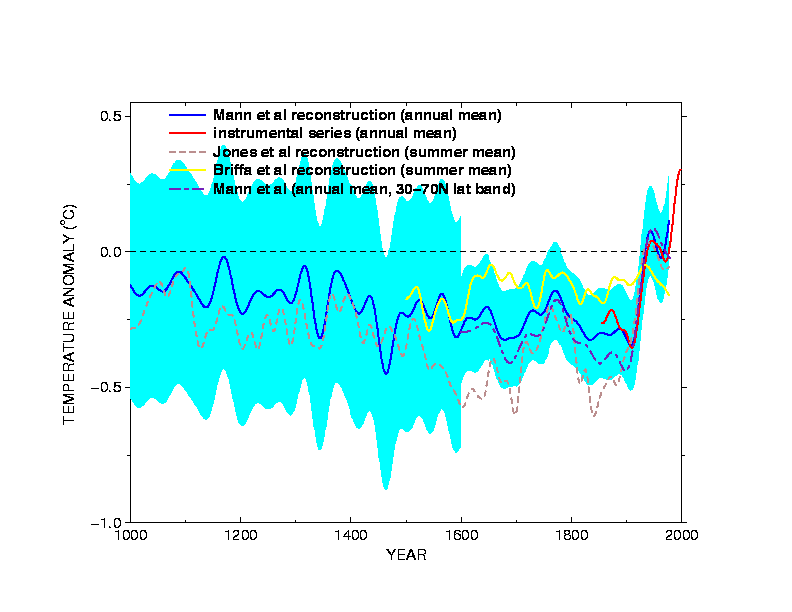
Summary graphs are by their very nature, summaries. The graphs you pick out were summaries of various estimates of what paleo-temperature estimates from the literature were. It is therefore not surprising that they show only the reconstructions where the authors had confidence that the reconstructions were actually of the temperatures.
Problems with modern divergence – which only applies to the Briffa et al curve in any case – are issues to be dealt with in the technical literature, as they still are.
The quote from the emails on the ‘dilution of the message’ was related to a completely different issue – the fact that Briffa et al’s initial reconstruction did not have very much centennial variability at all (the version of the graph that was being discussed is here:http://climateaudit.files.wordpress.com/2009/12/ipcc_tar_zero.png ). You arebeing misled if you think that is related.
One can have a difference of opinion in how to present a graph, and that depends entirely on what point you want to make. If you want to make a point about multi-decadal temperature changes in the past, it makes sense to include estimates of those temperatures and the uncertainties. It doesn’t make much sense to include annual estimates, or seasonal estimates, or parts of the curve that the originators think doesn’t reflect actual temperatures (for whatever reason). The only issue is to ensure that the graph is sufficiently documented so that these choices are clear (which in the WMO report they were not sufficiently so, but were fine in the IPCC graphs).
But to ascribe a difference of opinion to dishonesty is to remove yourself from any sensible discussion on the topic. Perhaps if I was to find a graph in one of your papers which I thought didn’t show some aspect of the data I was interested in, and then accuse you of dishonesty? Would you react well to that? This is exactly the same.
How can you claim to be building bridges, when you are so busy burning them?
curryja | February 22, 2011 at 7:41 pm | Reply
Gavin, the field does not need any more summary graphs of this nature. They have done an enormous disservice to climate science and its credibility. Continuing to defend these kinds of graphs is beyond anything I can understand. Leaving out that data and putting a “likely” confidence level on conclusions from that data is bad science, anyway you slice it. If you don’t like dishonest, try misguided and pseudoscience. There is no way this is defensible scientific practice. I really hope we don’t see any more of these kinds of graphs, in the AR5 or elsewhere. I’ve tiptoed around this one long enough, I’m calling it like I see it.

Gavin | February 22, 2011 at 8:45 pm | Reply
“I’m calling it like I see it”
How brave of you.
My point is that by lowering yourself to insult, you block off all sensible discussion of specific technical points – if you are so certain in your thinking that no further discussion is required, then fine. No more discussion will occur. But it would have been far better for you to have had the character to allow for disagreements without being disagreeable (did you not pick up anything in Lisbon?).
For a useful analogy, let’s take a different figure, say, figure 4 from Webster et al (2005):
http://www.sciencemag.org/ content/ 309/ 5742/ 1844/ F4.large.jpg
This shows a big increase in cat 4+5 hurricanes from 1970 to 2000. But why is it cut off at 1970? Surely it can’t be because the data is poorer prior to that? No, it must be that the pre-1970 data doesn’t support the thesis of the authors, they must be hiding the decline! I insist that the ‘adverse data’ be shown on all graphs, and that anything else is highly misleading. And without any further thought, it must be dishonest – because how is it possible that anyone could have an opinion on how to display data that differs from mine without being dishonest? Pseudo-science!
You see how easy this kind of stupidity is? What is point?
curryja | February 22, 2011 at 8:47 pm | Reply
Good one Gavin, brilliant argument.
Gavin | February 22, 2011 at 9:12 pm | Reply
I’ll let others judge. But your method of argument in the top post and the conclusions you draw can be argued and drawn for any subjective decision about pretty much any presentation of complex data. Once you do it based on your prior prejudices against one set of researchers, the flood gates are open to apply it to anyone. We therefore end up with a situation where any difference of opinion is put down to dishonesty, and the process of objective scientific analysis has been tossed to the wolves.
You see your stance as brave, while in fact it is just lazy. I’m sure your students are proud.
curryja | February 22, 2011 at 9:14 pm | Reply
Brilliant defense. Anyways, I’ll take lazy and prejudiced over dishonest, if you insist.
Curry has no response to Gavin’s devastating evisceration of her entire position.  WUWT, of course, just quoted the opening of Gavin’s second (8:45 pm)  comment without the incisive analogy.  Note that technical explanations for Curry’s choices don’t count, since, of course, the paleoclimate folks have technical explanations for their choices, too.
This thread is also telling:
  • Bart | February 23, 2011 at 7:50 am | Reply

    I initially applauded Curry’s efforts (even though I wasn’t in full agreement):
    http://ourchangingclimate.wordpress.com/ 2010/ 04/ 27/ judith-curry-on-climate-science-introspection-or-circling-the-wagons/
    But have since concluded that the way she goes about it is counterproductive to her stated goals:
    http://ourchangingclimate.wordpress.com/ 2010/ 11/ 05/ judith-curry-building-bridges-burning-bridges/

    • curryja | February 23, 2011 at 8:50 am | Reply
      Bart, i’m trying to catch up on responding to comments, you’ve mentioned the “building bridges” issues several times. You seem to think it is primary importance for bridges to be build to scientists involved in the CRU emails. As a climate scientist concerned about the integrity of the climate science, I find it of primary importance to build bridges with the broader community of scientists (including skeptics), the public, and policy makers. I stopped bothering with the RC crowd in summer 2007, when i received an unpleasant email from Mike Mann chastising me over congratulating Steve McIntyre on winning the 2008 Science Webblog Award. It was at that point that I stopped having anything to do with RC (other than my driveby comments about Montford’s book last summer). So I have built a bridge in the form of a platform for dialogue, they can meet me half way or not (pretty much not, the prefer the circling wagons strategy). But that is not the bridge that I am particularly interested in.
      • Bart Verheggen | February 23, 2011 at 9:49 am | Reply
        Judith,
        For it to be a bridge to some outside world, the bridge should remain grounded at the original place as well.
        Your strong and broadbrush accusations towards your professional peers, and the lack of criticism towards empty talking points and conspiratorial thinking
        make you lose that grounding imho. You’re pushing herself away it seems. It’s your choice of course, but I can’t square it with your stated objective.
        I think the core of your argument as I see it (the need for scientists to be less defensive, less circling of the wagons, more introspection, more communication and collaboration with “outsiders”, taking criticism seriously, etc) is important and valid. But the way you go about airing it, with broadbrush accusations towards mainstream science/ists (RC en the IPCC process are squarely in the mainstream), give the impression of a one way bridge, where as you walk along you burn the bridge behind you.
        See as an example how different (e.g. constructive rather than destructive) John N-G voices his criticism. Granted, your criticisms may be stronger, but the way they come across, I tend to think that an increasing number of climate related scientists will be put off by it, at the same time as an increasing number of true skeptics, pseudo-skeptics and conspiracy theorists will cheer you on.
        In effect, your accusatory framing comes across as very tribalist.
        • curryja | February 23, 2011 at 9:58 am |
          Bart, if this stuff hadn’t already been going on for 15 months, with absolutely no efforts by the people who wrote the emails to correct the record and work towards addressing the underlying problems, I would be more sympathetic to your approach. In the meantime, the public credibility of climate science remains in tatters. To infer that my failing to be kind to Gavin et al. and give them the benefit of every doubt is associated with my joining the tribe of Sky Dragons or whatever they should be called, is way off the mark.
        • Bart Verheggen | February 23, 2011 at 11:20 am |
          Judith, you writing in response to my comment “If…, I would be more sympathetic to your approach.” sounds like you’ve given up on building bridges?
Curry is like a non-bridge over troubled waters.
And finally, here’s  Gavin (after Curry explains why she went over to WUWT to tell them Gavin had been commenting on her blog):
Gavin | February 23, 2011 at 10:11 am | Reply
I find it kind of interesting that you characterise my comments as ‘defending the team’. What I am ‘defending’ are the norms of scientific dialogue. The point is that scientific dialogue has evolved a number of standards to ensure that scientific disputes can get resolved as objectively as possible. One of those norms is that you assume good faith when discussing technical details. Another is that you stick to the science and avoid personalising issues. And yet another is that you stay away from attributing motive and malice to people who disagree with you.
While those norms certainly don’t exist in politics or more generally in the blogosphere, neither of those spheres are charged with actually finding out what is happening on the planet. For that, somewhat more self-discipline is required.
Your guns-a-blazing, caution-to-the-winds accusations of malfeasance and misconduct, like Steve McIntyre’s before you, are simply poison to grown-up discussions of real issues. You appear to be well aware of that, and yet continue to indulge in it – even to the point of touting for partisan comments. One can therefore safely conclude that you are not actually interested in grown-up discussions of real issues. So be it.
Hear!  Hear!
Anyway, I’ve got some talks to give.  Have at it.

More Currygate: Judith curryja Curry getting fast and loose with the facts again, Gavin Schmidt weighs in

ok, more headvises required than I have in stock.  curryja once again show she knows too little about much


You have gone significantly over the line with this post. Accusations of dishonesty are way beyond a difference of opinion on how a graph should be displayed.
If you thought that a single, smoothed graph of estimates of paleo-temperature told the whole story of paleo-climate reconstructions is far more a failing at your end than it is the authors involved. How can a single graph say everything that can possibly be said?
Summary graphs are by their very nature, summaries. The graphs you pick out were summaries of various estimates of what paleo-temperature estimates from the literature were. It is therefore not surprising that they show only the reconstructions where the authors had confidence that the reconstructions were actually of the temperatures.
Problems with modern divergence – which only applies to the Briffa et al curve in any case – are issues to be dealt with in the technical literature, as they still are.
The quote from the emails on the ‘dilution of the message’ was related to a completely different issue – the fact that Briffa et al’s initial reconstruction did not have very much centennial variability at all (the version of the graph that was being discussed is here:http://climateaudit.files.wordpress.com/2009/12/ipcc_tar_zero.png ). You are being misled if you think that is related.
One can have a difference of opinion in how to present a graph, and that depends entirely on what point you want to make. If you want to make a point about multi-decadal temperature changes in the past, it makes sense to include estimates of those temperatures and the uncertainties. It doesn’t make much sense to include annual estimates, or seasonal estimates, or parts of the curve that the originators think doesn’t reflect actual temperatures (for whatever reason). The only issue is to ensure that the graph is sufficiently documented so that these choices are clear (which in the WMO report they were not sufficiently so, but were fine in the IPCC graphs).
But to ascribe a difference of opinion to dishonesty is to remove yourself from any sensible discussion on the topic. Perhaps if I was to find a graph in one of your papers which I thought didn’t show some aspect of the data I was interested in, and then accuse you of dishonesty? Would you react well to that? This is exactly the same.
How can you claim to be building bridges, when you are so busy burning them?


“I’m calling it like I see it”
How brave of you.
My point is that by lowering yourself to insult, you block off all sensible discussion of specific technical points – if you are so certain in your thinking that no further discussion is required, then fine. No more discussion will occur. But it would have been far better for you to have had the character to allow for disagreements without being disagreeable (did you not pick up anything in Lisbon?).
For a useful analogy, let’s take a different figure, say, figure 4 from Webster et al (2005):
http://www.sciencemag.org/content/309/5742/1844/F4.large.jpg
This shows a big increase in cat 4+5 hurricanes from 1970 to 2000. But why is it cut off at 1970? Surely it can’t be because the data is poorer prior to that? No, it must be that the pre-1970 data doesn’t support the thesis of the authors, they must be hiding the decline! I insist that the ‘adverse data’ be shown on all graphs, and that anything else is highly misleading. And without any further thought, it must be dishonest – because how is it possible that anyone could have an opinion on how to display data that differs from mine without being dishonest? Pseudo-science!
You see how easy this kind of stupidity is? What is point?

Sunday, December 5, 2010

Michael Tobis: At Kloor's and at Curry's

At Kloor's and at Curry's

by Michael Tobis, Only In It For The Gold, December 4, 2010

At Kloor's, someone called Huge Difference, pretty clearly a climate consensus doubter, says
This is what I’ve said before, you seem to rely on proxies, just like the rest of us. Because I rely on proxies outside my own field, I do not say things like “So and so is right, and so and so is wrong”, I say, it seems mainstream scientific thought believes that, but there seem to be significant amounts of disagreement. Many lawyers seem to feel that law would be … but there are others who disagree. I don’t think that’s an emphasis on false balance, I think that’s an emphasis on my stating what I’ve heard, giving people references, and letting them decide for themselves.

But what I see from you and other journalists, is Very Serious Person reporting.
I think there's something to hold onto in that. I replied (pending moderation, which Keith does to me sporadically):
While I am sure Huge Difference and I have huge differences regarding climate change, his point here is extremely cogent and sound. ...

This is just the flip side of my usual complaint: an incapacity of the journalistic profession to make adequate judgments of who the non-serious people are follows from an incapacity to judge who the serious people are. While this has been my key complaint about journalism, and indeed accounts for HD’s apparently skewed vision of the balance of evidence, it cuts both ways.

As I read in a very different context, and have quoted several times since, “when deep quality metrics are unavailable, customers will base their decisions on shallow metrics instead.” That is, we base our beliefs on signals of credibility when we are not in a position ourselves to judge credibility. Since the world is complex, we mostly base our beliefs on shallow metrics. If achieving shallow symbolism of credibility is much easier than achieving actual credibility (which becomes true the more the academic system is flawed, and nobody would argue that it is safe from charlatans nowadays) and false expertise will tend to drive out real expertise. The peer review defense fails once a topic gains broad enough interest; the definition of the peer group becomes unclear.

And here we find ourselves, both in environmental sciences and (I would argue) at least as seriously so in economics. We don’t have a quality metric. We (and this includes our political leadership) look to the press to solve the problem, and the press emits a massive shrug, and the world continues to spin out of control. The whole idea of democracy rides on it: these are not small problem domains.

If academic peer review can’t scale to meet the problem, something else has to. Our natural expectation is to turn to journalism, which basically punts or at best tries valiantly to manufacture some meaningless “middle ground” between theories which can’t be averaged out to anyone’s satisfaction.

My conclusion is that science journalism is too important to be left to nonspecialist journalists. We need a new institution and it will take some time (time that many of us do not feel is in ample supply) to develop its credibility.
Curry, meanwhile, has finally been diagnosed. Stoat says, in a gloss on a comment by Eli:
Still, she seems happy to attempt to re-write Climate from the ground up on her blog. It won't work, and it isn't interesting to watch, but it keeps her followers happy. Perhaps in part because if you do it like that, you can never leave the basic level, so it all remains very easy to understand 
and I think that nails what she is trying to do. It's as if she had heard of science but never seen it done. Sorry, everybody, but science (and engineering and medicine and everything that separates us from the ancients) is a collaborative enterprise. Curry seems to be taking this "nullius in verbum" thing altogether too seriously. (I understand it did not originally mean "Don't trust nobody, kid" but rather meant "Dogma is not decisive".) In fact, nobody since Descartes has managed to be a renaissance man, and that's why it's called that. Success depends on standing on the shoulders of giants. This means, of course, you have to have some sense of who the giants are.

Curry now has an article provocatively entitled "education versus indoctrination", which is certainly a good marketing pitch. One instinctively thinks that "education" is the good stuff and "indoctrination" the bad stuff. Now it just remains for the arguer to come up with a plausible distinction. And here it comes:
Often, the purpose of this knowledge transmission seems to be to convince people to “act” or support certain climate change policies, rather than education. True education occurs when the learner is enabled to critically examine the material. How can we we enable true education and engagement on the issue of climate change?
Aha. Well, to some extent we can't. I can't teach my clever cat to do Lebesgue integrals no matter how hard I try; even elementary limit theory seems to escape her. She will never have more than the crudest grasp of it, nor of the greenhouse effect. Most humans can get a glimmer of it, but few will spend the hundreds of hours needed to go from, say, high school algebra and physics to a reasonably complete grasp of the details. Yet we are in a democracy, and most humans must be convinced to take action, as the evidence for such action is quite overwhelming.

To some other extent, we could conceivably do vastly better than we do. The letter at Curry's from Michael Larkin is quite compelling:
I started getting more interested in the nuts and bolts. I desperately needed to find a decent primer. But no one out there seemed to be clued in to my entry behaviour. They seemed primarily involved in one of two things. First, disseminating not things that would help me think for myself, but convince me one way or the other. Second, things which I could perceived had educative value, but which were presented at too demanding a level. I was often referred to scienceofdoom, and all sides seemed to think that site is worthy. But it started at too high a level, and from my viewpoint rapidly went stratospheric. I needed something to bridge the gap between entry behaviour and that.
I haven’t even mentioned all the emotional influences in the debate. Partisanship, disdain, defensiveness… and all the rest, which, once perceived (from whatever side), cast doubts on reliability.
Somehow, I had to negotiate my way through the morass. The only place I found that sometimes spoke to my ignorance was WUWT, and particularly a fellow by the name of Willis Eschenbach. Willis may not realise it, but he is a born educator; he has an instinct for how the naïve mind works, and does not speak down to it. Okay, sometimes he goes above my head, but there is no one else in quite the same league. Yes, he’s a sceptic, but in no ways a bigot, and he can be as harsh on misinformed sceptics as on proponents, and that impressed on me his likely integrity.
Ouch. None of us is doing as well as Willis Eschenbach! Now I will give Willis this much: he's hardly the worst of the bunch and he does seem capable of getting some things right. But if he's the person a serious reader ends up watching closely (and I don't doubt that this happens) we are failing to serve that portion of the public that actually wants to think about these things as best as they can with the knowledge base they have.

This is a real problem, and if Curry were to stop here I'd be on her side.

On the other hand, this is fertile ground for denialists to sow confusion. It's why-why-why land and it's obviously bottomless. People who understand what is going on normally get to control the attentions of the student so as to optimize the path to understanding. But here we have a situation where people are, um, pessimizing. Directing attention so as to maxize the probability of confusion.

Curry fails to acknowledge this. Instead, her example is to doubt everything. Well, to doubt everything is to know nothing. We might as well abandon science if this is really the model of scientific thought. Without community there is no science. Without a credentialing system the community fails. If people are getting their understanding from Willis Eschenbach, they aren't getting it from the scientific community. And policy continues to ride off the rails, taking all us poor passengers alike with it.

Link:  http://initforthegold.blogspot.com/2010/12/at-kloors-and-at-currys.html

Thursday, November 11, 2010

More Currygate from Sourcewatch: Judith Curry, High Priestess of the Climate Denial Machine

UPDATE: Joseph Romm of Climate Progress has an excellent post on his take on Judith Curry testifying before a Congressional hearing on Nov. 17th:


Link:  http://climateprogress.org/2010/11/11/judith-curry-climate-science/#comment-306329

Judith Curry


Learn more from theCenter for Media and Democracy's portal on climate change.
Judith A. Curry is an American climatologist and chair of the School of Earth and Atmospheric Sciences at the Georgia Institute of Technology; her research interests include hurricanes, remote sensing, atmospheric modeling, polar climates, air-sea interactions, and the use of unmanned aerial vehicles for atmospheric research.

Contents

 [hide]

Climate views

Curry believes the IPCC has done a bad job of characterizing uncertainty".[1]
While Curry herself is not a climate change doubter, she has urged that climate scientists listen to doubters' criticisms (ref.?), and she does not view herself as a climate hawk[2] (one who judges that the risks of climate change are sufficient to warrant a robust response.[3]) - though somewhat confusingly, she also says "I am not playing down the urgency of climate action, I am saying nothing about that one way or the other".
In September 2010, Curry started a weblog, Climate Etc.; in its first two months, her blog has adopted the same "stress-the-uncertainties" approach taken by past efforts to thwart science-based policy actions, as documented by Naomi Oreskes and Erik Conway in Merchants of Doubt[4].

Criticisms from climate scientists

Outside her own published research, Curry's "public outreach" communication has been severely criticized by prominent climate scientists and other science-aligned climate bloggers for a propensity toward "inflammatory language and over-the-top accusations ...with the...absence of any concrete evidence and [with] errors in matters of simple fact."[5],[6],[7],[8],[9],[10].
Coby Beck said:[5]
"...Examples of the unreliability of Curry's blog publications are illustrated by Michael Tobis[11] and James Annan[12], who both showed basic flaws in her understanding of uncertainty and probability, or at least an irresponsible level of sloppiness in expressing herself. Arthur Smith pointed out an under-grad level misunderstanding[13] in her own field's basic terminology. In one comment some months ago[14] she called the blogger Deep Climate's detailed and documented investigation into the Wegman Report "one of the most reprehensible attacks on a reputable scientist that I have seen" even as she revealed in her incorrect synopsis of the charges that she had not even read it for herself. ... [i.e.] she shows herself ready to publicly criticise someone else in the strongest terms based entirely on second hand information gleaned from places like Climate Audit and Watts Up With That."
Gavin Schmidt has criticised Curry for "not knowing enough about what she has chosen to talk about[15], for not thinking clearly about the claims she has made with respect to the IPCC[16], and for flinging serious accusations at other scientists without just cause."[17]

Interests and disclosures

Dr. Curry does not appear to have any substantive conflict of interest driving her climate views.
Curry and Georgia Tech colleague Peter Webster have had a weather prediction consulting business, Climate Forecast Applications Network (CFAN), since 2006.[18] During Michael Lemonick's interview with Curry for a October 2010 Scientific American profile[19], Lemonick reports (pers. comm.) that he asked Curry about potential conflicts of interest, and she responded:
"I do receive some funding from the fossil fuel industry. My company...does [short-term] hurricane forecasting...for an oil company, since 2007. During this period I have been both a strong advocate for the IPCC, and more recently a critic of the IPCC, there is no correlation of this funding with my public statements."
Curry has since clarified (pers. comm.) that this is the full extent of her ties to fossil fuel interests, and that she has no ties to organizations or individuals with an interest in delaying climate action, or to organizations working on behalf of such interests such as PR firms and science-for-hire firms like New Hope Environmental Services, or subcontractors of such firms.

Views on disclosure

Curry has said she is not willing to accept non-disclosure as acceptable behavior by scientists.[20] But it's nuanced: when asked "If someone was...[publicly] playing down the urgency of climate action, and they had a relative affiliated with a libertarian organization, would there be an obligation to [voluntarily] disclose the connection?," she replied "No."

Other

Curry is not related to Manhattan Institute trustee Ravenel Curry III.[21]

Articles and Resources

References

  1.  Keith Kloor (2010-04-23). An Inconvenient Provocateur. Collide-a-scape. Retrieved on 2010-10-29. “"Chapter 2.3 in the IPCC WG1 Third Assessment Report and Chapter 6 in the IPCC WG1 Fourth Assessment Report, both of which address the paleoclimate proxy record, were not accurate assessments of the science and its uncertainties."”
  2.  John Rennie (2010-10-25). Update on Climate Hawks, Judith Curry and more. Retort. Retrieved on 2010-10-28. “"...So the answer is no, I am not going to sign up to be a climate hawk"”
  3.  Dave Roberts (2010-10-20). Introducing ‘climate hawks’. Grist. Retrieved on 2010-10-29. “it evokes a judgment: that the risks of climate change are sufficient to warrant a robust response.”
  4.  Brian Angliss (2010-07-08). WordsDay: Merchants of Doubt. Scholars and Rogues. Retrieved on 2010-10-28. “Merchants of Doubt also describes how Seitz et al misrepresented scientific uncertainty to their advantage over the course of the last 60 years. The scientists did this in a number of ways...”
  5. ↑ 5.0 5.1 Coby Beck (2010-11-05). Judith Curry plants her flag. A Few Things Ill Considered. Retrieved on 2010-11-05. “inflammatory language and over-the-top accusations, complete with the predictable absense of any concrete evidence and errors in matters of simple fact”
  6.  Steve Bloom (2010-08-23). comment on Currying confusion. Not Spaghetti. Retrieved on 2010-11-03. “She...specifically asserts that a Charney sensitivity well below 2C is plausible...her response was to point me to a recent review paper (Hegerl co-auth) she said agreed with her. I looked and... no, it didn't.”
  7.  Tim Lambert (2010-07-29). Judith Curry and the hockey stick. Deltoid. Retrieved on 2010-10-29. “Tamino has written a detailed review of the [Montford] book with particular emphasis on two of the three main critiques that Curry identified. The response from Curry was perplexing. Instead of thanking Tamino for addressing the main critiques that she had identified, Curry wrote that the cons for Tamino's review were: "numerous factual errors and misrepresentations, failure to address many of the main points of the book..." Pressed to identify these errors, Curry instead moved the goalposts, coming up with nine different "key points" of the book. When Gavin Schmidt demolished these, rather than concede that some, at least, were wrong, Curry asserted that Schmidt's rebuttal was full of logical fallacies (though once again without identifying any of them at all)”
  8.  William M. Connolley (2010-04-23). Curry. Stoat. Retrieved on 2010-10-29.
  9.  Joe Romm (2010-04-26). Beef with Curry. Climate Progress. Retrieved on 2010-10-29.
  10.  Things Break (pseudonymous blogger) (2010-09-12). Welcome to the blogosphere, Dr. Curry!. The Way Things Break. Retrieved on 2010-10-29.
  11.  Michael Tobis (2010-10-29). Judith Curry: Born Beyond the Shark?. Only In It For The Gold. Retrieved on 2010-10-29. “It's one thing to tolerate cranks. ... It's another thing entirely to encourage them and agree with them. Crank: 'There are many forcings and some are known to be underrepresented in the modeling such as aerosols / clouds and black soot.' curryja: 'very true, same goes for solar also.' ... [I]f you buckle down and try to understand what she is saying (instead of just nodding in enthusiastic agreement with the "not the IPCC" position) it is incomprehensible.”
  12.  James Annan (2010-10-29). More Curried leftovers. James' Empty Blog. Retrieved on 2010-10-29. “...she apparently conflates the concept of evidence for and against the proposition "most of the observed warming was very likely due to the GHG increase" with an estimate of the proportion of warming that was due to anthropogenic vs natural factors. This seems like a rather elementary point to get confused over ... Note that in the very first premise of her argument, she only assigns 70% probability to the fact that surface temperatures actually show a warming at all! This is the warming that the IPCC famously called "unequivocal" in their 2007 report. As far as I can tell, at this point she is simply so far out of touch with mainstream climate science that her analyses aren't worth the time it takes to read them. End of story.”
  13.  Arthur Smith (2010-08-18). Currying confusion. Not Spaghetti. Retrieved on 2010-11-05. “Where all the uncertainties in climate science lie is in the feedbacks, and the complex land and ocean processes Curry refers to play a critical role in those uncertainties. But on the "without feedbacks" number, as far as I can tell, she was just plain wrong.”
  14.  Judith Curry (2010-04-25). comment on An Inconvenient Provocateur. Collide-a-scape. Retrieved on 2010-11-05.
  15.  Judith Curry (2010-07-24). comment on The Montford Delusion. RealClimate. Retrieved on 2010-11-03.
  16.  Gavin Schmidt (2010-08-08). comment on The Curry Agonistes. Collide-a-scape. Retrieved on 2010-11-03.
  17.  Gavin Schmidt (2010-11-03). Science, narrative and heresy. RealClimate. Retrieved on 2010-11-03.
  18.  About CFAN. CFAN. Retrieved on 2010-10-28.
  19.  Michael D. Lemonick (2010-10-25). Climate Heretic: Judith Curry Turns on Her Colleagues. Scientific American. Retrieved on 2010-10-28.
  20.  Judith Curry (2010-09-18). Recent challenges to the credibility of climate science. Climate Etc.. Retrieved on 2010-10-29. “As a scientist, I am willing to accept sound science. I am not willing to accept tribalism, non-disclosure, shoddy methodologies, demonization of critical inquiry, nor shutting out public discourse as acceptable behavior by scientists.”
  21.  (Curry, pers. comm.; and confirmed with another source)

Related SourceWatch Articles

External resources

External articles