Blog Archive

Showing posts with label threat multiplier. Show all posts

Friday, May 30, 2014

Marine veteran "mad as hell": GOP climate-science deniers threaten national defense

by Paul B. Farrell, MarketWatch, May 29, 2014


SAN LUIS OBISPO, Calif. — I’m mad as hell. The GOP used to be the party of national defense. No more. What happened? In 2003 Bush launched the Iraq War to “defend our freedom.” Flash forward: Last week 227 of 231 GOP members of the House voted to turn the Pentagon into climate-science deniers, a decision certain to weaken national security. That’s about as absurd as telling Silicon Valley they can’t use technology.

AFP/Getty Images. The Pentagon building in Washington.
Seriously, the Republicans just passed an amendment to the $607 billion National Defense Authorization Act funding the Pentagon in 2014. Yes, 227 members of the GOP-dominated House just voted to limit the Pentagon’s ability to defend America, by preventing military planners from using any strategic research the military’s been gathering for years about threats to national security. Listen:
“None of the funds authorized to be appropriated or otherwise made available by this act may be used to implement the U.S. Global Change Research Program National Climate Assessment, the Intergovernmental Panel on Climate Change’s Fifth Assessment Report, the United Nation’s Agenda 21 sustainable development plan, or the May 2013 Technical Update of the Social Cost of Carbon for Regulatory Impact Analysis Under Executive Order.”
Get it? The Republican Party is now officially on record as the party of climate-science denialism. These research programs, ongoing and widely used by the Pentagon in strategic national defense planning for many years, could, if the Senate agrees, become illegal to use.
Yes, this Marine veteran is mad as hell. GOP science deniers have “crossed the line,” they’re now messing with national security. America is now under attack from an enemy within, irrational science denialism, a toxic mind-set, a spreading, self-destructive mental virus. Yes, this is a “War on America.” The military has been using climate-science research for decades. This vote is self-destructive. These research studies are essential in our national defense.
If you’re at all concerned about the safety of your family and our nation, you’ll be mad as hell, too, about this new “War on America.” All 227 Republicans are on record as science deniers, a real dumb message to send to our allies worldwide. Why? If the GOP regains the Senate in November, it may become the law of the land.
For the Democrats, this should be the last straw. These 227 GOP science deniers exposed a dangerous mind-set that’s more than just part of an attack sabotaging our national defense, but a deep attack on America’s moral conscience. This vote exposes a toxic virus spreading nationally. In fact, the GOP’s science denialism is now so self-destructive even the Koch Bros. should be embarrassed for no other reason than that the military is the world’s largest consumer of oil.

Pentagon’s historic use of climate-science research in defense planning

What if the GOP regains control of the Senate? Ask the CNA Corporation Military Advisory Board, a longtime Pentagon consultant that includes 16 retired generals and admirals. They just updated a report that earlier “described projected climate change as a threat multiplier.”
Get it? The Pentagon has seen climate change as a threat to our national defense for over seven years. Their updated report “drills down on the new vulnerabilities created and tensions amplified due to climate change, which it deems a catalyst for conflict.” No wonder the Dems warned GOP leaders before that radical amendment to the budget vote: “That’s science denial at its worst and it fails our moral obligation to our children and grandchildren.”
So here’s the likely scenario if the GOP takes back the Senate. The senator most likely to head the Senate Armed Services Committee is ranking GOP Sen. James Inhofe of Oklahoma, “a vocal skeptic of the established science that greenhouse-gas emissions contribute to global warming.” Inhofe “scoffed at the idea that climate change is linked to national security threats.”
Inhofe dismissed the updated Pentagon report by personally attacking retired Air Force Gen. Charles Wald, one of the 16 contributors. “There is no one in more pursuit of publicity than a retired military officer,” said Inhofe. “I look back wistfully at the days of the Cold War. Now you have people who are mentally unbalanced, with the ability to deploy a nuclear weapon. For anyone to say that any type of global warming is anywhere close to the threat that we have with crazy people running around with nuclear weapons, it shows how desperate they are to get the public to buy this.”
When the report was first released, Secretary of State John Kerry said that for years climate-science research has alerted the U.S military to hot spots and increasing regional conflicts: “Tribes are killing each other over water today. Think of what happens if you have massive dislocation, or the drying up of the waters of the Nile, of the major rivers in China and India. The intelligence community takes it seriously, and it’s translated into action.”
Now imagine Inhofe chairing the Senate Armed Services Committee enforcing the GOP’s climate-science-denialism amendment, warning Pentagon generals never to use climate science in national defense planning.

Thursday, May 29, 2014

Peter Gleick: Water and Conflict in Syria

by Peter H. Gleick, Huffington Post, May 28, 2014

SYRIA WATER CRISIS


Drought, Water and Agricultural Management, and Climatic Conditions as Factors in the Syrian Conflict
Starting in 2006 and lasting through 2011, Syria suffered the worst long-term drought and the most severe set of crop failures in recorded history. In a new research paper, I've looked at the role of regional drought, unsustainable water management policies, and climatic conditions in contributing to the severe conflict in Syria in the past few years (see the peer-reviewed paper "Water, Drought, Climate Change, and Conflict in Syria" by Dr. Peter H. Gleick, coming out in the July issue -- and here online -- in the American Meteorological Society journal Weather, Climate, and SocietyA press release on this paper is now available, here). Many factors influenced the civil war in Syria, including long-standing political, religious, and ideological disputes; economic dislocations from both global and regional factors; and the consequences of water shortages influenced by drought, ineffective watershed management, and the growing influence of climate variability and change.
The drastic decrease in water availability, water mismanagement, agricultural failures, and related economic deterioration contributed to Syria's population dislocations and the migration of rural communities to nearby cities. These factors further contributed to urban unemployment, economic dislocations, food insecurity for more than a million people, and subsequent social unrest. Key to mitigating risks in the region are improvements in water-use efficiency and productivity in agriculture, better management and monitoring of groundwater resources, and comprehensive international agreements on managing and sharing the rivers that cross political borders.
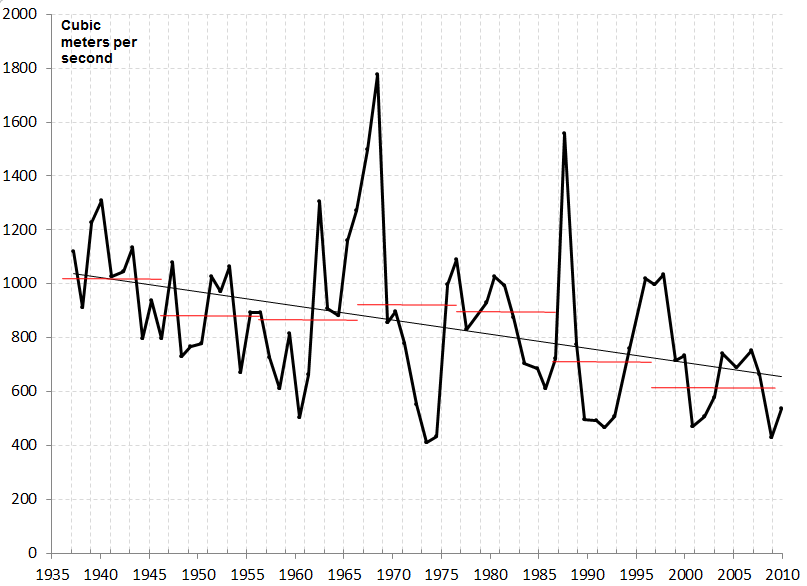
There is a long history of conflicts over water in the Middle East (this history can been seen in the Water Conflict Chronology, published online by the Pacific Institute). The region experiences high natural variability in precipitation and suffers from a lack of modernized agricultural and water management systems. Less than one-fifth of Syria's irrigated area uses modern sprinklers or drip irrigation. Half of all irrigation water comes from groundwater systems, which are in a condition of overdraft, leading to dropping groundwater levels and rising production costs. Water use and the construction of large water infrastructure upstream by Turkey have also decreased surface water supplies flowing into Syria (see Figure). Populations in the Tigris-Euphrates river basins have grown rapidly, further stressing limited water supplies. All of these factors were worsened by severe multi-year drought.
2014-05-28-JarablusdischargeV2.PNG

Figure 1. Discharge of the Euphrates River measured at Jarablus, Syria, from the mid-1930s to around 2010. Red lines show the decadal averages. The long-term linear trend is also shown. Data from the United Nations Economic and Social Commission for Western Asia, 2013.
Assessing the role of climatic changes in altering water availability finds growing evidence that drought frequency and intensity in the Levant/Eastern Mediterranean region have changed from historical climatic norms. Researchers have identified an increasing tendency in annual and seasonal drought intensity corresponding with an increasing number of dry days in the rainy season, and there is evidence that climate changes are already beginning to influence droughts in the area by reducing winter rainfall and increasing evapotranspiration at rates higher than can be explained by natural variability alone.
Future climate projections for this region are also unfavorable from the perspective of water availability. Recent climate simulations all indicate growing water-related risks from higher temperatures, increased evaporative water demands, reductions in future runoff levels, and changes in the timing of runoff.
In the face of this, there are viable options for reducing the risks of water-related conflicts in the region, including expansion of efficient irrigation technologies and practices, integrated management and monitoring of groundwater resources, and diplomatic and political efforts to improve the joint management of shared international watersheds and rivers. And as global warming worsens, populations increase, and pressures on water grow, efforts to reduce conflicts over water will have to expand and improve.
("Water, Drought, Climate Change, and Conflict in Syria" will appear in the July 2014 issue of Weather, Climate, and Society. The Early Online Release notice and the abstract are available here:http://journals.ametsoc.org/doi/abs/10.1175/WCAS-D-13-00059.1 Media requests for the paper should be sent to Nancy Ross, nross@pacinst.org. )
Dr. Peter Gleick is president of the Pacific Institute, a member of the US National Academy of Sciences, a MacArthur Fellow, and an expert on water, climate, and conflict. The Pacific Institute in Oakland, California is one of the world's leading independent research centers working to create a healthier planet and sustainable communities. www.pacinst.org

Thursday, May 15, 2014

U.S. Military Report: Climate Change is a ‘Catalyst for Conflict’

by Brandon Baker, EcoWatch, May 14, 2014
It’s hard to deny climate change when some of the most respected people in the U.S. affirm its existence.
That’s what happened this week when Military Advisory Board (MAB) of the Center for Naval Analyses (CNA) released its National Security and the Accelerating Risks of Climate ChangeBoard members plan on briefing the U.S. Senate Armed Services Committee on their findings, particularly that climate change could lead to conflict.
“It is not possible to discuss the future of national and international security without addressing climate change,” retired U.S. Air Force Gen. Donald Hoffman said in a statement. “Food shortages, droughts, floods—all directly tied to climate change will be catalysts for conflict.”

The board is comprised of 16 retired three- and four-star generals and admirals. Their message is not unlike the Intergovernmental Panel on Climate Change’s March report, which stated that global security could be comprised as the Earth continues to warm.
The new report, accompanied by a pair of videos, builds on a 2007 report from the MAB. Back then, the group referred to climate change as a “threat multiplier.” Now, the situation is more grave, with impacts on the economy, military, infrastructure and society.
“The projected impacts of climate change could be detrimental to military readiness, strain base resilience both at home and abroad, and may limit our ability to respond to future demands,” the report reads.
Here are a few recommendations from the report:
  • Supported by National Intelligence Estimates, the U.S. military’s Combatant Commanders should factor in the impacts of projected climate change across their full spectrum of planning and operations.
  • The U.S. should accelerate and consolidate its efforts to prepare for increased access and military operations in the Arctic.
  • The projected impacts of climate change should be fully integrated fully into the National Infrastructure Protection Plan and the Strategic National Risk Assessment.
“We hope this report will both influence public opinion as well as influence national security policymakers and leaders,” retired Navy rear admiral and co-author David Titley told The Huffington Post.
“We are speaking out because we believe the risk is accelerating, and will continue to do so unless action is taken now.”

http://ecowatch.com/2014/05/14/military-report-climate-change-conflict/

Thursday, March 6, 2014

Pentagon: Climate change a threat multiplier

Pentagon Calls Climate Change Impacts "Threat Multipliers," Could Enable Terrorism

by Steve Horn, DeSmogBlog, March 5, 2014

The U.S. Department of Defense released the 2014 version of its Quadrennial Defense Review (QDR) yesterday, declaring the threat of climate change impacts a very serious national security vulnerability that, among other things, could enable further terrorist activity. 
Released every four years, the QDR is a broad outline of U.S. military strategy discussing how to maintain global U.S. military hegemony. Like the 2010 document, the 64-page 2014 QDR again highlights the threats posed to national security by ever-worsening global climate disruption.
"The impacts of climate change may increase the frequency, scale, and complexity of future missions, including defense support to civil authorities, while at the same time undermining the capacity of our domestic installations to support training activities," the report details.
"Climate change poses another significant challenge for the United States and the world at large. As greenhouse gas emissions increase, sea levels are rising, average global temperatures are increasing, and severe weather patterns are accelerating."
For sake of context, some members of the U.S. Congress still deny the existence of climate change, despite overwhelming evidence to the contrary. But the Pentagon's assessment is that global warming is not only real, but also a civilizational threat, as stated in sobering language in the past three QDRs.
As outlined in Christian Parenti's 2011 book, Tropic of Chaos: Climate Change and the New Geography of Violence, the military establishment understands climate change is an unparalleled global threat, saying so clearly in reports like the QDR. The problem: its activities around the world are in large part responsible for the threat to begin with.

"Theat Multipliers...Can Enable Terrorist Activity"

Although climate change doesn't have its own robust section as it did in the 2010 QDR, in each of the eight times it's mentioned this time around, the QDR draws similar conclusions. 
Climate change has the ability to "devastate homes, land, and infrastructure" and "may exacerbate water scarcity and lead to sharp increases in food costs."
Further, the QDR says the desperation that many people, particularly in poorer regions, will face due to climate change impacts could lead to "resource competition" and even "terrorist activity."
"The pressures caused by climate change will influence resource competition while placing additional burdens on economies, societies, and governance institutions around the world," explains the report.
"These effects are threat multipliers that will aggravate stressors abroad such as poverty, environmental degradation, political instability, and social tensions – conditions that can enable terrorist activity and other forms of violence."
Spending the bulk of QDR ink perscribing the damages climate change will wreak on a global scale, the report also points to a few suggestions of how to tackle the crisis. Sort of.

"Creative Ways to Address...Climate Change"

According to the Pentagon, it's not all doom and gloom going forward.
"[T]he department will employ creative ways to address the impact of climate change, which will continue to affect the operating environment and the roles and missions that U.S. Armed Forces undertake," says the QDR. "The Department will remain ready to operate in a changing environment amid the challenges of climate change and environmental damage."
What the Department of Defense plans to do to tackle the crisis, though, is explained only in the vaguest of terms. 
"We have increased our preparedness for the consequences of environmental damage and continue to seek to mitigate these risks while taking advantage of opportunities," says the report.
The QDR then explains a couple more specific examples of its plans for the future.
The QDR explains, "The Department’s operational readiness hinges on unimpeded access to land, air, and sea training and test space...[and] [w]e are developing new policies, strategies, and plans, including the Department’s Arctic Strategy."

Making Bad Problem Worse

Unfortunately, the Pentagon's Arctic Strategy — published in November 2013 as a follow up to President Obama's National Strategy for the Arctic Region published last May — would only make a bad problem worse.
ClimateProgress Co-Editor Ryan Koronowski unpacked this in a November 2013 article:
The Arctic Strategy’s approach follows on the National Strategy for the Arctic Region, released in May, which focused — perhaps a little too much — on how a warming Arctic would allow the U.S. to access currently-inaccessible fossil fuels...Indeed, the main reason why the Arctic is warming enough to create such “historic opportunities” is the burning of fossil fuels that drives climate change.
As we've pointed out, before, here on DeSmogBlog, the Pentagon is an enormous consumer of fossil fuels.
As TomDispatch Associate Editor Nick Turse has explained (emphases mine), "In 2009, according to the Pentagon’s Defense Energy Support Center (DESC), the military spent $3.8 billion for 31.3 million barrels  around 1.3 billion gallons  of oil consumed at posts, camps, and bases overseas."
But until the Pentagon's call for "unimpeded access to land, air, and sea training and test space" ends, we can continue to expect QDRs every four years drawing increasingly horrific conclusions. 

Saturday, February 22, 2014

State Department Review To Emphasize Effects Of Climate Change On Global Conflict, Diplomacy

by Ryan Grim, Huffington Post, February 21, 2014

WASHINGTON -- Former Rep. Tom Perriello is leaving the Center for American Progress to head the State Department's Quadrennial Diplomacy and Development Review, which analyzes U.S. diplomatic and development efforts abroad.
Perriello was the president of the Center for American Progress Action Fund, the progressive think tank's advocacy arm, and had represented rural Virginia as a Democrat for one term before being wiped out in the 2010 tea party wave. His consistent progressive voting record bucked the conventional wisdom that swing-district Democrats should moderate their views. Though he lost, his race was much closer than in similar districts, where Democrats were defeated by double digits.
Perriello said one of his top objectives will be to make sure the reality of climate change is integrated into the State Department's strategic vision. The review, produced every four years, was first launched in 2010 by then-Secretary of State Hillary Clinton and is modeled after a similar Department of Defense project. The 2010 review includes only passing references to climate change.
"Anyone who looks at conflicts around the world understands the role changing climate is playing," Perriello told HuffPost, adding that such an understanding should be "integrated into all aspects of diplomacy and development."
During one of Perriello's discussions with Secretary of State John Kerry about the possibility of the new job, Kerry noted how Perriello as a congressman took and defended a hard vote in favor of climate legislation, despite the tough race he faced in coal country. Perriello and Kerry have been talking about the potential position since spring 2013.
The two first met when Perriello was 22 and joined Kerry's 1996 reelection campaign for Senate in Massachusetts. The young man was tasked with energizing environmental voters.
Neera Tanden, the head of CAP, said Perriello "definitely helped guide our discussion of climate." Perriello, she said, "focused on making the connections between what's happening with the disastrous weather we've been facing," highlighting "the real-life consequences."
One of the biggest climate change questions for the State Department, however, will be whether to recommend approval of the Keystone XL pipeline, which would expedite the production of fossil fuel energy from the tar sands in Canada. Approval would undermine the State Department's moral authority to press other nations to address climate change -- especially as the U.S. works through the World Trade Organization to try to thwart other countries from developing their own solar power industries.

Friday, February 21, 2014

Climate change is a far greater threat to the world than international terrorism, the UK Government's chief scientific adviser has said

BBC, January 9, 2004

Sir David King said the US had failed to reduce greenhouse gas emissions.

And without immediate action flooding, drought, hunger and debilitating diseases such as malaria would hit millions of people around the world.

US President George Bush says more research is needed before he introduces punitive carbon taxes on industry.

But Sir David criticised the Bush administration for relying too exclusively on market-based incentives and voluntary actions.


 Climate change is the most severe problem we are facing today 
Sir David King
He told Science, the "house magazine" of the US scientific establishment: "As the world's only remaining superpower, the United States is accustomed to leading internationally co-ordinated action.

"But at present the US Government is failing to take up the challenge of global warming."

Flood risk

In Britain, the number of people at high risk of flooding was expected to more than double to nearly 3.5 million by 2080, Sir David said.

And damage to properties could run to tens of billions of pounds every year.

Britain was trying to show leadership by cutting energy consumption and increasing the use of renewable sources, Sir David added.

But the UK was responsible for only about 2% of the world's emissions while the US, with just 4% of the world's population, produced more than 20%.

The UK was asking the world's developed economies to cut greenhouse gas emissions by 60% of 1990 levels by about 2050, under the United Nations Framework Convention on Climate Change (UNFCC), Sir David said.

Severe problem

But despite declaring support for the UNFCC's objectives, the US had failed to ratify the Kyoto accord for emission reductions and "refused to countenance any remedial action now or in the future."


 The United States is already in the forefront of the science and technology of global change, and the next step is surely to tackle emissions control too 
Sir David King
Sir David added: "We can only overcome this challenge by facing it together, shoulder to shoulder.

"We in the rest of the world are now looking to the USA to play its leading part."

Sir David said climate change was the most severe problem faced by the world.

"The United States is already in the forefront of the science and technology of global change, and the next step is surely to tackle emissions control too," he said.

"If we do not begin now, more substantial, more disruptive, and more expensive change will be needed later on."

Population growth

Levels of carbon dioxide and other greenhouse gases in the atmosphere have risen steeply since the industrial revolution.

Concentrations have increased mainly because of the use of fossil fuels, deforestation and other human activities, spurred on by economic and population growth.

Greenhouse gases stop energy escaping from the Earth's surface and atmosphere.

If levels rise too high, excessive warming can distort natural patterns of climate, researchers say.

http://news.bbc.co.uk/2/hi/science/nature/3381425.stm

Thursday, February 20, 2014

Sen Whitehouse and Rep. Waxman write McCain and Newt about their gobsmacking and dangerous-to-our-security inanity on climate change

February 20, 2014
The Honorable John McCain
241 Russell Senate Office Building
Washington, DC 20510
The Honorable Newt Gingrich
Gingrich Productions
4501 North Fairfax Drive
Suite 900
Arlington, VA 22203
Dear Senator McCain and Mr. Gingrich:
Over the weekend, Secretary of State John Kerry gave a powerful and important speech in Indonesia about the dangers of climate change.  Secretary Kerry accurately said, “When I think about the array of global threats … terrorism, epidemics, poverty, the proliferation of weapons of mass destruction … the reality is that climate change ranks right up there with every single one of them.”
Your reaction was disappointing.  Senator McCain asked, “On what planet does he reside?”   Mr. Gingrich called the Secretary “delusional” and “dangerous to our safety.”
You should know that Secretary Kerry’s assessment of the risks we face is consistent with those of national security experts of unimpeachable credentials.  For example:
• Admiral Samuel J. Locklear III, Chief of U.S. military forces in the Pacific region, said that the biggest long-term security threat in the region is climate change because it “is probably the most likely thing that is going to happen . . . that will cripple the security environment, probably more likely than the other scenarios we all often talk about.”
• General Anthony Zinni, the former Commander-in-Chief of U.S. Central Command, warned, “You may also have a population that is traumatized by an event or a change in conditions triggered by climate change. … [T]hen you can be faced with a collapsing state.  And these end up as breeding grounds for instability, for insurgencies, for warlords.  You start to see extremism.  These places act like Petri dishes for extremism and for terrorist networks.”
• Robert Gates, the former Defense Secretary, said, “over the next 20 years and more certain pressures – population, resource, energy, climate, economic, and environmental – could combine with rapid cultural, social, and technological change to produce new sources of deprivation, rage, and instability. … I believe the most persistent and dangerous threats will come less from ambitious states than failing ones that cannot meet the basic needs – much less aspirations – of their people.”
• Admiral Michael Mullen, the former Chairman of the Joint Chiefs of Staff, stated, “The scarcity of and potential competition for resources like water, food and space, compounded by the influx of refugees if coastal lands are lost, does not only create a humanitarian crisis but it creates conditions of hopelessness that could lead to failed states and make populations vulnerable to radicalization.”
• Admiral John Nathan, former Commander of the U.S. Fleet Forces, predicted, “There are serious risks to doing nothing about climate change.  We can pay now or we’re going to pay more later.”
• James Clapper, the Director of the National Intelligence, testified, “there will almost assuredly be security concerns with respect to … energy and climate change.  Environmental stresses are not just humanitarian issues.  They legitimately threaten regional stability.”
• Thomas Fingar, the former Chairman of the National Intelligence Council, concluded, “We judge global climate change will have wide-ranging implications for US national security interests.”
• Hans Blix, the former chief UN weapons inspector, said he thought climate change posed a greater threat to the planet than nuclear proliferation.
You may also want to review the 2010 Quadrennial Defense Review, which called climate change “an accelerant of instability or conflict” that “could have significant geopolitical impacts around the world, contributing to poverty, environmental degradation, and the further weakening of fragile governments.”
These concerns about the profound risks of climate change are shared by distinguished world leaders.  Last month, Kofi Annan, the former Secretary General of the United Nations, wrote in the Washington Post, “Climate change is the biggest challenge of our time.  It threatens the well-being of hundreds of millions of people today and many billions more in the future.”   Christine Lagarde, Managing Director of the International Monetary Fund, said last year that climate change has the “potential for major social and economic disruption.”   And Dr. Jim Yong Kim, President of the World Bank Group, stated that if we fail to confront climate change “we could witness the rolling back of decades of development gains and force tens of millions more to live in poverty.”
You may also want to reflect on what Robert Rubin, the widely respected former Treasury Secretary, said just last month about climate change:  “There are a lot of really significant, monumental issues facing the global economy, but this supersedes them all.”
Senator McCain made a particular point of criticizing Secretary Kerry for talking about climate change “when we have got 130,000 people in Syria killed.”    This is an inaccurate criticism because Secretary Kerry has been devoting extensive attention to Syria.  It is also uninformed.  There are experts who believe that climate change and the extended drought is one of the underlying causes of the conflicts in Syria.  As the New York Times columnist Thomas Friedman wrote, tensions in the Middle East have been “driven not only by political and economic stresses, but, less visibly, by environmental, population and climate stresses as well. If we focus only on the former and not the latter, we will never be able to help stabilize these societies.”
Secretary Kerry needs allies in this fight for the future of our planet.  History will not look back and fault him for leading the charge to prevent the worst impacts of climate change while we still have time.  But history may question why Republican leaders who were once their party's champions on climate change fled the field at a crucial moment.
 
Sincerely,
Rep. Henry A. Waxman
Sen. Sheldon Whitehouse

Monday, November 18, 2013

Michael Klare: A Climate Change-Fueled Revolution?

Yves Smith of the Naked Capitalism financial blog writes this introduction to Michael Klare's latest TomDispatch piece:

Yves here. The post below by Michael Klare is hardly radical; in fact, the Department of Defense has been for at least the last five years working on geopolitical scenarios that give a large role to climate change induced political instability, such as mass migrations out of heavily populated low-lying areas. So as much as Klare anticipates more and more popular uprisings, I’d anticipate that the powers that be are expecting them and are prepared to suppress them brutally. Thus the places they might succeed are in advanced economies with comparatively little police brutality in large cities (i.e., where you’d have lots of media coverage which would constrain how harsh the retaliation would be).

A Climate Change-Fueled Revolution?
by Michael Klare, Tom Dispatch, November 17, 2013
There’s a crossroads moment in our recent history that comes back to me whenever I think of our warming planet.  (2013 is shaping up to be the seventh warmest year since records began to be kept in 1850.  The 10 warmest years have all occurred since 1998.)  In the six months from July 1979 to January 1980, as Jimmy Carter’s one-term presidency was winding down, he urged two approaches to global energy on Americans.  One was dismissed out of hand, the other taken up with alacrity -- and our world is incommensurately the worse for it.  Here’s a description I wrote back in May that is worth quoting again: 
“On July 15, 1979, at a time when gas lines, sometimes blocks long, were a disturbing fixture of American life, President Jimmy Carter spoke directly to the American people on television for 32 minutes, calling for a concerted effort to end the country’s oil dependence on the Middle East.  'To give us energy security,' he announced, 'I am asking for the most massive peacetime commitment of funds and resources in our nation's history to develop America's own alternative sources of fuel -- from coal, from oil shale, from plant products for gasohol, from unconventional gas, from the sun...'
“It’s true that, with the science of climate change then in its infancy, Carter wouldn’t have known about the possibility of an overheating world, and his vision of ‘alternative energy’ wasn’t exactly a fossil-fuel-free one.  Even then -- shades of today or possibly tomorrow -- he was talking about having ‘more oil in our shale alone than several Saudi Arabias.’  Still, it was a remarkably forward-looking speech. 
“Had we invested massively in alternative energy R&D back then, who knows where we might be today?  Instead, the media dubbed it the ‘malaise speech,’ though the president never actually used that word, speaking instead of an American ‘crisis of confidence.’  While the initial public reaction seemed positive, it didn’t last long.  In the end, the president's energy proposals were essentially laughed out of the room and ignored for decades.
“Carter would, however, make his mark on U.S. energy policy, just not quite in the way he had imagined.  Six months later, on January 23, 1980, in his last State of the Union Address, he would proclaim what came to be known as the Carter Doctrine: ‘Let our position be absolutely clear,’ he said. ‘An attempt by any outside force to gain control of the Persian Gulf region will be regarded as an assault on the vital interests of the United States of America, and such an assault will be repelled by any means necessary, including military force.’
“No one would laugh him out of the room for that.  Instead, the Pentagon would fatefully begin organizing itself to protect U.S. (and oil) interests in the Persian Gulf on a new scale and America’s oil wars would follow soon enough.  Not long after that address, it would start building up a Rapid Deployment Force in the Gulf that would in the end become U.S. Central Command.  More than three decades later, ironies abound: thanks in part to those oil wars, whole swaths of the energy-rich Middle East are in crisis, if not chaos, while the big energy companies have put time and money into a staggeringly fossil-fuel version of Carter’s ‘alternative’ North America.  They’ve focused on shale oil, and on shale gas as well, and with new production methods, they are reputedly on the brink of turning the United States into a ‘new Saudi Arabia.’”
Could there have been a sadder choice in recent history? If, in 1979, the U.S. had invested in a big way in solar, wind, tidal power, and who knows what else, imagine where we might be today.  Imagine a world not facing a future in which storms like Super-Typhoon Haiyan, which recently leveled part of the Philippines, its winds devastating, its storm surge killing staggering numbers, threaten to become the norm for our children and grandchildren.
So oil wars, yes! -- which meant transforming the Greater Middle East into a region of chaos, instability, and death.  An oil-ravaged planet, yes indeed! -- which meant potentially transforming a future version of Earth into a planet of chaos, instability, and death!  A green energy revolution, not on your life! -- not while the giant energy corporations have so much invested in underground reserves of fossil fuels and such gigantic profits to make, not while so many governments are deeply intertwined with those energy giants or are themselves essentially giant energy companies.  No wonder TomDispatch regular Michael Klare suggests that it falls into our hands to ensure that a green energy revolution arrives ahead of a human-created, fossil-fueled apocalypse.
Surviving Climate Change 
Is a Green Energy Revolution on the Global Agenda? 
By Michael T. Klare
A week after the most powerful “super typhoon” ever recorded pummeled the Philippines, killing thousands in a single province, and three weeks after the northern Chinese city of Harbin suffered a devastating “airpocalypse,” suffocating the city with coal-plant pollution, government leaders beware!  Although individual events like these cannot be attributed with absolute certainty to increased fossil fuel use and climate change, they are the type of disasters that, scientists tell us, will become a pervasive part of life on a planet being transformed by the massive consumption of carbon-based fuels.  If, as is now the case, governments across the planet back an extension of the carbon age and ever increasing reliance on“unconventional” fossil fuels like tar sands and shale gas, we should all expect trouble.  In fact, we should expect mass upheavals leading to a green energy revolution.
None of us can predict the future, but when it comes to a mass rebellion against the perpetrators of global destruction, we can see a glimmer of the coming upheaval in events of the present moment.  Take a look and you will see that the assorted environmental protests that have long bedeviled politicians are gaining in strength and support.  With an awareness of climate change growing and as intensifying floodsfiresdroughts, and storms become an inescapable feature of daily life across the planet, more people are joining environmental groups and engaging in increasingly bold protest actions.  Sooner or later, government leaders are likely to face multiple eruptions of mass public anger and may, in the end, be forced to make radical adjustments in energy policy or risk being swept aside.
In fact, it is possible to imagine such a green energy revolution erupting in one part of the world and spreading like wildfire to others.  Because climate change is going to inflict increasingly severe harm on human populations, the impulse to rebel is only likely to gain in strength across the planet.  While circumstances may vary, the ultimate goal of these uprisings will be to terminate the reign of fossil fuels while emphasizing investment in and reliance upon renewable forms of energy.  And a success in any one location is bound to invite imitation in others.
A wave of serial eruptions of this sort would not be without precedent.  In the early years of twentieth-first century, for example, one government after another in disparate parts of the former Soviet Union was swept away in what were called the “color revolutions” -- populist upheavals against old-style authoritarian regimes.  These included the “Rose Revolution” in Georgia (2003), the “Orange Revolution” in Ukraine (2004), and the “Pink” or “Tulip Revolution” in Kyrgyzstan (2005).  In 2011, a similar wave of protests erupted in North Africa, culminating in what we call the Arab Spring.
Like these earlier upheavals, a “green revolution” is unlikely to arise from a highly structured political campaign with clearly identified leaders.   In all likelihood, it will erupt spontaneously, after a cascade of climate-change induced disasters provokes an outpouring of public fury.  Once ignited, however, it will undoubtedly ratchet up the pressure for governments to seek broad-ranging, systemic transformations of their energy and climate policies.  In this sense, any such upheaval -- whatever form it takes -- will prove “revolutionary” by seeking policy shifts of such magnitude as to challenge the survival of incumbent governments or force them to enact measures with transformative implications. 
Foreshadowings of such a process can already be found around the globe.  Take the mass environmental protests that erupted in Turkey this June.  Though sparked by a far smaller concern than planetary devastation via climate change, for a time they actually posed a significant threat to Prime Minister Recep Tayyip Erdogan and his governing party.  Although his forces eventually succeeded in crushing the protests -- leaving four dead, 8,000 injured, and 11 blinded by tear-gas canisters -- his reputation as a moderate Islamist was badly damaged by the episode.
Like so many surprising upheavals on this planet, the Turkish uprising had the most modest of beginnings: on May 27th, a handful of environmental activists blocked bulldozers sent by the government to level Gezi Park, a tiny oasis of greenery in the heart of Istanbul, and prepare the way for the construction of an upscale mall.  The government responded to this small-scale, non-violent action by sending in riot police and clearing the area, a move that enraged many Turks and prompted tens of thousands of them to occupy nearby Taksim Square.  This move, in turn, led to an even more brutal police crackdown and then to huge demonstrations in Istanbul and around the country.  In the end, mass protests erupted in 70 cities, the largest display of anti-government sentiment since Erdogan’s Justice and Development Party came to power in 2002.
This was, in the most literal sense possible, a “green” revolution, ignited by the government’s assault on the last piece of greenery in central Istanbul.  But once the police intervened in full strength, it became a wide-ranging rebuke to Erdogan’s authoritarian impulses and his drive to remake the city as a neo-Ottoman showplace -- replete with fancy malls and high-priced condominiums -- while eliminating poor neighborhoods and freewheeling public spaces like Taksim Square.  “It’s all about superiority, and ruling over the people like sultans,” declared one protestor.  It’s not just about the trees in Gezi Park, said another: “We are here to stand up against those who are trying to make a profit from our land.” 
The Ningbo Rebellion
The same trajectory of events -- a small-scale environmental protest evolving into a full-scale challenge to governmental authority -- can be seen in other mass protests of recent years.
Take a Chinese example: in October 2012, students and middle class people joined with poor farmers to protest the construction of an $8.8 billion petrochemical facility in Ningbo, a city of 3.4 million people south of Shanghai.  In a country where environmental pollution has reached nearly unprecedented levels, these protests were touched off by fears that the plant, to be built by the state-owned energy company Sinopec with local government support, would produce paraxylene, a toxic substance used in plastics, paints, and cleaning solvents. 
Here, too, the initial spark that led to the protests was small-scale.  On October 22nd, some 200 farmers obstructed a road near the district government’s office in an attempt to block the plant’s construction.  After the police were called in to clear the blockade, students from nearby Ningbo University joined the protests.  Using social media, the protesters quickly enlisted support from middle-class residents of the city who converged in their thousands on downtown Ningbo.  When riot police moved in to break up the crowds, the protestors fought back, attacking police cars and throwing bricks and water bottles.  While the police eventually gained the upper hand after several days of pitched battles, the Chinese government concluded that mass action of this sort, occurring in the heart of a major city and featuring an alliance of students, farmers, and young professionals, was too great a threat.  After five days of fighting, the government gave in, announcing the cancellation of the petrochemical project.
The Ningbo demonstrations were hardly the first such upheavals to erupt in China.  They did, however, highlight a growing governmental vulnerability to mass environmental protest.  For decades, the reigning Chinese Communist Party has justified its monopolistic hold on power by citing its success in generating rapid economic growth.  But that growth means the use of ever more fossil fuels and petrochemicals, which, in turn, means increased carbon emissions and disastrous atmospheric pollution, including one “airpocalypse” after another.
Until recently, most Chinese seemed to accept such conditions as the inevitable consequences of growth, but it seems that tolerance of environmental degradation is rapidly diminishing.  As a result, the party finds itself in a terrible bind: it can slow development as a step toward cleaning up the environment, incurring a risk of growing economic discontent, or it can continue its growth-at-all-costs policy, and find itself embroiled in a firestorm of Ningbo-style environmental protests. 
This dilemma -- the environment versus the economy -- has proven to be at the heart of similar mass eruptions elsewhere on the planet.
After Fukushima
Two of the largest protests of this sort were sparked by the reactor meltdowns at the Fukushima Daiichi nuclear power plants on March 11, 2011, after a massive tsunami struck northern Japan.  In both of these actions -- the first in Germany, the second in Japan -- the future of nuclear power and the survival of governments were placed in doubt.
The biggest protests occurred in Germany.  On March 26th, 15 days after the Fukushima explosions, an estimated 250,000 people participated in anti-nuclear demonstrations across the country -- 100,000 in Berlin, and up to 40,000 each in Hamburg, Munich, and Cologne.  “Today’s demonstrations are just the prelude to a new, strong, anti-nuclear movement,” declared Jochen Stay, a protest leader.  “We’re not going to let up until the plants are finally mothballed.”
At issue was the fate of Germany’s remaining nuclear power plants.  Although touted as an attractive alternative to fossil fuels, nuclear power is seen by most Germans as a dangerous and unwelcome energy option.  Several months prior to Fukushima, German Chancellor Angela Merkel insisted that Germany would keep its 17 operating reactors until 2040, allowing a smooth transition from the country’s historic reliance on coal to renewable energy for generating electricity.  Immediately after Fukushima, she ordered a temporary shutdown of Germany’s seven oldest reactors for safety inspections but refused to close the others, provoking an outpouring of protest.
Witnessing the scale of the demonstrations, and after suffering an electoral defeat in the key state of Baden-Württemberg, Merkel evidently came to the conclusion that clinging to her position would be the equivalent of political suicide.  On May 30th, she announced that the seven reactors undergoing inspections would be closed permanently and the remaining 10 would be phased out by 2022, almost 20 years earlier than in her original plan.
By all accounts, the decision to phase out nuclear power almost two decades early will have significant repercussions for the German economy.  Shutting down the reactors and replacing them with wind and solar energy will cost an estimated $735 billion and take several decades, producing soaring electricity bills and periodic energy shortages.  However, such is the strength of anti-nuclear sentiment in Germany that Merkel felt she had no choice but to close the reactors anyway. 
The anti-nuclear protests in Japan occurred considerably later, but were no less momentous.  On July 16, 2012, 16 months after the Fukushima disaster, an estimated 170,000 people assembled in Tokyo to protest a government plan to restart the country’s nuclear reactors, idled after the disaster.  This was not only Japan's largest antinuclear demonstration in many years, but the largest of any sort to occur in recent memory.
For the government, the July 16th action was particularly significant. Prior to Fukushima, most Japanese had embraced the country’s growing reliance on nuclear power, putting their trust in the government to ensure its safety.  After Fukushima and the disastrous attempts of the reactors’ owner, the Tokyo Electric Power Company (TEPCO), to deal with the situation, public support for nuclear power plummeted.  As it became increasingly evident that the government had mishandled the crisis, people lost faith in its ability to exercise effective control over the nuclear industry.  Repeated promises that nuclear reactors could be made safe lost all credibility when it became known that government officials had long collaborated with TEPCO executives in covering up safety concerns at Fukushima and, once the meltdowns occurred, in concealing information about the true scale of the disaster and its medical implications.
The July 16th protest and others like it should be seen as a public vote against the government’s energy policy and oversight capabilities.  “Japanese have not spoken out against the national government,” said one protestor, a 29-year-old homemaker who brought her one-year-old son.  “Now, we have to speak out, or the government will endanger us all.”
Skepticism about the government, rare for twenty-first-century Japan, has proved a major obstacle to its desire to restart the country’s 50 idled reactors.  While most Japanese oppose nuclear power, Prime Minister Shinzo Abe remains determined to get the rectors running again in order to reduce Japan’s heavy reliance on imported energy and promote economic growth.  “I think it is impossible to promise zero [nuclear power plants] at this stage,” he declared this October.  “From the government’s standpoint, [nuclear plants] are extremely important for a stable energy supply and economic activities.”
Despite such sentiments, Abe is finding it extremely difficult to garner support for his plans, and it is doubtful that significant numbers of those reactors will be coming online anytime soon.
The Explosions Ahead
What these episodes tell us is that people around the world are becoming ever more concerned about energy policy as it affects their lives and are prepared -- often on short notice -- to engage in mass protests.  At the same time, governments globally, with rare exceptions, are deeply wedded to existing energy policies.  These almost invariably turn them into targets, no matter what the original spark for mass opposition.  As the results of climate change become ever more disruptive, government officials will find themselves repeatedly choosing between long-held energy plans and the possibility of losing their grip on power.
Because few governments are as yet prepared to launch the sorts of efforts that might even begin to effectively address the peril of climate change, they will increasingly be seen as obstacles to essential action and so as entities that need to be removed.  In short, climate rebellion -- spontaneous protests that may at any moment evolve into unquenchable mass movements -- is on the horizon.  Faced with such rebellions, recalcitrant governments will respond with some combination of accommodation to popular demands and harsh repression. 
Many governments will be at risk from such developments, but the Chinese leadership appears to be especially vulnerable.  The ruling party has staked its future viability on an endless carbon-fueled growth agenda that is steadily destroying the country’s environment.  It has already faced half-a-dozen environmental upheavals like the one in Ningbo, and has responded to them by agreeing to protesters’ demands or by employing brute force.  The question is: How long can this go on? 
Environmental conditions are bound to worsen, especially as China continues to rely on coal for home heating and electrical power, and yet there is no indication that the ruling Communist Party is prepared to take the radical steps required to significantly reduce domestic coal consumption.  This translates into the possibility of mass protests erupting at any time and on a potentially unprecedented scale.  And these, in turn, could bring the Party’s very survival into question -- a scenario guaranteed to produce immense anxiety among the country’s top leaders.
And what about the United States?  At this point, it would be ludicrous to say that, as a result of popular disturbances, the nation’s political leadership is at any risk of being swept away or even forced to take serious steps to scale back reliance on fossil fuels.  There are, however, certainly signs of a growing nationwide campaign against aspects of fossil fuel reliance, including vigorous protests against hydraulic fracturing (“fracking”) and the Keystone XL tar sands pipeline.
For environmental activist and writer Bill McKibben, all this adds up to an incipient mass movement against the continued consumption of fossil fuels.  “In the last few years,” he has written, this movement “has blocked the construction of dozens of coal-fired power plants, fought the oil industry to a draw on the Keystone pipeline, convinced a wide swath of American institutions to divest themselves of their fossil fuel stocks, and challenged practices like mountaintop-removal coal mining and fracking for natural gas.”  It may not have achieved the success of the drive for gay marriage, he observed, but it “continues to grow quickly, and it’s starting to claim some victories.”
If it’s still too early to gauge the future of this anti-carbon movement, it does seem, at least, to be gaining momentum.  In the 2013 elections, for example, three cities in energy-rich Colorado -- Boulder, Fort Collins, and Lafayette -- voted to ban or place moratoriums on fracking within their boundaries, while protests against Keystone XL and similar projects are on the rise.
Nobody can say that a green energy revolution is a sure thing, but who can deny that energy-oriented environmental protests in the U.S. and elsewhere have the potential to expand into something far greater?  Like China, the United States will experience genuine damage from climate change and its unwavering commitment to fossil fuels in the years ahead.  Americans are not, for the most part, passive people.  Expect them, like the Chinese, to respond to these perils with increased ire and a determination to alter government policy.
So don’t be surprised if that green energy revolution erupts in your neighborhood as part of humanity’s response to the greatest danger we’ve ever faced.  If governments won’t take the lead on an imperiled planet, someone will. 
Michael T. Klare is a professor of peace and conflict studies at Hampshire College and the author, most recently, of The Race for What’s Left.  A documentary movie version of his book Blood and Oil is available from the Media Education Foundation.
Follow TomDispatch on Twitter and join us on Facebook or Tumblr. Check out the newest Dispatch Book, Ann Jones’s They Were Soldiers: How the Wounded Return From America’s Wars -- The Untold Story.
Comments at Naked Capitalism:

12 COMMENTS:

  •  Michael Fiorillo says:
    If Professor Klare’s prediction about climate-based rebellions is anywhere near as accurate as his assessment of the branding and marketing-driven “color revolutions” he uncritically refers to, then we can all expect to drown, burn and starve in our carbon shroud.
    Behind the curtain of almost all of these events has been the US State Department, the National Endowment for Democracy, USIA and, presumably, even less appetizing segments of the US government, working in conjunction with captive and/or special purpose NGOs.
    Here’s a link to a 2004 article in The Guardian about who was behind the scenes during Ukraine’s Orange Revolution: http://www.theguardian.com/world/2004/nov/26/ukraine/us
    •  Banger says:
      My thoughts precisely. But none of us is perfect–there is some merit to his argument but I don’t see much chance of green revolutions–there has to be something else going on.
  •  owenfinn says:
    The obscenely wealthy and powerful of the world – those who have benefited most from a world-wide system of industrialization and consumerism, want us to believe that we have only two choices – nuclear energy or fossil fuel. Of course, they say nothing about the possibility of changing the system itself.
  •  craazyboy says:
    I get this vision of Americans driving to the Revolution in their SUVS – with an average of 1.5 Revolutionaries per vehicle.
  •  wendy davis says:
    I’ll keep my own counsel on McKibben’s usefulness or not to the vast changes needed to address climate change, as many have already dissected that at sites like Counterpunch.
    But when I read this yesterday, I felt lower than a snake’s belly:
    “Yeb Sano, the Philippines’ lead negotiator at the UN climate change summit being held this weekend in Warsaw, spoke of a major breakdown in relations overshadowing the crucial talks, which are due to pave the way for a 2015 deal to bring down global emissions.
    The diplomat, on the sixth day of a hunger strike in solidarity for those affected by Haiyan, including his own family, told the Observer: “We are very concerned. Public announcements from some countries about lowering targets are not conducive to building trust. We must acknowledge the new climate reality and put forward a new system to help us manage the risks and deal with the losses to which we cannot adjust.”
    Munjurul Hannan Khan, representing the world’s 47 least affluent countries, said: “They are behaving irrationally and unacceptably. The way they are talking to the most vulnerable countries is not acceptable. Today the poor are suffering from climate change. But tomorrow the rich countries will be. It starts with us but it goes to them.”
    Recent decisions by the governments of Australia, Japan and Canada to downgrade their efforts over climate change have caused panic among those states most affected by global warming, who fear others will follow as they rearrange their priorities during the downturn.”
    http://www.theguardian.com/environment/2013/nov/16/climate-change-pledges-rich-nations
    With that sort of time horizon, *and* knowing that if the 2015 ‘negotiations’ lead to anything at all, they’ll be cosmetic at best. Do you all remember that absolutely nothing of value came out of the Rio 20 sustainability conference in 2012? I reported on the People’s Summit side meetings, and the fantastic declarations by several Indigenous groups from the golbal south, whose ideas could pave the way to a better future.
    Poor Yeb Sano; he should stop his fast. He’ll surely die before anything meaningful is hashed out. Yes, Michael Klare, a revolution of *some sort* will be the only way to begin to mitigate the disatrous trajectory we’re on.
    •  Banger says:
      I think it was inevitable that, after the economic downturn of 2008 and sane economic projections for the future show us that the post-WWII world of steady economic growth is no more. As such, environmental considerations are going out the window and a narrow focus on economic activity dominates every other consideration.
      When climate-change first became an issue twenty-five years ago I believed that as strong state and international agreements/institutions would be the path to dealing with the issue. The failure of all this leads me to believe that no change in environmental policy can come from this direction so that is why the world order must be broken and reconfigured as soon as possible. Thus we have a duty to resist in every way we can every element of the system and Chris Hedges has correctly stated. Like him I prefer it to be non-violent and it will always be so for me personally but I’m not going to criticize those that wish to take a more militant approach.
      •  Massinissa says:
        Banger, im wondering if a movement has to be entirely peaceful or entirely militant: Perhaps a hybridization might be most effective?
        Perhaps a large group of nonmilitants, with a smaller portion of militants (10%?) might be most effective: The majority can point at the minority and say, “Look how reasonable we are!”
        Sort of like how the Democrats try (often successfully) to paper themselves as republicans-lite.
        The only problem is that small number of militants would give the government ‘justification’ to crack down on the whole damn movement.
  •  Paul says:
    I remember reading the first assessments to the White House on the geopolitical threats from global warming (climate disruption) back in 2001 IIRC!
  •  Banger says:
    We have the technological capacity to wean ourselves from fossil fuels but if requires substantial change particularly in the power-relations in the world which, in turn, can only come from deep cultural change. Almost the entire oligarchy is hell-bent on keeping the status-quo even if it means economic stagnation and decline.
    But for the green revolutions to occur there has to be a cultural change that seems unlikely at this time. First we have to see ourselves as interdependent and that selfishness and greed are things we ought not encourage. Those things, in themselves, would be more revolutionary than anything imaginable. Second, we need to understand that the neoliberal/globalist capitalist world economy has created stunning growth and dynamism since WWII spreading ideas, technology, consumer goods of all kinds throughout the world and it still has a lot of attraction for most people in the world. Third, the system has, in the past, decade, become increasingly rigid and resistant to change and it looks like it has to break down and fragment because it system appears to be unable to adapt to not just a major danger like climate change but also to any collective challenge like the changing economic dynamics we see all around us–this breakdown is in the first stages right now and looks different in different places.
    In the U.S.A. it looks like climate-change in particular and the environment in general is just not an issue that has resonance with any major demographic. However, the environmental issue is one of several that are causing people to lack faith in their governmental institutions. We are at a point now when we are within sight of localities breaking away from the system and rule themselves. There is hostility in states against the federal government and in counties and regions against state governments. But here’s the benefit: people are beginning to take an interest in politics and in collective solutions to their common problems it is this interest that could produce a political renaissance in this century and awaken the long dormant American pragmatic spirit which has been snowed under by decades of passivity caused by layers and layers of commercials, PR, propaganda and so on that makes most people alive today in the USA almost completely ignorant about the world around them.
    •  eeyores enigma says:
      “We have the technological capacity to wean ourselves from fossil fuels…”
      It’s statements like this that will guarantee that we will not do anything until it is way too late.
      Truth is we do not have the technological capacity to wean ourselves from fossil fuels unless you are talking about how we, all of humanity can learn to live with a fraction of the energy we now use.
      This of course guarantees billions of people fall into terminal poverty (while the 1% continue to thrive not unlike what is happening now).
      What is needed is a way to equitably manage a global power down and reduce consumption of all goods radically across the board.
      This is too much for any to accept so we will deny the reality, continue to pray at the alter of Technology, and ramp up the ignorance and inequality.
      Technology is an energy consumer not an energy creator.
      •  Banger says:
        We certainly don’t have the ability to generate the amount of power we are using today. I say we have the technology to replace the power by using what I call elegant engineering and changes in infrastructure–all of this cannot magically appear and requires cultural as well as political change but it we do have the ability to use what energy can come from renewables (remember prices change through the economy of scale).
        The engineering ability exists, the ability to make almost anything “intelligent” dramatically changes the whole range of possibilities we have. What we are facing, also, is the fact the media and their corporate masters will not examine or report on this issue so we do not grasp the totality of what is possible. The interest of the corporate elite is to create a stable, steady-state world where growth is repressed and everything is in control of the few. Any new technological breakthrough that does not serve the corporate elite’s interest in producing toys and distractions is ignored and repressed.
  •  Anarcissie says:
    I would think that if people put up with, even believed in capitalism up to now, with its inevitable destruction of the physical environment, they would simply continue to do so. But I suppose there’s no telling which straw will break the camel’s back.
    One problem at present is that, for the multitude, there is no real alternative on offer. Anarchists and communists are so few in number that most people haven’t heard of their actually different ideas. Instead, as things fall apart, people are likely to be handed palliatives and placebos, with a dose of fascism if they aren’t satisfied. (The NSA knows where you live; nice little family you’ve got there….)